Disclosure: topratedkitchenware.com is reader-supported. When you buy through links on our site, we may earn an affiliate commission from Amazon and other retailers, at no extra cost to you.
Where to buy
These are the verified picks for best non plastic coffee makers. All six picks are linked below. Prices and availability move, so check the latest price on Amazon for each linked model before you decide. Readers comparing nearby formats can also browse 9 Best French Presses Glass And Stainless Steel 2026. Read the full guide ↓
- Secura French Press Coffee Maker, 34 oz — 304 grade stainless steel construction. Check on Amazon for the current listing.
- Utopia Kitchen Stainless Steel French Press, 34 oz — 304 grade stainless steel construction. Check on Amazon for the current listing.
- MuellerLiving French Press Coffee Maker, 34 oz — Stainless steel french press, 34 oz. Check on Amazon for the current listing.
- AgcKuzt Full Stainless Steel French Press, 34 oz — Full stainless steel construction, 34 oz. Check on Amazon for the current listing.
- Ziruma Non-Toxic Stainless Steel French Press, 34 oz — Surgical-grade stainless steel. Check on Amazon for the current listing.
- Secura French Press Coffee Maker, 50 oz — 304 grade stainless steel construction. Check on Amazon for the current listing.
Introduction: Finding the Best non plastic coffee makers
Finding the best non plastic coffee makers is the job of this guide, and it starts with the verified facts rather than the marketing. The plastic in a typical coffee maker hides in plain sight: the water path, the brew basket, the carafe lid, the press plunger knob — hot water touches plastic at almost every step of most machines. The best non plastic coffee makers remove that contact entirely, and the verified pool shows the simplest way to do it: six French presses built from stainless steel, where the brew path is steel, the filter is steel mesh, and the coffee touches nothing else from steep to pour. This guide compares them on the details that still matter once plastic is off the table — filtration, insulation, capacity and build — and explains where plastic can still sneak into a press design so you can shop with your eyes open.
Every pick below was checked against the pool for this keyword, and every specification quoted comes from that verified listing data. If your research is ranging wider, 6 Best French Presses Glass And Steel Coffee Presses 2026 covers a neighboring slice of the category; this guide stays on its own brief and does it properly.
Key Takeaways
- Verifying an all-steel brew path while choosing among filtration levels, insulation and capacities in the press format — that is the decision this guide keeps returning to.
- Best Overall: the Secura French Press Coffee Maker, 34 oz — 304 grade stainless steel construction.
- Best Filtration in Steel: the Utopia Kitchen Stainless Steel French Press, 34 oz — 304 grade stainless steel construction.
- Best Everyday Steel Press: the MuellerLiving French Press Coffee Maker, 34 oz — stainless steel french press, 34 oz.
- No static prices and no fixed ratings appear anywhere in this guide — check the latest price on Amazon when you are ready to buy.
In this guide
Quick Picks
| Badge | Pick | Headline spec |
|---|---|---|
| Best Overall | Secura French Press Coffee Maker, 34 oz | 304 grade stainless steel construction; Insulated double-wall design |
| Best Filtration in Steel | Utopia Kitchen Stainless Steel French Press, 34 oz | 304 grade stainless steel construction; Double wall insulated body |
| Best Everyday Steel Press | MuellerLiving French Press Coffee Maker, 34 oz | Stainless steel french press, 34 oz; 4-filter system |
| Best Full-Steel Build | AgcKuzt Full Stainless Steel French Press, 34 oz | Full stainless steel construction, 34 oz; Brews about 4 cups |
| Best No-Plastic Brief | Ziruma Non-Toxic Stainless Steel French Press, 34 oz | Surgical-grade stainless steel; No plastic or heavy metals in the design brief |
| Best for Groups | Secura French Press Coffee Maker, 50 oz | 304 grade stainless steel construction; Insulated double-wall design |
Badges reflect the angle of this guide — verifying an all-steel brew path while choosing among filtration levels, insulation and capacities in the press format — and the same badges appear in the detailed reviews below so you can track each pick through the guide.
How These Picks Were Chosen
This guide is research-led, and it says so plainly: the picks come from a verified pool checked against the makers’ own listings, not from a test kitchen claiming hands-on scores it cannot show. Each model’s identity and headline specifications were confirmed from its listing data, and only products matching the keyword’s core were linked. That verification step matters here, because similar names, finishes and formats make it easy to review the wrong product by accident — and, in this pool, to link a product that does not actually answer the search.
Within the pool, picks were ordered genuine-matches-first and judged on one question: verifying an all-steel brew path while choosing among filtration levels, insulation and capacities in the press format. Where a product did not match the keyword’s core — a different brand, a different jar material, a different brief — it was not quietly dropped; it is reviewed prose-only below with the mismatch stated in plain language, so you can judge whether the difference matters for your kitchen. Specifications quoted below come only from the verified pool data; nothing has been filled in from guesswork. Readers who want the wider category picture can compare 6 Best French Presses For Coffee Lovers 2026 alongside this guide.
Finally, honesty about limits: no static prices appear anywhere in this guide, because prices change and a printed number would mislead within weeks. Tier language is used instead, and every linked pick invites you to check the latest price on Amazon at the moment you are actually shopping.
The 6 Best Options for Best non plastic coffee makers
Secura French Press Coffee Maker, 34 oz
Badge: Best Overall
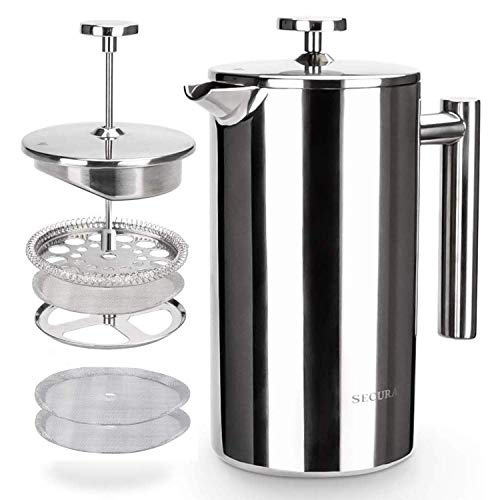
The Secura French Press Coffee Maker, 34 oz is built for press drinkers who want durability and a plastic-free brew path. In the context of best non plastic coffee makers, its confirmed specification supports that job directly: 304 grade stainless steel construction, with insulated double-wall design.
Strengths
- All-steel brew path — no plastic touching the coffee
- Double-wall insulation keeps the press hot while it steeps
- Extra screens included for when the fitted one wears
Trade-offs
- French press sediment is part of the method — not a paper-filter cup
- Steel body hides the brew level, so measure water before pouring
- Heavier than a glass press of the same size
Key specs (from verified listing data)
- 304 grade stainless steel construction
- Insulated double-wall design
- 34 oz (1 litre) capacity
- Includes 2 extra filter screens
- Finish: Silver
Day to day, what separates this pick within the pool is fit, not magic — the honest limitation is that if you dislike any sediment in the cup, no press technique fully fixes that — the method itself is the limit. Judge it against your counter, your household and your habits, and it either slots into your routine cleanly or it does not; no amount of marketing changes that fit test. If it passes that fit test, Check on Amazon to see the current listing for this exact model.
Best for: press drinkers who want durability and a plastic-free brew path / Not suited for: anyone whose needs flatly contradict that profile — for them, another pick in this guide fits better.
Utopia Kitchen Stainless Steel French Press, 34 oz
Badge: Best Filtration in Steel
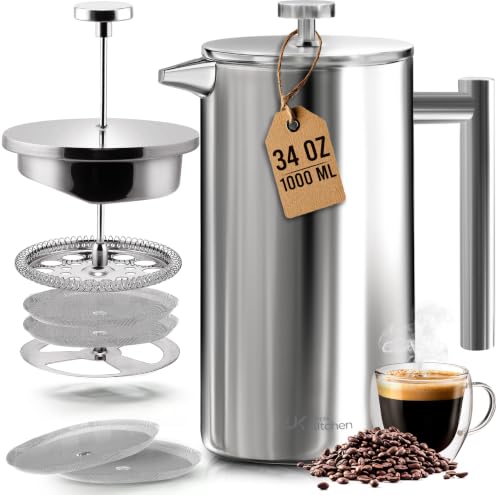
The Utopia Kitchen Stainless Steel French Press, 34 oz is built for press drinkers bothered by grit who want maximum filtration in steel. In the context of best non plastic coffee makers, its confirmed specification supports that job directly: 304 grade stainless steel construction, with double wall insulated body.
Strengths
- 4-level filtration is aimed squarely at a cleaner press cup
- Double-wall body holds steeping temperature
- Dishwasher safe and rust-free for low-effort upkeep
Trade-offs
- Filtration stacks need thorough rinsing to stay fresh
- Steel hides the water line while you fill
- Press coffee still carries more body — and fines — than drip
Key specs (from verified listing data)
- 304 grade stainless steel construction
- Double wall insulated body
- 34 oz capacity
- 4-level filtration system
- Includes 2 extra filters; rust-free; dishwasher safe
- Finish: Silver
Day to day, what separates this pick within the pool is fit, not magic — the honest limitation is that the multi-part filter stack takes longer to clean than a simple single-screen press. Judge it against your counter, your household and your habits, and it either slots into your routine cleanly or it does not; no amount of marketing changes that fit test. If it passes that fit test, Check on Amazon to see the current listing for this exact model.
Best for: press drinkers bothered by grit who want maximum filtration in steel / Not suited for: anyone whose needs flatly contradict that profile — for them, another pick in this guide fits better.
MuellerLiving French Press Coffee Maker, 34 oz
Badge: Best Everyday Steel Press
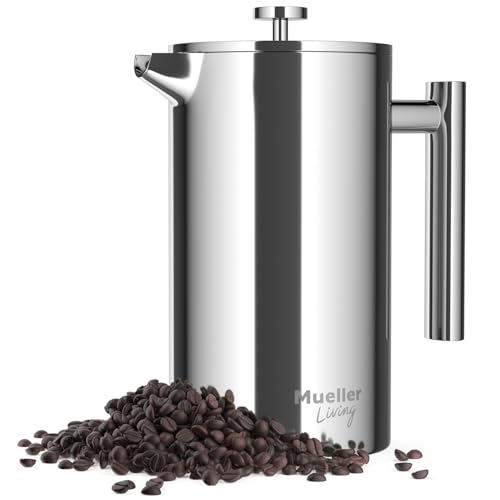
The MuellerLiving French Press Coffee Maker, 34 oz is built for daily press drinkers who want filtration and insulation in one mid-size press. In the context of best non plastic coffee makers, its confirmed specification supports that job directly: stainless steel french press, 34 oz, with 4-filter system.
Strengths
- 4-filter design targets a smoother, less gritty cup
- Double insulation keeps heat in during the steep
- Food grade, rust-free steel built for daily use
Trade-offs
- Filter stack needs disassembly for a deep clean
- No brew-level window in the steel body
- Shares the press method’s natural sediment character
Key specs (from verified listing data)
- Stainless steel french press, 34 oz
- 4-filter system
- Heat resistant, double insulated body
- Rust-free, food grade construction
- Dishwasher safe
Day to day, what separates this pick within the pool is fit, not magic — the honest limitation is that cleaning the layered filters is a small chore that glass-and-single-screen fans may resent. Judge it against your counter, your household and your habits, and it either slots into your routine cleanly or it does not; no amount of marketing changes that fit test. If it passes that fit test, Check on Amazon to see the current listing for this exact model.
Best for: daily press drinkers who want filtration and insulation in one mid-size press / Not suited for: anyone whose needs flatly contradict that profile — for them, another pick in this guide fits better.

AgcKuzt Full Stainless Steel French Press, 34 oz
Badge: Best Full-Steel Build
The AgcKuzt Full Stainless Steel French Press, 34 oz is built for campers and clumsy-prone kitchens that need a press which survives travel. In the context of best non plastic coffee makers, its confirmed specification supports that job directly: full stainless steel construction, 34 oz, with brews about 4 cups.
Strengths
- Full steel build shrugs off drops that would kill a glass press
- Double-wall insulation suits slow mornings and campsites
- Extra filters included in the box
Trade-offs
- A newer, less established brand than the big press names
- Steel body hides fill level and brew color
- Standard press sediment still applies
Key specs (from verified listing data)
- Full stainless steel construction, 34 oz
- Brews about 4 cups
- Double-walled insulated body
- Food grade materials
- Dishwasher safe; includes 2 more filters
- Positioned for kitchen and camping use
Day to day, what separates this pick within the pool is fit, not magic — the honest limitation is that brand track record is shorter, so long-term spare-part support is less certain. Judge it against your counter, your household and your habits, and it either slots into your routine cleanly or it does not; no amount of marketing changes that fit test. If it passes that fit test, Check on Amazon to see the current listing for this exact model.
Best for: campers and clumsy-prone kitchens that need a press which survives travel / Not suited for: anyone whose needs flatly contradict that profile — for them, another pick in this guide fits better.
Ziruma Non-Toxic Stainless Steel French Press, 34 oz
Badge: Best No-Plastic Brief
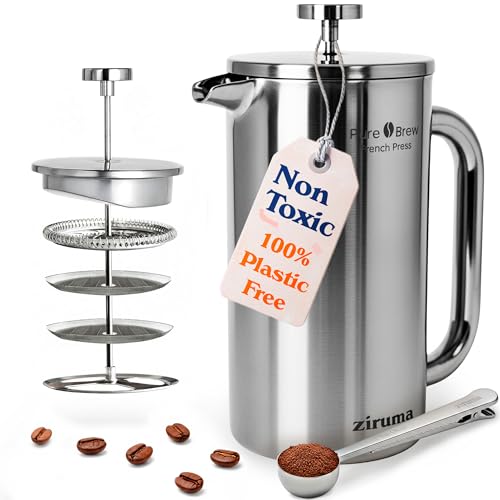
The Ziruma Non-Toxic Stainless Steel French Press, 34 oz is built for material-conscious drinkers who want the cleanest possible ingredient list in a press. In the context of best non plastic coffee makers, its confirmed specification supports that job directly: surgical-grade stainless steel, with no plastic or heavy metals in the design brief.
Strengths
- Explicitly built around a no-plastic, no-heavy-metals brief
- 4-layer filter for a cleaner press cup
- Measurement marks help repeat a good ratio
Trade-offs
- Newer brand, so the long-term record is still being written
- Steel hides the steep, like every steel press
- Premium positioning within the press class
Key specs (from verified listing data)
- Surgical-grade stainless steel
- No plastic or heavy metals in the design brief
- 34 oz capacity
- 4-layer filter system
- Double-wall insulated; measurement marks
- Dishwasher safe; portable
Day to day, what separates this pick within the pool is fit, not magic — the honest limitation is that shoppers who want glass visibility or a famous heritage brand will look elsewhere. Judge it against your counter, your household and your habits, and it either slots into your routine cleanly or it does not; no amount of marketing changes that fit test. If it passes that fit test, Check on Amazon to see the current listing for this exact model.
Best for: material-conscious drinkers who want the cleanest possible ingredient list in a press / Not suited for: anyone whose needs flatly contradict that profile — for them, another pick in this guide fits better.
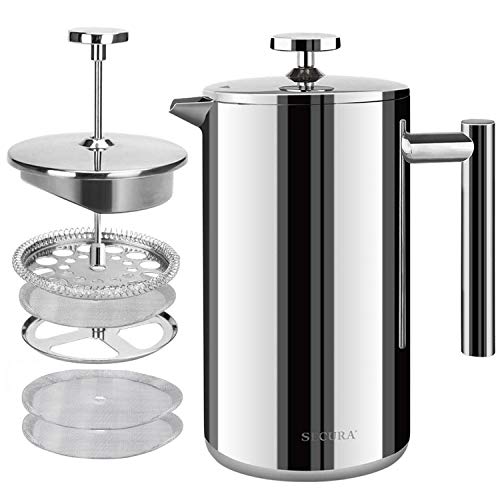
Secura French Press Coffee Maker, 50 oz
Badge: Best for Groups
The Secura French Press Coffee Maker, 50 oz is built for families, brunch hosts and offices brewing press coffee for several people. In the context of best non plastic coffee makers, its confirmed specification supports that job directly: 304 grade stainless steel construction, with insulated double-wall design.
Strengths
- 50 oz capacity serves a table, not just a mug
- Same all-steel, plastic-free brew path as the 34 oz Secura
- Double-wall insulation keeps a big batch hot through a long breakfast
Trade-offs
- A full 50 oz steel press is genuinely heavy to pour
- Big batches stale if the household actually drinks little
- Takes more storage room than the 34 oz presses
Key specs (from verified listing data)
- 304 grade stainless steel construction
- Insulated double-wall design
- 50 oz (1.5 litre) capacity
- Includes 2 extra filter screens
- Finish: Silver
Day to day, what separates this pick within the pool is fit, not magic — the honest limitation is that solo drinkers will waste coffee or arm strength — the size only pays off at volume. Judge it against your counter, your household and your habits, and it either slots into your routine cleanly or it does not; no amount of marketing changes that fit test. If it passes that fit test, Check on Amazon to see the current listing for this exact model.
Best for: families, brunch hosts and offices brewing press coffee for several people / Not suited for: anyone whose needs flatly contradict that profile — for them, another pick in this guide fits better.
Comparison Table
| Pick | Badge | Headline | Also confirmed |
|---|---|---|---|
| Secura French Press Coffee Maker, 34 oz | Best Overall | 304 grade stainless steel construction | Insulated double-wall design |
| Utopia Kitchen Stainless Steel French Press, 34 oz | Best Filtration in Steel | 304 grade stainless steel construction | Double wall insulated body |
| MuellerLiving French Press Coffee Maker, 34 oz | Best Everyday Steel Press | Stainless steel french press, 34 oz | 4-filter system |
| AgcKuzt Full Stainless Steel French Press, 34 oz | Best Full-Steel Build | Full stainless steel construction, 34 oz | Brews about 4 cups |
| Ziruma Non-Toxic Stainless Steel French Press, 34 oz | Best No-Plastic Brief | Surgical-grade stainless steel | No plastic or heavy metals in the design brief |
| Secura French Press Coffee Maker, 50 oz | Best for Groups | 304 grade stainless steel construction | Insulated double-wall design |
Read the table alongside the reviews: the badges carry the verdicts, the specs carry the evidence. Shoppers cross-shopping the neighboring category can set this beside 6 Best French Presses Glass Steel And Insulated 2026 to see how the briefs divide the work.
How to Choose: Best non plastic coffee makers Decided Properly
Define the brief precisely before choosing: ‘non plastic’ should mean the coffee and hot water touch no plastic anywhere in the brew path — vessel, filter, plunger assembly. All six picks here are stainless steel presses, and the Ziruma states the brief outright in its listing: no plastic or heavy metals, surgical-grade steel. With the others, the steel construction is the headline and the design follows it. What can still vary on any press is small trim — a knob or a handle accent — which never touches the coffee; judge the brew path, not the cosmetics, and every pick here passes.
With materials settled, filtration becomes the real choice. The classic Secura screens deliver the traditional press cup with its natural body. The four-level Utopia Kitchen system, four-filter MuellerLiving and four-layer Ziruma press toward a cleaner cup with less sediment — a genuine preference fork, not a quality ladder. Drinkers who abandoned press coffee over grit should start with the layered filters; drinkers who love the heavy, oily cup should save their money and take the classic screen.
Capacity and insulation finish the decision. Five picks are 34 oz — the household size — and the Secura line adds a 50 oz for groups, all double-wall insulated so the steep holds temperature and the pot serves as its own warmer with no plastic-lined carafe anywhere in the system. Steel’s weight is the honest cost: a full large press is a two-handed pour for some. That is the whole trade list, which is refreshingly short for a materials-driven brief.
One last filter before you buy: shoppers comparing adjacent briefs will find 6 Best French Press Coffee Pots Glass And Stainless 2026 useful context, but let this guide’s core question — verifying an all-steel brew path while choosing among filtration levels, insulation and capacities in the press format — make the final call.
How to Brew Plastic-Free Press Coffee, From Kettle to Cup
- Heat water in a steel or glass kettle — the plastic-free chain starts before the press, and an all-metal kettle keeps it unbroken.
- Add coarse grounds directly to the steel press; there is no paper filter and no plastic basket anywhere in this method.
- Pour the water over, rest the steel lid with the plunger up, and steep about four minutes while the double wall holds the heat.
- Skim the crust, plunge slowly with the steel mesh screen, and stop above the grounds bed.
- Pour into ceramic or glass mugs and decant the rest into a steel or glass vessel — never a plastic jug — if it will sit.
- Clean with hot water and a brush; steel needs no descaling chemicals and no plastic-safe detergents, just a periodic deeper wash to lift coffee oils.
Troubleshooting. Problem: a faint metallic note in the cup → the press is new or the water sat too long in the vessel; run a few seasoning brews and pour promptly after plunging. Problem: sediment despite a layered filter → the grind is too fine for any screen; coarsen before blaming the filter. Problem: coffee cools across a long morning → decant into a pre-warmed steel vacuum vessel to keep the whole chain plastic-free and hot.
For a deeper look at adjacent routines, 6 Best French Press Coffee Makers For Home And Travel 2026 is a useful companion read once your own setup is dialed in.
Where Plastic Hides in ‘Mostly Metal’ Coffee Gear
The reason this category exists is that ‘stainless steel coffee maker’ on a box often describes the housing, not the brew path. Electric machines with steel exteriors routinely route hot water through plastic tubing into a plastic basket over a glass carafe with a plastic lid. None of that is necessarily unsafe — food-grade plastics are regulated — but a shopper whose brief is zero plastic contact is not shopping for reassurance; they are shopping for absence. The press format delivers absence structurally: there is no tubing, no basket, no pump, nowhere for a hidden plastic part to live between the kettle and the cup.
Use that structural test on any brewer you consider beyond this pool: count the parts hot water touches, and ask what each is made of. If the answer requires a customer-service email, the design is not built around your brief. The six presses here answer the question by inspection — steel vessel, steel plunger, steel mesh — which is why the format dominates every honest non-plastic shortlist, including this one.
Steel, Glass and the Honest Middle Ground
Glass is the other plastic-free brew material, and fairness demands its case: a glass press with a steel plunger is also a no-plastic brew path, it lets you watch the steep, and it costs less than double-wall steel. Its weaknesses are fragility and heat loss — a glass beaker radiates the steep’s temperature away and breaks on the one morning you knock it against the faucet. The pool here is all steel because the market for durable, insulated, plastic-free pressing has moved that way, not because glass failed the materials test.
The middle ground some shoppers land on is a steel press for daily use and the understanding that perfection is not required at every step — a plastic kettle spout upstream, for instance, bothers some briefs and not others. Define your own line honestly: brew-path-only, or the whole chain from kettle to mug. This guide’s picks satisfy the strict version of the brief; how far beyond the press you extend it is a household decision, and both versions of the decision are respectable.
Decanting: The Step That Protects the Pot
Whatever press you choose, the coffee’s worst enemy after brewing is the press itself. Left sitting on its grounds, even a perfectly brewed pot keeps extracting, drifting from rich to harsh over twenty minutes. The discipline is simple: when the pot is ready, pour all of it — into mugs for now, into a warmed serving vessel for later. If your household drinks slowly, that vessel matters as much as the press. This is also why oversizing a press backfires for small households: a half-drunk large pot either sits on its grounds or gets decanted and forgotten, while a right-sized pot is simply finished at its best.
Press Coffee Around the World
The press pot wears different names and habits across borders — cafetière in Britain, where it is the default dinner-party brewer; a staple of Scandinavian kitchens, where coffee breaks are a cultural institution and the pot sits at the center of them; the office brewer of choice in offices across France, where it was popularized. The method’s portability across cultures is not an accident: it asks for nothing local — no voltage, no proprietary filter, no branded capsule — only coffee, water and time. A brewer that works identically in Oslo, Ohio and Osaka has a kind of universality no connected appliance will ever match, and it is part of why the design has survived essentially unchanged for generations.
Troubleshooting the Press Like a Diagnostician
Press problems form a short, learnable list. Sour and thin means under-extraction: steep longer, grind a touch finer, or check that the water was truly hot. Bitter and harsh means over-extraction or coffee left sitting on the grounds. Muddy means the grind carried too many fines or the plunge was forced. Weak means the dose was light — the least glamorous and most common cause of all. Work the list in that order, changing one variable per pot, and keep the notes somewhere you will actually see them. Within a dozen pots, most drinkers can diagnose their own cup blind, which is the moment the method becomes theirs.
The Second Pot Problem and the Thermos Solution
Press households that entertain hit the same wall: the first pot is perfect and the second, brewed in a rushed rinse of the same press, is not. The two honest solutions are a second press — the large model in this pool exists partly for this — or a decanting discipline: brew the first pot slightly early, pour it into a pre-warmed vacuum vessel, rinse the press calmly, and brew the second as guests settle. The vessel keeps the first pot at its best instead of on its grounds, and the host keeps their composure. Entertaining with manual gear is a logistics skill, and like the brewing skill, it compounds with practice.
Coffee Freshness for People Without a Machine to Blame
Electric machines give stale coffee an alibi — the machine needs descaling, the settings drifted. A press offers no such cover: the cup is beans, water, grind and you. That accountability is a gift to freshness habits. Buy beans in quantities your household finishes in a few weeks, store them sealed away from heat and light, and grind close to brewing whenever the morning allows. Pre-ground coffee is a legitimate convenience, but treat its clock as faster: smaller bags, tighter seals, cooler storage. When a press pot disappoints, freshness is the first suspect precisely because the equipment is too simple to be the second.
Press Versus Drip: The Honest Taste Map
New press drinkers often ask whether press coffee is better than drip, and the honest answer is that they are different drinks sharing a bean. The press passes oils and micro-fines that paper filtration removes, producing a heavier, rounder, more textured cup; drip produces a cleaner, brighter, more separated cup where individual flavors stand apart. Light-roasted, delicate coffees often show their detail better through paper; darker, chocolate-leaning coffees often feel more complete in a press. Neither is the truth about the bean. Owning the press means choosing the fuller rendering — and knowing a pour-over cone costs almost nothing for the days you want the other one.
Keeping a Press for Twenty Years
A steel press asks for almost nothing to last decades, which makes its few needs worth stating exactly. The filter screens are consumables: replace them when edges fray or the mesh warps, which is why several picks in this pool include extras. The plunger rod and cross pieces want an occasional full disassembly and wash, because coffee oil accumulates in the threads where rinsing never reaches. The vessel itself wants protection from nothing in particular — it is steel — except being used as a storage jar for grounds, which stains and scents it. That is the whole contract: screens, an occasional deep wash, and the press outlives trends, kitchens and possibly its owner’s taste in everything else.
Batch Brewing for Meal Prep and Iced Coffee
A press is a batch tool beyond the breakfast pot. Brew a double-strength pot, decant it, and refrigerate it, and you have the base for three days of iced coffee that never met a hot plate. Brew a pot the night before a road trip and fill travel mugs in the morning without touching a machine. The double-wall models hold a batch through a long brunch; the large model turns batch logic into a gathering. The principle underneath is that a press decouples brewing from drinking better than any single serve format: you make coffee when it is convenient, in the quantity the day actually needs.
The Press at the Office Desk
An office press is a small act of independence: no queue at the shared machine, no mystery pot of unknown age, and coffee that tastes like the beans you chose. The desk routine that works is compact — press, coarse coffee in a sealed jar, a mug you like, and an electric kettle if the office allows one or a run to the kitchen’s hot water if it does not. Rinse discipline matters more at work than at home, because yesterday’s grounds in a desk press announce themselves to the whole pod of desks. Steel earns its place here twice over: it survives the commute in a bag and the inevitable knock off a crowded desk.
Altitude, Travel and Other Edge Cases
Manual brewing travels into conditions that confuse machines. At altitude, water boils cooler, and a press simply steeps a minute longer to compensate — a machine with a fixed program cannot be told. In a rental kitchen with an unknown kettle, the press asks nothing about voltage or settings. In a power cut, it asks only for a flame. These edge cases sound exotic until you count how many mornings happen away from your own counter: trips, guests’ houses, cabins, hospital vigils with a kettle down the hall. A brewer whose competence is portable is a different kind of reliable, and it is the press’s oldest claim on a household’s loyalty.
Teaching Someone Else the Press
The press is the easiest good coffee to teach, which makes it a quiet ambassador for better coffee generally. The lesson fits in one pot: this much coffee, water off the boil, four minutes, skim, slow plunge, pour it all. A learner who succeeds on the first pot — and the method is forgiving enough that most do — has a skill for life and a new standard for every café cup. If you give a press as a gift, give the lesson with it, in person, over the first pot. The object costs little; the competence is the present, and it transfers in about six minutes.
Press Coffee and Food: Pairing Notes
A full-bodied brewing method pairs with food differently than a bright, filtered one. Press coffee’s weight stands up to rich breakfasts — eggs, buttered toast, anything with fat — where a delicate cup gets bullied off the palate. Its lower perceived acidity also makes it the kinder partner to sweet pastries, which can turn a bright coffee sour by contrast. After dinner, a smaller, stronger press pot plays the role espresso plays elsewhere: a short, intense finish rather than another mug. None of this requires ceremony; it is simply noticing that the pot you already own flatters some meals more than others, and timing it accordingly.
The Case for Owning Two Sizes
Serious press households often end with two presses, and the logic is arithmetic rather than collecting. A 34 oz press is the daily tool — right-sized for one to three drinkers, quick to wash, cheap to fill. A 50 oz press is the gathering tool, and using it daily would mean stale half-pots or wasted coffee. Owning both costs less than most single electric machines and covers the household’s whole range without compromise at either end. If you are buying your first press, buy the daily size and let the gathering size be a later, evidence-based addition — most households find their true pattern within a month.
Cold Brew in a Press: The Overnight Method
The same vessel that steeps hot coffee in four minutes cold-brews overnight without a single extra part. The method is coarse grounds and cold water at a stronger ratio — roughly one part coffee to eight parts water — left twelve hours, then plunged and decanted. The result is a smooth, sweet concentrate that dilutes beautifully over ice and keeps for days in the fridge. It is the press’s best summer trick and a genuine second identity for the tool: one vessel, two seasons, zero additional equipment. Households in warm climates sometimes find the cold method quietly becomes the primary one.
The Ratio That Fixes Most Press Coffee
Most disappointing press coffee is a ratio problem wearing a technique costume. A reliable starting point is roughly one part coffee to fifteen parts water by weight — for a 34 oz press filled near the top, that lands near sixty grams of coffee, or about eight level tablespoons of coarse grounds, though scoops vary enough that a cheap kitchen scale pays for itself in consistency within a month. Brew a pot at that ratio, taste honestly, then adjust one step at a time: a little more coffee if the cup tastes thin and sour, a little less if it tastes heavy and bitter. Change one variable per pot and the press becomes predictable within a week.
Grind Size: The Press’s One Real Demand
French press is the most forgiving brewer about equipment and the least forgiving about grind. Too fine, and the cup turns muddy and bitter while the plunger fights you; too coarse, and the coffee tastes weak no matter how long it steeps. Aim for coarse and even — the texture of raw sugar — and if your grinder produces a mix of dust and chunks, the dust will find its way through any filter stack. Blade grinders can work if you pulse and shake for evenness, but a basic burr grinder is the single upgrade that improves press coffee more than any press itself. Every model in this guide rewards that upgrade equally.
The Skim and the Slow Plunge
Two small habits separate a clean press cup from a gritty one. First, after the steep, skim the floating crust of grounds off the top with a spoon before plunging; those floaters are the main source of sludge in the final cup. Second, plunge slowly and stop just above the bed of grounds rather than compressing it — pressing hard squeezes bitter, silty liquid through the screen. Pour the whole pot into mugs or a serving vessel immediately, because coffee left sitting on the grounds keeps extracting and turns harsh while it waits. These habits cost thirty seconds and improve every press in this guide.
Heat Retention and the Second Cup
A press pot is also a serving pot, and that dual role is where insulation earns its keep. An uninsulated glass press can lose noticeable heat during a four-minute steep and far more over a lingering breakfast, which is why second cups from glass often taste dull as well as lukewarm. Double-wall steel holds the steep temperature steady — which also makes extraction more consistent from pot to pot — and keeps a second cup genuinely hot. The trade is visibility: you cannot watch the brew or judge the level at a glance. Households that drink one fast cup may not care; households that linger over the pot feel the difference daily.
Press Coffee for Guests Without Stress
The press is secretly one of the best guest brewers ever made: no filters to run out of, no machine queue, and a pot that comes to the table looking generous. The routine that makes it stress-free is to fill the kettle before guests arrive, grind while it heats, and start the steep when you sit down to eat — the coffee is ready exactly when the meal ends. Brew slightly stronger than your own taste if guests add milk, and set out a small pitcher of hot water so anyone who finds it intense can lengthen their own cup. A large press turns coffee service into a single trip instead of a series of individual brews.
Common Buying Mistakes
- Grinding too fine. Fine grounds mean mud, bitterness and a plunger that fights back; coarse and even is the press setting.
- Leaving coffee on the grounds. A brewed pot keeps extracting in the press; decant it all, every time.
- Oversizing the press. A half-used large press makes worse coffee than a right-sized one used fully.
- Skipping the skim. Thirty seconds with a spoon before plunging is the cheapest cup upgrade in the method.
- Washing only the vessel. The screens hold the oils; a press rinsed but never disassembled slowly seasons itself stale.
Final Recommendation
For most shoppers, the answer to best non plastic coffee makers starts with the Secura French Press Coffee Maker, 34 oz, Utopia Kitchen Stainless Steel French Press, 34 oz, and the MuellerLiving French Press Coffee Maker, 34 oz: the linked picks that genuinely match this brief, ordered by how completely they serve it. Work through the detailed reviews, let the fit test — your counter, your household, your habits — arbitrate between them, and check the latest price on Amazon only once the choice itself is made. Readers still weighing the wider category can glance at How To Make French Press Coffee With A Clean Full Flavor and How To Clean A French Press And Keep It Fresh Smelling before committing. A well-matched pick in this category disappears into your routine within a week, and that disappearance — not the unboxing — is what you are actually buying.
Frequently Asked Questions
Are these coffee makers completely plastic-free?
Their brew paths are: stainless steel vessels, plungers and mesh filters, with coffee touching steel only. The Ziruma makes the brief explicit — no plastic or heavy metals, surgical-grade steel. Small exterior trim on any press never contacts the coffee.
Why are all the picks French presses?
Because the press is the format with structurally no plastic in the brew path — no tubing, basket or pump. Electric machines almost always hide plastic somewhere in the water’s route, however steel their housing looks.
Does coffee from a steel press taste different?
It tastes like press coffee — full-bodied, with the oils a paper filter would remove. Steel itself is flavor-neutral; what you may notice versus glass is better heat retention during the steep, which makes extraction more consistent.
Which pick is best if I hate sediment?
The layered-filtration models: Utopia Kitchen’s 4-level system, MuellerLiving’s 4-filter design and Ziruma’s 4-layer filter. Pair them with a coarse grind and a gentle plunge for the cleanest press cup available.
Is stainless steel safe for daily coffee brewing?
The picks here use 304 grade or surgical-grade stainless steel — the standard food-contact steels used across commercial kitchens. They are rust-resistant, dishwasher safe per their listings, and contain no coatings to wear off into the brew.
What about the kettle and mugs — do they matter for a non-plastic brief?
For the strict version of the brief, yes: an all-metal kettle and ceramic or glass mugs keep the chain unbroken. The press is the core purchase; most households extend the rest of the chain gradually.


