Disclosure: topratedkitchenware.com is reader-supported. When you buy through links on our site, we may earn an affiliate commission from Amazon and other retailers, at no extra cost to you.
Where to buy
This guide started where your search did — with the best nontoxic coffee makers youtube searches surface again and again — and then checked those names against a verified product pool. All six picks below are stainless steel French presses you can confirm for yourself on the product pages linked here; check the latest price on Amazon before ordering.
- Secura French Press 34 oz — the 34 oz 304 stainless press that anchors most serious roundups
- Utopia Kitchen French Press 34 oz — 34 oz steel press whose 4-level filter stack is a video take-apart favorite
- MuellerLiving French Press 34 oz — 34 oz press with a 4-filter stack at the accessible end of the steel field
- AgcKuzt French Press 34 oz — full stainless 34 oz press pitched for kitchen and camping alike
- Ziruma Stainless Steel French Press 34 oz — surgical-grade steel press whose listing leads with its no-plastic build
- Secura French Press 50 oz — the 50 oz Secura for households that brew a full table at once
Read the full guide ↓
Introduction: the Best Nontoxic Coffee Makers YouTube Reviewers Keep Coming Back To
If you typed best nontoxic coffee makers youtube into a search box, you were probably looking for something text reviews cannot give you: a person on camera, holding the brewer, pouring the water, and showing you exactly what the coffee touches. That instinct is sound. Video is genuinely good at revealing construction — whether a lid is steel or plastic, how a plunger comes apart, how thick a press wall feels when someone knocks on it. This guide is built to pair with that research habit: it takes the category video reviewers return to most — the stainless steel French press — and lays out the six verified models worth your watch time, with the claims from the videos translated into checkable facts.
A warning first, because it matters: video is also where material claims get inflated. A creator holding a steel press may say it “leaches nothing” or call a plastic machine “toxic” with a confidence no one can test on camera. What a video can honestly show is construction: materials you can see, parts you can count, a water path you can trace. Judge every nontoxic video by that standard — does the presenter show you the inside of the brewer, name the steel grade, and take the filter apart, or are you being sold a mood?
All six picks here survive that test on paper and in our verified pool: double-wall stainless steel presses whose brew path is a steel chamber and a steel screen, in 34 oz sizes plus one 50 oz model. They are the presses that material-focused channels demonstrate most because there is something to demonstrate — layered screens, spare parts, insulation you can verify with a thermometer on camera. The sections below explain how to watch reviews critically, what the good videos consistently get right about these models, and where video advice needs correcting.
If you want the written deep-dives to read alongside the videos, start with our French Press Buying Guide Size Material And Plunger Design and the hands-on style roundup at Best French Presses Coffee Makers. Then come back here for the six models, the viewing checklist, and a brewing routine that matches what the best demonstrations actually show.
One more thing video does better than any other medium: it shows scale and sound. A press that looks compact in a product photo may tower over a mug on camera, and the scrape of a poorly fitted plunger is audible in a way no spec sheet conveys. Use that. When a demonstration includes a side-by-side with a standard mug, a decibel-friendly morning routine, or the clink test of a double wall, you are learning things written reviews genuinely cannot teach you — and the six picks below were chosen partly because they hold up under that kind of scrutiny.
Key Takeaways
- Video is great for verifying construction — lids, plungers, screen stacks — and poor at verifying chemistry. Trust what you can see; discount what a presenter merely asserts.
- The presses that dominate nontoxic-coffee videos are stainless steel French presses, because their all-steel water path can be shown, not just claimed.
- All six picks here are double-wall steel presses: five at 34 oz, one 50 oz family size.
- Watch for the take-apart moment: good reviews separate the screen stack and show spare screens, which are the wear parts that decide long-term value.
- Sponsored roundups exist in this niche; cross-check any video pick against a written spec list before buying.
- The brewing technique in the best videos — coarse grind, crust break at one minute, gentle press, immediate decant — is exactly right, and we reproduce it below.
- Every pick below links to a verified listing, so the model you saw demonstrated is the model you can actually check, spec by spec, before it ships.
In this guide
Quick Picks
The six presses below are ordered by how completely they answer the question video shoppers are asking: show me a brewer whose insides I do not have to worry about.
| Pick | Badge | Best for | Key detail | Link |
|---|---|---|---|---|
| Secura French Press 34 oz | Best Overall | The default recommendation | 304 stainless, double-wall, 2 extra screens | Check on Amazon |
| Utopia Kitchen French Press 34 oz | Best Filtration | Sediment haters | 4-level filtration, 2 extra filters, dishwasher safe | Check on Amazon |
| MuellerLiving French Press 34 oz | Best Value Design | Full steel on a budget | 4 filter screens, double insulated, dishwasher safe | Check on Amazon |
| AgcKuzt French Press 34 oz | Best for Camping and Travel | Home plus campsite duty | Full stainless build, 2 extra filters, dishwasher safe | Check on Amazon |
| Ziruma Stainless Steel French Press 34 oz | Best for Material Purists | Spec-sheet-first buyers | Surgical-grade steel, 4-layer filter, measure marks | Check on Amazon |
| Secura French Press 50 oz | Best for Families and Groups | Four-plus drinkers | 50 oz (1.5 litre), 304 stainless, 2 extra screens | Check on Amazon |
How These Picks Were Chosen
Our method for this guide mirrored the search that brought you here. We started with the products that nontoxic-coffee content — video and written — recommends most, then filtered them through the verified pool we use for every guide on this site: confirmed listings, confirmed specifications, and confirmed images via the Amazon Creators API. Anything we could not verify dropped out, however often it appears in video descriptions. What survived is a deliberately narrow field: six stainless steel French presses.
We then compared the survivors on the things a camera can actually adjudicate. Filter construction came first — single screen versus the three- and four-layer stacks several of these presses use — because sediment is the complaint video comment sections raise most. Next, included spares: presses that ship with extra screens (Secura, Utopia Kitchen, AgcKuzt) solve the one predictable wear problem before it happens. Then insulation, capacity, steel grade as stated by the maker, and dishwasher ratings.
What we did not do is treat view counts as evidence. A video with a million views can still be a sponsored placement, and a small channel can do the most careful take-apart in the niche. We used video the way we recommend you use it: as a construction reference, not a verdict. Our verdicts below rest on verified materials and specs, and where a maker uses the word “nontoxic” in its own product name, we say that is the maker’s framing and evaluate the material claim underneath it.
We also spot-checked the claims that recur across this niche’s videos against the verified listings: steel grades, screen counts, included spares, capacities, and dishwasher ratings. Where a popular video described a feature the current listing does not show — a changed lid material, a dropped spare part — we followed the listing, not the video. Products evolve quietly between production runs, and a guide is only useful if it describes the version you can actually buy today.
The 6 Best Nontoxic Coffee Makers Worth Watching
For each pick: what the videos show, what the specs confirm, and who should buy it. Badges reflect the role each press plays in the material-focused conversation online.
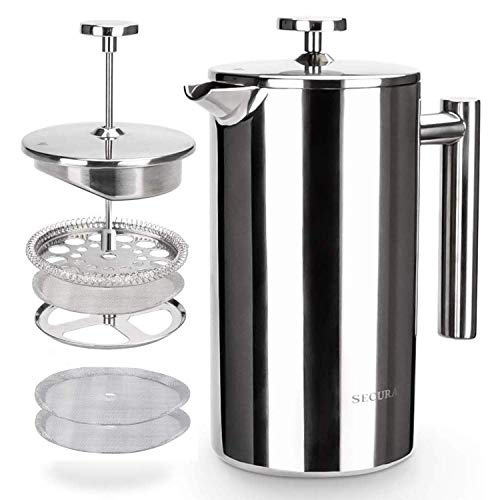
Secura French Press 34 oz
Badge: Best Overall
Strengths
- The press presenters reach for as the reference steel design: 304 stainless chamber, steel plunger and screen
- Two spare screens in the box — the detail careful reviewers always point out
- Double-wall insulation that temperature demos on camera consistently confirm holds heat well
Trade-offs
- You cannot watch the brew through steel, a small irony for video shoppers
- 34 oz ceiling suits couples and small households, not crowds
- Standard press sediment in the final sip, as with every model here
At a glance
- Capacity: 34 oz (1 litre)
- Material: 304-grade stainless steel
- Insulation: Double-wall insulated
- Filtration: Steel screen, 2 extra screens included
- Finish: Silver
Search this category on any video platform and one design language keeps recurring: a brushed steel cylinder, a steel plunger, and a presenter tapping the double wall to make the insulation point. The Secura 34 oz is the archetype. Its verified specs back the visuals — 304-grade stainless steel throughout the brew path, double-wall construction, and two spare screens in the box.
That spare-screen detail is why experienced reviewers rate it. A French press has exactly one wear part, the screen, and Secura is the brand that treats it as a consumable you should already own. On camera the press also disassembles and reassembles cleanly, which sounds trivial until you have watched a cheaper press with a wobbling plunger rod — alignment matters for an even press and a clean cup.
Its limits are the category’s limits. The steel wall hides the brew, the 34 oz size is a four-mug maximum, and the cup carries a trace of sediment. Within those honest bounds, this is the press to buy if you watch three videos, read one guide, and want the decision to be over.
Best for: Anyone who wants the most-demonstrated, best-supported steel press and an end to the research / Not suited for: Viewers who enjoy watching the coffee bloom and brew through glass
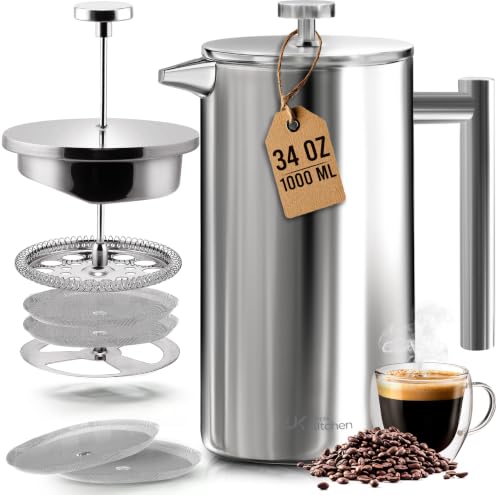
Utopia Kitchen French Press 34 oz
Badge: Best Filtration
Strengths
- 4-level filtration is the most demonstrable feature in this pool — layered screens you can count on camera
- 304 stainless, double-wall body keeps the water path fully steel
- Dishwasher safe, rust-free, with two extra filters included
Trade-offs
- Layered screens mean a firmer plunge and more parts to rinse apart
- Same 34 oz capacity as the standard field
- The stack needs occasional separation and scrubbing to stay free-flowing
At a glance
- Capacity: 34 oz
- Material: 304-grade stainless steel
- Insulation: Double-wall insulated
- Filtration: 4-level system, 2 extra filters included
- Care: Dishwasher safe, rust-free
The Utopia Kitchen press earns its video presence in the take-apart segment. Presenters unscrew the plunger, fan out the 4-level filtration stack, and hold the screens to the light — and for once the visual is the substance. Four layered steel screens genuinely do catch finer particles than one, and comment sections under press reviews are full of people whose only objection to the method is grit. This is the press aimed at them.
The supporting specs are what you would hope: 304-grade stainless steel, a double-wall insulated body, a dishwasher-safe and rust-free rating, and two spare filters in the box. In the cup, the difference versus a single-screen press is real but should be described honestly — cleaner, not filtered. You keep the heavy, low-acid press character; you lose most of the sludge.
The cost of the layers is maintenance attention. Grounds lodge between screens if you only rinse the assembled plunger, so separate and scrub the stack regularly — the good cleaning videos all show this step, and our own How To Clean A French Press And Keep It Fresh Smelling walks through it in writing.
Best for: Press-curious drinkers who have been put off by sediment in the cup / Not suited for: Minimalists who want the fewest parts possible between them and coffee
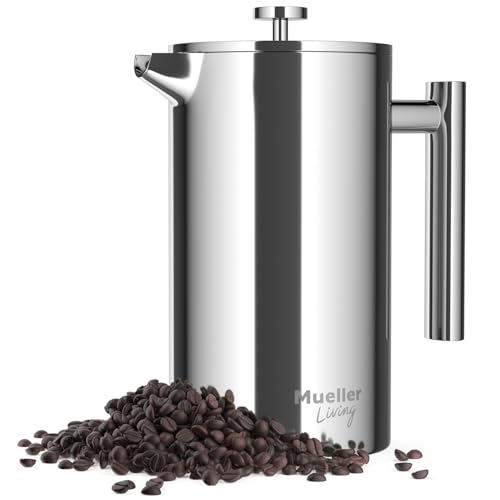
MuellerLiving French Press 34 oz
Badge: Best Value Design
Strengths
- Four-filter screen stack — a feature videos usually showcase on pricier presses
- Double-insulated food-grade stainless body
- Dishwasher safe and rust-free for low-effort daily use
Trade-offs
- Less video coverage and thinner brand support than Secura or Utopia Kitchen
- 34 oz, the standard ceiling
- Finish is functional rather than premium
At a glance
- Capacity: 34 oz
- Material: Stainless steel, food grade
- Insulation: Double insulated
- Filtration: 4 filter screens
- Care: Dishwasher safe, rust-free
MuellerLiving’s press is the one smaller channels and budget roundups tend to surface, and the specs explain why: it offers the four-filter screen stack that headline presses advertise, inside a double-insulated, food-grade stainless body, at the accessible end of this pool’s price tiers. If your video research left you thinking layered filtration was a premium-only feature, this model corrects that.
In use it behaves like its filtration count suggests — a cleaner-than-basic press cup, a slightly firmer plunge, and a screen stack that rewards an occasional proper scrub. The double insulation keeps the second cup hot, and the dishwasher-safe rating makes it a realistic weekday brewer.
The trade-offs are about the company, not the coffee. Mueller’s spare-part ecosystem and review footprint are smaller than the category leaders’, so you are trading a little long-term support for a lower entry price. For the materials question at the heart of this guide, though, the answer is identical: steel chamber, steel screens, nothing else in the water’s way.
Best for: Budget-first buyers who still want layered filtration and all-steel construction / Not suited for: Buyers who weight brand depth and parts support most heavily

AgcKuzt French Press 34 oz
Badge: Best for Camping and Travel
Strengths
- Nothing breakable: full stainless construction shrugs off travel knocks that kill glass presses
- Double-wall insulation matters even more outdoors, where cold air strips heat
- Two extra filters included; dishwasher safe back home
Trade-offs
- Least video coverage of any pick here — you are trusting specs more than demonstrations
- 34 oz serves four cups; big groups re-brew
- Brand track record is the shortest in this pool
At a glance
- Capacity: 34 oz (4 cups)
- Material: Full stainless steel, food grade
- Insulation: Double-walled insulated
- Filtration: Steel filter, 2 extra filters included
- Care: Dishwasher safe
This is the pick your video research probably did not show you, and it is worth a look precisely because its case is practical rather than presentational. The AgcKuzt is a full stainless steel, double-walled 34 oz press its maker pitches for kitchen and camping. Outdoors, the steel argument stops being about materials purity and becomes about survival: glass breaks in a loaded car, and a steel press simply does not care.
The double wall, a comfort feature at home, is a performance feature at a campsite, where a single-wall vessel loses heat to cold morning air quickly. Two extra filters ride along in the box, and back home the press goes in the dishwasher. The water path is steel end to end, satisfying the nontoxic brief as completely as any pick here.
The honest caveat is provenance: this is a lesser-known brand with a thin review record, so you are leaning on verified specifications rather than a crowd of demonstrations. As a travel and backup press — or a first press for someone whose gear lives a hard life — that is a reasonable trade. More travel-oriented options appear in 6 Best French Press Coffee Makers For Home And Travel 2026.
Best for: Campers, RV and cabin users, and anyone replacing a broken glass press / Not suited for: Shoppers who only buy products they have seen extensively reviewed
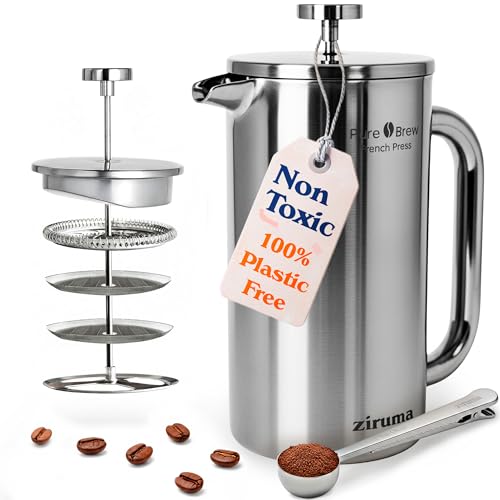
Ziruma Stainless Steel French Press 34 oz
Badge: Best for Material Purists
Strengths
- Surgical-grade stainless steel — the highest material spec in the pool, and the one material-focused videos cite
- Maker explicitly designs around no plastic and no heavy metals
- 4-layer filter plus measurement marks on the body
Trade-offs
- The steel-grade advantage is about corrosion resistance and finish, not a different safety category from 304
- 34 oz standard capacity
- Newer brand, shorter track record
At a glance
- Capacity: 34 oz
- Material: Surgical-grade stainless steel
- Insulation: Double-wall insulated
- Filtration: 4-layer filter
- Extras: Measurement marks, dishwasher safe, portable
If a video titled around nontoxic coffee makers put a name in your head, there is a fair chance it was this one: the Ziruma is the only product in the pool that builds its identity on the claim, with “Non-Toxic” in the product name itself and a listing that specifies surgical-grade steel, a no-plastic and no-heavy-metals brief, a four-layer filter, and double-wall insulation. It is the spec sheet the niche’s presenters read aloud.
Strip away the framing and the substance holds up. Surgical-grade steel is a genuine step in corrosion resistance; the four-layer filter matches the pool’s best filtration; and the measurement marks solve the one usability flaw of every steel press — you cannot see the water level, so the marks let you repeat your ratio without a scale. It is also rated dishwasher safe and sized for travel at 34 oz.
Our one editorial note is calibration. The 304 food-grade steel in the other five picks is already a proven, non-reactive food-contact material; surgical grade refines, it does not rescue. Buy the Ziruma if its total package — steel grade, filter, markings — appeals to you, and buy it knowing the whole pool answers the materials question well.
Best for: Material-first shoppers who want the highest steel specification in a press / Not suited for: Anyone expecting the steel grade alone to change the taste of the coffee
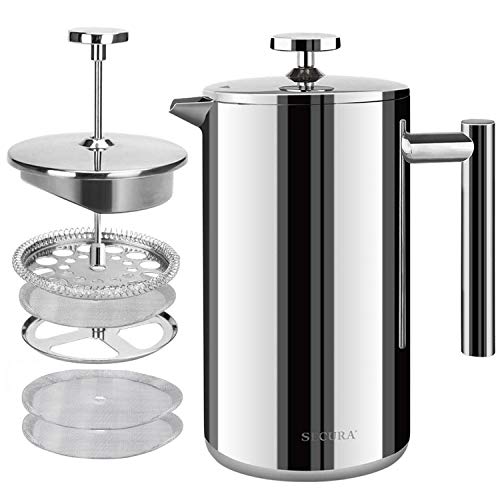
Secura French Press 50 oz
Badge: Best for Families and Groups
Strengths
- 50 oz brews about six mugs in a single press — the only crowd size in this pool
- Same 304 stainless, double-wall construction as the reference 34 oz Secura
- Two spare screens included, matching the smaller model
Trade-offs
- Full batches must be decanted promptly or the coffee over-extracts
- Large and heavy when full; not a travel or small-kitchen pick
- Too much press for one or two drinkers
At a glance
- Capacity: 50 oz (1.5 litre)
- Material: 304-grade stainless steel
- Insulation: Double-wall insulated
- Filtration: Steel screen, 2 extra screens included
- Finish: Silver
Family-kitchen videos — the ones brewing for a table rather than a desk — are where the 50 oz Secura appears, because it solves the standard press’s real limitation: volume. At 50 oz (1.5 litres) it produces roughly six mugs in one brew, with the same 304 stainless steel construction, double-wall insulation, and spare-screen inclusion as its 34 oz sibling.
The technique adjustment the good demonstrations show is decanting. A large batch left sitting on its grounds keeps extracting and turns bitter; pour the full press into mugs or a warmed serving vessel as soon as you have pressed, and the big format becomes an asset — brunch coffee for a crowd, brewed without a machine and without a plastic water path anywhere in the process.
For solo drinkers this size is a liability, not a luxury: half-batches in an oversized vessel brew unevenly, and full batches go stale. Match the size to the household. If yours fills a table most mornings, this is the pick; if not, the 34 oz Secura is the same quality at your scale.
Best for: Families, shared houses, and brunch hosts brewing for a group / Not suited for: Solo drinkers and couples
Comparison Table
Six steel presses, compared on the attributes video shoppers ask about most: what it is made of, how much it brews, and how its filter is built.
| Pick | Format | Capacity | Standout trait | Link |
|---|---|---|---|---|
| Secura French Press 34 oz | French press | 34 oz | Reference steel design | Check on Amazon |
| Utopia Kitchen French Press 34 oz | French press | 34 oz | 4-level filter stack | Check on Amazon |
| MuellerLiving French Press 34 oz | French press | 34 oz | 4 filters, value tier | Check on Amazon |
| AgcKuzt French Press 34 oz | French press | 34 oz | Full steel, travel-ready | Check on Amazon |
| Ziruma Stainless Steel French Press 34 oz | French press | 34 oz | Surgical-grade steel | Check on Amazon |
| Secura French Press 50 oz | French press | 50 oz | Largest capacity in pool | Check on Amazon |
How to Choose a Nontoxic Coffee Maker After Watching the Videos
Use video for what it is good at, and this section for the rest. When you watch a nontoxic coffee maker review, keep a short checklist beside you. Does the presenter show the inside of the brewer, or only the outside? Do they name the material of the lid, the plunger rod, and the filter — or only the headline material? Do they take the filter apart? Do they disclose sponsorship? A review that does those four things is worth trusting on construction; a review that does none of them is an advertisement with a kitchen backdrop.
Then verify the material claims in writing. Steel grade is the claim that matters most in this category: 304 food-grade stainless is the proven standard for hot-water contact, and surgical-grade steel is a legitimate premium refinement. What you are screening for is not really the grade — it is completeness. A press is an all-steel water path only if the chamber, screen, plunger, and lid are all steel, and the verified listings for the six picks here confirm exactly that.
Filtration is where written specs beat video impressions. A presenter can say a cup “looks clean,” but the screen count tells you the mechanism: single screens leave the most sediment, while the three- and four-layer stacks in this pool catch more fines. If you know you dislike grit, choose by layer count — Utopia, Mueller, and Ziruma all list four-layer or four-filter systems — and pair the press with a coarse, even grind.
Capacity deserves the same written check, because press “cups” are roughly 4 oz each. The 34 oz presses here make about four mugs; the 50 oz Secura makes about six. Video framing makes every press look similar in size, so trust the ounce figure, and buy for your household’s normal morning rather than its biggest one.
Finally, price the whole ownership, not the box. Screens wear out; a press that includes spares, as three of these six do, defers that cost and the discontinuation risk. A dishwasher-safe rating saves daily effort. These unglamorous details — rarely the focus of a video thumbnail — are what decide whether a press is still in your routine in three years. For the full written framework, our French Press Buying Guide Size Material And Plunger Design is the companion read.
A final filter that costs nothing: read the comment sections of the videos you watch, but read them for patterns, not verdicts. A single complaint is an anecdote; the same complaint about a wobbling plunger or a screen that frays, repeated across different channels and different years, is data. The picks in this guide were screened against exactly those recurring themes — plunger alignment, screen durability, and lid fit — because those are the failure modes owners actually report, as opposed to the ones marketing invents.
One more written check that video cannot do for you: confirm the exact variant. Several presses in this guide share a design across two sizes and multiple finishes, and marketplace listings bundle them under one page with a selector. The 34 oz and 50 oz Secura models are the obvious example here. Before ordering, read the size in the listing title itself — not the video title, not the thumbnail — and match it to the capacity math above. It takes five seconds and prevents the single most common disappointment in this category.
How to Brew French Press Coffee the Way the Good Videos Show It
The best brewing demonstrations online converge on the same routine, and it is the right one. Weigh or measure a 1:15 coffee-to-water ratio — about 65 grams of coarse-ground coffee for a full 34 oz press — and grind coarse, like raw sugar. Fine grounds are the hidden cause of most bad press coffee: they slip through screens, over-extract, and turn the cup muddy.
Pour water just off the boil over the grounds, saturating everything, and start a timer. At one minute, break the floating crust with a spoon and skim the foam — the step that separates the careful videos from the careless ones, and the one that most improves clarity. Lid on, plunger up, and wait to the four-minute mark.
Press slowly and stop just above the grounds bed. Heavy resistance means the grind is too fine; never force a press, both for safety and because forcing it churns sediment back into the coffee. Pour everything immediately into mugs or a warmed vessel — the single most repeated piece of advice in good demonstrations, because coffee left on the grounds keeps extracting and turns harsh.
Cleaning is the epilogue every routine needs. Knock grounds out (not down the sink), rinse the press warm, and periodically take the screen stack fully apart for a scrub — coffee oils trapped between layers are the main source of stale flavors in press coffee. The written version of the full method lives at How To Make French Press Coffee With A Clean Full Flavor.
If you are following along with a video while you brew, one adjustment will improve on most demonstrations: weigh your coffee and water at least the first few times. Presenters eyeball ratios for the camera because it films better, but a scale removes the guesswork that separates a great press from a muddy one. Once your hand knows what 65 grams of coarse grounds looks like in your press, you can retire the scale to the drawer and brew by eye with the confidence the presenters actually earned over hundreds of brews.
Troubleshooting
Problem: Coffee tastes bitter and heavy → you left it in the press too long or ground too fine. Decant immediately after pressing, hold the steep to four minutes, and coarsen the grind.
Problem: The cup is full of grit → your grind is uneven or too fine, or the screen stack needs separating and cleaning. A burr grinder and a four-layer press make the biggest difference.
Problem: Coffee tastes sour and weak → the water was not hot enough or the steep too short. Use water just off the boil and give the brew its full four minutes before pressing.
How to Spot a Sponsored “Nontoxic” Roundup
This niche runs on affiliate links and sponsorships — this guide included, as our disclosure states — so the skill is not finding unbiased content but recognizing honest content. Honest reviewers disclose sponsorships in the video and description, show products they do not recommend and say why, and criticize details of their own top pick. A roundup in which every product is flawless and every link points one place is a storefront, not a review.
Watch the language of certainty. Materials science does not support claims like “zero leaching, guaranteed” for any brewer, and it does not support calling regulated food-contact plastics “poison.” Presenters who speak in mechanisms — this part is steel, that part is plastic, here is the grade — are informing you. Presenters who speak in fear are selling to you. The six presses in this guide need no fear to make their case: their water paths are short, visible, and steel.
Finally, check the date and the description. Designs change quietly — a steel lid becomes plastic in a later production run — and careful creators update descriptions when that happens. When a video and a current verified listing disagree, believe the listing, and treat the disagreement as a reminder that video is a snapshot, not a spec sheet.
There is a simple tell that separates the careful creators in this niche from the rest: they show the scale. When a presenter weighs the dose, times the steep, and measures the water temperature on camera, they are signaling that their claims can be checked and repeated. When a video about a materials question never shows a material being tested, handled, or taken apart, the production is borrowing the aesthetic of rigor without the substance. The presses in this guide reward the rigorous style — everything about them that matters can be demonstrated with a screwdriver, a thermometer, and a scale.
What the Videos Get Right About Steel Presses
For all the caveats above, the video consensus on this category is broadly correct, and it is worth saying what it gets right. Demonstrations consistently show that double-wall steel presses hold serving temperature far longer than glass, that layered screens reduce sediment, and that an all-steel press is effectively unbreakable in normal kitchen life. Temperature probes, scale weigh-ins, and take-aparts on camera are real evidence about construction and heat — exactly the things this product type turns on.
The consensus brewing method is also right: coarse grind, water just off the boil, a crust break at one minute, four minutes total, a gentle press, and immediate decanting. If you follow only the videos for technique and only the spec sheets for purchasing, you will land in the right place — which is where this guide has tried to meet you. Broader family roundups at 6 Best French Presses Glass And Steel Coffee Presses 2026 and 6 Best French Press Coffee Pots Glass And Stainless 2026 fill in the glass side of the picture that steel-focused channels tend to skip.
The Comment Section as a Research Tool
There is a research resource hiding under every video in this niche: thousands of owners describing what broke, what annoyed them, and what they replaced. Used well, comments are the largest informal durability survey available for products like these. Used badly, they are a mood. The difference is method: search within comments for the specific part you care about — “screen,” “plunger,” “lid,” “rust” — and count how many independent owners mention it, rather than reading the top few reactions.
Applied to this category, comment patterns are reassuringly consistent. Owners of steel presses complain about sediment (a method trait, solvable with grind and layered screens) and about size misjudgments (solvable with the ounce math in this guide). What they rarely report is the brewer itself failing: there is no element to burn out and no pump to die. That quiet pattern, repeated under video after video, is part of why the six picks here are all presses — the format’s long-term owner story is unusually calm.
Common Buying Mistakes
Treating a view count as a quality signal is the first mistake. Popularity measures the thumbnail and the title as much as the testing. Use videos to inspect construction; use verified specs to decide.
The second mistake is believing any presenter who guarantees a chemical outcome — in either direction. No one can test leaching on camera. What can be verified is the material list, and that is what your decision should rest on.
Third, shoppers buy the press they saw and skip the supporting cast: a coarse-capable grinder and, for a fully steel water path, a stainless kettle. The press is the centerpiece, but the routine around it makes the coffee.
Fourth, do not leave brewed coffee sitting in the press because a video showed a host doing it during a long segment. That is filming convenience, not advice; decant after pressing or the last cup turns bitter.
Finally, check that the specific size and variant in a video matches the listing you open. Presses come in near-identical 34 oz and 50 oz versions, and more than one disappointed unboxing has been a size mix-up rather than a product flaw.
A related mistake is freezing your opinion at the first video. Recommendation algorithms reward confidence, so early videos in a niche often state positions more strongly than the evidence supports, and later, quieter corrections never reach the same audience. Before buying, deliberately watch one video that disagrees with your leading candidate. If the disagreement is about taste, ignore it; if it is about a part, a fit, or a failure mode, you have learned something worth the ten minutes.
Final Recommendation
If your video research has you convinced on the category — and it should, because the construction case for steel presses is visible and real — the Secura 34 oz is the model to act on: the reference design, fully steel in the water path, insulated, and shipped with its own spare screens. Sediment-sensitive viewers should take the Utopia Kitchen’s four-level filtration instead; spec-sheet maximalists, the Ziruma; families, the 50 oz Secura.
Watch one more take-apart video if it helps you feel sure — then buy by the spec list, brew by the method above, and let the algorithm find a new topic to show you.
And if the research itself has become the hobby — as it does in this niche — set yourself a stopping rule: once you have seen the construction clearly, confirmed the listing matches, and checked the comment patterns for the part that wears out, you know everything the internet can tell you about a forty-dollar-class steel press. The remaining knowledge only exists in your own kitchen, in the using.
That is the honest end of the video rabbit hole: six verified steel presses, a method you can watch or read, and a decision that does not need one more autoplay to be a good one.
Short on time? Start with the three picks our research kept circling back to: Secura French Press 34 oz, Utopia Kitchen French Press 34 oz and MuellerLiving French Press 34 oz. Each covers a different priority in this guide, and the detailed reviews above explain which one fits which kitchen.
Related guides
Frequently Asked Questions
Why do YouTube reviewers recommend French presses for nontoxic coffee?
Because the construction is demonstrable: a steel chamber and a steel screen can be shown on camera, taken apart, and verified. There is no hidden reservoir or tubing to wonder about, which makes the press the easiest brewer to evaluate honestly in video form.
Can I trust nontoxic claims made in videos?
Trust claims about visible construction — materials, parts, filter layers — especially when the presenter shows them. Be skeptical of chemical guarantees in either direction; no video can test what leaches, and honest creators say so.
What steel grade should I look for?
304 food-grade stainless is the proven standard for hot-water and food contact, and it is what most picks in this guide use. Surgical-grade steel, offered by one pick here, adds corrosion resistance. Either answers the materials question; completeness of the all-steel path matters more than the grade.
Do steel presses really keep coffee hotter than glass?
Yes — double-wall insulated steel holds serving temperature noticeably longer than single-wall glass, which is why presenters can demonstrate the difference with a thermometer. You should still decant after pressing to stop extraction.
How do I avoid sediment like the reviewers do?
Use a coarse, even grind, skim the crust at the one-minute mark, press gently without compressing the grounds bed, and pour carefully. A multi-layer screen press — several are in this guide — reduces sediment further.
Are these presses good for beginners?
They are among the easiest brewers to learn: no paper filters, no machine settings, just ratio, temperature, and time. The routine in this guide takes two or three brews to feel automatic.
Should I buy the exact model in a video I liked?
Buy the model whose verified listing matches what the video showed — and check the listing, because designs change between production runs. If the current version differs from the filmed one, trust the listing and look for a more recent demonstration of the current version.


