Disclosure: topratedkitchenware.com is reader-supported. When you buy through links on our site, we may earn an affiliate commission from Amazon and other retailers, at no extra cost to you.
Where to buy
All six picks below are the verified contenders for best offset smokers under 200, drawn from the assigned pool and listed with plain Amazon links — check the latest price on Amazon from any of them, and read the full guide ↓ for the detailed reviews, the comparison table and the buying guide before you decide.
- Dyna-Glo Wide Body Vertical Offset Charcoal Smoker — Best Overall
- Oklahoma Joe’s Longhorn Offset Charcoal Smoker and Grill — Best for Small Spaces
- Realcook Charcoal Grill with Offset Smoker — Most Versatile
- Oklahoma Joe’s Highland Offset Reverse Flow Smoker and Grill — Best for Even Heat
- Royal Gourmet CC1830W Charcoal Grill with Offset Smoker — Best Workstation
- Oklahoma Joe’s Laredo Series 1100 Offset Charcoal Smoker and Grill — Best Capacity
Shopping for the best offset smokers under 200 (the under $200 band) means accepting one truth up front: at this band you are buying the offset layout and the learning experience, not thick steel or luxury fittings. Every cooker in this roundup is a genuine offset design — a firebox mounted to the side of a cooking chamber, so smoke and indirect heat do the work — and every one of them will ask you to tend a real fire. What separates the picks is how honestly they handle that bargain: chamber size, firebox access, work surfaces, and how forgiving the draft feels when the wind picks up.
This guide reads the under $200 band qualitatively, the way experienced cooks talk about it. Nobody can promise what a given listing will cost on the day you shop, and this band is exactly where prices wobble most, so each pick is positioned by design tier instead: what the steel, size and features suggest about how it will cook. Thin steel is the defining reality here. It heats fast, responds fast, and loses heat fast — which makes these cookers lively teachers. If you want to learn brisket, ribs and fire management without committing to a flagship budget, this is the classroom.
Key Takeaways
- At the under $200 band, you are paying for the offset layout and the craft, not for heavy steel — expect active fire tending on every pick.
- The Dyna-Glo vertical cabinet is the capacity surprise: stacked grates hold crowd-sized loads on a small patio footprint.
- Reverse flow and long-chamber designs (Highland Reverse Flow, Longhorn) are the most forgiving when the chamber is fully loaded.
- A grate-level probe thermometer matters more than any single feature at this tier; lid gauges are rough guides only.
- Budget a cover and a charcoal basket into the purchase — both pay for themselves within a season at this steel thickness.
In this guide
Quick Picks
Six picks, six different strengths. Badges here match the badges in the detailed reviews, so you can jump straight to the design that fits your patio, your guest list and your cooking week.
| Pick | Badge | Cooking area (per title) | Standout |
|---|---|---|---|
| Dyna-Glo Wide Body Vertical Offset Charcoal Smoker | Best Overall | Not stated in title | Vertical cabinet, stacked grates, offset firebox |
| Oklahoma Joe’s Longhorn Offset Charcoal Smoker and Grill | Best for Small Spaces | 1,060 sq. in. | Long chamber, 1,060 sq. in., zoned heat |
| Realcook Charcoal Grill with Offset Smoker | Most Versatile | 800 sq. in. | 800 sq. in. barrel combo for gatherings |
| Oklahoma Joe’s Highland Offset Reverse Flow Smoker and Grill | Best for Even Heat | 1,093 sq. in. | Reverse flow baffle, 1,093 sq. in. |
| Royal Gourmet CC1830W Charcoal Grill with Offset Smoker | Best Workstation | 783 sq. in. | Wooden table, front shelf, hooks, adjustable fire grates |
| Oklahoma Joe’s Laredo Series 1100 Offset Charcoal Smoker and Grill | Best Capacity | 1,100 sq. in. | Laredo Series, 1,100 sq. in. chamber |
How These Picks Were Chosen
This roundup was built by comparing the verified offset and offset-combo listings in the assigned pool on the things that decide a cook at this band: chamber format (horizontal barrel versus vertical cabinet), stated cooking area, firebox access, heat-control features named in the listing, and work surfaces. Prices were deliberately not treated as a ranking input — the band in the keyword is the framing, and within it, design honesty matters more than a fluctuating number. Research was listing-led and cross-checked against the pool’s verified titles; nothing here claims hands-on testing, and every limitation we would expect an owner to meet is stated in the open.
The 6 picks in detail: best offset smokers under 200
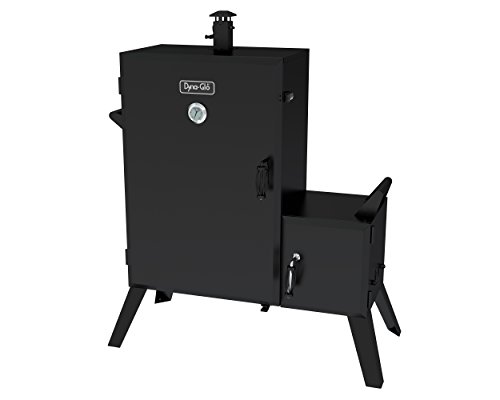
Dyna-Glo Wide Body Vertical Offset Charcoal Smoker
Badge: Best Overall
Strengths
- The vertical cabinet stacks cooking grates upward, so capacity grows without a huge patio footprint.
- An offset firebox keeps direct heat away from the food while smoke rises naturally through the cabinet.
- Wide-body proportions accept full racks and large cuts that narrow vertical smokers force you to cut down.
Trade-offs
- Vertical cabinets stratify heat — the top grate runs differently from the bottom, so rotation matters.
- Door seals on cabinets in this class benefit from attention; small smoke leaks are common.
- It is a smoker first; there is no meaningful direct-grilling role.
| Specification (from listing title) | Detail |
|---|---|
| Format | Wide body vertical offset smoker |
| Fuel | Charcoal |
| Model | DGO1890BDC-D |
| Finish | Black |
The Dyna-Glo takes the offset idea and turns it upright. Instead of a horizontal barrel, the cooking chamber is a wide cabinet with stacked grates, and the firebox hangs off the side at the base. Smoke and heat rise through the cabinet, which makes the footprint remarkably small for the amount of food it holds — a serious advantage on a crowded patio or deck. The wide-body width is the detail that matters most: narrow vertical smokers force you to halve rib racks, while this cabinet swallows them whole. Heat stratification is the trade you accept. The grate nearest the firebox inlet runs hotter than the top, so rotating food between levels during a long cook is part of the technique, not a flaw to complain about. Because the fire is offset rather than directly underneath, flare-ups are rare and the smoke flavour stays clean. It will not grill a steak, and it is not meant to. As a dedicated smoking cabinet for someone who cooks for a crowd in a small space, it is one of the most logical shapes in this entire roundup.
Judged against the under $200 band, Dyna-Glo Wide Body Vertical Offset Charcoal Smoker earns its place by giving you the full offset experience — real fire, real smoke, indirect heat — in a design that does not waste its limited budget on gimmicks.
Ownership of Dyna-Glo Wide Body Vertical Offset Charcoal Smoker settles into a routine quickly. Ash comes out of the firebox after every cook — left in place, it holds moisture against the steel and starts the rust clock. The grates want a hot brush-down while the chamber is still warm, and the interior benefits from the seasoning it builds over time: a thin, dark layer of polymerised oil and smoke that protects the metal better than any paint. Stored under a cover, in a spot where rain does not pool around the legs, this is a cooker that asks for minutes of care per cook and gives back seasons of service. The parts most likely to need attention over the years are the consumables of any charcoal cooker — grates, gaskets where fitted, and the firebox surfaces that live closest to the heat.
Best for: crowd smoking on a small patio footprint / Not suited for: anyone who also needs direct grilling

Oklahoma Joe’s Longhorn Offset Charcoal Smoker and Grill
Badge: Best for Small Spaces
Strengths
- 1,060 sq. in. gives true multi-zone room — brisket at one end, ribs or chicken at the other.
- The longer chamber smooths the temperature gradient compared with compact offsets.
- Doubles as a full-size charcoal grill when smoking is not on the menu.
Trade-offs
- The footprint is substantial; measure your patio before falling in love.
- A bigger chamber drinks more fuel to reach and hold temperature.
- Heavier steel than bargain barrels, but still a cooker that rewards a windbreak in winter.
| Specification (from listing title) | Detail |
|---|---|
| Cooking area | 1,060 sq. in. (per listing title) |
| Format | Horizontal offset smoker and grill |
| Fuel | Charcoal |
The Longhorn stretches the classic Highland formula into a longer chamber, and that length changes how the cooker behaves. With 1,060 sq. in. to work with, you can run a genuine two-zone cook: the firebox end for foods that like a bit more heat, the chimney end for delicate items that want gentle smoke. That gradient, which beginners see as inconsistency, is a tool once you understand it. The Longhorn also grills at full size, so it can be the only cooker on the patio for many households. The costs of size are real. It takes more charcoal to bring the big chamber to temperature, it occupies serious patio real estate, and moving it is a two-person thought rather than a casual whim. In return you get the most forgiving cooking area in this group — the cooker least likely to force you into Tetris arrangements with a brisket, two racks and a tray of wings. If your cooks regularly feed a table of eight or more, the extra length earns its keep every single session.
For a buyer watching this band closely, the question is whether Oklahoma Joe’s Longhorn Offset Charcoal Smoker and Grill spends its money on the cook itself; on chamber, firebox and workflow, it does.
Living with Oklahoma Joe’s Longhorn Offset Charcoal Smoker and Grill is mostly a story about ash and weather. Empty the firebox once the ash is fully cold, because ash plus humidity is the fastest route to corrosion in any steel cooker. Keep the cooking grates oiled lightly after cleaning and the chamber interior will season itself into a protective finish over the first dozen cooks. A fitted cover is not optional equipment for an outdoor cooker in this class; it is the difference between a five-season cooker and a two-season one. Wheels, shelves and hinges — the moving furniture of the design — repay a quick check each spring, and every other spare the design needs is the standard charcoal-cooker kit: chimney starter, basket, probes and a stiff brush.
Best for: party cooks who use heat zones across a long chamber / Not suited for: small patios and small households

Realcook Charcoal Grill with Offset Smoker
Badge: Most Versatile
Strengths
- 800 sq. in. is a sweet-spot size for parties without jumping to the biggest barrels.
- The combo layout grills directly in the main chamber and smokes via the offset box.
- A straightforward barrel design keeps assembly and learning curve approachable.
Trade-offs
- Accessory and ecosystem support is thinner than the big heritage brands.
- Firebox size suits chunks and small splits rather than long logs.
- Plan on a probe thermometer; treat any lid gauge as a rough hint.
| Specification (from listing title) | Detail |
|---|---|
| Cooking area | 800 sq. in. (per listing title) |
| Format | Barrel charcoal grill with offset smoker combo |
| Use case from title | Backyard parties and gatherings |
Realcook’s barrel combo aims squarely at the backyard party brief: 800 sq. in. of cooking space, a main chamber that grills burgers and chicken directly over charcoal, and an offset firebox for when the plan turns to ribs or a shoulder. The design is deliberately uncomplicated, which keeps the price tier accessible and the assembly manageable. In offset mode it behaves like other mid-size barrels — the firebox wants modest fuel pieces, the dampers respond quickly, and the cook who checks in every half hour or so is rewarded with steady smoke. Where it asks for compromise is in the details around the edges: the ecosystem of fitted accessories is smaller than the big-name brands, and serious winter smoking will expose the limits of its thermal mass. None of that prevents it from turning out genuinely good barbecue. For a household that grills often and smokes a few times a month, this is a rational, honestly positioned cooker.
At this tier the steel will be thinner than the flagships, and Realcook Charcoal Grill with Offset Smoker is no exception — what matters is that its layout makes that thin steel easy to live with.
Day to day, Realcook Charcoal Grill with Offset Smoker rewards the habits that all offsets reward. Preheat it fully and it behaves; rush it and it reminds you who is in charge. Keep the firebox ash-free between cooks, brush the grates hot, and let the interior build its seasoned finish rather than scrubbing it back to bare metal. Storage is simple but not negotiable: a cover, a dry footing, and a chimney cap or covered stack in wet climates. Over years of ownership the honest costs are charcoal, wood, replacement grates when the originals finally thin, and the occasional hinge or handle — the normal consumables of a working fire cooker, with no electronics to fail and no proprietary parts to hunt down.
Best for: hosts who grill and smoke for gatherings in one barrel / Not suited for: competition-style cooks chasing heavy-gauge gear

Oklahoma Joe’s Highland Offset Reverse Flow Smoker and Grill
Badge: Best for Even Heat
Strengths
- Reverse flow routing sends heat under a baffle first, evening out left-to-right temperatures.
- 1,093 sq. in. is the largest cooking area in this group.
- Keeps the Highland formula — offset firebox plus a chamber that can grill — in a bigger, calmer package.
Trade-offs
- Reverse flow baffles add a surface that needs scraping and care to stay clean.
- The big chamber is slower to preheat than compact barrels.
- Even heat distribution reduces the hot-spot zone some cooks like for finishing.
| Specification (from listing title) | Detail |
|---|---|
| Cooking area | 1,093 sq. in. (per listing title) |
| Format | Reverse flow offset smoker and grill |
| Fuel | Charcoal |
Reverse flow is the engineering answer to the offset smoker’s oldest complaint: one end cooks hotter than the other. On this Highland variant, smoke and heat from the firebox travel under a baffle plate to the far end of the chamber before rising and flowing back across the food toward the chimney. The result is a noticeably more even grate temperature, which matters when the chamber is loaded wall to wall with ribs that should all finish together. At 1,093 sq. in. it is also the biggest cooker in this lineup, with room for serious party quantities. The trade-offs are maintenance and patience: the baffle collects drippings and needs regular scraping, and a chamber this size takes its time coming up to temperature. Cooks who loved exploiting a hot zone for crisping chicken skin may miss it. But for brisket, shoulders and full rib loads where evenness is the whole game, the reverse flow layout is the most forgiving design here.
Within the under $200 brief, Oklahoma Joe’s Highland Offset Reverse Flow Smoker and Grill stands out because its headline feature solves a problem you will actually meet in the first month of ownership.
The ownership pattern for Oklahoma Joe’s Highland Offset Reverse Flow Smoker and Grill is the pattern of the category, executed on this design’s specific furniture. Clean the ash out after cooks, not before the next one. Treat shelves and tables as the outdoor furniture they are — wooden surfaces in particular want the cover on and, over the years, the occasional oil or sand-and-seal afternoon. Keep a probe thermometer’s cables away from direct flame, keep the charcoal dry, and keep the woodpile drier. Do those unglamorous things and the cooker simply works, cook after cook, which is the real test of any design in this roundup: not the first brisket, but the fortieth.
Best for: full, uniform loads that must finish together / Not suited for: cooks who love exploiting a hot spot for finishing

Royal Gourmet CC1830W Charcoal Grill with Offset Smoker
Badge: Best Workstation
Strengths
- Adjustable fire grates give direct control over grilling intensity in the main chamber.
- Wooden table and front shelf create a real work surface, with hooks for tools.
- The offset box adds genuine low-and-slow capability to a grill-first design.
Trade-offs
- Wooden surfaces weather outdoors; a cover is close to mandatory.
- 783 sq. in. is mid-size — big cooks need planning.
- The firebox is sized for chunks and short splits.
| Specification (from listing title) | Detail |
|---|---|
| Cooking area | 783 sq. in. (per listing title) |
| Format | Barrel charcoal grill with offset smoker |
| Features from title | Wooden table, front shelf, hooks, adjustable fire grates |
| Model | CC1830W |
The CC1830W is the grill-first member of the Royal Gourmet barrel family: a 783 sq. in. main chamber with adjustable fire grates for direct cooking, dressed with a wooden table and front shelf that make it feel like a proper outdoor workstation. Hooks keep tongs and brushes off the ground, and the offset smoker box on the side extends its range into ribs, shoulders and smoked chicken. The wooden furniture is both the charm and the chore — it looks warm and works well, but it will weather if the cooker lives uncovered in the rain, so a cover belongs in the budget from day one. As a smoker it follows the mid-size barrel pattern: modest fuel pieces, responsive dampers, and results that track the cook’s attentiveness. Households that grill twice a week and smoke twice a month will find the balance well judged.
The value case for Royal Gourmet CC1830W Charcoal Grill with Offset Smoker at this band is simple: it covers grilling and smoking in one footprint, so the budget is not split across two cookers.
What owners of Royal Gourmet CC1830W Charcoal Grill with Offset Smoker talk about after the first season is rarely the headline feature; it is the routine. The cooker finds its spot, the fire routine becomes muscle memory — chimney, bed, chunks, dampers, probes — and the machine’s individual habits become known quantities: how it answers a damper move, how it behaves in a crosswind, how long its bed burns. That familiarity is worth more than specifications, and it only arrives if the cooker is kept well enough to stay in service: ash out, grates brushed, cover on, fuel dry. Nothing in that list is expensive, and all of it together is the difference between a tool and a rusting ornament.
Best for: grill-first households that smoke regularly / Not suited for: maximum-capacity party smoking

Oklahoma Joe’s Laredo Series 1100 Offset Charcoal Smoker and Grill
Badge: Best Capacity
Strengths
- 1,100 sq. in. matches the biggest chambers here — true crowd capacity.
- Series positioning brings a more dressed-up feature set than entry barrels.
- Full grill capability in the main chamber keeps it a one-cooker patio solution.
Trade-offs
- Large footprint and preheat fuel use come with the territory.
- Big chambers punish sloppy fire management with slow recovery.
- Measure doorways and gates before ordering — it is a substantial unit.
| Specification (from listing title) | Detail |
|---|---|
| Cooking area | 1,100 sq. in. (per listing title) |
| Format | Offset smoker and grill, Laredo Series 1100 |
| Fuel | Charcoal |
The Laredo Series 1100 sits at the dressed-up end of the Oklahoma Joe’s offset range, pairing an 1,100 sq. in. chamber with the brand’s familiar offset layout. That capacity puts it in the same conversation as the reverse flow Highland for party duty: multiple briskets, or a brisket plus ribs plus chicken, without stacking compromises. The chamber’s size also changes the cooking rhythm — it preheats more slowly, holds a steadier cruise once there, and recovers more slowly if you let the fire sag, so it rewards cooks who plan fuel additions ahead of the temperature curve rather than reacting to it. As with its siblings, the main chamber grills directly over charcoal, which keeps the Laredo from being a single-purpose purchase. If your patio and your guest list both run large, this is one of the most complete expressions of the classic offset idea in the group.
If you stretch within the band for one cooker, Oklahoma Joe’s Laredo Series 1100 Offset Charcoal Smoker and Grill is the kind of design the stretch should buy — capacity and heat behaviour you will still appreciate in year three.
Long-term, Oklahoma Joe’s Laredo Series 1100 Offset Charcoal Smoker and Grill asks for the standard charcoal-cooker covenant: you give it ash removal, a seasoned interior, dry storage and a cover; it gives you a fire chamber that lights the same way in year four as in week one. The firebox takes the hardest life in any offset, so expect its surfaces to show honest wear first — that is normal, and it is why ash discipline matters most exactly there. Check fasteners after the first few heats and again each season, keep the stack clear, and store charcoal indoors. Follow that covenant and this design’s working life is measured in years of weekends, not in months of novelty.
Best for: large households and entertainers wanting flagship capacity / Not suited for: tight patios and quick weeknight preheats
Comparison Table
| Pick | Format | Cooking area (per title) | Standout | Listing |
|---|---|---|---|---|
| Dyna-Glo Wide Body Vertical Offset Charcoal Smoker | Vertical offset cabinet | Not stated in title | Vertical cabinet, stacked grates, offset firebox | Check on Amazon |
| Oklahoma Joe’s Longhorn Offset Charcoal Smoker and Grill | Horizontal offset | 1,060 sq. in. | Long chamber, 1,060 sq. in., zoned heat | Check on Amazon |
| Realcook Charcoal Grill with Offset Smoker | Barrel combo | 800 sq. in. | 800 sq. in. barrel combo for gatherings | Check on Amazon |
| Oklahoma Joe’s Highland Offset Reverse Flow Smoker and Grill | Reverse flow offset | 1,093 sq. in. | Reverse flow baffle, 1,093 sq. in. | Check on Amazon |
| Royal Gourmet CC1830W Charcoal Grill with Offset Smoker | Barrel combo | 783 sq. in. | Wooden table, front shelf, hooks, adjustable fire grates | Check on Amazon |
| Oklahoma Joe’s Laredo Series 1100 Offset Charcoal Smoker and Grill | Horizontal offset | 1,100 sq. in. | Laredo Series, 1,100 sq. in. chamber | Check on Amazon |
How to Choose the Right Offset for best offset smokers under 200
Start with the fire, because every offset decision flows from it. An offset smoker cooks with indirect heat: the fire lives in a side firebox, and hot air and smoke are drawn across the food by the chimney’s draft. That separation is the whole point — no flare-ups, no direct scorching, and smoke that bathes food for hours instead of blasting past it. It also means the cook manages two things at once, the fire and the food, and the designs in this roundup differ mainly in how kindly they treat that double job.
Chamber size should be bought against your largest regular cook, not your largest imaginable one. Measure in cuts, not square inches: a packer brisket needs clear length, rib racks need width side by side, and every item needs an airflow gap around it. A chamber that passes your two most common big cooks with gaps to spare is big enough; anything larger costs fuel, preheat time and patio on every single session, including the Tuesday chicken.
Firebox design decides your working rhythm. A side door lets you add fuel without opening the cooking chamber and dumping its heat. A compact box wants chunks and short splits; a generous box tolerates longer splits. Adjustable grates or charcoal pans in the main chamber belong to the grilling half of a combo’s life, and they matter more to weeknight satisfaction than any smoking specification.
Comparing across budgets is part of the homework: the same tests applied here are applied in our guide to Best Offset Smokers Under $2000, so the conclusions line up from band to band.
If your ceiling sits elsewhere, Best Offset Smokers Under $300 covers the neighbouring case with the same honesty about steel, size and fire craft.
Heat behaviour comes in three dialects in this category. Traditional offsets run a gradient — hot near the firebox, gentle near the chimney — which becomes zones in skilled hands. Reverse flow flattens the gradient with a baffle for uniform loads. Vertical cabinets stratify heat between stacked grates and answer with rotation. None is best in the abstract; each matches a cooking style, and the reviews above tell you which dialect each pick speaks.
Finally, budget for the system around the cooker. A dual-probe thermometer, a charcoal basket, a cover, seasoned hardwood and quality charcoal are not accessories in the decorative sense; they are the difference between the cooker as listed and the cooker as it performs in your weather, on your patio, with your fuel. The most common buying regret in this category is not choosing the wrong model — it is choosing the right model and none of the kit that makes it sing.
At the under $200 band, tier logic is simple to state and hard to shop: the cheapest barrels buy you the layout with the thinnest steel and fewest conveniences; the top of the band buys bigger chambers, better firebox access and features like adjustable fire grates or reverse flow routing. None of them buy thermal mass — that lives in a higher tier entirely — so judge these cookers on how gracefully they handle being light: tight-fitting lids, sensible damper placement and a firebox door you can open without disturbing the cook.
Firebox access is a theme that returns in Best Offset Smokers Under $400, where the same access-versus-capacity trade-off is weighed for a different brief.
How to Run a Budget Offset Smoker: Fire, Dampers and Rhythm
The method below works for every cooker in this roundup, from the smallest barrel to the vertical cabinet. Master it and the specific model matters far less than the fire you build in it.
- Build the base fire in the firebox, not the chamber. Light a chimney of charcoal and spread it as an even bed in the firebox. Add two or three wood chunks on top for smoke. This charcoal bed is your heat battery — it smooths every later adjustment.
- Preheat with the dampers open. Leave the firebox intake and the chimney fully open while the chamber comes up to temperature. A fully preheated chamber — walls, grates and all — swings far less once food goes on.
- Load food cold-side first and close the lid. Place the largest cuts toward the heat they need, leave airflow gaps between items, set your grate probe, and close the lid. From here, the lid stays closed except for planned interventions.
- Steer with small moves. Control temperature primarily with the firebox intake damper, in small steps, and wait ten minutes before judging each change. Keep the chimney open so smoke stays fresh rather than stale.
- Feed little and often. Check the fire on a regular rhythm and add small amounts of fuel before the temperature falls, not large amounts after. Pre-warmed chunks ignite cleanly and keep the smoke thin and sweet.
- Rest before you slice. When the meat is tender, rest it wrapped in a dry cooler or a low oven. Resting redistributes juices and finishes the cook more honestly than any extra hour on the grate.
The heat-behaviour discussion continues in Best Offset Smokers Under $40000, which looks at the gradient question from another angle.
A note on timing: every offset cook runs on the schedule of the meat, not the clock. Build your plan backwards from the table — allow the full preheat, allow the stall that large cuts take through the middle of the cook, and allow a proper rest at the end — and then add an hour you hope not to use. Cooks who plan this way finish relaxed; cooks who plan to the minute serve late and slice early, and both mistakes cost more quality than any equipment choice in this guide.
Troubleshooting
Problem: Temperature keeps climbing past target → what to do: Close the firebox intake a small step, confirm the chimney is not drawing excessively in wind, and let the charcoal bed burn down rather than adding fuel. Never choke the exhaust fully — stale smoke will punish the food.
Problem: Temperature keeps sagging → what to do: Check the ash level first; a choked firebox starves any fire. Rake the bed, add a small amount of lit charcoal from a chimney, and open the intake a step. Check whether wind or cold is stripping the chamber and shelter the cooker if so.
Problem: Smoke is thick, white and bitter-smelling → what to do: The fire is smouldering. Open the intake, add a smaller, hotter fuel piece rather than a large cold one, and wait for the exhaust to run thin and pale before trusting the cook again.
What Thin Steel Really Means at This Price Band
Every offset in this band is built from relatively thin steel, and understanding what that does to a cook is worth more than any single product feature. Thin walls store little heat, so the chamber temperature follows the fire closely: add fuel and it climbs quickly, let the fire sag and it falls quickly. That responsiveness is why these cookers teach fire management so fast — there is no thermal flywheel hiding your mistakes — and also why they demand a check-in rhythm of roughly every half hour on long cooks.
Thin steel also loses the fight against weather. Wind strips heat from the chamber walls, and a cold day can double fuel use compared with a calm summer afternoon. The countermeasures are cheap and effective: cook in a sheltered spot, keep the lid closed, preheat the chamber fully before loading food, and run a charcoal basket so the fire burns as a controlled bed rather than a scattered pile. Owners who accept these habits get genuinely good barbecue from this band; owners who expect pellet-grill indifference to conditions blame the cooker for physics.
Longevity follows the same logic. Thin steel plus high heat plus outdoor storage means rust is the enemy, and the defence is boring: season the interior, empty the ash after cooks, and keep a cover on it. A cooker at this band that is covered and ashed-out will outlast a neglected cooker costing twice as much.
For a different take on the workstation question, see Best Offset Smokers Under $500 and its treatment of shelves, pans and workflow.
Setting Honest Expectations for Your First Offset
The first brisket on a budget offset rarely goes to plan, and that is normal. The learning curve is the fire: how big to build it, when to add fuel, how small damper movements change the chamber ten minutes later. Plan your first cooks as practice with forgiving food — pork shoulder tolerates temperature swings that would ruin a brisket flat — and keep notes. Two or three cooks in, the rhythm clicks, and the same cooker that felt temperamental starts to feel predictable.
It also helps to expect the accessories that actually matter. A dual-probe thermometer (one for the grate, one for the meat) transforms guesswork into information. A charcoal basket concentrates the fire and extends burn time. A simple windbreak tames winter cooks. None of these cost much relative to the cooker, and together they close most of the gap between this band and cookers far above it. What no accessory fixes is impatience: offset cooking is measured in hours, and the cooks who enjoy it are the ones who enjoy the tending itself.
And if the vertical question is what brought you here, Best Offset Smokers Youtube is the companion read this guide keeps pointing toward.
Fuel and Wood: Setting Up the Supply Your Cooker Deserves
An offset is only ever as good as its fuel supply, and setting that supply up properly is a one-time job with permanent returns. Start with charcoal: a consistent, natural lump or quality briquette gives you a predictable bed, and predictability is what fire management is built on. Buy the same fuel for a run of cooks while you learn a new cooker, because changing fuel and learning a chamber at the same time doubles the variables. Store it indoors or under hard cover — charcoal that has absorbed humidity lights reluctantly and burns dirty, and no damper technique compensates for wet fuel.
Wood is the flavour half of the supply. Seasoned hardwood is the requirement: wood dried long enough to ignite quickly and burn with a thin, clean smoke. Oak is the reliable foundation for long cooks, hickory brings a stronger hand, pecan sits milder between them, and fruitwoods — apple, cherry — suit poultry and pork where a gentler smoke wins. Size the wood to the firebox: chunks for compact boxes, short splits for generous ones, and keep a small stock pre-cut beside the cooker so a mid-cook addition takes seconds rather than a trip to the woodshed with an axe.
Finally, think in terms of a system rather than a shopping list. A charcoal basket to contain the bed, a chimney starter to light without chemical flavours, a dry box or bin for the wood, and a probe thermometer to close the information loop — together these turn the cooker from a product into a practice. Cooks who build the system once stop troubleshooting their equipment and start improving their barbecue, which is the correct order of business.
Seasoning, Storage and Long-Term Care
Seasoning a new offset is not a ritual; it is corrosion engineering. Wipe the interior with a thin coat of high-heat cooking oil, run a moderate fire for a couple of hours, and let the heat polymerise the oil into a dark, hard finish. Repeat once more if the steel still looks raw. That finish, maintained by ordinary cooking, is the chamber’s main defence against rust — every smoky cook renews it a little, and every aggressive scrub back to bare metal destroys it.
Storage decides the rest of the story. Ash must come out after cooks, because ash is hygroscopic: it pulls moisture from the air and holds it against the firebox floor, which is why neglected offsets rust from the firebox outward. The cooker itself wants a cover that breathes rather than a tarp that traps condensation, a footing that drains, and — in wet climates — a cap or cover over the chimney so rain does not run straight into the chamber.
Build the small habits and the cooker repays them for years: brush grates while hot, empty the grease path before it becomes a flare-up risk, check hinges and fasteners each season, and store charcoal and wood under cover so the next fire starts dry. None of this is specialised work. It is the same care a cast-iron pan asks for, scaled up to a machine that lives outdoors — and it is the real difference between the cookers that are still cooking in five years and the ones photographed for resale listings.
Common Buying Mistakes
- Expecting set-and-forget behaviour from a thin-steel offset, then blaming the cooker for temperature swings that tending would have prevented.
- Judging chamber temperature by the lid thermometer alone; grate-level temperature can differ dramatically from dome air.
- Buying the biggest chamber in the band for two-person cooks, then fighting the fuel use and slow preheat on every session.
- Skipping the cover to save a little money, then losing the cooker to rust that a cover would have prevented.
- Loading the chamber wall to wall on the first cook, with no airflow gaps, and wondering why the smoke flavour turned bitter.
Final Recommendation
For most buyers in this band, the Oklahoma Joe’s Highland Offset Reverse Flow is the first recommendation: its baffle-routed heat is the most forgiving behaviour here when the chamber is full, and the capacity means it will not be outgrown in a year. If patio space is the binding constraint, the Dyna-Glo vertical cabinet holds surprising amounts of food on a small footprint. Grill-first households should look at the Royal Gourmet CC1830W’s workstation layout, and the smallest budgets with the smallest patios are honestly served by the CC1624W-class compact designs in the wider range.
Whichever pick you choose, spend the small extra on a probe thermometer and a cover before your first cook. At this band, those two items do more for your results than any upgrade between models.
Start with the shortlist: Dyna-Glo Wide Body Vertical Offset Charcoal Smoker · Oklahoma Joe’s Longhorn Offset Charcoal Smoker and Grill · Realcook Charcoal Grill with Offset Smoker — check the latest price on Amazon for each, then work down the detailed reviews if a shape or size does not fit your patio.
Frequently Asked Questions
Can an offset smoker under $200 cook a good brisket?
Yes — brisket quality is decided by fire management and patience more than by steel thickness. A budget offset will swing temperature more than a heavy cooker, so allow extra time, use a grate-level probe, and rest the brisket properly. Many cooks learn on exactly this class of cooker and produce brisket they are proud of.
Why does my cheap offset lose temperature so fast?
Thin chamber walls store little heat and shed it to the air, especially in wind. Cook in a sheltered spot, keep the lid closed, maintain a healthy charcoal bed as your heat battery, and add small fuel amounts often rather than large amounts rarely.
Charcoal, wood chunks or splits in a small offset?
Start with a charcoal bed for stable heat and add wood chunks for smoke flavour. Small fireboxes cannot burn long splits cleanly; chunks and short splits sized to the box burn hotter and cleaner. Save full log burning for large offsets with big fireboxes.
Do I need to modify a budget offset to make it work?
No modification is required to cook well. The highest-value additions are a probe thermometer and a charcoal basket. Seal and baffle modifications exist in the hobby, but learn the cooker stock first — most frustration blamed on design is actually fire technique.
How long will a budget offset smoker last?
With ash emptied after cooks, the interior seasoned and a cover used in storage, several seasons of regular use is a fair expectation. Left uncovered with ash sitting in the firebox, rust can start within a single wet season.
Offset smoker or pellet grill at this budget?
They are different crafts. The offset gives you real-fire flavour and the skill of fire management, with active tending. A pellet grill gives convenience. At this band the offset is the better teacher and, for many cooks, the more satisfying cooker — but only if you enjoy the process.


