Disclosure: topratedkitchenware.com is reader-supported. When you buy through links on our site, we may earn an affiliate commission from Amazon and other retailers, at no extra cost to you.
Where to buy
Every pick below in this guide to the best outdoor propane gas grills is a verified propane gas grill – no fuel conversions, no prose-only substitutes – and each name links to its Amazon listing, where you can check the latest price on Amazon and confirm the exact configuration. The six cover the full propane spectrum, from a single-burner portable to a six-burner party rig, so start here and then read the reviews to match size and layout to your cooking.
- IdeaMaxx 3-Burner Propane Gas Grill with Cast Iron Grates — Best Overall — Check on Amazon
- Weber Spirit E-425 Gas Grill — Best for Searing
- AMERLIFE 6-Burner Propane Gas Grill with Side Burner — Best for Big Gatherings
- Char-Broil Portable 1-Burner Propane Gas Grill — Best Portable
- Nexgrill 4-Burner Propane Gas Grill, Stainless Steel Body — Best Large Stainless Pick
- Nexgrill 4-Burner Propane Gas Grill with Side Burner — Best for Families
Read the full guide ↓
The best outdoor propane gas grills share one promise: push-button heat, on demand, with the control to sear hard or hold gentle without tending a fire. That is why propane dominates American patios, and it is the only fuel in this guide – every one of the six verified picks burns propane, from the IdeaMaxx three-burner that leads our list to a portable single-burner unit for campsites and tailgates. If you arrived here still weighing fuels, our survey of Best Outdoor Gas Grills puts propane in its wider context.
Choosing among propane grills is therefore a question of layout, not fuel. How many burners do you need to run real heat zones? How much grate will your biggest ordinary cook actually cover? Do you want a side burner, a sear zone, a cabinet, foldable shelves – and which of those will you still be using in month six? This guide answers those questions pick by pick, then steps back into a full buying guide and a practical how-to section, because the best outdoor propane gas grills only perform as well as the routine of the person cooking on them.
A note on range: this shortlist deliberately spans sizes. A household of two and a household that hosts twenty do not need the same grill, and pretending otherwise produces the two classic buying errors – the patio-filling rig that mostly sits empty, and the cute compact that turns every family dinner into batch cooking. Match the pick to your pattern, using the comparisons here and in Best Outdoor Bbq Grills Propane, and propane’s convenience will do the rest.
Key Takeaways
- All six picks burn propane – this is a pure propane shortlist with no prose-only substitutes.
- Burner count buys heat zones: three burners is the sweet spot for most households, six is for party cooks.
- The Weber Spirit E-425’s sear zone and the Monument-style broil concept solve thick-steak searing; the IdeaMaxx leads on cast iron value.
- A side burner appears on the family and party picks – worth it if your menu includes sauces, beans or corn.
- Portable propane is a second-grill category: the Char-Broil single-burner travels, but it will not feed a family alone.
In this guide
Quick Picks
| Pick | Badge | Why it stands out | Check |
|---|---|---|---|
| IdeaMaxx 3-Burner Propane Gas Grill with Cast Iron Grates | Best Overall | Cast iron grates hold heat for stronger sear marks; foldable shelves shrink the storage footprint | Check on Amazon |
| Weber Spirit E-425 Gas Grill | Best for Searing | Dedicated sear zone solves the thick-steak problem; porcelain-enamelled cast iron blends heat retention with easier care | Check on Amazon |
| AMERLIFE 6-Burner Propane Gas Grill with Side Burner | Best for Big Gatherings | 650 sq. in. handles party-size loads in one batch; six burners allow several heat zones at once | Check on Amazon |
| Char-Broil Portable 1-Burner Propane Gas Grill | Best Portable | Genuinely portable for camping, tailgates and picnics; simple single-burner design is easy to light and clean | Check on Amazon |
| Nexgrill 4-Burner Propane Gas Grill, Stainless Steel Body | Best Large Stainless Pick | Generous 626 sq. in. surface for larger family loads; stainless body suits buyers prioritising that material | Check on Amazon |
| Nexgrill 4-Burner Propane Gas Grill with Side Burner | Best for Families | 526 sq. in. is a comfortable family-plus-guests size; electronic ignition and lid thermometer simplify every cook | Check on Amazon |
How These Picks Were Chosen
This guide is research-led. We built the shortlist from a verified product pool in which every linked pick was cross-checked against manufacturer and retailer listing data, and we only publish an Amazon link for a product whose identity, brand and headline specifications could be confirmed from that verified data. Where a product in the pool did not genuinely match the brief of this guide, we did not quietly link it anyway: it is reviewed in prose only, clearly labelled, so you can still learn from the comparison without being sent to the wrong product.
We compared the picks on the things that decide real cooking outcomes: burner count and layout, total heat output, cooking area, grate material, the presence of a side burner or searing zone, ignition type, storage and prep space, and how much patio each grill asks for. We deliberately did not rank by price, by headline output alone, or by any single specification, because a grill is a system: a huge burner count over a thin, uneven firebox cooks worse than a modest burner count under heavy grates in a well-sealed lid.
One honesty note: this is a research-based guide, not a hands-on laboratory test. We do not claim to have cooked on every unit in a controlled test kitchen. Instead, the recommendations synthesise verified specifications, established grilling practice and the patterns that show up again and again in owner experience: where flare-ups happen, which grates rust when neglected, and which features owners actually use after the first month. Where a pick has a real limitation, the review says so, because a guide that only praises is advertising, not advice.
The 6 Best Outdoor Propane Gas Grills

IdeaMaxx 3-Burner Propane Gas Grill with Cast Iron Grates
Badge: Best Overall
Strengths
- Cast iron grates hold heat for stronger sear marks
- Foldable shelves shrink the storage footprint
- Strong BTU output for a three-burner grill
Trade-offs
- Cast iron needs seasoning and dry storage to prevent rust
- No side burner or extra cooking zone
- Foldable shelves carry less weight than fixed shelves
Key specs: 3 burners, 38,200 BTU output; Cast iron cooking grates; Foldable side shelves; Propane fuel, black finish; Cart body suited to patio and camping-base use.
The IdeaMaxx makes its case with two choices: cast iron grates and a strong 38,200 BTU output from three burners. Cast iron stores heat, so food that goes onto a properly preheated grate sears instead of steaming, and the marks on steaks, chops and burgers look and taste the way grill food should. The foldable side shelves are the second half of the appeal – open them for prep space while you cook, fold them down when the grill goes back against the wall or into a corner of the patio.
That cast iron is also the honest trade-off. It must be kept seasoned and dry; leave the grill uncovered in wet weather and the grates will punish you with rust. The foldable shelves, while clever, are not the place for a heavy cast iron pan or a full tray of raw meat. Treat this as a searing-focused three-burner for cooks who will maintain the grates, and it returns more cooking performance per square inch than most compact carts.
Best for: sear-focused cooks with limited storage space who will maintain cast iron / Not suited for: buyers who want a set-and-forget grill that can sit uncovered all winter

Weber Spirit E-425 Gas Grill
Badge: Best for Searing
Strengths
- Dedicated sear zone solves the thick-steak problem
- Porcelain-enamelled cast iron blends heat retention with easier care
- Accessory rails support a more organised cooking station
Trade-offs
- Premium-tier positioning within this pool
- Accessory system rewards buying into one brand
- Four-burner body needs a proper patio corner, not a balcony nook
Key specs: 4 burners, propane fuel; Sear Zone with Boost Burners; Porcelain-enamelled cast-iron cooking grates; Weber Works rails for compatible prep accessories; Black finish, cart-style body.
The Weber Spirit E-425 is the refinement pick. Its headline feature is the Sear Zone with Boost Burners, an extra-hot section of grate designed for the job ordinary burners do worst: putting a deep crust on a thick steak or chop without overcooking the centre. The porcelain-enamelled cast-iron grates support that work, holding serious heat while the enamel layer makes day-to-day cleaning less demanding than bare cast iron.
The Weber Works rails are the quieter advantage. They let compatible prep tools and accessories sit where the cook actually needs them, turning the grill from a single appliance into a small station. The limitation is positioning rather than performance: this is a premium-tier grill in this company, and its four-burner footprint assumes a real patio space. Buyers who grill often and care about searing and organisation will feel the difference every session; occasional grillers may not use what they are paying for.
Best for: frequent grillers who sear thick cuts and want an organised station / Not suited for: occasional grillers who only need burgers a few times each summer

AMERLIFE 6-Burner Propane Gas Grill with Side Burner
Badge: Best for Big Gatherings
Strengths
- 650 sq. in. handles party-size loads in one batch
- Six burners allow several heat zones at once
- Side burner and warming rack keep a full menu moving
Trade-offs
- Large footprint demands a big patio and storage spot
- Cast iron grates are heavy and need seasoning care
- More burners mean more parts to clean and maintain
Key specs: 6 main burners plus a side burner, 60,000 BTU; 650 sq. in. cooking area; Cast iron cooking grates; Warming rack and built-in thermometer; Regulating valve, propane fuel.
The AMERLIFE is the capacity pick, and it is not close. Six burners, 60,000 BTU and 650 square inches of cooking area let you run a genuine multi-zone fire: burgers at one end, chicken finishing gently in the middle, vegetables over direct heat at the other end, with a warming rack above and a side burner for beans or sauce. For birthdays, game days and neighbourhood cookouts, that space changes the cook from a bottleneck into a host.
The costs of capacity are physical. This grill occupies a large corner, its cast iron grates are heavy to lift for cleaning, and six burners mean six sets of ports to keep clear. In a small household it would spend most of its life mostly empty, burning fuel to heat space nobody uses. Match it to genuinely large, frequent gatherings and it earns its footprint; buy it for a family of three and it will feel like a catering rig parked on the patio.
Best for: large gatherings, parties and multi-dish cookouts / Not suited for: small households or anyone with a compact deck

Char-Broil Portable 1-Burner Propane Gas Grill
Badge: Best Portable
Strengths
- Genuinely portable for camping, tailgates and picnics
- Simple single-burner design is easy to light and clean
- Small footprint stores almost anywhere
Trade-offs
- One burner means one heat zone only
- Small surface cannot handle family-size batches
- No shelves, side burner or warming space
Key specs: 1 burner, 11,000 BTU; Aluminised steel body, black finish; Portable tabletop format; Propane fuel; Compact cooking surface for small loads.
The Char-Broil Portable is the specialist in this line-up: a single 11,000 BTU burner in an aluminised steel tabletop body, built to travel. It rides to campsites, tailgates, fishing spots and picnic shelters, lights quickly, and cooks for two to four people without the ceremony of a full-size cart. For apartment dwellers whose rules allow a small propane unit on a balcony, it can also be the difference between grilling and not grilling at all.
Its limits are absolute and worth stating plainly. One burner means one temperature zone, so reverse-searing or mixed loads are off the menu, and the cooking surface fills with a handful of burgers. This is not a family grill and does not pretend to be. Judged as a portable, it does the portable job well; judged as a household main grill, it would frustrate within a month. Many owners will sensibly treat it as the second grill, not the only one.
Best for: campers, tailgaters, couples and small balconies / Not suited for: families who need a single grill to do everything

Nexgrill 4-Burner Propane Gas Grill, Stainless Steel Body
Badge: Best Large Stainless Pick
Strengths
- Generous 626 sq. in. surface for larger family loads
- Stainless body suits buyers prioritising that material
- High total output supports strong preheats and searing
Trade-offs
- Big cart needs a large, level patio spot
- Stainless needs regular wiping to keep its finish
- Output this high rewards attention to flare-up management
Key specs: 4 main burners plus a side burner, 60,000 BTU; 626 sq. in. cooking space; Stainless steel body; Built-in thermometer and electronic ignition; Double-door cabinet base.
The stainless-bodied Nexgrill pairs the largest cooking space in this four-burner group – 626 square inches – with 60,000 BTU across four burners and a side burner. That is a lot of working room: two sheet-pan equivalents of vegetables beside a full load of chicken, or a double batch of burgers without stacking and steaming. The stainless steel body is the other half of its identity, aimed at buyers who prefer that material and look for their outdoor equipment.
Electronic ignition and a built-in thermometer keep the day-to-day experience simple despite the size. The honest cautions are space and care. Measure the patio before ordering, because this is a substantial cart, and plan to wipe the stainless down after cooks if the finish matters to you. Fatty loads over this much burner power also deserve respect: use zones, keep a cool area spare, and flare-ups stay a nuisance instead of a problem.
Best for: larger families who want stainless construction and maximum grate space / Not suited for: small patios or buyers who dislike maintaining a stainless finish
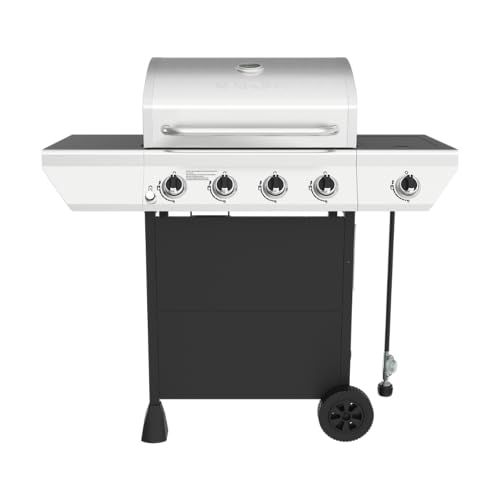
Nexgrill 4-Burner Propane Gas Grill with Side Burner
Badge: Best for Families
Strengths
- 526 sq. in. is a comfortable family-plus-guests size
- Electronic ignition and lid thermometer simplify every cook
- Cabinet base hides the tank and stores tools
Trade-offs
- Cast iron grates need seasoning and dry care
- Cabinet adds assembly time and weight
- Side burner is exposed to wind like most designs
Key specs: 4 main burners plus a side burner, 52,000 BTU; 526 sq. in. cooking space; Matte finish cast iron grates; Built-in thermometer and electronic ignition; Stainless steel lid, double-door cabinet base.
This Nexgrill sits in the productive middle of the pool: four burners, 52,000 BTU, 526 square inches of grate and a side burner, wrapped in a cabinet cart with a stainless steel lid. That combination covers the real weekly pattern for most families – weeknight chicken and vegetables, weekend burgers for a few extra guests – without the footprint of a six-burner rig. The matte finish cast iron grates hold heat well for searing, and electronic ignition removes the lighter-and-hope routine.
The built-in thermometer and double-door cabinet are small quality-of-life features that add up: you can judge preheat at a glance and keep the tank, brush and tools out of sight. The familiar cast iron caveat applies – season the grates, keep them dry, and do not leave the grill uncovered through a wet season. Buyers who do that routine maintenance get a balanced, full-featured family grill.
Best for: families who want one full-featured grill for weeknights and guests / Not suited for: buyers wanting the lightest, simplest assembly possible
Comparison Table
| Grill | Format | Cooking area / output | Grate note | Link |
|---|---|---|---|---|
| IdeaMaxx 3-Burner Propane Gas Grill with Cast Iron Grates | Cart body suited to patio and camping-base use | 3 burners, 38,200 BTU output | Foldable side shelves | Check on Amazon |
| Weber Spirit E-425 Gas Grill | Black finish, cart-style body | 4 burners, propane fuel | Porcelain-enamelled cast-iron cooking grates | Check on Amazon |
| AMERLIFE 6-Burner Propane Gas Grill with Side Burner | Regulating valve, propane fuel | 6 main burners plus a side burner, 60,000 BTU | Cast iron cooking grates | Check on Amazon |
| Char-Broil Portable 1-Burner Propane Gas Grill | Compact cooking surface for small loads | 1 burner, 11,000 BTU | Portable tabletop format | Check on Amazon |
| Nexgrill 4-Burner Propane Gas Grill, Stainless Steel Body | Double-door cabinet base | 4 main burners plus a side burner, 60,000 BTU | Stainless steel body | Check on Amazon |
| Nexgrill 4-Burner Propane Gas Grill with Side Burner | Stainless steel lid, double-door cabinet base | 4 main burners plus a side burner, 52,000 BTU | Matte finish cast iron grates | Check on Amazon |
How to Choose the Right Grill for Your Cooking
Start with the load, not the logo. Count the people you cook for in an ordinary week, then count the people you cook for at your biggest regular gathering, and buy for something between the two – closer to the ordinary week if gatherings are rare, because an oversized grill wastes fuel and patio space three hundred days a year to shine on five. As a working rule, allow roughly 75 to 100 square inches of primary grate per person for a mixed load of protein and vegetables; a family of four lands near 350 to 450 square inches, and party cooks should look at 550 square inches and above.
Burner count matters because it buys you zones, not just heat. Two burners give you hot and less-hot. Three burners give you a true two-zone fire with a safety lane in the middle. Four or more burners let you run searing, roasting and holding zones at once, which is what makes a mixed menu – steaks, chicken, vegetables, all finishing together – possible without panic. Total BTU figures only make sense divided by cooking area and read alongside grate weight: heavy cast iron over moderate output will out-sear a lightweight grate over headline output, because the grate, not the flame, is what touches the food.
Grate material is the maintenance decision you make at purchase time. Porcelain-enamelled grates, whether over steel or cast iron, clean easily and resist rust while the enamel is intact, but they need plastic or wooden tools and no wire-wheel enthusiasm. Bare cast iron sears superbly and lasts for years if it is seasoned, oiled and kept dry; neglected, it rusts faster than any other option. Stainless rod grates are the low-fuss middle path where they are offered. None of these is wrong – the wrong choice is the one whose care routine you will not actually follow.
With propane specifically, pay attention to the regulator, hose and ignition, because they are the parts you will interact with daily. Electronic ignition that lights first time changes how often a grill gets used; a temperamental lighter quietly turns a grill into furniture. Check how the tank mounts and swaps – you will change tanks in the dark, in a hurry, mid-cook, at least once – and prefer designs where that job is simple. A spare tank is not an accessory; it is the difference between a ruined dinner and a two-minute pause.
Think about fuel logistics before the grill arrives. A standard refillable propane tank, a sheltered and level spot with safe clearance from walls, fences and overhangs, and a cover that actually fits are part of the purchase, not accessories to consider later. Check how the tank is stored, whether the cabinet or cart hides it, and how the grill will move for cleaning and winter storage. Finally, measure the patio and the gate or door it must pass through. Every season, buyers discover that the perfect grill is two inches wider than the space they planned for it.
How to Set Up, Use and Maintain Your Grill
Good grilling is mostly preparation. Work through this routine and most of the problems beginners blame on their grill disappear.
- Position and level. Place the grill on a level, non-combustible surface with the clearance the manual specifies from structures and overhangs. Propane grills must sit outdoors or in genuinely open air – never in a garage or enclosed porch – with the tank upright, the hose untrapped, and the valve easy to reach in a hurry.
- Leak-check the fuel connection. With a new tank or after any reconnection, brush soapy water over the hose and regulator connections, open the tank valve, and watch for bubbles. Bubbles mean gas is escaping: close the valve and fix the connection before lighting anything.
- Preheat properly. Light the burners, close the lid, and preheat for ten to fifteen minutes. The grate must be hot before food touches it; food on a half-heated grate sticks, steams and tears.
- Clean and oil the grate. Brush the hot grate clean, then wipe it with a folded paper towel lightly coated in a high-heat oil, held in tongs. This seasons the surface and is the simplest anti-stick measure there is.
- Cook in zones. Keep one zone hot for searing and one zone cooler for finishing. Move food between zones instead of fighting flare-ups with a spray bottle, and rest cooked meat on the warming area or a tray while the rest finishes.
- Rest and shut down. Rest meat for several minutes before slicing. Then run the burners on high for a few minutes to burn off residue, brush the grate, close the tank valve first and then the burner knobs, and cover the grill once it is cool.
Maintenance is short but non-negotiable. Empty the grease tray regularly – most grill fires are grease fires that were scheduled by neglect. Inspect burner ports each season and clear blockages with a soft brush or a straightened paper clip, never a drill. Check the hose for cracks and the regulator connection for wear. Cast iron grates want a thin coat of oil after cleaning; porcelain enamel wants non-metal tools. A fitted cover, used consistently, doubles the cosmetic life of almost any grill.
Troubleshooting: three common problems
Problem: food sticks and tears when you turn it → what to do: the grate was not fully preheated or the food was moved too early. Preheat longer, oil the grate, and wait until the food releases on its own; properly seared food lets go of the grate when it is ready.
Problem: constant flare-ups and blackened edges → what to do: fat is dripping onto open flame faster than it can burn off. Trim excess fat, move the food to the cooler zone, and cook fatty cuts with indirect heat after the initial sear. Check that the grease tray is not full.
Problem: one side cooks much faster than the other → what to do: check for a clogged burner, a spider web in the venturi tube, or a low tank confusing the picture. Clean the ports, swap in a known-full tank, and rotate food between zones while you diagnose rather than serving half-raw, half-burnt results.
Propane Grill Anatomy: What Actually Differs Between Models
Strip the marketing away and propane grills differ in five places. The firebox: heavier, better-sealed boxes hold steadier temperatures and use less fuel. The burners: stainless tube burners are the workhorse standard, and their port pattern decides how even the heat is. The heat tents or flavour bars above the burners: they vaporise drippings, protect ports from grease and are a wear item you will eventually replace. The grates, covered in the buying guide above. And the cart: shelves, cabinets, wheels and tank access, which decide whether the grill is pleasant to live with.
Understanding that anatomy makes comparison shopping calmer. Two grills with identical burner counts and output can cook very differently because one has heavy grates and a tight lid while the other has thin grates and a leaky one. It also explains the honest shape of this shortlist: the picks differ less in headline numbers than in where each design spent its effort – searing hardware on the Weber, sheer area on the AMERLIFE and the large Nexgrill, portability on the Char-Broil, balance on the IdeaMaxx and the family Nexgrill. Readers curious about alternative formats, including vertical cabinet styles, can explore Best Outdoor Vertical Propane Gas Bbq Grills and Best Outdoor Vertical Propane Gas Bbq Grills Smokers as a separate branch of the propane family.
Getting the Most from Propane: Heat Management in Practice
Propane’s gift is repeatability, and repeatability rewards a routine. Learn your grill’s zones with a simple test: lay slices of plain white bread across the preheated grate for a minute and read the toast pattern like a map – dark corners, pale centre, fierce stripe over one burner. Every grill has this map; good cooks know theirs and place food accordingly, putting thick chicken over the gentle area and steaks over the fierce one, instead of blaming the hardware.
Two habits separate confident propane cooking from hopeful propane cooking. The first is cooking to temperature, not to time: an instant-read thermometer removes the guesswork that dries out chicken and undercooks thick burgers. The second is respecting the cool zone. Always keep one area of grate at low or off heat as a refuge – for food that is done early, for flare-up escapes, for resting. Do that, and propane’s other talents open up, including gentle jobs some owners never try, such as the baking-style cooks explored in Best Outdoor Gas Grills For Baking. Commercial-scale buyers, finally, are a different audience with different duty cycles; the considerations in Best Outdoor Gas Grills Commercial mark where household grills like these six stop being the right tool.
Two-Zone Cooking: the Skill That Unlocks a Propane Grill
Every recipe problem on a propane grill – burnt outsides and raw middles, flare-ups, dried chicken beside perfect burgers – is solved or prevented by two-zone cooking, and propane makes it easier than any other fuel because each burner is an independent dial. The setup is simple: one side of the grill runs hot for searing, the other side runs low or off as a finishing and holding zone. Sear over the fierce heat, then move food to the gentle side, lid down, to cook through in what is effectively a small oven. Thick cuts, bone-in chicken and anything with a sugary sauce should live most of their cook on the gentle side.
Three drills teach the skill fast. First, the bread test from the heat-management section: map your grill’s hot and cool areas so you place food by knowledge, not hope. Second, cook a batch of chicken thighs entirely by the sear-and-slide method – two minutes a side over high heat, then finish indirect to temperature – and notice how much calmer the cook feels than an all-direct scramble. Third, practise the refuge habit: whatever you are cooking, the cool zone stays empty until something needs rescuing, and something always does.
Once two-zone cooking is automatic, the differences between the picks in this guide become clearer, because zones are what burner counts buy. A three-burner grill gives you a hot lane, a gentle lane and a buffer; a six-burner gives you a whole map. That is also why this guide weights layout over headline output in every review: output you cannot arrange is just weather, while output arranged into zones is cooking.
One last propane habit is worth adopting before the first cook: keep a simple log for the first month. Note what you cooked, which burners you ran and where the food sat. It sounds excessive, and it takes twenty seconds, but a month of those notes teaches you your specific grill – its true preheat time, its fierce corner, its gentle lane – faster than a season of guessing. After the month, the log has done its job and your hands know the machine. That knowledge, more than any single feature compared in this guide, is what separates owners who love their propane grill from owners who merely own one, and it costs nothing but a pencil kept with the tongs.
Setting Up the Cooking Station Around Your Grill
A grill cooks the food, but the station around it decides how calm the cooking feels. Set up four things before the first cook and every session afterwards runs better. First, a heatproof landing surface within one step of the grill for the tray of raw food, and a second, separate surface for cooked food – the separation is a food-safety rule as much as a convenience. Second, a small kit that lives at the grill permanently: long tongs, a wide spatula, an instant-read thermometer, a brush, a bottle of high-heat oil and paper towels. If the kit lives indoors, half of it will be indoors when you need it.
Third, light. Evening cooking on a dim patio is how properly grilled food gets misjudged; a simple task light aimed at the grate, or a grill light on the handle, pays for itself in one season of weeknight dinners. Fourth, fuel discipline: mark the date on a fresh tank, keep the spare where you can reach it in the dark, and never store spare tanks indoors or in direct sun. On a propane cart, that station discipline is what turns a good grill into the appliance your household reaches for three nights a week.
Finally, give the station a five-minute reset ritual after each cook: burn off and brush the grate while it is hot, let the grill cool, empty nothing, store nothing – just cover it once cool and put the kit back in its place. The reset is what makes the next cook start at zero effort, and it is the cheapest performance upgrade any grill in this guide can receive.
Safety and Fuel Handling: the Non-Negotiables
Gas grilling is safe cooking when a short list of rules is treated as non-negotiable, and every pick in this guide assumes an owner who follows them. Keep the grill outdoors in open air, on a level and non-combustible surface, at the clearance from walls, fences, eaves and stored materials that the manual specifies. Never grill in a garage, a screened porch or under a low enclosed cover, however inviting the weather makes it look, because carbon monoxide and heat build-up do not announce themselves. Keep children and pets outside the cooking zone while the grill is hot and while it cools, which takes longer than most people expect.
Fuel handling deserves the same seriousness. Transport and store propane tanks upright, valve closed, outdoors and away from heat sources and ignition; never store a spare tank inside the house or in a hot vehicle. Connect and disconnect tanks with the valve fully closed, and run the soapy-water leak check after every reconnection, not just the first one – a connection that was tight in spring can weep by autumn. If you ever smell gas with the burners off, close the tank valve, move away from the grill, and do not light anything until the source is found and fixed.
Fire discipline at the grate is mostly grease discipline. Most grill fires start in a neglected grease tray or a firebox lined with old drippings, which is why this guide repeats the emptying and cleaning routine until it sounds tedious – tedious is the point. Keep a clear path to the tank valve so you can kill the fuel supply in seconds, know that the correct first response to a flare that will not settle is burners off, lid closed and fuel off, and never carry a hot grill or move it mid-cook. Propane’s convenience makes these habits easy to keep precisely because the fuel is so controllable: one valve, clearly off or clearly on, with no embers to manage afterwards. Owners who internalise these habits find that safety stops being a section in a guide and becomes simply how the grill is used, every time, without discussion.
Common Buying Mistakes
- Buying for the biggest party of the year. A grill sized for a once-a-year crowd sits mostly empty, heats slowly and eats patio space every other day. Size for your real pattern and borrow or batch-cook for the exception.
- Reading BTU as a quality score. Output without grate weight, lid seal and burner layout tells you almost nothing. A moderate-output grill with heavy grates will out-cook a high-output grill with thin ones.
- Ignoring grate care at purchase time. Cast iron rewards cooks who season and cover it and punishes everyone else. Choose the material whose routine you will genuinely keep.
- Forgetting the space around the grill. Side shelves, open lids and working room for the cook all need clearance. Measure the whole working footprint, not just the cart.
- Skipping the cover and the spare tank. A fitted cover and a backup propane tank are the two cheapest upgrades to grill ownership; running out of gas mid-cook, or watching a finish rust, costs more in frustration than both together.
- Chasing features over layout. A side burner you use weekly is worth more than a novelty feature you use twice. Rank features by your actual menu, not by the length of the list.
Final Recommendation
Start with IdeaMaxx 3-Burner Propane Gas Grill with Cast Iron Grates for the best balance of searing power, footprint and everyday usability, or step up to Weber Spirit E-425 Gas Grill if thick steaks are your signature and you want a dedicated sear zone doing that work. Party hosts should go straight to the AMERLIFE six-burner, families to the cabinet Nexgrill, and campers should add the Char-Broil portable as a second grill rather than forcing one grill to do two jobs.
Whichever pick you choose, budget the routine with it: a fitted cover, a spare tank, a good brush and an instant-read thermometer. Propane grills reward owners who keep those basics in place with years of push-button, weeknight-easy cooking – which is, after all, the entire point of the fuel.
Frequently Asked Questions
How many burners do I actually need?
Three is the sweet spot for most households: enough for a true two-zone fire with a safety lane. Four adds flexibility for mixed menus, five and six serve party-size loads, and one or two burners suit portables and very small households. Buy zones for your menu, not burners for their own sake.
Is a side burner worth it on a propane grill?
If your menu includes sauces, side dishes, beans or corn, yes – it keeps the whole meal outside and frees grate space. If you only ever grill protein and vegetables, the money and space are better spent on grate area or grate material.
How long does a propane tank last?
It depends on burner count and how hot you cook, but a standard tank typically carries a household through many weeks of regular grilling. The practical answer is to keep a spare: swapping tanks mid-cook takes two minutes, while running out without one ends the meal.
Why does food stick to my propane grill?
Almost always a cold or dirty grate, or food moved too early. Preheat a full ten to fifteen minutes with the lid down, brush and oil the grate, and let food release naturally – properly seared food lets go when it is ready to turn.
Can I convert a propane grill to natural gas?
Some models offer manufacturer conversion kits, many do not, and conversions should only ever use the kit made for that exact model. If a plumbed gas line is your plan, shop specifically for natural-gas-ready models rather than assuming a propane grill will convert.
What maintenance does a propane grill need each season?
Clear burner ports, empty and wash the grease tray, inspect the hose and regulator, clean the heat tents, oil cast iron grates, and store the grill covered with the tank valve closed. An hour a season prevents most performance complaints.


