Baking is the least forgiving thing an oven does. A roast tolerates a hot corner and a casserole shrugs off a cool one, but a tray of cookies records every flaw in an oven’s heat pattern in permanent, edible form: pale on the left, scorched on the right, risen in the middle and sulking at the edges. That is why this guide ranks ovens on baking behavior alone. Capacity, styling, and burner bragging rights all take a back seat to the questions that decide whether your baking comes out even — how the heat is generated, how it moves, how steady it stays across a long bake, and how honestly the cavity handles two trays at once.
The six picks below mix slide-in ranges and wall ovens, because bakers are not all shopping for the same hole in the kitchen. Some links in this article are affiliate links, which means we may earn an affiliate commission if you buy through them, at no extra cost to you. That commission never decides the ranking. What decides it is the convection system, the temperature discipline described in the manufacturer’s own documentation, the rack hardware, and the modes that matter to people who bake bread, layer cakes, and sheet-pan dinners week after week.
In this guide
Quick picks: best ovens for baking
| # | Product | Where to buy |
|---|---|---|
| 1 | Samsung NE63A6511SS | Check on Amazon |
| 2 | GE Profile Double Oven Range | Check on Amazon |
| 3 | KitchenAid KOES530PPS | Check on Amazon |
| 4 | Samsung Flex Duo Range | Check on Amazon |
| 5 | Frigidaire Gallery Wall Oven | Check on Amazon |
The six picks at a glance
If you read nothing else, read this. The Samsung freestanding range is the all-rounder: a 6.3 cubic foot cavity with no-preheat air fry and convection, the biggest single box on this list. The GE Profile gas double-oven range is the two-temperature answer for households that bake a main and a side at once. The KitchenAid single wall oven is the one-cavity pick, a full 5 cubic feet of Even-Heat convection at working height. The Samsung Flex Duo is the shape-shifter, a single cavity that divides into two zones when the divider goes in. The Frigidaire Gallery wall oven is the bread specialist, with a steam bake mode aimed squarely at crust. And the Café single wall oven is the precision instrument, true European convection with air directed from the top of the cavity. The rest of this guide explains what separates them and who each one suits.
How these ovens were ranked
Ranking by baking means weighting four things above everything else, in this order. First, the convection architecture: whether the oven heats the air it moves, because that single fact governs multi-tray evenness more than any other specification. Second, temperature discipline: how the cavity is built to hold a set point through a long, door-closed bake — mass, sealing, sensor placement, and preheat honesty. Third, the baking-specific toolkit: proofing warmth, steam, rack positions and hardware, and cavity dimensions measured against real pans rather than marketing totals. Fourth, everything else — controls, cleaning, connectivity, looks — which breaks ties but never outranks heat. The assessment rests on manufacturer specifications, manuals, and published engineering documentation for each model, read against the physics of baking rather than against advertising claims; where a brand promises an outcome, this guide reports the mechanism that would produce it and lets the mechanism carry the argument. That is also why no scores appear anywhere in this guide. A number would pretend to a precision that spec sheets cannot support, and bakers are better served by knowing why an oven suits their baking than by a decimal that hides the reasoning.
The best ovens for baking, pick by pick

1. Samsung NE63A6511SS freestanding range — the smart all-rounder with no-preheat air fry
Most electric ranges ask the baker to choose between a big cavity and a smart feature set. The NE63A6511SS refuses the trade: Samsung’s listing describes a 6.3 cubic foot smart freestanding electric range with no-preheat air fry and convection, in stainless steel. The headline is the capacity and the air fry together — a 6.3 cubic foot single cavity that takes a half-sheet pan with room to spare and a full-size roasting pan without argument, and an air fry mode that needs no preheating, so the oven is ready when the food is rather than ten minutes later.
The cavity is the largest single box on this list, and it earns its size in the ways that matter to a baker. Convection evens multi-tray work so the back row of a cookie sheet stops out-browning the front, the air fry mode crisps without a countertop appliance, and the smart connection lets the baker check the oven from the next room instead of hovering by the door. Preheat behavior is civilized, the fan is not intrusive, and the freestanding format drops into a standard 30-inch opening without the cutout work a slide-in demands, so the range replaces the old one rather than redesigning the kitchen around it.
Two practical details round out the baking case. The rack positions split the box evenly for two trays or hold a single tray in the true centre, and the racks themselves are stiff enough that a loaded half-sheet does not flex when it slides. And because bakers’ spills are sugary and frequent, the self-clean cycle for a season of caramelized overflow is a genuinely useful one to have, while the no-preheat air fry handles the weeknight frozen foods that never needed an oven at all. The controls stay simple rather than app-dependent, which suits a cook with flour on both hands.
Strengths
- 6.3 cubic foot single cavity — the largest on this list — fits half-sheet pans and tall pots.
- No-preheat air fry means the oven is ready when the food is.
- Convection evens multi-tray bakes from cookies to casseroles.
- Smart connectivity lets the baker check the oven without hovering by the door.
- Freestanding install drops into a standard 30-inch opening.
Trade-offs
- It is a range, so the oven sits at floor level and heavy trays come out at shin height.
- One cavity means one temperature; a two-recipe evening still needs sequencing.
- The smart features need Wi-Fi to matter; without it, it is simply a good range.
Who it suits: the everyday baker replacing a freestanding range who wants the biggest single cavity and a no-preheat air fry, without paying for a divider the household will never use.
For a range that treats the weeknight bake as seriously as the Sunday one, the Samsung is where this list begins, so check price on Amazon.
Check price on Amazon: Samsung NE63A6511SS

2. GE Profile PGS960YPFS double-oven range — two temperatures, one footprint
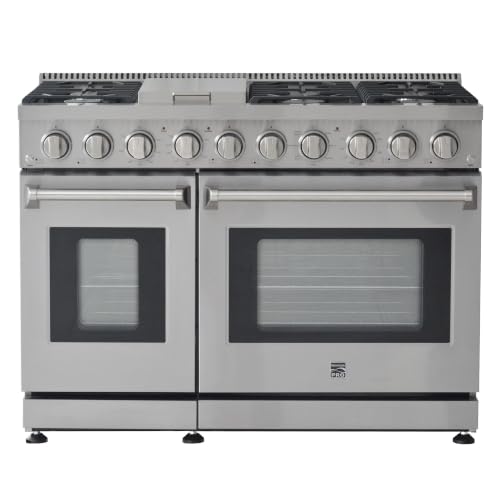
The double-oven range answers the baker’s oldest scheduling problem: the bread wants high heat, the cake wants gentle heat, and dinner wants to happen tonight. The PGS960YPFS stacks two cavities into a standard slide-in footprint, a smaller upper oven for everyday trays and a larger lower oven with GE’s True European Convection system — a fan plus a dedicated third element — for the serious work. Two recipes at two temperatures stop being a negotiation and become a timetable.
The lower cavity is the baking engine. True European Convection circulates heated air rather than merely stirring whatever the bake element produces, which is what keeps the back row of a muffin tray from out-browning the front. The upper oven runs on conventional heat, which sounds like a demotion until you remember how much of real baking — gratins, reheating, a single tray of scones on a weekday — never needed convection at all and preheats faster in a small box. Above the ovens sits a five-burner gas cooktop with an 18,000-BTU Power Boil burner and a Dual Purpose Center Burner that shifts between round and oval shapes, so the daily cooking is gas cooking — instant response, visible flame, and a centre burner that takes a griddle — while the ovens below do the baking.
Think through a real holiday with this layout and the appeal sharpens. The lower convection oven takes the large, long bake — the braided loaf, the full tray of rolls, the casserole that anchors the meal — while the upper oven handles the items that want a different climate entirely: the pie that would scorch at bread temperature, the gratin that needs a gentle finish, the second dessert timed to emerge as the first is served. Meanwhile the gas cooktop carries the sauce and the gravy without asking either oven for a favour. Neither cavity waits for the other, and neither bake is compromised into a shared middle temperature, which is the quiet failure mode of every single-oven holiday. The trade is vertical space in each box, and for bakers whose largest item is a sheet pan rather than a towering stand mixer bowl of dough, it is a trade that pays weekly.
Strengths
- Two independent cavities bake at two temperatures at the same time.
- True European Convection with a third element in the lower oven for even multi-tray results.
- Small upper oven preheats quickly and suits single-tray, everyday baking.
- Five-burner gas cooktop with an 18,000-BTU Power Boil burner and a Dual Purpose Center Burner.
- No-preheat air fry in the lower cavity adds weeknight range beyond baking.
Trade-offs
- The upper cavity is conventional only; convection bakers will live in the lower oven.
- Neither cavity alone is as tall as a big single oven, so very tall items need planning.
- The lower oven is near the floor, the ergonomic tax every double range charges.
Who it suits: households that regularly bake two things at once — holiday bakers, batch bakers, and anyone whose Sunday involves bread and a roast sharing a deadline.
When the calendar says two temperatures at six o’clock, this GE Profile is the range that simply agrees, so check price on Amazon.
Check price on Amazon: GE Profile Double Oven Range

3. KitchenAid KOES530PPS single wall oven — the one-cavity Even-Heat baker
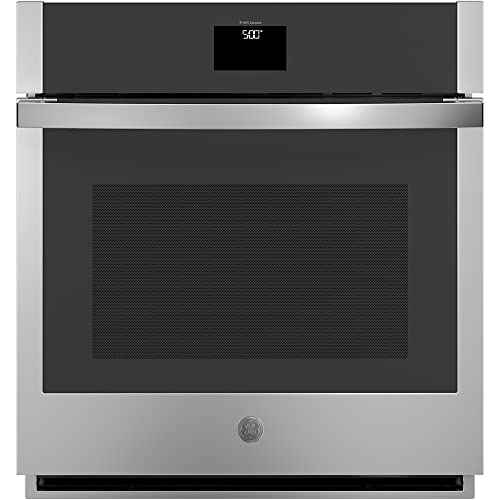
Some bakers do not need two temperatures. They need one cavity that behaves the same way every single time: a birthday cake that rises evenly, a double batch of rolls that cannot queue for a second oven, a sourdough schedule that collides with dinner. The KOES530PPS is KitchenAid’s 5 cubic foot single electric wall oven, and it carries the same Even-Heat True Convection as the double-wall models — a fan, a third heating element, and a bow-tie baffle that shapes the airflow so the back corners stop running hotter than the front. One cavity, properly engineered, beats two cavities that fight each other.
KitchenAid also sweats the least glamorous variable in baking: the preheat. The Even-Heat Preheat system is designed to bring the whole cavity — walls, racks, and air — up to temperature together, rather than announcing readiness the moment a single sensor near the element feels warm. Anyone who has slid a delicate sponge into an oven whose thermostat claimed readiness while the walls were still cool knows why that matters. Add the working height of a wall installation, where trays slide in and out at counter level and basting does not involve kneeling, and this is the pick for people whose baking output is serious but whose kitchen has room for exactly one wall oven.
The details hold up under a baker’s scrutiny. The cavity offers multiple rack positions with a gliding rack option that carries a heavy, full tray out toward you instead of asking your wrists to reach into the heat, and the interior is sized for genuine half-sheet pans rather than the almost-fits dimensions that plague lesser ovens. Because the single cavity does all the work, there is no second box to learn and no recipe that behaves differently upstairs and downstairs — the bake you dial in on Tuesday is the bake you get on Saturday. Timed bake and warm settings are present for the households that use them, and the glass-touch controls wipe clean of flour dust without crevices to excavate.
Strengths
- A full 5 cubic foot cavity with true convection, sized for half-sheet pans and big bakes.
- Bow-tie baffle and rear element shape airflow for corner-to-corner evenness.
- Preheat system heats the whole cavity, not just the air near a sensor.
- Wall height spares backs and makes heavy trays safer to move.
- A fit system guarantee eases replacement of an older 30-inch unit.
Trade-offs
- One cavity means one temperature; a two-recipe evening still needs sequencing.
- It needs a 30-inch cutout and a proper electrical supply; installation is a project, not an afternoon.
- No cooktop comes with it, so the range budget and the oven budget separate.
Who it suits: serious home bakers — the layer-cake makers, bread schedulers, and holiday producers — who want one cavity that behaves identically every bake and have room for exactly one wall oven.
For the baker whose problem is not temperature but sheer oven space in a single box, Even-Heat ends the argument, so check price on Amazon.
Check price on Amazon: KitchenAid KOES530PPS

4. Samsung NE63T8711SS Flex Duo range — one cavity, two personalities
The Flex Duo idea is a compromise engineered with unusual honesty. Most of the time a household wants one big oven; sometimes it wants two smaller ones. Samsung’s answer is a single large cavity and a removable Smart Divider that splits it into upper and lower zones with separate temperature settings. Divider out, it is a full-size oven that takes the biggest tray you own. Divider in, the top zone handles a tray of biscuits while the bottom roasts, and the smaller upper zone preheats quickly because it is heating a fraction of the space.
For bakers, the honest framing matters: this is fan convection rather than a third-element true convection system, and the two zones share one cavity’s air, so the temperature gap between zones has limits set by physics rather than by the control panel. Within those limits the flexibility is real. The upper zone is a gift for small daily bakes — a handful of rolls, a single scone batch — without heating a full-size box, and the air fry mode and wide cavity keep the range useful on the five days a week nobody is baking. It is the pragmatist’s pick: not the purest baking instrument here, but the one that adapts to the most kinds of evenings.
There is also a subtle energy argument a baker will recognize. Heating a full-size cavity to bake six rolls is wasteful in time as much as power: the big box takes longer to preheat and longer to recover after the door opens. With the divider in, the upper zone is a small oven that comes to temperature quickly and holds it through a short bake, which makes spontaneous small-batch baking — the Tuesday scones, the single tray of granola — far more likely to actually happen. Kitchens run on friction, and this design removes it for exactly the bakes that usually get skipped. The full cavity remains one divider-pull away for the weekend, which is the entire proposition: small oven on weekdays, big oven on demand, no second appliance to store or power.
Strengths
- Removable divider converts one big cavity into two temperature zones.
- Small upper zone preheats fast and suits little everyday bakes.
- Full cavity with the divider out fits the largest trays and pans.
- Air fry mode and a capable cooktop keep it versatile beyond baking.
- Smart controls allow preheating on the way home from the store.
Trade-offs
- Fan convection without a third element is a step below true convection for delicate multi-tray work.
- The two zones cannot hold extreme temperature differences; the gap has a ceiling.
- The divider needs storage space and a moment of handling when hot.
Who it suits: smaller households and flexible cooks who bake often but in modest quantities, and who would use a second oven weekly rather than daily.
If your baking changes size from day to day and your kitchen has room for exactly one oven, the Flex Duo bends without breaking, so check price on Amazon.
Check price on Amazon: Samsung Flex Duo Range

5. Frigidaire Gallery GCWS3067AF wall oven — the bread baker’s steam
Ask bread bakers what home ovens lack and the answer is steam. A burst of moisture in the first minutes of the bake keeps a crust supple long enough for the loaf to expand, then lets it set into the deep, shattering shell that separates bakery bread from home attempts. Most home bakers fake it with a Dutch oven or a pan of boiling water. The GCWS3067AF builds it in: its Total Convection system includes a dedicated Steam Bake mode that introduces moisture into the cavity during the bake, alongside convection bake, air fry, and a no-preheat mode for the impatient.
Total Convection is Frigidaire’s name for the full toolkit — fan, third element, and a set of modes tuned around them — and in a single wall oven cavity it makes this the most bread-focused appliance on the list. The cavity is roomy enough for a full-size baking stone or steel with clearance around it, the racks are arranged for the low-and-center placement loaves prefer, and the wall height means a heavy, steam-filled Dutch oven comes out toward your body at counter level rather than up from the floor. Pastry and cakes get the same even, fan-driven heat as the other true convection picks; bread gets the one feature none of them can imitate.
A word on how the steam cycle actually serves a loaf, because the mechanism matters more than the badge. In the first ten minutes in the oven, a dough’s surface decides its fate: stay moist and it stretches as the interior expands, giving the loaf its full rise and those dramatic ears on a scored top; dry out early and the crust sets into a shell that caps the expansion and tears wherever it pleases. Moisture in the cavity keeps that surface supple through the critical window, then the steam clears and the same dry heat that crisps a roast takes over to finish the crust deep and dark. Doing this with a mode instead of a cast-iron pot also frees the loaf’s shape — batards, boules, and full trays of rolls all get steam, not just the rounds that fit inside a Dutch oven.
Strengths
- Steam Bake mode adds cavity moisture for better oven spring and crust.
- Total Convection combines a fan and third element for even multi-tray baking.
- Air fry and no-preheat modes broaden the weeknight repertoire.
- Roomy single cavity fits a full-size stone or steel with working clearance.
- Wall installation keeps heavy, hot vessels at a safer handling height.
Trade-offs
- Steam comes from water added inside the cavity, not a plumbed line, so refills are manual.
- A single cavity still means one temperature at a time.
- The mode list is long, and the steam features reward reading the manual once.
Who it suits: bread-first bakers — sourdough schedules, baguette ambitions, pizza nights — who want steam without the Dutch-oven workaround, plus full convection for everything else.
For loaves that rise like they mean it and crusts that crackle on the cooling rack, the Frigidaire’s steam makes its case, so check price on Amazon.
Check price on Amazon: Frigidaire Gallery Wall Oven
6. Café CTS90DP2NS1 single wall oven — the precision instrument
Café is GE’s design-forward line, and this 30-inch single wall oven is built around a convection arrangement with a specific claim: True European Convection with Direct Air, in which the fan sits at the top of the cavity and heated air is directed down and around the food rather than pushed from the back wall. The practical promise is top-to-bottom evenness — the top tray and the bottom tray living in the same climate — which is precisely the promise a baker baking on two levels needs kept.
Around that system sits the most polished control experience on this list: a full-color touch display, Wi-Fi connection for remote preheat and monitoring, and Precision Cooking modes that walk a dish through a guided sequence instead of leaving every variable to memory. None of that bakes a cake by itself, and this guide does not pretend otherwise. What it does is reduce the two unforced errors that ruin more bakes than any hot spot — the wrong mode selected and the preheat abandoned halfway. For a design-led kitchen it also happens to be the best-looking appliance here, with handle and finish choices the other brands do not match. The cavity is a full-size single box, the racks glide properly, and the whole oven feels built for people who notice details.
Visibility deserves its paragraph, because more bakes are ruined by the door than by the thermostat. Every peek through an opened door dumps a measurable share of the cavity’s heat and resets the recovery clock, which is why this oven pairs a large window with bright interior lighting positioned to actually illuminate the back rack rather than the door glass. Watching a sponge rise or a crust color through the glass, with the cavity sealed, is not a luxury feature; it is temperature discipline. The same thinking shows in the temperature probe for roasts and the soft-close door, small engineering courtesies that keep a careful baker’s environment undisturbed. None of it substitutes for an even convection system, but all of it protects the evenness the system creates.
Strengths
- Direct Air true convection targets top-to-bottom evenness across racks.
- Guided precision modes reduce setup errors on complex bakes.
- Full-color display and connected controls are the clearest here.
- Premium finishes and handle choices suit design-led kitchens.
- Full-size single cavity with smooth-gliding rack hardware.
Trade-offs
- It sits in the premium tier of this list, priced by words rather than numbers: expect to pay for polish.
- A single cavity, so no simultaneous second temperature.
- Some connected features lean on the app more than traditionalists will love.
Who it suits: the detail-driven baker renovating once and doing it properly, who values guided precision and top-rack evenness and wants the appliance to look as considered as it cooks.
When the brief is precision with polish and two racks that finally agree with each other, the Café earns its premium, so check price on Amazon.
What to look for in an oven for baking
True convection vs standard convection
The word convection covers two different machines. Standard (or fan) convection adds a fan that stirs the air an ordinary bake element produces; it helps, mostly by sanding down the worst hot spots. True convection — called European convection by several brands — adds a third heating element around the fan itself, so the air being circulated is heated before it ever touches food. The difference shows up exactly where bakers feel it: on the second tray. With fan-only convection, the lower tray still sits in the radiant shadow of the element below it. With a third element, both trays live in moving, heated air, and rotation mid-bake becomes a preference instead of a rescue. If you regularly bake on two racks, treat true convection as the entry requirement, not the upgrade.
Baking modes, decoded
Mode names multiply faster than the physics underneath them, so here is the short translation a baker needs. Bake is the classic still-air mode: elements heat, air stratifies, and the recipe’s traditional instructions apply unchanged. Convection bake adds the fan — and in true convection models, the third element — and generally wants the temperature reduced a notch from a conventional recipe and the time watched a little earlier, because moving air delivers heat faster. It is the default for multi-tray work and for anything that browns. Convection roast runs the same machinery hotter and more aggressively for savory work; cakes have no business there. Air fry is convection bake at high fan speed in a shallow basket — excellent for wings, irrelevant for a sponge. Proof is not cooking at all, just a held warmth for dough. Steam bake adds moisture to a convection bake for the bread cases described above. And warm holds finished food at serving temperature without continuing to cook it much — useful for the first tray while the second finishes. Choosing the right mode is worth more than any single feature in this guide, because the wrong mode in a great oven bakes worse than the right mode in a modest one.
Range or wall oven: which suits a baker?
The format question is really three questions. The first is height: a wall oven loads and unloads at counter level, which matters more with every year and every heavy, sloshing tray, while a range oven asks you to lift from near the floor. The second is simultaneity: ranges with double cavities and wall double ovens both solve the two-temperature problem, but a single wall oven plus an existing range gives two cavities in two places, which some kitchens prefer. The third is the renovation reality — a range swaps into an existing gap in an afternoon, while a wall oven is cabinetry, electrical work, and a longer commitment. Choose the range when the kitchen layout is settled and the budget should go into the appliance itself; choose the wall oven when you are building the kitchen around the way you cook.
Side-by-side comparison
The table below compresses the six picks into the qualities this guide ranked. It is deliberately qualitative — no invented scores, just the character of each oven as its specification describes it.
| Pick | Format | Convection system | Baking signature | Best for |
|---|---|---|---|---|
| Samsung NE63A6511SS | Freestanding range | No-preheat air fry, convection | Biggest single cavity, smart | Everyday bakers replacing a range |
| GE Profile PGS960YPFS | Double-oven gas range | True European Convection in lower oven | Two temperatures at once | Batch and holiday bakers |
| KitchenAid KOES530PPS | Single wall oven | Even-Heat True Convection, 5 cu ft | One cavity, identical every bake | High-output home bakers |
| Samsung NE63T8711SS | Freestanding range | Fan convection, divider zones | One cavity that splits in two | Flexible, smaller households |
| Frigidaire Gallery GCWS3067AF | Single wall oven | Total Convection with Steam Bake | Steam-assisted crusts | Bread-first bakers |
| Café CTS90DP2NS1 | Single wall oven | True European Convection, Direct Air | Top-to-bottom evenness, guided modes | Precision and design-led kitchens |
Getting even results from any oven on this list
Hardware sets the ceiling; habits decide how close you get to it. Four habits matter most. First, preheat fully and then wait a little longer — the indicator reports air temperature, while the walls and racks lag behind, and a tray that enters a half-soaked cavity starts its bake in a cooler room than the dial promises. Second, give pans their air: a tray wedged against the back wall or a stone that spans the full rack width blocks the circulation you paid for, and an inch of clearance on every side is the cheapest upgrade in baking. Third, know that pan material is part of the recipe — dark pans absorb more heat and brown bottoms faster, glass holds heat and keeps cooking after removal, and pale aluminum is the neutral referee most recipes silently assume. Fourth, rotate with intention in conventional and fan-only modes, and resist rotating in true convection, where opening the door costs more evenness than the swap would gain. None of this requires talent. It requires treating the oven as an environment to be managed rather than a box to be trusted, and it lifts the results from every pick here, from the pragmatist’s Samsung to the precision Café.
Frequently asked questions
Is true convection worth it for baking, or is a fan enough?
For single trays of forgiving food, a fan is enough, and standard convection already beats a still oven. The third element earns its keep when you bake on two racks at once, bake delicate items that punish a hot corner — macarons, sponges, laminated dough — or bake often enough that mid-bake tray rotation becomes a chore you would rather delete. If your baking is a weekly tray of brownies, buy the fan. If it is a standing date with two racks of cookies, buy the element.
Can I bake two trays at once without rotating them?
In a true convection oven, yes, that is the point of the design: heated, moving air reaches both trays in similar condition, and most recipes written for convection assume no rotation. Two habits still help. Stagger the trays so one is not directly above the other, which lets air pass between them, and leave a gap around each pan rather than wedging pans against the walls. In a fan-only or conventional oven, rotating and swapping trays halfway remains the honest method, and there is no shame in it — ovens without a third element simply distribute heat less evenly, and the swap evens the ledger.
Is a gas oven bad for baking?
Not bad, but different, and on balance harder. Burning gas adds moisture to the cavity, which works against crisp crusts and dry-set finishes, and most gas ovens are conventional rather than true convection, so hot spots demand more management. Plenty of excellent bakers work in gas ovens by knowing their cavity’s habits, using a baking steel to stabilize heat, and venting steam late in a bread bake. If you are choosing fresh and baking leads the decision, electric is the simpler tool; if the house is plumbed for gas and the budget is real, a gas model with a convection fan is a workable compromise rather than a mistake.
What does a proof mode actually do, and do I need one?
A proof mode holds the oven at a low, steady warmth — the comfortable zone for yeast — with the door closed against drafts. It replaces the folk methods: the oven with the light on, the bowl near the radiator, the microwave with a cup of hot water. You need it if you bake yeasted dough often, live in a cool house, or keep a sourdough schedule that cannot wait on the weather. Occasional bakers can improvise the same environment in minutes. Frequent bread bakers tend to find, once a proof mode exists in the kitchen, that every dough quietly migrates into it.
Does pyrolytic self-cleaning damage the oven over time?
It is the harshest thing the oven ever does to itself, and the manual’s caution list reflects that: racks usually come out, the kitchen heats up, and the extreme cycle is not meant to run weekly. Run a few times a year, pyrolytic cleaning is within what the appliance is engineered for, and the alternative — chemical cleaners near food surfaces — has its own costs. The components that age quickest under repeated cycles are the door gasket and, eventually, electronic controls exposed to the heat. Steam cleaning between pyrolytic runs, and wiping sugary spills before they carbonize, stretches the interval so the big cycle stays an occasional event rather than a habit.
The last word
Every oven on this list will bake well; they differ in how they forgive. The LG forgives a crowded tray, the GE Profile forgives a crowded schedule, the KitchenAid forgives a crowded recipe list, the Samsung forgives a changing plan, the Frigidaire forgives a bread baker’s ambitions, and the Café forgives a moment’s inattention at the controls. Read your own baking honestly — how many trays, how many temperatures, how much bread — and one of those forgivenesses will match the way your kitchen actually runs. Pick the oven whose heat behaves the way your recipes assume it does, and every tray after that is just baking, not negotiation.