Disclosure: topratedkitchenware.com is reader-supported. When you buy through links on our site, we may earn an affiliate commission from Amazon and other retailers, at no extra cost to you.
Where to buy
This roundup deliberately mixes two families of grills, because the keyword does: two electric indoor grills and four propane outdoor grills, all from the current verified pool, all linked so you can check the latest price on Amazon. That mix is the honest shape of the modern grill market. Performance indoors means smokeless operation, fast and even electric heat, plates that swap and wash easily. Performance outdoors means burner power, grate mass, area and zones. A household that grills in January in a small apartment and a household that hosts twenty on a patio are both shopping for “performing grills,” and they need opposite machines. This guide ranks each pick inside its family and then helps you decide which family is yours.
- Pukomc Electric Indoor Grill, 2 in 1 — check the latest price on Amazon
- Electric Indoor Grill 1500W, 2 in 1 Korean BBQ Grill Pan — check the latest price on Amazon
- Charbroil Classic 3-Burner Propane Gas Grill — check the latest price on Amazon
- Electactic Stainless Steel 4-Burner Gas Grill with Side Burner — check the latest price on Amazon
- Charbroil Performance Series 4-Burner Gas Grill Cabinet with Side Burner — check the latest price on Amazon
- Nexgrill Propane 4 Burner Gas Grill, Stainless Steel Body with Side Burner — check the latest price on Amazon
Read the full guide ↓
The search for the best performing grills used to end at the patio door. Gas grills got bigger, hotter and more elaborate, and that was the whole conversation. Then electric indoor grills grew up: higher wattage, genuinely smokeless designs, removable plates that go in the dishwasher, and tabletop formats built around social cooking styles like Korean barbecue. Now “performance” has two legitimate meanings, and confusing them leads to bad purchases in both directions — the apartment dweller who buys a patio grill they cannot use, and the suburban host who expects a countertop electric to feed a graduation party. This guide keeps the two families side by side, scores each on its own family’s terms, and spends real time on the crossover question: which one belongs in your kitchen, on your counter or on your patio.
Every specification below comes from the verified listings — wattage for the electrics, burner counts and stated BTU totals for the gas models, cooking areas where published — and where a listing is silent, the article says so. If your heart is already set on outdoor gas alone, Best Performing Gas Grills ranks that family by itself; this page is for everyone still deciding what kind of grill their life actually needs, room by room and season by season, before a single specification is compared.
Key Takeaways
- “Performing” means different things indoors and out: indoors it is smokeless control and easy cleanup; outdoors it is heat, area and zones.
- The Pukomc is the indoor performance pick — 1700W, a 2-in-1 smokeless design and a dishwasher-safe removable plate.
- The YOHAWJAN is the social tabletop pick, built for Korean BBQ with grill and griddle plates plus raclette pans.
- The Charbroil Performance Series cabinet is the best all-round outdoor performer; the big Nexgrill is the throughput champion at 626 sq in.
- Electric indoor grills cannot replicate charcoal-or-gas crust at scale; gas grills cannot come inside. Choose the family first, the model second.
- Cleanup is a performance spec: the grill you wash willingly is the grill you use weekly.
- Frequency multiplies everything: a modest grill used three times a week delivers more real performance across a year than a flagship fired twice a summer, so buy for the calendar you actually live.
In this guide
Quick Picks
| Pick | Badge | Family | Performance identity | Link |
|---|---|---|---|---|
| Pukomc Electric Indoor Grill | Best Indoor Performer | Electric, 1700W | Smokeless 2-in-1, dishwasher-safe plate | Check on Amazon |
| YOHAWJAN Electric Indoor Grill | Best for Korean BBQ Nights | Electric, 1500W | Grill + griddle plates, raclette pans | Check on Amazon |
| Charbroil Classic 3-Burner | Best Compact Outdoor | Propane, 3-burner | 360 sq in of honest everyday heat | Check on Amazon |
| Electactic Stainless 4-Burner | Best Value Outdoor | Propane, 4-burner + side | 42,000 BTU, stainless, thermometer | Check on Amazon |
| Charbroil Performance Series Cabinet | Best Overall Outdoor | Propane, 4-burner + side | Zones plus enclosed cabinet storage | Check on Amazon |
| Nexgrill 4 Burner, 60,000 BTU | Best for Big Cookouts | Propane, 4-burner + side | 626 sq in, maximum throughput | Check on Amazon |
Read the family split in the table as the first decision. The detailed reviews then rank within each family, and the crossover sections help you pick the family itself.
How These Picks Were Chosen
All six picks were verified against Amazon’s catalog data on 2026-11-20 — ASIN, manufacturer title, brand and image confirmed — and only verified ASINs carry links. Specifications are quoted only where the verified listing states them. The indoor electrics were judged on the indoor performance stack: wattage (the electric equivalent of burner output), temperature control, smokeless design, plate versatility and how completely the unit cleans up, because an indoor grill that is miserable to wash performs badly in the only arena that matters, which is Tuesday.
The outdoor gas grills were judged on the outdoor stack used across this cluster: burner count and zoning, stated output in proportion to area, grate material, cooking area and ownership hardware such as side burners, thermometers, ignition and storage. Cross-family comparisons are made carefully and qualitatively — an indoor electric’s sear is a different physical event from a gas grill’s, and this guide describes the difference honestly rather than pretending a single score can span both.
Method note: this is research-led guidance from verified listing data and category knowledge, not hands-on laboratory testing. No performance figure appears here that the listing does not support, and the two families’ limits are stated as plainly as their strengths. That honesty is what makes the final recommendation usable: each pick is the right answer for a defined household, and the guide’s job is to define them sharply.
The 6 Best Performing Grills, Indoors and Out
Pukomc Electric Indoor Grill, 2 in 1
Badge: Best Indoor Performer
Strengths
- 1700W is strong output for the indoor class, supporting real browning rather than gentle warming.
- Smokeless design with both a grill net and a non-stick plate covers seared and delicate foods in one unit.
- Removable plate is dishwasher safe, and temperature control is built in — the two features that decide indoor usability.
Trade-offs
- Countertop scale: it cooks for a few people at a time, not a party.
- Electric heat cannot match a gas grill’s crust on thick steaks, however good the browning.
- Smokeless still means cooking aromas and some vapor — a nearby vent or open window remains wise.
Mini spec box
- Type: electric indoor grill, 2 in 1
- Power: 1700W
- Surfaces: smokeless grill net and non-stick removable cooking plate
- Controls: temperature control
- Cleanup: dishwasher-safe removable plate
- Finish: black
Indoor grilling lives or dies on three things — smoke, heat and the sink afterwards — and the Pukomc is built around all three. The smokeless design attacks the first: by managing how fat meets the hot surface, it keeps the kitchen air livable in a way old-school indoor grills never managed, which is the difference between a weeknight tool and a cupboard ornament. The 1700 watts attack the second: that is serious power for a countertop appliance, enough to brown chicken thighs, char vegetables and put color on burgers rather than steaming them grey. Temperature control lets you back off for delicate fish or cheese-topped items instead of riding a single scorching setting.
The 2-in-1 surfaces are the versatility story. The grill net gives the ridged, drained cooking that suits marinated meats and vegetables; the flat non-stick plate handles eggs at a brunch, pancakes, quesadillas and anything that would fall through or stick elsewhere. Swapping between them turns one appliance into the counter’s hardest worker. And when dinner ends, the removable plate goes into the dishwasher — the single most important performance feature in indoor grilling, because the history of this category is littered with capable grills abandoned because cleaning them was a project.
The limits are physics and scale. A countertop electric will not crust a thick ribeye like cast iron over gas, and it feeds a household, not a crowd. Within its arena — apartments, small kitchens, winter grilling, anyone whose building or lease says no to outdoor flames — it is the strongest performer in this pool.
Best for: apartment and small-kitchen cooks who want genuine indoor grilling with painless cleanup / Not suited for: large groups or thick-steak purists who need gas-level crust

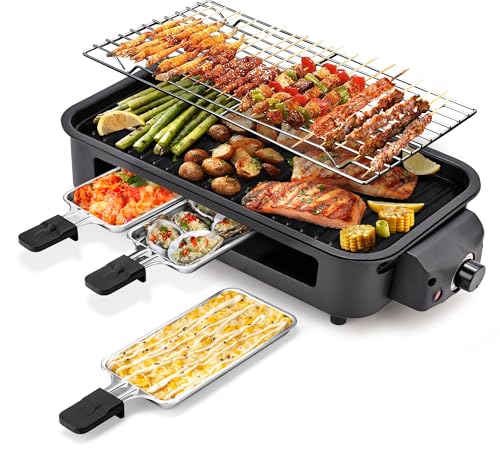
Electric Indoor Grill 1500W, 2 in 1 Korean BBQ Grill Pan (YOHAWJAN)
Badge: Best for Korean BBQ Nights
Strengths
- Purpose-built for Korean BBQ: grill and griddle plates plus three raclette cheese pans for the full tabletop ritual.
- 1500W with temperature control and a smokeless, non-stick design suited to cooking at the table.
- Removable plates and portable format make it the social, shareable pick.
Trade-offs
- Lower wattage than the Pukomc, so recovery with a fully loaded plate is gentler.
- The format is specialized: it shines for interactive meals and is less of an everyday solo grill.
- Multiple plates and pans mean more pieces to wash and store, even though they are removable.
Mini spec box
- Type: electric indoor grill, 2 in 1
- Power: 1500W
- Surfaces: non-stick removable grill plate and griddle plate
- Extras: 3 raclette cheese pans
- Controls: temperature control
- Design: smokeless, portable
Some grills are appliances; this one is an event. Korean barbecue is cooking as a shared activity — thin meats sizzling at the center of the table, everyone grilling their own bites, cheese melting in little raclette pans alongside — and the YOHAWJAN is specified for exactly that ceremony. The grill plate takes the marinated meats and vegetables; the griddle plate handles garlic, kimchi, mushrooms and anything that wants a flat surface; the three raclette pans melt cheese for dipping, which is the detail that turns dinner into the thing friends ask you to repeat.
Performance here is measured socially and thermally at once. The 1500 watts hold tabletop cooking temperatures across a loaded plate, the temperature control lets the host tune the sizzle, and the smokeless non-stick design keeps a dining room comfortable while raw ingredients cook a foot from the guests. Portability matters too: this is a grill that travels to a friend’s house or out to a screened porch, which no patio gas grill in this roundup can claim.
As a daily solo grill it is less ideal — the multi-plate setup is more ceremony than a Tuesday chicken breast needs, and its wattage trails the Pukomc’s. But judged on its own brief, interactive performance, it has no rival in the pool. If your grilling ambitions run social and indoors, this is your pick; if they run smoky and outdoors, keep reading. Households that entertain both ways often end up owning one from each family, and Best Performing Gas Grills shows the outdoor-only ranking in full.
Best for: hosts who love interactive Korean BBQ and tabletop cooking with friends / Not suited for: solo weeknight cooks who want the simplest possible indoor grill

Charbroil Classic 3-Burner Propane Gas Grill
Badge: Best Compact Outdoor
Strengths
- 30,000 BTU matched to 360 sq in gives even, honest heat across a family-size grate.
- Porcelain-coated grates clean easily and suit beginners and busy cooks.
- Compact body with side shelves fits real patios, not just showroom ones.
Trade-offs
- No side burner, and party loads need batching.
- Porcelain-coated grates store less heat than cast iron for hard searing.
- Three zones is a workable map, but a simple one.
Mini spec box
- Burners: 3 main
- Total output: 30,000 BTU (manufacturer stated)
- Cooking area: 360 sq in
- Grates: porcelain-coated
- Extras: side shelves; compact format
The Classic is the outdoor family’s entry point, and it performs the way a first gas grill should: predictably. Its output and area are in proportion, so the grate heats evenly without a ferocious center or cold edges; three burners draw the classic map of hot, medium and holding zones; and the porcelain-coated grates forgive the learning curve — food releases, cleanup is a brush and a wipe, and marinades do not become a rust project. For a household moving up from a kettle or a borrowed grill, that predictability is performance.
It also respects the patio. The compact footprint and side shelves give you landing space without swallowing the deck, and the format heats fast, which quietly encourages weeknight use — the grill that is ready in minutes gets used; the one that needs a ceremony does not. Burgers, chicken, sausages, vegetables and fish all cook here without drama, and for four to six servings at a time, drama-free is the whole brief.
Its ceiling shows at parties and at steak night: batching for crowds, and a good-but-not-great crust compared with the cast iron picks elsewhere in this cluster. Both are fair trades at its position. As the compact outdoor performer in a mixed roundup, it is the bridge between the countertop electrics and the big patio machines — and for many households, the bridge is the destination.
Best for: first-time gas grill buyers and small families who want predictable, compact outdoor performance / Not suited for: party hosts or cast-iron sear seekers

Electactic Stainless Steel 4-Burner Gas Grill with Side Burner
Badge: Best Value Outdoor
Strengths
- Four burners at 42,000 BTU plus a side burner — the complete zoning toolkit at a value position.
- Stainless steel body with built-in thermometer supports tidy, controlled outdoor cooking.
- Side burner keeps sauces and sides outside, protecting the main grate’s zones.
Trade-offs
- Cooking area and grate material are not stated in the verified listing — confirm on the manufacturer page.
- Stainless needs wiping to stay presentable outdoors.
- Value-brand parts support is thinner than the legacy brands’ over many years.
Mini spec box
- Burners: 4 main + side burner
- Total output: 42,000 BTU (manufacturer stated)
- Body: stainless steel
- Extras: built-in thermometer
- Fuel: propane gas
The Electactic is the value route into full-size outdoor performance. Four burners redraw the map the Classic sketches: now you can sear on two, roast on one, hold on the fourth, and still park a sauce on the side burner. The 42,000 BTU total is healthy for the format, the thermometer makes lid-down roasting a controlled process instead of a hopeful one, and the stainless body keeps the whole operation looking like deliberate equipment on the patio.
Performance per dollar is the argument, and it is a strong one for families whose menus have outgrown a three-burner but whose budget balks at premium badges. Whole chickens, mixed grills, tray-loads of vegetables — the Electactic’s zone count handles the choreography that makes those meals calm. In a mixed indoor-outdoor roundup it also marks the point where outdoor performance decisively separates from countertop scale: no indoor electric here can hold this much food at this many temperatures at once.
The homework before buying is the unstated cooking area and grate material — check the manufacturer page so the spec sheet in your head is complete. And the long-view caveat about value-brand parts applies. Neither dents the central verdict: complete outdoor hardware, honestly priced as a tier, performing where it counts.
Best for: growing families who need four zones and a side burner without a premium ticket / Not suited for: shoppers who want every spec published in the listing

Charbroil Performance Series 4-Burner Gas Grill Cabinet with Side Burner
Badge: Best Overall Outdoor
Strengths
- Four burners plus side burner: the most usable zone map in the mainstream format.
- Enclosed cabinet stores tank and tools — the workflow upgrade you feel on every cook.
- Established American grill brand with deep parts and support availability.
Trade-offs
- No BTU total or cooking area stated in the verified listing.
- Heavier cabinet format is a settle-in-place grill, not a mover.
- No dedicated sear burner; searing relies on preheat and zoning.
Mini spec box
- Burners: 4 main + side burner
- Body: cabinet style, black finish
- Model reference: 463253925
- Fuel: propane gas
If the roundup had to keep one outdoor grill, this is the survivor. The Performance Series combines the four-burner zone map with the cabinet body that keeps the tank hidden and the tools stored, and the result is the grill with the fewest daily annoyances in the pool. Performance across a season is mostly that: no friction at setup, no ferrying tools, no zone you wish existed. Mixed menus — the real test — flow here: proteins searing, vegetables roasting, finished food holding, sauce simmering on the side burner, all at once.
It concedes the extremes gracefully. The big Nexgrill beats it on area; dedicated sear hardware elsewhere beats it on crust; the electrics beat it on January evenings. But it is never the wrong grill for a meal, and that consistency, backed by a mainstream brand’s parts pipeline, is what “best overall outdoor” means in practice. Readers who arrived via the origin question will find its heritage discussed in Best Performing American Made Gas Grills; readers who care only about the cooking can stop here: this is the balanced pick.
The paper caveats remain — no published BTU or area in the listing — and the cabinet format commits you to a spot on the patio. Choose the spot well and the grill will repay you every week.
Best for: households wanting one do-everything outdoor grill with storage / Not suited for: frequent movers or sear-zone specialists

Nexgrill Propane 4 Burner Gas Grill, Stainless Steel Body with Side Burner
Badge: Best for Big Cookouts
Strengths
- 626 sq in — the largest stated cooking area here — cooks party loads in one wave.
- 60,000 BTU stated total keeps recovery strong when the grate is fully loaded.
- Electronic ignition, thermometer and double-door cabinet complete the host’s toolkit.
Trade-offs
- More grill than weeknight-for-two needs; preheat and fuel follow size.
- Stainless finish wants regular wiping.
- Grate material not stated in the verified listing.
Mini spec box
- Burners: 4 main + side burner
- Total output: 60,000 BTU (manufacturer stated)
- Cooking space: 626 sq in
- Ignition: electronic
- Extras: built-in thermometer, double-door cabinet, stainless steel body
Every roundup needs its heavy artillery, and the big Nexgrill is this one’s. The 626 square inches change what a cookout is: instead of waves and warming trays, everything cooks together, spaced properly, browning instead of steaming. The 60,000 BTU total is proportionate to the box, so the grate recovers between batches and holds temperature with the lid cycling for twenty guests. Electronic ignition, a thermometer and a double-door cabinet keep the big format manageable rather than theatrical.
Set against the indoor electrics, it is the opposite philosophy of performance: not convenience in a small footprint, but capacity as a feature in itself. Set against its outdoor siblings, it is the pick for the household whose grill is a social center — the one that hosts the team, the extended family, the neighborhood. If that is your summer, nothing else in this pool does the job.
Buy it with clear eyes about the quiet days: it is a lot of steel to heat for two burgers, and stainless asks for a cloth. Hosts will not care. Everyone else should take the hint and size down to the Char-Broil cabinet or Classic, which is not a demotion — it is the same performance logic applied to a different calendar.
Best for: hosts who cook for crowds and want one-wave capacity / Not suited for: small households, small patios, or indoor-only cooks
Comparison Table
| Pick | Family | Power | Area / format | Standout | Link |
|---|---|---|---|---|---|
| Pukomc Electric Indoor | Electric indoor | 1700W | Countertop, 2-in-1 plates | Dishwasher-safe removable plate | Check on Amazon |
| YOHAWJAN Electric Indoor | Electric indoor | 1500W | Tabletop Korean BBQ | Grill + griddle + raclette pans | Check on Amazon |
| Charbroil Classic 3-Burner | Propane outdoor | 30,000 BTU | 360 sq in | Compact, porcelain-coated grates | Check on Amazon |
| Electactic 4-Burner | Propane outdoor | 42,000 BTU | Not stated in listing | Stainless, side burner, thermometer | Check on Amazon |
| Charbroil Performance Cabinet | Propane outdoor | Not stated in listing | Not stated in listing | Cabinet storage, 4 burners + side | Check on Amazon |
| Nexgrill 4 Burner Stainless | Propane outdoor | 60,000 BTU | 626 sq in | Largest area, double-door cabinet | Check on Amazon |
Wattage and BTU are not interchangeable currencies — the table separates the families precisely so you compare within each before comparing across.
How to Choose Between Indoor Electric and Outdoor Gas
Decide the family with four questions. Where will you grill? If the honest answer is a small kitchen, a balcony with restrictions, or anywhere a lease or building rule forbids open flame, the decision is already made — take an electric and enjoy it fully rather than mourning a patio grill you cannot use. When will you grill? Year-round, weather-independent cooking favors indoor; fair-weather social cooking favors outdoor. How many mouths? Indoor electrics serve a household; parties belong to gas, with the Nexgrill at the top of the capacity ladder. What do you cook? Delicate, saucy, social and breakfast-style foods love plates and griddles; thick steaks, whole chickens and smoke-kissed anything belong over burners.
Within the family, the choices sharpen. Indoors: wattage for browning power, removable dishwasher-safe parts for sanity, and format — the Pukomc’s versatile 2-in-1 for everyday cooking, the YOHAWJAN’s Korean BBQ ceremony for social hosts. Outdoors: zones first (burner count), then area matched to your real headcount, then grate material and the ownership hardware — side burner, thermometer, cabinet — that you will touch weekly. Many households end up owning one of each family across a few years, and that is not indecision; it is the two tools covering two genuinely different jobs. If a plumbed outdoor setup enters the picture later, Best Natural Gas Barbecue Grills maps that branch of the family tree.
One last filter before you buy: storage and footprint honesty. Measure the counter or patio the grill will actually occupy, including the space its lid, plates or shelves need when open and in use, not just the closed silhouette in a listing photo. Indoor units earn a permanent counter corner or a cupboard shelf sized for their plates; outdoor units earn a level, sheltered patio position with room to work in front. A grill that fits its home gets used weekly; a grill that must be dragged out of a garage or unpacked from a closet performs beautifully in theory and rarely in practice. Every pick in this roundup was chosen partly for how livable its footprint is — the folding shelves, the cabinet bases, the portable tabletop formats — because the best performing grill in any family is first of all the one that is present, ready and clean when dinner is decided.
How to Use and Care for Your Grill, Whichever Family You Chose
Indoor electric routine: preheat the plate fully before food lands — electric elements reward patience with browning — and cook in uncrowded batches so moisture escapes instead of steaming the surface. Keep liquids and marinades modest on smokeless designs, since excess fat and sauce are what overwhelm the smoke management. After cooking, let the plate cool, remove it, and wash it or load the dishwasher; wipe the base and empty any drip tray while the unit is unplugged and cool. Never immerse the powered base.
Outdoor gas routine: leak-test at setup and after every tank change, burn off residue before the first cook, preheat lid-down until the grates are heat-soaked, and cook with zones set in advance. Brush grates warm after each session, empty the grease tray before it becomes a hazard, clear burner ports a few times a season, and cover the grill between uses. Both families share one law: the grill that is clean and ready gets used, and used grills are the only ones that perform.
Problem: indoor grill smokes more than expected → what to do: trim visible fat, pat marinated food drier, lower the temperature a notch, and clean the plate and drip path — accumulated residue is the most common smoke source on a smokeless design.
Problem: electric plate browns unevenly → what to do: preheat longer, rotate food between the center and edges, and avoid overloading; a crowded plate drops surface temperature and steams instead of searing.
Problem: gas grill flames are weak across all burners → what to do: reset the regulator (close the tank valve, disconnect, reconnect, open slowly with knobs off) and check the tank level before assuming a hardware fault.
Indoor vs Outdoor Performance: Two Different Sports
It helps to say plainly what each family cannot do. An indoor electric cannot produce the deep crust of cast iron over open flame, cannot smoke food in any meaningful sense, and cannot scale past a household. An outdoor gas grill cannot come inside, cannot grill in a thunderstorm with any pleasure, and cannot match the electric’s five-minute setup-to-cleanup arc on a weeknight. Neither list is an insult; they are the physics and the formats. The performing choice is the one whose strengths overlap your life. Apartment cooks who buy the Pukomc and use it three times a week have better grilled food in their lives than patio owners whose big grill fires twice a summer — frequency is the multiplier on every other performance figure, and it belongs in the buying decision explicitly. Brand-led outdoor shoppers can continue to Best Performing Weber Gas Grills for the premium end of the gas family.
Performance When the Weather Says No
Half the year in much of the country, outdoor grilling competes with cold, wind and early darkness. Wind is the gas grill’s quiet enemy: it strips heat from the cookbox, stretches preheats and makes low-and-slow control erratic, which is why sheltered placement and lid discipline matter more in November than in June. Cold thickens the patience required for cast iron to heat-soak. The indoor electrics simply opt out of the contest — the Pukomc grills January vegetables with the same indifference as July ones, and the YOHAWJAN turns a winter evening into a Korean BBQ night without anyone braving the patio. Households in four-season climates should weigh that calendar honestly: a grill family’s annual performance is its peak multiplied by the months you will actually use it, and for many homes the two-family household — modest gas grill outside, capable electric inside — outperforms one expensive grill used half the year.
Reading Electric Grill Specs: Watts, Plates and Smoke Claims
Electric grills are sold on softer language than gas grills, so the indoor shopper needs a translation guide. Wattage is the honest core spec: it is the ceiling on how much heat the element can deliver, and it predicts both preheat speed and how the surface responds when cold food lands. In this pool the spread is 1700W against 1500W — not a chasm, but enough to feel when both plates are fully loaded, and one reason the two indoor picks have different badges rather than a winner and a loser. Treat any indoor grill that hides its wattage the way you would treat a gas grill that hides its burner count: as a question to answer on the manufacturer’s page before money moves.
Plates are the second spec family. Ridged grill plates drain fat and mark food; flat griddles cook eggs, pancakes, chopped vegetables and anything small or delicate; non-stick coatings trade a little browning aggression for release and easy washing. The decisive practical question is whether the plates remove and whether they are dishwasher safe — the Pukomc’s removable, dishwasher-safe plate is the benchmark in this pool, and the YOHAWJAN’s removable grill and griddle set follows the same philosophy with more pieces in exchange for more formats. A fixed plate that must be wiped in place is the design most likely to be abandoned by spring.
Smoke claims deserve a calm reading. “Smokeless” describes a system — typically a design that keeps fat from reaching the hottest surfaces and channels vapor — not a physical guarantee of zero visible vapor in all conditions. Fatty meats at maximum temperature will still announce themselves. The claim is meaningful as a comparison against open indoor grills of the past, and both indoor picks here carry it; just set expectations at “kitchen-friendly” rather than “invisible,” run the vent if you have one, and keep the plate clean, because yesterday’s residue is today’s smoke regardless of the badge on the box.
A Week of Grilling in Each Family: The Honest Diary
Monday: it is raining and the chicken thighs were supposed to be grilled. The indoor household moves the Pukomc to the counter, preheats while the salad is made, and eats on time with the windows barely cracked. The outdoor household either braves the patio under an umbrella — a personality trait, not a strategy — or quietly converts dinner to the oven. Score one for the counter, and note that this exact Monday happens dozens of times a year in most climates.
Wednesday: burgers for the family, homework on the table, no time for ceremony. The gas household fires the Classic or the Performance cabinet, cooks in one wave with zones, and is done, with a brush of the grates as the whole cleanup. The indoor household batches on the electric plate — entirely doable, slightly slower, with a dishwasher doing the aftermath. Both families eat well; the gas grill’s advantage is throughput, the electric’s is that nobody went outside and nothing needs covering afterwards.
Saturday: the social exam, and the families diverge by design. The outdoor hosts run the big Nexgrill as a production line and feed a yard. The indoor hosts set the YOHAWJAN in the middle of the table and let a Korean BBQ night run itself, guests grilling, cheese melting in the raclette pans, conversation doing the rest. Neither event is a lesser version of the other — they are different pleasures, which is the entire argument of this guide in diary form. Sunday then asks its own question — a whole chicken, lid down and unattended-ish, is outdoor work; a brunch of eggs, pancakes and grilled fruit is plate work — and by the end of the week the pattern is clear: performance is a calendar before it is a specification, and the right grill is the one whose strengths cover your seven days.
Accessories That Actually Change Performance (and Those That Do Not)
A short list of additions genuinely moves the needle in both families. An instant-read thermometer is the first, indoors and out: it converts doneness from folklore into a number, and it costs less than one ruined steak dinner. A heavy grill press helps indoor plates and outdoor grates alike, improving contact on burgers, sandwiches and bacon. Outdoors, a second propane tank in rotation removes the only truly embarrassing failure mode in gas grilling, and a breathable cover quietly adds seasons to every component. Indoors, spare drip trays and a silicone brush for oiling plates keep the smokeless system working as designed, since the system depends on clean fat pathways.
Just as useful is the list of things that do not change performance, however good they look in a listing photo. Decorative finishes do not cook. Extra shelves you will never fold down are patio clutter with a spec name. Gadget bundles — racks of novelty tools — mostly duplicate the two or three tools you will actually reach for: tongs, a spatula, a brush, a thermometer. Spend on the short list, store it where the grill lives, and both families in this roundup will perform closer to their ceilings. The deeper pattern is the one this whole guide keeps returning to: performance is a system of grill, cook and habits, and the accessories that matter are the ones that strengthen the cook’s half of the system.
Common Buying Mistakes
- Choosing the family by aspiration instead of address. Your lease, balcony and climate vote first; buy for the home you live in.
- Expecting indoor electric to imitate a steakhouse sear. It browns well and cooks beautifully — within electric physics.
- Ignoring cleanup design indoors. A non-removable plate is where indoor grills go to be abandoned.
- Oversizing outdoors. Party capacity you use twice a year taxes every ordinary weeknight.
- Comparing watts to BTU directly. They measure different systems; compare within families, then decide the family.
- Forgetting the side burner and thermometer outdoors. Small hardware, weekly consequences.
Final Recommendation
Decide the family first. Indoor households: take the Pukomc Electric Indoor Grill for everyday performance and dishwasher-easy cleanup, or the YOHAWJAN Korean BBQ grill if your table is a social one. Outdoor households: the Charbroil Performance Series Cabinet is the balanced default, and hosts should step up to the big Nexgrill. Compact budgets and patios are well served by the Char-Broil Classic, and value hunters by the Electactic. The best performing grill is the one matched to your rooms, your weather and your headcount — get that match right and every pick here will feel like the correct answer.
Frequently Asked Questions
Can an electric indoor grill really sear?
It can brown and mark food convincingly, especially at higher wattages like the Pukomc’s 1700W with a fully preheated plate. What it cannot do is match the crust depth of cast iron over gas flame on thick cuts. For burgers, chicken, vegetables, seafood and Korean BBQ, indoor performance is genuinely satisfying.
Are smokeless indoor grills completely smokeless?
They dramatically reduce smoke by controlling how fat contacts the hot surface, but cooking still produces aromas and some vapor. A vent hood or nearby window remains a good idea; the difference versus old indoor grills is large, just not absolute.
Which family is cheaper to run?
Running costs are modest in both: electricity for a countertop unit through a meal, or propane across many meals per tank outdoors. The bigger economic factor is purchase fit — a grill matched to your life gets used for years; a mismatched one is the expensive option regardless of fuel.
Can I use an outdoor gas grill on a balcony?
Only if your building, lease and local rules explicitly allow it — many do not, and the compact electrics in this guide exist precisely for those homes. Check the rules before buying any outdoor model for a balcony.
Do I need both an indoor and an outdoor grill?
Not need — but four-season households often find the pair covers the year better than either alone: gas for capacity and summer, electric for winter weeknights and social tabletop meals. Start with the family your address dictates; add the other when the calendar argues for it. When you do add the second, buy it for the gaps the first leaves — the rainy Mondays, the winter evenings, the party overflow — rather than duplicating the first grill’s strengths in a second box, because complementary tools get used and duplicates gather dust.
Which family is better for beginners?
Indoor electrics are the gentler start: temperature is dialed rather than managed, there is no gas to connect or leak-test, and cleanup is a removable plate. Outdoor gas asks a little more of the cook — preheats, zones, tank changes — and repays it with capacity and crust. Many confident grillers began on a countertop unit and added a patio grill later, which is a perfectly good order of operations.
Can an indoor grill handle a whole meal for guests?
Yes, in the right format. A Korean BBQ night on the YOHAWJAN is designed for guests, with everyone cooking at the table and no single batch bottleneck. A conventional indoor grill like the Pukomc serves guests best with a menu planned in waves — proteins first, vegetables holding warm — or as the second grill alongside a host’s outdoor unit.
What wattage should I look for in an indoor grill?
Higher wattage generally means faster preheats and better browning recovery with a full plate. In this pool, the Pukomc’s 1700W leads the YOHAWJAN’s 1500W, which is one reason the Pukomc takes the everyday-performance badge while the YOHAWJAN wins on social format.
Still torn between formats? The grate-material discussion in Best Natural Gas Cast Iron Grills will sharpen your outdoor priorities before you decide.


