Disclosure: topratedkitchenware.com is reader-supported. When you buy through links on our site, we may earn an affiliate commission from Amazon and other retailers, at no extra cost to you.
Where to buy
If you are shopping for the best porcelain teapots, this guide links four pots whose bodies are porcelain or ceramic — the fired-clay family that porcelain belongs to — and covers two more pots prose-only, with no link and no photo, because their bodies are cast iron and Yixing clay rather than porcelain. Start with the four linked pots if a porcelain or ceramic body is the whole point of your search, then read the full guide for the sizing, infuser, and care advice that decides whether a pretty pot is also a practical one.
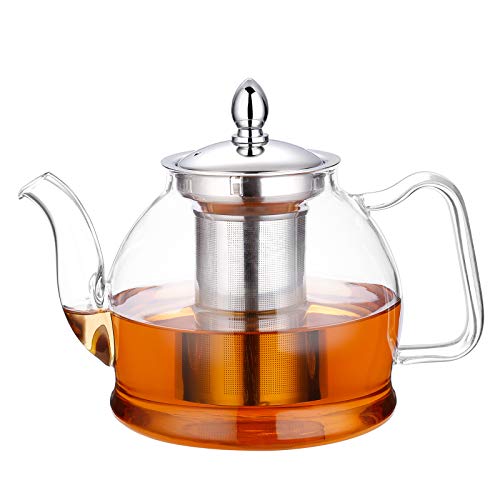
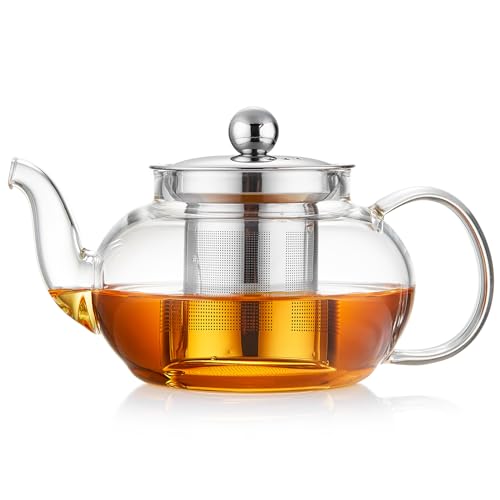
- Sweese Porcelain Teapot with Infuser, Sage Green, 27 oz — Check on Amazon
- Tea Forte Ceramic Fiore Teapot with Infuser, Stone Blue, 24 oz
- Steinzeit Design Ceramic Tea Pot with Infuser, Black, 44 oz
- chooguang Japanese Ceramic Teapot with Infuser, Blue, 25 oz
- Velaze Cast Iron Teapot Set with Trivet, 23 oz (covered prose-only below — cast iron, not porcelain)
- Yxhupot Yixing Clay Pot, Qingshuini, 10 oz (covered prose-only below — unglazed clay, not porcelain)
Read the full guide ↓
Porcelain earns its place on the tea table for reasons that go beyond looks. It is a non-reactive, glazed surface, so a porcelain pot does not hold on to the flavour of yesterday’s smoky lapsang when you brew a delicate white tea today. It rinses clean, it does not rust, it does not need seasoning, and the glaze gives makers freedom with colour and shape that metal and raw clay cannot match. When people search for the best porcelain teapots, they are usually looking for exactly that combination: a neutral brewing surface, an infuser that handles loose leaf properly, and a pot that looks at home on the table rather than hidden in a cupboard.
This guide compares six pots from one verified pool. Four are linked: a 27 oz Sweese porcelain pot in sage green, a 24 oz Tea Forte ceramic Fiore pot that is dishwasher and microwave safe, a large 44 oz Steinzeit ceramic pot in black, and a 25 oz Japanese-style ceramic pot from chooguang with a removable stainless steel filter. The other two — a Velaze cast iron set and a small Yxhupot Yixing clay pot — are covered prose-only as honest material comparisons, because both are good pots that simply are not porcelain. If your real interest is the clay side of that comparison, Best Quality Yixing Teapots covers it in depth, while this page stays with porcelain and its closest ceramic relatives.
One honesty note before the picks. Porcelain is itself a type of ceramic — the finest, most vitrified type — and listings use the words loosely. The Sweese is named porcelain in its own listing title. The Tea Forte, Steinzeit, and chooguang pots are named ceramic in theirs. We link all four because they share the glazed, non-reactive fired-clay body that porcelain buyers are actually choosing, and we label each pot with the exact word its maker uses, so you can weigh a named-porcelain pot against a named-ceramic one with your eyes open.
Key Takeaways
- The Sweese Porcelain Teapot is the only pick named porcelain in its own listing title, and its 27 oz size with an infuser is the most straightforward match for what most porcelain buyers want.
- Capacity splits this pool cleanly: the Steinzeit at 44 oz serves a table, the Sweese and chooguang sit in the everyday 25–27 oz middle, the Tea Forte is 24 oz, and the prose-only Yixing pot is a 10 oz gongfu vessel — a different ritual entirely.
- Every linked pick includes an infuser or filter for loose leaf tea, so none of them forces you into a separate strainer purchase.
- The Tea Forte is the only linked pick whose listing states dishwasher and microwave safety — a real convenience divide in a category where hand-washing is the safer default.
- Cast iron and Yixing clay, covered prose-only here, win on heat retention and ritual respectively; porcelain and ceramic win on flavour neutrality, easy cleaning, and colour.
In this guide
Quick Picks
| Pick | Badge | Capacity | Body | Link |
|---|---|---|---|---|
| Sweese Porcelain Teapot, Sage Green | Best Overall | 27 oz | Porcelain | Check on Amazon |
| Tea Forte Ceramic Fiore Teapot, Stone Blue | Best for Easy Care | 24 oz | Ceramic | Check on Amazon |
| Steinzeit Design Ceramic Tea Pot, Black | Best for a Crowd | 44 oz | Ceramic | Check on Amazon |
| chooguang Japanese Ceramic Teapot, Blue | Best Compact Design | 25 oz / 750 ml | Ceramic | Check on Amazon |
| Velaze Cast Iron Teapot Set | Best for Heat Retention (prose-only) | 23 oz / 700 ml | Cast iron | Prose-only — no link |
| Yxhupot Yixing Clay Pot, Qingshuini | Best for Gongfu Sessions (prose-only) | 10 oz / 320 ml | Yixing clay | Prose-only — no link |
The pattern in that table is the whole story of this category. The four linked pots cluster between 24 and 44 oz because porcelain and ceramic serving pots are built for pouring two to six cups at a table. The two prose-only pots sit at the extremes of purpose: the cast iron set is about keeping tea hot through a long, slow session for one or two people, and the Yixing pot is deliberately tiny because gongfu brewing uses small volumes and many infusions. Choose your ritual first and the capacity mostly chooses itself.
How These Picks Were Chosen
We built this shortlist from a verified product pool, checking every candidate against its own listing title as returned by Amazon’s product data. That title check is what decided linking. A pot earned a link only when its listing names a porcelain or ceramic body — Sweese says porcelain, Tea Forte, Steinzeit, and chooguang say ceramic. The Velaze listing names cast iron and the Yxhupot listing names Yixing clay, so both are reviewed in full but carry no link and no image here. That rule sounds strict, and it is: a porcelain guide that quietly links an iron pot would fail the reader who searched for porcelain on purpose.
Within the linked four, we compared the things a listing can actually evidence: stated capacity, whether an infuser or filter is included and whether it is removable, stated care instructions such as dishwasher or microwave safety, lid material where named, and colour and form. We did not invent specifications the listings do not state — where a title is silent on a detail, the review below is silent too, and the buying guide explains how to check that detail yourself on any pot.
This is research-led guidance, not a hands-on test report. We do not claim to have brewed in these pots. What we can do — and what this guide does — is read the verified listing evidence carefully, place each pot against well-established knowledge about how porcelain and ceramic behave, and be explicit about the judgements that only your own hands and your own kettle can settle, such as how a handle balances when the pot is full.
The 6 Best Porcelain Teapots — 4 Porcelain and Ceramic Picks Linked, 2 Material Comparisons Prose-Only

Sweese Porcelain Teapot with Infuser, Sage Green, 27 oz
Badge: Best Overall
Strengths
- The only pick whose listing title names porcelain outright, so there is no material guesswork.
- 27 oz is the versatile middle: roughly four generous mugs, without the weight of a family-size pot.
- Included infuser is sized for loose leaf tea, so the pot works as a complete brewing system out of the box.
Trade-offs
- Sage green is the identity of this version; if your kitchen runs neutral, the colour is a commitment.
- The listing does not state dishwasher or microwave safety, so hand-washing is the prudent routine.
- Porcelain walls are thinner than cast iron, so tea cools faster over a long session.
Mini spec box: Body: porcelain (per listing title) · Capacity: 27 oz · Infuser: included, for loose leaf tea · Colour: Sage Green
If you typed this search and want the most direct answer, this is it. The Sweese is a true porcelain pot at an everyday size, with an infuser included, in a soft sage green that suits the calm, table-centred ritual most porcelain buyers are imagining. Porcelain’s glazed surface means the pot itself contributes nothing to the flavour — what you taste is the leaf and the water — and it also means a quick rinse resets the pot completely between a morning Assam and an evening jasmine.
Who it suits: the loose leaf drinker brewing for one to four people who wants one good porcelain pot rather than a shelf of specialised vessels. The honest limitation is heat: porcelain gives up warmth sooner than iron or double-wall steel, so for a slow two-hour session you will either reheat the water or accept a gently cooling second half of the pot.
Best for: everyday loose leaf brewing in a genuine porcelain pot / Not suited for: marathon sessions where heat retention matters most

Tea Forte Ceramic Fiore Teapot with Infuser, Stone Blue, 24 oz
Badge: Best for Easy Care
Strengths
- Listing states dishwasher and microwave safe — rare, genuinely useful clarity in this category.
- Stainless steel loose leaf infuser paired with a ceramic lid, so the parts that touch tea are easy to rinse and durable.
- 24 oz suits one or two drinkers without brewing more than will be finished fresh.
Trade-offs
- The body is ceramic per its listing, not named porcelain — the finest-material purist should know the distinction.
- 24 oz is tight for four guests; a crowd needs the Steinzeit instead.
- The Fiore form is a designed, giftable shape, which will not match every table style.
Mini spec box: Body: ceramic (per listing title) · Capacity: 24 oz · Infuser: stainless steel, for loose leaf tea · Lid: ceramic · Care: dishwasher and microwave safe (per listing title) · Colour: Stone Blue
Tea Forte built its name on presentation, and the Fiore pot in stone blue is the design-led option in this pool — but its most practical feature is not the shape, it is the care line. A ceramic pot whose listing explicitly says dishwasher and microwave safe removes the two quiet frictions that push pretty teapots to the back of cupboards: hand-washing after every use, and reheating a cooled potful by decanting it into something else. For a weekday drinker, that convenience can matter more than a marginal difference in wall material.
Who it suits: the design-conscious everyday drinker, and anyone buying a first loose leaf pot as a gift, since the infuser, lid, and care story are all settled in one box. The honest limitation is the one printed in its own title: it is ceramic, not porcelain by name, and at 24 oz it is a pot for one or two, not for a full table.
Best for: convenient daily brewing and gifting / Not suited for: buyers who want porcelain named in the listing, or pots for four-plus drinkers
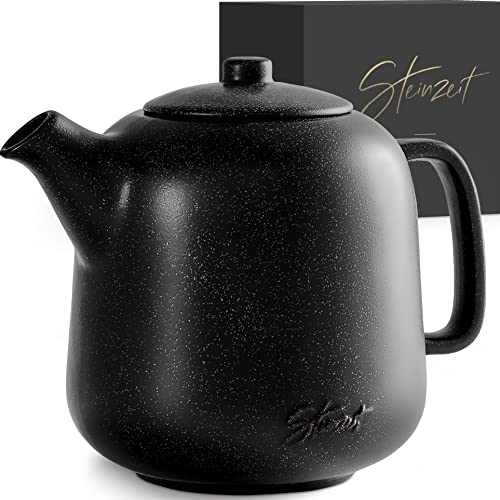
Steinzeit Design Ceramic Tea Pot with Infuser, Black, 44 oz
Badge: Best for a Crowd
Strengths
- 44 oz is the largest capacity in this pool by a wide margin — a genuine table pot.
- Removable strainer means the infuser lifts out for emptying and cleaning without a fight.
- Black ceramic gives the porcelain-family look a modern, neutral direction that suits most kitchens.
Trade-offs
- A full 44 oz ceramic pot is heavy in one hand; smaller drinkers may prefer two-handed pouring.
- Named ceramic in its listing, not porcelain.
- Brewing 44 oz for one person wastes leaf and leaves tea stewing; size must match your actual habit.
Mini spec box: Body: ceramic (per listing title) · Capacity: 44 oz · Infuser: included, with removable strainer, for loose tea · Colour: Black
Most porcelain and ceramic pots stop around 24–27 oz, which quietly assumes one or two drinkers. The Steinzeit breaks that assumption. At 44 oz it is built for the family breakfast table, the book club, the long brunch — anywhere tea is poured for four to six people from one brew. The removable strainer matters more at this size, because a big pot that is awkward to empty and rinse will be used less; here the strainer lifts out, the leaves go to the bin or compost, and the pot rinses clean.
Who it suits: households and hosts who brew for a group and are tired of making two pots. The honest limitation is physics: ceramic plus 44 oz of water is a substantial lift, and a pot this size only earns its cupboard space if group brewing is a weekly reality rather than a holiday exception.
Best for: family tables and entertaining / Not suited for: solo drinkers or anyone who finds a full large pot heavy

chooguang Japanese Ceramic Teapot with Infuser, Blue, 25 oz
Badge: Best Compact Design
Strengths
- 25 oz / 750 ml is a well-judged personal-to-small-table size in a Japanese-style form.
- Removable stainless steel filter handles loose tea and lifts out for cleaning.
- Listing frames it for office and home alike, which matches its compact footprint.
Trade-offs
- Ceramic per its listing title, not named porcelain.
- Japanese-style compact pots reward a slower, two-handed pour; not the fastest server at a big table.
- Blue is the identity of this version, like the Sweese’s sage — colour choice is part of the purchase.
Mini spec box: Body: ceramic (per listing title) · Capacity: 25 oz / 750 ml · Filter: removable stainless steel, for loose tea · Colour: Blue · Style: Japanese teapot form
The chooguang brings a Japanese silhouette to the ceramic family: compact, rounded, and made for a desk or a small table rather than a dining room. At 25 oz it brews a generous personal pot or two smaller cups, and the removable stainless steel filter keeps the loose leaf routine simple — fill, steep, lift out, rinse. Its listing speaks to office and home use and to gifting, and the size backs that up: this is the pot that lives where you actually sit.
Who it suits: desk brewers, small households, and anyone who likes the Japanese teapot form but wants a glazed ceramic body rather than clay or iron. The honest limitation is scale and naming: it is ceramic rather than porcelain by its title, and 25 oz will not stretch to a table of guests.
Best for: office and small-table brewing in a Japanese form / Not suited for: group serving or porcelain-by-name purists
Velaze Cast Iron Teapot Set with Infuser and Trivet, 23 oz — Prose-Only
Badge: Best for Heat Retention (prose-only)
Strengths
- Cast iron holds heat far longer than porcelain or ceramic — its whole reason to exist.
- Fully enameled interior per its listing, with a hammered Japanese-style design and a matching trivet.
- Set format with two cups, sized at 700 ml / 23 oz for one to two people.
Trade-offs
- The body is cast iron, not porcelain — which is exactly why it is prose-only in this guide.
- Iron is heavy and asks for drying after use to protect the exterior; more care than glazed ceramic.
- 23 oz is a one-to-two-person pot, not a table server.
Mini spec box: Body: cast iron (per listing title) · Capacity: 700 ml / 23 oz · Interior: fully enameled · Includes: infuser, trivet, 2 cups · Design: hammered, Japanese style
The Velaze is here so the comparison is honest rather than hidden. If your real priority is a pot that stays hot through a long, slow session, cast iron beats porcelain at that single job, and this set — enameled inside, hammered outside, with its own trivet and two cups — is a complete one-to-two-person ritual in a box. Readers who decide iron is actually their material should follow Best Sources For Authentic Cast Iron Teapots for the full picture. But iron is not porcelain: it is heavier, it needs drying, and its flavour story is about heat, not neutrality. In a porcelain guide it earns a fair review and no link.
Best for: slow sessions for one or two where heat retention leads / Not suited for: anyone who came here for porcelain itself
Yxhupot Yixing Clay Pot, Qingshuini, 10 oz — Prose-Only
Badge: Best for Gongfu Sessions (prose-only)
Strengths
- Hand-carved natural Qingshuini clay per its listing — a named zisha-family clay, not generic ceramic.
- 10 oz / 320 ml is a true gongfu size, built for many short infusions of the same leaves.
- Unglazed clay gradually seasons with one tea type, which devoted drinkers treat as a feature.
Trade-offs
- Unglazed clay is the opposite of porcelain’s neutrality: it absorbs, so it asks for one-tea dedication.
- 10 oz pours small cups only; useless as a family serving pot.
- The body is Yixing clay, not porcelain — prose-only here by the same material rule.
Mini spec box: Body: Yixing clay, Qingshuini (per listing title) · Capacity: 10 oz / 320 ml · Finish: hand-carved natural clay · Use: gongfu brewing, loose tea
The Yxhupot represents the other pole of tea culture from porcelain. Where porcelain is glazed, neutral, and rinses clean, Yixing clay is unglazed and absorbent, slowly taking on the character of the oolong or puerh you dedicate to it, and gongfu brewing turns its tiny 10 oz size into a virtue — small water, high leaf, infusion after infusion. None of that makes it a porcelain teapot, so it is reviewed here without a link or photo, as the clearest possible illustration of what porcelain is not.
Best for: gongfu drinkers who want a dedicated clay pot / Not suited for: mixed-tea households wanting one neutral pot
Comparison Table
| Pick | Body | Capacity | Infuser | Best for | Link |
|---|---|---|---|---|---|
| Sweese Porcelain Teapot | Porcelain | 27 oz | Included | Everyday all-round brewing | Check on Amazon |
| Tea Forte Ceramic Fiore | Ceramic | 24 oz | Stainless steel | Easy care, gifting | Check on Amazon |
| Steinzeit Design Tea Pot | Ceramic | 44 oz | Removable strainer | Groups and family tables | Check on Amazon |
| chooguang Japanese Teapot | Ceramic | 25 oz / 750 ml | Removable stainless steel filter | Desk and small-table brewing | Check on Amazon |
| Velaze Cast Iron Set | Cast iron | 23 oz / 700 ml | Included | Heat retention (prose-only) | Prose-only |
| Yxhupot Yixing Clay Pot | Yixing clay | 10 oz / 320 ml | Clay pot for loose tea | Gongfu sessions (prose-only) | Prose-only |
How to Choose the Right Porcelain Teapot
Start with capacity, honestly counted. A mug of tea is roughly 8–12 oz depending on your cups. The 24–27 oz linked pots here brew two to four mugs; the 44 oz Steinzeit brews four to six. Buy for your ordinary Tuesday, not your largest holiday: an oversized pot brewed half-full still works, but an oversized pot brewed full for one person leaves tea stewing on its leaves or cooling in the pot. If you mostly brew for one or two, the Tea Forte and chooguang sizes are the honest fit; if weekends mean a table, the Steinzeit earns its shelf space.
Understand the porcelain-versus-ceramic wording. Porcelain is a specific, high-fired, vitrified ceramic — typically finer, more translucent, and harder than general ceramic ware. Listings, however, use both words, and this pool shows the full range: one pot named porcelain, three named ceramic. All four share the properties porcelain buyers actually use daily — a glazed, non-reactive brewing surface that rinses clean and carries no flavour memory. If the named material itself matters to you, the Sweese is your pick; if daily behaviour matters more, any of the four delivers it.
Check the infuser, not just its existence. All four linked pots include one, but the details differ in ways you will feel weekly: the Steinzeit’s strainer and the chooguang’s filter are removable, which makes emptying wet leaves and rinsing simple; the Tea Forte pairs a stainless steel infuser with a ceramic lid. A removable, fine filter suits small-leaf teas; a coarser basket suits large whole leaves that need room to expand. Match the filter to the leaf you actually buy.
Read the care line before you fall for the colour. Only the Tea Forte’s listing states dishwasher and microwave safety. For the others, plan on hand-washing — which is genuinely quick for glazed ceramic — and on reheating tea in a cup rather than microwaving the pot. If you know yourself to be a dishwasher-only household, that single listing line should weigh heavily. Readers comparing across materials entirely will find the same care questions framed differently in Best Stainless Steel Teapots, where metal changes the answers.
Weigh the pot empty, then imagine it full. Water weighs about a pound per pint, so a 44 oz pot carries close to three pounds of water on top of its own ceramic weight, while a 24 oz pot carries about half that. If anyone in the household has limited grip strength, that arithmetic is not a detail — it decides whether the pot gets used daily or only when someone else pours. When in doubt, the mid-size pots in this pool are the safer household default, and the big pot belongs with the confident pourer who hosts often.
Think about the pour and the lid. A pot you use daily should pour without dribbling down its own side and hold its lid when you tip it. Listings rarely prove this, so treat it as your in-hand check on arrival: fill with water, pour at serving angle, and watch the stream and the lid before the return window closes. Colour — sage green, stone blue, black, blue across this pool — is the last decision, not the first: it is the one you will see every day, so choose it after size, infuser, and care are settled.
How to Brew and Care for a Porcelain Teapot
Brewing in porcelain is forgiving, which is its charm. Follow this routine:
- Warm the pot with a rinse of hot water. Porcelain is thinner than iron, and warming it keeps the brew temperature steadier and is kinder to the glaze.
- Add loose leaf to the infuser — roughly a teaspoon per cup as a starting point, adjusted to the tea.
- Pour water at the temperature your tea wants: just off the boil for black teas, noticeably cooler for green and white teas, which scorch and turn bitter in boiling water.
- Steep for the tea’s time, then lift the infuser out. Leaving leaves in the water is the single most common cause of a bitter second cup.
- Serve promptly. If a second infusion is planned, whole leaves in porcelain will usually give one — re-steep with fresh hot water and a little more time.
Care is simple because the glaze does the work. Rinse the pot and infuser with hot water after use; use a soft sponge and mild detergent only when needed, and avoid abrasive pads on the glaze. Never move a cold porcelain or ceramic pot straight onto high heat or into boiling water — thermal shock, not age, is what cracks glazed ware. Store the infuser dry and the lid seated loosely so the pot airs between uses.
Troubleshooting. Problem: tea tastes bitter by the second cup → the leaves stayed in the water; lift the infuser out at time and decant if needed. Problem: brown staining inside the pot → it is tea film on the glaze, not damage; a soak in warm water with a little baking soda and a soft sponge lifts it. Problem: a dribble runs down the pot when pouring → pour a touch more slowly and decisively; a hesitant, half-tipped pour is what breaks the stream.
Porcelain, Ceramic, Clay, and Iron: What Actually Changes in the Cup
The four materials in this guide divide along one axis: what the vessel does to the tea besides hold it. Porcelain and glazed ceramic do almost nothing — the glaze seals the surface, so the tea tastes of itself and the pot resets fully with a rinse. That neutrality is why porcelain is the taster’s material: if you rotate through many teas, one porcelain pot serves them all honestly. Unglazed Yixing clay does the opposite on purpose, absorbing a trace of each brew and gradually rounding the tea it is dedicated to — wonderful for a single-tea devotee, wrong for a varied shelf. Cast iron contributes heat: its mass keeps the water and then the tea hotter for longer, at the cost of weight and a drying routine. And metal, for readers weighing the full field, behaves differently again — Best Quality Stainless Steel Teapots examines what quality means when the body is steel rather than fired clay. None of these is the best material in the abstract; each is the best answer to a different question about how you drink.
Porcelain Teapots as Gifts: Matching the Pot to the Person
Teapots are gifted constantly and used, too often, rarely — usually because the giver chose by looks alone. Match the pot to the drinker’s actual habit. The new loose leaf convert needs the friction removed: the Tea Forte, with its infuser included and dishwasher and microwave safety stated, asks the least of a beginner. The design-led friend who hosts small dinners will use the chooguang’s Japanese form or the Sweese’s sage green because the pot can sit on the table as part of the setting. The family host needs capacity, which means the Steinzeit. And the friend who has moved beyond serving pots into ritual is the one case where the prose-only Yixing pot is the thoughtful gift — small, dedicated, and entirely different in spirit. A pot that fits a routine gets used weekly; a pot that fits only a shelf gets admired twice a year.
Infusers and Filters in Porcelain Pots: The Part You Will Touch Every Day
Ask a long-time porcelain pot owner what they would check first on a replacement, and many will surprise you: not the glaze, not the shape — the infuser. It is the component you fill, lift, empty, and rinse at every single brew, and the four linked pots here show the main arrangements. The Sweese includes an infuser built for loose leaf tea as part of the pot’s system. The Tea Forte pairs a stainless steel infuser with a ceramic lid, a combination that separates jobs sensibly: metal mesh for fine, durable filtering, ceramic for the lid you see and touch. The Steinzeit uses a removable strainer, and the chooguang a removable stainless steel filter — and that word removable is the one to underline. A filter that lifts out cleanly means wet leaves go straight to the bin in one motion and the mesh rinses under the tap in seconds. A fixed or awkward filter means fishing leaves out with a spoon and, over months, using the pot less.
Mesh fineness is the second consideration, and it should follow your leaf, not a spec sheet. Fine stainless mesh suits small or broken leaves and rooibos-style fine material, which escape through coarse holes and cloud the cup. Large whole-leaf teas — a rolled oolong, a long-leaf white — need the opposite: room. Leaves that cannot unfurl cannot flavour the water properly, so a roomy basket matters more than ultra-fine mesh for those teas. If you drink across that whole range, the practical answer is a pot with a generously sized removable basket, and a small standalone strainer kept in a drawer for the finest teas. Finally, think about the lid-and-infuser relationship at pouring time: when you tip the pot, you want the lid seated and the infuser staying where it belongs, not sliding toward the spout. That is an arrival-day check, done with water, before the pot’s first real brew.
One Neutral Pot, Every Tea: A Day of Brewing in Porcelain
The strongest practical argument for porcelain is a varied tea shelf. Because the glazed surface holds no flavour memory, a single porcelain or ceramic pot can carry a household through teas that would fight each other in an absorbent vessel. Start the morning with a malty black tea brewed just off the boil — the pot rinses clean in seconds. Midday, brew a green tea at cooler water; there is no trace of the morning’s malt to muddy its freshness, which is exactly why tasters reach for porcelain when evaluating a new tea. In the evening, a scented jasmine or a herbal blend goes into the same pot with the same clean result. Contrast that with the dedicated clay pot, where this rotation would slowly blur into one mixed seasoning, or with a pot you must scrub to reset. Porcelain asks for a rinse; that is the entire reset procedure.
Two habits make the rotation work even better. First, decant or lift the infuser at time for every tea, not just the delicate ones — over-extraction is the main way a good leaf disappoints, whatever the pot. Second, match water temperature to the tea rather than the pot: porcelain imposes no limits here, since the water arrives from the kettle at whatever temperature you chose. Cooler water for greens and whites, hotter for black teas and most herbals. Follow those two habits and the neutral pot becomes the most flexible brewer in the kitchen — which, more than translucency or tradition, is why porcelain has held its place on the table for centuries while more temperamental materials became special-occasion pieces.
How to Check a Porcelain Pot in Its First Week
Because the judgements that matter most — pour, balance, lid fit — can only be made in the hand, treat the first week with any porcelain or ceramic pot as a structured check rather than a honeymoon. On day one, before tea, fill the pot with plain water and pour every drop into a large jug. Watch three things: whether the stream stays clean or breaks into a dribble down the pot’s side, whether the lid stays seated at a full serving tilt without your thumb guarding it, and whether the handle feels secure and clear of the hot body when the pot is at full weight. Water is unforgiving and free; a flaw found with water costs nothing.
Across the week, brew your two most different teas back to back — a strong black tea one day, your most delicate tea the next — and taste for carryover after only a rinse between them. In a sound glazed pot there should be none, and confirming that early confirms the core promise of the material. Check the infuser with your finest leaf as well as your largest: a basket that handles both is the one you will still be happy with in a year. Look at the glaze in bright light for pinholes or rough patches inside, where they would hold residue. None of this takes long, and all of it happens while returning or exchanging is still simple. A pot that passes a deliberate first week is very likely to serve quietly for years; a pot that fails it has told you so at the cheapest possible moment.
Common Buying Mistakes
- Buying the material word instead of the material. A listing that says porcelain in the headline copy but ceramic in the title — or the reverse — deserves a careful read. This guide labels every pick with its own title’s word; do the same anywhere you shop.
- Sizing for guests you rarely host. A 44 oz pot for a solo drinker means stewed or wasted tea. Size for the ordinary day.
- Leaving the infuser in the pot. The most common brewing mistake of all: tea keeps extracting and turns bitter. Lift it out at time.
- Thermal shock. Cold pot, boiling water, no warm-up rinse — the classic way to craze or crack a glaze. Warm the pot first.
- Assuming dishwasher safety. Only one pick here states it. When a listing is silent, hand-wash; silence is not permission.
- Ignoring the colour commitment. Sage, stone blue, black, and blue are all lovely — and all permanent. A pot you see daily should be a colour you will still like in year three.
Final Recommendation
For most readers, the answer is the Sweese Porcelain Teapot: the one pick named porcelain in its own listing, at the most versatile size, with an infuser included. Choose the Tea Forte instead if easy care is your deciding factor, the Steinzeit if you brew for a table, and the chooguang if a compact Japanese form fits your desk or small kitchen. Let the Velaze and Yxhupot stand as the honest alternatives they are — superb at heat and at ritual respectively, and neither of them porcelain.
Frequently Asked Questions
Is ceramic the same as porcelain in a teapot?
Porcelain is a type of ceramic — the most refined, high-fired type — so every porcelain pot is ceramic, but not every ceramic pot is porcelain. In daily use they behave alike: a glazed, non-reactive surface that rinses clean. In this guide the Sweese is named porcelain in its listing and the Tea Forte, Steinzeit, and chooguang are named ceramic, and we label them exactly that way.
Why are the cast iron and clay pots in this guide not linked?
Because their bodies are not porcelain or ceramic. The Velaze is cast iron and the Yxhupot is Yixing clay, per their own listings. They are reviewed in full as comparisons — iron for heat, clay for gongfu ritual — but a porcelain guide should only link pots that match the material searched for. If iron turns out to be your direction, the typo-spelled twin of the steel search, Best Stinless Steel Teapots, shows how these material rules play out in that category too.
How much tea does a 27 oz teapot actually serve?
Roughly three to four ordinary mugs, or four to five smaller cups. That is why the 24–27 oz pots in this guide are the everyday sizes: enough for a couple or a small group, not so much that tea sits and stews.
Can I put a porcelain teapot on the stove?
Treat these as brewing and serving pots, not kettles. None of the linked listings here presents its pot as a stovetop vessel. Boil water in a kettle, then pour it over the leaves in the warmed pot — that is both the safe routine and the better-tasting one.
Does porcelain change the taste of tea?
That is its virtue: essentially no. The glazed surface is non-reactive and holds no flavour from previous brews, so porcelain is the most neutral common teapot material — the opposite of unglazed clay, which seasons over time.
How do I stop my teapot from dripping?
Pour smoothly and decisively rather than slowly and hesitantly, keep the spout lip clean of tea film, and do not overfill past the spout’s base. A pot that still dribbles at a normal pour angle when tested with plain water on arrival is showing you a spout-design flaw — that is what the return window is for.
Will a porcelain teapot keep tea hot for a long session?
Porcelain and glazed ceramic hold heat reasonably for the length of a normal serving — brewing, pouring, and drinking across half an hour or so — but their thinner walls give up warmth faster than cast iron or double-wall steel. Warming the pot before brewing, as the how-to section describes, closes much of the gap. If your sessions regularly run long, brew a right-sized pot and make a second fresh one rather than letting a large pot cool and stew; the flavour will be better for it.
How do I remove tea stains from inside the pot?
Tea film builds slowly on any glaze. Soak the pot in warm water with a spoonful of baking soda, then wipe with a soft sponge and rinse well. Avoid abrasive scouring pads, which dull the glaze over time and give future film more to grip. The infuser can be soaked the same way, which also clears mesh holes that a quick rinse leaves behind.
Which pick is best as a first loose leaf teapot?
The Tea Forte for most beginners, because its infuser is included and its listing states dishwasher and microwave safety, removing the two frictions that discourage new drinkers. The Sweese is the better first pick if you specifically want porcelain named in the listing.