Disclosure: topratedkitchenware.com is reader-supported. When you buy through links on our site, we may earn an affiliate commission from Amazon and other retailers, at no extra cost to you.
Where to buy
If you are working out the best portable barbecue grills question, start with the picks below. Linked picks were verified against the listing data in this guide’s pool, and each linked name leads to the same listing as its button, so the specification you read here is the specification you can confirm before you buy. Picks that did not meet this keyword’s core test are still reviewed in full, clearly marked as prose-only, with no link and no image.
- Realcook Charcoal Grill with Offset Smoker (prose-only pick – see its review below)
- YOHAWJAN Electric Indoor Grill 2-in-1 (1500W) – Best Overall
- IdeaMaxx 3-Burner Propane Grill with Cast Iron Grates – Best for Small Spaces
- Nexgrill 4-Burner Propane Grill with Side Burner (52,000 BTU) – Most Versatile
- Cuisinart 14-Inch Portable Charcoal Grill – Best Premium
- Realcook Charcoal Grill with Offset Smoker (800 sq. in.) (prose-only pick – see its review below)
Read the full guide ↓
Searching for the best portable barbecue grills is really a search for fit: the right fuel, the right format and the right seller, in that order. This guide is built around portable barbecue grills for cooking away from the patio, and it applies that test to six researched grills – comparing what each one genuinely does, where each one gives ground, and which households each one suits. The picks span charcoal, propane and electric formats because real households grill in all three ways, but the links in this guide are earned: only picks that meet the keyword’s core test carry them.
Portable barbecue means real barbecue – charcoal smoke, propane zones or a tabletop session – happening somewhere other than the home patio: a campsite, a beach car park, a tailgate or a rented cabin. This guide links four pool picks with a genuine portability claim in their verified listings, including a purpose-built portable charcoal grill, and keeps the two barrel offset smokers in prose, because a barrel that grills beautifully at home does not become portable by being wished into a car boot.
The method is simple and it is repeated for every pick. First the verified facts: fuel, format and the specifications actually stated in the listing. Then an honest account of strengths and trade-offs, a verdict naming who should buy and who should walk past, and a buying framework you can reuse on any listing you meet elsewhere, including when you compare Best Portable Barbecue Grills Target alongside the picks here. By the final section you will know which of the six belongs in your home – and, just as usefully, which five do not.
Key Takeaways
- The best portable barbecue grills question is answered by fit – fuel, format and seller support – not by the longest feature list.
- Linked picks in this guide met the keyword’s core test; prose-only picks are alternatives, flagged honestly with the reason.
- Decide fuel before model: charcoal for flavour and ritual, propane for speed and zones, electric for permission and convenience.
- Compare cooking area, grate material and format against your ordinary cook, not your largest party.
- Buy where the exact model, delivery terms and spare-parts route are published clearly, and keep the model number safe.
In this guide
Quick Picks
| Pick | Badge | Fuel | Offer |
|---|---|---|---|
| Realcook Charcoal Grill with Offset Smoker | Best for Entertaining | Charcoal | Prose-only – see review |
| YOHAWJAN Electric Indoor Grill 2-in-1 (1500W) | Best Overall | Electric | Check on Amazon |
| IdeaMaxx 3-Burner Propane Grill with Cast Iron Grates | Best for Small Spaces | Propane | Check on Amazon |
| Nexgrill 4-Burner Propane Grill with Side Burner (52,000 BTU) | Most Versatile | Propane | Check on Amazon |
| Cuisinart 14-Inch Portable Charcoal Grill | Best Premium | Charcoal | Check on Amazon |
| Realcook Charcoal Grill with Offset Smoker (800 sq. in.) | Best for Beginners | Charcoal | Prose-only – see review |
The table is a map, not a verdict. Badges summarise the role each pick plays in this guide – the overall recommendation, the entertaining option, the small-space answer and so on – but the detailed reviews below explain the conditions behind each badge, and those conditions matter. A pick that is wrong for your fuel rules or your space stays wrong however strong its badge sounds, a point worth remembering when comparing Best Natural Gas Barbecue Grills as well.
How These Picks Were Chosen
This guide is research-led. The pick pool was verified against listing data before writing: every linked product name, specification and image in this article comes from that verified pool, and no specification has been added from memory or from another site. Where a listing does not state a figure – and some do not – the review says so instead of filling the gap, because an honest blank is more useful than a confident invention.
The six picks were then tested against the keyword itself. For best portable barbecue grills, the core test is the one described in the introduction: does this product genuinely serve the need inside the keyword, in fuel, format and intended use? Picks that passed carry Amazon links and images. Picks that failed on a core point – wrong fuel, wrong brand, wrong format – were not deleted; they were demoted to prose-only reviews, because a near-miss product is often the right answer to a neighbouring question, and readers comparing Best Outdoor Barbecue Grills deserve to see the reasoning rather than a silent omission.
No hands-on testing is claimed. What this guide offers instead is disciplined comparison: verified specifications weighed the same way for every pick, trade-offs stated for the linked recommendations as plainly as for the alternatives, and a consistent verdict format that names who each grill suits and who it does not. Prices and fixed ratings are deliberately absent, because both change constantly; the guide works in qualitative tiers and directs you to check the current offer on the listing itself.
The 6 Best Options for Best portable barbecue grills
Realcook Charcoal Grill with Offset Smoker
Badge: Best for Entertaining
Prose-only pick: barrel offset format is not a portable grill; reviewed in prose only per Rule 5/6
Strengths
- Grill-and-smoker combination covers direct heat and low-and-slow cooking
- Barrel layout gives a long grate for family-size loads
- Charcoal fuel delivers the traditional barbecue flavour profile
Trade-offs
- Size and weight make it a stay-in-the-yard design despite the camping mention
- Charcoal fires need tending on long smokes
- Assembly of a barrel-and-firebox unit takes longer than a kettle or tabletop grill
Key specifications (from the verified listing)
- Offset smoker configuration
- Barrel-style charcoal grill and smoker combo
- Listed for backyard, patio, camping, picnic and party use
This pick is built for families who want one charcoal barrel unit for both grilling and smoking. In the context of best portable barbecue grills, its role is best for entertaining – and that role is earned by the format itself: a barrel grill with offset smoker running on charcoal behaves differently at the grate from every other format in this guide, and the households it suits are the ones whose cooking matches that behaviour. Preheat properly, cook with the lid working for you where the design allows it, and judge it on the food it is shaped to produce rather than on a specification contest with grills twice its size or half its weight.
The honest limitation deserves its own sentence, because every grill in this guide has one. Here it is the flip side of the format: the same design choices that make this pick right for its audience make it wrong for others, and the trade-off list above names them specifically rather than in general terms. If one of those trade-offs touches your ordinary cook – your group size, your fuel rules, your storage, your space – believe it, and move to the pick whose trade-offs you will never meet in practice.
Ownership is the longer test. This format rewards the standard habits – grate brushed warm, ash or drip management kept current, exterior wiped before grease sets, and a seasonal check of the parts that move or carry fuel. None of that is specialised work, but it is the difference between a grill that cooks well in its fourth year and one that is replaced in its second, and it is worth picturing your own routine honestly before deciding that this is the one.
Best for: families who want one charcoal barrel unit for both grilling and smoking / Not suited for: cooks whose fuel rules, group size or space contradict the format described above

YOHAWJAN Electric Indoor Grill 2-in-1 (1500W)
Badge: Best Overall
Strengths
- Grill and griddle plates plus raclette pans make it the most social tabletop format here
- Electric operation suits indoor and Korean-BBQ-style table cooking
- Removable non-stick plates keep washing up manageable
Trade-offs
- Tabletop electric output is gentler than a full-size gas or charcoal grill
- Best for small groups gathered around the unit itself
- No outdoor barrel or cart capacity for big parties
Key specifications (from the verified listing)
- 1500W electric power
- 2-in-1 grill and griddle plates, non-stick and removable
- 3 raclette cheese pans included
- Temperature control
- Listed as portable
This pick is built for small households that grill at the table and value an indoor, portable format. In the context of best portable barbecue grills, its role is best overall – and that role is earned by the format itself: a countertop indoor grill, listed as portable running on electric behaves differently at the grate from every other format in this guide, and the households it suits are the ones whose cooking matches that behaviour. Preheat properly, cook with the lid working for you where the design allows it, and judge it on the food it is shaped to produce rather than on a specification contest with grills twice its size or half its weight.
The honest limitation deserves its own sentence, because every grill in this guide has one. Here it is the flip side of the format: the same design choices that make this pick right for its audience make it wrong for others, and the trade-off list above names them specifically rather than in general terms. If one of those trade-offs touches your ordinary cook – your group size, your fuel rules, your storage, your space – believe it, and move to the pick whose trade-offs you will never meet in practice.
Ownership is the longer test. This format rewards the standard habits – grate brushed warm, ash or drip management kept current, exterior wiped before grease sets, and a seasonal check of the parts that move or carry fuel. None of that is specialised work, but it is the difference between a grill that cooks well in its fourth year and one that is replaced in its second, and it is worth picturing your own routine honestly before deciding that this is the one.
Best for: small households that grill at the table and value an indoor, portable format / Not suited for: cooks whose fuel rules, group size or space contradict the format described above

IdeaMaxx 3-Burner Propane Grill with Cast Iron Grates
Badge: Best for Small Spaces
Strengths
- Cast iron grates in a three-burner format suit smaller patios without giving up sear material
- Foldable shelves reduce the stored footprint
- Three burners still allow a hot zone and a holding zone
Trade-offs
- Three burners cap simultaneous zones compared with four-burner carts
- No side burner in this specification
- Cast iron grates ask for oiled, attentive maintenance
Key specifications (from the verified listing)
- 3 burners
- 38,200 BTU output per listing
- Cast iron grates
- Foldable side shelves
This pick is built for smaller households that want cast iron searing and a fold-away footprint. In the context of best portable barbecue grills, its role is best for small spaces – and that role is earned by the format itself: a cart grill with foldable shelves, listed for portable use running on propane behaves differently at the grate from every other format in this guide, and the households it suits are the ones whose cooking matches that behaviour. Preheat properly, cook with the lid working for you where the design allows it, and judge it on the food it is shaped to produce rather than on a specification contest with grills twice its size or half its weight.
The honest limitation deserves its own sentence, because every grill in this guide has one. Here it is the flip side of the format: the same design choices that make this pick right for its audience make it wrong for others, and the trade-off list above names them specifically rather than in general terms. If one of those trade-offs touches your ordinary cook – your group size, your fuel rules, your storage, your space – believe it, and move to the pick whose trade-offs you will never meet in practice. Readers weighing Best Portable Bbq Grills will find the same standard applied there.
Ownership is the longer test. This format rewards the standard habits – grate brushed warm, ash or drip management kept current, exterior wiped before grease sets, and a seasonal check of the parts that move or carry fuel. None of that is specialised work, but it is the difference between a grill that cooks well in its fourth year and one that is replaced in its second, and it is worth picturing your own routine honestly before deciding that this is the one.
Best for: smaller households that want cast iron searing and a fold-away footprint / Not suited for: cooks whose fuel rules, group size or space contradict the format described above
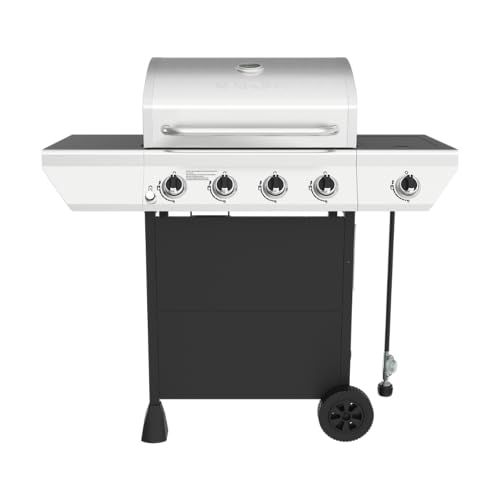
Nexgrill 4-Burner Propane Grill with Side Burner (52,000 BTU)
Badge: Most Versatile
Strengths
- Cast iron grate material is the sear-focused choice in this pool
- Generous 526 sq. in. area with a side burner for parallel cooking
- Stainless lid and thermometer round out a full-feature cart specification
Trade-offs
- Cast iron grates need seasoning-style care to stay at their best
- Cart format is movable on its base rather than truly travel-portable
- Four burners plus side burner is more grill than a couple needs
Key specifications (from the verified listing)
- 4 burners plus side burner
- 52,000 BTU per listing
- 526 sq. in. cooking space
- Stainless steel lid
- Matte finish cast iron grate
- Built-in thermometer and electronic ignition
This pick is built for sear-minded families who want cast iron grates in a full-size propane cart. In the context of best portable barbecue grills, its role is most versatile – and that role is earned by the format itself: a cart grill, listed as portable running on propane behaves differently at the grate from every other format in this guide, and the households it suits are the ones whose cooking matches that behaviour. Preheat properly, cook with the lid working for you where the design allows it, and judge it on the food it is shaped to produce rather than on a specification contest with grills twice its size or half its weight.
The honest limitation deserves its own sentence, because every grill in this guide has one. Here it is the flip side of the format: the same design choices that make this pick right for its audience make it wrong for others, and the trade-off list above names them specifically rather than in general terms. If one of those trade-offs touches your ordinary cook – your group size, your fuel rules, your storage, your space – believe it, and move to the pick whose trade-offs you will never meet in practice.
Ownership is the longer test. This format rewards the standard habits – grate brushed warm, ash or drip management kept current, exterior wiped before grease sets, and a seasonal check of the parts that move or carry fuel. None of that is specialised work, but it is the difference between a grill that cooks well in its fourth year and one that is replaced in its second, and it is worth picturing your own routine honestly before deciding that this is the one.
Best for: sear-minded families who want cast iron grates in a full-size propane cart / Not suited for: cooks whose fuel rules, group size or space contradict the format described above

Cuisinart 14-Inch Portable Charcoal Grill
Badge: Best Premium
Strengths
- Purpose-built to travel: lid locks and a carry-friendly format are in the listing itself
- Dual vents give more heat control than most tabletop charcoal units
- 196 sq. in. is a real cooking area for a grill this small
Trade-offs
- Charcoal in miniature still means lighting, ash and cool-down time
- Tabletop size caps the menu for groups
- Chrome-plated grates are lighter-duty than cast iron
Key specifications (from the verified listing)
- 14-inch portable format
- 196 sq. in. cooking area
- Chrome-plated grate
- Dual air vent system
- 3 lid locks for one-handed carrying (model CCG-190RB)
This pick is built for campers, tailgaters and picnic cooks who want real charcoal in a carryable size. In the context of best portable barbecue grills, its role is best premium – and that role is earned by the format itself: a portable tabletop charcoal grill running on charcoal behaves differently at the grate from every other format in this guide, and the households it suits are the ones whose cooking matches that behaviour. Preheat properly, cook with the lid working for you where the design allows it, and judge it on the food it is shaped to produce rather than on a specification contest with grills twice its size or half its weight.
The honest limitation deserves its own sentence, because every grill in this guide has one. Here it is the flip side of the format: the same design choices that make this pick right for its audience make it wrong for others, and the trade-off list above names them specifically rather than in general terms. If one of those trade-offs touches your ordinary cook – your group size, your fuel rules, your storage, your space – believe it, and move to the pick whose trade-offs you will never meet in practice.
Ownership is the longer test. This format rewards the standard habits – grate brushed warm, ash or drip management kept current, exterior wiped before grease sets, and a seasonal check of the parts that move or carry fuel. None of that is specialised work, but it is the difference between a grill that cooks well in its fourth year and one that is replaced in its second, and it is worth picturing your own routine honestly before deciding that this is the one.
Best for: campers, tailgaters and picnic cooks who want real charcoal in a carryable size / Not suited for: cooks whose fuel rules, group size or space contradict the format described above

Realcook Charcoal Grill with Offset Smoker (800 sq. in.)
Badge: Best for Beginners
Prose-only pick: barrel offset format is not a portable grill; reviewed in prose only per Rule 5/6
Strengths
- The largest cooking space in this pool, aimed squarely at parties and gatherings
- Offset firebox allows low-and-slow smoking alongside direct grilling
- Barrel format gives long, usable grate runs for mixed loads
Trade-offs
- A large barrel footprint needs real patio space and is not a portable design
- Offset smoking is a hands-on technique with a learning curve
- Charcoal fuel means ash, fuel storage and longer start-up than gas
Key specifications (from the verified listing)
- 800 sq. in. cooking space (per listing title)
- Offset smoker configuration
- Barrel-style charcoal grill and smoker combo
This pick is built for hosts who cook for groups and want one charcoal unit that grills and smokes. In the context of best portable barbecue grills, its role is best for beginners – and that role is earned by the format itself: a barrel grill with offset smoker running on charcoal behaves differently at the grate from every other format in this guide, and the households it suits are the ones whose cooking matches that behaviour. Preheat properly, cook with the lid working for you where the design allows it, and judge it on the food it is shaped to produce rather than on a specification contest with grills twice its size or half its weight.
The honest limitation deserves its own sentence, because every grill in this guide has one. Here it is the flip side of the format: the same design choices that make this pick right for its audience make it wrong for others, and the trade-off list above names them specifically rather than in general terms. If one of those trade-offs touches your ordinary cook – your group size, your fuel rules, your storage, your space – believe it, and move to the pick whose trade-offs you will never meet in practice.
Ownership is the longer test. This format rewards the standard habits – grate brushed warm, ash or drip management kept current, exterior wiped before grease sets, and a seasonal check of the parts that move or carry fuel. None of that is specialised work, but it is the difference between a grill that cooks well in its fourth year and one that is replaced in its second, and it is worth picturing your own routine honestly before deciding that this is the one.
Best for: hosts who cook for groups and want one charcoal unit that grills and smokes / Not suited for: cooks whose fuel rules, group size or space contradict the format described above
Comparison Table
| Pick | Badge | Fuel | Format | Offer |
|---|---|---|---|---|
| Realcook Charcoal Grill with Offset Smoker | Best for Entertaining | Charcoal | Barrel grill with offset smoker | Prose-only |
| YOHAWJAN Electric Indoor Grill 2-in-1 (1500W) | Best Overall | Electric | Countertop indoor grill, listed as portable | Check on Amazon |
| IdeaMaxx 3-Burner Propane Grill with Cast Iron Grates | Best for Small Spaces | Propane | Cart grill with foldable shelves, listed for portable use | Check on Amazon |
| Nexgrill 4-Burner Propane Grill with Side Burner (52,000 BTU) | Most Versatile | Propane | Cart grill, listed as portable | Check on Amazon |
| Cuisinart 14-Inch Portable Charcoal Grill | Best Premium | Charcoal | Portable tabletop charcoal grill | Check on Amazon |
| Realcook Charcoal Grill with Offset Smoker (800 sq. in.) | Best for Beginners | Charcoal | Barrel grill with offset smoker | Prose-only |
Read the comparison by columns, not by rows. Fuel decides your weekly routine, format decides your space and your menu, and the badge merely summarises the role. Two picks with the same fuel can still be opposite purchases – a barrel smoker and a kettle both burn charcoal and share almost nothing else – which is why the format column deserves as much attention as any other, here and when you compare Best Portable Boat Grills.
How to Choose When the Question Is Best portable barbecue grills
Choose in a fixed order and the decision stays manageable: fuel first, format second, size third, seller fourth. Fuel is first because it governs everything downstream – what you can cook, where you can cook it, what you must store and what your building or household allows. Format is second because a kettle, a barrel, a cart and a countertop unit organise the same fuel into completely different cooking lives. Size is third and should be set by the ordinary cook. The seller is last, but not least: the same grill bought through a channel with published specifications, sensible delivery and obtainable parts is a better purchase than the same grill bought blind.
Sizing deserves a worked example rather than a rule of thumb. Count the people at your ordinary cook, not the annual party: four adults eating burgers need roughly one burger footprint per person per round, plus space for the items that rest while others finish. A grill that handles the ordinary cook in one round will be used constantly; a grill sized for the annual party will feel empty and slow to heat on every ordinary Tuesday, and the party itself can always be cooked in two rounds.
Fuel storage and handling belong in the buying decision, not after it. Charcoal needs a dry, sealed store and an ash routine; propane needs an upright tank stored outdoors, sound connections and a leak-check habit; electric needs a suitable outlet and a dry home for the cord. Households that plan storage on day one keep their grills in service for years, while grills bought without a storage plan quietly migrate to the back of the garage.
Tier language is used deliberately throughout this guide instead of prices. In every format here there is a simpler, lower-cost tier that covers the fundamentals, a middle tier that adds convenience and capacity, and a premium tier that buys materials, fit and ecosystem. The honest question is never which tier is best in the abstract; it is which tier your cooking frequency justifies. A household grilling twice a week earns the middle tier quickly, while a household grilling twice a summer should let the simpler tier do its honest work.
The total cost of grilling is fuel, parts and time rather than a single purchase figure, and it should be weighed qualitatively. Charcoal costs preparation time on every cook, propane costs tank exchanges, electric costs the least effort per session, and every format eventually costs a grate, a burner or a vent part. Buying where those parts are obtainable – and choosing formats whose parts are simple – is the quiet economy that separates a five-year grill from a two-season one.
How to Run a Portable Barbecue Away From Home
Step 1: Set up in the right place. Position the grill on a stable, level surface with the clearances its format needs, away from siding, railings and overhangs. For fuel grills, confirm connections and vents before lighting; for electric grills, confirm the outlet and keep the cord dry and untangled. Five minutes of placement prevents most of the problems that appear later in the cook.
Step 2: Preheat with intent. Bring the grill to temperature with the lid down where the design allows, and let the grate heat through rather than trusting the air temperature alone. Food released onto a properly heated grate sears and lifts cleanly; food placed on a warming grate steams, sticks and tears, and no seasoning rescues the difference.
Step 3: Cook in zones and in order. Arrange a hot zone and a holding zone, whether that means burners at different settings, charcoal banked to one side, or the cooler edge of an electric plate. Cook in sequence – items that tolerate holding first, fast and delicate items last – and rest finished food briefly so juices settle before serving.
Step 4: Clean while the lesson is fresh. Brush the grate warm, deal with ash, grease or drip trays once they are safe to handle, and wipe the exterior. The ten-minute version of this routine, done every time, is the whole maintenance philosophy of this guide in miniature.
Maintenance is mostly a ten-minute habit repeated often. Brush the grate while it is still warm, empty ash or drip trays before they overflow, wipe exterior surfaces before grease bakes on, and check burners, vents and connections at the start of each season. Covers help, but a cover over a dirty grill protects the dirt as faithfully as the metal, so the cleaning habit matters more than the cover itself.
Troubleshooting. Problem: food sticks to the grate → the grate was not hot enough or was not clean; preheat longer, brush before cooking, and oil the food rather than flooding the grate. Problem: heat will not rise or keeps falling → check fuel supply, vent position and wind exposure before blaming the grill; most heat problems are airflow or fuel problems wearing a disguise. Problem: flare-ups scorch food → move items to the holding zone, close the lid briefly to starve the flame, and trim or stage fatty items so dripping is spread across the cook rather than concentrated in one moment.
Matching Portable Formats to Real Trips
Start with the trip, not the grill. A car-camping weekend can carry the Cuisinart portable charcoal in this guide and reward you with real charcoal flavour at the pitch; a balcony-to-park picnic suits the tabletop electric where a hookup or pavilion outlet exists; a group tailgate may justify the folding-shelf propane format that the IdeaMaxx represents. Each linked pick in this guide maps to one of those trips, and its review names the trip it suits.
Weight and packed shape decide whether a portable grill actually travels. Manufacturers state cooking area proudly and packed dimensions quietly, so check both, and rehearse the lift: a grill you can carry in one hand with the lid locked will go everywhere, while a two-person lift quietly stops being invited. The Cuisinart’s lid locks and one-handed carrying claim in its listing is the standard to compare against.
Plan the whole portable kit alongside the grill: fuel sized to the trip, a small brush, tongs that pack flat, a heat-safe surface for the table, and a cool-down and ash plan for charcoal. Portable barbecue fails on the forgotten accessory more often than on the grill itself, and the cooks who enjoy it treat the kit as one packed system.
Heat management is the skill that separates grill owners from grill buyers. Every format in this guide rewards the same habits: preheat with the lid down until the grate is properly hot, cook with the lid down to keep heat even, leave a cooler zone or a holding area for finished items, and rest cooked food briefly before serving. None of that depends on the badge on the lid, and all of it improves results more than any single feature on a specification sheet.
Weather and season change how a grill should be judged. Wind steals heat from every format and argues for a sheltered position and lid-down cooking; cold weather lengthens preheats and increases fuel use; summer crowds argue for cooking area and a holding zone. A grill that suits your climate and your calendar will outperform a nominally larger grill that fights both, which is why this guide keeps returning to fit rather than to specification size alone.
One more angle is worth stating plainly, because it is where searches like best portable barbecue grills most often go wrong: the most advertised answer and the right answer are different things. Advertising follows margin and season; fit follows your fuel rules, your space, your group size and your habits. The picks and the framework in this guide are organised around fit, and the same test will serve you when a seller, a neighbour or a comment thread argues for a grill that fails it – including when the comparison starts from Best Portable Charcoal Camping Grills instead.
Common Buying Mistakes
- Buying the party size for a weekday life. Oversized grills heat slowly, use more fuel and get used less. Size for the ordinary cook and batch the party.
- Choosing fuel by habit instead of by rules. Building rules, storage and space decide which fuels are actually available to you; check before falling for a format.
- Trusting adjectives over stated specifications. If cooking area, burner count or grate material is not stated, treat the claim as unmade.
- Ignoring the parts route. Grates, burners, dampers and igniters wear. A grill whose parts cannot be obtained is a disposable appliance at a durable price tier.
- Skipping the seller checks. Delivery terms, returns process and a recorded model number protect you long after the headline offer is forgotten.
- Forgetting the kit. A thermometer, proper tongs and a brush are part of the purchase in everything but name; budget the attention for them from the start.
Accessories should be bought in the order they will be used. A reliable instant-read thermometer comes first, because doneness by temperature ends guesswork for every fuel type. Long tongs and a sturdy spatula come second, a grill brush third, and only then the specialised extras – baskets, stones, racks and pans – that match the way your household actually cooks. A short, used kit beats a drawer of gadgets for every grill in this guide.
Safety is a set of placements, not a warning label. Keep any grill clear of siding, railings and overhangs, cook on a stable and level surface, keep children and pets outside the cooking triangle, and never leave a lit grill unattended. Charcoal ash stays hot long after it looks grey and belongs in a metal container; propane connections deserve a soapy-water leak check whenever the tank changes; electric grills need dry hands, sound cords and distance from sinks and pools.
Sizing deserves a worked example rather than a rule of thumb. Count the people at your ordinary cook, not the annual party: four adults eating burgers need roughly one burger footprint per person per round, plus space for the items that rest while others finish. A grill that handles the ordinary cook in one round will be used constantly; a grill sized for the annual party will feel empty and slow to heat on every ordinary Tuesday, and the party itself can always be cooked in two rounds.
Heat management is the skill that separates grill owners from grill buyers. Every format in this guide rewards the same habits: preheat with the lid down until the grate is properly hot, cook with the lid down to keep heat even, leave a cooler zone or a holding area for finished items, and rest cooked food briefly before serving. None of that depends on the badge on the lid, and all of it improves results more than any single feature on a specification sheet.
Fuel storage and handling belong in the buying decision, not after it. Charcoal needs a dry, sealed store and an ash routine; propane needs an upright tank stored outdoors, sound connections and a leak-check habit; electric needs a suitable outlet and a dry home for the cord. Households that plan storage on day one keep their grills in service for years, while grills bought without a storage plan quietly migrate to the back of the garage.
Final Recommendation
Start with the YOHAWJAN Electric Indoor Grill 2-in-1 (1500W), this guide’s Best Overall pick for best portable barbecue grills. It earned the badge by meeting the keyword’s core test with the most complete balance of format, stated specification and everyday usability in the pool: check the current offer on Amazon and confirm the listing matches the specification described in its review before you commit. If its trade-offs touch your ordinary cook, the detailed reviews above are organised so the alternative is obvious – choose the pick whose strengths describe your cooking and whose trade-offs describe somebody else’s. For convenience, the shortlist links are repeated here: IdeaMaxx 3-Burner Propane Grill with Cast Iron Grates and Nexgrill 4-Burner Propane Grill with Side Burner (52,000 BTU).
Whichever pick you choose, run the final checks in order: the exact model stated in writing, the fuel and format matched to your rules and space, the delivery and returns terms read before payment, and the model number recorded when the box arrives. A grill chosen that way stops being a search result and becomes the appliance your household actually wanted when it typed best portable barbecue grills into the search box – and readers still comparing neighbouring questions can carry the same checklist to Best Portable Charcoal Grills For Camping.
Frequently Asked Questions
What is the most portable barbecue format?
A small lidded tabletop grill with locking lid and carry handles – the Cuisinart charcoal pick in this guide is built exactly that way. Tabletop electrics travel just as easily where power is available.
Can a barrel smoker be a portable barbecue grill?
Not realistically. Barrel offset smokers are yard appliances; both barrel picks here are reviewed in prose for this keyword because their size and weight contradict the portable brief.
What else should I pack besides the portable grill?
Fuel for the planned cooks, a brush, flat-packing tools, a heat-safe mat or board, and for charcoal a metal container for ash. The kit matters as much as the grill.
How do I choose between charcoal, propane and electric grills?
By rules and routine. Charcoal gives flavour and smoking range at the cost of preparation; propane gives speed and zones at the cost of tank logistics; electric gives permission and convenience where flame is restricted, at the cost of raw power. Your building rules and your weeknight habits usually make the decision for you.
What size grill does a typical household need?
Size for the ordinary cook: enough area for your usual group in one round, with a holding zone. Most households are served by a mid-size format and batch-cook the rare large party.
Why does this guide not list prices or ratings?
Because both change constantly and printing them would mislead within weeks. The guide works in qualitative tiers and sends you to the listing for the current offer, which is the only version of the number that matters.


