A hot plate asks more of a pot than a full-size range does, and it asks in a specific order. The burner surface is small — roughly six to seven inches across on a typical single unit, with a second, larger surface of around ten inches on a double — the heat source is concentrated under one tight circle, and on the glass-topped infrared models the whole cooking surface is a single sheet of ceramic that also has to survive as furniture in a dorm room, an RV galley, a studio kitchenette, or a crowded counter already carrying a kettle and a knife block. A saucepan that behaves beautifully on a wide range grate can rock on a coil, spin on glass, overhang a small induction ring until its handle pulls it off balance, or spread its contents across a base so much wider than the burner that the centre scorches while the edges sulk. The six pots and pans in this guide were chosen on one axis only: the fit between the bottom of the vessel and the top of a portable burner. Every pick has a flat base, a base diameter that sits inside the working range of common hot plates, and a construction the manufacturer documents for the burner type it is matched to.
A note on how this page is put together, before the picks. This site may earn an affiliate commission when readers buy through its links, and that commission funds the guide; the comparisons themselves are assembled from manufacturer documentation — stated diameters, base constructions, burner-compatibility lists, and care instructions as each brand publishes them — together with published buying research, and reasoned through on paper rather than gathered at a stove. Where a number comes from a maker’s own literature, the text says so. Prices are not printed, because they change too often to print honestly; each pick instead closes with a pointer to its current price on the Amazon listing page.
Two boundaries keep this guide honest. First, it chooses cookware, not burners: a sister guide on another site in this network shops for the hot plate itself, including models sized for large pots, and that is the opposite side of the same pairing — a burner bought there still needs vessels whose bases fit it, which is the entire subject here. Second, this is not a general cookware roundup wearing a portable costume. This site already covers pots and pans for full-size ceramic glass cooktops, where the burners are larger, the glass is thicker, and a twelve-inch skillet is an ordinary citizen. On a hot plate, a twelve-inch skillet is a hazard with a handle. Diameter discipline that would be fussy on a range is the whole game here, and several excellent, famous pans were left off this list for no reason except that their bases are too wide, too domed, or too heavy for the small electric surfaces they would be asked to sit on.
In this guide
Quick picks: best pots and pan for hot plate
| # | Product | Where to buy |
|---|---|---|
| 1 | Tramontina Tri-Ply Clad Sauce Pan | Check on Amazon |
| 2 | Cuisinart MultiClad Pro Saucepan | Check on Amazon |
| 3 | Duxtop Professional Saucepan | Check on Amazon |
| 4 | Lodge Cast Iron Skillet | Check on Amazon |
| 5 | T-fal Professional Fry Pan | Check on Amazon |
| 6 | Calphalon Classic Saucepan | Check on Amazon |
What a hot plate actually is, in three burner types
Portable hot plates reach the market in three mechanically different forms, and a pot that suits one can be useless on another, so the vocabulary matters before any shopping does. The oldest form is the exposed coil: a spiral of resistance wire in a metal drip bowl, which glows dull red and touches the pan only along the coil’s ridges. Coil burners are mechanically forgiving of thin bases and slightly imperfect bottoms, because the contact is already a set of raised lines rather than a plane, but they punish overhang — a base much wider than the coil heats at the ring and merely warms at the rim. The second form hides the element under a sheet of ceramic glass and works by infrared radiation: the glass glows, the pan absorbs radiant heat across the whole of its base, and the quality of that transfer depends directly on how much of the base is truly flat and truly in contact. The third form is portable induction, a single electromagnetic ring under glass that heats only cookware with a magnetic base, only where the base covers the ring, and not at all if the vessel is aluminium or copper without a magnetic layer, however expensive it is. Makers of portable induction units publish a working window for base diameter — commonly a minimum near five inches, below which the unit cannot detect the pan, and a maximum near the width of the glass itself. Every pick below is labelled with the burner types it belongs on, because on a hot plate the burner is half the product.
What to look for in pots and pans for a hot plate
Flatness first: the base is the interface
On a range, a slightly crowned base is an annoyance. On a hot plate it is a failure mode. Infrared and induction surfaces transfer heat across the contact patch, so a base that touches only at its rim delivers a ring of heat and a cool centre, while a base that touches only at its centre rocks, spins when a spoon leans on it, and concentrates the burner’s whole output into one scorching disc. The check is unglamorous: a straightedge laid across the bottom should meet metal along its whole length, and the pan should sit on a counter without a wobble when pressed at the handle. Manufacturers rarely print a flatness tolerance, but they do print construction, and construction predicts flatness — fully clad bodies and thick machined disc bases hold their plane under heat, while thin stamped aluminium is the classic warper, bowing upward as it expands until it balances on a dome. Thin pans are not disqualified from hot plate duty; on a coil burner, where contact is a set of ridges anyway, a light pan is often the sensible tool. But on glass, flat and a little bit thick beats light and lively every time, and every glass-matched pick in this guide carries a base built to stay put.
Base diameter against burner diameter: the matching rule
The working rule of this entire category is that the flat part of the base — not the rim, not the flared lip the diameter on the box describes — should be close to the diameter of the burner surface, modestly smaller rather than larger. A single hot plate’s surface is typically six to seven inches across; a saucepan whose base lands in that same band puts nearly all of its floor over the heat, which means even simmering, no cold rim for sauces to skin against, and no overhang levering the vessel toward a tip when the handle is bumped. The larger surface on a double unit, commonly around ten inches, opens the door to ten-inch skillets and three-and-a-half-quart saucepans whose bases run seven and a half to eight and a half inches. Overshoot is worse than undershoot. A base two inches wider than the burner wastes the outer floor, overheats the glass beyond the ring on infrared models, and — on induction — may simply refuse to register evenly; a base an inch narrower merely cooks a little slower at the edges. When a manufacturer lists a diameter, treat it as the rim measurement unless the documentation says otherwise, and expect the true contact patch to be half an inch to an inch and a half smaller. The picks below were sorted by that contact patch, not by the number printed largest on the packaging.
Material follows burner: magnetic for induction, anything sound for coil
Induction is the only one of the three burner types that can reject a pot outright. The ring under the glass generates a field, and the field only couples into metal that is magnetic — cast iron, enamelled steel, and stainless constructions whose outer layer the maker has made magnetic for exactly this purpose. Brands state induction suitability in their documentation, and that statement, not a guess from the metal’s name, is the authority: plenty of stainless cookware is built on non-magnetic grades and will sit inert on an induction plate forever. A magnet held to the base is a useful screening habit — a strong grab is encouraging, a weak slide is a warning — but the maker’s published compatibility list settles arguments, and the induction picks below are ones whose manufacturers publish that compatibility in writing. Coil and infrared burners accept any sound cookware material, which shifts the question from permission to behaviour: cast iron’s mass smooths a coil’s pulsing on-off cycle, clad stainless spreads a small ring’s output sideways better than plain steel, and thin aluminium answers fast but warps young. Readers comparing burner types while they shop can cross-check against this site’s guide to , which covers the fixed counterparts of these portable surfaces.
Base thickness and the warp problem on a small, fierce heat source
A hot plate’s element is small, and small elements run fierce: the whole output of the burner pours into a circle six or seven inches wide, so the metal directly above it expands harder and faster than the metal at the rim. That gradient is what warps pans — the centre grows, the rim resists, and something has to give, usually the flatness the pan arrived with. Thick bases resist by brute thermal mass and by conducting heat sideways fast enough to soften the gradient. Fully clad cookware, in which an aluminium core runs through the base and up the walls, is the premium answer; a heavy impact-bonded or machined disc base is the budget answer; a thin single layer of steel or aluminium is the gamble. The gamble is not always wrong — a small saucepan of plain stainless that mostly boils water for noodles lives an easy life — but a frying pan asked to sear on an infrared plate will tell the truth about its base within a season. Each pick below notes its base construction as the manufacturer describes it, because on this category of burner the base is not a detail of the pan. It is most of the pan.
Lids, handles, and the ergonomics of a crowded little surface
Hot plates live in tight quarters, and the cookware has to share a small, hot stage with the cook’s hands. Lids matter more than they do on a range: a portable burner has less surplus power, so a lid that seals well is what lets a small ring hold a simmer or bring a pot of pasta water back to the boil in reasonable time, and a glass lid lets a dorm cook check rice without dumping the heat the little element worked to build. Handles want the same scrutiny. A long handle on a small saucepan is a lever waiting for a sleeve; loop handles and short helper handles keep the vessel’s footprint honest on a six-inch surface. Heat behaviour differs by burner, too — on a coil, the handle sits close above a glowing element and a phenolic grip earns its keep; on induction, the glass beyond the ring stays comparatively cool, but the pan’s own base radiates. Every pick here has a handle arrangement its maker rates for stovetop use, and the sections below flag the ones whose balance deserves respect when the pot is full and the burner is small.
Weight when full: the glass top has a limit and so does the cook
A portable glass hot plate is a sheet of ceramic resting in a light frame, and its documentation carries a maximum load that is easy to forget when a stockpot is involved. Water is the silent multiplier: a gallon weighs a little over eight pounds, so a modest three-quart saucepan of soup can put eleven or twelve pounds on the glass before the pan’s own metal is counted. Cast iron doubles the arithmetic — the skillet in this guide weighs more than five pounds empty, per its maker’s listing, and arrives at the burner pre-loaded. None of this forbids heavy cookware on glass; it asks for arithmetic and for manners. Heavy pieces should be set down, not dropped, and lifted rather than slid, a courtesy that also protects the glass from scratches that weaken it. Where a pick’s weight is a genuine consideration, the section says so plainly, and the coil-burner household — whose metal top shrugs at loads that would make a glass owner wince — will find the heavy pick recommended to them without the lecture.
Pieces versus sets when the burner is small
Cookware sets are priced to look like a bargain, and on a range they often are. On a hot plate the arithmetic changes, because a set is a bundle of diameters chosen for a four-burner cooktop, and the small kitchen will find that half the bundle misses its one or two rings entirely: the big stockpot too wide and too heavy full, the little butter warmer too small to register on an induction unit, the ten-inch skillet duplicated by the twelve-inch that cannot be used at all. The disciplined way to shop this category is by the base, one vessel at a time — the saucepan whose footprint matches the ring you own, then the skillet that matches the same ring or the larger one, and only then a second pot if the cooking genuinely calls for it. Two pieces that fit are worth more than ten that straddle. This is also why the picks in this guide are individual vessels rather than sets, even where the same construction is sold in a boxed bundle: the bundle’s other members were not measured against your burner, and several of them would fail the matching rule that every pick here had to pass. Buy the bundle later, for a bigger kitchen, if the construction has earned your trust; buy pieces now, sized to the surface in front of you.
The six picks, matched to the burner
The list is ordered the way a small kitchen usually grows: a clad saucepan for the single burner first, then its larger sibling for the big ring of a double unit, an induction specialist, a heavy skillet for coil and infrared work, a light nonstick pan for glass, and a compact pot for the smallest setups. No pick appears because it is famous; each is here because its base, as its manufacturer documents it, fits the surfaces described above.

1. Tramontina Tri-Ply Clad 3-Quart Sauce Pan — the single-burner default
Tramontina’s Tri-Ply Clad line is the reference construction for this category: an 18/10 stainless steel cooking surface, a core of aluminium running through the base and up the walls, and an outer layer of magnetic stainless steel, a build the company documents as induction-ready and oven safe to 500 degrees Fahrenheit. The three-quart covered sauce pan is the size a single hot plate was born for. Its flat base sits in the six-to-seven-inch band that matches a single burner’s surface almost exactly, so the ring’s output lands under the food instead of under the rim, and the clad core spreads that output sideways before a sauce can catch at the centre. Sauces, oatmeal, reheated soup, a modest batch of rice — the daily traffic of a one-burner kitchen — all of it plays to this pan’s strengths, and the fitted stainless lid returns the heat that a small element cannot spare.
What lifts it above the plain stainless saucepans at the same size is behaviour at a simmer. A small burner cycles — full power, then nothing — and a thin base passes those pulses straight into the food, so milk scorches in waves. The aluminium core here irons the pulses flat, and the pan holds a bare simmer with a steadiness that makes a six-inch ring feel less like a compromise. The handle is cast stainless, riveted, and long enough to keep knuckles off the glass without turning the pan into a seesaw; empty, the pan is light enough to pour from one-handed, and full of three quarts it is a two-hand lift that the helper handle on the far side quietly anticipates. Tramontina rates the line for every stovetop type including induction, so this is also the pick that survives a change of burner — buy it for a coil today and it will still be the right pan when the coil is replaced by an induction unit.
Strengths
- Tri-ply clad construction, documented by the maker, spreads a small ring’s heat evenly across the base and up the walls.
- Base diameter lands in the single-burner band, so nearly the whole floor sits over the heat source.
- Magnetic outer layer is published as induction-ready, making the pan portable across all three hot plate types.
- Fitted lid and riveted handles suit the low surplus power of a portable burner.
Trade-offs
- Clad stainless costs more than plain stamped pans of the same capacity, and shows it only over years of use.
- The stainless interior asks for a soak after rice or oatmeal rather than a quick wipe.
- Three quarts is the ceiling — a pasta night for four wants the double burner and a bigger pot.
Who it suits
This is the first pan a one-burner kitchen should own: the dorm cook, the studio dweller, the RV traveller whose single plate handles everything from morning oatmeal to evening soup. If only one vessel can be justified, its base fits the burner, its build forgives the burner’s pulses, and its lid respects the burner’s limits — so settle the saucepan question here and check price on Amazon.
Check price on Amazon: Tramontina Tri-Ply Clad Sauce Pan
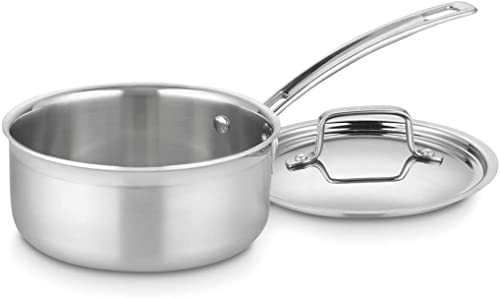
2. Cuisinart MultiClad Pro 3.5-Quart Saucepan — for the large ring of a double hot plate
A double hot plate changes the arithmetic of the small kitchen, because its larger surface — commonly around ten inches — can carry a saucepan that would straddle a single ring and sulk. Cuisinart’s MultiClad Pro three-and-a-half-quart saucepan is built for that bigger circle. The line is triple-ply: a pure aluminium core bonded between stainless layers, with what Cuisinart calls Heat Surround technology carrying the core up the side walls, and the company documents the range as suitable for induction alongside conventional stovetops. The flat base of the three-and-a-half-quart size runs roughly seven and a half to eight inches across — too wide for a six-inch single ring, where its outer floor would hang past the heat, and exactly right for the large ring, where the whole base is fed and the extra quart of capacity turns the pan into a small stockpot for pasta, potatoes, and batch cooking.
The details suit the double-burner household’s habits. The rim is rolled for drip-free pouring, which matters when the destination is a bowl on a crowded counter rather than a sink beside a range. The main handle is Cuisinart’s Cool Grip design, hollow cast stainless that stays comparatively cool on the stovetop, and there is a helper handle opposite for the two-handed carry that three and a half quarts of water demands — that full load runs close to thirteen pounds, a figure worth respecting on a glass double unit, whose larger sheet is also its more flexible one. Set the pan down squarely, and the glass will not notice; drop it an inch, and it might. On the smaller ring of the same double unit this pan can still work in a pinch, centred carefully, but its home is the big circle, and the guide places it there without apology.
Strengths
- Triple-ply build with an aluminium core carried up the walls, for even heating across a wide base.
- Base size is honestly matched to the big circle of a double unit rather than squeezed onto a single ring.
- Documented as induction-suitable, so it serves double induction units as well as coil and infrared pairs.
- Cool Grip handle, helper handle, and a drip-free rim suit full, heavy, frequent use.
Trade-offs
- Oversized for a single burner — the outer base overhangs the ring and heats unevenly there.
- Full of water it is a serious load on a glass top and must be placed, never dropped.
- The brushed exterior shows water spotting in hard-water households unless dried after washing.
Who it suits
Households running a double hot plate as their main cooker — the garden-flat kitchen, the annexe, the serious dorm setup — will get the most from this pan, because it converts the large ring into a true batch-cooking station. It is the big-pot answer to the first pick’s everyday answer, sized for the surface it will actually sit on, so compare your ring diameter and then check price on Amazon.
Check price on Amazon: Cuisinart MultiClad Pro Saucepan


3. Duxtop Professional Stainless Steel Saucepan — the portable induction specialist
Most cookware that works on induction was designed for a full-size induction range and merely tolerates a portable ring. Duxtop’s Professional line comes at the problem from the other direction: the brand’s main business is portable induction cooktops, sold under the same name, and its cookware is built to the dimensions those units demand. The Professional saucepans are whole-clad tri-ply — stainless steel around an aluminium core through the entire body, not just a disc on the bottom — with a magnetic base engineered for induction coupling, and the two-and-a-half-quart size carries a flat base of roughly six and a half inches, squarely inside the detection window that portable induction units publish. Where a range-sized pan can sit half on and half off a portable ring’s field, this base sits wholly inside it, which is why the pan answers the control dial with an immediacy that surprises cooks raised on coil burners.
That responsiveness is the pick’s real argument. Portable induction is chosen for precision — chocolate, custards, a beurre blanc in a rented kitchen — and precision is wasted on a base that lags. The whole-clad build also removes the failure mode of cheap induction cookware, the bonded disc that separates or drums after a few hundred heat cycles; there is no disc here to fail. The saucepan carries a tempered glass lid with a steam vent, a riveted stay-cool handle, and measurement markings inside, small mercies that compound in a kitchen with one burner and no spare counter. It also works, of course, on coil and infrared plates, since magnetic stainless is welcome everywhere; but its reason for being on this list is the portable induction household, which is the fastest-growing corner of the hot plate world and the one most ill-served by cookware designed for ranges. Buyers should note the base diameter discipline runs both ways: the larger Professional stockpots exceed a portable ring’s window and belong on the brand’s bigger units or a range, so keep to the saucepan sizes named here.
Strengths
- Whole-clad tri-ply construction with no bonded disc to separate, drum, or delaminate.
- Base diameter sits inside the published detection window of portable induction units.
- Built by a brand whose core product is the portable induction burner itself, so dimensions are designed rather than accidental.
- Responsive to induction’s fine control — the pan for delicate sauces on a single ring.
Trade-offs
- The saucepan sizes are modest; the line’s big stockpots outgrow a portable ring’s window entirely.
- Whole-clad pricing sits above disc-base induction cookware of similar capacity.
- The glass lid’s vent makes it a poor choice for long, sealed, low-water braises.
Who it suits
Owners of a portable induction unit — the renter who chose induction for its cool glass and fine control, the office kitchen, the caravan with an inverter — should start here, because this is the rare saucepan drawn to the same scale as their burner. It rewards the dial rather than fighting it, and its base was measured against the ring from the first sketch, so give your induction plate the pan it was designed around and check price on Amazon.
Check price on Amazon: Duxtop Professional Saucepan

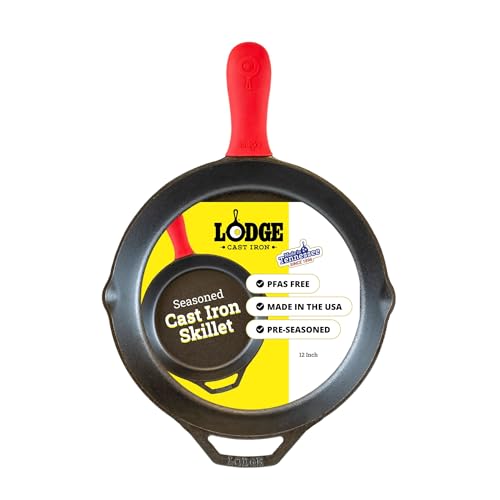
4. Lodge Seasoned Cast Iron Skillet, 10.25 Inch — the coil and infrared heavyweight
Every hot plate kitchen eventually wants to sear something, and searing on a small electric burner is a problem of stored heat: the moment cold meat lands, a light pan’s temperature collapses and the element takes its time recovering. Cast iron solves the problem with mass. Lodge’s 10.25-inch skillet — the company’s founding format, seasoned with vegetable oil and documented by Lodge for use on all cooking surfaces, induction included — weighs a little over five pounds empty, and that iron is a battery. Bring it up to heat slowly on a coil or infrared plate, and it holds a searing temperature through the landing of a steak in a way no clad pan on a six-inch ring can match. The underside of the modern Lodge skillet is machined flat across a contact patch of about eight inches, which is why this pick is assigned to the large ring of a double unit or a generously sized single infrared plate, and not to a small coil it would dwarf.
The cautions are as much a part of this pick as the praise, and Lodge’s own care guidance supports them. On a glass-topped hot plate, cast iron must be lifted, never slid — the rough underside can score ceramic glass, and a five-pound pan set down carelessly concentrates its arrival on one edge. The weight arithmetic of the earlier section applies in full: skillet, food, and rendered fat together can pass nine pounds, within the documented load of most glass units but deserving of a two-handed, deliberate placement. On a coil burner the manners relax — the metal top does not scratch, and the coil’s ridges meet the iron’s flat base happily — which is why the coil household gets this pick with the fewest reservations. Seasoning maintenance is the other honest cost: the pan is washed, dried on the warm burner, and oiled lightly, a ritual its owners tend to defend fiercely and its detractors cite as the reason nonstick exists. Both are right; the guide simply notes that on a hot plate, where stored heat is the scarcest resource, iron earns its ritual.
Strengths
- Thermal mass holds searing heat through the temperature collapse that defeats light pans on small burners.
- Flat machined base of about eight inches fits the big circle of a double burner or a wide single infrared plate.
- Documented by Lodge for all cooking surfaces, including induction, so it crosses burner types freely.
- Seasoned surface improves with use and tolerates metal utensils and high heat without complaint.
Trade-offs
- Heavy — over five pounds empty — and must be lifted rather than slid on glass, and set down with care.
- Too wide for a small single coil, where most of its base would hang past the heat.
- Seasoning asks for a wash-dry-oil routine that nonstick owners may not want to adopt.
Who it suits
The coil-burner cook who refuses to give up a proper sear, and the double-unit household with a wide infrared ring, are this skillet’s people. It turns a portable burner’s weakness — recovery time — into a non-issue by arriving pre-loaded with heat, and it will outlast the hot plate, the kitchen, and possibly the cook, so treat the glass kindly and check price on Amazon.
Check price on Amazon: Lodge Cast Iron Skillet


5. T-fal Professional Total Nonstick Fry Pan — the light, flat disc for glass tops
The glass-topped infrared hot plate has one cookware problem the coil never faces: everything slides. A light pan on a tilted dorm counter, a spoon resting against a rim, a nudge from a kettle — and the pan wanders off the ring’s centre. The defence is a base that is flat, broad enough to be stable, and mated to a pan light enough to reposition without drama. T-fal’s Professional Total Nonstick fry pan, in the 10.25-inch size, answers with a machined flat disc base — stainless steel on the induction-ready variant of this line, a point the variant notes below flag carefully, because T-fal sells sibling lines whose bases are not magnetic — under an aluminium body light enough to move with one hand even when it carries a frittata. The flat contact patch runs about seven and a half inches, which centres it on the large surface of a double unit or a wide single glass plate.
Inside, the pan carries the features T-fal documents for the Professional line: a ProGlide nonstick interior and the Thermo-Spot heat indicator, the patterned disc in the centre that turns solid red when the pan has preheated. On a burner with no visible glow — an induction ring, or an infrared plate before it colours — that indicator replaces guesswork, and for eggs, pancakes, and fish, the foods a small kitchen cooks most in a fry pan, a known starting temperature is the difference between release and wreckage. The riveted handle is silicone-wrapped and the whole pan is notably undemanding: no seasoning, no soaking, a wipe and a rinse. Its limits are the honest limits of nonstick — the maker rates it for moderate heat rather than ripping sears, metal utensils are discouraged, and the coating is a consumable with a lifespan measured in years, not decades. Within those limits, and on glass where its light weight is a virtue rather than a compromise, it is the easiest pan in this guide to live with.
Strengths
- Machined flat disc base sits stably on glass and centres well on the large ring.
- Light aluminium body is easy to lift, tilt, and reposition on a small surface.
- Thermo-Spot indicator signals preheat on burners that give no visible glow.
- Nonstick interior handles the egg-and-pancake traffic of small kitchens with minimal washing up.
Trade-offs
- Nonstick coating is a finite-life surface; this is a pan replaced on a cycle, not inherited.
- Documented for moderate heat — the searing job belongs to the cast iron pick.
- The line includes non-induction variants; the base must be confirmed magnetic for induction use.
Who it suits
Glass-top owners who cook breakfast more often than steak — the studio cook doing eggs and grilled sandwiches on a single infrared plate — will use this pan daily and forgive its finite life without thinking twice. It is the low-effort, low-weight, flat-based answer for delicate food on a smooth surface, so put the iron away for the morning and check price on Amazon.
Check price on Amazon: T-fal Professional Fry Pan

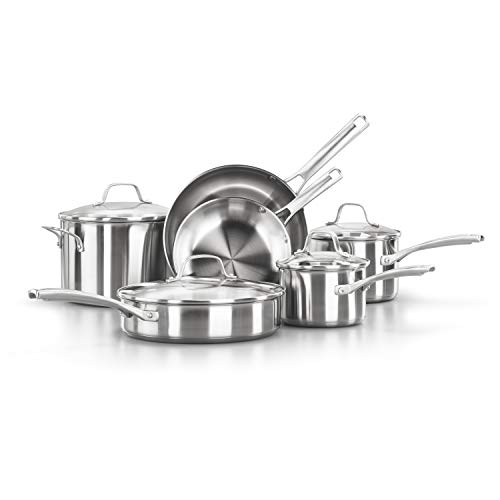
6. Calphalon Classic Stainless Steel 2.5-Quart Sauce Pan — the compact pot for coil and infrared
The smallest kitchens sometimes run the smallest burners, and the smallest burners deserve one pick drawn exactly to their scale. Calphalon’s Classic stainless steel line is built around an impact-bonded aluminium base — a disc of aluminium fused to the stainless body to spread heat — and the two-and-a-half-quart covered saucepan lands its flat base at roughly six inches, the natural partner of a compact single coil or a small infrared ring. Calphalon documents the Classic line for gas, electric, halogen, and glass stovetops, and — this is the discipline this guide keeps — does not list induction among them, so this pick is assigned plainly to coil and infrared households and withheld from induction owners, who have the Duxtop and Tramontina picks above. A pan honestly matched beats a pan hopefully matched, every time.
Within its assignment, the little saucepan is well thought out for tight quarters. The base disc is thick enough to resist the doming that plagues stamped pans at this size, so the pot keeps its flat seat season after season of noodle water and reheated beans. The lid carries a straining design with pour spouts on the pan’s rim — Calphalon fits the Classic saucepans with lids whose edges align to drain pasta or potatoes without a colander, a feature that sounds minor until the kitchen in question has one burner, one small sink, and no counter to spare for a colander’s landing. Fill lines are etched inside, the handle is riveted cast stainless, and the whole vessel is light enough that a full pot is a comfortable one-handed pour for most cooks. It will not sear, it will not feed six, and it will not work on induction; it will sit dead flat on a six-inch burner and do the daily boiling of a small household without a single wobble, which is precisely the job it was chosen for.
Strengths
- Base of roughly six inches is drawn to the scale of compact single burners rather than adapted to them.
- Impact-bonded aluminium base resists the warping that unseats thin small pans.
- Straining lid and pour spouts remove the colander from a one-sink kitchen’s routine.
- Documented by the maker for electric, halogen, and glass stovetops — the coil and infrared assignment is published, not assumed.
Trade-offs
- Not induction compatible — the maker’s documentation omits it, and this guide does not override the maker.
- Two and a half quarts caps the household size it can serve as the main pot.
- The bonded-disc base spreads heat well at this diameter but lacks the wall conduction of fully clad rivals.
Who it suits
The single-coil dorm room, the RV galley, the office kitchenette reheating lunch — anywhere the burner is small, conventional, and asked to boil reliably — is this saucepan’s parish. It asks nothing exotic of the surface beneath it and gives back a flat seat and an easy pour, so measure your little ring, nod once, and check price on Amazon.
Check price on Amazon: Calphalon Classic Saucepan
The six picks side by side
The table compresses the matching logic of the whole guide into one view: base construction, the size of the contact patch, the burner types each manufacturer documents, and the job each vessel does best on a portable surface.
| Pick | Base construction | Base size class | Burner types | Best job |
|---|---|---|---|---|
| Tramontina Tri-Ply Clad 3-Qt Sauce Pan | Fully clad tri-ply, magnetic outer layer | Single-burner band, about 6–7 in | Coil, infrared, induction | Everyday sauces, grains, and soups on one ring |
| Cuisinart MultiClad Pro 3.5-Qt Saucepan | Triple-ply, aluminium core up the walls | Large-ring band, about 7.5–8 in | Coil, infrared, induction | Batch cooking on the big ring of a double unit |
| Duxtop Professional Saucepan | Whole-clad tri-ply, magnetic base | Single-burner band, about 6.5 in | Induction first; coil and infrared too | Precision work on a portable induction ring |
| Lodge Cast Iron Skillet 10.25 In | Cast iron, machined flat underside | Large-ring band, about 8 in | Coil, infrared, induction | Searing, where stored heat beats recovery time |
| T-fal Professional Fry Pan 10.25 In | Aluminium body, machined disc base | Large-ring band, about 7.5 in | Infrared and coil; induction on the magnetic variant | Eggs, pancakes, and fish on glass |
| Calphalon Classic 2.5-Qt Sauce Pan | Stainless, impact-bonded aluminium base | Compact band, about 6 in | Coil and infrared — not induction | Daily boiling in the smallest kitchens |
Read the table by burner first and by food second. The burner column is a hard filter — a pan the field cannot heat or the ring cannot feed is not a compromise but an error — while the best-job column is a soft ranking among pans that all pass the filter. Households with two burner types in their lives, a coil in the dorm and an induction unit at home, should weight the three all-surface picks at the top of the table accordingly.
Pairing cookware to the burner you actually own
Coil owners hold the easiest hand. The coil forgives thin bases, accepts every material in this guide, and shrugs at weights that glass owners must calculate, so the coil household can choose by food alone: the Calphalon for daily boiling, the Lodge for searing, the Tramontina when one pan must do everything. The single discipline coil still imposes is diameter — keep the base near the coil’s span, because a wide base on a narrow coil heats in a ring and the overhang becomes a handle-side lever.
Infrared owners cook on glass, and glass adds two rules: flatness and manners. The base must be a true plane, because radiant transfer happens across the contact patch, and the pan must be lifted rather than slid, set down rather than dropped. The T-fal’s light disc and the two clad saucepans are the natural citizens here; the Lodge is welcome with its manners minded. Owners cross-shopping fixed glass surfaces will find the same physics at larger scale in this site’s coverage of ‘ closest electric relatives — though gas itself, with its forgiving grates, is the one common surface where none of this discipline applies, which is exactly why hot plate cookware cannot be chosen by range habits.
Induction owners start from the maker’s word. The field couples only into documented magnetic bases, and only where the base covers the ring, so the shortlist writes itself: Tramontina, Cuisinart, Duxtop, and the Lodge, in the sizes whose bases fall inside the unit’s published window. The Calphalon is excluded by its own documentation and the T-fal only in its magnetic-base variant. An induction household that respects those two lines will never stand over a cold pan wondering why.
Mistakes that make good cookware behave badly on a hot plate
The commonest error is buying by rim diameter. The number on the box measures the top of the pan, but the burner meets the bottom, and the bottom of a flared pan can be two inches narrower than its rim — a twelve-inch skillet whose base is eight inches may fit a large ring beautifully, while a ten-inch saucepan with a six-inch base starves on the same ring. Measure the base, or find it in the maker’s dimensions, before anything else is decided.
The second error is the overhang shrug: centring a wide pan on a small ring and accepting the cold rim as a personality trait. Beyond uneven cooking, an overhung pan on a portable unit is top-heavy in a way a range pan never is — the handle’s leverage acts on a vessel whose support circle is smaller than its floor, and a bumped handle can walk the whole pan toward the edge. The third error is thermal impatience: putting a cold pan on a burner already at full power. Small elements concentrate their output, and the shock gradient is what bows bases over a season; thirty seconds of patience at medium while the pan warms through preserves the flatness the purchase was based on. The fourth is sliding — on glass, always sliding — and the fifth is assuming that because a magnet sticks weakly to a base, an induction unit will heat it well. Weak coupling means slow, uneven heating; the maker’s compatibility list, not the magnet, is the contract.
Building a hot plate kit in the right order
A one-burner kitchen does not need six pans; it needs the right two first, in the right order, and the picks above were arranged with that sequence in mind. The first purchase is always the lidded saucepan sized to the ring, because it covers the largest share of actual cooking — boiling, reheating, grains, sauces, soups — and because its lid multiplies the little burner’s effective power. For most single units that means the Tramontina on any burner type, the Duxtop where the unit is induction and precision matters, or the Calphalon where the burner is a small coil and the budget of space is tighter than the budget of money. The second purchase is the skillet, chosen by the food the household actually fries: the Lodge where searing is a weekly event and the surface can take its weight and manners, the T-fal where breakfast is the main event and the top is glass.
The double-burner household reverses nothing but adds one step: after the everyday saucepan, the large-ring saucepan — the Cuisinart here — converts the second surface from a warming zone into a batch-cooking station, and only then does a skillet earn its shelf space. What no hot plate kitchen should buy early is the big stockpot. It is the piece most often donated, unused, when a small kitchen is packed up, because its base overhangs, its full weight bullies glass, and its jobs — pasta for six, stock from carcasses — are the jobs a one-or-two-burner household does least. If a recipe truly demands volume, a deep saucepan in the large-ring band borrows most of the stockpot’s usefulness at half its footprint. Kits built in this order stay small, stay flat-based, and stay matched to the rings they serve, which is the entire philosophy of this guide compressed into a shopping sequence.
Frequently asked questions
Can I use my regular range cookware on a hot plate?
Often, yes — if the base is flat, magnetic where induction requires it, and close in diameter to the burner surface. Range cookware fails on hot plates for geometric reasons, not quality reasons: bases too wide for the ring, domed bottoms that rock on glass, and stockpots whose full weight exceeds what a portable glass top is documented to carry. Check those three things and most sound pans transfer without trouble.
Why does my pan spin or rock on a glass hot plate?
Because its base is no longer flat. Heat concentrated under a small circle expands the centre of a thin base faster than its rim, and over time the bottom bows into a dome that touches only at the middle — the pan then balances on that dome and spins at a touch. Thick clad and heavy disc bases resist the bowing; a pan already domed belongs on a coil burner, whose ridges tolerate it, rather than on glass.
What base size should I choose for a single versus a double hot plate?
Match the flat contact patch to the burner surface, slightly under rather than over. Single units commonly present a surface of about six to seven inches, which suits saucepans and pans with bases in that same band; the larger surface of a double unit, commonly around ten inches, carries ten-inch skillets and larger saucepans with bases in the seven-to-eight-inch range. The diameter printed on packaging is the rim — the base is smaller, and the base is the number that matters.
Is cast iron safe on a glass-top hot plate?
Yes, with manners, and Lodge documents its skillets for all cooking surfaces including glass and induction. The conditions are mechanical: lift the pan rather than sliding it, since a rough iron underside can score ceramic glass; set it down flat rather than dropping an edge; and count the full weight — pan, food, and fat — against the load the hot plate’s documentation allows. On a coil burner none of these cautions apply with the same force.
How do I know whether a pan will work on an induction hot plate?
Trust the manufacturer’s published compatibility statement first: brands list the stovetop types each line is built for, and induction appears only where the base construction is magnetic. A strong magnet grip on the base is a reasonable screening habit, but a weak or partial grip warns of slow, uneven coupling, and some magnetic-seeming bases still fall outside a portable unit’s detection window if their diameter is too small. When the maker’s list and the magnet disagree, the maker’s list wins.
Every kitchen in this guide’s audience is, by definition, making do with less stove than it wants — and the quiet discovery waiting on the other side of that constraint is that a small burner with the right pan on it cooks with a precision and calm that a big range, loaded carelessly, rarely matches.