Disclosure: topratedkitchenware.com is reader-supported. When you buy through links on our site, we may earn an affiliate commission from Amazon and other retailers, at no extra cost to you.
Where to buy
These six picks answer the search for best pressure cookers for beans: the linked models are sold on Amazon, and the prose-only profiles are included so the comparison stays honest. Start with the shortlist here, read the full guide further down, and use any Check on Amazon link to see the live listing for that exact model before you buy. Read the full guide ↓
- Hamilton Beach 6 Quart Slow Cooker 33665G — Best Overall for Beans. Check on Amazon
- Crock-Pot Programmable Slow Cooker 8-Quart, Black Stainless Steel — Best for Big Bean Batches. Check on Amazon
- AROMA Digital Rice Cooker ARC-914SBD, 4-Cup Uncooked — Best Compact Multicooker for Small Bean Pots. Check on Amazon
- Cosori Rice Cooker 10 Cup with Fuzzy Logic — Best for One-Pot Bean Flavour. Check on Amazon
- BLACK+DECKER Rice Cooker 6-Cup Cooked — Grain Cooker, Not a Bean Pot (Prose-Only) (prose-only profile, not linked in this guide).
- AROMA Rice Cooker ARC-363NG, 3-Cup Uncooked — Small Grains and Soup, Not Beans (Prose-Only) (prose-only profile, not linked in this guide).
Anyone searching for the best pressure cookers for beans wants the same small miracle: dried beans, bought cheap and stored forever, turned tender and flavourful without a day of planning. Pressure cooking is famous for that miracle because a sealed pot hydrates and softens legumes faster than any other home method. This guide owes you the truth about its own shortlist before anything else: the verified pool behind it contains no true sealed pressure cooker. Not one of the six picks below will give you pressure speed, and this guide will not pretend otherwise.
What the shortlist does contain is the other great bean tradition. Four picks genuinely cook beans well by the slow and multi-function route, and they are linked as recommendations for that job: two stoneware slow cookers from Hamilton Beach and Crock-Pot that can hold a serious batch at a gentle simmer all day, a compact AROMA multicooker for small pots, and a Cosori fuzzy-logic platform whose verified listing names saute and slow cook modes, letting you build the aromatic base and slow the beans in the same vessel. Beans cooked this way are not a consolation prize. Slow beans absorb their cooking liquid’s flavour deeply, hold their shape for salads and stews, and ask for soaking and planning instead of pressure.
The final two picks, small rice cookers from BLACK+DECKER and AROMA, are profiled prose-only and deliberately not linked. Small rice vessels foam, crowd and undercook dried beans too easily to be honest bean recommendations, and linking them under this keyword would invite a disappointing, gummy batch. They appear so the comparison is complete and so grain-first readers can judge them for their real job. Throughout the guide, the pressure method is explained in prose: what it would add, how its timings and liquid levels differ, and how to convert between the methods without ruining dinner. Readers starting from the broader category can compare this bean-first view with our guides to Best Pressure Cookers For Mushrooms and Best Pressure Cookers For Quart Jars, where pressure is asked to do very different jobs from dinner.
No prices are printed here, because listings change; linked picks carry Check on Amazon links to their live listings, and tiers are described in words. One safety point belongs in the introduction rather than buried later: certain beans, most famously red kidney beans, contain a natural lectin that must be destroyed by a proper vigorous boil. Slow cookers should not be trusted to do that job from raw, so this guide’s method pre-boils kidney beans on the stove before they meet any slow pot, or uses canned beans for that variety. Flavour advice can be flexible; that point is not.
Key Takeaways
- No pick in this verified shortlist is a true pressure cooker; the linked picks cook beans by the slow and multi-function methods, and the guide says so openly rather than inventing pressure performance.
- Best bean pick for most households: the Hamilton Beach 6 Quart Slow Cooker, whose size, stoneware and simple settings suit a weekly bean batch with leftovers.
- Best for big batches: the Crock-Pot Programmable 8-Quart, whose verified listing pairs crowd capacity with a digital timer up to 20 hours and automatic warm.
- Best one-pot flavour building: the Cosori Rice Cooker 10 Cup, whose listing names saute and slow cook in one ceramic-coated vessel.
- Red kidney beans need a vigorous pre-boil before slow cooking, or should be used canned; no slow setting in this guide should be asked to make raw kidney beans safe.
- Two small rice cookers are profiled prose-only and not linked: they are grain tools, not honest bean pots.
In this guide
Quick Picks
Badges in this table follow each pick through the whole guide. Note the two prose-only rows at the bottom: they are compared fairly, but they carry no link, because a bean guide should only sell you pots that cook beans well.
| Badge | Pick | Key specification | Best for |
|---|---|---|---|
| Best Overall for Beans | Hamilton Beach 6 Quart Slow Cooker 33665G | 6-quart stoneware; 3 cooking settings; dishwasher-safe crock and glass lid | households cooking a weekly bean batch with flavour and leftovers in mind |
| Best for Big Bean Batches | Crock-Pot Programmable Slow Cooker 8-Quart, Black Stainless Steel | 8-quart for 10+ people; digital timer up to 20 hours; automatic warm; dishwasher-safe parts | batch cookers, large families and freezer stockers who load beans before work |
| Best Compact Multicooker for Small Bean Pots | AROMA Digital Rice Cooker ARC-914SBD, 4-Cup Uncooked | 4-cup uncooked / 8-cup cooked; 2 Qt; steamer, grain cooker and multicooker positioning | single cooks and couples making small bean, soup and grain pots |
| Best for One-Pot Bean Flavour | Cosori Rice Cooker 10 Cup with Fuzzy Logic | 10-cup uncooked / 20-cup cooked; fuzzy logic; 18-in-1 with saute and slow cook; ceramic-coated pot | flavour-first cooks wanting saute, slow beans and grains in one sensed pot |
| Grain Cooker, Not a Bean Pot (Prose-Only) | BLACK+DECKER Rice Cooker 6-Cup Cooked | 6-cup cooked; steaming basket; removable non-stick bowl | cooking the rice half of rice and beans in a household with a real bean pot |
| Small Grains and Soup, Not Beans (Prose-Only) | AROMA Rice Cooker ARC-363NG, 3-Cup Uncooked | 3-cup uncooked / 6-cup cooked; 1.5 Qt; oatmeal cooker and soup maker; automatic keep warm | single cooks wanting rice, oatmeal and quick soups in a tiny footprint |
How These Picks Were Chosen
Candidates for this guide were taken from a verified research pool for the cooker category and then judged against a bean-specific standard, because beans expose weaknesses that rice hides. A bean pot needs sustained gentle heat without hot spots that scorch the bottom layer, enough capacity for beans that roughly double or more in volume as they hydrate, a lid that holds moisture across a long cook, and, ideally, a way to build the aromatic base, the onion, garlic, spices and tomato that turn beans from plain to dinner, without dirtying a second pan unnecessarily.
Pressure performance was tested as a binary question against each verified listing: does the listing describe a sealed pressure function? None did, so none was credited, and the guide’s framing was rebuilt honestly around the slow tradition instead of borrowing pressure language. Within that framing, dedicated stoneware scored highest for batch beans, the Cosori scored highest for one-pot flavour building because its listing explicitly names saute alongside slow cook, and the two small rice cookers failed the capacity and foaming test for dried beans, which is why they sit prose-only. The same listing-first discipline governs our companion guides across the cooker category, where function claims are checked in the same way.
This is research-led guidance built from verified specifications, manufacturer documentation and the accumulated owner experience of these long-running cooker platforms. It makes no claim of laboratory testing. Where bean advice involves safety, the guide follows the conservative, widely published food-safety position: soak dried beans, boil kidney beans vigorously before slow cooking, add acidic ingredients late because acid firms bean skins, and refrigerate cooked beans promptly in shallow containers.
The 6 Best Pressure Cookers for Beans, Reviewed Honestly
Each review states what the verified listing promises, how the pot actually handles a bean batch, where it compromises, and who should skip it. Read the capacity notes with bean maths in mind: dried beans expand substantially as they cook, foam early in the process, and reward a pot filled no more than about two-thirds, so headline capacity is never bean capacity.

Hamilton Beach 6 Quart Slow Cooker 33665G
Badge: Best Overall for Beans
Strengths
- Stoneware’s even surround heat keeps bean skins intact while interiors turn creamy
- Six-quart class holds a proper weekly batch inside the two-thirds fill rule
- Dishwasher-safe crock and lid make the bean habit easy to repeat
Trade-offs
- No programmable countdown, so timing discipline belongs to the cook
- No saute function: the aromatic base is built in a separate pan
- Slow only, so bean day must be planned rather than improvised
Key specifications (from the verified listing)
- Capacity: 6 quart, per the verified listing
- Cooking settings: 3, per the verified listing
- Vessel: stoneware crock, described as dishwasher-safe
- Lid: glass, described as dishwasher-safe
- Finish: silver; model 33665G
The Hamilton Beach takes the lead badge for beans because beans reward exactly what this pot is: a stoneware vessel, a glass lid, three settings and no distractions. Stoneware heats gently and evenly from all sides, which is the thermal personality dried legumes love, softening through without the violent bubbling that bursts skins in a hard-driven pot. At six quarts, the working batch after the two-thirds rule is the size a bean-eating household actually consumes in a week of soups, salads and burritos, with a freezer portion left over as a bonus rather than a burden.
Its simplicity shapes a reliable routine. Soak the night before, build the base in a pan while the crock warms, load, and leave it alone, judging through the glass. There is no program to mis-set and no display to fail in year five, and when the batch is done, both the crock and the lid are described in the verified listing as dishwasher-safe, which is the unglamorous feature that decides whether bean cooking becomes a habit or a memory. For flavour-first bean cooks, that repeatability beats any feature list.
The limitations are timing and browning. Without a programmable countdown, a batch loaded before a long and unpredictable day can ride past tenderness, so this pot suits cooks who are home or whose days are regular. And with no saute mode, the onion, garlic and spice base happens in a pan you wash separately, a small tax the Cosori below avoids. Neither point dents its position as the default bean pot of this guide.
Best for: households cooking a weekly bean batch with flavour and leftovers in mind / Not suited for: last-minute bean cooking, or anyone needing a timer to end the cook
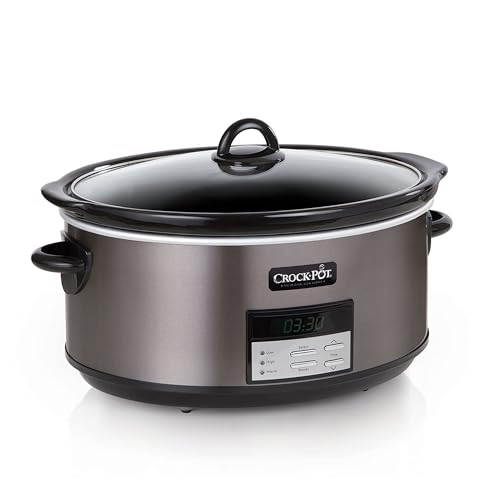
Crock-Pot Programmable Slow Cooker 8-Quart, Black Stainless Steel
Badge: Best for Big Bean Batches
Strengths
- The batch capacity bean stockpilers actually need, inside the fill rule
- Programmable timer with automatic warm protects a batch loaded before work
- Stoneware gentleness at scale, with dishwasher-safe cleanup afterwards
Trade-offs
- Large and heavy: it needs a permanent home and two hands when full
- A small bean batch will rattle around in it and cook unevenly at the edges
- No saute function for building the base in the pot itself
Key specifications (from the verified listing)
- Capacity: 8-quart, described as serving 10+ people
- Timer: digital, up to 20 hours, per the verified listing
- Warm: automatic warm setting after cooking
- Vessel and lid: stoneware pot and lid described as dishwasher-safe
- Finish: black stainless steel
Bean cooking scales beautifully, and this is the pot for households that cook it at scale: the freezer stockers, the soup-for-the-week planners, the families for whom a bean batch is measured in dinners plural. Its verified listing pairs an 8-quart capacity, described as serving ten or more people, with a digital timer running up to 20 hours and an automatic warm setting, which is the exact combination batch bean cooking asks for, because the bigger the batch, the more expensive a timing mistake becomes.
Programming is the quiet hero here. A large crock loaded before work can be trusted to end its cook and hold the beans at serving warmth, rather than simmering them into collapse through a delayed evening, and that trust is what turns an occasional big batch into a system. Stoneware keeps the gentleness that beans want even at this size, and the listing’s dishwasher-safe stoneware and lid keep the aftermath proportional to the production, which at this scale is no small mercy.
Buy it for demonstrated volume. Cooked at a sensible fill it is magnificent; cooked with a modest two-person batch it is a wide, shallow puddle that dries at the edges and wastes the pot’s talents. It also shares the family limitation of its class: no saute, no pressure, and a footprint that must be measured before, not after, purchase. For the batch household, none of that outweighs capacity plus timing discipline in one vessel.
Best for: batch cookers, large families and freezer stockers who load beans before work / Not suited for: small batches, small kitchens, or anyone cooking beans for one or two

AROMA Digital Rice Cooker ARC-914SBD, 4-Cup Uncooked
Badge: Best Compact Multicooker for Small Bean Pots
Strengths
- Compact size correctly matched to small, deliberate bean pots for one or two
- Multicooker positioning covers bean-adjacent grains, soups and steamed sides
- Digital programs remove guesswork for small households cooking varied pots
Trade-offs
- Two quarts is a hard ceiling: no family batches, no freezer stocking
- A grain-first vessel, so long bean cooks are a supporting role, not its speciality
- No pressure and no stoneware-style slow depth in its listing
Key specifications (from the verified listing)
- Capacity: 4-cup uncooked / 8-cup cooked; 2 Qt, per the verified listing
- Functions named in the listing: rice cooker, steamer, grain cooker, multicooker
- Exterior: stainless steel
- Model: ARC-914SBD
Not every bean cook needs a batch, and the AROMA ARC-914SBD is this guide’s answer for the small, deliberate pot: a 2 Qt digital platform whose verified listing names rice cooker, steamer, grain cooker and multicooker roles in a stainless steel body. For a single cook or a couple, its virtue is proportion. A modest quantity of beans, lentil-adjacent pots, bean-and-grain soups and the rice to serve them with all live comfortably at this scale, where the big crocks would cook a small batch thinly and unevenly.
Judged honestly, its bean work is the lighter end of the guide’s range. The vessel is a grain cooker first, its programmes are tuned to absorption cooking, and a long dried-bean session asks it to play a supporting role rather than the lead. Lentils, split peas and small soaked batches suit it best, especially where the same pot then produces the rice or steamed vegetables that complete the plate. Within those terms it is a genuinely useful small-kitchen bean option, and it is linked on exactly those terms.
Do not promote it beyond them. It will not stock a freezer, will not feed a gathering, and its kidney-bean batches still begin with the stovetop pre-boil this guide insists on. Households whose bean ambitions grow will graduate to the stoneware above and keep this pot for grains, which is a honourable second career for any compact multicooker.
Best for: single cooks and couples making small bean, soup and grain pots / Not suited for: batch cooking, large families, or pressure-speed expectations

Cosori Rice Cooker 10 Cup with Fuzzy Logic
Badge: Best for One-Pot Bean Flavour
Strengths
- Saute and slow cook in one vessel: build the bean base and slow the beans without a second pan
- Fuzzy logic steadiness suits long, gentle legume and grain cooking
- Ceramic-coated pot and steamer basket extend the same session to sides and grains
Trade-offs
- A rice platform’s vessel and heat pattern, not a stoneware crock, for very large bean batches
- Coated pot requires gentle utensils and non-abrasive cleaning
- Delay timer must not be used to leave soaking beans waiting at room temperature
Key specifications (from the verified listing)
- Capacity: 10 cup uncooked / 20 cup cooked, per the verified listing
- Logic: fuzzy logic control
- Functions named in the listing: 18-in-1, including saute and slow cook
- Inner pot: ceramic coating, described as non-stick
- Timing: 24H keep warm and delay timer, per the listing
- Accessory named in the listing: stainless steel steamer basket
The Cosori earns its bean badge on a single decisive combination that its verified listing states outright: saute and slow cook in the same vessel, inside an 18-in-1 fuzzy-logic platform with a ceramic-coated inner pot. Bean flavour is built before the beans ever soften, in the onion, garlic, peppers, spices and tomato paste bloomed in fat, and this is the only linked pick here that lets you build that base and then slow the batch without moving pots or washing a pan in between. For flavour-first cooks, that is not a convenience; it is the recipe.
Its slow mode handles soups, bean pots and grain-legume mixtures with sensor-guided steadiness, and the platform’s grain mastery means the rice, quinoa or other base for the plate comes from the same appliance on another setting. The steamer basket named in the listing rounds out the session with vegetables. Used with the guide’s discipline, soaked beans, acids held to the end, kidney beans pre-boiled on the stove first, it produces bean dishes with a depth the plainer pots reach only with an extra pan’s help.
The boundaries are vessel and care. A rice-shaped coated pot will not match an oval stoneware crock for a huge joint-adjacent bean batch, the coating wants silicone and wood rather than metal, and the delay timer, useful for grains, must never be used to park soaking beans at room temperature. Respect those terms and this is the most complete one-pot bean instrument in the guide.
Best for: flavour-first cooks wanting saute, slow beans and grains in one sensed pot / Not suited for: huge stoneware batches, metal-utensil habits, or pressure timetables
BLACK+DECKER Rice Cooker 6-Cup Cooked
Badge: Grain Cooker, Not a Bean Pot (Prose-Only)
Strengths
- As a rice cooker for bean-adjacent meals, it is simple and dependable
- Steaming basket adds the vegetables that complete a rice-and-beans plate
- Removable non-stick bowl serves and washes without fuss
Trade-offs
- Not a bean pot: small rice vessels foam and crowd dried legumes badly
- No slow, saute or pressure function appears in its verified listing
- Cooked capacity suits a side dish, never a bean batch
Key specifications (from the verified listing)
- Capacity: 6-cup cooked, per the verified listing
- Accessory named in the listing: steaming basket
- Bowl: removable, non-stick
- Finish: white
This BLACK+DECKER appears in a bean guide to make a distinction that protects your dinner. As a rice cooker it is a sound, simple tool: six cups of cooked grain, a steaming basket, and a removable non-stick bowl. Served beside beans cooked in a proper pot, it does its half of a rice-and-beans plate perfectly well, and a household that already owns a bean solution could buy it for exactly that supporting role with this guide’s blessing.
As a bean cooker itself, it fails the physics. Dried beans expand well beyond their starting volume, foam as they heat, and need sustained, spacious, gentle liquid cooking; a small rice vessel offers none of that headroom, and its absorption-tuned cycle is designed to take water away into grain, not to hold legumes at a patient simmer. The predictable results are overflow, uneven tenderness and a gummy pot. So it is profiled in full and linked nowhere in this guide, because a bean guide that sells you a rice cooker as a bean pot has failed at its only job.
Best for: cooking the rice half of rice and beans in a household with a real bean pot / Not suited for: cooking dried beans themselves, in any quantity that matters
Prose-only profile: this model is covered for comparison, but it is not linked in this guide because it does not serve the main job this keyword names. See the sources note published with this guide for the reasoning.
AROMA Rice Cooker ARC-363NG, 3-Cup Uncooked
Badge: Small Grains and Soup, Not Beans (Prose-Only)
Strengths
- A sweet, small tool for rice, oatmeal and soup for one or two
- Automatic keep warm holds a small serving at readiness
- Footprint suits the smallest kitchens, dorms and office corners
Trade-offs
- Far too small and grain-tuned for dried beans in any honest sense
- No slow, saute or pressure role appears in its verified listing
- Its soup role suits canned or quick legumes at most, not dried batches
Key specifications (from the verified listing)
- Capacity: 3-cup uncooked / 6-cup cooked; 1.5 Qt, per the verified listing
- Roles named in the listing: small rice cooker, oatmeal cooker, soup maker
- Keep warm: automatic keep warm
- Finish: white; model ARC-363NG
The little AROMA ARC-363NG closes this guide as its second prose-only lesson in category honesty. Its verified listing describes a 1.5 Qt small rice cooker that also serves as an oatmeal cooker and soup maker with automatic keep warm, and for a single cook making breakfast porridge, a small rice serving or a quick soup, that is a charming and sufficient specification. Its soup role deserves one precise note: a soup built on canned beans or quick lentils, heated through in a seasoned broth, is within its talents.
A dried-bean batch is not. The vessel is too small for beans that double in volume, too grain-tuned in its heating logic for a long legume simmer, and too prone to foaming over at exactly the moment beans misbehave. Linking it here would trade on the word soup to sell a pot that cannot do this keyword’s job, so it stands profiled and unlinked, fairly praised for rice, oatmeal and soup, and plainly excused from beans. Readers who need the small-pot bean option should return to the compact AROMA multicooker above, which was linked for precisely that role.
Best for: single cooks wanting rice, oatmeal and quick soups in a tiny footprint / Not suited for: dried beans, batch cooking, or any slow or pressure expectation
Prose-only profile: this model is covered for comparison, but it is not linked in this guide because it does not serve the main job this keyword names. See the sources note published with this guide for the reasoning.
Comparison Table
For beans, read capacity as batch potential after the two-thirds fill rule, and read the control column as your schedule: manual simplicity for cooks who are home, programmable timing for cooks who are not, and sensor multi-function control for cooks who want to saute and slow in one vessel.
| Pick | Badge | Capacity | Control style | Listing |
|---|---|---|---|---|
| Hamilton Beach 6 Quart Slow Cooker 33665G | Best Overall for Beans | 6-quart | 3 settings, simple manual-style control | Check on Amazon |
| Crock-Pot Programmable Slow Cooker 8-Quart, Black Stainless Steel | Best for Big Bean Batches | 8-quart | Programmable digital timer with automatic warm | Check on Amazon |
| AROMA Digital Rice Cooker ARC-914SBD, 4-Cup Uncooked | Best Compact Multicooker for Small Bean Pots | 2 Qt / 8-cup cooked grain | Digital rice, steam and multicooker programs | Check on Amazon |
| Cosori Rice Cooker 10 Cup with Fuzzy Logic | Best for One-Pot Bean Flavour | 10-cup uncooked grain | Fuzzy logic with delay timer and keep warm | Check on Amazon |
| BLACK+DECKER Rice Cooker 6-Cup Cooked | Grain Cooker, Not a Bean Pot (Prose-Only) | 6-cup cooked grain | Simple rice cooking with steaming basket | Prose-only |
| AROMA Rice Cooker ARC-363NG, 3-Cup Uncooked | Small Grains and Soup, Not Beans (Prose-Only) | 1.5 Qt / 6-cup cooked grain | Simple cooking with automatic keep warm | Prose-only |
How to Choose a Cooker for Beans: Pressure Speed vs Slow Depth
Decide first whether your bean problem is time or flavour, because the two methods in this keyword solve different problems. Pressure solves time: dried beans, even unsoaked in many cases, become tender in a fraction of the slow timetable, which rescues weeknight cooking when the bean decision happens at five o’clock. Slow cooking solves depth and convenience of a different kind: beans simmer for hours in their seasoned liquid, absorb it as they soften, and are ready when you walk in, with a texture many cooks prefer for refried beans, bean soups and pots destined for the freezer. Neither answer is wrong; buying the slow pot while secretly needing the pressure timetable is the only wrong move, and this guide exists partly to prevent it.
Capacity maths for beans is unforgiving. Dried beans expand to well over double their dry volume, they foam as they come to temperature, and the pot should still sit no more than about two-thirds full at the start. Work backwards from the cooked quantity you actually eat: a household batching beans weekly for soups, burritos and salads will use the 6-quart class fully and the 8-quart class gratefully, while a couple cooking a modest pot for two dinners is better served by the compact multicooker, because a small batch in a huge crock cooks unevenly at the edges and dries at the surface.
Heat character matters more with beans than with almost any other food. Stoneware’s gentle, even surround heat is kind to beans: skins stay intact, interiors go creamy, and the bottom layer is less likely to catch and scorch across a long cook than in a thin metal vessel driven hard. Sensor and multi-function platforms compensate with control, holding a steadier low temperature and offering the saute step that builds the base. What beans dislike is aggression and interruption: a rolling boil bursts skins, and repeated lid lifting drops the temperature that a long cook depends on, which is why glass lids and patience appear so often in this guide.
Controls decide your bean routine. A simple settings dial suits the Saturday batch cooked while you are home. A programmable timer with automatic warm, as on the large Crock-Pot here, suits the weekday batch loaded before work, because the pot can end the cook and hold the beans safely at serving warmth rather than cooking them into collapse during a delayed commute. A delay timer on a multi-function platform suits porridge-adjacent legume dishes and overnight oats more than dried beans, which should not sit soaking at room temperature inside a warm appliance for hours before cooking begins; soak beans in the fridge, not in a delayed pot.
Finally, choose for the bean varieties you actually cook. Chickpeas and black beans are forgiving slow candidates; lentils and split peas cook so quickly by any method that they barely need this guide; white beans reward gentleness; and red kidney beans carry the safety rule stated in the introduction, pre-boil vigorously or use canned, with no exceptions for convenience. Shoppers cooking bean-heavy regional cuisines will find useful cross-reading in our guides to Best Pressure Cookers For Cuban Food and Best Pressure Cookers For Indian Cooking, where the same legumes are treated through those kitchens’ own seasoning traditions.
How to Cook Beans in a Slow Cooker or Multi Cooker, Step by Step
The method below is written for the stoneware picks in this guide and adapts to the Cosori’s slow mode with the notes given. It assumes dried beans, a planned day, and the goal of beans that are tender all the way through, flavourful from their own liquid, and firm enough to hold together in the dish they were cooked for.
- Sort and rinse. Spread the dried beans on a tray, discard stones, debris and shrivelled beans, then rinse the rest under running water. This unglamorous minute prevents the gritty batch and the cracked tooth.
- Soak with intention. Cover the beans generously with cold water and soak overnight in the refrigerator, or use a quick soak: boil for a few minutes on the stove, rest covered for an hour, then drain. Soaking shortens the slow cook, evens the texture and makes beans gentler eating.
- Pre-boil kidney beans without exception. If the batch contains red kidney beans, boil the soaked beans vigorously in fresh water on the stove for a full ten minutes before they go anywhere near a slow cooker. For other varieties this step is optional; for kidney beans it is the recipe.
- Build the base. Soften onion, garlic, peppers and spices in a pan, or in the Cosori using its saute mode, with tomato paste or smoked seasoning if the dish wants depth. Beans absorb the character of their liquid, so season the liquid like you mean it, keeping salt moderate until the end.
- Load and liquid correctly. Add beans and base to the pot, cover with fresh water or stock by a modest margin, and keep the total load at or below two-thirds full. Hold back tomatoes, vinegar, citrus and other acids until the beans are nearly tender, because acid firms skins and can double the wait.
- Cook low and leave it alone. Give the batch its hours on the gentle setting, judging progress through the glass rather than by lifting the lid. Begin checking tenderness near the expected end: a done bean crushes easily between finger and thumb and tastes creamy, not chalky, at the centre.
- Finish and store like a cook who plans to enjoy them twice. Salt properly at the end, add acid and fresh herbs now, and let the beans cool in their liquid, which they will absorb as they rest. Refrigerate in shallow containers with enough liquid to cover, and freeze portions in that same liquid for the easiest second life.
Converting a pressure bean recipe to this method is mostly patience plus liquid. Keep the aromatics and seasonings, expect the slow pot to need hours where the pressure pot needed a short sealed cook, soak the beans the pressure recipe may have skipped, and move acids and dairy to the end. Converting in the other direction, for readers who later buy a true pressure pot, means reducing liquid, because pressure loses almost none, and respecting that variety’s pressure timing rather than improvising. A method comparison laying the two timetables side by side in prose is the best companion for exactly this conversion work.
Cleaning after beans is a soak’s job, not a scourer’s. Bean starch sets into a stubborn film on stoneware and coatings alike; warm water and time loosen it completely, while abrasive pads spend the surface of the pot to save ten minutes. The Hamilton Beach crock and the large Crock-Pot’s stoneware and lid are described in their verified listings as dishwasher-safe, which makes the weekly bean habit sustainable, and the Cosori’s ceramic coating asks only for the soft sponge its finish deserves.
Troubleshooting
Problem: beans are still hard after the full cook → age, acid and hard water are the usual suspects, in that order. Old dried beans can take dramatically longer; tomatoes or vinegar added early will firm skins against softening; and very hard water slows hydration. Cook longer, add acids only at the end, and buy dried beans from a shop with brisk turnover.
Problem: skins are burst and the pot is mushy → the heat was too aggressive or the cook ran far past tenderness. Use the gentler setting, check earlier with small or quick-cooking varieties, and remember that beans destined for refrying or soup can be mushy on purpose, while salad beans should be caught at the first moment of tenderness.
Problem: the batch tastes flat despite good seasoning → the salt and acid arrived too early or never arrived at the end. Beans need their final seasoning after they are tender: salt to wake them, a splash of vinegar or citrus to brighten them, and a good oil or herb finish to carry the flavour.
Bean Varieties and How the Slow Method Treats Each One
Black beans are the slow pot’s easiest success: they soften evenly, keep a handsome shape, and drink up cumin, garlic, bay and citrus added at the right moments, which is why they anchor so many weeknight soups and burrito bowls. Chickpeas sit at the other end of the timetable, dense and patient, rewarding a full soak and a long gentle cook with the creamy interior that hummus and stews want, and punishing impatience with a chalky centre that no sauce can disguise. Pinto and kidney-family beans land between the two, with the kidney safety rule from the introduction applying in full.
White beans, cannellini and navy beans among them, are the gentleness test: cooked slowly they turn silky without disintegrating, which is what Tuscan-style soups and cassoulet-inspired pots require, while aggressive heat shatters them into the liquid. That shattering is sometimes the point; a portion of deliberately overcooked white beans mashed back into a soup is a classic thickener. Lentils and split peas barely belong in a long-cook guide at all, since they soften quickly by any method and turn to puree if given a bean batch’s full timetable, so cook them on their own shorter schedule, in the multicooker or on the stove, rather than in the big crock.
Fresh and frozen legumes change the maths again. Freshly shelled beans and frozen varieties arrive already hydrated, cook far faster than their dried equivalents, and should be added with a correspondingly shorter expectation, while canned beans, the honourable shortcut, need only heating through in a seasoned liquid and belong in the final stretch of any slow dish. Knowing which form you are holding is worth more than any single timing chart, a point the Indian-cooking companion guide makes for dal varieties in Best Pressure Cookers For Indian Cooking.
Soaking, Salt and Acid: The Three Arguments Bean Cooks Never Settle
Soaking is accused of leaching flavour and credited with saving hours, and both claims contain some truth. A soak unquestionably evens and shortens cooking, and it begins the hydration that makes beans digest more comfortably. The flavour question is subtler: beans cooked from dry in a seasoned liquid absorb that seasoning as they hydrate, which is why many cooks skip the soak when time is abundant and the liquid is worth absorbing. The slow pot supports either philosophy safely, with the kidney pre-boil standing apart as a non-negotiable. Choose based on your schedule, and do not let the argument stop you cooking beans at all.
Salt was once blamed for toughening beans, and modern kitchen testing has largely acquitted it: salting the soaking water and seasoning the cooking liquid moderately produces beans that are seasoned throughout rather than only on the surface. This guide’s method still finishes salt at the end, not from fear of toughness but because a reducing, absorbing pot concentrates seasoning unpredictably, and final adjustment is simply more accurate. Acid remains the genuine firming agent, which is a tool as much as a warning: a tomato-rich dish that must hold its beans together benefits from acid’s discipline, while a plain batch should meet its vinegar only at the table.
The practical settlement is a routine, not a verdict. Soak when you can, salt with a light hand early and a confident hand late, keep acid out until tenderness arrives, and write down what you did on the batch that turned out perfectly. Bean cooking rewards households that repeat a good routine far more than it rewards households that keep re-litigating the theory, and a stoneware pot on the counter every week will teach your hands the answers faster than any guide can.
Common Buying Mistakes
- Buying a small rice cooker as a bean pot. Rice vessels are sized and vented for grain absorption, not for foaming, expanding legumes. Beans in a small rice cooker crowd, foam over and cook unevenly, which is why two picks in this guide are profiled without links.
- Skipping the kidney bean pre-boil. Convenience does not amend food safety. Red kidney beans must be boiled vigorously before slow cooking, or bought canned; no setting on any pot in this guide substitutes for that boil. The same respect for heat and pressure governs home preserving, covered in our guide to Best Pressure Cookers For Canninh.
- Adding tomatoes or vinegar at the start. Acid firms bean skins and can leave a batch stubbornly hard under a tender-looking surface. Build the base with aromatics and spices, and let acid in only when the beans are nearly done.
- Filling the crock to the brim with dried beans and water. Beans expand and foam. A load that starts at two-thirds full is the largest honest batch; anything more risks spillover, uneven cooking and a scorched, crowded bottom layer.
- Judging doneness by the clock alone. Bean age, variety, soak and water all move the finish line. Taste for a creamy centre from the expected window onward, and let the bean, not the timer, declare the batch done.
- Storing beans dry in the pot on warm. Warm is a serving window, not storage. Cool cooked beans in their liquid, refrigerate them shallow and promptly, and freeze extra portions in liquid for the best texture on reheating.
Final Recommendation
For most households, the first choice for beans in this guide is the Hamilton Beach 6 Quart Slow Cooker: stoneware’s gentle surround heat, a family-right batch size after the two-thirds rule, three settings that never confuse, and dishwasher-safe parts that make a weekly bean habit realistic rather than aspirational. It will not cook beans fast. It will cook them, week after week, into the kind of tender, flavour-soaked batches that make dried beans the best value in the kitchen.
Choose the Crock-Pot Programmable 8-Quart if your bean cooking is batch cooking, loaded before work, feeding many, or stocking a freezer, and choose the Cosori if building the aromatic base and slowing the beans in one vessel matters more than stoneware tradition. The compact AROMA suits small deliberate pots, and the two prose-only rice cookers should be bought, if at all, for rice. If your honest need is dried beans cooked from scratch at speed, on the day, then honour that need directly with a true pressure cooker bought for the purpose, and let one of these pots be its slow, flavourful partner. Start with the top bean pick here:
Check on Amazon: Hamilton Beach 6 Quart Slow Cooker Check on Amazon: Crock-Pot Programmable 8-Quart Slow Cooker Check on Amazon: AROMA Digital Rice Cooker ARC-914SBD
Frequently Asked Questions
Are any of these picks true pressure cookers?
No. The verified pool for this keyword contains slow cookers, a multicooker, a fuzzy-logic rice platform with slow and saute modes, and two small rice cookers. None of the listings describes a sealed pressure function, so this guide recommends the linked picks for slow-cooked beans and explains the pressure method in prose, rather than crediting any pot with pressure performance it does not have.
How long do beans take in a slow cooker compared with pressure?
Hours compared with a short sealed cook: a soaked batch in a slow pot is a planned, half-day or full-day affair depending on variety and setting, while pressure compresses the same tenderness into a small fraction of that timetable. The slow reward is depth of flavour and walk-away timing; the pressure reward is spontaneity. Choose by which reward your household actually needs.
Do I have to soak beans before slow cooking?
Soaking is strongly recommended: it shortens and evens the cook and improves texture and digestibility. Unsoaked beans can eventually soften in a slow pot, but the timetable stretches and the results vary by variety and age. Soak in the refrigerator, drain, and cook in fresh liquid.
Are red kidney beans safe in a slow cooker?
Only with the pre-boil: soaked red kidney beans must be boiled vigorously in fresh water for a full ten minutes on the stove before slow cooking, because a slow cooker’s gentle heat cannot be trusted to destroy the natural lectin they contain. Canned kidney beans are already processed and can be used directly. This rule has no convenient exceptions.
Why are the two rice cookers not linked?
Because they would cook beans badly. Small rice vessels foam, crowd and undercook dried legumes, and their verified listings describe grain cooking, not bean cooking. They are profiled so the comparison is complete and fairly judged for rice, and left unlinked so nobody buys one for beans by mistake.
When should I add salt, tomatoes and vinegar?
Season the cooking liquid lightly as you build the base, keep tomatoes, vinegar, citrus and other acids out until the beans are nearly tender because acid firms skins, then finish confidently at the end: full salt, acid for brightness, and fresh herbs or good oil to carry the flavour.


