Disclosure: topratedkitchenware.com is reader-supported. When you buy through links on our site, we may earn an affiliate commission from Amazon and other retailers, at no extra cost to you.
Where to buy
The best progammable coffee makers are this roundup’s whole point: every linked machine below can be loaded at night and trusted to brew on schedule, or — in the BUNN’s case — stays perpetually ready so scheduling becomes unnecessary. A quick note on the keyword itself: ‘progammable’ is the widely searched spelling of ‘programmable’, and the machines compared here are the genuine programmable article, however the search was spelled.
- BLACK+DECKER 12-Cup Thermal Programmable Coffee Maker (CM2046S) — a 12-cup thermal carafe machine with brew strength control and a VORTEX showerhead; check the latest price on Amazon
- Cuisinart PerfecTemp 12-Cup Thermal Drip Coffee Maker (DCC-3400NAS) — Cuisinart’s PerfecTemp design brews hotter, into a double-wall stainless thermal carafe; check the latest price on Amazon
- BLACK+DECKER CaféCraft 12-Cup Thermal Coffee Maker — a programmable 12-cup thermal machine that brews for both hot and iced coffee; check the latest price on Amazon
- Cuisinart 12-Cup Programmable PerfecTemp Thermal Coffee Maker (White) — Cuisinart’s PerfecTemp thermal machine in white, with a dedicated 1–4 cup setting and Brew Pause; check the latest price on Amazon
- BUNN Speed Brew Platinum Thermal Coffee Maker (CSB3T) — BUNN’s Speed Brew design keeps water hot and ready, pouring a 10-cup pot with minimal wait; check the latest price on Amazon
- Hamilton Beach FlexBrew Advanced 5-in-1 Coffee Maker — a 5-in-1 system: 12-cup programmable thermal drip on one side, single-serve pods or grounds on the other; check the latest price on Amazon
Read the full guide ↓
The best progammable coffee makers — programmable coffee makers, in the spelling the manufacturers use — solve the oldest problem in home coffee: the pot is never ready when you are. A programmable machine inverts the morning. You do the small work at night, when you have patience for it, and the machine does its work while you sleep, so the first conscious moment of the day can involve a poured cup rather than a setup routine.
This guide compares six machines that take scheduling seriously in two different ways. Five are classic programmable drip brewers with timers, thermal carafes, and strength controls. The sixth, the BUNN, challenges the premise: its reservoir is always hot, so it does not need an appointment — it is ready whenever you are, which for irregular schedules can be better than a timer. Households that also keep a cup-at-a-time option will find the pod side of the family in Best Single Serve Pod Coffee Makers; this page stays with full pots and the timers that make them.
What separates a good programmable machine from a merely timed one is everything that happens around the schedule: whether the carafe protects the coffee after brewing, whether the water distributes evenly enough to be worth waking up to, and whether the controls are simple enough to set correctly at 11 p.m. with the day still on you. Those are the criteria applied below.
Key Takeaways
- Programmability is a system, not a button: timer, auto-start reliability, and a carafe that protects the finished pot all have to work together.
- Thermal carafes beat hot plates for scheduled brewing, because a pot that brews at 6 a.m. may not be finished until 9 — and a plate stews it the whole time.
- The Cuisinart PerfecTemp models add hotter brewing; the white model adds a 1–4 cup setting for small scheduled batches.
- The BUNN CSB3T is the exception that tests the rule: always-hot water means no schedule is needed at all.
- The Hamilton Beach FlexBrew is the pick when some cups in the house are scheduled pots and others are spontaneous singles.
- Set the machine’s clock correctly on day one and re-check it after every power outage — most ‘my timer failed’ stories are clock stories.
In this guide
Quick Picks
Six schedulable machines, six different answers to the question of what should happen around the timer. Badges name each machine’s specialty and follow it into the detailed reviews.
| Pick | Badge | Why it stands out | Link |
|---|---|---|---|
| BLACK+DECKER 12-Cup Thermal Programmable Coffee Maker (CM2046S) | Best Overall | Full programmability, a thermal carafe that skips the hot plate, and even saturation from the VORTEX showerhead | Check on Amazon |
| Cuisinart PerfecTemp 12-Cup Thermal Drip Coffee Maker (DCC-3400NAS) | Best for Hotter Brewing | Hotter brewing water for fuller extraction, plus Brew Strength control and a stainless thermal carafe | Check on Amazon |
| BLACK+DECKER CaféCraft 12-Cup Thermal Coffee Maker | Best for Hot and Iced | One programmable machine covering the morning hot pot and the afternoon iced glass | Check on Amazon |
| Cuisinart 12-Cup Programmable PerfecTemp Thermal Coffee Maker (White) | Best for Small Batches | The 1–4 cup setting makes small pots taste right, and Brew Pause serves a cup mid-brew | Check on Amazon |
| BUNN Speed Brew Platinum Thermal Coffee Maker (CSB3T) | Best for Speed | The always-ready reservoir approach: the fastest route from decision to full pot in this pool | Check on Amazon |
| Hamilton Beach FlexBrew Advanced 5-in-1 Coffee Maker | Most Versatile | Full pot and single cup, pods and grounds, hot and iced — the one-machine answer for mixed households | Check on Amazon |
How These Picks Were Chosen
The pool was verified first: every machine here was confirmed against its manufacturer’s specification as a genuinely programmable brewer — a clock, a settable brew start, and the ability to hold that schedule — with one deliberate exception. The BUNN CSB3T carries no wake-up timer; it was included, and labeled Best for Speed, because its always-ready reservoir is the main alternative philosophy to scheduling, and an honest guide to programmable coffee should let readers choose between ‘brewed at 6:30’ and ‘brewable in minutes at any time’.
Beyond scheduling, the comparison weighted what determines whether programmed coffee is worth drinking: carafe type (thermal throughout this pool, deliberately), brew temperature, water distribution, strength control, and small-batch competence. This is research-led guidance built from verified specifications, not a claim of hands-on testing, and each review states its machine’s limitations plainly. Readers whose mornings are single cups rather than pots should cross-shop Best Single Serve Type Coffee Makers alongside this guide.
The 6 Best Progammable Coffee Makers, Reviewed in Detail
The reviews run from the most complete programmable package to the most specialized. Note how often the verdict turns not on the timer — all the timers work — but on the carafe, the brew temperature, and the batch sizes each machine handles gracefully.
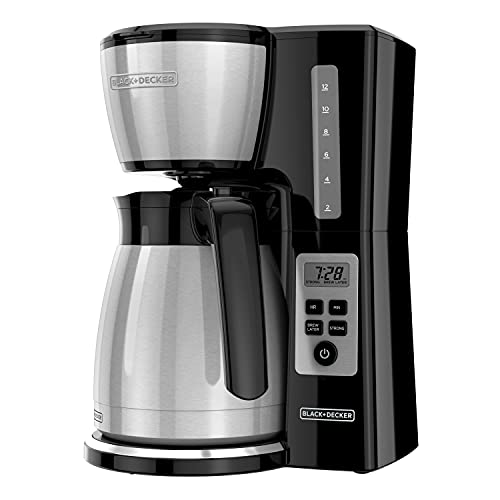
BLACK+DECKER 12-Cup Thermal Programmable Coffee Maker (CM2046S)
Badge: Best Overall
Strengths
- Programmable scheduling means coffee is brewed when you wake, not started when you stumble into the kitchen
- Thermal carafe holds heat without a warming plate, so the last cup never tastes scorched
- VORTEX showerhead is designed to saturate grounds evenly rather than channeling through the middle
Trade-offs
- A thermal carafe keeps coffee hot for hours, not all day; marathon grazers will reheat a cup eventually
- No built-in grinder, so peak freshness still depends on a separate grinder or pre-ground coffee
- The black and steel finish shows fingerprints and coffee splashes more readily than matte designs
Mini spec box
- Capacity: 12 cups
- Carafe: Thermal, Black/Steel (model CM2046S)
- Controls: Programmable, with Brew Strength control
- Showerhead: VORTEX Technology
The CM2046S is built around the two decisions that matter most in a weekday coffee maker: when it brews, and what the coffee sits in afterward. The programmable timer handles the first — set it the night before and the machine starts on schedule, so the kitchen smells like coffee before your alarm has finished being resented. The thermal carafe handles the second. Because there is no hot plate cooking the finished pot, the coffee you pour at nine tastes like the coffee that brewed at seven, just a little cooler, instead of progressively stewing into bitterness.
BLACK+DECKER’s VORTEX showerhead is the extraction story here: instead of a single stream drilling into the center of the grounds, water is distributed in a swirling pattern meant to wet the whole bed. Paired with the Brew Strength control, which adjusts how assertively the machine brews, the CM2046S covers a wide household range — a mild pot for a sensitive stomach on Monday, a stronger one for a deadline on Friday — without changing coffees. It is not a specialty instrument, and it does not pretend to be; it is a dependable, schedulable, good-tasting pot machine, which is what most kitchens actually need.
The honest limitations are the class limitations. There is no grinder on board, the carafe’s heat retention is measured in hours rather than a full workday, and the glossy black-and-steel exterior rewards a quick wipe. None of that undermines the core proposition: this is the pool’s most complete expression of set-it-tonight, drink-it-all-morning drip coffee.
Best for: households that drink a full pot across the morning and want it brewed before they wake / Not suited for: single-cup drinkers, or anyone who wants grinding built into the same machine

Cuisinart PerfecTemp 12-Cup Thermal Drip Coffee Maker (DCC-3400NAS)
Badge: Best for Hotter Brewing
Strengths
- PerfecTemp hotter brewing targets the water temperature window where coffee extracts most completely
- Double-wall stainless thermal carafe protects flavor and shrugs off the knocks that crack glass
- Brew Strength control gives a real say in the cup without changing beans or dose
Trade-offs
- Hotter brewing is a liability with stale or very dark beans, which can tip toward harshness
- Stainless carafe hides the coffee level, so you judge the remaining pot by weight and memory
- No integrated grinder; it is a brewer only, by design
Mini spec box
- Capacity: 12 cups
- Carafe: Double-wall stainless steel thermal
- Brewing: PerfecTemp hotter brewing
- Controls: Brew Strength control
- Finish: Silver
The PerfecTemp’s argument starts with a number-free fact about coffee: water that is too cool under-extracts, leaving coffee sour and thin. Cuisinart built this machine around brewing hotter — the PerfecTemp name is the promise — so the water meets the grounds in the range where sugars and aromatics actually dissolve. With fresh, decent beans the difference is not subtle: the cup tastes rounder and more complete, especially with the medium and lighter roasts that cooler machines leave tasting grassy.
The brewed coffee lands in a double-wall stainless steel thermal carafe, which is the right destination for it. There is no hot plate to keep cooking the pot, the steel takes counter knocks that would end a glass carafe’s career, and the insulation holds serving temperature through a long, interrupted morning. Brew Strength control rounds out the package, letting you push the same beans toward bold when the pot is destined for milk, or keep it regular for drinking black.
Its limits are honest ones. Hotter water is unforgiving of stale beans — it will extract their flaws as efficiently as their virtues — and the opaque carafe means you cannot see how much coffee is left. It also brews only: no grinder, no pods, no espresso. As a focused drip instrument for people who care about extraction temperature, it is the connoisseur’s pick in this pool.
Best for: drinkers who buy good beans — especially lighter roasts — and want drip that extracts them fully / Not suited for: anyone using stale or very dark beans, or who wants an all-in-one grinding machine

BLACK+DECKER CaféCraft 12-Cup Thermal Coffee Maker
Badge: Best for Hot and Iced
Strengths
- Hot and iced capability in one programmable machine covers the household’s whole day
- Thermal carafe keeps the hot pot at temperature without a flavor-cooking hot plate
- Programmable start means the hot pot can be waiting before the house wakes
Trade-offs
- Iced results depend on brewing over ice correctly; the machine cannot fix a watery technique
- Jack-of-two-temperatures design means neither mode gets the specialized depth of a dedicated machine
- Thermal carafe, as always, trades the visibility of glass for insulation
Mini spec box
- Capacity: 12 cups
- Carafe: Thermal
- Modes: Hot and iced coffee
- Controls: Programmable
The CaféCraft’s insight is about the calendar. Households that drink drip coffee rarely drink it the same way in January and July, and this machine is built for both households at once: a programmable 12-cup thermal brewer for the hot pot, with an iced-coffee mode for the months when the pot migrates into a glass over ice. One appliance, one footprint, no seasonal swap and no second machine crowding the counter.
The hot side is properly equipped. Programmability means the pot can be set the night before, and the thermal carafe means what brews stays hot and un-scorched through the morning, with no warming plate slowly concentrating bitterness. The iced side addresses the classic home-iced-coffee failure — hot coffee poured over ice and diluted into sadness — by brewing with the ice in mind, so the finished glass tastes like coffee rather than coffee-flavored water.
The compromises are the familiar ones for a dual-mode machine: it will not out-specialize a dedicated iced-coffee device or a temperature-obsessed drip brewer, and it has no grinder. But for the very common household that splits its year between hot pots and iced glasses, it is the most season-proof pick in this pool.
Best for: households that split the year between hot morning pots and iced afternoon coffee / Not suited for: single-mode purists who never drink iced coffee, or who want a dedicated specialty brewer

Cuisinart 12-Cup Programmable PerfecTemp Thermal Coffee Maker (White)
Badge: Best for Small Batches
Strengths
- The 1–4 cup setting adjusts brewing for small batches, so a half pot does not taste like an afterthought
- Brew Pause lets you pour a cup mid-cycle without the basket dripping down the carafe’s side
- PerfecTemp hotter brewing and Brew Strength control carry over from Cuisinart’s drip flagship
Trade-offs
- White finishes show coffee splashes and demand a wipe-down habit
- Thermal carafe hides the fill level, a minor daily guessing game
- Still no grinder; the small-batch setting perfects brewing, not bean freshness
Mini spec box
- Capacity: 12 cups, with 1–4 cup setting
- Carafe: Thermal
- Brewing: PerfecTemp
- Controls: Programmable, Brew Strength control, Brew Pause
- Finish: Stainless steel and white
Most 12-cup machines quietly punish small households: brew four cups in a basket designed for twelve and the water races through too little coffee, producing a thin, sour pot. This Cuisinart’s 1–4 cup setting exists to fix exactly that, adjusting the brew for small batches so a couple’s morning pot tastes like a deliberate brew rather than a diluted one. It is the single most useful feature in this pool for the way many households actually drink.
The rest of the specification is Cuisinart’s proven drip formula. PerfecTemp hotter brewing for complete extraction, Brew Strength control for adjusting intensity, full programmability for waking up to a finished pot, and a thermal carafe that holds the coffee without a hot plate stewing it. Brew Pause adds the small mercy of a mid-brew cup — pull the carafe, pour, replace — for the mornings when waiting for the full cycle is not an option anyone is willing to discuss.
In white and stainless it is also the bright-kitchen pick, a real consideration in kitchens where every other appliance is black. Its compromises: white shows every splash, the thermal carafe conceals its contents, and there is no grinder. For small households that occasionally host a full-pot crowd, it threads the needle better than anything else here.
Best for: couples and small households that brew 1–4 cups daily but still host full-pot occasions / Not suited for: large households that always brew full pots, or dark kitchens where a white appliance clashes

BUNN Speed Brew Platinum Thermal Coffee Maker (CSB3T)
Badge: Best for Speed
Strengths
- Speed Brew design keeps brew water ready, so a full pot follows the decision to make one almost immediately
- BUNN’s commercial heritage shows in a simple, serviceable, no-nonsense build
- Thermal carafe protects the fast-brewed pot from hot-plate damage afterward
Trade-offs
- The always-hot reservoir uses standby energy and wants to stay plugged in and filled
- Its speed-first philosophy means no wake-up timer ritual — the machine is ready, but it does not start itself on a clock schedule
- 10 cups is the smallest capacity here; big households will brew twice
Mini spec box
- Capacity: 10 cups
- Carafe: Thermal
- Design: Speed Brew, stainless steel
- Model: 55200 CSB3T
- Finish: Black
Every other machine in this pool starts cold. The BUNN starts ready. Its Speed Brew design keeps an internal reservoir of water at brewing temperature around the clock, so when you add fresh water, the hot water is displaced into the basket almost immediately — a full 10-cup pot in the time a conventional machine spends just heating up. For households where coffee is a decision made in the moment — a second pot at ten, an unexpected guest, a work call that demands reinforcements — that readiness is a genuinely different ownership experience.
The philosophy extends to the whole machine. BUNN builds for cafes and diners, and the CSB3T carries that DNA: stainless construction, a thermal carafe instead of a fragile glass pot on a plate, controls that do one thing. There is no wake-up scheduling ritual because the machine’s answer to scheduling is to always be ready; you trade the romance of waking to brewed coffee for the reality of coffee minutes after you ask for it, at any hour.
The costs are real: an always-hot tank draws standby power and demands descaling discipline, and 10 cups is the pool’s smallest pot. But as a speed instrument from the most commercially proven name in drip coffee, it occupies ground none of the others contest.
Best for: impatient drinkers, irregular schedules, second-pot households, and small offices / Not suited for: schedule-driven drinkers who want coffee brewed before they wake, or very large households
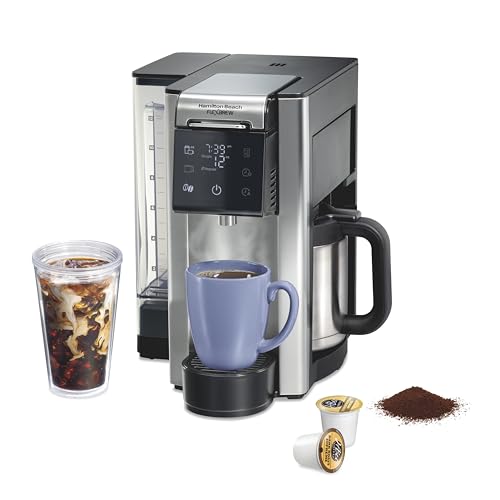
Hamilton Beach FlexBrew Advanced 5-in-1 Coffee Maker
Badge: Most Versatile
Strengths
- Drip and single-serve in one machine ends the two-appliance standoff in mixed households
- Accepts both pods and grounds on the single-serve side, so nobody is locked into one format
- The 60 oz. removable reservoir refills at the sink instead of by the jug-under-cabinet shuffle
Trade-offs
- Two brewing systems mean two sets of parts to clean and descale
- A multi-format machine rarely matches a dedicated machine’s mastery of any single format
- The larger, busier design will dominate a small counter
Mini spec box
- Capacity: 12-cup drip, plus single serve
- Carafe: Thermal, programmable drip side
- Single serve: Pods and grounds
- Reservoir: Removable, 60 oz.
- Modes: Hot and iced; 5-in-1 FlexBrew design
The FlexBrew Advanced exists because of a household argument: one person drinks pots, another drinks pods, and the counter cannot hold two machines. Its answer is a genuine 5-in-1 — a 12-cup programmable thermal drip brewer on one side, and a single-serve brewer on the other that takes both pods and loose grounds, with hot and iced capability across the system. That is not a drip machine with a novelty attachment; both sides are fully realized, which is what makes the compromise work.
The details show a designer who has watched people use coffee makers. The 60 oz. reservoir is removable, so it fills at the sink rather than via a measuring jug poured at an angle under a cabinet. The drip side is programmable with a thermal carafe, matching the dedicated machines feature for feature. The single-serve side’s grounds option matters more than it appears: it frees the pod drinker from pod prices and pod waste whenever they have two extra minutes, without buying a second device.
The honest costs: two systems to descale, a footprint that will own its corner of the counter, and the standing truth that a specialist machine usually beats a generalist at its specialty. For the mixed household, though, this is not a compromise so much as a peace treaty — one machine, every drinker served.
Best for: mixed households split between pot drinkers and single-cup drinkers, pods and grounds / Not suited for: single-habit households, tiny counters, or minimalists who descale reluctantly
Comparison Table
Side by side, the six divide cleanly: five timer-driven drip machines with different secondary talents, and one always-ready outlier. Capacity, carafe, and the scheduling approach are the columns that matter.
| Pick | Capacity | Carafe | Scheduling approach | Standout feature | Link |
|---|---|---|---|---|---|
| BLACK+DECKER 12-Cup Thermal Programmable Coffee Maker (CM2046S) | 12 cups | Thermal carafe | Programmable + Brew Strength | VORTEX showerhead | Check on Amazon |
| Cuisinart PerfecTemp 12-Cup Thermal Drip Coffee Maker (DCC-3400NAS) | 12 cups | Stainless thermal carafe | PerfecTemp hotter brewing | Brew Strength control | Check on Amazon |
| BLACK+DECKER CaféCraft 12-Cup Thermal Coffee Maker | 12 cups | Thermal carafe | Programmable | Hot + iced modes | Check on Amazon |
| Cuisinart 12-Cup Programmable PerfecTemp Thermal Coffee Maker (White) | 12 cups (1–4 cup setting) | Thermal carafe | PerfecTemp + programmable | Brew Pause + strength control | Check on Amazon |
| BUNN Speed Brew Platinum Thermal Coffee Maker (CSB3T) | 10 cups | Thermal carafe | Speed Brew reservoir | Commercial-style build | Check on Amazon |
| Hamilton Beach FlexBrew Advanced 5-in-1 Coffee Maker | 12 cups + single serve | Thermal carafe | Pods + grounds, hot + iced | 60 oz. removable reservoir | Check on Amazon |
How to Choose the Best Progammable Coffee Makers for Your Mornings
A programmable coffee maker is a promise you make to your future self every night. Choosing well means thinking about the whole chain — the night-before setup, the unattended brew, and the hours the coffee waits afterward — rather than falling for any single feature.
The timer is table stakes; the carafe is the differentiator
Every machine in this pool can start itself on schedule (and the BUNN sidesteps the need). What happens next decides whether the coffee is good at 8 a.m. A glass carafe on a hot plate keeps coffee hot by cooking it, and the flavor bill arrives within the hour: bitterness, staleness, a pot that punishes the household’s late riser. A thermal carafe — every pick here uses one — simply insulates. For scheduled brewing specifically, where the gap between brewing and finishing is built into the concept, thermal is close to non-negotiable.
Match batch size to your real household
A 12-cup machine brews twelve cups well and four cups indifferently, unless it has a small-batch setting. The white Cuisinart’s 1–4 cup mode exists for couples whose scheduled pot is small. Conversely, the BUNN’s 10-cup pot and the FlexBrew’s dual format serve different households again: the FlexBrew’s single-serve side means the scheduled pot can be sized for the pot drinkers only, while early risers and decaf drinkers self-serve. Count your drinkers, honestly, at the hours they actually drink.
Brew temperature and strength: the quality levers
Once scheduling is solved, flavor is governed by extraction. Hotter brewing — Cuisinart’s PerfecTemp approach — extracts more completely and flatters fresh, lighter-roasted beans. Strength controls adjust intensity without changing your coffee or dose. Even water distribution, like the BLACK+DECKER’s VORTEX showerhead, keeps the basket extracting uniformly. None of these requires you to become a hobbyist; they are set-and-forget virtues that operate inside the scheduled brew you were already going to run.
The night-before ritual, honestly assessed
Programmable brewing moves work to the evening: water, filter, grounds, timer check. It takes two minutes, and machines differ in how gracious they make it — removable reservoirs (the FlexBrew’s 60 oz. tank) fill at the sink; fixed reservoirs fill by jug. Also decide how the machine handles the details: a clock that survives outages, a ready light you can read across a dark kitchen, an auto-shutoff policy that suits your mornings. If your household’s cups are mostly solo, the guides at Best Single Server Coffee Makers and Best Single Srve Coffee Makers cover the one-cup branch of the family; for pots on a schedule, the six above are the field.
One more consideration belongs in this section because it decides more purchases than any specification: who else uses the machine. A programmable brewer in a household of one schedule is a simple tool. Add a partner on a different shift, a teenager with weekend hours, or a grandparent who finds touch controls baffling, and the best machine is the one whose programming is optional rather than mandatory — every pick here also brews immediately on demand, and the simplest control layouts (the BUNN above all) forgive the least technical user in the house.
How to Set Up, Program, and Maintain a Programmable Coffee Maker
A programmable machine rewards a correct first setup and a light maintenance rhythm. This is the full routine, from day one to the monthly descale.
First setup
- Wash the carafe, lid, and brew basket with warm soapy water, rinse, and dry. Run one full cycle of plain water through the machine to clear manufacturing residue, and discard it.
- Set the clock before anything else, and set it carefully — the brew schedule is only as accurate as the clock it reads. Note whether the display uses a.m./p.m. correctly; the classic programmable failure is a pot that brews at 6 p.m.
- Place the machine where the carafe clears your cabinets when lifted and the reservoir is reachable for filling.
The nightly programming routine
- Fill the reservoir with fresh, cold water to the line for tomorrow’s pot size. Water that sat in the tank all day brews flat coffee.
- Fit the filter and add grounds — roughly a level tablespoon per cup as a starting point, adjusted to taste over the first week. Level the bed of grounds with a gentle shake so water meets an even surface.
- Set the brew time, confirm the program indicator is lit, and put the empty carafe in place. Forgetting the carafe is the one mistake the machine cannot forgive.
- In the morning, remove the brew basket promptly after brewing finishes; leaving spent grounds over the pot invites drips and stale aromas.
Cleaning and descaling
Wash the carafe and basket daily with hot soapy water — coffee oils go rancid and will season every future pot. Descale on the maker’s schedule or whenever brews slow down: mineral scale insulates heating elements, drops brew temperature, and quietly ruins the extraction you bought the machine for. Use the manufacturer’s descaling method or a citric-acid solution, then run two plain-water cycles. Hard-water households should descale more often; the always-hot BUNN reservoir, in particular, concentrates minerals and rewards the discipline.
Troubleshooting
- Problem: the pot did not brew on schedule → check the clock first (especially after any power flicker), then confirm the program indicator was actually armed; most timer ‘failures’ are one of these two.
- Problem: coffee tastes weak or sour → the usual causes are stale grounds loaded the night before a long delay, too coarse a grind, or scale dropping the brew temperature. Descale, then adjust dose.
- Problem: the carafe overflows or the basket drips → a clogged basket drain or a carafe lid misaligned after washing. Rinse the basket valve and reseat the lid.
A final maintenance note specific to scheduled machines: the basket and carafe sit assembled and closed for hours before every brew, which makes the nightly rinse more than cosmetic. A basket rinsed at loading time carries no yesterday into tomorrow’s pot, and a carafe emptied and rinsed before the evening load never seasons a fresh pot with the dregs of the old one. Thirty seconds, attached to the loading ritual, is the whole cost.
Waking Up to Coffee: What Scheduling Actually Changes
It is easy to treat programmability as a convenience feature, a small luxury in the same family as a remote start on a car. Living with it reveals something slightly different: scheduling changes who does the work and when. The two minutes of setup move from the worst moment of the day — groggy, rushed, pre-caffeine — to one of the best, the unhurried evening kitchen. The machine’s contribution is not speed; it is timing, and timing compounds across a year of mornings.
There are secondary effects worth knowing. A scheduled pot tends to be a consistent pot: the same dose, the same water, the same hour, which quietly removes the variance of half-awake measuring. Households also report the scheduled pot reduces cafe spending more than any other appliance feature, simply because coffee is ready at the moment the ‘I’ll just grab one on the way’ impulse strikes. The flip side is discipline — the ritual fails on the nights you skip it, which is why the always-ready BUNN philosophy, covered in its review, appeals to households whose evenings are as irregular as their mornings. The single-cup branch of this same timing question — machines that are ready in a minute rather than on a schedule — is explored in Best Single Shot Coffee Makers.
Programmable Drip vs. Single-Serve: Choosing the Household System
The programmable pot is not the only answer to the morning; it is one architecture among several, and the honest comparison is about households, not machines. A pot amortizes its setup across many cups: one filter, one cleanup, coffee for everyone, refills included. Its cost per cup with grounds is a fraction of pod coffee, and its waste is a compostable filter of grounds. Its weakness is the solo cup — brewing a pot for one drinker wastes coffee or demands a small-batch machine like the white Cuisinart.
Single-serve inverts every term: zero waste per cup, total freedom of flavor per drinker, higher cost per cup, and pod waste unless grounds are used. The FlexBrew in this pool is the diplomatic solution, and it is no accident it earns the Most Versatile badge. For a fuller map of the cup-at-a-time territory, see Best Single Serve Multi Brew Coffee Makers. But if your household drinks coffee together, in quantity, on a schedule, the programmable pot remains the most economical and convivial system ever put on a counter — and the six machines above are its current best expressions.
The Programmable Habit: Making the Schedule Stick
Every programmable coffee maker is sold on a morning, but it is kept or abandoned on evenings. The households that still use the timer after a year share a pattern: the setup is attached to an existing evening ritual rather than floating free. Loading the machine while the dinner dishes dry, or while the kettle boils for tea, costs no extra decision — the habit rides on a habit. Households that treat programming as a separate chore, to be remembered at bedtime, quietly stop remembering within a month, and the machine becomes an ordinary brewer with an unused clock.
Two small design choices support the ritual, and both appear in this pool. A removable reservoir — the FlexBrew’s 60 oz. tank is the exemplar — turns filling into a trip to the sink instead of a jug-balancing act under a cabinet, removing the setup’s one awkward moment. And a program indicator you can verify at a glance from the doorway removes the bedtime doubt that sends people back downstairs to check. When you shop this category, you are really shopping for an evening you can sustain; the machines above were chosen partly because none of them makes that evening harder than it needs to be.
Programmable Machines and the People Who Hate Mornings
There is a personality type this category serves better than any other appliance: the person who is not themselves until coffee. Every other coffee technology asks something of that person at their worst moment — measuring, waiting, deciding, cleaning. The programmable machine asks nothing. Its entire design philosophy can be stated as a kindness: decisions were made last night by a more competent version of you; this morning’s version merely pours.
That framing explains the category’s fierce loyalty. Owners of programmable machines replace them with programmable machines, and describe the timer in the language of gratitude usually reserved for people. It also explains the BUNN’s cult from the opposite direction: its owners are the people whose mornings cannot be predicted, for whom a machine that is always ready is the same kindness in a different tense. Whichever tense your life is written in, choose the machine that asks the least of you before coffee — that, more than any feature list, is what you are buying.
Common Buying Mistakes
Setting the program but not the clock
A programmable machine obeys its clock absolutely. A clock left unset after unboxing — or wrong by twelve hours — produces a pot at midnight and none at dawn. Set the clock first, verify a.m./p.m., and re-check after every outage.
Loading grounds the night before a long delay
Grounds loaded at 8 p.m. for a 7 a.m. brew sit exposed to air for eleven hours, and pre-ground coffee stales noticeably. If your delay is long, use the freshest grind you can, store the canister sealed, and accept the trade consciously rather than wondering why scheduled coffee tastes tired.
Choosing a hot-plate machine for scheduled brewing
The entire point of programming is that coffee waits for people. A warming plate punishes exactly that wait. Every pick in this guide uses a thermal carafe for this reason; treat a hot plate as a disqualifier for a schedule-first machine.
Never descaling because ‘it still works’
Scale does not stop a machine; it slowly lowers brew temperature until every pot is under-extracted and sour, and owners blame the beans. Descale on schedule — it is the cheapest flavor upgrade in coffee.
Brewing full pots for a two-cup household
Oversized daily pots waste coffee and train you to drink stale reheats. Either choose a machine with a real small-batch setting or let the single-serve side of a dual machine carry the small days.
Final Recommendation
Start with the BLACK+DECKER CM2046S Check on Amazon unless your household has a specific reason to go elsewhere: it is the most complete programmable package here — timer, thermal carafe, VORTEX distribution, strength control — and it asks the fewest compromises in return. It is the machine the phrase ‘programmable coffee maker’ should mean.
The Cuisinart PerfecTemp Check on Amazon is the upgrade for bean quality: hotter brewing extracts more from good coffee, and its white sibling serves small households with a 1–4 cup setting. The CaféCraft Check on Amazon is the hot-and-iced household’s pick. The BUNN is the answer for irregular schedules, and the FlexBrew for divided ones. Each is the right machine for a legible reason, which is what a good roundup should give you.
Whichever you program tonight, do the two unglamorous things that make it sing: set the clock correctly, and descale on schedule. The timer gets the coffee made; those two habits get it made well.
Frequently Asked Questions
What does a programmable coffee maker actually do?
It lets you load water and grounds in advance and set a clock time at which brewing starts automatically. You wake — or walk in — to a finished pot. All the timer-driven machines in this guide work this way; the BUNN instead keeps water hot continuously so it can brew a pot on demand within minutes, which serves the same goal by different means.
Does coffee lose quality when it is brewed before I wake up?
The brewed coffee waits in a thermal carafe in every pick here, which holds temperature without cooking the coffee the way a hot plate does. A pot brewed an hour before you pour is in fine shape; the bigger quality variable is grounds loaded many hours ahead, which stale slowly in the basket. Keep the delay reasonable and the coffee fresh, and scheduled coffee tastes like coffee you made — because you did, just earlier.
What happens to the schedule if the power goes out?
Most programmable machines lose their clock setting in an outage and will not brew until it is reset. If your home has frequent flickers, make re-setting the clock part of your outage routine, and consider that the always-ready BUNN approach sidesteps schedule-keeping entirely.
How much coffee should I use in a programmable drip machine?
A level tablespoon of grounds per cup of water is the standard starting point; adjust a spoon up or down across the first week to find your household’s strength. Machines with a Brew Strength control, like several picks here, let you fine-tune from there without changing your measuring habit.
Can a programmable machine make just a few cups well?
Only if it is designed to. Small batches in a full-size basket tend to under-extract. The white Cuisinart in this guide has a dedicated 1–4 cup setting that adjusts the brew for small quantities, and the FlexBrew’s single-serve side covers the one-cup case outright. If your household size varies by day, one of those two designs fits best.
How often should I descale a programmable coffee maker?
Follow the manufacturer’s interval as a floor, and descale sooner if brews slow down, temperatures seem off, or your water is hard. Scale lowers brew temperature and quietly under-extracts every pot. The BUNN’s always-hot reservoir concentrates minerals fastest and rewards the most regular descaling in this pool.
Can I program the machine for weekends only?
Most programmable brewers hold one schedule and apply it daily once armed; the practical weekend pattern is to arm the program on Friday night and disarm it — or simply not load the machine — on nights before a lie-in. Households with sharply different weekday and weekend hours sometimes keep the weekday schedule and brew on demand on Saturdays, which the thermal carafe makes painless: the weekday pot’s drinker can also be the weekend’s first riser without disturbing anyone.


