Disclosure: topratedkitchenware.com is reader-supported. When you buy through links on our site, we may earn an affiliate commission from Amazon and other retailers, at no extra cost to you.
Where to buy
The best programmable drip coffee makers unite drip brewing with a clock: that is the exact brief, and every machine below is a true drip brewer with programmable scheduling — or, in the BUNN’s case, an always-ready drip brewer that makes scheduling moot. All six are linked; all six brew drip coffee by the pot, into thermal carafes, with no hot plate waiting to stew the results.
- BLACK+DECKER 12-Cup Thermal Programmable Coffee Maker (CM2046S) — a 12-cup thermal carafe machine with brew strength control and a VORTEX showerhead; check the latest price on Amazon
- Cuisinart PerfecTemp 12-Cup Thermal Drip Coffee Maker (DCC-3400NAS) — Cuisinart’s PerfecTemp design brews hotter, into a double-wall stainless thermal carafe; check the latest price on Amazon
- BLACK+DECKER CaféCraft 12-Cup Thermal Coffee Maker — a programmable 12-cup thermal machine that brews for both hot and iced coffee; check the latest price on Amazon
- Cuisinart 12-Cup Programmable PerfecTemp Thermal Coffee Maker (White) — Cuisinart’s PerfecTemp thermal machine in white, with a dedicated 1–4 cup setting and Brew Pause; check the latest price on Amazon
- BUNN Speed Brew Platinum Thermal Coffee Maker (CSB3T) — BUNN’s Speed Brew design keeps water hot and ready, pouring a 10-cup pot with minimal wait; check the latest price on Amazon
- Hamilton Beach FlexBrew Advanced 5-in-1 Coffee Maker — a 5-in-1 system: 12-cup programmable thermal drip on one side, single-serve pods or grounds on the other; check the latest price on Amazon
Read the full guide ↓
The best programmable drip coffee makers unite the two ideas that built the American kitchen’s coffee habit: drip brewing — water showered over grounds, gravity doing the work — and a clock that starts the process without you. Either idea alone is common. Together, executed well, they produce the defining luxury of the modern weekday: a fresh pot, brewed by a method you trust, waiting at the hour you chose.
Six drip machines are compared here, and the comparison is really about what each does with drip’s known variables. Water temperature, distribution over the grounds, the carafe the coffee lands in, and the batch sizes the basket handles gracefully — those are drip’s levers, and each machine below pulls a different combination. Readers whose kitchens also run a cup-at-a-time station can map that territory in Best Single Serve Pod Coffee Makers; this guide is about the pot.
One machine argues with the premise, usefully. The BUNN CSB3T is a drip brewer whose water is always hot, so it brews on demand in minutes rather than on a timer. It is included because ‘programmable’ shoppers are really shopping for readiness, and readiness has two honest implementations. The reviews will make the distinction plain rather than papering over it.
Key Takeaways
- Drip quality is decided by water temperature, even distribution, and the carafe — the timer only decides when those things happen.
- Every pick here uses a thermal carafe, because programmed coffee waits, and waiting coffee should never sit on a hot plate.
- Cuisinart’s PerfecTemp models brew hotter for fuller extraction; the white version adds a 1–4 cup small-batch setting.
- BLACK+DECKER’s two entries split the difference: the CM2046S is the complete package, the CaféCraft adds iced coffee.
- The BUNN replaces the timer with an always-hot reservoir — readiness on demand instead of readiness on schedule.
- The FlexBrew is a programmable drip machine and a single-serve brewer in one housing, for households that refuse to choose.
In this guide
Quick Picks
Badges mark each drip machine’s specialty. Notice that the specialties are all drip specialties — temperature, distribution, batch size, format — because in this category the timer is the entry ticket, not the prize.
| Pick | Badge | Why it stands out | Link |
|---|---|---|---|
| BLACK+DECKER 12-Cup Thermal Programmable Coffee Maker (CM2046S) | Best Overall | Full programmability, a thermal carafe that skips the hot plate, and even saturation from the VORTEX showerhead | Check on Amazon |
| Cuisinart PerfecTemp 12-Cup Thermal Drip Coffee Maker (DCC-3400NAS) | Best for Hotter Brewing | Hotter brewing water for fuller extraction, plus Brew Strength control and a stainless thermal carafe | Check on Amazon |
| BLACK+DECKER CaféCraft 12-Cup Thermal Coffee Maker | Best for Hot and Iced | One programmable machine covering the morning hot pot and the afternoon iced glass | Check on Amazon |
| Cuisinart 12-Cup Programmable PerfecTemp Thermal Coffee Maker (White) | Best for Small Batches | The 1–4 cup setting makes small pots taste right, and Brew Pause serves a cup mid-brew | Check on Amazon |
| BUNN Speed Brew Platinum Thermal Coffee Maker (CSB3T) | Best for Speed | The always-ready reservoir approach: the fastest route from decision to full pot in this pool | Check on Amazon |
| Hamilton Beach FlexBrew Advanced 5-in-1 Coffee Maker | Most Versatile | Full pot and single cup, pods and grounds, hot and iced — the one-machine answer for mixed households | Check on Amazon |
How These Picks Were Chosen
Verification came first: each machine was confirmed as a genuine drip brewer with programmable scheduling from its verified specification — drip basket, shower-style water delivery, clock-set auto-start — before any ranking language was applied. The BUNN was admitted as the documented exception, a drip brewer that substitutes an always-hot reservoir for a timer, and its review says so openly.
Ranking weighed the drip fundamentals in order: brew temperature and extraction completeness, water distribution across the basket, carafe performance over a long morning, strength control, and batch-size flexibility. The guidance is research-led, drawn from verified specifications and the established science of drip extraction, not from claimed hands-on testing. If your counter also needs the one-cup format, Best Single Serve Multi Brew Coffee Makers covers the hybrid machines from that side.
The 6 Best Programmable Drip Coffee Makers, Reviewed in Detail
Read the six as a set of answers to one question: once the timer starts a drip brew unattended, what has the machine done to make sure the result deserves your morning? Temperature, distribution, carafe, and batch handling supply the answers.
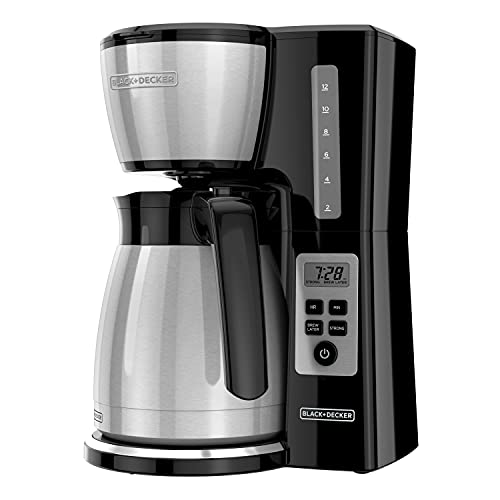
BLACK+DECKER 12-Cup Thermal Programmable Coffee Maker (CM2046S)
Badge: Best Overall
Strengths
- Brew Strength control lets the same machine pour a gentle weekday pot and a bolder weekend one
- Thermal carafe keeps coffee hot through a long morning without any extra energy draw
- Even, shower-style water distribution supports a more uniform extraction across the basket
Trade-offs
- Programmability covers the brew start; grind size, dose, and water quality still decide the cup
- Thermal carafes pour a little slower than glass and need a rinse habit to avoid stale-oil buildup
- It is a full-size footprint on the counter, worth measuring if your cabinets sit low
Mini spec box
- Capacity: 12 cups
- Carafe: Thermal, Black/Steel (model CM2046S)
- Controls: Programmable, with Brew Strength control
- Showerhead: VORTEX Technology
If your household runs on a schedule, the CM2046S is the machine in this pool that respects it most directly. Programming is the headline: load water and grounds at night, set the brew time, and the pot makes itself. But the detail that elevates it above a merely adequate timer machine is the thermal carafe. Glass pots on hot plates begin degrading the moment brewing ends; a double-wall thermal carafe simply holds the coffee at drinking temperature, quietly, for the length of a long morning.
Extraction is handled by the VORTEX showerhead, which spreads water across the grounds bed in a rotating pattern. Even wetting is the unglamorous foundation of good drip coffee — dry pockets under-extract and taste sour, channeled spots over-extract and taste harsh — and the showerhead design is aimed squarely at avoiding both. Brew Strength control then lets you bias the result toward mellow or bold without buying a second coffee or changing your dose math.
Where it asks for compromise: you bring your own grinder, the carafe wants regular washing to keep coffee oils from seasoning it the wrong way, and the footprint is that of a full 12-cup machine. As an overall package for a household that drinks coffee across a morning rather than in one sitting, it is the most balanced pick here.
Best for: households that drink a full pot across the morning and want it brewed before they wake / Not suited for: single-cup drinkers, or anyone who wants grinding built into the same machine

Cuisinart PerfecTemp 12-Cup Thermal Drip Coffee Maker (DCC-3400NAS)
Badge: Best for Hotter Brewing
Strengths
- Hotter brew water pulls more of the desirable compounds out of the grounds, especially with lighter roasts
- Stainless thermal carafe is the durable choice for busy counters and clumsy mornings
- Cuisinart’s drip machines have a long track record, and the control layout is sensibly arranged
Trade-offs
- The silver finish and squared profile read more appliance-like than design-led on the counter
- Thermal carafe adds heft; a full 12-cup pot is a two-handed pour for smaller hands
- Brew Strength and temperature are its levers — drinkers wanting espresso-style drinks need a different machine entirely
Mini spec box
- Capacity: 12 cups
- Carafe: Double-wall stainless steel thermal
- Brewing: PerfecTemp hotter brewing
- Controls: Brew Strength control
- Finish: Silver
Among the six, the DCC-3400NAS is the machine for the drinker who has ever called a drip pot ‘weak’ and meant it literally. Weak drip is usually a temperature story: the water never got hot enough to extract the grounds fully. PerfecTemp brewing attacks exactly that, heating the brew water beyond what basic machines manage, so the extraction finishes the job. The result is a pot with more body and less of the sour, underdeveloped edge that sends people back to cafes.
Cuisinart pairs that hotter brew with the other half of good drip discipline, a double-wall stainless thermal carafe. Heat retention without a hot plate preserves the flavor the hotter water worked to extract, and the steel body is a practical blessing in a real kitchen — no glass to crack against a faucet, no replacement carafe hunt if it takes a knock. Brew Strength control adds the final adjustment, and the whole machine feels engineered around the cup rather than around a feature checklist.
Choose it with clear eyes: it will not grind, it will not make espresso drinks, and its hotter extraction demands beans fresh enough to deserve it. Fed good coffee, it makes the strongest technical case in this roundup for what drip can taste like.
Best for: drinkers who buy good beans — especially lighter roasts — and want drip that extracts them fully / Not suited for: anyone using stale or very dark beans, or who wants an all-in-one grinding machine

BLACK+DECKER CaféCraft 12-Cup Thermal Coffee Maker
Badge: Best for Hot and Iced
Strengths
- Iced-coffee brewing answers the summer shift in habits without a second appliance
- Full 12-cup capacity suits households and small offices, not just couples
- Thermal carafe travels from counter to table without a cord trailing behind
Trade-offs
- Counter footprint is full-size; small kitchens should measure before committing
- No built-in grinder, so fresh-ground drinkers still need a separate unit
- Hot-and-iced versatility matters only if someone in the house actually drinks iced coffee
Mini spec box
- Capacity: 12 cups
- Carafe: Thermal
- Modes: Hot and iced coffee
- Controls: Programmable
Ask what a coffee maker must do across a full year and the CaféCraft’s design starts to look inevitable. Hot coffee in the morning, programmable so it is ready on schedule; a thermal carafe so the pot stays honest until the last cup; and an iced mode for the long stretch of the year when half the household switches to cold coffee and starts queueing at cafes. The CaféCraft folds all three into one 12-cup machine.
Programmability does quiet, daily work here: set it once in the evening and the morning pot is a solved problem. The thermal carafe preserves that solution — no hot plate, no stewed second pot — and doubles as a serving vessel at the table. The iced function, used properly with the glass filled with ice before brewing, produces the concentrated-over-ice style that cafes charge a premium for, at home, on the same machine that made breakfast coffee.
It is not a grinder-equipped machine, and its two-mode nature means purists in either camp can point at a more specialized tool. For a household whose coffee habits genuinely swing with the seasons, though, this is the pragmatic center of the pool.
Best for: households that split the year between hot morning pots and iced afternoon coffee / Not suited for: single-mode purists who never drink iced coffee, or who want a dedicated specialty brewer

Cuisinart 12-Cup Programmable PerfecTemp Thermal Coffee Maker (White)
Badge: Best for Small Batches
Strengths
- White and stainless finish suits bright kitchens where black appliances glower
- Full programmability with a thermal carafe is the complete weekday combination
- Small-batch competence means couples are not forced to brew — and waste — a full pot
Trade-offs
- Brew Pause is a convenience with a cost: pulling the carafe early steals water from the remaining extraction
- A 12-cup machine for mostly small batches is counter space spent on capacity you rarely use
- The feature set overlaps heavily with its silver sibling; the choice is finish and the small-batch emphasis
Mini spec box
- Capacity: 12 cups, with 1–4 cup setting
- Carafe: Thermal
- Brewing: PerfecTemp
- Controls: Programmable, Brew Strength control, Brew Pause
- Finish: Stainless steel and white
The defining question for this machine is not how much coffee it can make but how little it can make well. Its 1–4 cup setting slows the small-batch problem down to size: less water, adjusted delivery, proper contact with a smaller bed of grounds. Couples and solo drinkers who have been over-brewing and dumping half pots — or under-brewing and suffering through them — will feel the difference in the first week.
It does not achieve that focus by giving up the flagship features. This is a PerfecTemp machine, brewing hotter for fuller extraction, with Brew Strength control and full programmability, dispensing into a thermal carafe that keeps the pot at temperature without cooking it. Brew Pause handles the impatient cup. The white finish distinguishes it visually from its silver sibling and suits the pale, bright kitchens that dominate current design.
Be clear about what it is not: not a grinder combo, not a single-serve machine, and its white exterior will keep a record of every splash until wiped. As a programmable drip brewer that respects small households, it has the most thoughtful feature in the pool.
Best for: couples and small households that brew 1–4 cups daily but still host full-pot occasions / Not suited for: large households that always brew full pots, or dark kitchens where a white appliance clashes

BUNN Speed Brew Platinum Thermal Coffee Maker (CSB3T)
Badge: Best for Speed
Strengths
- Fewer electronic features means fewer things to fail; the machine is deliberately straightforward
- Stainless construction suits it to hard daily use in homes and small offices
- The 10-cup size is a realistic household capacity that brews faster than oversized pots
Trade-offs
- No brew-strength electronics or specialty modes; control is dose and grind, the old way
- A reservoir kept hot needs descaling discipline, especially with hard water
- It looks like commercial equipment because it essentially is — design-led kitchens may hesitate
Mini spec box
- Capacity: 10 cups
- Carafe: Thermal
- Design: Speed Brew, stainless steel
- Model: 55200 CSB3T
- Finish: Black
Speed is a feature, and the CSB3T is the only machine here that treats it as the feature. BUNN’s reservoir design holds water at temperature continuously, so brewing begins the moment you pour fresh water in — no heat-up wait, no watching a machine think. The 10-cup thermal carafe then keeps the pot where it belongs, hot and un-stewed, without a warming plate.
This is also the pool’s most commercially descended machine, and it shows in the priorities: stainless where it counts, an interface that a half-awake person can operate, and an absence of delicate electronics to fail. What it deliberately omits is the clock-based scheduling the programmable machines lead with — the BUNN philosophy is that a machine which is always ready does not need an appointment. Whether that trade suits you depends on whether your coffee is a ritual at a fixed hour or a response to a changing day.
Standby energy use and descaling are the ownership notes, and 10 cups caps its hospitality. For impatient households, offices, and second-pot people, it is the most honest machine in the roundup: it does one thing, extremely fast, for years.
Best for: impatient drinkers, irregular schedules, second-pot households, and small offices / Not suited for: schedule-driven drinkers who want coffee brewed before they wake, or very large households
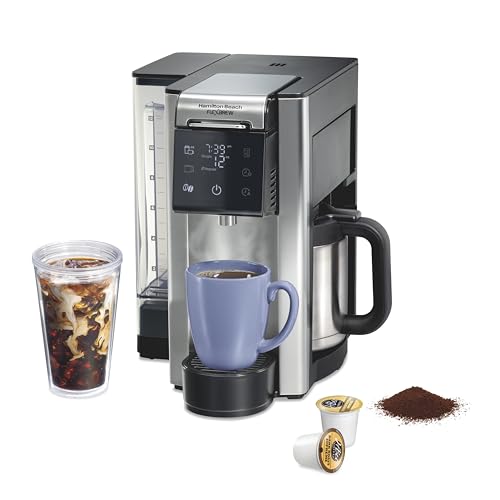
Hamilton Beach FlexBrew Advanced 5-in-1 Coffee Maker
Badge: Most Versatile
Strengths
- Thermal programmable drip side is a full-featured pot brewer, not a token add-on
- Hot and iced capability spans the household’s whole year of habits
- One footprint and one water reservoir simplify the counter and the cleaning routine
Trade-offs
- Pod use carries the usual per-cup cost and waste that grounds avoid
- More features mean a longer learning curve for guests and less tech-confident users
- Single-serve and drip sides share the reservoir, so heavy mixed use means frequent refills
Mini spec box
- Capacity: 12-cup drip, plus single serve
- Carafe: Thermal, programmable drip side
- Single serve: Pods and grounds
- Reservoir: Removable, 60 oz.
- Modes: Hot and iced; 5-in-1 FlexBrew design
Count the coffee drinkers in a mixed household and you will find the FlexBrew’s market: the pot drinker, the pod sprinter, the grounds enthusiast, the iced-coffee convert. Serving all four normally takes two or three appliances. The FlexBrew Advanced serves them with one — 12-cup programmable thermal drip, single-serve for pods or grounds, hot or iced — and backs the concept with the pool’s most practical reservoir, a removable 60 oz. tank that fills at the tap.
Crucially, the drip side is not a token. Programmable timing and a thermal carafe put it in direct conversation with the dedicated machines in this roundup, while the single-serve side handles the one-cup moments — a solo early riser, a guest’s decaf, an afternoon cup — without brewing a pot nobody will finish. The grounds basket on that side is the sleeper feature, quietly removing the cost and waste objections to pod brewing.
Ownership notes: you are maintaining two brew paths, so descaling is a double appointment, and the machine’s presence on the counter is substantial. Households where everyone drinks the same way will not use half of it. Households divided in their habits will wonder how they managed without it.
Best for: mixed households split between pot drinkers and single-cup drinkers, pods and grounds / Not suited for: single-habit households, tiny counters, or minimalists who descale reluctantly
Comparison Table
Side by side, the six divide cleanly: five timer-driven drip machines with different secondary talents, and one always-ready outlier. Capacity, carafe, and the scheduling approach are the columns that matter.
| Pick | Capacity | Carafe | Scheduling approach | Standout feature | Link |
|---|---|---|---|---|---|
| BLACK+DECKER 12-Cup Thermal Programmable Coffee Maker (CM2046S) | 12 cups | Thermal carafe | Programmable + Brew Strength | VORTEX showerhead | Check on Amazon |
| Cuisinart PerfecTemp 12-Cup Thermal Drip Coffee Maker (DCC-3400NAS) | 12 cups | Stainless thermal carafe | PerfecTemp hotter brewing | Brew Strength control | Check on Amazon |
| BLACK+DECKER CaféCraft 12-Cup Thermal Coffee Maker | 12 cups | Thermal carafe | Programmable | Hot + iced modes | Check on Amazon |
| Cuisinart 12-Cup Programmable PerfecTemp Thermal Coffee Maker (White) | 12 cups (1–4 cup setting) | Thermal carafe | PerfecTemp + programmable | Brew Pause + strength control | Check on Amazon |
| BUNN Speed Brew Platinum Thermal Coffee Maker (CSB3T) | 10 cups | Thermal carafe | Speed Brew reservoir | Commercial-style build | Check on Amazon |
| Hamilton Beach FlexBrew Advanced 5-in-1 Coffee Maker | 12 cups + single serve | Thermal carafe | Pods + grounds, hot + iced | 60 oz. removable reservoir | Check on Amazon |
How to Choose the Best Programmable Drip Coffee Makers
Buying a programmable drip machine means buying two things at once: a drip brewer, judged by extraction science, and a scheduling system, judged by how gracefully it fits your evenings and mornings. Most disappointment in this category comes from judging only one of the two.
Judge the drip brewer first
Water temperature is drip’s master variable. Too cool and the coffee under-extracts — sour, thin, salty at the edges. Cuisinart’s PerfecTemp machines brew hotter specifically to complete extraction, and they reward fresh beans accordingly. Distribution is the second variable: a showerhead that wets the whole bed (BLACK+DECKER’s VORTEX design is the explicit example here) prevents the channeling that leaves dry pockets and bitter streaks in the same pot. Strength control is the third: it adjusts the brew’s assertiveness for different beans and drinkers without new measuring habits.
Then judge the wait
Programmed coffee is coffee that waits — for the household to assemble, for the second cup, for the late riser. A thermal carafe is the only kind answer to that wait, holding temperature by insulation instead of by continued cooking. Every machine in this pool uses one, and that uniformity is a deliberate editorial choice: a hot plate undermines the entire programmable proposition. Judge carafes additionally by pour behavior and lid design; you will handle yours thousands of times.
Batch math and household shape
Twelve cups is the pool’s standard (the BUNN pours ten), but the operative question is your smallest regular batch. Small pots in big baskets under-extract unless the machine compensates — the white Cuisinart’s 1–4 cup setting is the compensation, and the FlexBrew’s single-serve side abolishes the problem by changing format. Households should also weigh the reservoir: fixed tanks fill by jug, the FlexBrew’s removable 60 oz. tank fills at the sink, a small daily mercy that adds up.
Finally, consider design longevity in the plainest sense: drip machines live hard lives of daily heat cycles and mineral water. Favor simple, proven mechanisms and descale faithfully. The design-conscious will find the sleeker end of the programmable category mapped in Best Sleek Programmable Coffee Makers, and the cup-at-a-time alternatives in Best Single Serve Type Coffee Makers.
A word about warranties and service, unfashionable but decisive at year three: drip machines fail at heating elements, pumps, and carafe lids, in that order, and the makers in this pool have the parts networks and production longevity that make those failures repairable rather than terminal. When two machines tie on extraction — as several here do — the one from the line with the longer production history is the rational tiebreak, because its replacement carafe will still exist when yours meets the floor.
How to Brew Better Drip Coffee on a Programmable Machine
A programmable drip machine automates timing, not judgment. These are the practices that decide whether the automated pot is excellent or merely punctual.
The five variables you still control
- Beans: buy coffee you would enjoy brewed by hand, in quantities you will finish while it is fresh. No machine feature compensates for stale beans.
- Grind: a medium grind, like coarse sand, suits most drip baskets. Too fine chokes the flow and turns bitter; too coarse rushes through and turns sour.
- Dose: start near a level tablespoon per cup and adjust by taste over several pots, changing one thing at a time.
- Water: fresh and cold at fill time. If your tap water tastes of chlorine, your coffee will too; a simple filter pitcher changes the cup more than most upgrades.
- Ratio consistency: measure the same way every night. Programmable brewing rewards a repeatable ritual because the machine repeats everything else.
Loading for a scheduled brew
Fill the reservoir, seat the filter fully so it cannot fold over mid-brew (a folded filter is the classic overflow cause), add grounds, and level the bed with a gentle shake. Set the time, verify the program light, and confirm the carafe is in place with its lid seated — Brew Pause mechanisms and drip stops assume the carafe is present, and a missing carafe is the one error no sensor forgives.
After the brew
Remove the basket promptly once brewing completes, serve, and return the carafe to keep the rest warm. Wash basket and carafe daily; coffee oils oxidize into a rancid seasoning that flavors every subsequent pot. Descale on the manufacturer’s schedule — scale drops brew temperature, and in a drip machine temperature is flavor. The always-hot BUNN reservoir deserves the strictest descaling discipline of the six.
Troubleshooting
- Problem: sour, thin coffee → under-extraction. Check grind (too coarse), dose (too little), and scale (brew temperature sagging). Descale before changing anything else if it has been a while.
- Problem: bitter, harsh coffee → over-extraction or stale beans. Coarsen the grind slightly, reduce dose, and check bean freshness; on the PerfecTemp machines, very dark roasts can tip harsh, so lighten the dose first.
- Problem: basket overflow → a folded filter, too-fine grind, or a clogged drip-stop. Reseat the filter, coarsen slightly, and rinse the basket valve.
Keep a simple brew log for the first month — date, beans, dose, grind, strength setting, and a three-word verdict. It sounds like homework and functions like compound interest: programmable machines repeat themselves perfectly, so the log converts a month of small experiments into a permanent recipe, and it ends the household argument about which setting was ‘the good one’ by writing it down.
A Short History of Drip — and Why the Timer Mattered
Drip brewing conquered the American kitchen in the twentieth century because it replaced the percolator’s recirculated, boiled coffee with a single, clean pass of hot water through grounds. The method’s genius is its forgiveness: gravity, a paper filter, and a shower of water produce a decent cup across a wide range of technique. What drip never solved was labor timing — someone still had to stand there at the moment coffee was wanted.
The programmable timer, arriving as clock chips cheapened, removed exactly that friction, and it is no exaggeration to say it completed the drip machine. The six brewers in this guide are the current form of that completed idea: thermal carafes where hot plates once stewed, hotter and more even brewing where lukewarm channeling once passed, small-batch intelligence where one-size baskets once ruled. The design-forward branch of the same evolution is surveyed in Best Sleek Programmable Coffee Makers.
Drip Pots and the Household Economy of Coffee
Run the arithmetic of a coffee household and the programmable drip pot’s endurance explains itself. A pot brewed from grounds costs a small fraction, cup for cup, of pod coffee or cafe coffee, and the machine that makes it is a one-time purchase with a multi-year working life. The programmable feature specifically defends that economy at its weakest point — the rushed morning, when the alternative is buying coffee out. A pot that is already brewed is a pot nobody replaces with a purchase.
The pot’s other economy is social: it is the only home format that serves a table. Guests, family breakfasts, work-from-home refills — the pot covers them at no marginal effort, which is why households that experiment with single-serve so often keep a drip machine for company. The FlexBrew’s dual format is the market’s acknowledgment of that pattern. Readers weighing the single-cup side on its own merits will find it in Best Single Server Coffee Makers and the espresso-adjacent angle in Best Single Shot Coffee Makers.
Water: Drip Coffee’s Forgotten Ingredient
Every variable discussed in this guide so far lives inside the machine. The largest variable lives outside it: the water. Coffee is overwhelmingly water by weight, and drip — with no pressure and no pod to mediate — tastes of its water more honestly than any other method. Chlorine announces itself in the cup. Heavy mineral content flattens acidity and scales the machine that is trying to heat it. Very soft water can leave extraction tasting hollow. None of the six machines can fix its water supply; all of them will faithfully report it.
The practical program is simple. If your tap water tastes good cold, brew with it cold and change nothing. If it carries chlorine, a basic carbon filter pitcher removes the taint for pennies a pot. If your water is very hard, filtered water plus faithful descaling protects both the cup and the machine’s temperature — the variable this guide has treated as drip’s master key. Households often spend freely on beans and machines while brewing with water they would not serve a guest; in drip, that order of spending is exactly backwards.
The Paper Filter Question
Drip’s last quiet variable sits in the basket: the filter. Paper — the standard across this pool’s drip machines — traps the coffee’s oils and finest particles, producing the clean, clear cup that defines the method and that this guide’s quality language assumes. It also costs a trivial amount per pot, composts with the grounds, and varies more than shoppers expect: thick, well-made filters rinse cleaner and resist the papery taste that a quick pre-rinse of the empty filter largely eliminates.
The alternatives trade clarity for body. Metal and cloth filters pass oils and micro-fines, yielding a heavier, rounder cup some drinkers prefer and others call muddy — a legitimate taste, honestly come by, and the reason reusable-filter machines like the grind-and-brew designs elsewhere in this wave have their devotees. For the programmable drip machines here, the advice is conservative: master the paper-filtered cup the machines were tuned for, dial in dose and grind across your first week, and only then experiment. Drip rewards the drinker who changes one variable at a time — including this one.
The Second Pot Problem
Drip households know the moment: the first pot is gone by nine, the day is young, and the question of a second pot divides the house. Brew it and risk waste; skip it and risk the afternoon cafe run. Programmable drip machines reframe the problem usefully. A second pot is cheap in grounds, quick to load, and — with a thermal carafe — patient once brewed, so the economics favor brewing and letting the carafe, not the clock, decide how much gets drunk. The household rule that emerges in practice: brew the second pot smaller, using the same discipline as the first.
The BUNN dissolves the problem entirely, which is its deepest appeal to work-from-home households: a fresh pot is minutes away at any hour, so there is no second-pot decision at all, only a second-pot moment. The FlexBrew dissolves it from the other side, letting the afternoon’s single drinkers serve themselves without a pot at all. However your household solves it, notice that the problem was never really about coffee — it is about matching a batch format to an unpredictable day, and the machines in this pool are, each in its own way, answers to unpredictability.
Drip Coffee for People Who Work Nights
Every programmable guide quietly assumes a household that sleeps at night. A significant minority does not, and drip serves them with particular grace. The night-shift worker’s ‘morning’ is another household’s evening; their coffee problem is not waking to a pot but arriving home to a kitchen that must produce one on an inverted schedule. Programmable machines adapt without modification — the timer does not care which twelve the clock says — and a pot programmed for a 7 a.m. homecoming is the same small luxury as one programmed for a 7 a.m. rising, delivered to someone who arguably needs it more.
The thermal carafe earns a second mention in this life: shift households often contain two schedules under one roof, and a pot brewed for the incoming worker can still be honest coffee for the outgoing one an hour later, which no hot plate would permit. The BUNN, again, is the alternative philosophy — a household with no shared schedule at all may find readiness simpler than any appointment. The point for the roundup is structural: programmability is not a morning feature. It is a schedule feature, and schedules belong to everyone.
Common Buying Mistakes
Shopping the feature list instead of the extraction
Timers, lights, and modes are easy to compare in a store; brew temperature and water distribution are not printed as boldly but decide every cup. In this pool, the PerfecTemp and VORTEX stories matter more than any control-panel flourish.
Ignoring the small-batch question
A couple that brews four cups in an uncompensated twelve-cup basket will drink under-extracted coffee for years and blame the beans. Either buy the small-batch setting or buy the dual-format machine.
Letting the carafe become the flavor
An unwashed thermal carafe accumulates oxidized coffee oil that flavors fresh pots from the first pour. Daily washing is not fussiness; it is the difference between the machine’s coffee and last week’s.
Skipping the descale until the machine slows
By the time scale announces itself in slow brewing, it has been taxing your extraction temperature for months. Descale on the calendar, not on symptoms.
Judging drip by espresso standards
Drip is a different beverage — clearer, milder, meant to be drunk in mugs across a morning. Shoppers who want espresso intensity should buy an espresso machine; shoppers who want drip should judge these machines against drip’s own virtues, at which several of them excel.
Final Recommendation
The BLACK+DECKER CM2046S Check on Amazon is the default recommendation: programmable, thermal, evenly extracting, strength-adjustable — the complete programmable drip specification with no asterisks. Most households should start, and end, there.
Move to the Cuisinart PerfecTemp Check on Amazon when bean quality justifies hotter extraction, or to its white sibling when your daily pot is small. The CaféCraft Check on Amazon covers the household that ices its coffee half the year. The BUNN serves the unscheduled life, and the FlexBrew the divided household. Drip’s virtues are patience and plenty; these six machines deliver both, on time.
Whichever you choose, spend the first week dialing in dose and grind before judging it. A programmable drip machine is a system, and systems reward a little calibration with years of mornings that start one step ahead.
Frequently Asked Questions
What makes a drip coffee maker ‘programmable’?
A clock and a settable automatic start: you load water and grounds in advance, choose the brew time, and the machine brews unattended at that hour. Every timer-driven pick in this guide works this way. The BUNN is the included exception — its always-hot reservoir delivers readiness on demand instead of on schedule.
Is drip coffee from a machine as good as pour-over?
A good drip machine replicates pour-over’s essentials — hot water, even saturation, a single pass — with the advantage of perfect repeatability and the disadvantage of less per-cup control. Machines with hotter brewing and proper showerheads, like the PerfecTemp and VORTEX models here, close most of the gap for everyday drinking.
Why do all these machines use thermal carafes?
Because programmed coffee waits to be drunk, and a hot plate cooks waiting coffee into bitterness. A thermal carafe insulates instead, preserving the pot’s flavor across a long morning. For the programmable use case specifically, it is the correct engineering choice.
How do I make a small pot taste right in a big machine?
Use a machine with a small-batch setting — the white Cuisinart’s 1–4 cup mode adjusts the brew for small quantities — or keep your dose proportional and your grind slightly finer for small pots. Alternatively, a dual-format machine like the FlexBrew lets the single-serve side handle small days entirely.
What grind should I use in a programmable drip machine?
Medium — the texture of coarse sand — is the standard for drip baskets. If the coffee tastes sour and thin, grind a step finer or add dose; if bitter and heavy, a step coarser or less dose. Change one variable at a time across several pots so you can taste what each change did.
How long does a programmable drip machine last?
With daily use and regular descaling, a well-built drip machine serves for years; mineral neglect is the usual cause of early decline, because scale both slows brewing and drops temperature. The simpler, commercially descended designs — the BUNN above all — are built with longevity as a headline feature.
Should I rinse the paper filter before brewing?
A quick rinse of the empty filter with hot water washes away loose paper fibers and pre-warms the basket, and many drinkers taste the difference as a cleaner first cup. It is a ten-second step, easiest on manual brews; for a scheduled programmable pot loaded the night before, most households skip it and accept the negligible cost — consistency of dose and grind matters far more.


