Disclosure: topratedkitchenware.com is reader-supported. When you buy through links on our site, we may earn an affiliate commission from Amazon and other retailers, at no extra cost to you.
Where to buy
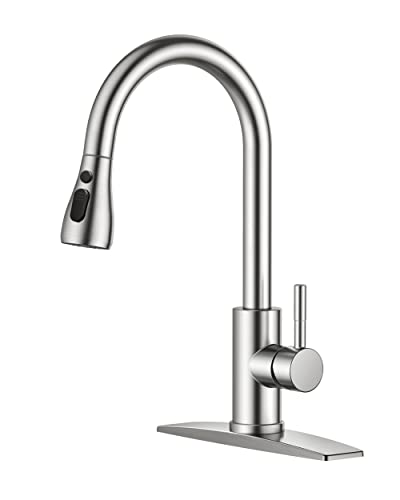
The best pull down kitchen faucets all do the one thing a fixed faucet cannot: the spray head pulls down from a high-arc spout on a flexible hose, so the water comes to the pot, the pan and the far corner of the sink instead of the other way round. Every faucet in this verified shortlist states that pull-down or pulldown mechanism in its listing, and the six differ in the ways that matter — stated hose and reach figures, spray modes, spring versus docked designs, certifications and brand support. Each pick carries an Amazon link so you can check the latest price on Amazon before you buy.
- VFAUOSIT Kitchen Faucet with Pull Down Sprayer, Modern Bar Sink Faucet — Best Stated Hose.
- WEWE High-Arc Pull-Down Kitchen Faucet, Brushed Nickel — Best Overall.
- FORIOUS Kitchen Faucet with Pull Down Sprayer, Brushed Nickel — Best Value.
- Moen Essie Pulldown Kitchen Faucet, Spot Resist Stainless, 87014SRS — Best Brand Name.
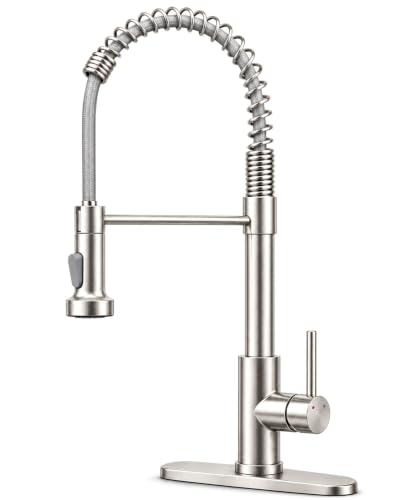
- OWOFAN Kitchen Faucet with Pull Down Sprayer, Brushed Nickel — Best Spring Design.
- WEWE Pull-Down Kitchen Faucet, Brushed Nickel, High Arc — Best Easy-Clean.
Read the full guide ↓ for how far each sprayer really reaches, which heads offer which spray modes, and how to match the format to your sink, your water and your cooking.
Best Pull Down Kitchen Faucets: Why the Format Won the Kitchen
There is a reason the best pull down kitchen faucets dominate modern shortlists: the format solved the kitchen sink’s oldest geometry problem. A fixed spout delivers water at one point, in one direction, and everything being washed must be brought to that point and tilted under it. A pull-down faucet inverts the relationship. The spout sits high, clearing the tallest stockpot; the head detaches and travels down and out on a hose, rinsing a roasting tray where it lies, filling a pot where it stands, and sweeping the bowl clean in a spiral at the end of the day. Once a household has washed up this way for a month, the fixed faucet in a holiday rental feels like a tool with a part missing.
This guide treats the format seriously, which means judging the six verified faucets on the mechanism’s own terms. Reach comes first: two picks state explicit figures — a retractable hose length on the compact VFAUOSIT and a pull-down reach on the WEWE high-arc — and those numbers are weighted accordingly, because a printed measurement can be checked against your own sink in a way an adjective cannot. Docking comes second, because a head that retracts cleanly and seats positively is a pleasure ten thousand times, and one that dangles is an annoyance the same number of times. Spray behaviour, hose management, mounting flexibility and the substance behind the water — stainless bodies, ceramic cartridges, stated certifications — fill out the assessment.
The six picks also map the format’s price and philosophy range. At one end sits the FORIOUS, the classic recipe at a value tier; at the other, the Moen Essie, whose brief listing sells brand support rather than stated features. Between them are a spring-spout design that borrows the commercial pre-rinse silhouette, a compact certified station faucet with the longest stated hose, and two WEWE models that compete on reach and cleanability. None of them is the right answer for every sink, and the guide’s job is to make the differences legible: bowl size, deck holes, water hardness and cooking style should pick the winner, not the order of a list. Readers cross-shopping the neighbouring format, where the head pulls out from a lower spout, should start with Best Pull Out Kitchen Faucets and return here to compare the two geometries honestly.
Key Takeaways
- Every pick states a pull-down or pulldown sprayer in its verified listing — the defining mechanism of this guide — in docked high-arc form on five picks and an exposed spring form on the OWOFAN.
- Stated reach figures are the exception and deserve weight: the VFAUOSIT lists a 23-inch retractable hose and the WEWE high-arc lists a 20-inch pull-down reach.
- Three-mode sprayers on the VFAUOSIT, the WEWE high-arc and the WEWE pull-down separate filling, rinsing and residue work in one head.
- Docking quality is a hose-and-weight story: a clear under-sink path and a correctly placed counterweight decide whether the head seats cleanly for years.
- Certifications are stated on the VFAUOSIT and OWOFAN listings — lead-free and plumbing-code marks that the other picks’ titles do not claim.
- The Moen Essie trades stated features for brand infrastructure, a legitimate exchange for long-horizon buyers and a poor one for spec-led shoppers.
In this guide
Quick Picks
| Pick | Badge | Defining trait | Check |
|---|---|---|---|
| VFAUOSIT Pull Down Faucet | Best Stated Hose | 23-inch retractable hose stated, certified, compact | Check on Amazon |
| WEWE High-Arc Pull-Down | Best Overall | 20-inch reach stated, rub-clean silicone nozzles | Check on Amazon |
| FORIOUS Pull Down Faucet | Best Value | Classic high-arc recipe, deck plate included | Check on Amazon |
| Moen Essie Pulldown | Best Brand Name | Moen support, Spot Resist Stainless, 87014SRS | Check on Amazon |
| OWOFAN Spring Faucet | Best Spring Design | Spring spout, lead-free NSF certified build | Check on Amazon |
| WEWE Pull-Down Faucet | Best Easy-Clean | Easy-clean nozzles, ceramic cartridge, tool-free install positioning | Check on Amazon |
The quick view shows a format that has matured into specialisations. The two stated-figure picks anchor the reach conversation; the spring OWOFAN serves cooks who want the head perpetually mobile; the FORIOUS strips the format to its classic essentials; the Essie wraps it in brand support; and the second WEWE aims at the maintenance reality of hard water and daily use. None of these is a compromise version of another — each is the format tuned to a different sink and a different owner, which is exactly what a healthy category looks like.
How These Picks Were Chosen
The six faucets come from a verified product pool checked against Amazon listing data on 2026-11-20. The pull-down rule was applied at title level: a pick is linked here only because its verified title states the pull-down mechanism — as pull down sprayer, pull-down hose with sprayer, pull-down reach, or, in the Moen’s case, the brand’s own word pulldown for the same format. Specifications are reported only as the listings state them. Hose and reach figures appear in this guide for exactly the two picks whose titles print them, and the absence of a figure for the other four is reported as absence, not filled in from other models, photographs or general knowledge.
Within the qualifying pool, selection favoured diversity of the mechanism’s expressions — spring and docked, compact and full-size, certified and brand-backed — and each pick was assessed on reach evidence, spray behaviour, mounting flexibility, stated construction and the realism of its maintenance story. This is a research-led guide built from verified listing data, not a hands-on test programme; we do not claim measured flow rates or endurance results, and the judgements offered are buying guidance for readers matching a format to a sink. That restraint is deliberate: a pull-down faucet is a ten-year purchase, and advice grounded in what can be verified ages better than enthusiasm.
The 6 Best Pull Down Kitchen Faucets, Reviewed in Detail

VFAUOSIT Kitchen Faucet with Pull Down Sprayer, Modern Bar Sink Faucet
Badge: Best Stated Hose
Strengths
- The longest stated hose in this guide: a 23-inch retractable hose, printed in its listing.
- Lead-free construction with NSF 61/372 and cUPC marks stated.
- Three spray modes, cold-start safety and fast tool-free install positioning in a compact format.
Trade-offs
- Bar-sink positioning means compact scale at a large main sink.
- Efficiency-led design with little decorative presence.
- Its compact arc gives less tall-pot clearance than the high-arc picks.
Mini spec box
- Certifications: lead-free NSF 61/372 and cUPC (as stated in listing)
- Sprayer: pull down sprayer, 3 spray modes
- Hose: 23-inch retractable hose (as stated in listing)
- Safety: cold-start safety
- Install: tool-free install positioning (as stated in listing)
- Positioning: modern bar sink faucet
The VFAUOSIT leads this guide on evidence. In a category where reach is usually sold with adjectives, its listing prints a number — a 23-inch retractable hose — and a buyer with a tape measure can test that number against their own sink before spending anything. Around the hose, the specification is equally concrete: lead-free construction with NSF and cUPC marks stated, three spray modes, and cold-start safety, which defaults the water to cold on opening and is a thoughtful touch at a station used by guests or children. The fast tool-free installation positioning suits its natural habitats: a bar sink, a prep station, a studio or utility space where the faucet is fitted by its user and expected to work immediately.
Scale is the honest boundary. This is a compact faucet, positioned by its own listing for a bar sink, and its arc will not tower over a farmhouse bowl or swallow a stockpot the way the high-arc picks do. What it offers instead is proportion: the full pull-down mechanism, certified and multi-mode, sized for the second sink and the smaller kitchen — settings where the big designs are not better, merely bigger. Buyers furnishing a compact workspace will find it the most completely argued pick in this guide.
Best for: bar sinks, prep stations and compact kitchens wanting stated reach and certifications / Not suited for: buyers needing maximum tall-pot clearance at a main sink
WEWE High-Arc Pull-Down Kitchen Faucet, Brushed Nickel, 3-Mode Sprayer
Badge: Best Overall
Strengths
- A stated 20-inch pull-down reach — the clearest main-sink working figure in the guide.
- Soft silicone nozzles that rub clean, built for hard-water reality.
- Three spray modes, full swivel, ceramic cartridge and SUS 304 construction in one specification.
Trade-offs
- Manual operation only.
- High arc requires overhead clearance.
- Tool-first character rather than a design statement.
Mini spec box
- Material: SUS 304 stainless steel
- Finish: brushed nickel
- Sprayer: pull-down, 3-mode sprayer
- Reach: 20-inch pull-down reach (as stated in listing)
- Nozzles: soft silicone, easy to rub clean
- Swivel: 360 degree
- Cartridge: ceramic cartridge
- Mounting: 1- or 3-hole fit
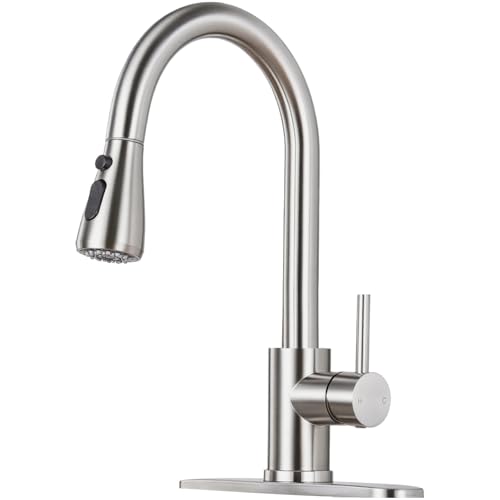
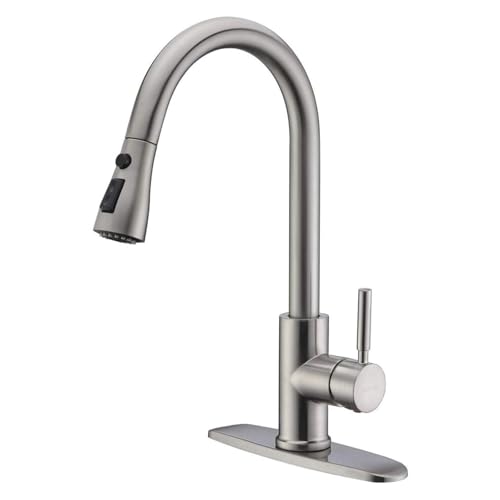
The WEWE high-arc takes the overall badge because it is the most complete expression of the mainstream format: a tall docked arc for clearance, a pull-down head with a reach figure actually stated at 20 inches, three spray modes for the fill-rinse-residue rotation, a spout that swings out of the way entirely, and the maintenance pairing that decides long-term satisfaction — silicone nozzles that clear scale with a fingertip and a ceramic cartridge. In brushed nickel over stainless, it also wears the finish that hides a busy sink’s evidence best. Read as a checklist against everything this guide says a pull-down should be, it is the pick with no empty boxes.
Its compromises are the mainstream’s own. There is no sensor, so hands-free work is not on offer; the arc that clears stockpots needs cabinet room above the sink; and the design is content to be equipment rather than ornament. For the majority of full-size home sinks — especially in hard-water areas, where the rub-clean nozzles will earn their keep weekly — those are the right compromises, and this is the faucet against which the rest of the list should be measured.
Best for: most full-size home sinks, especially in hard-water homes / Not suited for: buyers wanting touchless operation or a compact faucet
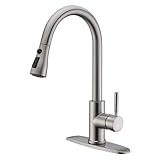

FORIOUS Kitchen Faucet with Pull Down Sprayer, Brushed Nickel
Badge: Best Value
Strengths
- The classic pull-down recipe — high arc, sprayer, single handle — at the value end of the format.
- Deck plate included, answering the one- or three-hole question in the box.
- Stainless construction and a brushed nickel finish that forgives daily splashes.
Trade-offs
- No reach or hose figure stated in its listing.
- No spray-mode count stated — the mechanism in its simplest form.
- Value-brand support network.
Mini spec box
- Material: stainless steel
- Finish: brushed nickel
- Sprayer: pull down sprayer
- Arc: classic high arc
- Handle: single handle
- Mounting: deck plate for 1 or 3 hole
- Settings named in listing: farmhouse, camper, laundry, RV, bar
Every mature format has a pick that proves how far the essentials have travelled down the price ladder, and in this guide it is the FORIOUS. The high arc, the pull down sprayer, the single-handle control and the included deck plate are the format’s founding features, and they are all here in stainless and brushed nickel at a value position. Its listing names farmhouse, camper, laundry, RV and bar settings alongside the kitchen, which fairly describes its character: a versatile, unfussy workhorse for wherever a sink works hard and budgets are watched.
The silences in its listing are reported honestly in this guide: no reach figure, no mode count, no certification line. A buyer who needs those assurances has the VFAUOSIT, WEWE and OWOFAN picks to turn to. A buyer who needs the mechanism itself, working properly, at the lowest sensible tier — for a rental, a first home, a utility sink — will find the FORIOUS the format’s honest entry point, and will not feel short-changed by it in daily use.
Best for: budget-focused buyers and secondary sinks wanting the core format / Not suited for: buyers who need stated reach figures, modes or certifications
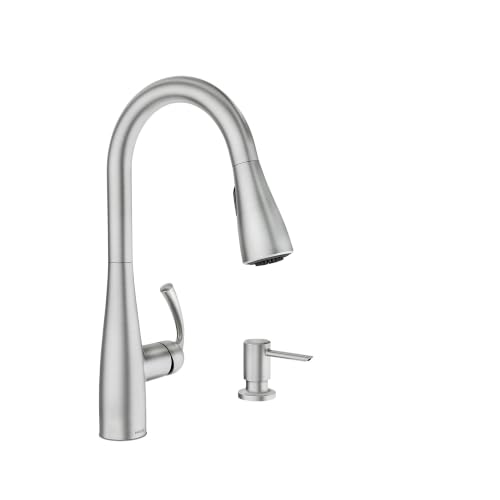
Moen Essie Pulldown Kitchen Faucet, Spot Resist Stainless, 87014SRS
Badge: Best Brand Name
Strengths
- Moen’s pulldown format with the brand’s parts and support infrastructure behind it.
- Spot Resist Stainless finish for a cleaner-looking sink with less wiping.
- Model 87014SRS — a recognised number for future parts and service.
Trade-offs
- Higher tier than the value-brand picks.
- The briefest verified listing in the guide: no reach, hose or mode figures stated.
- No stated certifications in its title data.
Mini spec box
- Brand: Moen
- Model: Essie 87014SRS
- Finish: Spot Resist Stainless
- Sprayer: pulldown
The Essie is the format’s establishment option. Moen’s pulldown head delivers the same geometry as every pick here — down from the spout, around the bowl, back to its dock — and the faucet’s Spot Resist Stainless finish addresses the daily cosmetic battle that brushed finishes fight more passively. What the Essie principally adds is not visible in the sink at all: a national parts catalogue indexed by its model number, support channels, and plumbers who know the range. For a pull-down system, whose hose, dock and cartridge are moving and wearing parts, that infrastructure is a rational thing to pay a tier for.
The discipline of this guide requires the other side to be stated just as clearly: on verified data, the Essie is the least specified pick here. No reach figure, no mode count, no certification line appears in its title, and a buyer comparing columns will watch rivals win them. The Essie’s argument is temporal — it is about years three to ten, when the wearing parts need the system behind them. Long-horizon homeowners will find that argument persuasive; spec-led and budget-led shoppers have better-matched picks above and below it in this list, including the home-layout perspective gathered in Best Pull Down Kitchen Faucets Home.
Best for: long-term owners who value brand support for a wearing mechanism / Not suited for: spec-sheet comparers or strict budgets

OWOFAN Kitchen Faucet with Pull Down Sprayer, Brushed Nickel
Badge: Best Spring Design
Strengths
- Spring spout keeps the sprayer mobile across a wide working arc — the pre-rinse idea, domesticated.
- Lead-free, NSF certified stainless construction stated in its listing.
- One handle, deck plate for one- or three-hole decks.
Trade-offs
- The exposed spring is a bold look that dominates a small or traditional kitchen.
- Spring-held heads park differently from docked heads — less visually tidy.
- No spray-mode count stated in its title data.
Mini spec box
- Material: stainless steel, lead-free
- Certification: NSF certified (as stated in listing)
- Finish: brushed nickel
- Sprayer: pull down sprayer, spring design
- Handle: 1 handle
- Mounting: 1 or 3-hole deck plate
The OWOFAN is the format’s extrovert. Instead of parking its head inside an arc, it carries the sprayer on an exposed spring, so the head is always essentially deployed — free to be drawn across a farmhouse bowl, angled into a deep pot or swept along a tray, with the spring bearing its weight and returning it to a ready position. For cooks whose washing-up is constant and physical, that perpetual readiness is the most enjoyable version of the pull-down idea, and it arrives here with a credential the style alone would not predict: lead-free, NSF certified stainless construction, stated plainly in the listing.
The costs are presence and tidiness. A spring faucet is the first thing a visitor notices at the sink, and in a small or traditional kitchen that can be the wrong kind of notice; the head’s parked position is functional rather than sculptural. Its listing also states no mode count, so buyers set on a three-mode head should look to the WEWE and VFAUOSIT picks. For a big sink, a confident scheme and a household that washes in volume, the OWOFAN delivers the format’s most distinctive working experience with certified substance underneath the show.
Best for: large sinks and volume washing with a statement spring design / Not suited for: small or traditional kitchens wanting the faucet to blend in

WEWE Pull-Down Kitchen Faucet, 3-Mode Sprayer, Brushed Nickel, High Arc
Badge: Best Easy-Clean
Strengths
- Easy-clean nozzles and a ceramic cartridge target the format’s two commonest ageing problems.
- Three-mode pull-down sprayer with a full-swivel, high-arc spout.
- Tool-free installation positioning and braided supply hoses reduce the hidden costs of fitting.
Trade-offs
- Listed for one-hole fit, so three-hole decks need the plate question answered first.
- No reach figure stated, unlike its WEWE high-arc sibling.
- Shares the value brands’ thinner support network.
Mini spec box
- Material: SUS 304 stainless steel
- Finish: brushed nickel
- Sprayer: pull-down, 3-mode sprayer
- Swivel: 360 degree
- Cartridge: ceramic cartridge
- Nozzles: easy-clean
- Mounting: 1-hole fit, tool-free install positioning
- Supply: 304 braided supply hoses
The second WEWE in this guide is the maintenance realist’s pull-down. Where its high-arc sibling competes on a stated reach figure, this model competes on the two things that actually degrade a faucet’s daily pleasure: nozzles that clog and cartridges that drip. Its listing answers both directly — easy-clean nozzles, a ceramic cartridge — and adds a three-mode sprayer, a full-swivel high arc, braided supply hoses and tool-free installation positioning on a SUS 304 body. It is a specification written by someone thinking about year two, and in a hard-water home that thinking is worth more than a headline feature.
Fit is its one sharp edge: the listing positions this model for a one-hole deck, so owners of three-hole sinks should confirm their covering arrangement before ordering, where its sibling fits either pattern. Its support story is the value-brand standard it shares with most of this list. Within those honest bounds, it is the pick for buyers who have already owned a faucet that slowly strangled its own spray pattern — and who intend never to own another. Retailer-guided shoppers comparing the same shortlist logic will find a parallel discussion in Best Pull Down Kitchen Faucets Yale Appliances.
Best for: hard-water homes and practical buyers prioritising cleanability and cartridge quality / Not suited for: unconfirmed three-hole decks
Comparison Table
| Pick | Head style | Stated figure | Modes stated | Certification stated | Check |
|---|---|---|---|---|---|
| VFAUOSIT Pull Down | Docked, compact | 23-inch retractable hose | 3 spray modes | NSF 61/372, cUPC | Check on Amazon |
| WEWE High-Arc | Docked, high arc | 20-inch pull-down reach | 3-mode sprayer | Not stated in title | Check on Amazon |
| FORIOUS Pull Down | Docked, high arc | Not stated | Not stated | Not stated in title | Check on Amazon |
| Moen Essie | Docked pulldown | Not stated | Not stated | Not stated in title | Check on Amazon |
| OWOFAN Spring | Exposed spring | Not stated | Not stated | Lead-free NSF certified | Check on Amazon |
| WEWE Pull-Down | Docked, high arc | Not stated | 3-mode sprayer | Not stated in title | Check on Amazon |
Two columns do the honest work in this table. The stated-figure column shows how rarely manufacturers commit to a reach number — two picks of six — and therefore how much weight those two commitments deserve. The certification column shows the same pattern for water safety. Everything else is design character: spring against dock, modes against simplicity, brand against value, and those are choices a buyer can make confidently once the two evidence columns have been read first.
How to Choose the Right Pull Down Faucet for Your Sink
Measure before you fall in love. The three measurements that decide fit are the distance from the faucet’s dock to the far corner of your bowl, the height of your tallest regularly washed vessel, and the clearance between the sink and any cabinet, shelf or window sill above it. Test stated figures against the first measurement: a 20-inch reach or a 23-inch hose either covers your bowl’s geometry or it does not, and that arithmetic is more useful than any review. The second measurement arbitrates arc height — stockpot households need the high-arc picks; the third arbitrates against them where overhead room is tight, and towards compact designs like the VFAUOSIT.
Then match the head style to the bowl. A wide single bowl rewards the OWOFAN’s spring mobility or a long-reach docked head; a double bowl rewards a full-swivel spout that parks over either side, as on the WEWE models; a small or secondary sink rewards compact proportion. Match the specification to your water next: hard water promotes the rub-clean and easy-clean nozzle designs and makes a ceramic cartridge a near-necessity, while households that drink and cook from the tap all day should weight the stated certifications on the VFAUOSIT and OWOFAN. Finally, count the deck holes and settle the plate question before ordering — included on the FORIOUS and OWOFAN, a one-hole positioning on the WEWE pull-down — because a beautiful faucet in a box beside an uncovered hole is a project, not an upgrade. Hose-fed portable appliances add one more niche check, covered for the neighbouring format in Best Pull Out Kitchen Faucets For Portable Dishwasher.
How to Install, Use and Maintain a Pull-Down Faucet
Installation follows the familiar sequence, with the hose given first-class attention. Shut off both supplies, remove the old faucet, clean the deck and dry-fit the new unit — deck plate on, where the hole pattern needs it — before final tightening. Connect the hot and cold supplies, then thread the pull-down hose, attach its counterweight at the marked position, and cycle the head in and out several times while the cabinet is still open, watching the hose loop move. It should travel freely, without rubbing the cabinet sides or catching on the supply lines, and the head should seat into its dock with a clean, positive feel. Only then restore the water, slowly, check each joint with a dry hand, and flush the faucet for a minute to clear any line debris before judging the spray.
Daily technique is mostly kindness to the mechanism. Pull the head out along its natural path rather than sideways, guide it home for the last few inches instead of letting it snap back, and swing the spout by the body rather than by the head. Rub the nozzles with a fingertip weekly in hard-water homes — the WEWE designs are built for exactly this — and keep the under-sink hose loop free of stored bottles, because that loop needs its travel space every single day.
Troubleshooting follows the pattern this series uses throughout. Problem: the head hangs loose or will not retract → the counterweight has shifted or the hose is snagging; reposition, clear the loop, and test again before blaming parts. Problem: the spray fans unevenly or loses force → mineral build-up; rub the nozzles clean and rinse the head’s screen. Problem: a drip persists after shut-off → the cartridge is the wear item; identify the model, source its cartridge, and treat the job as maintenance rather than replacement of the whole faucet.
Pull-Down, Pull-Out or Fixed: Choosing the Geometry Honestly
The pull-down’s dominance can make its cousins sound obsolete, and they are not; they are different geometries for different sinks. A pull-out faucet draws its head forward from a lower, shorter spout, which suits sinks under low cabinets or windows where a high arc cannot stand, and gives a longer, flatter working trajectory at the cost of tall-pot clearance. The neighbouring sink-format discussion at Best Pull Out Kitchen Sink Faucets explores that geometry on its own terms. A fixed high-arc faucet, meanwhile, has no hose, no dock and nothing to retract — and for a household that fills pots and rinses glasses but rarely wrestles a tray, that simplicity is a feature with a genuine decade-long argument behind it.
The pull-down wins where the washing is varied and physical: big cookware, wide bowls, produce in volume, a sink that doubles as a utility station. Its costs are the mechanism’s own — a hose to manage, a dock to keep seating, a cartridge and head that are more complex than a fixed spout’s aerator. The honest way to choose is to watch your own sink for a week. Count how often you tilt something awkwardly under a fixed stream, how often a pot is filled somewhere other than the bowl, how often the bowl itself needs sweeping clean. If those moments are daily, the pull-down is not a trend purchase; it is the correction of a daily friction, and this shortlist is where the correction starts.
Docking, Hoses and Weights: The Mechanism’s Quiet Engineering
Most of a pull-down faucet’s long-term character is decided by parts the buyer never sees in the showroom photograph. The hose must flex thousands of times without kinking or abrading, travel through the spout smoothly, and carry its counterweight at the point that balances retraction against a head that is easy to draw out. Too little weight and the head docks shyly and eventually dangles; too much and every pull feels like exercise. The dock itself must locate the head positively — by fit, by magnet in some designs across the wider market, by the spout’s geometry — so that the faucet looks and feels parked rather than abandoned. None of these details appear in the verified titles for this guide’s picks, and this guide does not pretend otherwise; what it can do is tell the buyer how to judge them in the first week of ownership, when adjustment is easy.
The practical tests are simple. Draw the head to its full comfortable extension twenty times: the travel should feel even, without a sticky patch that suggests the hose is rubbing. Release it from several positions: it should return fully, every time, without a guiding hand. Leave it docked overnight and look at it with morning honesty: a head that has crept out of its seat is telling you the weight position needs moving before the habit sets. And keep the cabinet beneath arranged so the hose’s loop is a clear tunnel, because nine in ten retraction complaints across this format trace back to a cleaning bottle parked in the hose’s road. A pull-down treated this way in week one will usually still be docking cleanly in year five, whichever of the six badges it wears.
Living With a Pull-Down: A Week of Real Kitchen Work
Specifications describe a faucet; a week of meals reveals it. Consider the ordinary rhythm of a cooking household and where the pull-down format quietly changes it. Monday’s pasta pot is filled at the counter, where it will be lifted once, full, to the stove — rather than filled in the bowl and lifted out wet and heavier, the small ergonomic theft the format commits every day without announcing itself. Tuesday’s sheet-pan dinner ends with the pan laid flat in the bowl and rinsed corner to corner by a head that travels, instead of the pan being rotated under a stream like a ship turning in a harbour. Wednesday’s market vegetables are washed in a colander held in one hand while the other walks the sprayer across them, a two-handed task the fixed faucet turns into a one-handed compromise.
The week’s end is where the format’s advocates are made. A stock day fills the biggest pot the house owns, breaks down carcasses or simmers bones, and generates the long, greasy wash-up that tests a sink’s character; the pull-down answers with clearance above, reach below and a final spiral sweep that sends the whole day’s debris to the drain in one motion. Baking days tell the same story in flour: bowls rinsed before the dough sets like cement, the sprayer doing in seconds what a fixed stream does in minutes of soaking. None of these moments is dramatic, and that is the point. The pull-down’s value is not a feature you demonstrate to guests; it is friction removed from a hundred small tasks a week, compounding into a kitchen that feels easier to cook in. Buyers deciding whether the format is worth specifying at all should interrogate their own week, not the showroom: if the moments above sound familiar, the mechanism will pay for its complexity quickly and then keep paying.
Finishes, Handles and the Details Around the Mechanism
Around the pull-down mechanism sit the ordinary faucet decisions, and they deserve the same clear-eyed treatment, because they are what the eye and hand meet a thousand times more often than the hose. Finish first. Five of this guide’s six picks wear brushed nickel or a stainless-look finish, and that convergence is practical wisdom rather than lack of imagination: brushed surfaces scatter light, hide fingerprints and water spots, and age gracefully in a splash zone. The Essie’s Spot Resist Stainless pursues the same goal with a purpose-built finish system, trading the brushed look for engineered spot resistance. In hard-water homes the finish decision is really a cleaning decision — how the faucet will look on the days nobody wipes it — and it should be made with the household’s actual habits, not its aspirations.
Handle design is the second detail. Every pick here is a single-handle or single-lever design, which suits the pull-down workflow: one hand sets temperature and flow while the other holds the sprayer or the item being rinsed, and adjustment mid-task takes a nudge rather than a two-handed reset. Buyers who cook with a partner should think about which side the handle lives on and who stands where, because a handle that suits a right-handed solo cook can mildly annoy a left-handed one sharing the sink. The third detail is the spout’s swivel: the WEWE models state a full 360-degree swing, which lets the whole faucet park over either bowl of a double sink or swing aside for a tall load — a small specification with an outsized effect in double-bowl kitchens, and one worth confirming in any listing where it is not stated. None of these details will headline a product page, but together they decide whether a well-chosen mechanism also becomes a well-liked faucet, which is the difference between a good purchase and a merely correct one.
Common Buying Mistakes
- Buying reach by adjective. Where a figure is stated, measure your sink against it; where it is not, expect competence, not miracles.
- Forgetting overhead clearance. A high arc under a low cabinet or shelf turns the format’s main virtue into a daily collision.
- Skipping the deck-hole count. Included plates, one-hole positionings and three-hole decks must be reconciled before the box is opened.
- Letting the hose loop fill with storage. The commonest pull-down complaint is a cabinet organisation problem, not a faucet defect.
- Paying for modes the kitchen will never use. Uniform washing needs a good single spray; varied washing earns a three-mode head.
- Ignoring hard water until the spray distorts. In hard-water homes, rub-clean nozzles and a ceramic cartridge are core specifications, not luxuries.
Final Recommendation
Start with the VFAUOSIT if your sink is compact or a second station: its stated hose and certifications make it the best-argued small pull-down here. For a full-size main sink, the WEWE High-Arc is the complete mainstream choice, with its stated reach and rub-clean nozzles. On a strict budget, the FORIOUS delivers the format’s essentials without apology — while the Essie serves brand loyalists, the OWOFAN serves spring-format fans, and the second WEWE serves hard-water realists. Measure your bowl, count your holes, and let those two facts choose among six good answers.
Frequently Asked Questions
What is the difference between a pull-down and a pull-out kitchen faucet?
A pull-down head travels down and out from a high-arc spout, giving tall-pot clearance above and hose reach below. A pull-out head extends forward from a lower, shorter spout, suiting sinks with limited height above them. Both put water on a hose; the pull-down suits bigger cookware and deeper work, the pull-out suits tighter vertical spaces.
How far should a pull-down sprayer reach?
Far enough to cover the far corner of your bowl and the spot beside the sink where you fill large vessels. Two picks here state their numbers — a 23-inch retractable hose on the VFAUOSIT and a 20-inch pull-down reach on the WEWE high-arc — and measuring your own sink against a stated figure is the most reliable way to judge any model.
Why does my pull-down faucet head dangle instead of docking?
Usually because the hose’s counterweight under the sink has slid from its intended position, or because stored items have drifted into the hose loop and are holding it. Clear the loop, reposition the weight, and cycle the head several times; docking almost always returns without any parts being replaced.
Are three spray modes worth having on a pull-down faucet?
If your washing alternates between delicate items, everyday dishes and baked-on cookware, yes — each mode has a real job. If your sink sees a narrow, gentle range of work, a single good spray pattern, honestly delivered, is sufficient and simpler to maintain. The mode count should follow the cooking, not the marketing.
Is a spring pull-down faucet better than a docked one?
It is different rather than better. The spring format, like the OWOFAN’s, keeps the sprayer mobile on an exposed coil with a wide working arc — excellent for large bowls and constant rinsing. Docked designs are tidier and suit more kitchens. The sink’s size and your tolerance for a bold silhouette should decide.
Does a pull-down faucet work with a double-bowl sink?
Very well, provided the spout can swing between the bowls — a full 360-degree swivel, as stated on the WEWE picks, is ideal — and the hose reach covers the far bowl’s far corner. The head can then service both bowls without the faucet being repositioned, which is one of the format’s quiet advantages over a fixed spout parked over a single point.
Can a pull-down faucet be installed in an existing three-hole sink?
Usually yes, when a deck plate covers the extra holes — the FORIOUS and OWOFAN in this guide include one for one- or three-hole decks. The exception is a model positioned for a single hole only, like the WEWE pull-down here, where the plate arrangement should be confirmed before ordering. Counting the holes and checking the listing’s mounting line takes two minutes and prevents the commonest installation surprise in this category.
How long should a pull-down faucet last?
The body of a stainless faucet should serve for many years; the wearing parts are the cartridge, the hose and the spray head, in roughly that order of attention. Designs that make those parts easy to clean and, eventually, to service — and brands with parts catalogues behind them — stretch the format’s working life the furthest. In practical terms, a buyer should expect the daily mechanism to feel unchanged for a long first chapter of ownership, provided the simple habits in this guide are kept: nozzles rubbed clean, the hose loop left clear, and the head docked by hand rather than by momentum.