As an Amazon Associate, this site may earn an affiliate commission from qualifying purchases made through links on this page, at no extra cost to you.
In this guide
Quick picks: best quality microwave convection ovens
| # | Product | Where to buy |
|---|---|---|
| 1 | Panasonic NN-CD87KS | Check on Amazon |
| 2 | Toshiba ML-EC42P(SS) | Check on Amazon |
| 3 | Breville Combi Wave 3-in-1 | Check on Amazon |
| 4 | Sharp SMC1585KB | Check on Amazon |
| 5 | BLACK+DECKER 5-in-1 | Check on Amazon |
Why a microwave that actually bakes changes what your kitchen can do
Most microwaves promise speed and deliver sogginess. They heat from the inside out, which is fine for reheating soup and terrible for anything you want crisp, browned, or evenly baked. A microwave convection oven is a different machine wearing the same shape: it adds a fan and a heating element that circulate hot air around the food, so it can roast a chicken, bake cookies, crisp pizza, and brown a casserole while still reheating leftovers in ninety seconds. The idea is not new, but the execution varies enormously, and that variation is the whole story of this guide.
A cheap convection microwave often treats convection as a checkbox. The fan is small, the element is weak, and the cavity loses heat the moment you open the door. The result is a machine that technically has a convection mode and practically never earns its keep: cookies come out pale on one side and overdone on the other, roast chicken takes longer than the regular oven, and you quietly go back to microwaving. A well-built one behaves like a second oven that happens to sit on your countertop. It holds temperature, moves air evenly, recovers quickly after the door closes, and survives years of daily heating cycles without the fan getting louder or the door seal giving up.
That durability is where “quality” actually lives in this category. A microwave convection oven is not a gadget you replace every two years; it is a workhorse that runs hot, cycles its element on and off thousands of times, and gets slammed, splattered, and wiped down daily. The machines worth buying are the ones built with that life in mind: a fan that stays quiet and balanced, a cavity that resists staining and cleans without a fight, a door that closes with a solid thunk rather than a rattle, and controls that still make sense when your hands are wet. This guide looks at six models that clear that bar in different ways, at different sizes and for different kitchens, and explains exactly where each one earns its place.
Before the picks, a note on what this guide does not do. It does not quote prices, because prices in this category move constantly and any figure printed here would be stale within weeks. Each review ends with a prompt to check the current price on Amazon, where live pricing and availability are shown. It also does not assign star ratings, because a single number cannot capture the difference between a machine that bakes beautifully and one that merely reheats well. Instead, every pick gets a full, honest review: what it does well, where it falls short, and who should — and should not — bring it home.
Quick comparison: six ovens, six temperaments
Six machines, six different answers to the same question. The Panasonic leads on precision and quiet operation. The Toshiba wins on sheer versatility per dollar. The Breville is the premium choice for cooks who want the most capable countertop oven in the category. The GE Profile is the best fit for a family kitchen that needs capacity and sensor cooking. The Sharp is the large-cavity workhorse for big households. The BLACK+DECKER is the compact five-in-one for kitchens that need everything in a small footprint.
| Oven | Best for | Capacity feel | Convection character | Noise character |
|---|---|---|---|---|
| Panasonic NN-CD87KS | Precise, quiet daily cooking | Mid-size family | Even, gentle, steady | Notably quiet |
| Toshiba ML-EC42P(SS) | Maximum functions, modest budget | Mid-size family | Strong, with air-fry edge | Moderate |
| Breville the Combi Wave 3-in-1 | Serious cooking, premium build | Mid-size, tall cavity | Powerful, fast, even | Moderate, purposeful |
| GE Profile PEB9159SJSS | Family capacity and sensors | Large family | Reliable, even, forgiving | Moderate |
| Sharp SMC1585KB | Big batches, big cavity | Large family | Steady, spacious, even | Moderate |
| BLACK+DECKER 5-in-1 | Small kitchens, five jobs in one | Small household | Compact, brisk, direct | Moderate |
Read the table as a map, not a ranking. A large family that bakes in batches will be happier with the Sharp’s roomy cavity than with the Breville’s power. A single cook in a small kitchen will get more from the BLACK+DECKER’s compact footprint than from the GE’s capacity. The reviews below are where each machine’s personality comes out in full.
What to look for in a quality microwave convection oven
Shopping for a convection microwave is confusing because the spec sheets all look alike: every model lists convection, most list air fry, and all of them claim even cooking. The differences that matter are the ones the spec sheet hides. Here are the five things to check before you buy.
Fan and element: the convection system is the oven
Convection is not a feature; it is a system made of a heating element, a fan, and a cavity designed to move air. In the best machines, the element sits behind the fan and the fan pulls air across it, so the cavity fills with evenly heated moving air rather than a hot spot near the element. In weaker machines, the element is a coil at the top and the fan is an afterthought, which means the top of the food browns while the bottom stays pale. You can feel the difference in results: good systems bake cookies that brown evenly across the tray, roast vegetables that crisp on all sides, and hold a steady temperature when you open the door to check. Ask how the air moves, not whether convection is listed. A machine with a true rear-mounted element and a fan that runs at more than one speed will outperform a machine with a top coil every time, and it will do it quietly, because a balanced fan does not have to scream to move air.
Crisping versus reheating: two different jobs
A microwave reheats by exciting water molecules. A convection oven crisps by drying the surface and browning it with hot air. A good combination oven has to do both, and the transition between the two matters more than either mode alone. The most useful machines let convection and microwave work together — microwave power for speed, convection heat for the finish — so a frozen pizza comes out hot through and crisp underneath instead of hot through and soggy underneath. Look for combination modes with sensible presets, and for a machine that preheats its convection cavity quickly. A convection oven that takes fifteen minutes to preheat is a machine you will not use for a quick weeknight dinner. The best in this guide preheat in a fraction of that time and tell you clearly when they are ready, with a signal you can hear from the next room.
Capacity and the shape of the cavity
Capacity numbers are measured in cubic feet, but what matters is what fits: a standard dinner plate, a nine-by-thirteen baking dish, a whole chicken on a rack. A cavity can be large on paper and awkward in practice if it is shallow, or if the turntable is small, or if the door opening is narrow. Tall cavities matter for convection baking, because air needs room to circulate above the food; a short cavity browns the top of a muffin before the middle is done. Measure your largest baking dish and your tallest casserole before you shop, and check the turntable diameter against your dinner plates. A machine that cannot hold your everyday dishes is a machine you will resent every single day, no matter how good its convection system is.
Build quality: the door, the cavity, and the fan over years
Quality in this category is a durability story. The door gets opened and closed thousands of times a year, and a cheap latch loosens, a thin door flexes, and a weak seal lets heat escape. The cavity gets splattered with grease and sauce, and a rough or porous interior stains and holds odors while a smooth stainless or ceramic-enamel interior wipes clean. The fan runs for hours at high temperature, and a cheap bearing gets louder month by month until the machine sounds like it is working harder than it is. When you inspect a machine, open and close the door a dozen times and listen for a solid, consistent close. Run your hand over the cavity and feel for a smooth, sealed surface. Ask about the warranty on the magnetron and the cavity, because the length of the warranty is the manufacturer’s own statement about how long the machine is built to last.
Noise, controls, and the daily experience
A microwave convection oven lives on your countertop, which means you live with its noise. Fan noise during convection cooking is normal — air has to move — but there is a difference between a low, steady hum and a high-pitched whine that fills the kitchen. The best machines keep the fan balanced and the pitch low, and they run the cooling fan only as long as needed after cooking instead of droning on for minutes. Controls matter just as much: a good interface puts the modes you use daily within one touch, keeps the display readable in bright kitchen light, and does not bury the convection temperature behind three menus. If the machine has a child lock, a mute function, or a way to turn off the beep, those small kindnesses add up over years of daily use.
The best quality microwave convection ovens, reviewed
Every pick below was chosen for a different strength. Read them as six different kitchens, and find yours.
Top pick
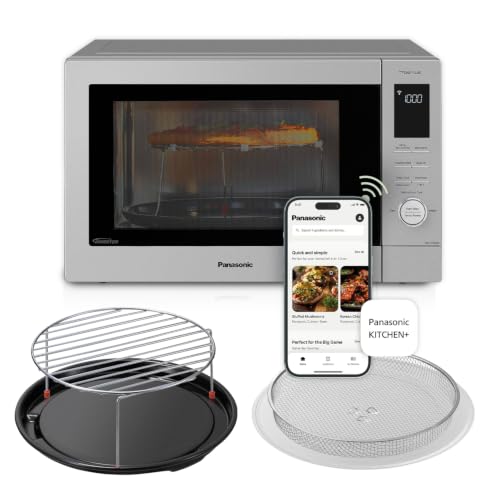
1. Panasonic NN-CD87KS: the quiet precision cook
Panasonic has spent decades making microwaves that do not sound or feel like microwaves, and the NN-CD87KS is the fullest expression of that philosophy in a convection machine. It is a four-in-one — microwave, convection, broiler, and air fry — built around Panasonic’s inverter technology, which delivers steady, continuous power instead of the on-off cycling of a conventional microwave. The practical result is food that heats evenly without the hot and cold spots that come from pulsing power, and a machine that runs noticeably quieter than its rivals. In a kitchen where the oven runs every day, that quietness is not a luxury; it is the difference between a machine you enjoy using and a machine you tolerate.
The convection system is the heart of this pick. A rear-mounted element and a well-balanced fan move hot air evenly through the cavity, and the inverter’s steady power means the temperature holds without the surges and sags that ruin delicate baking. Cookies brown evenly across the tray. Roast vegetables crisp on the edges without drying out in the middle. A whole chicken comes out with skin that crackles and meat that stays juicy, because the heat is doing one steady job instead of several interrupted ones. The combination modes are where the machine earns its keep on weeknights: microwave speed with convection finish, so a frozen pizza is hot through and crisp underneath in a single cycle, and a baked potato gets a fluffy interior and a skin that actually crunches.
Strengths: Inverter power makes heating genuinely even, with no pulsing hot spots, and it makes the machine unusually quiet for a convection oven. The four-in-one range covers microwave, convection, broiling, and air frying without a separate appliance. The cavity is smooth stainless steel that wipes clean after a splatter, and the door closes with a solid, reassuring feel. Controls are straightforward, with a dial and clear mode selection, and the sensor reheat function is one of the more reliable ones in the category — it reads steam rather than guessing at time. The machine is compact for its capability, which matters in kitchens where counter space is already spoken for.
Trade-offs: The cavity is mid-size, so a very large baking dish or a big family roast will not fit; this is a machine for households of one to four, not for a crowd. The convection preheat, while fast, is not the fastest in this guide, and impatient cooks will notice the wait on a busy evening. There is no turntable-off option for rectangular dishes in some modes, which can be annoying when a square pan catches the walls. The air-fry function, while genuinely useful, is not as fierce as a dedicated air fryer — it crisps well but will not match a standalone basket fryer for the crunchiest results. And the styling is restrained to the point of plainness; this is a machine that disappears into a kitchen rather than announcing itself.
Who it suits: The Panasonic is the right buy for a cook who values precision and quiet over raw power: someone who bakes as well as reheats, who notices when cookies brown unevenly, who cooks daily and wants a machine that will still be running quietly in five years. It suits apartments and open-plan kitchens where fan noise matters, and households that want one capable machine rather than a counter full of gadgets. If your household regularly feeds six or more, or you want the most aggressive air-fry crunch available, look at the Sharp or the Breville instead. For a closer look at the current configuration and availability, check price on Amazon.
Check price on Amazon: Panasonic NN-CD87KS
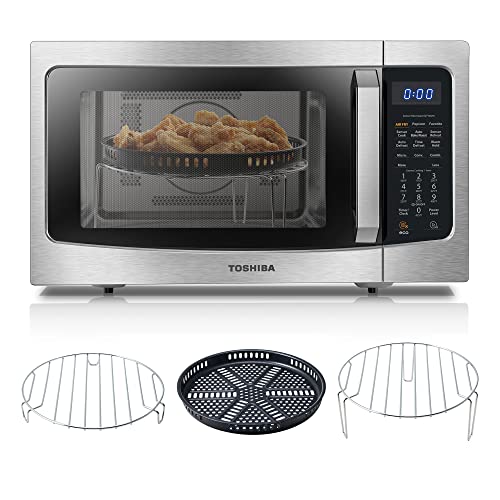
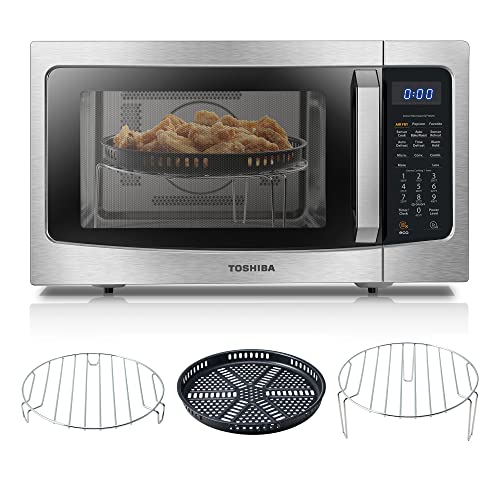
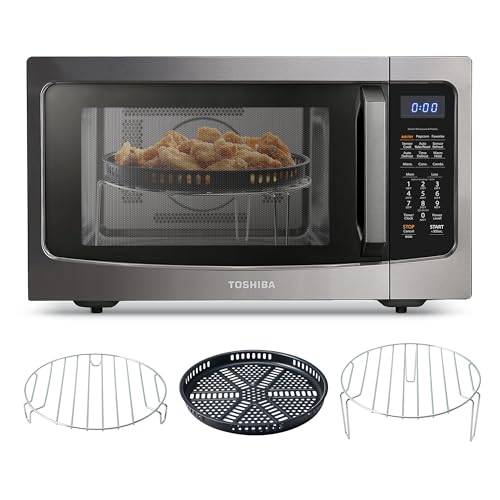
2. Toshiba ML-EC42P(SS): the versatile value pick
Toshiba’s ML-EC42P(SS) is the machine in this guide that does the most jobs for the least fuss. It is an eight-in-one — microwave, convection, air fry, broil, bake, roast, and a handful of combination modes — in a mid-size stainless body that looks considerably more expensive than it is. The appeal is not any single feature; it is the way the whole package hangs together. The convection system is strong and honest, the air-fry mode is genuinely effective rather than decorative, and the controls are simple enough that a household can actually use all eight functions instead of learning two and ignoring the rest. For a family that wants one machine to replace a microwave, a toaster oven, and an air fryer, this is the most convincing argument in the category.
What stands out in daily use is the convection performance at this tier. The fan moves air briskly and the element holds temperature well, so roast chicken gets genuinely brown skin, frozen snacks crisp instead of steaming, and baked goods rise evenly. The air-fry mode deserves a special mention: where many combination ovens treat air fry as a marketing label, the Toshiba’s version moves enough air at high enough temperature to produce real crunch on fries, wings, and breaded fish. The sensor cooking is solid rather than spectacular — it handles popcorn, potatoes, and reheating well — and the one-touch presets are sensibly chosen for the foods people actually cook. The cavity is a good size for a family, holding a standard dinner plate and a nine-by-thirteen dish without a fight, and the stainless interior cleans with a single wipe after most cooking sessions.
Strengths: Eight functions in one machine at a price that undercuts most rivals, with a convection system that genuinely performs rather than merely existing. The air-fry mode is strong enough to replace a standalone fryer for most households. The stainless steel cavity resists staining and wipes clean easily. Controls are clear and direct, with a readable display and presets that match real cooking habits. The door opens and closes with a satisfying solidity, and the machine’s footprint is reasonable for the capacity it offers. For households consolidating appliances, the value is hard to beat.
Trade-offs: The fan is louder than the Panasonic’s at full convection speed — a steady whoosh rather than a hum — and in a quiet apartment kitchen you will notice it. The convection preheat takes a little longer than the premium machines, so weeknight dinners need a few minutes of planning. The sensor modes are good but not as finely tuned as the Panasonic’s, and delicate reheating sometimes needs a manual touch. The turntable is standard size, so very large plates can feel cramped. And while the build is solid, the fit and finish — the feel of the buttons, the weight of the door — is a step below the Breville and the Panasonic, which is the honest trade for the price.
Who it suits: Choose the Toshiba if you want the widest range of cooking modes in one machine and you cook for a family most nights: roast chicken on Monday, air-fried fries on Friday, baked potatoes on Sunday, all from the same box on the counter. It suits households replacing several appliances at once, renters who want capability without a premium price, and cooks who will genuinely use the air-fry and convection modes rather than leaving them untouched. If absolute quiet matters most, the Panasonic is the better fit; if you want the most refined cooking performance and are willing to pay for it, the Breville is the step up. To see the current listing and its full specifications, check price on Amazon.
Check price on Amazon: Toshiba ML-EC42P(SS)


3. Breville the Combi Wave 3-in-1: the premium all-rounder
Breville does not make appliances that disappear into the kitchen, and the Combi Wave 3-in-1 is the most deliberate cooking machine in this guide. It combines microwave, convection oven, and air fryer in a single unit with a tall cavity, a fast preheat, and a level of control that feels closer to a proper oven than to a microwave with extras. The defining feature is the way it moves between modes: microwave power and convection heat can be blended in precise proportions, so you can set a dish to cook fast and finish crisp in one program instead of two. For a cook who wants the countertop oven to be a real cooking tool rather than a reheating box, this is the machine that treats the job seriously.
The convection performance is the best in this guide. The fan is powerful and the element recovers temperature quickly after the door opens, so the cavity holds its heat through the whole bake. Cookies come out evenly browned, edge to edge. Roast vegetables crisp deeply without drying. A chicken roasts with skin that shatters and meat that stays moist, because the hot air is doing continuous work rather than cycling. The air-fry mode is the strongest here too — genuinely comparable to a standalone air fryer for fries, wings, and breaded foods. The tall cavity is a real advantage: it holds a whole chicken on a rack with air circulating above it, and it fits taller dishes that would crowd a shorter machine. The interface is a dial-and-button system that rewards a few minutes of learning with fast, precise control over power, temperature, and time.
Strengths: The most capable convection system in this group, with fast preheat and excellent temperature recovery. True combination cooking with adjustable microwave-to-convection ratios. A tall cavity that fits whole chickens and taller dishes. The air-fry mode is strong enough to retire a standalone fryer. Build quality is a clear step up: the door feels substantial, the cavity is smooth stainless, and the controls are precise. The machine looks and feels like a premium appliance, and it performs like one.
Trade-offs: This is the most expensive machine in the guide, and the premium is real. The footprint is large and the machine is heavy, so it needs a committed patch of countertop and is not a machine you move often. The fan is audible at full speed — a purposeful sound rather than a whine, but present. The interface, while precise, has a learning curve; the first week involves more reading of the manual than the other machines here. And the capacity, while tall, is not the widest — a very large baking dish will not fit, so big-batch bakers should check dimensions before buying.
Who it suits: The Breville suits the cook who treats the countertop oven as a primary cooking appliance: someone who roasts, bakes, and air-fries several times a week and wants the best results this category can offer. It fits kitchens where the oven earns its counter space daily, and cooks who enjoy precise control and are willing to pay for it. If your budget is tight, the Toshiba delivers most of the versatility for much less; if you need the biggest cavity for a large family, the Sharp is the better fit. For the latest listing on this premium model, check price on Amazon.
Check price on Amazon: Breville Combi Wave 3-in-1
4. GE Profile PEB9159SJSS: the family capacity pick
GE’s Profile line has always been aimed at the family kitchen, and the PEB9159SJSS is the machine in this guide built most squarely for feeding a household. It is a large-capacity convection microwave with a strong sensor system, a roomy cavity, and a convection mode that is forgiving rather than fussy. The defining quality is reliability: it does the everyday jobs — reheating, defrosting, roasting, baking — with a consistency that builds trust over months of use. Where some machines reward a careful cook and punish a hurried one, the GE forgives a hurried cook. The sensors read steam and adjust time, the convection holds temperature steadily, and the cavity is big enough that a family dinner is never a puzzle of fitting dishes in.
The convection system is solid and even. It will not match the Breville for raw power, but it bakes cookies evenly, roasts a chicken with properly browned skin, and crisps frozen foods without drama. The sensor cooking is the real strength: sensor reheat and sensor cook modes handle the foods families actually eat — leftovers, vegetables, potatoes, frozen entrees — with a hit rate that makes the machine feel smart rather than guessing. The cavity is genuinely large, holding a nine-by-thirteen dish and a standard dinner plate with room to spare, and the turntable is generously sized. The stainless interior wipes clean, and the door has the solid, weighted feel of a machine built to be opened and closed a dozen times a day for years.
Strengths: Large capacity that fits family-size dishes without a struggle. Excellent sensor cooking that takes the guesswork out of reheating and defrosting. Even, reliable convection that handles roasting and baking well. A sturdy door and a smooth stainless cavity that stand up to daily family use. Controls are clear and family-friendly, with one-touch options for the most common jobs. GE’s service network is wide, which matters when a machine needs attention years down the line.
Trade-offs: The machine is big and heavy, so it needs a substantial countertop and is not suited to a small kitchen. The convection preheat is steady rather than fast, and the air-fry capability — while present in combination modes — is not as aggressive as the Toshiba’s or the Breville’s. The fan noise is moderate and noticeable in a quiet kitchen. The styling is classic rather than modern, which will suit some kitchens and date others. And the price sits in the upper-middle of the group, reflecting the capacity and the sensor system rather than raw cooking power.
Who it suits: Choose the GE Profile if you cook for a family most nights and want a machine that handles volume without fuss: big dishes, big batches, and a sensor system that gets reheating right. It suits households where several people use the microwave, because the controls are forgiving and the results are consistent. If you cook for one or two, the Panasonic or the BLACK+DECKER will fit your kitchen better; if you want the most powerful convection cooking available, the Breville is the upgrade. For current availability in the configuration you want, check price on Amazon.

5. Sharp SMC1585KB: the big-cavity workhorse
Sharp invented the countertop microwave category, and the SMC1585KB carries that history in the most practical way possible: a large, honest machine that does the big jobs without fuss. It is the largest cavity in this guide, built for households that cook in volume — big roasts, full trays of cookies, family-size casseroles — and it treats convection as a workhorse function rather than a premium extra. The fan and element are steady rather than flashy, the cavity is deep and tall, and the machine is built to run hot for long sessions without complaint. For a large household, the extra space is not a luxury; it is the difference between cooking dinner in one go and cooking it in shifts.
The convection system is even and patient. It holds temperature across a large cavity, which is harder than it sounds — a big box of air wants to stratify, with hot air at the top and cool air at the bottom — and the Sharp’s fan does the work of keeping it mixed. Cookies bake evenly across a full tray, a large casserole browns on top without drying at the edges, and a whole chicken roasts with consistent results. The microwave side is powerful and straightforward, with sensor options that handle reheating and defrosting reliably. The stainless steel cavity is smooth and easy to clean, and the door has the solid feel of a machine designed for heavy daily use. Controls are simple and direct, with no learning curve to speak of.
Strengths: The largest cavity in this guide, fitting family-size dishes and full baking trays. Even convection across a big space, with good temperature holding. A powerful microwave side with reliable sensor modes. Simple, direct controls that anyone in the household can use. A durable build — solid door, smooth stainless cavity — made for years of heavy use. The price is reasonable for the capacity on offer.
Trade-offs: The machine is large and heavy, and it will dominate a small countertop; measure before you buy. The convection preheat is unhurried, so weeknight cooking needs a few minutes of planning. The fan is audible at full speed, a steady sound rather than a quiet one. The air-fry performance is decent but not as sharp as the Toshiba’s or the Breville’s — it crisps, but it does not crunch the way a dedicated fryer does. And the styling is plain and functional, a machine that works hard rather than looking the part.
Who it suits: The Sharp is the right buy for a large household that cooks in volume: families of five or more, hosts who cook for gatherings, and anyone whose baking dishes are measured in full trays rather than single portions. It suits kitchens with the counter space to give it a permanent home, and cooks who want capacity and reliability over premium features. If you cook for one or two, the BLACK+DECKER or the Panasonic will fit better; if you want the most refined cooking performance, the Breville is the step up. For the current Sharp listing with the full specifications, check price on Amazon.
Check price on Amazon: Sharp SMC1585KB

6. BLACK+DECKER 5-in-1: the compact five-in-one
BLACK+DECKER’s 5-in-1 is the smallest machine in this guide, and it is also the most honest about what a small kitchen needs. It combines microwave, convection bake, convection roast, and air fry in a 0.9 cubic foot body at 900 watts — five jobs in a footprint that fits where the big machines cannot: a small apartment counter, a dorm kitchen, a home office nook. The appeal is consolidation: one machine, one plug, one patch of counter, and the ability to reheat, roast, bake, and crisp without a second appliance. For a small household, that consolidation is worth more than raw capacity.
The convection system is brisk and direct. The cavity is small, which means it heats quickly and the fan does not have far to move the air, so preheat is fast and the temperature holds well. Roast vegetables crisp nicely, small batches of cookies bake evenly, and a chicken breast roasts with a browned exterior and a juicy interior. The air-fry mode is surprisingly effective for the size — fries and wings come out properly crisp — because the small cavity concentrates the hot air. The microwave side is straightforward and powerful for the size, and the controls are simple, with clear mode buttons and presets that make sense. The machine’s footprint leaves room on the counter for the rest of life.
Strengths: Compact footprint that fits small kitchens. Fast preheat thanks to the small cavity. Genuinely useful five-in-one range — microwave, convection bake, convection roast, and air fry all perform. Surprisingly strong air-fry results for the size. Simple, clear controls with no learning curve.
Trade-offs: The cavity is small, so a standard nine-by-thirteen dish will not fit and a whole chicken is out of the question; this is a machine for one or two people, not a family. The turntable is modest, so large plates feel cramped. The fan is audible for the size of the machine. The convection system, while brisk, does not have the deep, even heat of the larger machines for serious baking — a full tray of cookies is beyond it. And the capacity limits mean big-batch cooking is not an option.
Who it suits: Choose the BLACK+DECKER if your kitchen is small and your household is smaller: a single cook, a couple, a student, or anyone whose counter space is precious. It suits apartments, offices, and kitchens where one machine must do everything, and cooks who want real convection and air-fry capability without dedicating half a counter to it. If you cook for a family, the GE or the Sharp will serve you better; if you want the most precise cooking in a mid-size machine, the Panasonic is the pick. For today’s availability on this compact model, check price on Amazon.
Check price on Amazon: BLACK+DECKER 5-in-1
Choosing between them: match the oven to your household
Start with the size of your household and the size of your kitchen, because those two facts eliminate most of the field. A household of one or two in a small kitchen should look at the BLACK+DECKER first, and the Panasonic second if the budget allows and quiet matters. A family of four with a normal countertop should look at the Toshiba for versatility, the Panasonic for precision, or the Breville if cooking is a serious hobby. A family of five or more, or a household that cooks for gatherings, should look at the GE Profile or the Sharp, and choose between them on sensor cooking versus sheer cavity size.
Then ask what you cook most. If you bake — cookies, muffins, roast vegetables, anything where even browning matters — the Breville and the Panasonic are the strongest choices, because their convection systems hold temperature and move air evenly. If you air-fry most nights, the Toshiba and the Breville have the most aggressive air-fry modes, and the BLACK+DECKER punches above its size. If you mostly reheat and defrost, with convection as an occasional treat, the GE’s sensor system and the Sharp’s capacity will serve you better than raw convection power. And if your kitchen is open-plan, the Panasonic’s quiet fan is worth real money, because a loud oven is a loud oven three times a day.
Finally, be honest about how much counter space you are willing to give up. The Breville, the GE, and the Sharp are large machines that need a permanent home with clear space around them for ventilation. The BLACK+DECKER and the Panasonic ask for less. Measure your counter, check the clearance the manual requires on each side, and remember that a machine crammed against a wall will run hotter, louder, and shorter than a machine with room to breathe.
Placing it right: space, ventilation, and power
A microwave convection oven is not a microwave, and it should not be installed like one. Convection cooking generates real heat, and the machine needs to shed it. Leave the clearance the manual specifies on the sides, the back, and especially the top — typically a few inches on each side and more above — and do not push the machine flush against a wall or under a low cabinet. A machine that cannot vent will run its cooling fan longer and louder, and its electronics will age faster. If the oven will live in a cabinet nook, check that the nook is rated for a convection appliance; an enclosed space without ventilation is the fastest way to shorten a machine’s life.
Power matters too. These machines draw serious current, especially when the microwave and convection elements run together, and they should have a dedicated outlet rather than sharing a power strip with a toaster and a kettle. A shared circuit will trip, or the machine will underperform, and neither is a fault of the oven. Check the plug type and the circuit rating before the machine arrives, and if your kitchen’s outlets are old or shared, have an electrician look at the circuit before you blame the appliance.
Living with one: cleaning, odors, and small habits
The daily life of a convection microwave is messier than the daily life of a plain microwave, because roasting and baking splatter grease and sauce in ways that reheating soup does not. The habit that saves the most trouble is the simplest: wipe the cavity after every convection session, while it is still warm. A damp cloth takes ten seconds and prevents grease from baking onto the walls over weeks. Once a week, wipe the door seal and the turntable ring, and run a bowl of water with a slice of lemon for a few minutes on microwave mode to loosen anything stubborn and freshen the cavity.
Odors are the other daily reality. A machine that roasts fish on Monday and bakes cookies on Tuesday will carry Monday into Tuesday unless it is aired. Leave the door ajar for a few minutes after cooking to let steam and smell escape, and keep a small open box of baking soda in the cavity when the machine is idle if odors persist. Never use abrasive pads on the cavity — a scratched stainless interior stains faster and holds odor longer — and never spray cleaner directly onto the control panel, where it can seep behind the buttons.
When something seems off: a calm troubleshooting order
Uneven browning is the most common complaint, and it usually has a boring cause. First, check that the turntable is actually turning — a stuck turntable is the single most common reason one side of a dish browns and the other does not. Second, check the rack position: food placed too high browns on top before the middle cooks, and food placed too low stays pale. Third, check that the cavity is not overcrowded; air needs room to move, and a tray packed edge to edge blocks the very airflow that makes convection work. If all three check out and the browning is still uneven, the fan may be failing, and that is a service call rather than a settings problem.
A machine that runs loud is usually a machine with a dirty or unbalanced fan. Grease on the fan blades throws the balance off and raises the pitch, so a thorough cleaning of the cavity and the fan area — with the machine unplugged — often restores the original sound. A machine that takes much longer to preheat than it used to may have a failing element or a door seal that no longer closes fully; check the seal for food debris and warping before calling for service. And a machine that trips the circuit breaker when convection and microwave run together is almost always on a shared circuit, not a faulty machine — move it to a dedicated outlet and the problem usually disappears.
Convection versus air fry: what is actually different
Every machine in this guide lists both convection and air fry, and it is fair to ask whether they are two names for the same thing. They are not, and the difference explains a lot about why results vary. Convection is a general method: a fan circulates hot air through the whole cavity, at a moderate speed, to cook food evenly. Air fry is a special case of convection: the fan runs faster, the air is hotter and more focused, and the food sits on a perforated tray or basket so hot air reaches every surface, including the underside. The goal of convection is even cooking. The goal of air fry is a crisp, dry surface.
That distinction matters when you choose a machine. A machine with a strong convection system and a weak air-fry mode will roast beautifully and crisp adequately, which is fine if you air-fry occasionally. A machine with a genuinely strong air-fry mode — a fast fan, a focused element, a proper perforated tray — will produce fries and wings with a crunch that convection alone cannot match. The Toshiba and the Breville are the strongest air fryers in this guide because their fans and elements are built for that focused, high-speed air. The Panasonic and the BLACK+DECKER are good rather than great, and the GE and the Sharp treat air fry as a useful secondary mode rather than a headline feature.
The practical advice is simple: if you air-fry three or more nights a week, buy for the air-fry mode and treat convection as a bonus. If you roast and bake more than you fry, buy for the convection system and treat air fry as a convenience. And whatever you buy, use the perforated tray or rack that comes with the machine — air fry without airflow underneath the food is just convection with a different label, and the underside will stay soft.
Countertop or built-in: which installation makes sense
All six machines in this guide are countertop models, and for most kitchens that is the right choice. A countertop machine can be moved, replaced, and serviced without a carpenter, and it can be placed wherever the outlet and the clearance allow. But some kitchens are built around a wall oven or a microwave drawer, and the question of a built-in installation comes up. The honest answer is that a convection microwave can be built in only if it is designed — or explicitly rated — for that installation, with a trim kit and ventilation that match the cabinet. A countertop machine pushed into a closed cabinet will overheat, run loud, and fail early, because the heat it generates has nowhere to go.
If you are renovating and want a built-in look, look for a model with a manufacturer trim kit and a specified cutout, and budget for the kit and the installation. If you are not renovating, the countertop route is simpler, cheaper, and more flexible: the machine sits where you can reach it, vents freely, and can be replaced in an afternoon if it ever fails. The six machines here are all designed for the countertop, and they all perform best with clear space around them. The best installation for a convection microwave is the simplest one — a stable counter, a dedicated outlet, and room to breathe on every side.
Frequently asked questions
Can a microwave convection oven really replace a regular oven?
For most everyday cooking, yes. A good convection microwave roasts, bakes, broils, and air-fries with results that are close to a full-size oven for single dishes and family meals. Where it cannot replace a regular oven is in volume and in simultaneous cooking: a full-size oven holds several dishes at once, while a countertop machine holds one. If you cook one dish at a time, a good convection microwave can carry the whole meal. If you cook a holiday dinner with four dishes, you will still want the big oven.
How long does convection preheat take?
Most machines in this guide preheat to a typical baking temperature in five to ten minutes, with the smaller cavities on the faster end and the larger cavities on the slower end. The Breville and the BLACK+DECKER are the quickest; the Sharp and the GE take a little longer. A machine that takes much longer than ten minutes is either very large or has a weak element, and either way it is a machine you will use less often, because waiting becomes a chore. The practical habit is to start the preheat before you finish preparing the food, so the oven is ready when you are.
Do I need special cookware for convection mode?
No, and that is one of the category’s advantages over a plain microwave. In convection mode the oven behaves like a regular oven, so metal pans, baking sheets, and ceramic dishes are all fine — the microwave restrictions on metal apply only to microwave mode and combination modes, and the manual will spell out exactly what is safe in each mode. The one thing to avoid is a dish that is too tall for the cavity, because it blocks airflow and browns unevenly. A low, wide pan is always the better choice in a convection microwave.
Is the air-fry mode in a convection microwave as good as a standalone air fryer?
It depends on the machine. The Breville and the Toshiba come closest, with air-fry results that most households will find indistinguishable from a standalone fryer for fries, wings, and breaded foods. The Panasonic and the BLACK+DECKER are genuinely good but a step behind the strongest standalone fryers for the crunchiest results. The GE and the Sharp crisp well but are not the best air fryers in the group. If air frying is your primary cooking method, the Breville or the Toshiba is the right choice; if it is one job among many, any machine here will do it well enough.
How long should a quality microwave convection oven last?
A well-built machine should last eight to ten years of daily use, and the machines in this guide are built to that standard. The parts that fail first are the door latch, the fan bearing, and the magnetron, and the length of the manufacturer’s warranty on those parts is the best public signal of expected life. The habits that extend life are simple: wipe the cavity after cooking, leave clearance for ventilation, do not slam the door, and keep the machine on a dedicated circuit. A machine treated that way will outlast a machine that is neglected, whatever the brand.
The last word on an oven that does two jobs well
A microwave convection oven is a compromise only if you buy a bad one. Buy a good one — a machine with a real fan, a real element, a solid door, and a cavity built to last — and the compromise disappears, leaving a second oven that reheats in seconds and roasts like it means it. The Panasonic is the quiet precision pick, the Toshiba the versatile value pick, the Breville the premium cook’s pick, the GE the family pick, the Sharp the big-batch pick, and the BLACK+DECKER the small-kitchen pick. Choose the one that matches your household, give it room to breathe, and it will change what your kitchen can do every single day.