Disclosure: topratedkitchenware.com is reader-supported. When you buy through links on our site, we may earn an affiliate commission from Amazon and other retailers, at no extra cost to you.
Where to buy
The best quality single coffee makers are chosen under one honest definition, stated up front because honesty here is the guide’s foundation: these are single machines — one well-chosen coffee maker, bought once, that carries a household’s coffee on its own. They are full-pot drip brewers, not single-serve pod machines; the FlexBrew alone adds a true single-cup side. If your search meant one cup at a time, the reviews say so plainly and point you onward. All six are linked as the quality single-machine field.
- BLACK+DECKER 12-Cup Thermal Programmable Coffee Maker (CM2046S) — a 12-cup thermal carafe machine with brew strength control and a VORTEX showerhead; check the latest price on Amazon
- Cuisinart PerfecTemp 12-Cup Thermal Drip Coffee Maker (DCC-3400NAS) — Cuisinart’s PerfecTemp design brews hotter, into a double-wall stainless thermal carafe; check the latest price on Amazon
- BLACK+DECKER CaféCraft 12-Cup Thermal Coffee Maker — a programmable 12-cup thermal machine that brews for both hot and iced coffee; check the latest price on Amazon
- Cuisinart 12-Cup Programmable PerfecTemp Thermal Coffee Maker (White) — Cuisinart’s PerfecTemp thermal machine in white, with a dedicated 1–4 cup setting and Brew Pause; check the latest price on Amazon
- BUNN Speed Brew Platinum Thermal Coffee Maker (CSB3T) — BUNN’s Speed Brew design keeps water hot and ready, pouring a 10-cup pot with minimal wait; check the latest price on Amazon
- Hamilton Beach FlexBrew Advanced 5-in-1 Coffee Maker — a 5-in-1 system: 12-cup programmable thermal drip on one side, single-serve pods or grounds on the other; check the latest price on Amazon
Read the full guide ↓
The best quality single coffee makers — read ‘single’ the way most households mean it when they ask the question — are the one machine that does the job: a single purchase, a single footprint, a single appliance trusted with the household’s coffee rather than a rotation of gadgets. Judged that way, quality means the one machine must be complete: right temperature, even extraction, a carafe that protects the pot, and no missing capability that sends you shopping again in a year.
This guide’s six are full-pot drip machines, and the distinction matters enough to state in the introduction: they brew pots, not single servings. The exception that bridges the two meanings is the Hamilton Beach FlexBrew, whose single-serve side brews one cup at a time from pods or grounds beside its full drip brewer. Readers whose ‘single’ definitely means single-serve will find that territory mapped in Best Small Single Serve Coffee Makers and Best Small Kcup Coffee Makers; readers choosing the one household machine should read on.
What follows is a completeness audit. Each review asks whether this machine, alone on the counter, covers its household — mornings, guests, small days, iced season, irregular hours — and where its coverage honestly ends. A single machine with a known edge beats a collection of half-solutions, and knowing the edge is the point of the exercise.
Key Takeaways
- ‘Single’ here means one machine for the household — judged on completeness: no second purchase hiding in its limitations.
- The FlexBrew is the completeness champion and the bridge pick: full drip pot plus a true single-serve side for pods or grounds.
- The CM2046S is the most complete pure drip machine: programmable, thermal, even extraction, strength control.
- Small households should audit batch range before anything: the white Cuisinart’s 1–4 cup setting is what makes one machine fit a two-person home.
- The BUNN’s single-machine case is endurance and readiness — one commercial-grade brewer, always ready, for years.
- Every pick is a thermal-carafe machine, because the one household machine cannot outsource the second cup’s quality to a hot plate.
In this guide
Quick Picks
Badges name each machine’s single-machine argument — the reason a household could buy it, alone, and stop shopping. The reviews stress-test each argument against the days that break lesser machines: guests, small mornings, iced summers, odd hours.
| Pick | Badge | Why it stands out | Link |
|---|---|---|---|
| BLACK+DECKER 12-Cup Thermal Programmable Coffee Maker (CM2046S) | Best Overall | Full programmability, a thermal carafe that skips the hot plate, and even saturation from the VORTEX showerhead | Check on Amazon |
| Cuisinart PerfecTemp 12-Cup Thermal Drip Coffee Maker (DCC-3400NAS) | Best for Hotter Brewing | Hotter brewing water for fuller extraction, plus Brew Strength control and a stainless thermal carafe | Check on Amazon |
| BLACK+DECKER CaféCraft 12-Cup Thermal Coffee Maker | Best for Hot and Iced | One programmable machine covering the morning hot pot and the afternoon iced glass | Check on Amazon |
| Cuisinart 12-Cup Programmable PerfecTemp Thermal Coffee Maker (White) | Best for Small Batches | The 1–4 cup setting makes small pots taste right, and Brew Pause serves a cup mid-brew | Check on Amazon |
| BUNN Speed Brew Platinum Thermal Coffee Maker (CSB3T) | Best for Speed | The always-ready reservoir approach: the fastest route from decision to full pot in this pool | Check on Amazon |
| Hamilton Beach FlexBrew Advanced 5-in-1 Coffee Maker | Most Versatile | Full pot and single cup, pods and grounds, hot and iced — the one-machine answer for mixed households | Check on Amazon |
How These Picks Were Chosen
The pool is the verified programmable drip field — machines confirmed against their specifications — re-read through a single question: could this be a household’s only coffee maker without apology? Admission required the full quality core (thermal carafe, credible temperature and distribution, programmability or the labeled always-ready alternative) plus a completeness story for the household patterns that typically force a second purchase.
The guidance is research-led and states its framing openly: ‘single’ is interpreted as a single household machine, the FlexBrew’s single-serve side is the bridge to the other meaning, and pure single-serve shoppers are directed to the dedicated guides rather than sold a pot machine under a false flag. Within the frame, limitations are printed in every review. Compact-machine shoppers will find the adjacent field in Best Small Size Coffee Makers and Best Small Serve Coffee Makers.
The 6 Best Quality Single Coffee Makers, Reviewed in Detail
Read each review as a solo audition. The question is never ‘is this a good machine’ — all six are — but ‘is this machine, alone, enough for a household like yours, on its worst coffee day as well as its best?’
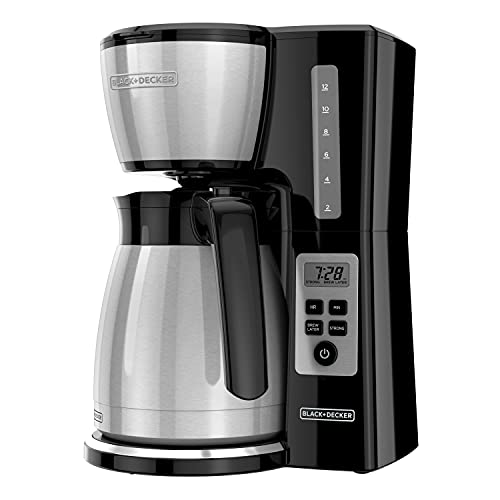
BLACK+DECKER 12-Cup Thermal Programmable Coffee Maker (CM2046S)
Badge: Best Overall
Strengths
- Brew Strength control lets the same machine pour a gentle weekday pot and a bolder weekend one
- Thermal carafe keeps coffee hot through a long morning without any extra energy draw
- Even, shower-style water distribution supports a more uniform extraction across the basket
Trade-offs
- Programmability covers the brew start; grind size, dose, and water quality still decide the cup
- Thermal carafes pour a little slower than glass and need a rinse habit to avoid stale-oil buildup
- It is a full-size footprint on the counter, worth measuring if your cabinets sit low
Mini spec box
- Capacity: 12 cups
- Carafe: Thermal, Black/Steel (model CM2046S)
- Controls: Programmable, with Brew Strength control
- Showerhead: VORTEX Technology
If your household runs on a schedule, the CM2046S is the machine in this pool that respects it most directly. Programming is the headline: load water and grounds at night, set the brew time, and the pot makes itself. But the detail that elevates it above a merely adequate timer machine is the thermal carafe. Glass pots on hot plates begin degrading the moment brewing ends; a double-wall thermal carafe simply holds the coffee at drinking temperature, quietly, for the length of a long morning.
Extraction is handled by the VORTEX showerhead, which spreads water across the grounds bed in a rotating pattern. Even wetting is the unglamorous foundation of good drip coffee — dry pockets under-extract and taste sour, channeled spots over-extract and taste harsh — and the showerhead design is aimed squarely at avoiding both. Brew Strength control then lets you bias the result toward mellow or bold without buying a second coffee or changing your dose math.
Where it asks for compromise: you bring your own grinder, the carafe wants regular washing to keep coffee oils from seasoning it the wrong way, and the footprint is that of a full 12-cup machine. As an overall package for a household that drinks coffee across a morning rather than in one sitting, it is the most balanced pick here.
Best for: households that drink a full pot across the morning and want it brewed before they wake / Not suited for: single-cup drinkers, or anyone who wants grinding built into the same machine

Cuisinart PerfecTemp 12-Cup Thermal Drip Coffee Maker (DCC-3400NAS)
Badge: Best for Hotter Brewing
Strengths
- Hotter brew water pulls more of the desirable compounds out of the grounds, especially with lighter roasts
- Stainless thermal carafe is the durable choice for busy counters and clumsy mornings
- Cuisinart’s drip machines have a long track record, and the control layout is sensibly arranged
Trade-offs
- The silver finish and squared profile read more appliance-like than design-led on the counter
- Thermal carafe adds heft; a full 12-cup pot is a two-handed pour for smaller hands
- Brew Strength and temperature are its levers — drinkers wanting espresso-style drinks need a different machine entirely
Mini spec box
- Capacity: 12 cups
- Carafe: Double-wall stainless steel thermal
- Brewing: PerfecTemp hotter brewing
- Controls: Brew Strength control
- Finish: Silver
Among the six, the DCC-3400NAS is the machine for the drinker who has ever called a drip pot ‘weak’ and meant it literally. Weak drip is usually a temperature story: the water never got hot enough to extract the grounds fully. PerfecTemp brewing attacks exactly that, heating the brew water beyond what basic machines manage, so the extraction finishes the job. The result is a pot with more body and less of the sour, underdeveloped edge that sends people back to cafes.
Cuisinart pairs that hotter brew with the other half of good drip discipline, a double-wall stainless thermal carafe. Heat retention without a hot plate preserves the flavor the hotter water worked to extract, and the steel body is a practical blessing in a real kitchen — no glass to crack against a faucet, no replacement carafe hunt if it takes a knock. Brew Strength control adds the final adjustment, and the whole machine feels engineered around the cup rather than around a feature checklist.
Choose it with clear eyes: it will not grind, it will not make espresso drinks, and its hotter extraction demands beans fresh enough to deserve it. Fed good coffee, it makes the strongest technical case in this roundup for what drip can taste like.
Best for: drinkers who buy good beans — especially lighter roasts — and want drip that extracts them fully / Not suited for: anyone using stale or very dark beans, or who wants an all-in-one grinding machine

BLACK+DECKER CaféCraft 12-Cup Thermal Coffee Maker
Badge: Best for Hot and Iced
Strengths
- Iced-coffee brewing answers the summer shift in habits without a second appliance
- Full 12-cup capacity suits households and small offices, not just couples
- Thermal carafe travels from counter to table without a cord trailing behind
Trade-offs
- Counter footprint is full-size; small kitchens should measure before committing
- No built-in grinder, so fresh-ground drinkers still need a separate unit
- Hot-and-iced versatility matters only if someone in the house actually drinks iced coffee
Mini spec box
- Capacity: 12 cups
- Carafe: Thermal
- Modes: Hot and iced coffee
- Controls: Programmable
Ask what a coffee maker must do across a full year and the CaféCraft’s design starts to look inevitable. Hot coffee in the morning, programmable so it is ready on schedule; a thermal carafe so the pot stays honest until the last cup; and an iced mode for the long stretch of the year when half the household switches to cold coffee and starts queueing at cafes. The CaféCraft folds all three into one 12-cup machine.
Programmability does quiet, daily work here: set it once in the evening and the morning pot is a solved problem. The thermal carafe preserves that solution — no hot plate, no stewed second pot — and doubles as a serving vessel at the table. The iced function, used properly with the glass filled with ice before brewing, produces the concentrated-over-ice style that cafes charge a premium for, at home, on the same machine that made breakfast coffee.
It is not a grinder-equipped machine, and its two-mode nature means purists in either camp can point at a more specialized tool. For a household whose coffee habits genuinely swing with the seasons, though, this is the pragmatic center of the pool.
Best for: households that split the year between hot morning pots and iced afternoon coffee / Not suited for: single-mode purists who never drink iced coffee, or who want a dedicated specialty brewer

Cuisinart 12-Cup Programmable PerfecTemp Thermal Coffee Maker (White)
Badge: Best for Small Batches
Strengths
- White and stainless finish suits bright kitchens where black appliances glower
- Full programmability with a thermal carafe is the complete weekday combination
- Small-batch competence means couples are not forced to brew — and waste — a full pot
Trade-offs
- Brew Pause is a convenience with a cost: pulling the carafe early steals water from the remaining extraction
- A 12-cup machine for mostly small batches is counter space spent on capacity you rarely use
- The feature set overlaps heavily with its silver sibling; the choice is finish and the small-batch emphasis
Mini spec box
- Capacity: 12 cups, with 1–4 cup setting
- Carafe: Thermal
- Brewing: PerfecTemp
- Controls: Programmable, Brew Strength control, Brew Pause
- Finish: Stainless steel and white
The defining question for this machine is not how much coffee it can make but how little it can make well. Its 1–4 cup setting slows the small-batch problem down to size: less water, adjusted delivery, proper contact with a smaller bed of grounds. Couples and solo drinkers who have been over-brewing and dumping half pots — or under-brewing and suffering through them — will feel the difference in the first week.
It does not achieve that focus by giving up the flagship features. This is a PerfecTemp machine, brewing hotter for fuller extraction, with Brew Strength control and full programmability, dispensing into a thermal carafe that keeps the pot at temperature without cooking it. Brew Pause handles the impatient cup. The white finish distinguishes it visually from its silver sibling and suits the pale, bright kitchens that dominate current design.
Be clear about what it is not: not a grinder combo, not a single-serve machine, and its white exterior will keep a record of every splash until wiped. As a programmable drip brewer that respects small households, it has the most thoughtful feature in the pool.
Best for: couples and small households that brew 1–4 cups daily but still host full-pot occasions / Not suited for: large households that always brew full pots, or dark kitchens where a white appliance clashes

BUNN Speed Brew Platinum Thermal Coffee Maker (CSB3T)
Badge: Best for Speed
Strengths
- Fewer electronic features means fewer things to fail; the machine is deliberately straightforward
- Stainless construction suits it to hard daily use in homes and small offices
- The 10-cup size is a realistic household capacity that brews faster than oversized pots
Trade-offs
- No brew-strength electronics or specialty modes; control is dose and grind, the old way
- A reservoir kept hot needs descaling discipline, especially with hard water
- It looks like commercial equipment because it essentially is — design-led kitchens may hesitate
Mini spec box
- Capacity: 10 cups
- Carafe: Thermal
- Design: Speed Brew, stainless steel
- Model: 55200 CSB3T
- Finish: Black
Speed is a feature, and the CSB3T is the only machine here that treats it as the feature. BUNN’s reservoir design holds water at temperature continuously, so brewing begins the moment you pour fresh water in — no heat-up wait, no watching a machine think. The 10-cup thermal carafe then keeps the pot where it belongs, hot and un-stewed, without a warming plate.
This is also the pool’s most commercially descended machine, and it shows in the priorities: stainless where it counts, an interface that a half-awake person can operate, and an absence of delicate electronics to fail. What it deliberately omits is the clock-based scheduling the programmable machines lead with — the BUNN philosophy is that a machine which is always ready does not need an appointment. Whether that trade suits you depends on whether your coffee is a ritual at a fixed hour or a response to a changing day.
Standby energy use and descaling are the ownership notes, and 10 cups caps its hospitality. For impatient households, offices, and second-pot people, it is the most honest machine in the roundup: it does one thing, extremely fast, for years.
Best for: impatient drinkers, irregular schedules, second-pot households, and small offices / Not suited for: schedule-driven drinkers who want coffee brewed before they wake, or very large households
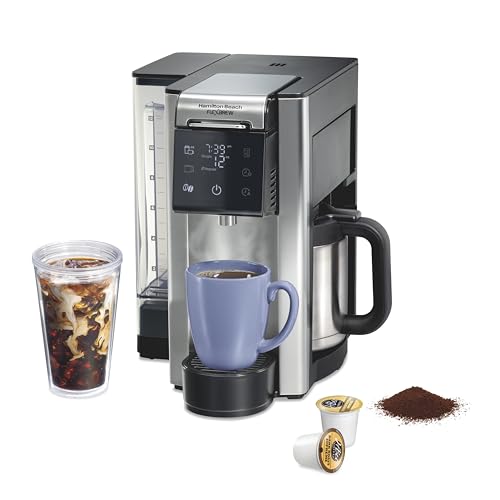
Hamilton Beach FlexBrew Advanced 5-in-1 Coffee Maker
Badge: Most Versatile
Strengths
- Thermal programmable drip side is a full-featured pot brewer, not a token add-on
- Hot and iced capability spans the household’s whole year of habits
- One footprint and one water reservoir simplify the counter and the cleaning routine
Trade-offs
- Pod use carries the usual per-cup cost and waste that grounds avoid
- More features mean a longer learning curve for guests and less tech-confident users
- Single-serve and drip sides share the reservoir, so heavy mixed use means frequent refills
Mini spec box
- Capacity: 12-cup drip, plus single serve
- Carafe: Thermal, programmable drip side
- Single serve: Pods and grounds
- Reservoir: Removable, 60 oz.
- Modes: Hot and iced; 5-in-1 FlexBrew design
Count the coffee drinkers in a mixed household and you will find the FlexBrew’s market: the pot drinker, the pod sprinter, the grounds enthusiast, the iced-coffee convert. Serving all four normally takes two or three appliances. The FlexBrew Advanced serves them with one — 12-cup programmable thermal drip, single-serve for pods or grounds, hot or iced — and backs the concept with the pool’s most practical reservoir, a removable 60 oz. tank that fills at the tap.
Crucially, the drip side is not a token. Programmable timing and a thermal carafe put it in direct conversation with the dedicated machines in this roundup, while the single-serve side handles the one-cup moments — a solo early riser, a guest’s decaf, an afternoon cup — without brewing a pot nobody will finish. The grounds basket on that side is the sleeper feature, quietly removing the cost and waste objections to pod brewing.
Ownership notes: you are maintaining two brew paths, so descaling is a double appointment, and the machine’s presence on the counter is substantial. Households where everyone drinks the same way will not use half of it. Households divided in their habits will wonder how they managed without it.
Best for: mixed households split between pot drinkers and single-cup drinkers, pods and grounds / Not suited for: single-habit households, tiny counters, or minimalists who descale reluctantly
Comparison Table
For a single-machine decision, compare coverage: capacity for the crowd, the carafe for the morning, the scheduling philosophy for the routine, and the feature that closes each machine’s most likely gap.
| Pick | Capacity | Carafe | Scheduling approach | Standout feature | Link |
|---|---|---|---|---|---|
| BLACK+DECKER 12-Cup Thermal Programmable Coffee Maker (CM2046S) | 12 cups | Thermal carafe | Programmable + Brew Strength | VORTEX showerhead | Check on Amazon |
| Cuisinart PerfecTemp 12-Cup Thermal Drip Coffee Maker (DCC-3400NAS) | 12 cups | Stainless thermal carafe | PerfecTemp hotter brewing | Brew Strength control | Check on Amazon |
| BLACK+DECKER CaféCraft 12-Cup Thermal Coffee Maker | 12 cups | Thermal carafe | Programmable | Hot + iced modes | Check on Amazon |
| Cuisinart 12-Cup Programmable PerfecTemp Thermal Coffee Maker (White) | 12 cups (1–4 cup setting) | Thermal carafe | PerfecTemp + programmable | Brew Pause + strength control | Check on Amazon |
| BUNN Speed Brew Platinum Thermal Coffee Maker (CSB3T) | 10 cups | Thermal carafe | Speed Brew reservoir | Commercial-style build | Check on Amazon |
| Hamilton Beach FlexBrew Advanced 5-in-1 Coffee Maker | 12 cups + single serve | Thermal carafe | Pods + grounds, hot + iced | 60 oz. removable reservoir | Check on Amazon |
How to Choose the Best Quality Single Coffee Makers
Choosing one machine is a coverage problem disguised as a product choice. The method is to enumerate your household’s coffee situations and refuse any machine that fails one you cannot delegate.
Enumerate the situations
The weekday pot (programmable, thermal — the pool’s shared core). The small morning (a couple’s two cups: the white Cuisinart’s 1–4 cup setting, or the FlexBrew’s single side). The solo cup at an odd hour (the BUNN’s readiness, or the FlexBrew again). Guests (the 12-cup machines’ headroom). Iced season (the CaféCraft’s second mode, or the FlexBrew’s iced capability). Decaf for one (single-serve side, or a small batch). Write your list before reading specifications; the machine that covers it is your machine.
Weight the quality core as non-negotiable
Coverage cannot come at the core’s expense. Temperature (PerfecTemp), distribution (VORTEX), and the thermal carafe are what make the one machine worth centralizing on — a household that consolidates onto a mediocre brewer has merely centralized its disappointment. The pool’s discipline is that every pick holds the core; the choice among them is about which coverage edges matter to you.
Accept the honest edges
No single machine in this pool grinds its beans, makes espresso drinks, or disappears into a small kitchen’s counter. If grinding integration or espresso is on your non-negotiable list, the single-machine answer lives in a different category entirely. For drip households, though, one of these six will cover the list — and the discipline of one good machine, maintained well, beats a counter of specialists. The dedicated one-cup field, for readers whose list is truly a list of one, is at Best Small Serving Coffee Makers and Best Small Pod Coffee Makers.
Buy the single machine from a line you expect to exist in five years. Singularity raises the stakes on parts — a carafe, a lid, a basket — and the proven model lines in this pool are, among their other virtues, the ones whose parts will still be stocked when the household needs them. Obscurity is the one unforgivable trait in a machine asked to serve alone.
How to Run One Coffee Maker as the Household’s Whole System
A single machine succeeds as a system when its household builds small rituals around its range. These practices stretch one drip brewer across every situation in the buying guide above.
One machine, several batch disciplines
- Full pot: the programmed weekday standard — consistent dose, leveled bed, carafe in place, program verified the night before.
- Small pot: use the small-batch setting where fitted; otherwise keep dose proportional and grind a touch finer to defend extraction at low volume.
- Solo cup: on the FlexBrew, the single side with grounds is the economical ritual; on pot-only machines, brew the smallest honest batch and let the thermal carafe hold the rest for a second cup rather than dumping it.
- Iced: brew the iced mode over a full glass of ice; on machines without the mode, brew a double-strength small pot over ice and accept a little dilution as the tax.
Keep the single point of failure healthy
One machine means no backup, which raises the value of boring maintenance: daily washing of carafe and basket, weekly valve and showerhead checks, descaling on the manufacturer’s schedule without deferral. Keep a simple fallback in the cupboard — a kettle and a cone or press — not because the machine is unreliable, but because a household with one coffee system should never be one descale away from a cafe run.
Troubleshooting
- Problem: the machine is perfect except for one recurring situation → solve the situation, not the machine: a small-batch setting habit, a travel mug routine, or an iced technique usually closes the gap without a second purchase.
- Problem: quality slipping across all situations at once → the shared causes: scale, oil, stale beans. Descale, deep-wash, refresh the coffee, in that order.
- Problem: guests overwhelm capacity → brew back-to-back pots into the thermal carafe, which holds the first while the second brews; the carafe is the expansion slot the machine already has.
Keep the machine’s whole world in one cupboard zone: coffee, filters, scoop, descale solution, and the recipe card. A single system should have a single home; the two-minute nightly load and the monthly descale both happen more reliably when nothing must be fetched from elsewhere in the kitchen.
The Case for One Good Machine
There is a quiet luxury in the single, sufficient appliance. It is learned completely — its dose, its grind, its moods — in a way a rotation of devices never is. Its counter footprint is one footprint. Its maintenance is one calendar. And its coffee is consistent, because a household that brews on one machine dials that machine in and then enjoys the dialed-in result for years. The six machines here were chosen because each can sustain that relationship: complete enough to centralize on, honest enough about its edges that the centralization is informed.
The counter-argument is specialization, and it is real: a dedicated single-serve machine serves the solo cup with less ceremony, and a dedicated espresso machine opens a different beverage entirely. The single-machine household is not denying those goods; it is declining their costs — money, counter, maintenance, decision fatigue — in favor of depth in one format. For most drip-drinking households, that trade is the quality decision itself. Readers still torn toward the solo-cup pole will find its best case made in Best Small Single Serve Coffee Makers.
When the Single Machine Should Be a Dual Machine
The FlexBrew’s presence in this pool is the market admitting something: for a large class of households, the ‘single machine’ that covers everything is a dual-format machine. The pot drinker and the pod sprinter, the scheduled morning and the spontaneous cup — a household containing both patterns does not have two coffee habits; it has one complicated habit, and it wants one appliance that speaks both dialects. The FlexBrew’s drip side holds the full quality specification, so the consolidation costs little in the cup and saves an entire second machine’s worth of counter and upkeep.
The discipline is to buy the duality only when the household’s patterns genuinely demand it. A unanimous pot household gains nothing but a second system to descale. Read your own mornings honestly — the buying guide’s situation list is the diagnostic — and let the count of patterns, not the appeal of features, decide whether your single machine is a pure drip brewer or the bridge. The compact dual-format field extends the same logic downward in size at Best Small Kcup Coffee Makers.
One Machine, Learned Completely: The Mastery Dividend
There is a benefit to the single-machine household that no specification lists: mastery. A household with one brewer learns its exact dose by feel, its grind setting by number, its strength control’s real meaning across three kinds of beans. Guests’ machines feel approximate by comparison; cafes become a change rather than an upgrade. That fluency compounds quietly — every pot is made by a household that has made a thousand identical pots — and it is the deepest reason the one-machine arrangement satisfies people out of proportion to its simplicity.
Mastery also disciplines purchasing. When the machine is singular, its consumables get attention: the household notices which beans it loves, keeps them fresh, and stops auditioning gadgets. The six machines in this pool were chosen to reward that attention span — proven designs with the production longevity to still be on the counter, unchanged, when the household’s fluency is complete. A machine replaced every two years never pays the mastery dividend at all.
When One Machine Stops Being Enough
Honesty about the single-machine life requires naming its exits. The household that develops a genuine espresso practice has outgrown drip’s format, not its quality. The household that begins hosting weekly crowds may outgrow a 12-cup pot’s cadence. The household that splits across time zones of schedule — night-shift and day-shift under one roof — may find one machine’s carafe perpetually empty or perpetually stale, and a second, smaller brewer becomes a kindness rather than a clutter.
Notice what those exits have in common: they are changes in the household, not failures of the machine. The correct response is to re-run the situation list from the buying guide against the new life, and to add or change machines only where a situation genuinely goes unserved. Households that shop that way own few appliances, all of them used, all of them mastered — which is the single-machine philosophy surviving even its own exceptions.
The Single Machine and the Rhythm of the House
Houses have rhythms, and a single coffee machine becomes their metronome. The evening load is the day’s closing ritual in miniature — kitchen tidied, tomorrow prepared. The morning pot is the house waking on schedule. Even the descale weekend acquires a place in the calendar’s texture. Multiple machines diffuse that rhythm into a set of unrelated events; one machine concentrates it, and households that have lived both ways often describe the single-machine kitchen as calmer without being able to say why. The rhythm is why.
This is, admittedly, an argument no specification can make — which is exactly why it belongs in a guide that has spent its length on specifications. The measurable virtues chose the six machines in this pool. The unmeasurable one is what a household gets for choosing among them singly and keeping the choice: a small daily ceremony, performed by a known tool, at the hinge of every day. Quality, in the end, is partly that.
Teaching the Next Cook: One Machine as Curriculum
A single, stable coffee machine teaches the household’s next generation of coffee drinkers in a way a churn of gadgets cannot. A teenager trusted with the evening load learns proportion, routine, and the care of a tool — the whole domestic curriculum in one appliance. A partner new to coffee learns on a known machine with a written recipe, rather than facing a stranger’s espresso apparatus. Even guests can be inducted: ‘the scoop is two per six cups, the card is on the cupboard door’ is a sentence a single-machine household can say.
There is sentiment in that, and also utility: a machine everyone in the house can operate is a machine whose benefits survive one person’s travel, illness, or indifference. Singularity, chosen well, is resilience. The pool’s machines — mainstream, documented, long-produced — are the kind a whole household can learn, which may be the most practical quality argument in this entire guide, and the one least visible from a specification sheet.
Common Buying Mistakes
Reading ‘single’ as single-serve and buying a pot
The costliest mistake available on this keyword: a household that wanted one-cup brewing and bought a 12-cup machine on a quality list. Read the framing — this guide interprets ‘single’ as one household machine, says so openly, and points single-serve shoppers to their own guides. Do the same honesty check on any roundup you read.
Buying coverage you will never use
A dual-format machine in a unanimous household is a second maintenance burden purchased for imaginary guests. Enumerate your real situations and buy for those.
Under-buying batch range
The opposite error: a small household on a full-size-only machine, drinking under-extracted small pots for years. If your days are mostly small, the 1–4 cup setting is not a detail; it is the purchase.
Centralizing on a weak core
One machine with a hot plate and lukewarm brewing centralizes mediocrity. The quality core — temperature, distribution, thermal carafe — is what licenses the single-machine strategy in the first place.
No fallback for the single point of failure
One machine, descaling day, houseguests: plan the kettle-and-cone backup before the morning it is needed. A single system should still have a spare tire.
Never re-running the situation list
The single machine was chosen for a household that existed at purchase time. Moves, new partners, new schedules, and new caffeine rules all rewrite the list quietly. Re-run it yearly; a machine that no longer fits should be changed deliberately, not endured resentfully — endurance is a virtue in machines, not in mismatches.
Final Recommendation
For the household that wants one machine and no asterisks, start with the most complete pure drip machine in the pool: the BLACK+DECKER CM2046S Check on Amazon — programmable, thermal, evenly extracting, strength-adjustable. If your household’s patterns include true single cups, the FlexBrew is the completeness crown’s other claimant, adding a pods-or-grounds single-serve side to a full drip brewer; choose it when the situation list demands both formats from one housing.
The Cuisinart PerfecTemp Check on Amazon is the single machine for the bean-serious household, its white sibling for the small one, and the CaféCraft Check on Amazon for the household whose year has an iced season. The BUNN is the single machine as infrastructure — bought once, ready always, outlasting trends.
One machine, well chosen and well kept, is not a limitation. It is the oldest and best arrangement in home coffee: a known tool, a dialed-in recipe, and a pot that is ready when you are.
Frequently Asked Questions
Does ‘single coffee maker’ mean single-serve?
It can, which is why this guide states its reading openly: here, ‘single’ means one machine for the household — a single, complete coffee maker rather than a collection. These are pot brewers; only the FlexBrew also brews single servings. If you want one-cup-at-a-time machines specifically, the dedicated single-serve guides linked in this article cover that field.
Can one drip machine really cover a whole household?
For drip-drinking households, yes — with the right coverage choices. Programmability covers the weekday, a thermal carafe covers the long morning, a small-batch setting or a single-serve side covers small days, and 12-cup capacity covers guests. The buying guide’s situation list is the test: run your household through it before buying.
Which single machine suits a household of two?
The white Cuisinart, whose 1–4 cup setting brews small batches properly, or the FlexBrew if the two of you drink differently — one by the pot, one by the cup. A standard 12-cup machine without small-batch compensation is the one awkward fit for couples.
What can a single drip machine not do?
It cannot grind beans (pair it with a grinder if freshness demands), cannot make espresso-based drinks, and cannot brew a true single cup unless it is the dual-format FlexBrew. Those are category boundaries, not defects — households that need them should shop those categories directly.
Is a dual-format machine a good ‘single’ machine?
For households with two drinking patterns, it is the best single machine: one footprint, one purchase, both patterns served, and in the FlexBrew’s case a drip side at full specification. Unanimous households gain nothing from the second system and should buy the pure drip machine.
How do I keep one machine from becoming a single point of failure?
Maintain it like infrastructure: daily washing, scheduled descaling, and a simple manual fallback — kettle plus cone or press — in the cupboard for descale days and surprises. The machines in this pool are proven designs; with that routine, the single-machine household is a robust one.
Should a single-machine household buy a grinder too?
A grinder is the one companion purchase this guide endorses without hesitation for bean-buying households: it does not compete with the coffee maker, it completes it, by moving grinding to the moment of brewing. Households using pre-ground coffee bought fresh and often can defer it indefinitely.
How will I know the single machine I chose was the right one?
By the second month, the signs are mundane and unmistakable: the machine is loaded without thinking, the recipe needs no discussion, guests are served without apology or improvisation, and nobody in the house is browsing coffee gadgets. Contentment with an appliance is quiet. If instead a specific situation keeps defeating the machine — named, repeated, real — that situation, and only that one, justifies the next purchase.


