Disclosure: topratedkitchenware.com is reader-supported. When you buy through links on our site, we may earn an affiliate commission from Amazon and other retailers, at no extra cost to you.
Where to buy
If you are shopping for the best quick coffee makers covered in this guide, start with the six verified picks below. Each name links to its Amazon listing so you can check the latest price on Amazon and confirm the current configuration before you decide. Prices and availability change, so we never print a fixed figure here.
- BLACK+DECKER CM2046S — Best Grab-and-Go Pot. Check on Amazon for the current listing details.
- Cuisinart PerfecTemp DCC-3400NAS — Best for Busy Households. Check on Amazon for the current listing details.
- BLACK+DECKER CaféCraft — Best for Iced Coffee Runs. Check on Amazon for the current listing details.
- Cuisinart PerfecTemp, White — Best for Two-Cup Mornings. Check on Amazon for the current listing details.
- BUNN Speed Brew Platinum — Best for On-Demand Pots. Check on Amazon for the current listing details.
- Hamilton Beach FlexBrew Advanced — Best for Mixed Schedules. Check on Amazon for the current listing details.
Read the full guide ↓ for how each pick performs, where each one compromises, and which households each one actually suits.
The best quick coffee makers solve a slightly different problem from the one in a pure brewing-speed test. Quick coffee, in real life, means coffee that fits around everything else: a travel mug filled on the way to the door, a pot that is ready for the first person up and still good for the last, an iced coffee made at home instead of bought on the way, and a second cup that does not require starting the whole ritual again. This guide judges six thermal drip machines and one flexible hybrid against that everyday definition of quick.
The picks divide by lifestyle. The BUNN Speed Brew Platinum is the on-demand specialist, for homes that decide and drink in the same few minutes. The programmable BLACK+DECKER and Cuisinart models suit households run on alarms and routines. The white Cuisinart’s 1-4 cup setting serves the two-mug dash better than any full pot can. The CaféCraft covers the iced-coffee run. And the Hamilton Beach FlexBrew Advanced, with single servings from pods or grounds alongside a full thermal pot, is built for houses where nobody’s schedule matches anybody else’s.
Quick should never mean careless, so every review is frank about what each machine does slowly as well as fast, and the how-to section covers the grab-and-go habits — staging, travel-mug sizing, batch discipline — that make any of these machines feel quicker in practice. If your quick coffee is usually a single mug away from home, pair this guide with Best Small Single Serve Coffee Makers before you buy.
Key Takeaways
- Quick coffee is a routine, not just a brew time: staging, batch size and first-cup access decide how fast coffee fits a busy day.
- The BUNN Speed Brew Platinum is the fastest on-demand pot for households that brew and leave together.
- Programmable thermal models make coffee that is ready before you are, and still good when the last person pours.
- The white Cuisinart’s 1-4 cup setting is the quickest honest option for one or two mugs.
- The FlexBrew Advanced covers staggered schedules best, with single servings for early leavers and a full pot for everyone else.
- Home iced coffee from the CaféCraft removes the café detour, which is the biggest time saving of all in summer.
In this guide
Quick Picks
| Pick | Badge | Headline facts |
|---|---|---|
| BLACK+DECKER CM2046S | Best Grab-and-Go Pot | Capacity: 12 cups; Carafe: thermal |
| Cuisinart PerfecTemp DCC-3400NAS | Best for Busy Households | Capacity: 12 cups; Carafe: double-wall stainless steel thermal |
| BLACK+DECKER CaféCraft | Best for Iced Coffee Runs | Capacity: 12 cups; Carafe: thermal |
| Cuisinart PerfecTemp, White | Best for Two-Cup Mornings | Capacity: 12 cups; Carafe: PerfecTemp thermal carafe |
| BUNN Speed Brew Platinum | Best for On-Demand Pots | Capacity: 10 cups; Carafe: thermal |
| Hamilton Beach FlexBrew Advanced | Best for Mixed Schedules | Format: 5-in-1 drip and single serve; Modes: hot and iced coffee |
How These Picks Were Chosen
We chose these six from the verified pick pool by mapping each machine to a recognisable quick-coffee situation rather than ranking them on one laboratory measure. A pick earned its place by being the fastest sensible answer to at least one common morning: the group departure, the staggered household, the two-cup dash, the iced-coffee run, or the ready-on-waking routine. Machines that were merely ordinary at everything, and quick at nothing in particular, did not fit this guide’s brief.
We also required a thermal carafe from every pick. Quick coffee that stews on a hot plate punishes the last person in the house, and quick routines are exactly the routines where pots get left. Insulated holding keeps a fast morning kind to slow starters. Readers working with very little counter should also browse Best Smallest Coffee Makers, because the quickest machine is no use if it does not fit where it must live.
On method: this is research-led guidance from manufacturer specifications and listing data. We do not invent precise brew-time figures for listings that do not publish them, and we describe speed mechanisms — fast-cycle design, programmability, small-batch modes, brew pause, single-serve formats — in plain terms so you can match them to your own timetable.
The site rules apply as always: no static prices, no fixed ratings or review counts, and links only to the verified listings in the pool, so what you read about is what you can check.
The 6 Best Quick Coffee Makers, Reviewed in Detail
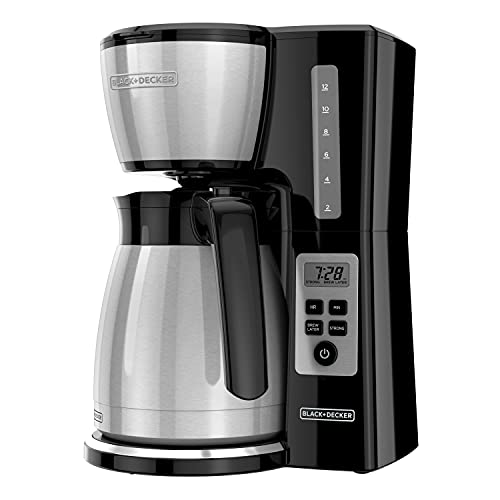
BLACK+DECKER 12-Cup Thermal Programmable Coffee Maker CM2046S
Badge: Best Grab-and-Go Pot
Strengths
- Programmable twelve-cup pot can be ready the moment the household is
- Thermal carafe keeps the quick morning’s coffee good for late pourers
- Strength control covers both the black-coffee sprinter and the milk-and-sugar lingerer
Trade-offs
- Quickness depends on the nightly set-up habit; unprogrammed, it is a conventional brewer
- No small-batch mode listed, so the two-mug morning runs a bigger cycle than needed
- VORTEX system serves flavour, not pace
At a glance: Capacity: 12 cups · Carafe: thermal · Programmable: yes · Brew strength control: yes · Technology: VORTEX Technology · Colour: Black/Steel · Model: CM2046S
For the classic family departure — everyone up, everyone out within the hour — the CM2046S is the quiet organiser. Programmed the night before, it delivers a full twelve-cup thermal pot with zero morning waiting, and the VORTEX saturation system means the fast routine does not taste like one. The thermal carafe is doing quiet work too: the first person out and the last person out drink the same pot at close to the same quality.
Its limits are the limits of its strategy. Forget the timer and you are brewing a conventional full cycle while coats go on. Brew for two and you are running more machine than the morning needs. Households with a fixed routine will barely notice either point; households without one should look at the on-demand picks below.
Best for: routine-driven households leaving together in the morning / Not suited for: improvisers who never set timers

Cuisinart PerfecTemp 12-Cup Thermal Drip Coffee Maker DCC-3400NAS
Badge: Best for Busy Households
Strengths
- One full cycle serves the whole house, ending repeat-brewing delays
- PerfecTemp hotter brewing keeps the fast household pot tasting complete
- Thermal carafe supports staggered pouring without a warming plate
Trade-offs
- Pace is conventional; its quickness is about doing the job once, properly
- No 1-4 cup setting listed for the smallest mornings
- Silver thermal format is a substantial counter presence
At a glance: Capacity: 12 cups · Carafe: double-wall stainless steel thermal · Brewing: PerfecTemp hotter brewing · Brew strength control: yes · Colour: silver · Model: DCC-3400NAS
The DCC-3400NAS is the pick for households that are quick in aggregate rather than in any single moment. Its PerfecTemp hotter brewing produces a full, properly extracted pot the first time, which quietly deletes the slowest parts of many mornings: the second pot because the first tasted weak, the microwaved cup, the negotiation about whose turn it is to brew again. One cycle, twelve cups, thermal holding — the whole house is caffeinated inside one unhurried process.
It will not win a sprint against the BUNN, and it is not trying to. Its case is reliability at household scale, with the flavour to match. If your home’s coffee delays come from repetition and disappointment rather than raw cycle time, this is the machine that removes them. Smaller homes with faster, lighter routines may find their fit in Best Small Size Coffee Makers instead.
Best for: busy households that want one good pot to cover everyone / Not suited for: solo drinkers chasing the fastest single cup

BLACK+DECKER CaféCraft 12-Cup Thermal Coffee Maker
Badge: Best for Iced Coffee Runs
Strengths
- Hot and iced brewing keeps summer coffee at home and off the commute route
- Programmable schedule covers the standard morning without thought
- Twelve-cup thermal carafe suits groups and gatherings
Trade-offs
- No dedicated fast or small-batch features are listed
- Iced coffee depends on keeping ice ready at home
- Extraction detail in the listing is thinner than the PerfecTemp models
At a glance: Capacity: 12 cups · Carafe: thermal · Modes: hot and iced coffee · Programmable: yes · Line: CaféCraft
The CaféCraft’s contribution to a quick-coffee guide is the journey it deletes. An iced coffee bought on the way to work costs a detour, a queue and a markup, every day, all summer. A machine that brews iced coffee at home — at a strength brewed for dilution over ice — turns that into a kitchen task measured in moments, and across a season it is the largest time saving any pick here offers.
For hot coffee it is a dependable programmable twelve-cup thermal machine, quick in the ready-when-you-are sense rather than the stopwatch sense. We place it honestly in the middle of this guide for pace, and at the top of it for households whose quick-coffee problem wears sunglasses. If that is your summer, this is your machine.
Best for: iced-coffee households tired of the café detour / Not suited for: buyers who only drink hot coffee and want maximum pace

Cuisinart 12-Cup PerfecTemp Thermal Carafe Coffee Maker, White
Badge: Best for Two-Cup Mornings
Strengths
- 1-4 cup setting makes the two-mug morning genuinely quick
- Brew pause fills a travel mug before the cycle ends
- PerfecTemp brewing keeps small, fast batches from tasting thin
Trade-offs
- Full-pot pace is ordinary; its gifts are for small batches
- White finish shows the evidence of hurried mornings
- Travel-mug drinkers should confirm their tallest mug fits the pour routine
At a glance: Capacity: 12 cups · Carafe: PerfecTemp thermal carafe · Small-batch setting: 1-4 cups · Brew strength control: yes · Brew pause: yes · Finish: stainless steel, white
Most quick-coffee advertising imagines a crowd. Most real mornings are one or two people and a deadline. The white Cuisinart PerfecTemp is built for that reality: its 1-4 cup setting brews a small batch properly and promptly, and brew pause lets you fill a travel mug the moment enough coffee has landed, rather than when the machine declares itself finished. For the two-mug dash out of the door, nothing else in this guide respects the clock as well.
It remains a full twelve-cup programmable machine for weekends and guests, with hotter brewing and strength control, so the small-morning specialism costs nothing in range. The white finish is the only lifestyle caveat: hurried households splash, and white shows it. Wipe it when you wipe the counter and it stays handsome.
Best for: one or two drinkers with a travel mug and a deadline / Not suited for: households that always brew full pots

BUNN 55200 CSB3T Speed Brew Platinum Thermal Coffee Maker
Badge: Best for On-Demand Pots
Strengths
- Fastest on-demand full pot in the guide, for decide-and-drink households
- Thermal carafe pours and travels to the table without a cord
- Focused controls: nothing to configure stands between you and coffee
Trade-offs
- Ten cups is the ceiling; big gatherings need a second cycle
- No timer, strength or small-batch modes listed for other kinds of quick
- Speed advantage shrinks for single casual cups, where small-batch picks compete
At a glance: Capacity: 10 cups · Carafe: thermal · Material: stainless steel · Line: Speed Brew Platinum · Colour: black · Model: 55200 CSB3T
Some households will never programme a timer, stage a filter the night before, or plan coffee at all — and for them, the BUNN Speed Brew Platinum is the answer. Its Speed Brew design exists to produce a full ten-cup thermal pot fast, on demand, when the decision is made. No routine to maintain, no schedule to keep: press, pour, go. In a house of improvisers, that is the only kind of quick that survives contact with reality.
The focused design cuts both ways. There are no listed modes for small batches, strength tweaks or scheduled starts, so the BUNN is a specialist, not a generalist. But specialism is the point. If your mornings are unplannable and your coffee must simply be fast when asked, this is the first choice in the guide.
Best for: unplanned households that brew a pot when they want it / Not suited for: timer-lovers and small-batch specialists
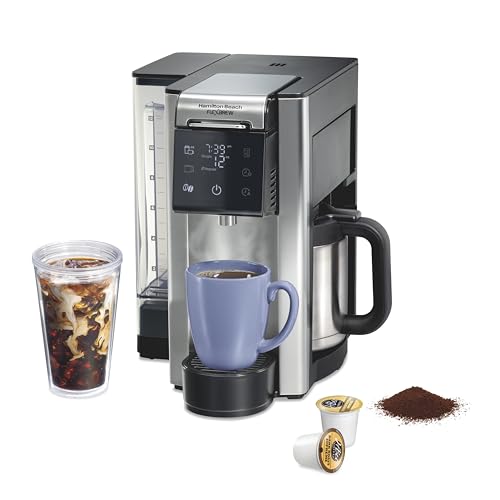
Hamilton Beach FlexBrew Advanced 5-in-1 Coffee Maker
Badge: Best for Mixed Schedules
Strengths
- Single-serve side delivers a cup for the earliest leaver without waking a pot routine
- Full twelve-cup thermal drip side covers the household when schedules align
- Pods or grounds, hot or iced: the widest quick-coffee menu in the guide
Trade-offs
- Using every mode means cleaning several formats, not one
- Pod cups are about speed, not peak flavour
- Pot pace is standard; the magic is in the single servings
At a glance: Format: 5-in-1 drip and single serve · Modes: hot and iced coffee · Drip capacity: 12 cups, thermal, programmable · Brewing options: pods and grounds · Reservoir: removable, 60 oz · Colour: black
Staggered households are where quick coffee goes to die: one person leaves at six, another at eight, a third works from home, and a single pot serves none of them well. The FlexBrew Advanced is the guide’s answer. Its single-serve side — pods or grounds, hot or iced — gives the early leaver a fast, personal cup, while the twelve-cup thermal programmable drip side stands ready for the hours when the house drinks together.
The removable 60 oz reservoir keeps the whole system fed with fewer refills, and the format consolidation matters on real counters: this one machine replaces the pot brewer and the pod machine competing for the same socket. It is not the fastest pot brewer here, and we do not claim otherwise. It is the quickest fit for the widest range of actual schedules, which for many homes is the same thing. Households comparing it with compact single-format machines can also check Best Space Saving Coffee Makers.
Best for: households on different schedules sharing one machine / Not suited for: single-routine homes that only need one format
Comparison Table
| Pick | Badge | Capacity / format | Holding / carafe | Listing |
|---|---|---|---|---|
| BLACK+DECKER CM2046S | Best Grab-and-Go Pot | Capacity: 12 cups | Carafe: thermal | Check on Amazon |
| Cuisinart PerfecTemp DCC-3400NAS | Best for Busy Households | Capacity: 12 cups | Carafe: double-wall stainless steel thermal | Check on Amazon |
| BLACK+DECKER CaféCraft | Best for Iced Coffee Runs | Capacity: 12 cups | Carafe: thermal | Check on Amazon |
| Cuisinart PerfecTemp, White | Best for Two-Cup Mornings | Capacity: 12 cups | Carafe: PerfecTemp thermal carafe | Check on Amazon |
| BUNN Speed Brew Platinum | Best for On-Demand Pots | Capacity: 10 cups | Carafe: thermal | Check on Amazon |
| Hamilton Beach FlexBrew Advanced | Best for Mixed Schedules | Format: 5-in-1 drip and single serve | Modes: hot and iced coffee | Check on Amazon |
How to Choose Among the Best quick coffee makers
Start by describing your household’s coffee traffic, not your taste in machines. Who drinks, when, how much, and who leaves when? The answers point at one of the six patterns in this guide far more reliably than any feature list, because quick is always quick for someone, at some moment.
The departure pattern
Everyone drinks within the same hour: choose capacity and either a timer or outright fast brewing. The BUNN and the programmable twelve-cup models divide this pattern between planners and improvisers.
The staggered pattern
Drinkers spread across hours: thermal holding and single-serve flexibility matter more than cycle speed. The FlexBrew Advanced was picked for exactly this house.
The small-morning pattern
One or two mugs on weekdays: a 1-4 cup setting and brew pause beat any full-pot specification. Do not buy twelve cups of speed for a two-cup life.
The seasonal pattern
Iced coffee half the year: a hot-and-iced machine deletes the café detour, the largest hidden time cost in coffee.
The flavour floor
Quick coffee still has to taste like coffee. Hotter brewing, strength control and even saturation are the features that keep a fast routine worth drinking.
The counter reality
One flexible machine can be quicker to live with than two fast ones fighting for space and sockets. Measure the counter before admiring the spec sheet, and consider Best Stainless Steel Coffee Makers Wth Auto Shut Off if unattended morning brewing makes shut-off behaviour part of your decision.
Across tiers, money in this category buys back minutes in different places: scheduling in the lower tier, extraction quality and batch flexibility in the middle, outright brewing speed and multi-format range at the top. None of those minutes is worth more than the ones your household actually loses, so let your traffic pattern, not the tier ladder, make the decision.
How to Build a Grab-and-Go Coffee Routine That Actually Works
A quick routine is designed once and then simply repeated. Set yours up with these steps and any pick in this guide will feel faster within days.
- Map the morning: write down who needs coffee, at what time, and in what vessel. Brew for that map, not for an imaginary household.
- Stage at night: filter in, coffee measured, fresh water in the reservoir, carafe seated, mugs and travel lids beside the machine.
- Size the batch to the day: small setting for weekday dashes, full pot for weekends. Keep both recipes — dose and grind — written on a card by the machine.
- Programme finish times, not start times: work backwards so the cycle completes just before the first pour is needed.
- Use brew pause or single-serve mode for the genuinely first cup, then let the pot finish for the rest of the house.
- Keep travel mugs to a standard size your machine’s pour height handles comfortably, and store lids with the mugs, not in a separate drawer.
- Reset the station when you empty it: rinse the carafe, bin the grounds, refill the water. A station that is always ready is the real quick-coffee technology.
Troubleshooting
Problem: The first cup is strong and the rest of the pot is weak → what to do: That is brew pause physics: the earliest coffee is the most concentrated. Pour early only when you must, or brew a dedicated small batch instead.
Problem: Coffee is ready but the morning still is not → what to do: The bottleneck has moved to staging and vessels: standardise mugs, stage lids, and keep the station set up the night before.
Problem: Weekend pots taste worse than weekday cups → what to do: The recipe did not scale: use your written full-pot ratio rather than guessing extra scoops, and check the strength setting is where the household agreed it should be.
Travel Mugs, Batch Sizes and the Real Shape of Quick Coffee
The travel mug quietly governs quick coffee. Its capacity decides your true batch size, its height decides whether brew pause pouring is graceful or a splash hazard, and its lid decides whether the whole routine survives a car journey. Households shopping this category should measure their favourite mug before choosing a machine, the same way they would measure the counter.
Batch size follows from the mug count. Two travel mugs is a four-cup problem, not a twelve-cup one, and the machines with small-batch settings exist because manufacturers know it. Brewing your real quantity is faster, fresher and cheaper in coffee — a rare case of the honest option winning on every axis at once.
None of this requires new equipment to start. Time your current routine, count your actual mugs, and note where the waiting happens. The right pick from this guide is the one whose strengths land exactly on those notes.
One Machine or Two? The Counter-Space Side of Quick
Many kitchens drift into a two-machine settlement: a pot brewer for weekends and a pod machine for weekday dashes, each half-used, both crowding the counter and competing for the socket nearest the water. A hybrid like the FlexBrew Advanced exists to end that settlement, and for staggered households it usually does.
But consolidation has a discipline cost: more formats mean more parts to rinse, and a household that only ever drinks one format gains nothing from the other’s hardware. The quickest kitchen is the one where everything present is used weekly and everything used is within arm’s reach of the sink.
Audit honestly before buying. List what your household actually drank last week, by format. Buy the machine — or the single hybrid — that covers that list, and let the imaginary formats go.
Two Playbooks: The Weekday Dash and the Weekend Pot
Most households live two coffee lives and try to serve both with one habit. The weekday life is timed: alarms, departures, travel mugs, a kitchen used as a staging post. The weekend life is social: a full pot, second cups, people drifting through. Quick-coffee machines earn their keep by serving the weekday life without apology, and the picks in this guide were chosen with that priority — but the household that configures its machine once, for one of those lives, will be vaguely dissatisfied in the other forever.
Write both playbooks down. The weekday playbook is a batch size, a recipe, a finish time and a vessel: small or programmed, measured, ready when the first person is, poured into the mug that lives by the machine. The weekend playbook is the full pot, the strength setting where the household likes it, and the carafe carried to the table. Machines with small-batch settings, programmability and thermal carafes — most of this guide — can hold both playbooks without adjustment beyond the recipe card. Households that skip the writing-down step rediscover their preferences by argument every Saturday.
The deeper point is that quick is a weekday word. Nobody has ever needed a fast pot on a slow Sunday. Shop, configure and judge your machine by the weekday playbook first, and let the weekend be the bonus it should be.
Coffee for Guests Without Losing Your Morning
Guests are where quick-coffee routines go to be tested. The house is fuller, the batches are bigger, the preferences are unknown, and the host is somehow also making breakfast. The machines in this guide handle the scenario better than most because of two shared traits: full thermal pots that can be brewed before guests surface and held without stewing, and strength controls or hybrid formats that let one strong pot and one gentle option coexist without a second machine.
The host’s playbook is simple. Brew the full pot early and let the thermal carafe do the hosting; it pours quietly for hours and never needs reheating theatre. Put out milk, sugar and a smaller vessel of hot water for the guest who wants a weaker cup, rather than brewing a second, compromised pot. If your machine has a single-serve side, it becomes the guest valve: the early riser, the decaf drinker and the one-cup guest all route there, leaving the main pot’s rhythm undisturbed.
What not to do is hover. A host who re-brews, re-heats and apologises teaches guests that the coffee is a problem. A host who pours from a thermal carafe and sits down teaches them it is not. The machine’s job on guest mornings is to disappear, and that is a quickness of its own kind.
Small Kitchens, Desks and Dorms: Quick Coffee in Tight Quarters
Quick coffee matters even more where space is scarce, because a cramped station turns every step into a negotiation. In a small kitchen, a dorm room or a desk-side setup, the winning traits shift: a footprint that fits the one available surface, a carafe or format that does not demand elbow room, and a routine with few loose parts. Several picks in this guide are full-size machines and should be measured honestly against the space; a twelve-cup thermal brewer that does not fit is not a quick machine, it is furniture in the wrong room.
Where a full pot genuinely fits, the thermal format suits tight quarters well: no hot plate means less ambient heat in a small room, and the carafe can be carried to wherever people actually sit, freeing the brewing corner. Where it does not fit, the honest answer is a smaller format altogether, and this guide’s internal links to the small and single-serve clusters exist for exactly that reader. The FlexBrew’s consolidation is the middle path: one footprint doing the work of two machines is, in a tight kitchen, a form of speed all by itself.
Noise and neighbours belong in this calculation too. Drip brewing is a considerate format for shared walls and sleeping roommates, which is one more reason the category, as a whole, suits small-space life better than pump-driven or grinding alternatives.
The Two-Minute Reset: Cleaning Routines for Busy People
Busy households do not skip cleaning because they are careless; they skip it because cleaning routines are usually written as weekend projects. Reframe the work in two-minute units and it actually happens. After the last pour: grounds into the bin or compost, basket rinsed, carafe rinsed and left open to dry. That is the daily reset, and it prevents the stale-oil flavours that make people brew second pots and waste the very time this guide is trying to save.
Weekly, wash the carafe and basket with mild detergent and a soft brush, paying attention to the carafe lid, where old coffee hides. Monthly, or on the rhythm your water demands, descale. These are calendar tasks, not inspiration tasks: attach them to an existing habit — the first weekend shop, the changing of a water filter — and they stop depending on memory.
Keep supplies where the machine lives: detergent, descaler and spare filters in the same cupboard. A cleaning routine that starts with a search is a routine that gets postponed, and postponed maintenance is how quick machines become slow, tired-tasting ones. Two minutes a day is the entire price of keeping every other minute this guide promised you.
Coffee at Work: Desks, Break Rooms and the Commute Between
For many readers the quickest coffee problem is not at home at all. The break room machine of uncertain cleanliness, the café queue that eats the margin of a lunch break, the desk drawer of emergency instant — work coffee is where quick home coffee gets its revenge, because a travel mug filled from a good thermal pot at home outperforms all three. The picks in this guide support that strategy directly: programmable pots ready before departure, thermal carafes that keep a second mug’s worth honest for a partner leaving later, and brew pause for the mug that must be filled mid-cycle on the way out of the door.
The maths of the mug are worth doing once. A household that replaces even part of its bought coffee with home-brewed travel mugs changes its mornings as much as its spending: the queue disappears, the departure time moves later, and the coffee improves in the same motion. None of that requires a new machine — it requires a routine pointed at the door — but machines with timers, pause features and small-batch settings make the routine considerably easier to keep, which is why they dominate this guide.
Treat the travel mug as equipment, not an accessory. A mug that seals properly, fits the machine’s pour height and survives the dishwasher will be used daily; a mug that leaks, dribbles or demands hand-washing will quietly retire itself to the back of the cupboard, taking the routine with it. Buy the mug with the same care as the machine and the quickest coffee system in this guide is the one that leaves the house with you.
Reading Your Own Routine: A One-Week Quick-Coffee Diary
Every household in this category believes it knows its coffee habits, and most are working from a flattering summary. A one-week diary replaces the summary with evidence. Note, for each coffee made at home: the time, the format, the batch size, who drank it, and whether any of it was poured away. Five columns, ten seconds per entry, and by Sunday the household’s real pattern is on paper — usually with surprises. The full pots turn out to be a weekend habit. The weekday reality is two mugs and a single cup. Or the reverse, which is equally decisive.
Decisions made from the diary are unusually durable, because they are not really opinions. If the diary shows staggered single cups, the hybrid’s case makes itself. If it shows one communal pot, the fast and programmable full-size picks compete on their merits. If it shows waste — pots poured away half-drunk — the small-batch setting stops being a feature and becomes the point of the purchase.
Keep the diary for a week after any new machine arrives, too. The comparison is the truest review your household will ever write: less waiting, less waste, better coffee, or not. Machines in this guide are chosen to move those three numbers, and a household that measures them will know, rather than hope, that the purchase worked.
The Long Game: Keeping a Quick Routine Quick for Years
Routines decay quietly. The staged station drifts back into cupboards, the recipe card disappears under a magnet, the timer stays set for a schedule the household left months ago, and scale builds in the machine a gram at a time. None of it feels like a decision, yet within a year a quick-coffee household can find itself queueing at its own counter again, blaming a machine that has changed far less than the habits around it. The defence is a small, scheduled act of maintenance — not of the machine alone, but of the system.
Once a month, reset the system deliberately. Restage the station. Rewrite the recipe card if it has wandered. Check the timer against the household’s current mornings. Descale if the water demands it, wash the carafe properly, and confirm the travel mugs still seal. Fifteen minutes, attached to some existing monthly rhythm, preserves everything the original purchase bought. Households that do this keep their quick routine for the life of the machine; households that do not eventually buy the same morning twice.
That, in the end, is the honest promise of this category. The machine provides the capability — the timer, the fast cycle, the small batch, the single serving — and the household provides the small, repeated acts of order that turn capability into coffee, quickly, every day. Both halves are in this guide, and both halves are required.
Common Buying Mistakes
- Brewing weekend quantities on weekdays: The most common quick-coffee error in America. Match batch to day and mornings shorten immediately.
- Leaving the station un-staged: A fast machine behind an empty reservoir and a missing filter is a slow morning with better hardware.
- Buying for guests instead of residents: The machine serves the household three hundred mornings a year and guests on six. Optimise for the residents.
- Ignoring the last drinker: Quick pots that stew punish whoever pours last. Thermal holding is a fairness feature as much as a flavour one.
- Treating pods and pots as enemies: Mixed households often need both. A hybrid or a small-batch pot ends the argument more cheaply than two machines.
- Never timing the routine: Feelings about speed are unreliable. One week of honest timing usually reveals the real bottleneck, and it is rarely the brew cycle alone.
Final Recommendation
For most busy households, the most complete quick-coffee answer here is the Hamilton Beach FlexBrew Advanced, because it covers the staggered reality of modern schedules — a fast single cup for the first leaver, a full thermal pot when the house aligns — and you can check the Hamilton Beach FlexBrew Advanced on Amazon to see the current listing.
If your household leaves together and plans ahead, the programmable BLACK+DECKER CM2046S is the simpler win — check the BLACK+DECKER CM2046S on Amazon — while unplannable households should go straight to the on-demand specialist and check the BUNN Speed Brew Platinum on Amazon.
Whatever you choose, spend one evening building the staged routine in the how-to section. Quick coffee is mostly choreography; the right machine simply makes the choreography worth performing.
Quick Coffee for One: The Solo Drinker’s Version
Everything in this guide scales down to the household of one, but the priorities reorder themselves. Capacity stops mattering almost entirely; a twelve-cup pot becomes a weekend luxury rather than a daily tool. What matters instead is the distance between the decision and the drink, measured across a kitchen crossed alone, half awake, with nobody to impress and no queue to serve. For that reader, the honest shortlist inside this guide is short: a small-batch setting that brews two honest cups without ceremony, a brew pause that releases the first of them early, or a single-serve mode that treats one cup as a complete event rather than a fraction of a pot.
The solo drinker also gains the most from staging, because there is no second person to share the friction with. A station that is always ready — water in, filter in, mug waiting — turns a solo morning into a single press and a pour, and a thermal carafe sized by a small batch keeps the second cup pleasant rather than apologetic. Buy for that routine, and the full-pot capacity you may never use becomes what it should have been all along: a pleasant extra for guests, not the centre of the purchase.
One more habit deserves a place in any quick routine, because it protects all the others: decide the night before what tomorrow’s coffee is. Not the brand, not the recipe — those are settled — but the shape of it. A pot or a small batch, a mug at home or a travel mug for the road, the timer set or the machine left to be started by hand. That ten-second decision, made with a clear head in the evening, removes the only remaining slow step in the system, which is a sleepy person standing in a kitchen working out what kind of morning it is. Quick coffee, in the end, is coffee that has already been decided.
Frequently Asked Questions
What makes a coffee maker quick in everyday use?
A combination of short effective waiting — through fast brewing, programming, small batches or single servings — and a routine that is staged and ready. The fastest machine in a chaotic kitchen loses to an ordinary machine in a prepared one.
Should I buy a fast brewer or a programmable one?
Planners should buy programmable: coffee ready on waking beats any cycle time. Improvisers should buy fast: a machine like the BUNN that produces a pot on demand, with no routine to maintain.
Is a hybrid drip and single-serve machine a good idea?
For mixed households, yes. It covers staggered schedules in one footprint and ends the two-machine counter problem. Single-format households gain less and may prefer a dedicated machine’s simplicity.
How do I make iced coffee quickly at home?
Use a machine with an iced mode, like the CaféCraft here, which brews at a strength intended for dilution over ice. Keep ice ready in the freezer and the whole drink takes minutes at home instead of a café detour.
Why does my quick coffee taste weak?
Usually the batch and the cycle are mismatched: a small amount of coffee in a full-size cycle under-extracts. Use a small-batch setting if you have one, keep your ratio measured, and avoid pouring mid-brew as a habit.
What size machine does a two-person household need?
A twelve-cup machine with a good 1-4 cup setting, like the white Cuisinart in this guide, covers both the two-mug weekday and the guest weekend. A household that never hosts may be happier with a smaller format altogether.


