Disclosure: topratedkitchenware.com is reader-supported. When you buy through links on our site, we may earn an affiliate commission from Amazon and other retailers, at no extra cost to you.
Where to buy
The picks below are the verified shortlist for this guide to best quiet food processors. Each linked name takes you to its Amazon listing, where you can check the latest price on Amazon, confirm the current configuration, and read the newest owner feedback before you decide.
- Hamilton Beach Food Processor, 10-Cup (70730) — Best for Short-Burst Quiet Jobs
- BLACK+DECKER Food Processor, 8-Cup, 450W — Best Full-Size Pick for Brief Runs
- Cuisinart Core Custom 4-Cup Mini Chopper (MCH-4) — Best Mid-Size Pick
- KitchenAid 3.5 Cup Food Chopper, Empire Red (KFC3516ER) — Best Mini for Quick Tasks
- BLACK+DECKER 1.5-Cup Electric Food Chopper, 150W — Best Smallest-Footprint Pick
- KitchenAid 3.5 Cup Food Chopper, Contour Silver (KFC3516CU) — Best for Stainless-Led Kitchens
Read the full guide ↓ for how each pick performs, where each one compromises, and which households each one actually suits.
Looking for the best quiet food processors means accepting one honest fact first: no food processor is silent, and none of the verified listings in this guide states a noise figure. Any guide that printed decibel numbers for these machines would be inventing them. What can be ranked honestly is the design logic of noise: how long the machine runs per job, how big its motor and bowl are, and how much of your prep can be done in short, low-drama bursts instead of sustained roars.
That logic reshapes the shortlist in an interesting way. The quietest processor experience in a real kitchen usually comes from a small chopper that finishes in three pulses, not from a large machine marketed with soft language. So this guide includes the full-size Hamilton Beach for households that need it, and is explicit that its noise strategy is brevity at scale, while the minis win the everyday quiet contest by simply being finished before the noise becomes an event. Apartment cooks and parents of napping toddlers will find the reasoning familiar, and Best Prices Food Processors covers the same machines from the value angle.
Every claim in the reviews below is tied to the verified listing: capacities, wattages and control types are stated; noise character is reasoned from those facts and labelled as reasoning, not measurement. If a manufacturer ever publishes verified noise data for this class, it will slot into this framework unchanged, because the framework is about how noise is produced, not about a number.
Key Takeaways
- No pick’s verified listing states a decibel figure, so this guide ranks by noise logic, not invented numbers.
- Short jobs are quiet jobs: minis that finish in a few pulses make the least total noise in daily life.
- Full-size machines manage noise through brevity at scale, one batch instead of three.
- Pulse technique, load size and bowl fill level change real-world noise more than any single feature.
- Where the machine sits, on a towel-damped counter away from a wall corner, audibly matters.
In this guide
Quick Picks
- Best for Short-Burst Quiet Jobs: Hamilton Beach Food Processor, 10-Cup (70730) — a pick defined by a full-size 10-cup processor with a bowl scraper that keeps food moving without stopping.
- Best Full-Size Pick for Brief Runs: BLACK+DECKER Food Processor, 8-Cup, 450W — a pick defined by a mid-size 450W processor that covers shred, slice, mince, grind and puree in an 8-cup bowl.
- Best Mid-Size Pick: Cuisinart Core Custom 4-Cup Mini Chopper (MCH-4) — a pick defined by a 4-cup mini chopper with an auto-reversing SmartPower blade and dishwasher-safe parts.
- Best Mini for Quick Tasks: KitchenAid 3.5 Cup Food Chopper, Empire Red (KFC3516ER) — a pick defined by a 3.5-cup chopper with two speeds plus pulse and a dishwasher-safe work bowl.
- Best Smallest-Footprint Pick: BLACK+DECKER 1.5-Cup Electric Food Chopper, 150W — a pick defined by a one-touch 1.5-cup chopper with a 150W motor and a stay-sharp blade for the smallest jobs.
- Best for Stainless-Led Kitchens: KitchenAid 3.5 Cup Food Chopper, Contour Silver (KFC3516CU) — a pick defined by the same two-speed-plus-pulse 3.5-cup KitchenAid chopper in a Contour Silver finish.
How These Picks Were Chosen
The verified pool was assessed for this keyword through the Creators API, with noise treated as a design question. Each model was confirmed, and only specifications stated in the verified listing appear in this guide. The factors weighed were motor class and wattage where stated, bowl size, because sustained full-bowl runs are the loudest events in this category, and control type, because pulse control lets a cook use the shortest effective bursts.
The resulting shortlist is honest about its own shape: one full-size machine for batch brevity, one mid-size 450W machine, and a set of minis whose claim is that they are finished before they are loud. Two listings are the same KitchenAid chopper design in Empire Red and Contour Silver, included because both were in the verified pool and the choice between them is a finish choice, stated openly in their reviews. Size-focused readers may also want Best Prices On 8 Or 10 Cup Food Processors.
This is a research-led guide. No hands-on testing, sound measurement or decibel claim is made anywhere in it. Where the text discusses noise, it reasons from the verified specifications and from the physics of the category, and it says so, because a quiet-seeking reader deserves better than a fabricated number in a tidy table.
The 6 Best Options for Best Quiet Food Processors

Hamilton Beach Food Processor, 10-Cup (70730)
Badge: Best for Short-Burst Quiet Jobs
Strengths
- 10-cup bowl handles family batches, doughs and big shredding jobs in one load
- Built-in bowl scraper folds food back toward the blade while it runs
- Slicing, shredding, mincing and pureeing covered by the included discs and blade
Trade-offs
- Full-size footprint needs real counter or cupboard space
- More parts to wash than any mini chopper in this guide
- Plastic bowl class build rather than a premium metal body
Key specifications (from the verified listing)
- Capacity: 10 cups (from verified listing)
- Functions: slice, shred, mince and puree
- Feature: Easy Clean bowl scraper; model 70730; stainless steel accents
The Hamilton Beach 70730 is the workhorse format most households picture when they say food processor: a 10-cup bowl, a chopping blade plus slicing and shredding discs, and enough room to make a slaw, a pie dough or a double batch of salsa without splitting it. Its signature detail is the bowl scraper, a simple arm that sweeps the bowl wall as it runs, which matters more than it sounds, because uneven bowls are the main reason processors leave a ring of unprocessed food above the blade line.
For a quiet-seeking kitchen, the Hamilton Beach Food Processor, 10-Cup (70730) argues its case by being a full-size 10-cup processor with a bowl scraper that keeps food moving without stopping. Noise is time multiplied by intensity, and this pick attacks the time side of that equation: jobs sized to its bowl finish in a handful of controlled bursts, after which the kitchen is silent again, which is the outcome quiet shoppers actually want.
Placement and technique will decide how the Hamilton Beach Food Processor, 10-Cup (70730) sounds in your home as much as its design does. Run it on a folded towel, away from the corner where walls amplify, fill it sensibly so the blade is not labouring, and its noise footprint shrinks to a few brief, unremarkable seconds at a time.
There is a final, practical test that separates a good shortlist entry from a great one, and the Hamilton Beach Food Processor, 10-Cup (70730) passes it: the week-two test. In week one any new processor is a novelty that gets used because it is new. By week two the novelty is gone, and the machines still on the counter are the ones whose size, controls and cleanup fit the household’s actual rhythm. Everything in this pick’s verified design, its capacity class, its blade system and the way its parts wash, points toward surviving that test in the kitchens its review describes, which is ultimately the only endorsement that compounds.
Best for: family prep, slaws, doughs and big shredding or slicing sessions / Not suited for: tiny counters or cooks who only ever make single portions
Check on Amazon for the current listing, configuration and latest price.

BLACK+DECKER Food Processor, 8-Cup, 450W
Badge: Best Full-Size Pick for Brief Runs
Strengths
- 8-cup bowl is the sweet spot between mini choppers and full-size machines
- 450W motor with attachments to shred, slice, mince, grind and puree
- Stainless steel blade and a feed chute sized for real vegetables
Trade-offs
- Mid-size bowl still means batching for very large prep days
- Disc-based slicing gives one thickness rather than adjustable cuts
- Controls are simple rather than programmable
Key specifications (from the verified listing)
- Capacity: 8 cups (from verified listing)
- Power: 450W (from verified listing)
- Blade: stainless steel; attachments for shred, slice, mince, grind and puree
The BLACK+DECKER 8-cup sits deliberately in the middle of this guide: bigger than the minis, lighter than the 10 and 14-cup machines, and powered by a 450W motor that covers the five jobs its listing names, shredding, slicing, mincing, grinding and pureeing. For a household of two to four that preps most nights, the 8-cup bowl is usually the size that gets used rather than admired, large enough for a meal’s worth of vegetables, small enough to wash without resentment.
For a quiet-seeking kitchen, the BLACK+DECKER Food Processor, 8-Cup, 450W argues its case by being a mid-size 450W processor that covers shred, slice, mince, grind and puree in an 8-cup bowl. Noise is time multiplied by intensity, and this pick attacks the time side of that equation: jobs sized to its bowl finish in a handful of controlled bursts, after which the kitchen is silent again, which is the outcome quiet shoppers actually want.
Placement and technique will decide how the BLACK+DECKER Food Processor, 8-Cup, 450W sounds in your home as much as its design does. Run it on a folded towel, away from the corner where walls amplify, fill it sensibly so the blade is not labouring, and its noise footprint shrinks to a few brief, unremarkable seconds at a time.
There is a final, practical test that separates a good shortlist entry from a great one, and the BLACK+DECKER Food Processor, 8-Cup, 450W passes it: the week-two test. In week one any new processor is a novelty that gets used because it is new. By week two the novelty is gone, and the machines still on the counter are the ones whose size, controls and cleanup fit the household’s actual rhythm. Everything in this pick’s verified design, its capacity class, its blade system and the way its parts wash, points toward surviving that test in the kitchens its review describes, which is ultimately the only endorsement that compounds.
Best for: households of two to four wanting one mid-size machine for nightly prep / Not suited for: very large batch days or cooks wanting programmable controls
Check on Amazon for the current listing, configuration and latest price.

Cuisinart Core Custom 4-Cup Mini Chopper (MCH-4)
Badge: Best Mid-Size Pick
Strengths
- 4-cup bowl is a useful step up from 3-cup minis for dips and dressings
- Auto-reversing SmartPower blade covers chopping and grinding in one unit
- Dishwasher-safe parts make the small-job cleanup genuinely small
Trade-offs
- Blade-only machine: no slicing or shredding discs
- 4 cups still means batching for crowd-size prep
- White and stainless finish shows every splash until wiped
Key specifications (from the verified listing)
- Capacity: 4 cups (from verified listing)
- Blade: auto-reversing stainless steel SmartPower blade
- Model: MCH-4, white/stainless steel; dishwasher-safe parts
The Cuisinart Core Custom MCH-4 is the mini for cooks who found 3-cup bowls just slightly too small. The extra cup sounds trivial and is not: it is the difference between a batch of hummus that fits and one that climbs the lid. It keeps the family’s auto-reversing SmartPower blade, sharp edge to chop, blunt edge to grind, and pairs it with dishwasher-safe parts, so the machine’s whole ownership proposition is speed at both ends of the job, seconds to process, seconds to clean.
For a quiet-seeking kitchen, the Cuisinart Core Custom 4-Cup Mini Chopper (MCH-4) argues its case by being a 4-cup mini chopper with an auto-reversing SmartPower blade and dishwasher-safe parts. Noise is time multiplied by intensity, and this pick attacks the time side of that equation: jobs sized to its bowl finish in a handful of controlled bursts, after which the kitchen is silent again, which is the outcome quiet shoppers actually want.
Placement and technique will decide how the Cuisinart Core Custom 4-Cup Mini Chopper (MCH-4) sounds in your home as much as its design does. Run it on a folded towel, away from the corner where walls amplify, fill it sensibly so the blade is not labouring, and its noise footprint shrinks to a few brief, unremarkable seconds at a time.
There is a final, practical test that separates a good shortlist entry from a great one, and the Cuisinart Core Custom 4-Cup Mini Chopper (MCH-4) passes it: the week-two test. In week one any new processor is a novelty that gets used because it is new. By week two the novelty is gone, and the machines still on the counter are the ones whose size, controls and cleanup fit the household’s actual rhythm. Everything in this pick’s verified design, its capacity class, its blade system and the way its parts wash, points toward surviving that test in the kitchens its review describes, which is ultimately the only endorsement that compounds.
Best for: dips, dressings and small batches that overflow a 3-cup mini / Not suited for: slicing, shredding or crowd-size processing
Check on Amazon for the current listing, configuration and latest price.

KitchenAid 3.5 Cup Food Chopper, Empire Red (KFC3516ER)
Badge: Best Mini for Quick Tasks
Strengths
- Two speeds plus pulse give real control over texture in a mini format
- Stainless steel multi-purpose blade and dishwasher-safe bowl keep cleanup easy
- Easy cord wrap makes it a tidy drawer or counter resident
Trade-offs
- Chopper format only: no discs for slicing or shredding
- 3.5-cup bowl is for small batches by design
- Empire Red finish is a statement colour not every kitchen wants
Key specifications (from the verified listing)
- Capacity: 3.5 cups (from verified listing)
- Controls: 2 speeds plus pulse
- Model: KFC3516ER, Empire Red; stainless steel multi-purpose blade; easy cord wrap
KitchenAid’s 3.5 Cup Chopper is the control-freak mini of the group. Where most small choppers offer one button and optimism, this one offers two speeds plus pulse, and pulse is the control that decides whether onions come out diced or pureed. The stainless steel multi-purpose blade, dishwasher-safe bowl and easy cord wrap complete a design clearly meant to live within reach and be used daily, and the Empire Red finish makes it the one pick in this guide that doubles as counter decor.
For a quiet-seeking kitchen, the KitchenAid 3.5 Cup Food Chopper, Empire Red (KFC3516ER) argues its case by being a 3.5-cup chopper with two speeds plus pulse and a dishwasher-safe work bowl. Noise is time multiplied by intensity, and this pick attacks the time side of that equation: jobs sized to its bowl finish in a handful of controlled bursts, after which the kitchen is silent again, which is the outcome quiet shoppers actually want.
Placement and technique will decide how the KitchenAid 3.5 Cup Food Chopper, Empire Red (KFC3516ER) sounds in your home as much as its design does. Run it on a folded towel, away from the corner where walls amplify, fill it sensibly so the blade is not labouring, and its noise footprint shrinks to a few brief, unremarkable seconds at a time.
There is a final, practical test that separates a good shortlist entry from a great one, and the KitchenAid 3.5 Cup Food Chopper, Empire Red (KFC3516ER) passes it: the week-two test. In week one any new processor is a novelty that gets used because it is new. By week two the novelty is gone, and the machines still on the counter are the ones whose size, controls and cleanup fit the household’s actual rhythm. Everything in this pick’s verified design, its capacity class, its blade system and the way its parts wash, points toward surviving that test in the kitchens its review describes, which is ultimately the only endorsement that compounds.
Best for: texture-sensitive small jobs where pulse control decides the result / Not suited for: disc work of any kind, or batches beyond a few cups
Check on Amazon for the current listing, configuration and latest price.
BLACK+DECKER 1.5-Cup Electric Food Chopper, 150W
Badge: Best Smallest-Footprint Pick
Strengths
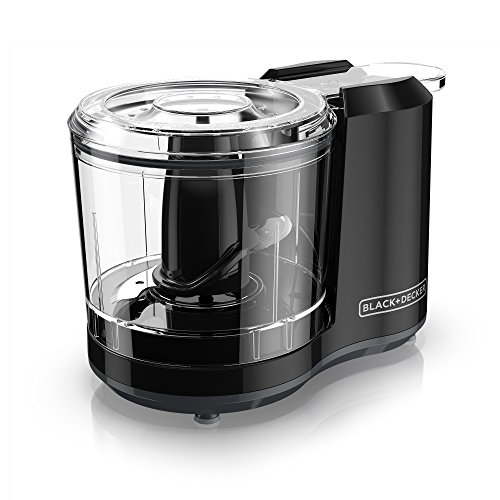
- 1.5-cup bowl is perfectly sized for garlic, herbs, nuts and baby-food portions
- One-touch pulse operation could not be simpler to learn or teach
- Stay-sharp blade and dishwasher-safe parts keep ownership effort near zero
Trade-offs
- Smallest capacity in this guide: strictly a small-jobs machine
- 150W motor is not built for hard, dense or large loads
- One-touch pulse only, no speed settings to grow into
Key specifications (from the verified listing)
- Capacity: 1.5 cups (from verified listing)
- Power: 150W (from verified listing)
- Operation: one-touch pulse; stay-sharp blade; dishwasher safe
The BLACK+DECKER 1.5-cup chopper is the smallest machine in this guide and makes no apology for it. Its job description is the forty small tasks a week that are beneath a full-size processor and tedious by knife: a handful of garlic, a bunch of herbs, nuts for a salad, a small onion, a portion of baby food. One-touch pulse, a 150W motor, a stay-sharp blade and dishwasher-safe parts add up to a tool whose entire virtue is that using it is faster than deciding whether the job is worth a bigger machine.
For a quiet-seeking kitchen, the BLACK+DECKER 1.5-Cup Electric Food Chopper, 150W argues its case by being a one-touch 1.5-cup chopper with a 150W motor and a stay-sharp blade for the smallest jobs. Noise is time multiplied by intensity, and this pick attacks the time side of that equation: jobs sized to its bowl finish in a handful of controlled bursts, after which the kitchen is silent again, which is the outcome quiet shoppers actually want.
Placement and technique will decide how the BLACK+DECKER 1.5-Cup Electric Food Chopper, 150W sounds in your home as much as its design does. Run it on a folded towel, away from the corner where walls amplify, fill it sensibly so the blade is not labouring, and its noise footprint shrinks to a few brief, unremarkable seconds at a time.
There is a final, practical test that separates a good shortlist entry from a great one, and the BLACK+DECKER 1.5-Cup Electric Food Chopper, 150W passes it: the week-two test. In week one any new processor is a novelty that gets used because it is new. By week two the novelty is gone, and the machines still on the counter are the ones whose size, controls and cleanup fit the household’s actual rhythm. Everything in this pick’s verified design, its capacity class, its blade system and the way its parts wash, points toward surviving that test in the kitchens its review describes, which is ultimately the only endorsement that compounds.
Best for: the smallest daily jobs: garlic, herbs, nuts, baby food, single servings / Not suited for: anything dense, large or disc-based
Check on Amazon for the current listing, configuration and latest price.

KitchenAid 3.5 Cup Food Chopper, Contour Silver (KFC3516CU)
Badge: Best for Stainless-Led Kitchens
Strengths
- Two speeds plus pulse for texture control in a compact bowl
- Stainless steel multi-purpose blade; dishwasher-safe work bowl
- Contour Silver finish suits stainless-led kitchens better than the red
Trade-offs
- Same chopper-only format: no slicing or shredding discs
- 3.5-cup capacity remains a small-batch brief
- Mechanically identical to the Empire Red listing, so choose on finish and listing terms
Key specifications (from the verified listing)
- Capacity: 3.5 cups (from verified listing)
- Controls: 2 speeds plus pulse
- Model: KFC3516CU, Contour Silver; stainless steel multi-purpose blade; easy cord wrap
The Contour Silver KFC3516CU is the Empire Red chopper’s mechanical twin: the same 3.5-cup bowl, the same two speeds plus pulse, the same stainless steel multi-purpose blade and dishwasher-safe bowl, in a silver finish that disappears into a stainless-led kitchen instead of accenting it. It earns its own review slot in this guide because the two listings are sold separately and the right choice between them is genuinely about finish and the listing in front of you, not about performance, which is identical.
For a quiet-seeking kitchen, the KitchenAid 3.5 Cup Food Chopper, Contour Silver (KFC3516CU) argues its case by being the same two-speed-plus-pulse 3.5-cup KitchenAid chopper in a Contour Silver finish. Noise is time multiplied by intensity, and this pick attacks the time side of that equation: jobs sized to its bowl finish in a handful of controlled bursts, after which the kitchen is silent again, which is the outcome quiet shoppers actually want.
Placement and technique will decide how the KitchenAid 3.5 Cup Food Chopper, Contour Silver (KFC3516CU) sounds in your home as much as its design does. Run it on a folded towel, away from the corner where walls amplify, fill it sensibly so the blade is not labouring, and its noise footprint shrinks to a few brief, unremarkable seconds at a time.
There is a final, practical test that separates a good shortlist entry from a great one, and the KitchenAid 3.5 Cup Food Chopper, Contour Silver (KFC3516CU) passes it: the week-two test. In week one any new processor is a novelty that gets used because it is new. By week two the novelty is gone, and the machines still on the counter are the ones whose size, controls and cleanup fit the household’s actual rhythm. Everything in this pick’s verified design, its capacity class, its blade system and the way its parts wash, points toward surviving that test in the kitchens its review describes, which is ultimately the only endorsement that compounds.
Best for: the same small-job brief as the red KitchenAid, in a stainless-led kitchen / Not suited for: disc work of any kind, or batches beyond a few cups
Check on Amazon for the current listing, configuration and latest price.
Comparison Table
Read the table by columns rather than rows: the badge column tells you the role each pick plays in this guide, the specification column keeps the comparison on verified facts from the listings, and the best-for column is the one to weigh against your own kitchen, because fit is decided there and nowhere else. Capacities and wattages are the manufacturers’ listing figures; no prices or ratings appear, for the reasons this guide has given throughout.
| Pick | Badge | Key specifications | Best for |
|---|---|---|---|
| Hamilton Beach Food Processor, 10-Cup (70730) | Best for Short-Burst Quiet Jobs | Capacity: 10 cups (from verified listing); Functions: slice, shred, mince and puree | family prep, slaws, doughs and big shredding or slicing sessions |
| BLACK+DECKER Food Processor, 8-Cup, 450W | Best Full-Size Pick for Brief Runs | Capacity: 8 cups (from verified listing); Power: 450W (from verified listing) | households of two to four wanting one mid-size machine for nightly prep |
| Cuisinart Core Custom 4-Cup Mini Chopper (MCH-4) | Best Mid-Size Pick | Capacity: 4 cups (from verified listing); Blade: auto-reversing stainless steel SmartPower blade | dips, dressings and small batches that overflow a 3-cup mini |
| KitchenAid 3.5 Cup Food Chopper, Empire Red (KFC3516ER) | Best Mini for Quick Tasks | Capacity: 3.5 cups (from verified listing); Controls: 2 speeds plus pulse | texture-sensitive small jobs where pulse control decides the result |
| BLACK+DECKER 1.5-Cup Electric Food Chopper, 150W | Best Smallest-Footprint Pick | Capacity: 1.5 cups (from verified listing); Power: 150W (from verified listing) | the smallest daily jobs: garlic, herbs, nuts, baby food, single servings |
| KitchenAid 3.5 Cup Food Chopper, Contour Silver (KFC3516CU) | Best for Stainless-Led Kitchens | Capacity: 3.5 cups (from verified listing); Controls: 2 speeds plus pulse | the same small-job brief as the red KitchenAid, in a stainless-led kitchen |
How to Choose the Right Option for Best Quiet Food Processors
Think in total noise, not peak noise
Every processor is loud at full speed; they differ in how long they stay there. A mini that dices an onion in four pulses makes perhaps fifteen seconds of noise. A full-size machine shredding a week’s vegetables makes several minutes, but replaces twenty minutes of knife work and its own kind of clatter. Decide which profile your household minds: brief and frequent, or longer and rare. That decision, not a decibel figure, is the real quiet buying decision.
Motor and load: where the sound comes from
Processor noise is motor whine plus food impact plus bowl resonance. Dense, hard loads at high fill levels maximise all three, which is why technique appears in this buying guide at all: smaller pieces, sensible fill and pulsing reduce noise on any machine. Wattage alone does not predict loudness in a simple way, but sustained strain does, so a machine sized generously for its jobs tends to sound calmer than one working at its limit.
Controls that shorten runs are quiet features
Pulse control is a noise feature because it replaces one long run with several short, effective bursts and stops the blade the instant the texture is right, rather than overshooting into extra seconds of puree and noise. Two speeds plus pulse, as on the KitchenAid choppers here, gives the cook a lower gear for soft jobs, and lower gears are where quiet daily prep actually happens.
Plan the kitchen, not just the machine
A processor run on a hard stone counter in a tiled corner will sound fierce whatever you buy. A folded towel under the base, a position away from the wall junction, and a cabinet door closed between the machine and a sleeping household change perceived noise dramatically. Budget a thought for placement alongside the purchase, and even the full-size pick in this guide becomes a considerate neighbour.
How to Use a Food Processor as Quietly as Possible
Prep for brevity. Cut food to even, modest pieces before it goes in, because uniform pieces process in fewer bursts. Fill to the working line and no further, since an overfilled bowl needs long, loud, uneven runs. Then pulse: short bursts, checking texture between them, and stop the moment the job is done rather than running on for insurance. Most daily jobs finish in under half a minute of total motor time done this way.
Choose the right gear for the food. Soft jobs, herbs, dressings, soft vegetables, belong on low speed or gentle pulses, which are audibly calmer and give better texture anyway. Reserve full speed for the short moments that genuinely need it, like the first seconds of a shred or a dense puree. On disc work, steady feeding through the chute keeps the run continuous and brief instead of stop-start and prolonged.
Manage the room as well as the machine. Run the processor on a folded towel, away from corners, with doors between it and anyone sleeping. Batch your loud jobs together in one session rather than scattering them across an evening, because one announced noisy minute is easier on a household than five surprise ones. Quiet in a shared home is mostly scheduling plus technique, and both are free.
- Problem: the machine seems louder than expected → check the fill level and piece size first; straining loads are the commonest cause of a harsh, loud run.
- Problem: the bowl rattles on the counter → the base is on a hard, resonant surface; a folded towel underneath damps both the rattle and the perceived volume.
- Problem: one long run pureed what should have been diced → switch to pulses and check between bursts; overshooting texture is also overshooting noise.
Why No Decibel Numbers Appear in This Guide
Some categories publish noise figures and some do not, and food processors, in the verified listings supplied for this guide, do not. That absence is itself information: it tells you the industry does not compete on measured quietness the way, say, dishwasher makers do, and that any precise figure attached to these models by a third party should be treated as unverified. This guide therefore ranks by mechanism, how noise is made and how long it lasts, which a buyer can reason about and verify in their own kitchen.
The mechanism ranking is not a consolation prize; it is arguably more useful than a laboratory figure, because your kitchen’s surfaces, your loads and your technique will move the real number further than the difference between models. A reader who understands burst length, fill level and placement owns the quiet outcome regardless of which pick they choose. The same machines are compared on other axes in Best Prices On Full Sized Food Processors.
Quiet Is a Household Negotiation, Not Just a Specification
The demand behind this keyword is rarely about the cook’s own ears. It is about the baby asleep in the next room, the partner on a call, the flatmate on night shifts, the thin walls of an apartment block. That context rewards a particular buying shape: a small, fast machine for the daily jobs that happen at sensitive hours, and acceptance that the weekly big batch, done at a sociable hour on the full-size machine, can make its noise in peace.
Several households solve it with two machines, a mini living on the counter for quiet daily work and the big processor emerging for planned sessions. This shortlist supports that reading naturally, since its minis and its full-size pick are complements rather than rivals. Buying the pair deliberately, across time, is often the real answer this keyword is groping toward.
A Realistic Quiet Ranking for This Shortlist
Since no measured figures exist for these machines, the honest ranking this guide can offer is a ranking of typical experience, stated as such. For a single small job at a sensitive hour, the order runs: the 1.5-cup BLACK+DECKER first, finished in seconds; the KitchenAid choppers next, their low speed and pulse giving the cook control over every second of noise; the Cuisinart minis close behind, their reversing blades ending jobs decisively rather than gradually. For a week’s vegetables in one planned session, the order inverts: the Hamilton Beach finishes the whole job in one announced interval, and the BLACK+DECKER 8-cup sits between the two philosophies, big enough to batch, modest enough to stay brief.
Treat that ranking as a starting hypothesis for your own kitchen rather than a laboratory result, because your surfaces, your loads and your walls will rearrange it at the margins. What will not rearrange is the structure underneath it: small jobs favour small machines, planned batches favour big ones, and technique, pulsing, damping, scheduling, moves every machine in the list toward the quiet end of its own range. A reader who absorbs that structure owns the quiet outcome whichever pick they choose, which is a more durable gift than any decibel figure this guide could have invented.
The Physics of Processor Noise in Plain Terms
Three sources make the sound. The motor contributes a whine that rises with load and speed. The food contributes impact noise, hard pieces striking the bowl and blade, worst in the first seconds of a run. The bowl and counter contribute resonance, amplifying both through hard surfaces. Each source has a countermeasure in technique: pulse to shorten, pre-cut to soften impacts, damp the base to kill resonance. No model in any guide escapes the physics; the good ones simply give you controls that cooperate with the countermeasures.
This is why the guide resists declaring a single quietest model. The KitchenAid choppers offer the most control over run profile, the 1.5-cup BLACK+DECKER finishes its tiny jobs fastest, and the Hamilton Beach compresses a week of prep into one planned session. Each is the quietest answer to a differently shaped question, and naming your question is the buyer’s real task.
Apartment and Open-Plan Living: The Real Brief
Open-plan homes removed the kitchen door, and with it the cheapest noise control ever invented. In those spaces the processor’s sound reaches the sofa, the desk and the cot undiminished, which is why this keyword has grown with open-plan living. The design response is the one this guide keeps returning to: small machines, short bursts, sociable scheduling, and a base damped against the worktop that would otherwise act as a sounding board.
There is also a courtesy technology already in your kitchen: the timer in your head. Running the processor before the household’s quiet hours, or batching the week’s noisy prep into one weekend session, costs nothing and outperforms any product feature. Buy the machine whose size matches your sensitive-hour jobs, and let scheduling handle the rest.
What Manufacturers Could Do, and What to Watch For
If this category ever competes seriously on quietness, the signs will be specific: published noise figures measured to a stated standard, motor housings described as damped or insulated, and bowls designed against resonance. Until listings argue in those specifics, treat quiet claims in any headline as marketing weather rather than climate, and buy on the mechanisms you can verify: size, controls and the shape of your own usage.
In the meantime, the verified listings here offer what they offer honestly, capacities, wattages, control types and parts, and this guide has built the quietest reasonable reading of them. That restraint is deliberate. A reader who trusts a guide’s silence about numbers it cannot verify can also trust the numbers it does print.
Common Buying Mistakes
- Believing any precise decibel figure for these models that the manufacturer never published.
- Buying a full-size machine for sensitive-hour daily jobs that a mini would finish in seconds.
- Overfilling the bowl, which lengthens and loudens every run.
- Running the processor on a bare stone counter in a tiled corner and blaming the machine.
- Holding the motor on continuously when pulsing would be shorter, quieter and better textured.
- Scattering noisy jobs across an evening instead of batching them into one announced session.
Final Recommendation
For the quietest daily experience, the answer in this guide is a mini used well: the KitchenAid 3.5-cup choppers, in either finish, give the most control over how long and how hard the machine runs, and the BLACK+DECKER 1.5-cup finishes the smallest jobs before noise becomes a topic at all. The Cuisinart minis sit close behind with their reversing blades ending jobs decisively.
Keep the Hamilton Beach 10-cup for the planned, sociable-hour batch, where its noise buys back a week of quiet evenings, and the BLACK+DECKER 8-cup as the middle path. Choose by which hours your kitchen must stay calm, damp the base, pulse with intent, and any of these machines will behave like a considerate member of the household.
Ready to decide? Compare Hamilton Beach Food Processor, 10-Cup (70730), BLACK+DECKER Food Processor, 8-Cup, 450W and Cuisinart Core Custom 4-Cup Mini Chopper (MCH-4) on Amazon to check the latest price on Amazon and the current configuration of each.
Readers researching the wider category will also find Best Prices On 8 Cup Food Processors and Best Prices On Breville Food Processors useful background before they decide.
Frequently Asked Questions
Are food processors ever truly quiet?
No. Chopping and shredding are violent processes and every machine in this category makes real noise at work. Quiet in this category is relative and practical: shorter runs, calmer loads and considerate timing, which this guide ranks because no verified decibel figures exist for these models.
Why are there no decibel ratings in the comparison?
Because none of the verified listings for these picks states a noise figure, and printing unverified numbers would mislead. The guide instead compares the factors that determine real-world noise: bowl size, motor class, control type and the run length each design invites.
Which type of processor makes the least noise in daily use?
Small choppers, in practice, because their jobs finish in a few short pulses. A mini that dices an onion in fifteen seconds of total motor time makes less household noise than any large machine, whatever their relative peak volumes.
How can I make my existing processor quieter?
Pulse instead of running continuously, pre-cut food evenly, fill only to the working line, run the machine on a folded towel away from wall corners, and batch noisy jobs into one session at a sociable hour. Together these change perceived noise more than a model swap usually does.
Does a more powerful motor mean a louder machine?
Not in a simple way. Noise rises with strain, and a generously sized motor working comfortably can sound calmer than a small motor at its limit. Sustained hard loads are the loud events; matching machine size to the job is the control.
Is a mini chopper a good quiet choice for an apartment?
It is the classic apartment answer: small jobs done in seconds, at whatever hour, with the base damped on a towel. For the occasional big batch, plan it for a sociable hour, or accept the full-size machine’s brief, announced session as the trade for its capacity.