Disclosure: topratedkitchenware.com is reader-supported. When you buy through links on our site, we may earn an affiliate commission from Amazon and other retailers, at no extra cost to you.
Where to buy
All six picks in this guide to best regular blenders for making baby food are listed on Amazon, where you can check the latest price on Amazon, confirm the exact variant, and read the current listing details before ordering. Listings, colours and bundles change, so match the full model name on the listing to the pick reviewed below. Picks marked prose-only are covered in full in the reviews but carry no purchase link in this guide, for the reason noted with each one.
- Best Overall: Bonsenkitchen Immersion Hand Blender — Check on Amazon
- KOIOS Immersion Blender 1000W — Check on Amazon
- OVENTE Electric Hand Blender 300W, Black (HS560B) — Check on Amazon
- OVENTE Electric Hand Blender 300W, Red (HS560R) — Check on Amazon
- MAGETANG 1800W Countertop Blender, 70 oz — Check on Amazon
- Vitamix VX1 Professional-Grade 64 oz — Check on Amazon
Read the full guide ↓
The search for the best regular blenders for making baby food hides a small surprise: the right answer is usually not a special baby machine at all, but a regular blender whose format matches how baby food is actually cooked. First foods are soft, warm and made in modest batches, which is why this guide is led by immersion blenders that puree in the cooking pot, backed by two countertop machines for families who batch-cook and freeze.
Six verified picks are compared here, and they divide honestly by strategy. Three hand blenders cover daily fresh purees at three tiers and levels of control; a fourth listing of one of those designs makes the case for a dedicated baby-only unit; and two full-size countertop blenders serve the weekly production session. Each review states plainly what the pick cannot do, because a tool that fails at nap time or stalls on sweet potato will be resented by tired parents faster than any other appliance in the kitchen.
You will also find a buying guide on texture stages and batch maths, a step-by-step routine for safe homemade purees, and answers to the questions new parents ask most. If your kitchen research extends beyond the baby year, Best Small Blenders For Food covers the compact end of the wider blender market.
Key Takeaways
- Baby food rewards format over power: immersion blenders puree in the pot, in small warm batches, with seconds of washing-up.
- Texture control is the feature that matters — weaning moves from silk-smooth to lumpy, and your blender must manage both ends.
- Batch freezers should buy capacity instead: a 64–70 oz countertop pitcher turns a week of purees into one session.
- A dedicated, inexpensive baby-only unit is a legitimate strategy — the red OVENTE listing exists in this guide to make that point.
- Never blend hard or frozen loads with a light hand blender; cook food tender first and the modest tools perform beautifully.
In this guide
Quick Picks
- Bonsenkitchen Immersion Hand Blender — Best Overall. The Bonsenkitchen immersion blender: a handheld stick blender positioned explicitly for smoothies, purees and baby food, with stainless steel blades — the brief matches the job exactly. — Check on Amazon
- KOIOS Immersion Blender 1000W — Best for Control. The KOIOS immersion blender: 1000W with 12 speeds and a Turbo mode, plus an anti-scratch guard — the control pick for parents who want to manage texture stages precisely. — Check on Amazon
- OVENTE Electric Hand Blender 300W, Black (HS560B) — Best Budget Pick. The OVENTE HS560B in black: a 300W, two-speed corded hand blender — a simple, lower-cost tier tool for soft purees, soups and first foods. — Check on Amazon
- OVENTE Electric Hand Blender 300W, Red (HS560R) — Best Second Unit. The OVENTE HS560R in red: the same 300W, two-speed HS560 design in red — ideal as a dedicated baby-food unit kept separate from the household’s main blender. — Check on Amazon
- MAGETANG 1800W Countertop Blender, 70 oz — Best for Batch Freezing. The MAGETANG countertop blender: 1800W with a 70 oz BPA-free pitcher and a 20 oz to-go cup — the batch-production pick for parents who cook and freeze purees in volume. — Check on Amazon
- Vitamix VX1 Professional-Grade 64 oz — Best Premium. The Vitamix VX1: a professional-grade 64 oz blender for families who want baby food handled by the same premium machine that does all the household’s blending. — Check on Amazon
How These Picks Were Chosen
These picks were chosen by mapping the verified pool onto the real workflow of homemade baby food: cooking method, batch size, texture stage and washing-up. That mapping is why immersion blenders lead — the pool’s hand blenders include one positioned explicitly for baby food and purees — and why the two countertop machines are framed as batch tools rather than daily ones. Picks were assessed on format fit, speed control for texture management, blade material for hot acidic foods, and the honesty of their tier.
This is research-led guidance, not a claim of nursery testing. Food-safety guidance in the how-to section follows the standard principles parents are taught everywhere: cook thoroughly, puree promptly, chill fast, freeze in small portions and reheat once, piping hot. Where a pick’s design and a baby-food task genuinely conflict — a light motor against frozen fruit, a huge pitcher against a single portion — the review says so and the verdict reflects it. Parents also comparing stick blenders for other kitchen work may find Best Stick Blenders For Soap Making an interesting look at the same tool category in a very different craft.
The 6 Best Options for Best regular blenders for making baby food

Bonsenkitchen Immersion Hand Blender
Badge: Best Overall
Strengths
- Sold explicitly for purees and baby food, so the brief matches the job
- Blends in the cooking pot, which keeps batches warm and washing minimal
- Stainless steel blades handle soft cooked vegetables and fruit well
Trade-offs
- Handheld use means you are the timer and the thermostat
- Small blending head makes large volumes slow going
- Not built for ice, nuts or hard frozen loads
Key specs from the listing: Type: immersion (hand) blender; Blade: stainless steel; Positioning: smoothies, purees and baby food; Format: portable stick mixer.
Baby food is a texture problem before it is anything else: cooked vegetables and fruit must go from soft chunks to a genuinely smooth puree, and later to controlled lumpiness as your baby grows. An immersion blender solves it in the most practical way possible — it works in the pot the food was cooked in, so a batch of steamed carrots or apples is pureed where it sits, at temperature, with no transferring of hot food into a cold pitcher and back again. The Bonsenkitchen is positioned for exactly this work, naming purees and baby food in its own brief, and its stainless steel blades are the right material for daily contact with hot, acidic foods.
The handheld format also matches how baby food is actually made: in modest batches, several times a week, often one-handed in the wider sense that a parent is rarely fully free at the stove. A stick blender rinses clean in seconds, stores in a drawer, and never asks you to wash a full pitcher assembly for a cup of puree. Its limits are the category’s limits — it will not crush ice, it does not love rock-hard frozen fruit, and big family batches take passes — but baby food, especially in the first year, plays directly to its strengths.
Picture a weekday evening with a hungry baby, a pan of vegetables and about ten free minutes, and put the Bonsenkitchen Immersion Hand Blender in the middle of it. In that moment the tool must be reachable, quick and forgiving, because the cook’s attention is divided by definition and the customer has no patience for a learning curve. Start with what the listing itself promises — type: immersion (hand) blender; blade: stainless steel — because those facts decide most of what the moment feels like: whether the batch fits the need, whether the control suits the person working it, and whether the machine is cooperating with the setting or arguing with it. Buyers tend to forgive a machine its stated limitations and resent it only for unstated ones, which is why this guide keeps returning to the specification instead of the slogan. The practical habit that follows is simple: blend a double portion whenever the pan is on, because tomorrow’s portion is almost free once the machine is already out and the food is already cooked. Do that consistently, and this pick’s strengths stop being features on a page and become the texture of an ordinary day — which is, in the end, the only place a blender recommendation is ever really tested.
Best for: parents making fresh purees several times a week / Not suited for: crushing ice or blending hard frozen ingredients

KOIOS Immersion Blender 1000W
Badge: Best for Control
Strengths
- 12 speeds plus a Turbo burst give fine control over texture
- Blends directly in the pot, pan or beaker, so there is no pitcher to wash
- Anti-scratch blade guard is kinder to coated cookware than bare metal guards
Trade-offs
- You hold the motor the whole time, so long or heavy batches tire the hand
- Small blending footprint means big volumes take several passes
- Not a countertop workhorse: thick, frozen loads are outside its comfort zone
Key specs from the listing: Type: immersion (hand) blender, 3-in-1; Power: 1000W; Speeds: 12 speeds plus Turbo mode; Blade: stainless steel, anti-scratch design.
Weaning is a progression of textures, from silk-smooth first tastes to mashed, then minced, then family food, and the tool that manages progression best is the one with the finest speed control. The KOIOS offers twelve speeds plus a Turbo burst, which in practice means you can start a puree gently to avoid splashing, finish it at full power for smoothness, and later in the journey pulse a batch briefly to leave it deliberately textured. That range is the difference between a tool you use for one stage and a tool that follows the whole first year.
Two details suit it to family kitchens in particular. The anti-scratch blade guard is kinder to the coated pots most parents cook in, and 1000W gives it authority over fibrous vegetables — sweet potato, squash, cooked greens — that strain weaker hand blenders. It remains a hand blender, with the category’s honest limits on ice and very hard loads, and you hold it throughout the job. For parents who cook baby food from the family’s vegetables rather than from a separate menu, that control makes it the most adaptable pick here.
Consider a weekday evening with a hungry baby, a pan of vegetables and about ten free minutes. The KOIOS Immersion Blender 1000W meets that moment with a specific character: type: immersion (hand) blender, 3-in-1; power: 1000W. In that moment the tool must be reachable, quick and forgiving, because the cook’s attention is divided by definition and the customer has no patience for a learning curve, and it is worth tracing how the character answers, piece by piece — the format deciding the batch, the controls deciding how much of the cook’s attention the job consumes, the design deciding whether the machine belongs in the setting at all. This is the level at which buying decisions actually succeed or fail, far below the level of brand names and badges, and it is why two machines with similar headlines can produce opposite ownership stories. So judge this pick the way its most thoughtful reviewers did: by the fit between its listed facts and a repeated reality. Then build the small routine that supports the fit — blend a double portion whenever the pan is on, because tomorrow’s portion is almost free once the machine is already out and the food is already cooked — and the machine will repay the attention.
Best for: parents who want fine texture control across weaning stages / Not suited for: hands-free blending or frozen dessert work

OVENTE Electric Hand Blender 300W, Black (HS560B)
Badge: Best Budget Pick
Strengths
- Simple two-speed control is easy for new cooks to learn
- Light handheld format stores in a drawer, not on the counter
- A lower-cost tier design for soft purees and soups
Trade-offs
- 300W is modest, so thick or partly frozen mixtures strain it
- Only two speeds limit texture fine-tuning
- Small batches only: family soup volumes take several passes
Key specs from the listing: Power: 300W; Speeds: 2 mixing speeds; Blade: stainless steel; Colour: black, model HS560B.
Not every baby-food tool needs to be a system. The OVENTE HS560B is a straightforward 300W hand blender with two speeds, and for the core baby-food workload — soft cooked vegetables, ripe fruit, porridge stirred smooth — straightforward is genuinely sufficient. First foods are cooked until tender by definition, and a modest motor with stainless blades purees tender food without drama. Its black finish and drawer-size format make it the kind of tool that gets bought for the weaning months without a family summit about the purchase.
Honesty about the tier matters. Three hundred watts is a soft-food specification: partly frozen fruit, fibrous raw vegetables and thick mixtures will strain it, and two speeds give you less texture finesse than the twelve-speed pick above. It is also a small-batch tool, happiest with a pot or jug of puree rather than a freezer-filling production run. Within its brief — simple, soft, small — it does the job at the friendliest tier in this guide, which for a stage of life measured in months is a rational way to buy.
The test that matters for the OVENTE Electric Hand Blender 300W, Black (HS560B) is not a single blend but a repeated one: a weekday evening with a hungry baby, a pan of vegetables and about ten free minutes, again and again, until the machine is furniture and the routine is reflex. In that moment the tool must be reachable, quick and forgiving, because the cook’s attention is divided by definition and the customer has no patience for a learning curve. Its specification reads plainly — power: 300W; speeds: 2 mixing speeds — and plain specifications are a virtue in a buyer’s hands, because they let you simulate the repetition honestly before spending anything. Imagine the tenth use rather than the first: the container’s size against the usual batch, the controls against your patience on a tired day, the footprint against the space it must live in permanently. Machines that pass the tenth-use test are the ones still on the counter in the second year, still earning their verdict. Support the relationship with the obvious habit — blend a double portion whenever the pan is on, because tomorrow’s portion is almost free once the machine is already out and the food is already cooked — and the repetition becomes the pleasure instead of the grind.
Best for: budget-conscious parents making soft first foods / Not suited for: fibrous, thick or partly frozen mixtures
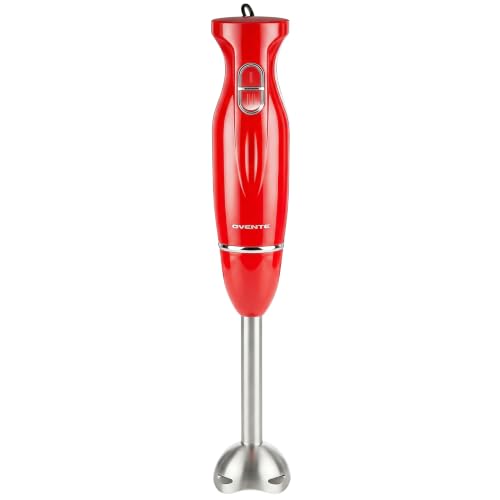
OVENTE Electric Hand Blender 300W, Red (HS560R)
Badge: Best Second Unit
Strengths
- Simple two-speed control is easy for new cooks to learn
- Red finish is easy to spot in a crowded drawer or kitchen
- A lower-cost tier design for soft purees and soups
Trade-offs
- 300W is modest, so thick or partly frozen mixtures strain it
- Only two speeds limit texture fine-tuning
- Small batches only: family soup volumes take several passes
Key specs from the listing: Power: 300W; Speeds: 2 mixing speeds; Blade: stainless steel; Colour: red, model HS560R.
This pick is the red colourway of the same HS560 design as the black model above, and a baby-food guide is exactly where a second listing of one design earns its place: many parents keep a dedicated tool for baby food, separate from the blender that handles chillies, garlic and coffee-adjacent jobs in a busy kitchen. A distinct red unit makes the separation foolproof — everyone in the household, including grandparents and babysitters, can see at a glance which blender is the baby’s.
Everything said about the black model’s working character applies here unchanged: 300W suited to soft cooked foods, two speeds, stainless blades, small batches, honest limits on anything hard or frozen. Choose between the two listings on colour and current listing details alone, and consider the strategy rather than the shade the real decision: a dedicated, inexpensive baby-food blender removes cross-flavour worries, keeps the tool always to hand, and costs little enough that nobody minds it retiring to a drawer when the puree era ends.
There is a version of a weekday evening with a hungry baby, a pan of vegetables and about ten free minutes where the OVENTE Electric Hand Blender 300W, Red (HS560R) is exactly right, and this guide’s job is to help you check whether that version is yours. In that moment the tool must be reachable, quick and forgiving, because the cook’s attention is divided by definition and the customer has no patience for a learning curve. The raw material of the check is the listing itself — power: 300W; speeds: 2 mixing speeds — read not as marketing but as a description of your future ordinary days. Where those facts align with the scene, this pick’s badge is earned and its review above will read like a description of your life. Where they grind against the scene, another pick in this guide is the honest answer, and the reviews are written to tell you which one and why. Either way, the working tip travels with the machine: blend a double portion whenever the pan is on, because tomorrow’s portion is almost free once the machine is already out and the food is already cooked. A buyer who runs this check before ordering rarely writes the disappointed review afterwards — the fit was verified while it was still free to change.
Best for: families wanting a dedicated, clearly marked baby-food blender / Not suited for: anyone expecting it to differ mechanically from the black HS560

MAGETANG 1800W Countertop Blender, 70 oz
Badge: Best for Batch Freezing
Strengths
- 70 oz pitcher is the largest capacity in this line-up
- 1800W motor is specified for smoothies and frozen mixtures
- Included 20 oz to-go cup covers weekday single servings
Trade-offs
- Large pitcher and motor base take real counter and cabinet space
- High-power blending is not a quiet operation
- Big pitcher is oversized for very small single batches
Key specs from the listing: Power: 1800W; Motor speed: 28000 RPM; Pitcher: 70 oz, BPA-free; Extras: 20 oz to-go cup included.
Some families make baby food daily and fresh; others run a weekly production session and freeze portions in trays. The second strategy needs a countertop machine, and the MAGETANG is built for it: an 1800W motor, a 70 oz BPA-free pitcher that swallows a whole session’s steamed vegetables at once, and the power to take a big batch fully smooth without the stop-start passes a hand blender needs at that volume. The included 20 oz to-go cup then covers the other end of family life — smoothies for the parents who are doing all this cooking.
The trade-offs are scale and delicacy. A 70 oz pitcher is the wrong tool for a single small portion, where ingredients spread too thin to circulate, and a high-power countertop machine is not a quiet one during nap time. It also asks for a full wash between batches where a stick blender rinses in seconds. Treat it as the production line, not the everyday tool: pair it with any hand blender in this guide for daily portions, and the two-machine system covers the whole weaning year better than either could alone.
Picture a weekday evening with a hungry baby, a pan of vegetables and about ten free minutes, and put the MAGETANG 1800W Countertop Blender, 70 oz in the middle of it. In that moment the tool must be reachable, quick and forgiving, because the cook’s attention is divided by definition and the customer has no patience for a learning curve. Start with what the listing itself promises — power: 1800W; motor speed: 28000 RPM — because those facts decide most of what the moment feels like: whether the batch fits the need, whether the control suits the person working it, and whether the machine is cooperating with the setting or arguing with it. Buyers tend to forgive a machine its stated limitations and resent it only for unstated ones, which is why this guide keeps returning to the specification instead of the slogan. The practical habit that follows is simple: blend a double portion whenever the pan is on, because tomorrow’s portion is almost free once the machine is already out and the food is already cooked. Do that consistently, and this pick’s strengths stop being features on a page and become the texture of an ordinary day — which is, in the end, the only place a blender recommendation is ever really tested.
Best for: batch-cooking parents who freeze puree portions weekly / Not suited for: single small portions or nap-time blending

Vitamix VX1 Professional-Grade 64 oz
Badge: Best Premium
Strengths
- 64 oz container covers soups and family smoothie rounds in one go
- Professional-grade build aimed at daily, heavy use
- Straightforward food-blender brief: smoothies, soups and batch prep
Trade-offs
- Large container is bulky to store in small kitchens
- Fewer headline programs than the Ascent step-up models
- Big minimum practical batch for a single small serving
Key specs from the listing: Container: 64 oz; Positioning: professional-grade food blender; Batches: sized for small and large batches; Colour: black.
The VX1 answers a different buying philosophy: instead of a dedicated baby tool, one professional-grade machine that handles baby food as a subset of everything. Its 64 oz container suits batch purees for the freezer, and a professional-grade platform brings the texture authority that matters most at the very first stage, when a puree must be completely smooth — no flecks, no strings — for a young baby learning to swallow. Fibrous vegetables that defeat lesser machines are this class of blender’s home ground.
The counter-arguments are proportion and price tier. This is a premium, full-size machine bought for a job a drawer-size stick blender also does well, and for small daily portions the big container is genuinely awkward. The rational case is the household that will use the machine hard for a decade of family blending beyond the baby year — soups, smoothies, sauces — and treats baby food as the first of many jobs. Bought on that basis, it is the strongest long-term pick here; bought for the puree months alone, it is more machine than the task requires.
Consider a weekday evening with a hungry baby, a pan of vegetables and about ten free minutes. The Vitamix VX1 Professional-Grade 64 oz meets that moment with a specific character: container: 64 oz; positioning: professional-grade food blender. In that moment the tool must be reachable, quick and forgiving, because the cook’s attention is divided by definition and the customer has no patience for a learning curve, and it is worth tracing how the character answers, piece by piece — the format deciding the batch, the controls deciding how much of the cook’s attention the job consumes, the design deciding whether the machine belongs in the setting at all. This is the level at which buying decisions actually succeed or fail, far below the level of brand names and badges, and it is why two machines with similar headlines can produce opposite ownership stories. So judge this pick the way its most thoughtful reviewers did: by the fit between its listed facts and a repeated reality. Then build the small routine that supports the fit — blend a double portion whenever the pan is on, because tomorrow’s portion is almost free once the machine is already out and the food is already cooked — and the machine will repay the attention.
Best for: families buying one premium blender for a decade of use / Not suited for: parents wanting a cheap, dedicated puree-only tool
Comparison Table
| Pick | Badge | Container / format | Controls | Link |
|---|---|---|---|---|
| Bonsenkitchen Immersion Hand Blender | Best Overall | immersion (hand) blender | See review | Check on Amazon |
| KOIOS Immersion Blender 1000W | Best for Control | immersion (hand) blender, 3-in-1 | 12 speeds plus Turbo mode | Check on Amazon |
| OVENTE Electric Hand Blender 300W, Black (HS560B) | Best Budget Pick | Power: 300W | 2 mixing speeds | Check on Amazon |
| OVENTE Electric Hand Blender 300W, Red (HS560R) | Best Second Unit | Power: 300W | 2 mixing speeds | Check on Amazon |
| MAGETANG 1800W Countertop Blender, 70 oz | Best for Batch Freezing | Power: 1800W | See review | Check on Amazon |
| Vitamix VX1 Professional-Grade 64 oz | Best Premium | 64 oz | See review | Check on Amazon |
How to Choose the Right Blender for Best regular blenders for making baby food
Choose by texture stage first. In the earliest weeks a puree must be completely smooth, which favours either a fine-control hand blender worked patiently in the pot or a powerful countertop machine. As weaning progresses, the requirement inverts: you need to leave texture in, which favours pulse control and lower speeds over raw power. A blender with a wide speed range — the twelve-speed pick in this guide is the extreme case — covers the whole journey in one tool, while a simple two-speed tool covers the smooth stage well and the lumpy stage adequately with short bursts.
Choose by batch pattern second. Daily-fresh cooks make a cup or two at a time, and for them a countertop pitcher is mostly washing-up; the hand blender’s rinse-and-drawer routine wins every ordinary day. Batch freezers make a litre or more at a sitting, and for them the arithmetic reverses: a 70 oz pitcher finishes in one blend what a hand blender does in passes, and the washing-up is amortised across a week of meals. Many families honestly need both patterns at different times, which is why this guide treats the two-machine combination as a system rather than an extravagance.
Choose by ingredients third. Baby food is cooked food, and cooked-tender vegetables and fruits are gentle loads that modest motors handle well. The failures happen at the edges: fibrous sweet potato and squash need either patience or power, raw hard vegetables should be cooked first rather than forced, and frozen ingredients should be thawed or cooked rather than attacked. If your menu leans on the fibrous end — root vegetables, greens, lentils — weight motor authority higher; if it leans on fruit and soft vegetables, any pick here will serve. Our guide to Best Pro Blenders shows where the heavy-duty end of blending begins, for families whose cooking grows in that direction.
Finally, choose for the tired operator. Baby food is made by people who are short of sleep and time, so the practical virtues dominate: a tool that lives in a drawer beats one that lives in a cupboard, a rinse beats a disassembly, and a control you can work with wet hands beats a clever interface. The best baby-food blender is the one still being used happily at month nine, and that is decided by friction far more than by specifications.
How to Make Smooth, Safe Baby Purees at Home
Homemade baby food is simple cooking with strict hygiene, and a regular blender handles the blending step completely once the routine is right.
- Wash hands, utensils and produce; peel where appropriate and cut vegetables and fruit into even pieces so they cook at the same rate.
- Cook until completely tender — steaming and simmering both work — because tenderness, not the blender, decides how smooth the puree can be.
- Keep some of the cooking liquid: it is nutrient-rich and lets you adjust the puree’s consistency without diluting flavour with plain water later.
- Blend in the pot with an immersion blender, or transfer to a countertop pitcher, starting slowly and building speed until the texture matches your baby’s stage.
- Check the texture honestly: for early weaning, the puree should fall from a spoon in a smooth ribbon with no flecks or strings.
- Cool portions quickly, refrigerate what will be used within a couple of days, and freeze the rest in small covered portions such as ice-cube trays.
- Reheat frozen or refrigerated portions once, until piping hot throughout, stir well to remove hot spots, and let cool to serving temperature before offering.
Problem: The puree has strings or flecks that will not blend out → what to do: the food was undercooked or too fibrous for the tool; cook longer until truly tender, add a little cooking liquid, and blend in smaller amounts so the blades stay engaged — a sieve is a legitimate finishing step for the earliest stage.
Problem: The puree is too thin → what to do: drain more cooking liquid before blending next time; to rescue this batch, stir in a little baby rice, mashed potato or avocado to body it up rather than re-blending, which only makes it thinner.
Problem: The hand blender splashes hot puree → what to do: the head is too close to the surface or the pot is too shallow; use a deeper pot, keep the blade head fully submerged, and start at the lowest speed until the mixture is moving.
Texture Stages: What Your Blender Must Do at Each Age of Weaning
Weaning is usually described in stages, and each stage is a different blending job. The first stage asks for completely smooth, thin purees — the hardest test of a blender’s finishing ability and the stage where fibrous ingredients expose weak tools. The second stage asks for thicker, mashed textures with soft lumps, which is a test of restraint: short pulses and low speeds, stopping early on purpose. The third stage is minced and chopped family food, where a blender is often the wrong tool entirely and a fork or knife is better.
Plan the purchase against the whole arc. A wide speed range shines because it serves stage one and stage two with the same tool; a simple two-speed blender serves stage one well and stage two with a light touch on the button. What no blender should do is keep food artificially smooth for months because the tool cannot do otherwise — texture progression is part of learning to eat, and the equipment should follow the baby, not lead.
Batch Freezing Without Losing Quality
Freezing is what makes homemade baby food sustainable for busy families, and it rewards a routine: cook double, puree once, freeze in single portions. Small portions thaw quickly and waste little when appetites vary, and a covered ice-cube tray or small pots keep flavours separate. Label with the food and the date, because frozen purees are anonymous orange cubes within a fortnight, and rotate stock so the oldest is used first.
Quality survives freezing well when two rules hold: freeze fresh, on the day of cooking, and reheat thoroughly exactly once. Texture can loosen after thawing, especially with vegetables — a brief re-blend or a stir with a spoon restores it. Families running this system weekly are exactly the batch pattern the countertop picks in this guide were chosen for, and our notes on Best Prices On Ninja Blenders cover the value side of that countertop category for comparison.
One Blender or a Dedicated Baby Unit?
The dedicated-unit strategy deserves more respect than it usually gets. A cheap hand blender reserved for baby food never carries chilli heat, garlic or onion pungency into a first food, never goes missing into a partner’s smoothie routine, and can live in the drawer nearest the stove. The cost is one more object in the kitchen; the return is a small daily calm. Families with the budget for it often find the dedicated tool is the one that actually gets used for a quick single portion, while the household machine handles weekends. There is no wrong answer — only an honest look at how your kitchen really runs.
Common Buying Mistakes
- Buying a delicate personal blender for baby food and expecting it to handle fibrous vegetables daily.
- Blending food that is not cooked tender enough, then blaming the blender for strings and flecks.
- Making tiny single portions in a huge countertop pitcher, where ingredients cannot circulate properly.
- Keeping purees too long: refrigerated and frozen portions need prompt chilling, clear labelling and one thorough reheat.
- Holding a baby at smooth purees for months because the tool cannot do lumpy — texture must progress with the baby.
Final Recommendation
For most families, start with the Bonsenkitchen immersion blender: it is positioned for baby food and purees, works in the pot, and keeps the daily routine to seconds of washing-up. Parents who want texture finesse across the whole weaning journey should step up to the KOIOS and its twelve speeds, and budget-conscious households are honestly served by the OVENTE — in black as the main tool, or in red as a dedicated baby-only unit.
Batch freezers should add or choose the countertop route: the MAGETANG for production volume, the Vitamix VX1 for the one-premium-machine household. Whichever combination you land on, cook tender, blend to the stage, chill fast — and the regular blender you already understand will outperform any gadget bought in a panic. Further comparisons live in Best Prices On Vitamix Blenders for the premium end of this list.
Compare the finalists directly on Amazon: Bonsenkitchen Immersion Hand Blender — Check on Amazon.
Frequently Asked Questions
Do I need a special baby food maker, or is a regular blender enough?
A regular blender is enough, and for most families it is better: the cooking still happens in a normal pot, and the blender handles the pureeing step completely. Dedicated baby machines combine steaming and blending in one small unit, which suits tiny kitchens, but their capacity is small and their useful life ends with the puree stage. A regular hand or countertop blender keeps working for the family for years afterwards.
Which is better for baby food: an immersion blender or a countertop blender?
For daily fresh portions, the immersion blender: it purees in the cooking pot, handles small warm batches gracefully and rinses clean in seconds. For weekly batch cooking and freezing, the countertop blender: its large pitcher finishes in one blend what a hand blender does in passes. Many families end up with both, using each where it is strong, which is why this guide reviews the two formats as a system.
Can a hand blender make a puree smooth enough for first weaning?
Yes, provided the food is cooked completely tender first. Smoothness is decided more by tenderness and blending time than by the tool category: work the head slowly through the pot, keep it submerged, and allow a full minute or more for fibrous vegetables. For the very first stage, passing the puree through a sieve is a legitimate finishing step that guarantees no strings remain.
How long can homemade baby puree be kept?
Follow the standard guidance your health visitor or paediatric source gives: refrigerate promptly and use within a couple of days, or freeze in small portions for longer storage. Always cool food quickly before chilling, label frozen portions with contents and date, and reheat only once, until piping hot, stirring to remove hot spots and cooling to serving temperature before feeding.
What foods should not go in a light hand blender?
Anything hard or frozen: ice, frozen fruit straight from the freezer, raw hard vegetables and nuts will strain or damage a light immersion blender. Cook vegetables until tender, thaw frozen fruit, and leave ice and nuts to a countertop machine built for them. The modest tools in this guide perform beautifully inside their brief — the failures only happen when the brief is ignored.
When should purees stop being completely smooth?
As your baby gains confidence with first tastes, textures should gradually thicken and gain soft lumps, moving toward mashed and then minced family foods. Your blender supports this by blending less: shorter pulses, lower speeds, and stopping while texture remains. Exact timing varies by baby, so follow your paediatric guidance — the equipment point is simply to choose a tool whose control lets you stop early on purpose.
Can I use the same blender for baby food and the rest of the family’s food?
Yes, with ordinary hygiene: wash the tool thoroughly between uses, and be thoughtful about strong flavours — a blender that made a chilli sauce at lunch should be washed with extra care before it makes a first food at dinner, because traces of heat and pungency carry. Many families solve the question entirely with a dedicated inexpensive unit, as this guide’s red OVENTE pick illustrates, but dedication is a convenience, not a safety requirement, provided washing is honest.
What consistency should a first puree actually be?
For the very first tastes, think of a smooth, thin puree that falls from the spoon in a ribbon and holds no flecks, strings or lumps — the baby is learning to move food from the front of the mouth to swallowing, and texture is a skill to add gradually. As confidence grows over the following weeks, leave the puree progressively thicker and then softly lumpy. Your blender supports the whole progression if you blend less deliberately at each stage rather than reaching for a different tool.


