Disclosure: topratedkitchenware.com is reader-supported. When you buy through links on our site, we may earn an affiliate commission from Amazon and other retailers, at no extra cost to you.
Where to buy
Every linked pick in this guide to best rice cookers heavy com is listed on Amazon, where you can check the latest price on Amazon, confirm the exact variant and read the current listing details before ordering. Listings and bundles change, so match the full model name on the listing to the pick reviewed below. Orders are placed on Amazon under its normal delivery and returns terms.
- Best Overall: AROMA Digital Rice Cooker ARC-914SBD — Check on Amazon
- Cosori Rice Cooker 10 Cup with Fuzzy Logic — Check on Amazon
- BLACK+DECKER Rice Cooker 6-Cup (Cooked) — Check on Amazon
- AROMA Rice Cooker ARC-363NG 3-Cup — Check on Amazon
- Zojirushi NS-ZCC10 Neuro Fuzzy Rice Cooker — Check on Amazon
- Zojirushi NS-TSC10 Micom Rice Cooker 5.5 Cup — Check on Amazon
Read the full guide ↓
Readers who type best rice cookers heavy com are usually looking for the kind of direct, no-nonsense roundup that Heavy.com-style buying coverage made familiar: a shortlist, a clear winner, the honest trade-offs, and none of the mystique that kitchen-appliance marketing loves. This guide is written in that spirit. Six verified rice cookers, ranked by what they actually do well, with the limitations stated in the same breath as the strengths.
The shortlist deliberately spans the whole market shape: a mid-size digital all-rounder, a 10-cup fuzzy-logic multicooker, two simple compacts, and the two Japanese specialist machines that roundup readers are always told to consider and rarely have explained plainly. Every claim in the reviews traces to the verified listing information for the model — capacity, controls and functions as the manufacturer states them — and where a roundup would normally print a score, this one prints the reasoning instead, because a score cannot tell you whether a cooker fits your batch, your counter or your patience.
You will find the ranking logic, a comparison table, a buying guide that cuts through program-name inflation, and a practical how-to for getting a good batch out of any machine here. For the specialist version of this shortlist, see Best Rice Cookers Japanese; for the grain-first version, see Best Rice Cookers Japanese Rice.
Key Takeaways
- The roundup answer, up front: the mid-size digital AROMA is the buy for most households; the Zojirushi models are the buy for texture obsessives.
- Program counts are the most inflated number in rice cookers — control type and capacity fit matter more.
- Fuzzy logic and Micom control are real differences, visible in demanding grains and repeated daily cooking.
- Basic cookers are not bad cookers; they are honest ones, best in small batches with careful measuring.
- Capacity claims mix cooked and uncooked cups across brands — convert before you compare.
- Check the latest price on Amazon for each pick, since roundup pricing elsewhere goes stale fastest of all.
In this guide
Quick Picks
Six picks, one shortlist. The table below is the whole guide to best rice cookers heavy com on one screen; the detailed reviews that follow explain the reasoning, the trade-offs and the kitchens each machine actually suits.
| Pick | Badge | Format (from listing title) | Best for | Amazon |
|---|---|---|---|---|
| AROMA Digital Rice Cooker ARC-914SBD | Best Overall | Format: digital rice cooker, grain cooker and multicooker with steamer function | households cooking rice most days in family-size batches | Check on Amazon |
| Cosori Rice Cooker 10 Cup with Fuzzy Logic | Most Versatile | Controls: fuzzy logic, 18-in-1 functions including sauté and slow cook | larger households that want fuzzy-logic control and a ceramic-coated pot | Check on Amazon |
| BLACK+DECKER Rice Cooker 6-Cup (Cooked) | Best Simple Pick | Format: rice cooker with steaming basket | small households wanting a simple, easy-clean basic cooker | Check on Amazon |
| AROMA Rice Cooker ARC-363NG 3-Cup | Best for Small Households | Format: small rice cooker, oatmeal cooker and soup maker | one- and two-person households cooking modest batches often | Check on Amazon |
| Zojirushi NS-ZCC10 Neuro Fuzzy Rice Cooker | Best Premium | Controls (per listing title): Neuro Fuzzy logic | daily rice cooks who value texture refinement and a Japanese specialist design | Check on Amazon |
| Zojirushi NS-TSC10 Micom Rice Cooker 5.5 Cup | Best with a Display | Controls (per listing title): Micom (microcomputer) controls with LCD | households wanting Japanese Micom control in the classic 5.5-cup size | Check on Amazon |
How These Picks Were Chosen
This shortlist was built the way a good roundup should be: from a verified pool, with each model checked for what its listing actually promises rather than what its marketing implies. The six were kept because together they cover the real decision space — size, control, simplicity and specialism — without padding the list with near-duplicates. Two models share a brand and a compact format because they serve genuinely different finishes and routines; no model is here to fill a quota.
The ranking method is stated plainly so you can disagree with it productively. Everyday versatility and capacity fit were weighted first, control refinement second, and extra functions third, because that is the order in which owners actually feel a cooker over a year of use. A reader who cooks demanding grains daily should promote the premium picks to the top of their personal list; a reader who cooks rice twice a month should demote them. The reviews give you the material to re-rank honestly, which is what roundup coverage owes you.
Badges follow that method and stay attached to each model from Quick Picks to the detailed reviews. Readers comparing this editorial style with the retailer-led angle will find a useful contrast at Best Rice Cookers Kohls, and those who want the Japanese-specialist argument in full should read Best Rice Cookers Japanese next.
The 6 Picks for best rice cookers heavy com, Reviewed in Roundup Style

AROMA Digital Rice Cooker ARC-914SBD
Badge: Best Overall
Strengths
- Mid-size 4-cup uncooked capacity suits most households without taking over the counter
- Digital controls give more repeatable results than a single lever for mixed grain cooking
- Steamer and multicooker roles mean one appliance covers rice plus a simple steamed side
Trade-offs
- Too large to be the most efficient choice for a single small serving cooked alone
- Digital programs still need the right water level; they cannot rescue a badly measured batch
- Stainless exterior shows fingerprints and needs a wipe to stay looking clean
Key specs (from the verified listing)
- Capacity (per listing title): 4-cup uncooked / 8-cup cooked, 2 Qt
- Format: digital rice cooker, grain cooker and multicooker with steamer function
- Exterior: stainless steel
- Model: ARC-914SBD
The ARC-914SBD sits in the useful middle of this shortlist: a 4-cup uncooked, 8-cup cooked digital cooker in a 2 Qt body with a stainless steel exterior. That size is the everyday sweet spot for a household that cooks rice several times a week, because a half batch still has enough depth in the bowl to cook evenly while a full batch feeds a family meal without a second round. The digital control set matters more than the styling. Programmed cooking holds a steadier soak and finish than a basic lever cooker, which is exactly what demanding grains need, and the steamer and grain-cooker roles described in the listing title make it a genuine multicooker rather than a one-job pot. In research terms this is the balanced pick: not the smallest, not the largest, and not the most specialised, but the one whose capacity, controls and extra functions overlap the widest range of real kitchens. Treat the programs as helpers, not magic — rinse, measure with the cup supplied, and let the finished rice rest before fluffing, and this design rewards the routine with consistent batches.
The roundup winner’s case, plainly: 4 cups uncooked is the size most households actually cook, digital control is steady without being precious, and the steamer and multicooker roles mean the ARC-914SBD covers weeknight cooking beyond rice. It is not the cheapest machine here, not the smartest, and not the smallest — it is the one with the fewest reasons to regret it. Roundups live or die on their top pick being defensible a year later, and a mid-size digital cooker with a stainless exterior and a sensible footprint is about as defensible as this category gets.
Best for: households cooking rice most days in family-size batches / Not suited for: solo cooks who only ever make one small serving

Cosori Rice Cooker 10 Cup with Fuzzy Logic
Badge: Most Versatile
Strengths
- Fuzzy logic adjusts the cook as it goes, which helps with grains that punish small timing errors
- Ceramic-coated inner pot is the interesting alternative for buyers avoiding conventional non-stick
- 18-in-1 range plus sauté and slow cook makes it the most versatile machine in this pool
Trade-offs
- 10-cup capacity is far more cooker than a small household will use well at minimum batch sizes
- A long program list takes longer to learn than a one-touch design
- Large footprint and black finish dominate a small counter
Key specs (from the verified listing)
- Capacity (per listing title): 10 cup, 20 cup cooked
- Controls: fuzzy logic, 18-in-1 functions including sauté and slow cook
- Inner pot: ceramic coating, non-stick
- Extras (per listing title): 24H keep warm and delay timer, stainless steel steamer basket
- Colour: black
The Cosori is the technology-led pick in this pool: a 10-cup fuzzy-logic cooker with a ceramic-coated inner pot, an 18-in-1 program range that includes sauté and slow cook, a stainless steel steamer basket, and 24-hour keep warm with a delay timer, yielding 20 cups cooked. Fuzzy logic is the headline that actually matters, because the cooker monitors the cook and adjusts instead of running one fixed cycle, which forgives small variations in water and grain age. The ceramic coating is the second real differentiator, giving buyers who prefer to avoid a conventional non-stick surface a credible option that still releases rice cleanly. Size is the honest caveat. Ten cups uncooked is a big-family or batch-cooking machine, and its best work happens at medium and large loads; a tiny test batch rattles around in a pot built for volume. Choose it when you want one appliance that cooks rice carefully, steams in a steel basket, and can also sauté or slow cook — and when your household size matches the capacity it was designed around.
The Cosori is the feature-heavy entry every roundup includes and the one readers most need help judging. Strip the headline down: fuzzy logic is a real advantage for texture, the ceramic-coated pot is a real alternative for buyers avoiding conventional non-stick, and the 18-in-1 range is real versatility if — and only if — your kitchen will use sauté and slow-cook functions in a rice cooker body. At 10 cups uncooked it is also genuinely large. Verdict in roundup language: excellent machine, wrong size for small households, and its program list should be the last reason you buy it, not the first.
Best for: larger households that want fuzzy-logic control and a ceramic-coated pot / Not suited for: one-person kitchens cooking minimal batches

BLACK+DECKER Rice Cooker 6-Cup (Cooked)
Badge: Best Simple Pick
Strengths
- Simple format that a first-time rice-cooker owner can use without reading a program chart
- Removable non-stick bowl lifts out for serving and straightforward washing
- Included steaming basket adds a vegetables-or-dumplings option above the rice
Trade-offs
- 6-cup cooked is a small ceiling; growing families will outgrow it quickly
- Basic controls offer no dedicated settings for different grain types
- Results depend heavily on your water measuring, with no fuzzy-logic safety net
Key specs (from the verified listing)
- Capacity (per listing title): 6-cup (cooked)
- Format: rice cooker with steaming basket
- Bowl: removable, non-stick
- Colour: white
This BLACK+DECKER is the straightforward end of the pool: a 6-cup cooked rice cooker with a steaming basket and a removable non-stick bowl, finished in white. There is no program library to learn and no display to decode, and for many buyers that is the point. You add rice and water, start the cook, and the machine handles the one job it was built for. The removable bowl is its practical strength, because it goes from cooker to table to sink without scraping rice out of a fixed pot, and the steaming basket lets a small portion of vegetables or dumplings cook in the same cycle. The limits are equally clear. Six cups cooked is a modest ceiling, the controls cannot adapt to different grains the way a fuzzy-logic model can, and your water ratio does most of the work. Judge it as an honest basic cooker for small, regular batches: buyers who measure carefully will get dependable rice, while buyers who want the machine to think for them should look at the digital picks in this guide instead.
Every good roundup needs its honest basic, and this 6-cup cooked BLACK+DECKER is it. No display, no programs, a removable non-stick bowl and a steaming basket. The roundup truth about basic cookers is double-edged: they cook rice perfectly well in small batches when you measure properly, and they expose every lazy habit you have. If your household cooks modest amounts and wants a machine that a guest can operate without instructions, this is the pick. If you want the cooker to compensate for guesswork, it will not, and the digital models above it exist for you.
Best for: small households wanting a simple, easy-clean basic cooker / Not suited for: cooks who want grain-specific programs or large batches

AROMA Rice Cooker ARC-363NG 3-Cup
Badge: Best for Small Households
Strengths
- Genuinely small 3-cup uncooked capacity built for modest batches
- 1.5 Qt footprint fits counters and cupboards that rule out full-size cookers
- Oatmeal and soup roles make a small appliance earn its storage space
Trade-offs
- 6-cup cooked ceiling is too small for entertaining or big batch prep
- Basic format has no fuzzy logic to correct a careless water measurement
- Auto keep warm should be used for hours, not all day, before texture suffers
Key specs (from the verified listing)
- Capacity (per listing title): 3-cup uncooked / 6-cup cooked, 1.5 Qt
- Format: small rice cooker, oatmeal cooker and soup maker
- Feature (per listing title): auto keep warm
- Model: ARC-363NG, white
The ARC-363NG is AROMA’s compact classic in this pool: 3 cups uncooked, 6 cups cooked, in a 1.5 Qt white body that the listing also describes as an oatmeal cooker and soup maker, with auto keep warm. Its virtue is proportion. A small batch sits at a sensible depth in a small bowl, so the grains at the edge and the grains in the middle meet similar heat and moisture, which is precisely where oversized cookers disappoint. The extra roles matter at this size, because a tiny appliance has to justify its cupboard space: morning oatmeal and a small pot of soup make it a daily tool rather than a rice-only gadget. Keep expectations aligned with the format. There is no fuzzy-logic correction layer, so rinsing and measuring still decide the result, and the cooked ceiling rules out party batches. For one or two people cooking rice often and in modest amounts, though, this is the kind of right-sized, uncomplicated machine that gets used instead of stored.
The compact AROMA is the roundup’s small-household answer, and its case is proportion: 3 cups uncooked in a 1.5 Qt body that fits real cupboards, with oatmeal and soup roles that keep a small appliance in daily work. Roundup readers are often steered to bigger machines by capacity anxiety; this pick exists to say that a couple who cook two cups of rice are better served by a cooker built for two cups of rice. Auto keep warm, a white finish, no drama. It is the recommendation for first flats, couples and anyone whose current cooker is mostly a storage problem.
Best for: one- and two-person households cooking modest batches often / Not suited for: large families or bulk batch cooking
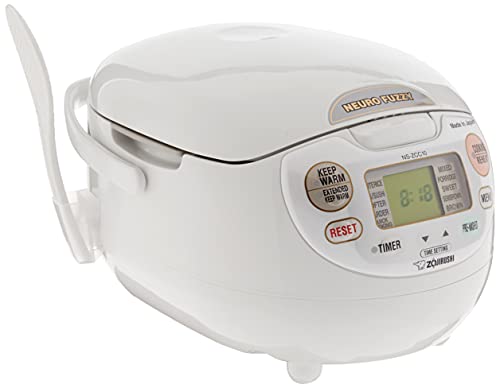
Zojirushi NS-ZCC10 Neuro Fuzzy Rice Cooker
Badge: Best Premium
Strengths
- Neuro Fuzzy logic is designed to fine-tune the cook rather than run one fixed cycle
- Japanese specialist brand with a long rice-cooker focus behind the design
- Delay timer and automatic keep-warm suit set-and-forget weekday routines
Trade-offs
- Premium-tier positioning compared with the basic cookers in this pool
- The listing title does not state capacity, so size must be checked carefully before buying
- Buyers who only cook plain long-grain rice may never use its refinement
Key specs (from the verified listing)
- Brand / origin: Zojirushi, the Japanese rice-cooker specialist brand in this pool
- Controls (per listing title): Neuro Fuzzy logic
- Features (per listing title): automatic keep-warm, delay timer
- Format: rice cooker and warmer, white
- Note: the listing title does not state a cup capacity — confirm the exact size variant on the listing before ordering
The NS-ZCC10 is the connoisseur pick in this pool: Zojirushi’s Neuro Fuzzy cooker and warmer in white, with automatic keep-warm and a delay timer. Zojirushi is the Japanese specialist brand here, and the Neuro Fuzzy name describes a control system built to make small, continuous adjustments during the cook instead of following one rigid curve. That refinement shows up most with demanding grains, where a few minutes of soak behaviour and a gentler finish separate separate, glossy grains from a sticky slab. The delay timer supports the way these cookers are actually used in Japanese-style routines: rice measured in the morning, ready at dinner, then held on automatic keep-warm without constant attention. Two honest cautions belong in any recommendation. First, this is premium-tier equipment, and a household that cooks plain rice twice a month will not feel the difference it pays for. Second, the listing title does not state the cup capacity, so confirm the exact size variant on the listing itself before ordering. For daily rice cooks who notice texture, it is the benchmark the rest of this list is measured against.
The Neuro Fuzzy Zojirushi is the premium entry, and the roundup obligation is to say exactly when the premium is real. It is real when rice is cooked daily, when the grains are demanding, and when the cook notices the difference between good rice and the glossy, evenly finished batch this machine’s managed cooking produces. It is not real for occasional rice or for households that drown rice in sauce anyway. The listing title does not state capacity, so check the variant on the listing. Buy it as a daily instrument, not as a trophy, and it earns its badge.
Best for: daily rice cooks who value texture refinement and a Japanese specialist design / Not suited for: occasional rice cooks who will not feel the premium difference

Zojirushi NS-TSC10 Micom Rice Cooker 5.5 Cup
Badge: Best with a Display
Strengths
- 5.5-cup size is the classic household capacity in Japanese-style cooker design
- Micom control with an LCD makes settings and timing easy to confirm at a glance
- Delay timer supports morning-setup, evening-ready rice routines
Trade-offs
- Premium-tier positioning next to the basic lever cookers in this pool
- 5.5 cups will be small for very large families cooking in one batch
- Refined controls are wasted on buyers who want a single lever and nothing else
Key specs (from the verified listing)
- Capacity (per listing title): 5.5 cup, 1.0 L
- Controls (per listing title): Micom (microcomputer) controls with LCD
- Feature (per listing title): delay timer
- Format: rice cooker and warmer
The NS-TSC10 pairs Zojirushi’s Micom — microcomputer — control with LCD controls and a delay timer in a 5.5-cup, 1.0-litre cooker and warmer. That capacity is worth pausing on: 5.5 cups uncooked is the long-standing standard household size in Japanese cooker design, large enough for a family dinner and small enough that a half batch still cooks at a sensible depth. The LCD matters in daily use more than spec sheets suggest, because you can confirm the setting and the timer at a glance instead of guessing from a lever position. Micom control gives the cook a managed curve rather than a simple on-off boil, which is the difference buyers are paying for with this brand. As with its Neuro Fuzzy sibling, the honest framing is value through repetition: cooked daily, the consistency compounds; cooked rarely, a basic cooker in this guide does the job for less commitment. Check the listing for the current variant details, measure your usual batch against the 5.5-cup ceiling, and this becomes an easy cooker to recommend to texture-focused households.
The NS-TSC10 is the premium pick for buyers who want the specialist argument with the paperwork in order: a stated 5.5-cup, 1.0-litre capacity, Micom control, an LCD to confirm settings, and a delay timer for the load-it-and-leave routine. In roundup terms it is the connoisseur’s sensible choice — the Japanese specialist approach in the classic household size, without asking you to guess a variant. If you have read the Neuro Fuzzy review and thought ‘yes, but which size is it’, this is your model, and the display alone will please anyone who has ever squinted at a lever wondering what they set.
Best for: households wanting Japanese Micom control in the classic 5.5-cup size / Not suited for: very large families or lever-only simplicity seekers
Comparison Table
| Pick | Brand | Capacity (per listing title) | Standout point | Amazon |
|---|---|---|---|---|
| AROMA Digital Rice Cooker ARC-914SBD | AROMA | 4-cup uncooked / 8-cup cooked, 2 Qt | Mid-size 4-cup uncooked capacity suits most households without taking over the counter | Check on Amazon |
| Cosori Rice Cooker 10 Cup with Fuzzy Logic | Cosori | 10 cup, 20 cup cooked | Fuzzy logic adjusts the cook as it goes, which helps with grains that punish small timing errors | Check on Amazon |
| BLACK+DECKER Rice Cooker 6-Cup (Cooked) | BLACK+DECKER | 6-cup (cooked) | Simple format that a first-time rice-cooker owner can use without reading a program chart | Check on Amazon |
| AROMA Rice Cooker ARC-363NG 3-Cup | AROMA | 3-cup uncooked / 6-cup cooked, 1.5 Qt | Genuinely small 3-cup uncooked capacity built for modest batches | Check on Amazon |
| Zojirushi NS-ZCC10 Neuro Fuzzy Rice Cooker | Zojirushi | Zojirushi, the Japanese rice-cooker specialist brand in this pool | Neuro Fuzzy logic is designed to fine-tune the cook rather than run one fixed cycle | Check on Amazon |
| Zojirushi NS-TSC10 Micom Rice Cooker 5.5 Cup | Zojirushi | 5.5 cup, 1.0 L | 5.5-cup size is the classic household capacity in Japanese-style cooker design | Check on Amazon |
Read the table by role, not by row order: the right machine for best rice cookers heavy com is the one whose capacity, controls and standout point match the work described in the reviews above.
How to Choose Among the best rice cookers heavy com Shortlist
Roundup discipline starts with ignoring the two numbers marketing shouts loudest: program count and headline capacity. Program count tells you how many labels fit on a panel, not how well the machine cooks; a fuzzy-logic cooker with a handful of honest settings will out-cook a basic machine wearing twenty badges. Headline capacity, meanwhile, mixes cooked and uncooked cups so freely across brands that an uninformed comparison is meaningless. Convert every claim to uncooked cups — cooked volume is roughly double — and compare control types, not label counts.
Size is the second discipline, and the roundup version is blunt: buy for your usual batch. The usual batch for most households is two to four cups uncooked, which is why the mid-size and 5.5-cup machines anchor this list and why the 10-cup Cosori, for all its technology, is a specialist purchase. A cooker run mostly at a quarter of its capacity cooks worse than a modest cooker run at its design point, because grain beds need depth. Be as honest about your batch as this guide tries to be about the machines.
Control is the third. The ladder in this pool is clear: one-touch basic, digital programs, Micom with a display, fuzzy logic that adjusts mid-cook, and Neuro Fuzzy at the top. Each rung forgives more and costs more commitment. The right rung is the one matched to your measuring habits and your grain ambitions — daily demanding grains justify the top; weekly plain rice does not. Roundup readers who want the origin story behind the top rungs should continue to Best Rice Cookers Japanese Rice for the Japanese table-rice context.
Extras are the last discipline, ranked last on purpose. Steamer baskets, slow-cook roles and sauté functions are worth having when counter space forces consolidation, and several picks here offer them per their listing titles. They never improve the rice itself. Let them break ties between machines that already fit your batch and your control needs, and be suspicious of any roundup — including ones in this style — that leads with a feature list instead of a batch size.
Finally, use listings like a roundup editor: check the latest price on Amazon at the moment of buying, confirm the exact model code against the review, and read current owner feedback for the specific failure modes the review flagged. Editorial shortlists age; a guide that tells you how it ranked is more durable than one that only tells you what it ranked, which is why this one shows its working throughout.
How to Get a Good Batch From Any Cooker in This Roundup
Roundups rank machines, but batches are made by routines. This is the shared routine that lets every pick here perform at its best.
- Measure rice and water with the cup supplied with your cooker, and use it consistently; most ‘bad batches’ are measuring drift, not machine failure.
- Rinse the grains until the water runs mostly clear for table rice, and always for starchy short grain styles.
- Match the batch to the bowl: if the grains do not form a bed with real depth, cook more, cook in a smaller machine, or accept an uneven result knowingly.
- Soak demanding grains briefly in their cooking water before starting, or use a delay timer to hold the soak for you.
- Keep the lid closed for the whole cook. Every peek is steam the top layer needed.
- Rest the finished rice, covered, for about ten minutes, then fluff once with a paddle in slicing motions.
- Serve, then hold on keep warm only for the meal. Rice for later is better refrigerated and reheated with a sprinkle of water under a cover.
- Wipe the pot, lid and steam vent after use; a clean cooker cooks more predictably than a seasoned-with-starch one.
Troubleshooting
Problem: results vary wildly between batches in the same cooker: Measuring drift. Standardise the cup, the rinse and the water level for three cooks before changing anything else; consistency is diagnostic information.
Problem: the premium cooker does not seem better than the old basic one: The difference shows in demanding grains, daily repetition and the finish of the batch, not in a single pot of plain rice. Cook a short grain or a timed, soaked batch and compare honestly before concluding.
Problem: rice sticks and scorches in a new machine: Check batch depth and pot seating first, then water level. A correctly seated, sound pot at the right batch size should not scorch on a standard cycle.
How to Read Any Rice Cooker Roundup, Including This One
A trustworthy roundup has three tells. It states its method, as this guide does in How These Picks Were Chosen. It keeps its badges consistent from the summary table into the detailed reviews, so a ‘best budget’ pick does not quietly become a premium pick by page three. And it names limitations in the same tone as strengths — a review with no trade-off section is an advertisement wearing a guide’s clothes. Judge every list you read, on any site, by those three tests before you judge its picks.
The fourth tell is what the roundup does with mismatches. Lists built carelessly will happily rank a family cooker for a solo brief or a basic machine for a specialist job, because the list needed six entries. This guide’s wider programme handles that by reviewing ill-fitting picks as prose-only references or skipping mismatched keywords outright, and the same scepticism should be applied to any ranking that seems to have a product for every conceivable search. Fit is the ranking; everything else is commentary.
The Heavy-Style Verdict Format: Winner, Runner-Up, and Who Should Skip Both
Heavy-style coverage popularised a verdict shape worth keeping: name the winner, name the runner-up, and name who should skip both. Applied here: the winner for most households is the AROMA Digital ARC-914SBD, the runner-up is the Zojirushi NS-TSC10 for texture-led buyers, and the households who should skip both are solo cooks — who should buy the Dash-scale or 3-cup compact class instead — and crowd cooks, who should be reading a large-capacity shortlist. A verdict that cannot tell a reader to buy neither of its top picks is not a verdict.
That shape also disciplines the writer. Every claim in the winner’s review has to survive the runner-up’s existence, which is why the AROMA’s case is built on fit and versatility rather than superlatives, and why the Zojirushi’s case is built on a specific, repeatable difference rather than brand aura. Readers who prefer their verdicts retailer-first can compare the framing at Best Rice Cookers Kohls — the picks overlap, the reasoning route differs, and seeing both is a decent education in how buying guides work.
What Roundups Cannot Tell You (and What to Check Yourself)
No roundup can tell you how a cooker sounds on your counter at midnight, whether its lid drips onto your worktop, or whether its keep warm suits your family’s staggered dinners. Those are ownership details, and the honest way to source them is current owner feedback on the listing for the exact model, read for patterns rather than for individual rants. This guide’s job is the shortlist and the reasoning; the listing check — latest price, exact variant, recent owner patterns — is the reader’s final step, and skipping it is how good shortlists produce bad purchases.
Equally, no roundup should invent what it cannot verify. The reviews here credit no machine with a setting, dimension or capacity its verified listing title does not state, and they flag the one case — the Neuro Fuzzy model — where the title omits capacity. That restraint is deliberate. A guide that guesses specs to look complete will eventually guess one that matters, at the reader’s expense.
The One-Paragraph Version: If You Only Read the Verdicts
Roundup readers are busy, so here is the whole guide compressed honestly. Buy the AROMA Digital ARC-914SBD if you want the default answer. Buy a Zojirushi — the defined NS-TSC10 or the flagship Neuro Fuzzy NS-ZCC10 — if you cook rice daily and judge it closely. Buy the Cosori if your household is large and your counter can host a 10-cup fuzzy-logic multicooker. Buy the compact AROMA or the simple BLACK+DECKER if your batches are small and your measuring is careful. Buy nothing on this list if your batch size matches none of them, and go and find the list written for your batch instead.
That compression loses the reasoning, which is why the full reviews exist — but it loses nothing dishonest, because every sentence in it can be traced to a review above with its trade-offs attached. That traceability is the difference between a roundup and a ranking-shaped advertisement, and it is the standard this guide set itself in its method section. If another list, on any site, cannot survive being compressed this way without its claims wobbling, you have learned something important about the list — and you did not even have to buy a cooker to learn it.
Scores Versus Reasons: Why This Roundup Prints No Numbers
Heavy-style roundups often attach a score to every pick, and readers reasonably ask why this one refuses. The answer is that a single number cannot carry the information this category runs on. A cooker that is perfect for a daily short grain ritual and wrong for a monthly crowd batch does not have a score; it has two different verdicts for two different kitchens, and printing one figure would flatten both into a false precision. Badges plus stated trade-offs carry the real information — who the machine serves, what it does well, and where it will disappoint — in a form a reader can actually act on. If a number would help you decide, let it be your own: count your weekly batches, your usual cups, and the cooks in your household. Those three numbers, honestly counted, will rank this list for you better than any score printed beside it.
Common Buying Mistakes
- Ranking program counts instead of control types when comparing cookers.
- Comparing a cooked-cup capacity from one brand with an uncooked-cup capacity from another.
- Buying the roundup winner without checking it against your usual batch size.
- Treating a premium badge as a universal verdict rather than a daily-use justification.
- Skipping the listing check — exact model, current variant, latest price — because the guide felt thorough.
- Expecting any cooker to compensate for unrinsed, unmeasured, unrested rice.
Final Recommendation
The roundup verdict, in the format this style of guide owes you: start with the AROMA Digital ARC-914SBD, the best overall pick for the widest range of households, and compare it against the Zojirushi NS-TSC10 before deciding — between them they cover the two honest reasons to buy a rice cooker, versatile daily competence and specialist texture control.
Start your shortlist with the AROMA Digital Rice Cooker ARC-914SBD, and compare it against the Cosori Rice Cooker 10 Cup with Fuzzy Logic before deciding — between them they cover the two most common use patterns in this guide.
Skip both, deliberately, if you cook for one — take the compact AROMA or the personal-mini class — or if you cook for a crowd, where the 10-cup Cosori and its fuzzy-logic control become the serious option. The BLACK+DECKER remains the honest basic for careful measurers. That is the whole list, ranked with its reasoning showing, which is all a roundup should ever promise.
Frequently Asked Questions
What does ‘heavy com’ mean in this search?
It points to Heavy.com-style buying coverage: direct, roundup-format guides that rank products with clear winners and plain trade-offs. This article follows that format — shortlist first, reasoning shown, limitations stated — while keeping this site’s rule that every claim traces to the verified listing information for each model.
Which rice cooker would a roundup pick for most people?
The mid-size digital: in this shortlist, the AROMA ARC-914SBD, with 4-cup uncooked capacity, digital control and steamer and multicooker roles. Most households cook mid-size batches of ordinary rice most of the time, and that machine fits the pattern with the fewest compromises. Texture-led daily cooks are the exception, and their pick is the Zojirushi class.
Are expensive rice cookers actually better, or is it marketing?
Both things exist. Fuzzy-logic and Micom control produce measurably more consistent results with demanding grains and repeated daily cooking — that part is real. Program-count inflation and badge engineering are marketing. The dividing question is how often you cook and what grains you cook; the premium in this list is justified by daily, texture-sensitive use and by nothing else.
Why do roundups disagree with each other about the best rice cooker?
Because they weight differently and rarely say so. A list weighted by price crowns a basic cooker; a list weighted by texture crowns a Zojirushi; a list weighted by features crowns the Cosori. This guide states its weighting — versatility and fit first, control second, extras third — so you can re-rank the same six machines for your own priorities instead of treating any ranking as a fact.
How do I compare capacities when brands measure differently?
Convert everything to uncooked cups. Cooked volume is roughly twice the uncooked volume, so a 6-cup cooked compact and a 5.5-cup uncooked Micom machine are not the near-match their numbers suggest — the Micom machine is far larger. The spec boxes in this guide quote each listing title exactly, which makes the conversion possible from the page.
Should I trust a roundup or individual owner reviews more?
Use them for different jobs. A roundup with a stated method is better at structuring the decision — sizes, control types, trade-offs. Current owner feedback on the exact listing is better at surfacing ownership patterns: lid drips, keep-warm behaviour, pot durability. Shortlist with the guide, verify with the listing, and be wary of either source that claims to do both jobs perfectly.


