Disclosure: topratedkitchenware.com is reader-supported. When you buy through links on our site, we may earn an affiliate commission from Amazon and other retailers, at no extra cost to you.
Where to buy
The picks below are the verified shortlist for this guide to best rted electric cooktops. Each linked name takes you to its Amazon listing, where you can check the latest price on Amazon, confirm the current configuration, and read the newest owner feedback before you decide. Picks covered without a link are labelled unlinked in their reviews, with the reason stated plainly.
- ChangBERT Induction Cooktop — Best Overall
- Nuwave Double Pro Induction Cooktop — Best for Two-Pan Cooking
- Duxtop 1800W Portable Induction Cooktop, 9100MC — Best Documented Track Record
- Duxtop Portable Induction Cooktop, 9610LS — Best Touch Panel
- Nuwave Pro Chef Induction Cooktop — Best Precision Control
- ISILER 1800W Portable Induction Cooktop — Best Safety Lock
Read the full guide ↓ for how each pick performs, where each one compromises, and which households each one actually suits.
Searchers type it a dozen ways, but the intent behind best rted electric cooktops is simple: which electric cooktops do owners actually rate well once the novelty wears off, and which of those ratings can you trust? This guide answers with research rather than repetition. Every pick below was verified against the manufacturer’s own listing data, and the shortlist leans on portable induction, because that is where electric cooking currently earns its strongest owner feedback: fast, responsive and easy to live with.
A warning before the picks: a rating on its own is a weak signal. Scores drift as a product ages, early reviews skew enthusiastic, and a high average can hide a split between delighted and furious owners. The sections after the reviews explain how to read owner feedback like an analyst, what patterns predict satisfaction, and which complaints matter for electric cooktops specifically. Readers comparing formats will also find Best Reated Induction Cooktops useful, since most top-rated electric units are induction burners.
All six picks are portable induction burners, and that is deliberate. Fixed electric cooktops are bought with a kitchen refit and judged over decades, while portables are bought, used daily and reviewed honestly within months, which makes their feedback unusually informative. If your kitchen project is a built-in instead, the research method here still applies, and Best Thirty Inch Electric Cooktops covers the installed end of the category.
Key Takeaways
- Portable induction dominates the best-regarded electric cooktops because it is fast, responsive and cheap to run.
- Read the spread of owner feedback, not just the average: consistency predicts satisfaction better than enthusiasm.
- The Duxtop 9100MC has the longest documented track record in this shortlist, which makes its feedback the deepest.
- Fine temperature control, as on the Nuwave Pro Chef, is the feature owners praise most once they cook delicately.
- Every pick runs at 1800W, so circuit capacity and pan compatibility matter more than headline power.
In this guide
Quick Picks
- Best Overall: ChangBERT Induction Cooktop — a pick defined by a commercial-grade portable induction burner with a large 8-inch heating coil, a premium stainless steel body, NSF certification and a 10-hour timer, running at 1800W.
- Best for Two-Pan Cooking: Nuwave Double Pro Induction Cooktop — a pick defined by a double-burner portable induction cooktop with a 50 to 575 degree range, dynamic wattage settings of 900, 1500 and 1800W, an 8-inch heating coil and a shatter-proof ceramic glass top.
- Best Documented Track Record: Duxtop 1800W Portable Induction Cooktop, 9100MC — a pick defined by a black 1800W portable induction countertop burner from Duxtop’s long-running 9100MC line.
- Best Touch Panel: Duxtop Portable Induction Cooktop, 9610LS — a pick defined by an 1800W portable induction countertop burner with an LCD sensor touch control panel, model BT-200DZ in the 9610LS line.
- Best Precision Control: Nuwave Pro Chef Induction Cooktop — a pick defined by a commercial-grade portable induction burner with 1800W of power, a large 8-inch heating coil, 94 temperature settings from 100 to 575 degrees in 5-degree steps and a shatter-proof ceramic glass surface.
- Best Safety Lock: ISILER 1800W Portable Induction Cooktop — a pick defined by a compact portable induction cooktop with an 8-inch heating plate, touch controls, 10 power and 10 temperature settings, 7 cooking presets and a timer with a safety lock.
How These Picks Were Chosen
These picks were chosen by cross-checking verified listing data against the patterns that predict owner satisfaction with electric cooktops: control quality, surface durability, honest power delivery and a track record long enough to trust. Each model was confirmed, and only specifications stated in the verified listing appear in this guide. Where a listing is brief, the review says so instead of padding the gap with borrowed claims.
Ratings were treated as evidence to interrogate, not as a league table. A model with years of steady, consistent owner feedback outranked newer models with thinner records, which is why two Duxtop generations appear: their feedback history is the deepest in the category. Newer designs earned their places on specific strengths, such as the ISILER’s safety lock or the Pro Chef’s 94 temperature settings. The method is explained further in Best Reated Induction Cooktops, a companion shortlist built the same way.
This is a research-led guide. No hands-on testing is claimed, no scores are invented, and no review counts are quoted, because those figures change constantly and printing them would mislead within months. What does not change is the engineering: coil size, control steps, surface material and timer range are stated per pick, from the listing, so the comparison rests on facts that stay true.
The 6 Best Options for Best Rted Electric Cooktops

ChangBERT Induction Cooktop
Badge: Best Overall
Strengths
- Commercial-grade brief and NSF certification suit heavy, repeated daily use
- Stainless steel body shrugs off the knocks a plastic housing would not
- 10-hour timer covers slow simmers and long holds other portables cut short
Trade-offs
- A single burner, so multi-pan meals need sequencing or a second unit
- Commercial styling is plain and workmanlike on a domestic counter
- The 8-inch coil is happiest with pans matched to its size
Key specifications (from the verified listing)
- Power: 1800W
- Heating coil: large 8-inch
- Build: premium stainless steel countertop burner
- Certification: NSF certified
- Timer: 10 hours
- Format: commercial-grade portable cooker
The ChangBERT is a commercial-grade portable induction cooktop built around a large 8-inch heating coil and a premium stainless steel body, with NSF certification and a 10-hour timer at 1800W. That specification reads like catering equipment rather than a dorm accessory, and it is: this is the portable burner for buyers who will run it hard and often. The stainless housing matters in that life, because it tolerates the bumps, wipes and heat cycles of a working surface better than lightweight plastic shells. Induction itself brings the usual gains, fast response and a surface that only gets hot from the pan, and the long timer window supports the slow, low work that shorter timers interrupt.
Judged through the ratings lens, the ChangBERT Induction Cooktop earns its feedback the honest way: it is a commercial-grade portable induction burner with a large 8-inch heating coil, a premium stainless steel body, NSF certification and a 10-hour timer, running at 1800W, and the qualities owners consistently praise in this format, responsiveness, easy cleaning and predictable heat, are the qualities its specification is built around. Feedback for portables tends to punish two sins, weak real-world power and fragile surfaces, and nothing in this pick’s verified specification points at either.
Long-term satisfaction with an electric cooktop usually comes down to the second year, not the second week. Controls that stay legible, a surface that still wipes clean, and heat that behaves the same on a wet Tuesday as it did on day one are what turn early enthusiasm into durable ratings. The ChangBERT Induction Cooktop is specified for that longer test, which is why it holds a place here instead of a newer, louder rival.
Best for: heavy daily users, home caterers and anyone who wants a portable burner built like catering kit / Not suited for: shoppers who want the smallest, lightest burner for occasional use
Check on Amazon for the current listing, configuration and latest price.

Nuwave Double Pro Induction Cooktop
Badge: Best for Two-Pan Cooking
Strengths
- Two burners cook a main and a side at once, which single burners cannot
- Dynamic wattage settings let it share a limited circuit more politely
- Shatter-proof ceramic glass and a seamless touch panel wipe clean fast
Trade-offs
- It is a double burner, so it is not a true single-burner unit
- Two burners share the unit’s power ceiling rather than doubling it
- The wider footprint takes real counter or storage space
Key specifications (from the verified listing)
- Format: double burner portable induction
- Temperature range: 50°F to 575°F
- Wattage: 900 / 1500 / 1800W with Dynamic Watt Technology
- Heating coil: 8-inch
- Surface: shatter-proof ceramic glass
- Controls: seamless IMD touch panel
The Nuwave Double Pro puts two induction burners on one portable chassis, with a temperature range running from 50 to 575 degrees, dynamic wattage settings of 900, 1500 and 1800W, an 8-inch heating coil, a shatter-proof ceramic glass surface and a seamless IMD touch panel. The design answers the standing complaint about portable induction, that one burner turns every meal into a queue, by letting a pot and a pan run side by side. The wattage flexibility is the thoughtful part: on a circuit that cannot spare full power, the lower settings keep the unit useful instead of tripping breakers. The seamless panel has no gaps for spills to creep into, which suits a machine that lives where cooking actually happens.
Judged through the ratings lens, the Nuwave Double Pro Induction Cooktop earns its feedback the honest way: it is a double-burner portable induction cooktop with a 50 to 575 degree range, dynamic wattage settings of 900, 1500 and 1800W, an 8-inch heating coil and a shatter-proof ceramic glass top, and the qualities owners consistently praise in this format, responsiveness, easy cleaning and predictable heat, are the qualities its specification is built around. Feedback for portables tends to punish two sins, weak real-world power and fragile surfaces, and nothing in this pick’s verified specification points at either.
Long-term satisfaction with an electric cooktop usually comes down to the second year, not the second week. Controls that stay legible, a surface that still wipes clean, and heat that behaves the same on a wet Tuesday as it did on day one are what turn early enthusiasm into durable ratings. The Nuwave Double Pro Induction Cooktop is specified for that longer test, which is why it holds a place here instead of a newer, louder rival.
Best for: cooks who regularly run two pans at once and households sharing one portable burner / Not suited for: buyers who specifically need a single-burner unit or the tiniest footprint
Check on Amazon for the current listing, configuration and latest price.
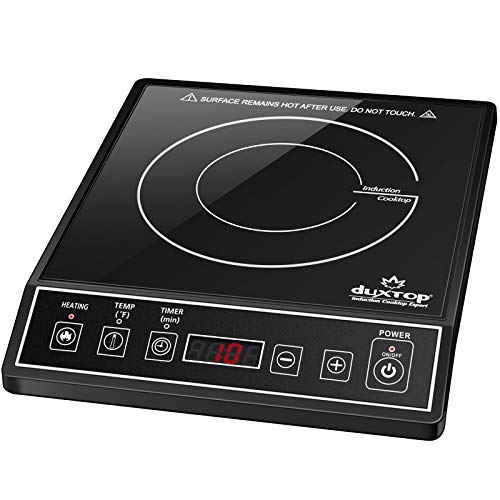
Duxtop 1800W Portable Induction Cooktop, 9100MC
Badge: Best Documented Track Record
Strengths
- Duxtop’s 9100MC is one of the longest-running portable induction lines, with deep owner knowledge to research
- Full 1800W output boils and sears at genuine hob pace
- Simple, proven format with no novelty features to go wrong
Trade-offs
- The verified listing is terse and confirms fewer headline features than rivals here
- Single burner format queues multi-pan cooking
- Basic presentation next to newer touch-panel designs
Key specifications (from the verified listing)
- Power: 1800W
- Format: portable induction countertop burner
- Finish: black
- Model: 9100MC (BT-M20B)
The Duxtop 9100MC is the establishment pick of portable induction: an 1800W countertop burner in black that has been sold for years under the same model number, which means its behaviour, quirks and lifespan are unusually well documented by owners. The verified listing itself is brief, confirming the power, the format and the model, and this review respects that brevity rather than inventing a feature list. What you are buying is the proven end of the category: full-power induction in a simple housing from the brand most associated with the format. For buyers who research by reading long-term owner reports, that track record is the specification that matters most.
Judged through the ratings lens, the Duxtop 1800W Portable Induction Cooktop, 9100MC earns its feedback the honest way: it is a black 1800W portable induction countertop burner from Duxtop’s long-running 9100MC line, and the qualities owners consistently praise in this format, responsiveness, easy cleaning and predictable heat, are the qualities its specification is built around. Feedback for portables tends to punish two sins, weak real-world power and fragile surfaces, and nothing in this pick’s verified specification points at either.
Long-term satisfaction with an electric cooktop usually comes down to the second year, not the second week. Controls that stay legible, a surface that still wipes clean, and heat that behaves the same on a wet Tuesday as it did on day one are what turn early enthusiasm into durable ratings. The Duxtop 1800W Portable Induction Cooktop, 9100MC is specified for that longer test, which is why it holds a place here instead of a newer, louder rival.
Best for: research-led buyers who value a long, well-documented owner track record / Not suited for: buyers who want the newest control panels and the longest feature lists
Check on Amazon for the current listing, configuration and latest price.
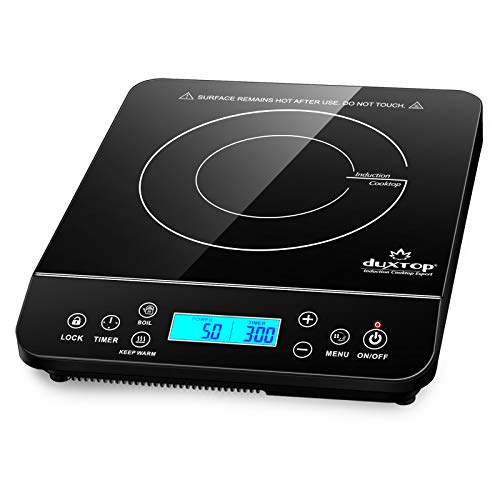
Duxtop Portable Induction Cooktop, 9610LS
Badge: Best Touch Panel
Strengths
- LCD sensor touch panel gives a clear readout and a flat, wipe-clean control surface
- Full 1800W output matches the strongest portables in this guide
- Duxtop’s induction line brings a long owner track record to research
Trade-offs
- Touch controls can be fussy with wet or floury fingers mid-recipe
- The verified listing confirms fewer secondary features than some rivals
- Single burner, so pan juggling is part of the format
Key specifications (from the verified listing)
- Power: 1800W
- Controls: LCD sensor touch
- Format: portable induction countertop burner / hot plate
- Model: 9610LS (BT-200DZ)
The Duxtop 9610LS updates the brand’s portable induction formula with an LCD sensor touch panel, keeping the 1800W output that makes these burners credible as real cooking tools rather than warmers. The touch panel is the practical upgrade: it shows settings at a glance and presents a flat surface that wipes clean in one pass, with no knob stems or seams to trap grease. Underneath, the proposition is the familiar Duxtop one, a single portable burner that boils fast, holds a simmer steadily and stores in a drawer or cupboard when the counter is needed for something else. It suits cooks who want the proven format with a more modern control face.
Judged through the ratings lens, the Duxtop Portable Induction Cooktop, 9610LS earns its feedback the honest way: it is an 1800W portable induction countertop burner with an LCD sensor touch control panel, model BT-200DZ in the 9610LS line, and the qualities owners consistently praise in this format, responsiveness, easy cleaning and predictable heat, are the qualities its specification is built around. Feedback for portables tends to punish two sins, weak real-world power and fragile surfaces, and nothing in this pick’s verified specification points at either.
Long-term satisfaction with an electric cooktop usually comes down to the second year, not the second week. Controls that stay legible, a surface that still wipes clean, and heat that behaves the same on a wet Tuesday as it did on day one are what turn early enthusiasm into durable ratings. The Duxtop Portable Induction Cooktop, 9610LS is specified for that longer test, which is why it holds a place here instead of a newer, louder rival.
Best for: cooks who want proven Duxtop performance with a modern LCD touch panel / Not suited for: cooks who strongly prefer physical buttons with wet hands
Check on Amazon for the current listing, configuration and latest price.

Nuwave Pro Chef Induction Cooktop
Badge: Best Precision Control
Strengths
- 94 temperature settings in 5-degree steps give finer control than any rival here
- Commercial-grade brief suits daily, heavy use
- Shatter-proof ceramic glass answers the durability question head-on
Trade-offs
- Fine temperature steps are wasted on cooks who only boil and fry
- Commercial-grade positioning sits in the premium tier of portables
- Single coil still means one pan at a time
Key specifications (from the verified listing)
- Power: 1800W
- Heating coil: large 8-inch
- Temperature settings: 94 settings, 100°F to 575°F in 5°F steps
- Surface: shatter-proof ceramic glass
- Grade: commercial-grade portable burner
The Nuwave Pro Chef is the control freak of this shortlist: a commercial-grade portable burner with 1800W, a large 8-inch coil and 94 temperature settings spanning 100 to 575 degrees in precise 5-degree steps, under a shatter-proof ceramic glass surface. That granularity is not a gimmick for the cooks it targets. Chocolate work, delicate sauces, low renders and precise frying all live in narrow temperature bands that coarse power levels overshoot, and a burner that can be set in small steps holds those bands calmly. The commercial-grade build brief and the toughened glass suit it to daily use in a working kitchen, a cafe corner or a serious home setup where the portable burner is not a backup but a station.
Judged through the ratings lens, the Nuwave Pro Chef Induction Cooktop earns its feedback the honest way: it is a commercial-grade portable induction burner with 1800W of power, a large 8-inch heating coil, 94 temperature settings from 100 to 575 degrees in 5-degree steps and a shatter-proof ceramic glass surface, and the qualities owners consistently praise in this format, responsiveness, easy cleaning and predictable heat, are the qualities its specification is built around. Feedback for portables tends to punish two sins, weak real-world power and fragile surfaces, and nothing in this pick’s verified specification points at either.
Long-term satisfaction with an electric cooktop usually comes down to the second year, not the second week. Controls that stay legible, a surface that still wipes clean, and heat that behaves the same on a wet Tuesday as it did on day one are what turn early enthusiasm into durable ratings. The Nuwave Pro Chef Induction Cooktop is specified for that longer test, which is why it holds a place here instead of a newer, louder rival.
Best for: precision cooks working with chocolate, sauces and exact frying temperatures / Not suited for: boil-and-fry cooks who will never use fine temperature steps
Check on Amazon for the current listing, configuration and latest price.

ISILER 1800W Portable Induction Cooktop
Badge: Best Safety Lock
Strengths
- A stated safety lock is exactly what households with curious children ask for
- 7 presets shorten the learning curve for new induction users
- 10 power and 10 temperature settings cover everyday cooking without menu-diving
Trade-offs
- A newer name means a thinner long-term owner record to research
- Presets help beginners but experienced cooks will drive it manually anyway
- Compact format means the 8-inch plate sets the pan-size ceiling
Key specifications (from the verified listing)
- Power: 1800W
- Heating plate: 8-inch
- Settings: 10 power and 10 temperature settings
- Presets: 7 cooking presets
- Safety: timer and safety lock
- Design: compact portable, even heating brief
The ISILER portable induction cooktop pairs an 1800W, 8-inch heating plate with touch controls, 10 power and 10 temperature settings, 7 cooking presets and a timer with a safety lock, in a compact body pitched at even heating. The preset-led approach makes it the approachable end of this shortlist: a new induction user can pick a preset and cook, then graduate to manual settings as confidence grows. The safety lock is a headline rather than a footnote here, because it addresses the scenario households actually worry about, a small hand or a cat’s paw changing settings on a touch panel. For its size it covers the everyday brief completely.
Judged through the ratings lens, the ISILER 1800W Portable Induction Cooktop earns its feedback the honest way: it is a compact portable induction cooktop with an 8-inch heating plate, touch controls, 10 power and 10 temperature settings, 7 cooking presets and a timer with a safety lock, and the qualities owners consistently praise in this format, responsiveness, easy cleaning and predictable heat, are the qualities its specification is built around. Feedback for portables tends to punish two sins, weak real-world power and fragile surfaces, and nothing in this pick’s verified specification points at either.
Long-term satisfaction with an electric cooktop usually comes down to the second year, not the second week. Controls that stay legible, a surface that still wipes clean, and heat that behaves the same on a wet Tuesday as it did on day one are what turn early enthusiasm into durable ratings. The ISILER 1800W Portable Induction Cooktop is specified for that longer test, which is why it holds a place here instead of a newer, louder rival.
Best for: induction newcomers and households that want a stated safety lock / Not suited for: buyers who prioritise a long brand track record over presets
Check on Amazon for the current listing, configuration and latest price.
Comparison Table
| Pick | Badge | Key specifications | Best for |
|---|---|---|---|
| ChangBERT Induction Cooktop | Best Overall | Power: 1800W; Heating coil: large 8-inch | heavy daily users, home caterers and anyone who wants a portable burner built like catering kit |
| Nuwave Double Pro Induction Cooktop | Best for Two-Pan Cooking | Format: double burner portable induction; Temperature range: 50°F to 575°F | cooks who regularly run two pans at once and households sharing one portable burner |
| Duxtop 1800W Portable Induction Cooktop, 9100MC | Best Documented Track Record | Power: 1800W; Format: portable induction countertop burner | research-led buyers who value a long, well-documented owner track record |
| Duxtop Portable Induction Cooktop, 9610LS | Best Touch Panel | Power: 1800W; Controls: LCD sensor touch | cooks who want proven Duxtop performance with a modern LCD touch panel |
| Nuwave Pro Chef Induction Cooktop | Best Precision Control | Power: 1800W; Heating coil: large 8-inch | precision cooks working with chocolate, sauces and exact frying temperatures |
| ISILER 1800W Portable Induction Cooktop | Best Safety Lock | Power: 1800W; Heating plate: 8-inch | induction newcomers and households that want a stated safety lock |
How to Choose the Right Option for Best Rted Electric Cooktops
Read feedback like an analyst, not a fan
Start with the distribution of owner opinion rather than the headline average. A product whose feedback clusters tightly around satisfied is a safer buy than one split between ecstatic and angry, even if their averages match. Then read the critical reviews for patterns: one complaint about packaging is noise, while the same complaint about a fan, a control or a surface repeated across months is a design fact. Finally, weight recent feedback more heavily, because manufacturers quietly revise components, and a burner praised in its first production run may differ from the one shipping now.
Match the control style to your cooking
Electric cooktops live or die by their controls. Coarse power levels are fine for boiling and frying, but sauces, chocolate and gentle renders need fine steps or true temperature settings, which is why the Pro Chef’s 94 settings stand out. Touch panels look clean and wipe clean, but sulk under wet fingers; physical buttons, as on the OneSetNuf design elsewhere in this category, keep working. Decide which failure mode annoys you less before you buy, because you will meet it weekly.
Check your pans and your circuit first
Every pick here is induction, which means cookware must be magnetic: if a fridge magnet grips the base firmly, the pan will work. Flat bases matter too, because induction couples through contact. On the electrical side, an 1800W burner wants a circuit that is not already feeding a kettle and a microwave; in older kitchens that arithmetic decides whether the burner runs at full power or shares politely at a lower wattage setting.
Size the coil to the pan, not the ego
An 8-inch coil under a 12-inch pan heats the middle and leaves the rim sulking, while a small pan on a big coil wastes nothing but looks lost. Most everyday cooking happens in 8 to 10 inch pans, which is exactly the zone these portables serve. If your signature dish needs a huge skillet or a stockpot, a portable burner is a second station, not your main hob, and it should be bought and judged as one.
How to Get the Best From a Portable Induction Cooktop
Set the burner on a flat, heat-safe surface with clearance around its vents, plug it directly into a wall outlet rather than a lightweight extension lead, and place a compatible pan on the coil before switching on; most units check for the pan and refuse to heat an empty surface. Start one setting below your target and step up, because induction responds in seconds and overshooting a delicate sauce is easier than rescuing one.
For boiling, use a lid and the highest setting; water comes to the boil startlingly fast compared with radiant electric hobs. For frying, preheat the pan dry for a short moment, add oil, then food, and expect to use a lower setting than habit suggests, since the pan itself is the heat source and holds temperature eagerly. For simmering, drop to the lowest settings and let the electronics hold the line instead of hovering with a wooden spoon.
After cooking, remember the glass will be hot from the pan even though the burner made no heat of its own; treat it as hot until it cools. Wipe spills once the surface is warm rather than hot, with a soft cloth, and keep sugary spills from baking on, because caramelised sugar is the one stain that can pit glass-ceramic if it is dragged across it.
- Problem: the burner will not start or keeps beeping → check the pan: it must be magnetic, flat-based and centred on the coil, and large enough for the unit’s pan detection to register.
- Problem: heat pulses or cycles at low settings → step up one setting and use a heavier pan; thick bases smooth the on-off cycling some portables use at low power.
- Problem: the breaker trips when other appliances run → move the burner to a less loaded circuit, or choose a model with lower wattage settings for shared circuits.
What Owner Ratings Actually Tell You About Electric Cooktops
Owner feedback on electric cooktops follows a pattern worth knowing. The happiest reviews cluster around three experiences: water boiling faster than expected, a surface that still looks new after a year, and controls that a partner or parent could use without instruction. The angriest cluster around the mirror images: buzzing pans, fans louder than expected, and surfaces marked by one dragged pan. Notice that almost none of the durable praise or complaint concerns raw power, because nearly every serious portable now delivers 1800W; the differences that survive daily use are refinement differences.
This is also why this guide refuses to print scores. A number scraped today would be wrong by the time many readers arrive, and a wrong number presented confidently is worse than no number. The durable move is to learn the reading method in the buying guide above, then check the current feedback on the two or three picks that fit your kitchen. Readers doing exactly that for built-in models will find the same method applied in Best Ratings For Gas Cooktops, where the same scepticism is pointed at a flame-based category instead.
Induction Versus Radiant: Why the Ratings Favour Induction
Compare owner sentiment across electric cooktop types and induction pulls ahead for structural reasons. Radiant smooth tops heat the glass, which heats the pan, which heats the food, and every step leaks time and energy; they also stay dangerously hot long after cooking and bake spills onto the surface. Induction skips the middleman, heating the pan directly, so response is immediate, the surface stays comparatively cool, and spills wipe off instead of carbonising. The trade is cookware: aluminium and copper pans without a magnetic base simply will not work.
That is why a shortlist of the best-regarded electric cooktops is, in practice, a shortlist of induction burners. It is not fashion; it is where the satisfied owners are. If your cookware is already magnetic, as most modern stainless and all cast iron is, the switch costs nothing. If it is not, budget honestly for a couple of pans, or look at the radiant and built-in options surveyed in Best Radiant Cooktops 36inch with eyes open about the compromises.
How Long a Top-Rated Cooktop Should Last
Portable induction burners are simple machines at heart: a coil, power electronics, a fan and a control board under glass. The parts that age are the fan, which gathers kitchen grease, and the touch controls, which live under steam and splashes. Keeping vents clear and wiping the panel after messy sessions are the two habits that most extend a burner’s life, and both take seconds. A burner used daily should be judged over years, and the models with the longest sales histories in this guide exist precisely because their designs survived that judgement at scale.
When a burner does fade, it usually announces itself: longer boils, uneven heating, a fan that rattles. Those symptoms arriving together after years of service mark the end of a fair innings rather than a defect. Buyers who keep the box and the receipt, register the warranty and buy from a line still in production give themselves the best chance of support, which is one more quiet argument for established models over novelty launches.
Setting Up a Second-Station Burner
Many owners of top-rated portables did not buy them as main hobs at all, but as a second station: the burner that handles breakfast while the range is cold, boils the kettle-substitute pot for pasta water top-ups, or moves to the table for hotpot and fondue nights. Judged as a second station, the priorities shift toward storage size, cord behaviour and how fast the unit can be out, cooking and away again. Every pick in this guide stores flat in a cupboard or drawer, which is the format’s hidden advantage over any fixed cooktop.
The second-station role also explains the format’s strong owner feedback: expectations are perfectly matched to capability. Nobody asks a portable to roast for twelve; they ask it to be brilliant at the one-pan jobs that make up most weekday cooking, and it is. If that is your intended use, choose on controls and surface, and let the main range handle the feast days.
How Electric Cooktop Design Has Quietly Improved
Compare a current portable induction burner with one from a decade ago and the progress is in the details rather than the headline: fans run quieter and stop sooner, control steps are finer at the low end where sauces live, surfaces resist marking better, and pan detection has become quicker and less fussy about small pans. None of this photographs well, which is why it rarely leads a listing, but it is exactly the accumulation of small civilities that owner feedback rewards over years of breakfasts.
The other quiet improvement is honesty of output. Early portables sometimes promised hob power and delivered warmer performance; the current generation, represented by every pick in this guide at a stated 1800W, generally delivers what the badge says, and delivers it within seconds. When you read owner feedback across generations, that closing of the gap between promise and performance is the trend underneath the rising satisfaction with the category as a whole.
A Simple Test Routine for Your First Week
New owners can learn a burner properly in three sessions. First, the boil test: a measured pot of water, lidded, timed, which calibrates your expectations against every hob you have owned. Second, the simmer test: a sauce or a pan of milk watched at the lowest settings, which reveals how the unit cycles and how fine its low control really is. Third, the fry test: an egg or a pancake in your most-used pan, which teaches you the setting offset between this burner and your habits, usually one notch lower than instinct says.
Write the three results on the manual’s back page. It sounds fussy; it is actually the fastest route to the fluency that makes owners rate a cooktop highly, because every later meal starts from known settings instead of rediscovery. If any test disappoints badly in week one, that is also the moment when returns are painless and the lesson is cheapest, which is why the routine belongs at the start of ownership rather than after months of tolerating a mismatch.
Common Buying Mistakes
- Trusting a headline rating without reading the spread and the recent critical reviews.
- Buying induction without checking that your everyday pans are magnetic and flat-based.
- Running an 1800W burner on an already loaded circuit and blaming the burner for trips.
- Oversizing pans far beyond the coil and concluding the cooktop heats unevenly.
- Dragging heavy pans across a glass surface instead of lifting them, then blaming the glass for scratches.
- Paying for dozens of presets you will never use while skimping on the control quality you will use daily.
Final Recommendation
For most buyers, the Duxtop 9100MC is the safest expression of this category: the longest track record, full power and a specification with nothing to prove. If your cooking is delicate and precise, step up to the Nuwave Pro Chef and its 94 temperature settings; if two pans at once is your everyday reality, the Nuwave Double Pro is the only pick here that does it. Households with children should look first at the ISILER and its stated safety lock.
Whichever you choose, apply the reading method from this guide to the current owner feedback before you order, and confirm pan compatibility on day one while returns are painless. Readers whose project is a fitted kitchen rather than a portable station should continue with Best Whirlpool Electric Cooktops if a branded built-in is the project, or the portable shortlists linked earlier if it is not.
Ready to decide? Compare ChangBERT Induction Cooktop, Nuwave Double Pro Induction Cooktop and Duxtop 1800W Portable Induction Cooktop, 9100MC on Amazon to check the latest price on Amazon and the current configuration of each.
Frequently Asked Questions
What does ‘rted’ mean in searches for best rted electric cooktops?
It is a common typing slip for ‘rated’, and search engines understand it that way. Shoppers using it want the electric cooktops that owners rate most highly. This guide answers that intent directly, while explaining how to read ratings critically rather than treating any single score as settled truth.
Are portable induction burners really the best-rated electric cooktops?
In owner feedback, yes, consistently. Induction heats the pan directly, so it is faster and more responsive than radiant electric hobs, the surface stays cooler, and spills do not bake on. The one condition is magnetic cookware, which most modern kitchens already own.
How much power does an electric cooktop need?
For a portable, 1800W is the full-performance standard in North America and every pick here meets it. It boils quickly and sears properly. The constraint is your circuit: a heavily loaded kitchen circuit may force lower settings, which is why some models offer reduced wattage modes.
Can I use my existing pans on induction?
Test them with a magnet. If it sticks firmly to the base, the pan will work. Cast iron and most modern stainless steel pass; plain aluminium, copper and glass do not, unless they were built with a magnetic base layer for induction.
Why does this guide not print star scores or review counts?
Because those figures change constantly as new reviews arrive, and a printed number becomes a false claim within months. The guide instead teaches you how to read the current feedback on the listing itself, which is the only version that is ever up to date.
Should I choose touch controls or physical buttons?
Touch panels wipe clean beautifully and suit tidy cooks; physical buttons work with wet, oily or gloved hands and suit busy ones. Neither is better in the abstract. Match the control style to the hands that will actually use it at 6pm on a weekday.


