Disclosure: topratedkitchenware.com is reader-supported. When you buy through links on our site, we may earn an affiliate commission from Amazon and other retailers, at no extra cost to you.
Where to buy
If you are shopping for the best selling cookware sets, you are really asking which designs the market keeps re-ordering after the reviews are written and the novelty wears off. The six sets below are the stainless ranges that sustain that demand. Each pick links to its live listing so you can check the latest price on Amazon and confirm the current piece configuration before you buy.
- Cuisinart Chef’s Classic Stainless Steel Set, 11 pc (77-11G) — Best Overall
- Cuisinart MultiClad Pro 12-Piece Set (MCPS-12N) — Best Fully Clad
- Cuisinart Chef’s Classic Stainless Steel Set, 17 pc (77-17N) — Best for Large Families
- Calphalon Classic Stainless Steel Cookware Set, 10-Piece — Best Bonded-Base Value
- Cuisinart Chef’s Classic Stainless Steel Set, 7 pc (77-7P1) — Best Starter Set
- CAROTE Tri-Ply Stainless Steel Cookware Set with Detachable Handle, 15 pcs — Best Space-Saving Design
Read the full guide ↓ for the research method, the detailed reviews, the comparison table, the buying guide and the care instructions.
There is a useful difference between a set that sells well once and the best selling cookware sets that stay on the charts for years. A launch spike can be bought with advertising; a decade of steady sales cannot. The sets that keep selling share a profile: honest construction, an assortment that matches how people actually cook, and a brand infrastructure that replaces a lid or adds a matching piece years later.
This guide reads the best-selling phenomenon critically before it recommends anything. Selling well is evidence, but it is noisy evidence – piece counts are padded with lids, famous names coast on reputation, and a set can sell in huge numbers to first-time buyers who have nothing to compare it with. So the six picks below were filtered twice: first for sustained market presence, then for whether the construction and assortment actually deserve it.
That double filter produces a list dominated by stainless steel, and that is not an editorial bias – it is what durability does to sales over time, because a pan that never wears out generates recommendations instead of replacements. If your own shortlist started from critical coverage rather than sales, compare this list with Best Reviewed Cookware Sets and notice how much the two approaches overlap.
Key Takeaways
- Sustained sales are a durability signal: sets keep selling when owners do not have to replace them and recommend them instead.
- Read piece counts skeptically – lids count as pieces, so compare vessel counts and sizes, not headline numbers.
- Two constructions dominate the charts: full tri-ply clad for sidewall heat, and impact-bonded bases for value.
- Every pick here is induction compatible stainless, so the list suits gas, electric, ceramic and induction kitchens alike.
- The best-selling set for a household of two is a compact 7-piece; for families, 11-12 pieces is the proven sweet spot.
In this guide
Quick Picks
| Pick | Badge | Why it made the list |
|---|---|---|
| Cuisinart Chef’s Classic Stainless Steel Set, 11 pc (77-11G) | Best Overall | The evergreen 11-piece Chef’s Classic assortment |
| Cuisinart MultiClad Pro 12-Piece Set (MCPS-12N) | Best Fully Clad | Tri-ply clad with Heat Surround technology |
| Cuisinart Chef’s Classic Stainless Steel Set, 17 pc (77-17N) | Best for Large Families | 17 pieces for parallel cooking |
| Calphalon Classic Stainless Steel Cookware Set, 10-Piece | Best Bonded-Base Value | Impact-bonded aluminum base, oven safe to 450F |
| Cuisinart Chef’s Classic Stainless Steel Set, 7 pc (77-7P1) | Best Starter Set | The compact 7-piece essentials set |
| CAROTE Tri-Ply Stainless Steel Cookware Set with Detachable Handle, 15 pcs | Best Space-Saving Design | Tri-ply set with detachable handles that nest |
How These Picks Were Chosen
We built this shortlist from the verified pick pool for cookware sets, cross-checking every product against Amazon’s catalog data; only confirmed listings carry links and images. The comparison criteria were construction type, assortment logic (which vessels, in which sizes), handle design, stovetop and oven compatibility, and the brand’s track record of keeping a line in production – a practical proxy for long-term parts and lid availability.
A note on method honesty: this is a research-based guide, not a hands-on test report. We make no claim to have cooked in these pans. What research establishes reliably is structural: clad walls move heat differently than bonded bases, detachable handles change storage math, and a 17-piece box will not fit a galley kitchen. Those structural facts, plus the sales-longevity evidence, are what the recommendations rest on. For the recommendation-led view of the same category, see Best Recommended Cookware Sets.
The 6 Best selling cookware sets Candidates, Reviewed in Detail
The reviews below are ordered from the evergreen all-rounder to the space-saving specialist. Each one states plainly who the set suits, how it behaves in daily cooking, and the limitation its sales numbers will not tell you about.

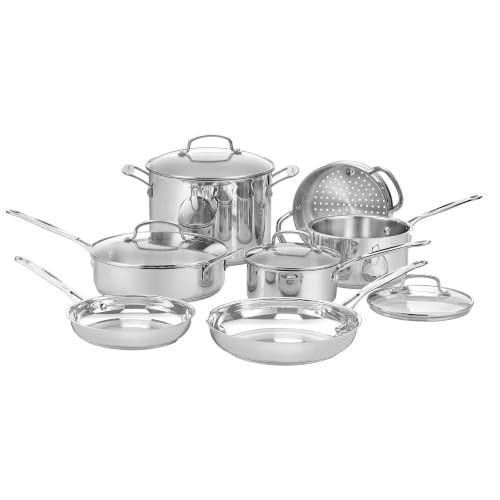
Cuisinart Chef’s Classic Stainless Steel Set, 11 pc (77-11G)
Badge: Best Overall
Strengths
- Cool-grip handles that stay manageable on the stovetop
- A balanced 11-piece mix with no obvious filler
- Induction compatible and oven safe, so it moves between cooktops easily
Trade-offs
- Not a full tri-ply clad build like the MultiClad Pro line
- 11 pieces may feel light for very large households
- Stainless cooking surfaces need preheating technique to limit sticking
Mini spec box: 11-piece set; Stainless steel construction; Induction compatible; Cool-grip handles; Oven safe; PFAS free.
The 11-piece Chef’s Classic is the set Cuisinart has sold for years as the sensible middle of its stainless range, and the design explains the staying power. The cool-grip handles are the everyday highlight: they are shaped to stay comfortable and comparatively cool during stovetop work, which matters more across a week of dinners than any single specification.
The set is induction compatible and oven safe, and it is made without PFAS coatings, so the cooking surface is bare stainless – durable, metal-utensil tolerant and free of any coating lifespan to worry about. The trade-off of bare stainless is technique: preheat the pan, add oil, then add food, and eggs and fish become manageable; skip the preheat and food will grab.
Day to day, this is the set that suits a two-to-four-person household that cooks most nights. The saucepan sizes cover sauces and reheating, the larger pieces handle pasta and soups, and the whole set cleans up without special rules. Its honest limitation is that it is a bonded-base style stainless set rather than a fully clad one, so cooks who push very high heat for hard searing may prefer the tri-ply option elsewhere in this guide.
Ownership details worth knowing: the Chef’s Classic line has been in production long enough that replacement lids and matching open-stock pieces are realistically findable years later, which quietly extends the set’s useful life beyond the pans themselves. The cool-grip handles are riveted in the classic manner and stay comfortable through long stovetop sessions. Treat the 11-piece count honestly – it includes lids – and what remains is a tight core of vessels in the sizes a household of two to four rotates weekly, with no specialty piece taking up rent in the cupboard.
Through the best-selling lens, this is the reference point: the set whose steady sales define what the market considers a normal, complete stainless kitchen.
Best for: most households wanting a proven, mid-size stainless set with comfortable handles / Not suited for: cooks who specifically want fully clad tri-ply walls
Check on Amazon for the current listing, configuration and latest price.

Cuisinart MultiClad Pro 12-Piece Set (MCPS-12N)
Badge: Best Fully Clad
Strengths
- True tri-ply clad construction through the walls, not just the base
- Heat Surround design aims heat up the sidewalls for even results
- Brushed finish hides everyday scuffs better than mirror polish
Trade-offs
- Premium-tier positioning within this guide
- Heavier in the hand than bonded-base sets
- Brushed finish shows water spots if air-dried carelessly
Mini spec box: 12-piece set; Tri-ply clad construction; Heat Surround technology; Brushed stainless steel finish; Induction compatible (stainless construction).
MultiClad Pro is Cuisinart’s fully clad line: the tri-ply construction wraps the core in stainless and runs it up the walls, and the brand’s Heat Surround language describes exactly that – heat distributed through the body of the pan rather than concentrated in a floor disc. For sauces, risottos and anything that cooks against the sidewalls as much as the base, that is a real functional difference, not a cosmetic one.
The brushed stainless finish is the practical choice for a working kitchen because it disguises the small scuffs and utensil marks that a mirror finish advertises. The 12-piece assortment is a cook’s selection rather than a marketer’s: fewer, more useful pieces, each earning its shelf space.
In daily use the MultiClad Pro pieces feel substantial – noticeably weightier than disc-base pans – and they respond predictably when you raise or lower the heat, which makes them forgiving for timing-sensitive cooking. The honest limitation is that weight plus premium positioning: cooks with wrist issues, or anyone who mostly reheats and boils, will not extract enough benefit to justify choosing it over a lighter set in this guide.
Two ownership notes on the MultiClad Pro. First, the brushed finish is a deliberate kindness: it camouflages the micro-scratches and water marks that polished clad shows, so the set ages gracefully in a working kitchen. Second, clad pans reward a slightly gentler preheat – the core conducts fast, and medium heat on a clad pan does the work that high heat does on a thin one. Cooks who internalize that find the set responsive rather than aggressive, and the even sidewall heat shows up most in dishes like risotto, polenta and custards, where the walls are half the cooking surface.
Its sales story is the upgrade story – it sells to people replacing failed cheap pans, which is why its numbers stay strong even at a premium tier.
Best for: serious home cooks who want fully clad performance and even sidewall heat / Not suited for: budget-first buyers or anyone who finds heavy pans tiring
Check on Amazon for the current listing, configuration and latest price.

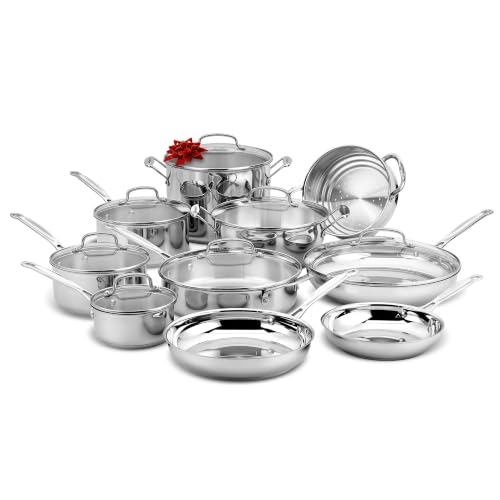
Cuisinart Chef’s Classic Stainless Steel Set, 17 pc (77-17N)
Badge: Best for Large Families
Strengths
- The largest Chef’s Classic assortment – few gaps for a busy kitchen
- Cool-grip handles across the set
- Induction compatible, oven safe and PFAS free
Trade-offs
- 17 pieces demand real storage space
- Overlaps its 11-piece sibling – some households will duplicate pieces they own
- Bonded-base style construction rather than full tri-ply cladding
Mini spec box: 17-piece set; Stainless steel construction; Induction compatible; Cool-grip handles; Oven safe; PFAS free.
The 17-piece Chef’s Classic takes the same formula as its 11-piece sibling – stainless construction, cool-grip handles, induction compatibility, oven safety, no PFAS coatings – and stretches the assortment to cover the edges: more saucepan capacity, more lids, more of the in-between sizes that a household cooking for guests or teenagers actually runs out of.
Whether that stretch is worth it depends entirely on your kitchen. If you regularly cook two sauces at once, host family dinners, or meal-prep in batches, the extra pieces stop being filler and start being the reason nothing waits for a washed pan. If your cooking is weeknight-simple, the same money buys the smaller set and leaves cupboard room to spare.
In daily cooking the depth of the assortment shows up on busy nights: a sauce reducing in one pan, vegetables in another, pasta in the big pot, and still a clean skillet for the protein. The honest limitation is the footprint – seventeen pieces with lids is a commitment of shelf and drawer space, and the set duplicates some sizes that smaller households will simply never run in parallel.
Inventory the assortment before you buy: at 17 pieces, this set’s value is in parallel capacity – multiple saucepans and lids that let a sauce, a side and a main move at once. If your cooking rarely runs two burners, the same budget buys its 11-piece sibling and leaves room in the cupboard. Storage deserves a plan as well: seventeen pieces with lids store best nested by size with lids filed vertically, and households that set that system up once find the big count stops feeling big within a week of daily use.
This variant sells on assortment depth: when a household grows, this is the box that ends the ‘we need another saucepan’ conversation for years.
Best for: larger households and frequent entertainers who run several pans at once / Not suited for: small kitchens or cooks who rarely use more than three pieces simultaneously
Check on Amazon for the current listing, configuration and latest price.
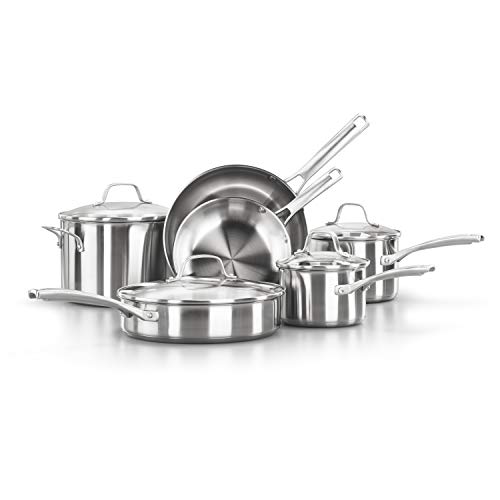
Calphalon Classic Stainless Steel Cookware Set, 10-Piece
Badge: Best Bonded-Base Value
Strengths
- Impact-bonded aluminum base spreads heat across the cooking floor
- Stay-cool handles for confident stovetop handling
- Oven safe to 450F per the listing title, covering most stove-to-oven recipes
Trade-offs
- Heat lives mainly in the base – sidewalls are plain stainless
- 10 pieces is a lean assortment for big households
- Bonded bases ask for sensible preheating rather than thermal shock
Mini spec box: 10-piece set; Impact-bonded aluminum base; Stay-cool handles; Oven safe to 450F (per API title); Stainless steel construction.
Calphalon’s Classic stainless set takes the other mainstream route to even heat: instead of cladding the whole pan, it impact-bonds an aluminum base onto stainless steel, putting the heat-spreading layer exactly where the burner delivers energy. For boiling, simmering and pan-frying – the work most home cooking consists of – that base does the heavy lifting well.
The stay-cool handles and the 450F oven rating from the listing title make the set an easy stove-to-oven citizen: start a frittata or a pan sauce on the burner and finish it under heat without changing vessels. The 10-piece count is deliberately lean, which suits cooks who would rather own fewer, better-chosen pieces.
Day to day this set behaves predictably: water comes to the boil evenly, sauces sit at a steady simmer without a scorched ring, and the pans move to the oven without drama. The honest limitation is sidewall cooking – a thick stew that needs gentle heat up the sides gets less help here than from a fully clad pan, and cooks who make a lot of those dishes should weigh the tri-ply options in this guide.
The bonded base deserves one clarification: impact bonding fuses the aluminum layer into the pan’s floor under pressure, which is why these bases sit flat and stay flat through years of thermal cycles when treated with ordinary care. The stated oven rating of 450F in the listing covers the great majority of stove-to-oven cooking – frittatas, finishes and braises included. Where the design asks something of you is preheating discipline: give the base a minute to come up to temperature evenly rather than blasting it, and it returns the favor with a scorch-free simmer.
Calphalon’s chart position rests on the bonded base doing the everyday jobs well – proof that most buyers cook in the base of the pan and know it.
Best for: everyday cooks who want even base heat, stay-cool handles and a lean piece count / Not suited for: cooks who rely on sidewall heat for slow braises and reductions
Check on Amazon for the current listing, configuration and latest price.

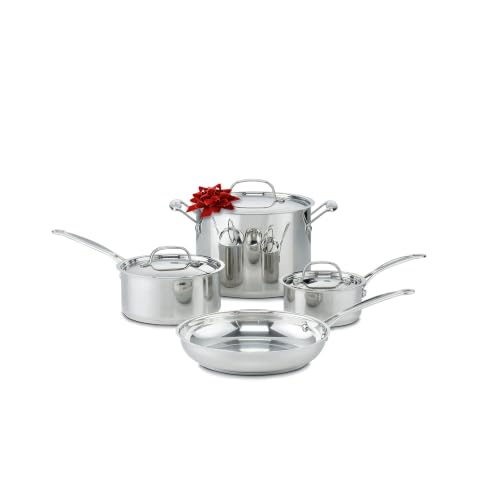
Cuisinart Chef’s Classic Stainless Steel Set, 7 pc (77-7P1)
Badge: Best Starter Set
Strengths
- The compact Chef’s Classic – the essentials without filler
- Cool-grip handles and induction compatibility at the smallest footprint in this guide
- An easy first stainless set for one or two people
Trade-offs
- No spare capacity for entertaining or batch cooking
- Growing households will outgrow it and buy twice
- Same bonded-base style construction as its larger siblings
Mini spec box: 7-piece set; Stainless steel construction; Induction compatible; Cool-grip handles; Oven safe; PFAS free.
The 7-piece Chef’s Classic is the distillation of the line: the same stainless construction, cool-grip handles, induction compatibility and oven safety as the bigger sets, cut down to the pieces a single cook or a couple genuinely uses every week. Nothing in the box is decorative, which is exactly the point of a small set.
Small sets live or die on whether the included sizes match real meals, and this assortment is built around the core rotation – a skillet, saucepans and a stockpot-style piece – rather than specialty shapes. It is the set to buy when the alternative is a giant box whose bottom half never leaves the cupboard.
In daily cooking for one or two, the 7-piece set covers breakfast eggs, weeknight pasta, soups and reheating without a wasted motion, and cleanup is quick because everything is honest stainless. The honest limitation arrives the first time you cook for six: you will borrow pans or cook in sequence. Buy it as a deliberate starter or a compact-kitchen solution, not as a forever set for a growing family.
What the 7-piece set teaches better than any other pick here is assortment discipline: every included vessel maps to a weekly task, and there is no ‘aspirational’ piece waiting for a dinner party that never comes. For first kitchens it pairs naturally with a single later addition – most owners eventually add one larger stockpot or a second skillet as open stock, which is exactly how a small set should grow: by evidence, not by box size. The cool-grip handles and induction compatibility carry over from the larger Chef’s Classic sets, so nothing about the small version feels like a downgrade in the hand.
Compact sets sell steadily because life keeps producing small kitchens – first apartments, downsizers, RVs – and this is the stainless answer that segment keeps choosing.
Best for: singles, couples, dorms, RVs and compact kitchens wanting real stainless / Not suited for: families or entertainers who cook several dishes at once
Check on Amazon for the current listing, configuration and latest price.

CAROTE Tri-Ply Stainless Steel Cookware Set with Detachable Handle, 15 pcs
Badge: Best Space-Saving Design
Strengths
- Detachable handles let the pans nest and stack tightly
- Tri-ply construction at a value-oriented position in this guide
- Pans move from stovetop to table or oven without a handle in the way
Trade-offs
- You must attach and detach the handle as part of every use
- A shared-handle system is a habit some cooks never warm to
- Newer brand with a shorter track record than the legacy names here
Mini spec box: 15-piece set; Tri-ply stainless steel construction; Detachable handle system; Non-toxic cooking surface; Induction compatible.
CAROTE’s 15-piece set is built around one idea executed thoroughly: the handles detach. With the handle off, the tri-ply stainless pans nest inside each other, slide into shallow drawers and crowded cabinets, and go to the table or into the oven without a long handle dictating placement. For small kitchens it is the single most practical storage idea in this guide.
The construction underneath the trick is respectable – tri-ply stainless, induction compatible and a non-toxic bare-metal cooking surface with no coating to wear out. The detachable handle itself is the thing to think about: it clips on for cooking and off for storage, and cooks who like to shake a pan one-handed over high heat should be sure the system suits their style before committing.
In daily cooking the routine becomes: clip, cook, unclip, stack. Breakfast for one uses a single pan that then disappears into a drawer; a full dinner still works because the piece count is a real 15, not a token assortment. The honest limitation is that the handle ritual never fully disappears – on a rushed weeknight, reaching for the clip is one more step than grabbing a fixed handle, and some cooks will find that step charming and others will find it tiresome.
Living with the detachable system has a rhythm worth picturing: one handle lives in a drawer, clips onto whichever pan the meal needs, and comes off again for serving, oven finishing and storage. The pans themselves are tri-ply stainless, so the storage trick never asks you to accept thin metal as its price. Two habits make the system sing – dry the rim where the handle clips, so the connection stays positive, and plan two-pan dishes around handle swaps until the motion becomes automatic, which owners report happens within the first week or two of cooking.
The detachable-handle design is the newest idea on this list, and its sales show the market rewarding a genuine storage innovation rather than another lid in the count.
Best for: small kitchens, RVs and anyone whose storage problem is handles, not pans / Not suited for: cooks who toss pans one-handed or dislike clip-on hardware
Check on Amazon for the current listing, configuration and latest price.
Comparison Table
| Pick | Badge | Headline spec (from listing) | Standout trait |
|---|---|---|---|
| Cuisinart Chef’s Classic Stainless Steel Set, 11 pc (77-11G) | Best Overall | 11-piece set | The evergreen 11-piece Chef’s Classic assortment |
| Cuisinart MultiClad Pro 12-Piece Set (MCPS-12N) | Best Fully Clad | 12-piece set | Tri-ply clad with Heat Surround technology |
| Cuisinart Chef’s Classic Stainless Steel Set, 17 pc (77-17N) | Best for Large Families | 17-piece set | 17 pieces for parallel cooking |
| Calphalon Classic Stainless Steel Cookware Set, 10-Piece | Best Bonded-Base Value | 10-piece set | Impact-bonded aluminum base, oven safe to 450F |
| Cuisinart Chef’s Classic Stainless Steel Set, 7 pc (77-7P1) | Best Starter Set | 7-piece set | The compact 7-piece essentials set |
| CAROTE Tri-Ply Stainless Steel Cookware Set with Detachable Handle, 15 pcs | Best Space-Saving Design | 15-piece set | Tri-ply set with detachable handles that nest |
Compare the table in two passes: first by assortment (does the vessel mix match your week?), then by construction (clad walls or bonded base?). Price tier follows those two decisions more honestly than it follows brand fame.
How to Choose Best selling cookware sets
Start with the vessel audit. List the pans you used in the last seven days, with sizes. Most households land on a skillet, a small and a large saucepan, and a stockpot, plus one or two occasionals. The set you buy should cover your list with no more than two extra pieces – that discipline is what separates the satisfying best sellers from the ones resold secondhand, still half in plastic.
Then choose your construction honestly. Tri-ply clad is the better tool if you cook sauces, custards, grains and reductions that touch the walls, or if you hate hot spots on a wide burner. A bonded base is the better value if your cooking is boiling, frying and simmering in the floor of the pan – which describes most weeknight cooking, and explains the sales of both patterns. There is no wrong answer, only a mismatch between the pan and your habits.
Finally, weigh the ownership ecosystem. Long-selling lines offer replacement lids, matching add-on pieces and stable designs, so your set can grow instead of being replaced. That ecosystem is a real part of what you are paying a legacy brand for, and it is the main thing newer value brands cannot yet match. If coatings are on your mind at all, read Best Quality Non Stick Cookware Sets before deciding – the lifespan trade is different there.
How to Get the Best from a Stainless Set, Day One to Year Ten
A best-selling set only becomes a beloved set if the first month goes well. This routine covers seasoning-free stainless technique, the cleaning habits that keep the finish bright, and the storage choices that prevent the slow damage nobody notices until it is done.
- Learn the water-bead preheat. Heat the dry pan over medium for a minute or two and flick in a few drops of water. When they form beads that skate across the surface, the pan is at the searing sweet spot – add oil, then food.
- Cook with the fond, not against it. Browned bits stuck after searing are an asset. Deglaze with water, stock or wine, scrape gently, and you have a pan sauce plus a pan that rinses clean.
- Season nothing, maintain everything. Stainless needs no seasoning. It needs prompt drying to prevent water spots, an occasional powdered-cleanser polish for heat tint, and a vinegar wipe for mineral film.
- Store to protect the bases. Nest pans with a cloth or pan protector between them, or hang them. A warped or scratched base is usually a storage injury, not a cooking injury.
- Respect thermal shock. Let a hot pan cool briefly before washing, and never plunge it into cold water. This single habit is the difference between a flat base for decades and a spinner on a glass cooktop within a year.
Troubleshooting
Problem: a pan rocks or spins on a flat cooktop → the base has warped, usually from thermal shock or extreme heat on an empty pan. Prevention is the cure; cook on matched burner sizes and cool pans gradually.
Problem: white spots and a dull film after dishwashing → mineral deposits, common with hard water. A vinegar wipe restores the shine; hand drying prevents it.
Problem: food leaves a stubborn browned layer → soak the warm pan with water and a little baking soda, then use a powdered stainless cleanser. The surface can take it – that durability is why you bought stainless.
How ‘Best Selling’ Lists Are Built – and How to Read Them
Marketplace best-seller rankings are calculated from recent sales velocity, which means they mix two very different signals: the launch spike of a promoted newcomer and the flat, endless line of an evergreen set that sells the same healthy number every week for a decade. The second signal is the valuable one, and you can spot it by checking whether the same model has clearly been in production for years with a stable design and name.
Piece-count marketing is the other distortion to correct for. A ’17-piece set’ and a ’10-piece set’ may contain a similar number of actual cooking vessels once lids are subtracted, and the utensils bundled into some counts are worth almost nothing. When you compare across this guide, compare vessels and sizes – the reviews above do that arithmetic for you. The sets that survive this correction and still look good are the ones whose sales mean something.
Why Stainless Owns the Long-Term Charts
Run the ownership math and the sales pattern explains itself. A coated pan is replaced on a cycle; each replacement is a new sale for the coating category but a quiet failure for the owner. A stainless set is bought once, and its owner becomes a recommender – to siblings setting up kitchens, to friends asking what to register for, to anyone who will listen. Recommendation-driven demand is the steadiest demand in retail, and it accumulates around products that do not wear out.
There is also a compatibility ratchet: as induction cooktops spread, older incompatible pans fall out of kitchens, and the replacement purchase lands on induction-ready stainless. Every pick in this guide is induction compatible per its verified listing, so the set you buy now survives your next cooktop change too – one more reason these particular models keep their chart positions while cooktops change underneath them. Shoppers weighing a full kitchen refit sometimes pair this decision with Best Rv Cookware Sets for a second, compact set – a reminder that ‘best selling’ always depends on the kitchen it serves.
Evergreen vs Trending: How to Tell Which Kind of Seller You Are Looking At
Marketplace charts blend two animals. The trending set spikes on a promotion, a viral video or a seasonal gift rush, and its chart position says little about its third year. The evergreen set sells the same steady volume in March as in December, because its demand comes from recommendations and replacements-within-the-brand rather than attention. Every pick in this guide was chosen for the second pattern: stable names, stable designs, assortments that have survived years of contact with real kitchens.
You can run the evergreen test yourself on any set you meet elsewhere. Has the model name existed, unchanged, for years? Do the listing’s details read like a product that expects to be sold next year too – replacement lids findable, matching pieces sold alongside? Does the assortment look designed for cooking rather than for a photograph? Three yeses mark an evergreen; the trending sets usually fail the first test immediately.
The reason to care is resale-proofing your own decision. An evergreen set can be extended, repaired-by-replacement and matched; a discontinued trending set becomes an orphan the first time a lid breaks. In a category where the product physically lasts decades, the brand’s commitment to the line is a product feature, and it is the one the sales charts measure best.
What Changes Hands When a Set Sells for a Decade
A set that sells for ten years accumulates something no new product can buy: a public record. Thousands of households have cooked the same weeknight rotation in it, broken the same lid, asked the same questions and posted the answers. That record is why evergreen sets feel low-risk in a way their specifications alone cannot explain – you are not trusting the brand’s promises, you are trusting the accumulated experience of everyone who bought before you.
It also disciplines the manufacturer. A line with a decade of owners cannot quietly thin its metal or shrink its saucepans without the change being noticed and discussed, which keeps evergreen designs honest in a way launch products are not yet forced to be. When this guide prefers long sellers, that accountability – not nostalgia – is the reason.
One more reading skill for sales charts: look at what a set’s sales survive. A design that kept selling through the shift to induction, through the air-fryer years and through several kitchen-fashion cycles has passed a harder test than any single review round – it has remained useful while the kitchen around it changed.
And a practical note on gifting, which drives a surprising share of this category’s sales: a mid-size set from a long-running line is the safest registry or housewarming purchase in cookware, precisely because lids and matching pieces remain buyable. The 11-piece Chef’s Classic’s chart position owes more than a little to that quiet fact.
If your household is still growing, bias toward the lines with the deepest ecosystems rather than the biggest single box. A 10 or 12-piece core you can extend piece by piece will fit your kitchen in five years better than a 21-piece assortment chosen for today’s apartment.
Consider, finally, the secondhand market as an auditor of this entire page. Evergreen stainless sets circulate used for years – at estate sales, in classified listings, between generations – and they hold meaningful value because the product does not expire. Trending and coated sets barely circulate at all; their secondhand price collapses toward zero because everyone understands the surface is spent. That difference is the market’s long-term verdict rendered in cash: the sets that keep selling new are the same sets that keep selling used, and both facts flow from the same source – a pan whose hundredth year looks much like its first, given ordinary care. When you buy from this shortlist you are joining the durable side of that verdict, and your future self, cooking in the same pans in a different kitchen, is the person who will thank you for choosing the evergreen.
There is one more filter worth applying before you commit, and it costs nothing: read the assortment list of your finalist set against your own stove. Count the burners you actually use – most households live on two – and ask whether the set’s vessel sizes let two pans work those burners at once without crowding. The best-selling sets earn their keep precisely here, in the unglamorous geometry of a Tuesday night, and the ones whose saucepans are sized for real burners rather than for the photograph are the ones owners describe, years later, as the set that just fits their cooking. Fit, in the end, is what sustained sales have been measuring all along – this page simply teaches you to measure it in advance instead of discovering it by ownership.
And if two finalists remain tied after all of this, let the tie be broken by the handle and the lid – the two parts your hands will judge a thousand times for every once your eyes judge the metallurgy. A handle that fits your grip with a towel in it, and a lid that sits without rattling at a simmer, are the daily texture of ownership. The charts cannot measure them, but they are why owners of the right set describe it with affection rather than satisfaction – and affection, sustained over a decade of dinners, is the true engine behind every number on the best-seller page.
Choose the evergreen, size it to your household, and let the next decade of dinners grade the decision – that is the entire method, and it has never needed improving.
Common Buying Mistakes
- Reading the headline piece count as the number of pots and pans – subtract the lids first.
- Assuming the best-selling set fits your household; the charts are dominated by family-size assortments that swamp small kitchens.
- Buying a famous name’s cheapest line and expecting the flagship’s construction – check whether the build is clad or bonded-base.
- Judging stainless by the first egg. The preheating technique takes a week to learn and pays off for decades.
- Ignoring the replacement ecosystem: a set you cannot buy a spare lid for in five years is a worse buy than its sales suggest.
- Storing pans unprotected in a deep drawer, then blaming the cooktop for a scratched, rocking base.
Final Recommendation
If you want the single safest purchase on this page, it is the Cuisinart Chef’s Classic 11-piece – the evergreen assortment that the market has validated more thoroughly than any other here. Step up to the MultiClad Pro if you want clad walls and cook accordingly; step down to the 7-piece if your household is small; choose the CAROTE detachable-handle set if storage, not cooking, is your binding constraint; and consider the Calphalon the value pick for base-focused cooking. Best-selling status got these sets onto the page – the reviews above are how you choose among them.
Start your shortlist with Cuisinart Chef’s Classic Stainless Steel Set, 11 pc (77-11G), Cuisinart MultiClad Pro 12-Piece Set (MCPS-12N) and Cuisinart Chef’s Classic Stainless Steel Set, 17 pc (77-17N) — compare their current listings, configurations and latest prices, then commit to the one that matches your kitchen.
Frequently Asked Questions
What makes a cookware set ‘best selling’ over many years?
A stable design, honest construction, an assortment that matches real cooking, and owners who recommend instead of replace. Launch marketing can spike a set for a season; only durability keeps it selling for a decade.
Should I just buy the number-one best seller?
Use the charts to build a shortlist, not to make the decision. The top seller is optimized for the average kitchen; your burner sizes, household and storage may make a different pick on this page the better buy.
Do piece counts include lids?
Yes, almost always. A 17-piece set typically holds around ten cooking vessels plus lids. Compare vessel counts and sizes when you shop, which is why our comparison table leads with the assortment logic of each set.
Is tri-ply worth it over a bonded base?
If you cook sauces, grains and reductions that touch the pan walls, yes – clad construction heats the walls evenly. If your cooking is boiling, frying and simmering in the base, a good bonded base delivers most of the performance for less.
Can these sets go in the oven and dishwasher?
The sets here are oven safe (the Calphalon listing specifies 450F) and the stainless surfaces tolerate dishwashing. Hand washing and prompt drying simply keep the finish looking new, and most owners of long-lived sets do exactly that.
What if I cook on induction?
Every pick in this guide is induction compatible according to its verified listing data. When shopping elsewhere, the magnet test settles it: a magnet that grips the pan’s base firmly means induction will work.