Disclosure: topratedkitchenware.com is reader-supported. When you buy through links on our site, we may earn an affiliate commission from Amazon and other retailers, at no extra cost to you.
Where to buy
This guide to the best selling slow cookers brings together the six verified models that define what most households actually buy: classic stoneware crocks from Crock-Pot and Hamilton Beach in 6-, 7-, and 8-quart sizes, plus two multicookers from Cosori and Aroma that slow cook alongside their rice and steaming roles. Each name below links to its Amazon listing, where you can check the latest price on Amazon and confirm the current configuration before you decide.
- Cosori Rice Cooker 10 Cup with Slow Cook and Sauté
- Aroma Housewares 20 Cup Cooked Digital Rice Cooker, Slow Cooker, Food Steamer
- Crock-Pot Oval Manual Slow Cooker, 7-Quart
- Crock-Pot Programmable Slow Cooker with MyTime, 7-Quart
- Hamilton Beach 6 Quart Slow Cooker
- Crock-Pot Programmable Slow Cooker, 8-Quart
Read the full guide ↓ for what makes these models perennial sellers, how to choose between a manual dial, a programmable timer, and a multicooker, and the capacity math that decides which size belongs in your kitchen.
The best selling slow cookers did not become best sellers by accident, and they did not become best sellers by being exotic. They earned their place by doing one of cooking’s oldest jobs — turning tough cuts, dried beans, and sturdy vegetables into tender food with almost no attention — at sizes and prices ordinary households could justify, in formats that survive years of weekly use. Read this list as a map of what the market has collectively learned: most people want a crock between 6 and 8 quarts, controls they cannot set wrong, a pot that goes in the dishwasher, and, increasingly, the option of a machine that slow cooks as one of several jobs rather than its only one.
That last shift is the story inside this selection. Four of the six picks are traditional stoneware slow cookers, the format that built the category: a heating base, a heavy oval crock, a glass or locking lid. Two are multicookers in rice-cooker format that include a slow cook function among many, and their presence in a best-seller conversation would have been unthinkable a generation ago. Both shapes slow cook well; they differ in what else they do, how they handle small batches, and how much counter they claim. This guide weighs each model on the slow-cooking fundamentals first — capacity, heat behavior, controls, cleanup — and then on the extras, so you can see whether the classic or the multicooker version of the idea fits your kitchen.
A word on the phrase best selling itself. Popularity is evidence of a kind: it tells you a model has been bought, used, gifted, and re-bought at scale, that its replacement parts and recipes are easy to find, and that its failure modes are known rather than mysterious. It does not tell you a model is right for your batch size or your schedule. This guide uses popularity as the pool and fit as the criterion, which is why the reviews below are as frank about each model’s limits as about its strengths.
Key Takeaways
- The classic best-seller shape is a 6- to 8-quart stoneware crock: the Crock-Pot 7-quart manual, MyTime programmable, and 8-quart models plus the Hamilton Beach 6-quart cover that range.
- Manual controls (the 7-quart Crock-Pot) are the simplest and most foolproof; programmable models add timers and auto warm for households with unpredictable schedules.
- The MyTime Crock-Pot adjusts the cook to your chosen serving time, the most schedule-aware design among the traditional crocks.
- Multicookers (Cosori with sauté and slow cook, Aroma with rice, slow cook, and steam) suit households that want one appliance for several jobs.
- Buy for your usual batch: slow cookers cook best half to three-quarters full, so an 8-quart crock is a crowd tool, not a two-person weeknight tool.
- Readers who want the schedule-driven, lectin-focused counterpart to slow cooking should also see our guide to the Best Simple Pressure Cookers Dr Gundry.
In this guide
Quick Picks
| Pick | Badge | Capacity (as listed) | Standout trait | Link |
|---|---|---|---|---|
| Cosori Rice Cooker 10 Cup | Most Versatile | 10 cup (20 cup cooked) | Sauté plus Slow Cook, fuzzy logic, ceramic pot | Check on Amazon |
| Aroma 20 Cup Cooked Digital | Best Rice-and-Slow Combo | 20 cup cooked (10 cup uncooked) | Rice cooker, slow cooker, and steamer in one | Check on Amazon |
| Crock-Pot Oval Manual 7-Quart | Best Classic | 7-quart, serves 8+ | Manual High, Low, Warm; removable stoneware | Check on Amazon |
| Crock-Pot Programmable MyTime 7-Quart | Best Overall | 7-quart, feeds 9+ | MyTime scheduling, locking travel lid | Check on Amazon |
| Hamilton Beach 6 Quart | Best Mid-Size Value | 6 quart | Dishwasher-safe crock and glass lid, 3 settings | Check on Amazon |
| Crock-Pot Programmable 8-Quart | Best for Crowds | 8-quart, for 10+ | Digital timer to 20 hours, auto warm | Check on Amazon |
Two decisions organize this table: classic crock or multicooker, and then size. Answer those and the right row usually selects itself; the detailed reviews exist to confirm the answer and warn you about the trade-offs inside it.
How These Picks Were Chosen
This pool represents the best-selling shapes of the category as verified listings: three Crock-Pot stoneware models across the manual, programmable, and largest sizes, Hamilton Beach’s mid-size staple, and the two multicookers that have earned a place in slow-cooking conversations. We evaluated each on its confirmed specification only — capacity, settings, timer and keep-warm behavior, lid and vessel design, and cleanup claims the manufacturer itself makes — and we did not import features from sibling models or other years.
We weighted the fundamentals that explain repeat purchases. A best seller is a machine people buy again for a second home, a wedding gift, or a replacement after a decade, and that loyalty tracks reliability and fit rather than novelty. So capacity honesty, control clarity, and dishwasher-safe cleanup counted heavily, while program counts counted lightly. This is research-led guidance; we make no hands-on testing claims, and where a listing is silent — about a sear mode on the classic crocks, for instance — the reviews say so and point you to the model in this pool that does list one.
The 6 Best Selling Slow Cookers and Why They Sell

Cosori Rice Cooker 10 Cup with Fuzzy Logic, Sauté, and Slow Cook
Badge: Most Versatile
Strengths
- Slow Cook sits inside an 18-in-1 function set that also includes Sauté, so browning and slow cooking share one ceramic-coated pot.
- Fuzzy logic control with 24-hour keep warm and a delay timer makes scheduling unusually flexible.
- Stainless steel steamer basket adds a steaming role beyond rice and slow cooking.
Trade-offs
- Rice-cooker format and 10-cup scale suit saucy dishes better than one large whole roast.
- Many programs will go unused by a cook who only slow cooks.
- Coated pot needs gentler handling than a stoneware crock.
Mini spec box
- Capacity: 10 cup (20 cup cooked)
- Functions: 18-in-1, including Sauté and Slow Cook
- Inner pot: ceramic coating, non-stick
- Controls: fuzzy logic, 24H keep warm, delay timer
- Included: stainless steel steamer basket
The Cosori represents where the slow cooker market is drifting: toward machines that slow cook as one talent among many. Its slow cook function lives in a ceramic-coated pot that can also sauté, which quietly solves the classic slow cooker’s oldest weakness — the separate skillet needed for browning — and its fuzzy logic control, delay timer, and long keep-warm make it the most schedulable machine in this guide. For stews, curries, braises, beans, and rice-centered households that also want a slow cooker, it is a genuinely modern answer.
Its best-seller logic is consolidation: one appliance replacing a rice cooker, a steamer, and a slow cooker on counters that cannot hold all three. The honest limitation is geometry. A 10-cup multicooker pot is deep rather than wide, so a whole chicken or a broad roast fits less naturally than in the oval stoneware crocks below, and cooks whose slow cooking is mostly large roasts should choose those instead. For chopped, sauced, and braised dishes — the majority of slow cooking, in practice — this is the most capable machine in the selection.
Best for: households wanting slow cooking plus rice, sauté, and steaming in one unit / Not suited for: cooks centered on large whole roasts

Aroma Housewares 20 Cup Cooked Digital Rice Cooker, Slow Cooker, Food Steamer
Badge: Best Rice-and-Slow Combo
Strengths
- Three confirmed roles — digital rice cooker, slow cooker, food steamer — in one stainless exterior unit.
- Large 20-cup cooked (10-cup uncooked) capacity serves family quantities across all three roles.
- Digital controls offer more structure than a manual dial for mixed-use households.
Trade-offs
- No sauté mode is listed, so browning before a slow cook still needs a skillet.
- Its size is wasted on small households cooking small batches.
- Slow cooking shares a pot designed primarily around rice.
Mini spec box
- Capacity: 20 cup cooked (10 cup uncooked)
- Functions: digital rice cooker, slow cooker, food steamer
- Exterior: stainless steel
- Model: ARC-150SB
Aroma built its name on rice cookers, and this model’s slow cook function rides on that foundation: a big digital unit that cooks rice daily, steams when asked, and slow cooks on the days a stew is wanted. For households whose cooking genuinely rotates among those three jobs, it replaces a shelf of appliances with one footprint, which is precisely why this format sells. The digital controls keep the roles distinct and the capacity honest.
As a pure slow cooker it sits behind the dedicated crocks for roast-shaped cooking and behind the Cosori for browning, since no sauté mode is listed. But best-seller status is about total usefulness, and a family that serves rice four nights a week and slow cooks on Sundays may rationally rank this first. Readers cross-shopping the rice side of its personality will find its relatives throughout our Best Simple Rice Cookers guide.
Best for: rice-centered families that also slow cook and steam at scale / Not suited for: small households or sear-first slow cooking

Crock-Pot Oval Manual Slow Cooker, 7-Quart
Badge: Best Classic
Strengths
- The archetypal slow cooker: 7-quart oval stoneware serving 8+ people, shaped for whole chickens and roasts.
- Manual High, Low, and Warm settings that anyone can operate and nothing can misprogram.
- Removable stoneware moves from base to table to sink with no fuss.
Trade-offs
- No timer: it cooks until you turn it, and will not shift itself to Warm.
- No browning mode; searing happens in a separate pan.
- Stoneware is heavy when full and dislikes sudden temperature shocks.
Mini spec box
- Capacity: 7-quart, serves 8+
- Settings: High, Low, Warm
- Vessel: removable oval stoneware
- Exterior: stainless steel
- Controls: manual
If the category has a default answer, this is it. The 7-quart oval manual Crock-Pot is the machine generations of cooks learned slow cooking on, and its continued best-seller status is a lesson in fit: the oval stoneware takes the shapes real food comes in, the capacity feeds a family with leftovers, and the dial offers exactly three decisions. Chili, pulled pork, pot roast, bean soup — the canon of slow cooking was written for this vessel, and it still performs the canon beautifully.
What it asks in return is presence. With no timer, the cook ends when you say so, which suits home-centered schedules and frustrates unpredictable ones. Households whose workdays stretch should look at the programmable models below; households that cook on weekends and evenings at home may never miss the feature. In a guide about what sells and why, this model is the evidence that simplicity itself is a feature people pay for, a theme our Best Simple Rice Cookers guide takes up for the rice side of the counter.
Best for: classic family slow cooking with a home-centered schedule / Not suited for: set-and-forget weekday cooking away from home
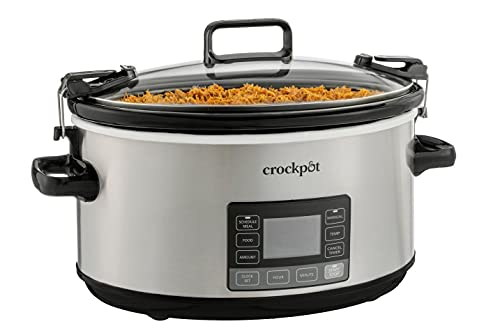
Crock-Pot Programmable Slow Cooker with MyTime, 7-Quart
Badge: Best Overall
Strengths
- MyTime technology adjusts the cooking so the food is ready at your chosen time, solving the overcooked-by-overtime problem.
- Cook & Carry locking lid makes a full 7-quart crock genuinely transportable.
- Feeds 9+ people, the largest serving claim among the traditional crocks here.
Trade-offs
- Programmable controls are a step more complex than a manual dial.
- No browning mode is listed; searing remains a stovetop step.
- Scheduling features reward planners; improvisational cooks may ignore them.
Mini spec box
- Capacity: 7-quart, feeds 9+
- Technology: MyTime adjusts cooking to your schedule
- Lid: Cook & Carry locking lid
- Exterior: stainless steel
- Controls: programmable
The MyTime model is what the classic slow cooker becomes when it listens to its owners’ most common complaint. Traditional slow cooking has a rigid window: food is done when the recipe’s hours run out, and a delayed commute turns dinner dry. MyTime inverts the relationship by adjusting the cook to land at the serving time you choose, which is a small idea with large daily consequences. Add the locking Cook & Carry lid — the feature that makes potlucks, tailgates, and bringing a meal to family practical without a sloshing car — and you have the most thoughtfully evolved traditional crock in this pool.
It takes our Best Overall badge because it keeps everything the classic does well — oval stoneware, family capacity, the familiar Crock-Pot format — and removes the classic’s two biggest frictions, timing and transport. Its limitations are the category’s: no in-pot browning, and controls that ask a little more of the user than a dial. For the working household that slow cooks on weekdays, those trades point clearly toward this model.
Best for: working households, potluck carriers, and large family batches / Not suited for: cooks who want in-pot searing or absolute simplicity

Hamilton Beach 6 Quart Slow Cooker
Badge: Best Mid-Size Value
Strengths
- 6-quart size is the practical middle: roasts and soups for a family without an oversized crock.
- Dishwasher-safe stoneware crock and glass lid make cleanup the easiest in this guide.
- Three cooking settings keep the machine completely approachable.
Trade-offs
- No programmable timer in the confirmed specification.
- No browning or sauté function.
- Basic feature set will not grow with a cook who wants a multicooker later.
Mini spec box
- Capacity: 6 quart
- Settings: 3 cooking settings
- Vessel: stoneware crock, dishwasher-safe
- Lid: glass, dishwasher-safe
- Model: 33665G, silver
Hamilton Beach’s 6-quart cooker is the quiet workhorse of the best-seller list: not the biggest, not the smartest, and very possibly the most sensibly sized. Six quarts holds a family roast or a generous soup while still suiting a two-person household’s batch of chili, and the dishwasher-safe crock and lid remove the one chore that makes people abandon slow cooking, which is scrubbing a heavy pot at the end of a long day. Its three settings are the whole interface, and for a large share of owners that is exactly the point.
It earns its sales the way appliances used to: by being the right size at the right tier with nothing to go wrong. The trade-offs are the familiar ones — no timer, no browning — and they matter most to weekday-away cooks, who should step up to the MyTime model. Everyone else gets a machine that will simply work, week after week, which is the deepest definition of a best seller there is.
Best for: families wanting the easiest-clean, right-size classic crock / Not suited for: unattended weekday cooking that needs a timer
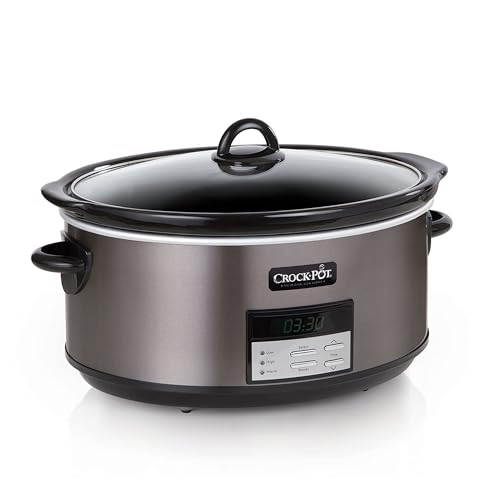
Crock-Pot Programmable Slow Cooker, 8-Quart
Badge: Best for Crowds
Strengths
- 8-quart capacity for 10+ people: the crowd, freezer-prep, and game-day size.
- Digital timer up to 20 hours with auto warm covers the longest recipes and schedules.
- Dishwasher-safe lid and stoneware pot keep a very large cooker practical to clean.
Trade-offs
- No browning mode despite the digital controls.
- A full 8-quart stoneware crock is heavy to lift, carry, and wash.
- Half-empty cooking in a pot this size runs less evenly for small households.
Mini spec box
- Capacity: 8-quart, for 10+ people
- Timer: digital, up to 20 hours
- Keep warm: auto warm setting
- Vessel: stoneware pot, dishwasher-safe with lid
- Finish: black stainless steel
Every category has a maximum, and this is slow cooking’s: eight quarts of stoneware under a digital timer that runs to twenty hours and then holds the food warm automatically. It exists for the cooks who feed crowds — holidays, team dinners, church suppers, freezer-stocking weekends — and for them the specification reads like a checklist of exactly what the job demands. The black stainless finish lets it sit on a serving table without looking like a utility appliance, and the dishwasher-safe vessel keeps the aftermath proportionate.
Its best-seller presence proves that the crowd niche is not small. But the same size is its warning label: this crock rewards being filled and punishes being dabbled in, so a couple cooking two chicken breasts should choose anything else in this guide. Buy it for the batches you actually cook at scale, and it will be the hardest-working appliance you own on the days that matter most.
Best for: crowd cooking, meal prep, and long timed recipes / Not suited for: small households or small batches
Comparison Table
| Model | Capacity | Controls | Standout trait | Link |
|---|---|---|---|---|
| Cosori 10 Cup Multicooker | 10 cup (20 cup cooked) | Fuzzy logic, delay timer | Sauté plus Slow Cook in one pot | Check on Amazon |
| Aroma ARC-150SB | 20 cup cooked | Digital | Rice, slow cook, steam in one | Check on Amazon |
| Crock-Pot Manual 7-Quart | 7-quart | Manual dial | Classic oval stoneware | Check on Amazon |
| Crock-Pot MyTime 7-Quart | 7-quart | Programmable, schedule-adjusting | Ready-at-your-time cooking, locking lid | Check on Amazon |
| Hamilton Beach 6 Quart | 6 quart | 3 settings | Dishwasher-safe crock and lid | Check on Amazon |
| Crock-Pot Programmable 8-Quart | 8-quart | Digital timer to 20 hours | Auto warm, crowd capacity | Check on Amazon |
How to Choose Among the Best Selling Slow Cookers
Start with the batch you cook most. Slow cookers perform best between half and three-quarters full: enough food to hold moisture and heat evenly, enough headroom to avoid bubbling over. A household of two to four cooking stews and soups lives in the 6-quart class. Families of five or more, or anyone cooking whole chickens and large roasts, belong at 7 quarts. The 8-quart model is for crowds and freezer prep, and the multicookers suit saucy, chopped dishes in family quantities. Buying one size up for the occasional holiday is the most common sizing error in the category; the holiday is one day, and the too-big crock is fifty weeks of half-empty cooking.
Next, choose your control philosophy. Manual dials are honest and indestructible but demand your presence at the end of the cook. Digital timers with auto warm, as on the 8-quart Crock-Pot, forgive an unpredictable day. Schedule-adjusting cooking, the MyTime approach, goes further and plans backwards from dinner. Multicooker controls trade that slow-cooking focus for breadth: rice, steam, sauté, and slow cook in one interface. Neither philosophy is superior; they answer different lives. Third, think about transport and cleanup. A locking lid matters if the cooker travels; dishwasher-safe stoneware matters every single week. Finally, decide the browning question. If your recipes regularly start with a sear, only the Cosori in this pool lists the mode to do it in the pot; everyone else’s browning lives in a skillet, which is a perfectly good answer if you know it in advance. Shoppers comparing against pressure formats can continue in our Best Simple Pressure Cookers guide.
How to Slow Cook Well: Setup, Timing, and Care
- Load the crock in the right order: hard vegetables such as carrots and potatoes at the bottom near the heat, meat above them, and liquid enough to create the braising environment without drowning the ingredients.
- Fill between half and three-quarters full, and resist lifting the lid during the cook; each peek releases the accumulated heat and steam the timing assumes.
- Choose Low for the long, gentle cooks that tenderize tough cuts, and High when the schedule is shorter, knowing the two settings differ mainly in how fast the cooker reaches its cooking temperature.
- Add delicate ingredients — dairy, fresh herbs, quick-cooking vegetables — near the end so they finish fresh rather than faded.
- Rest the finished dish briefly, skim surface fat if the cut was fatty, and adjust salt and acidity at the end, when the flavors have fully developed.
- Move leftovers to shallow containers and refrigerate promptly; the crock is a cooker, not a storage vessel.
Care is mostly about the stoneware. Let a hot crock cool before washing, avoid sudden cold water on hot ceramic, and never place a stoneware insert on a stovetop burner or under a broiler unless the manufacturer explicitly rates it for that use — none of the classic crocks in this guide claim that rating. The multicookers’ coated pots want soft sponges and no metal utensils. Wipe bases with a damp cloth and keep the heating surfaces free of dried spills, and any of these machines should serve for years.
Troubleshooting
Problem: the meat is tender but the sauce is watery → too much liquid was added or the lid was lifted often; reduce added liquid next time, since ingredients release their own, and thicken the finished sauce by simmering it briefly or with a slurry.
Problem: vegetables are mushy while the meat is perfect → they were cut too small or added too early; cut hard vegetables larger, and add softer ones in the last portion of the cook.
Problem: food overcooks before you get home → the cooker’s window and your schedule disagree; choose a programmable model with auto warm, or the schedule-adjusting MyTime approach, for weekday cooking.
Why These Models Keep Selling: The Pattern Behind the List
Look across the six and a pattern emerges that is more useful than any single review. Every model here is built around a vessel that removes easily and washes easily. Every model states its capacity in terms of people fed, not just volume. The traditional crocks compete on timing and transport; the multicookers compete on consolidation. Nobody in this pool sells complexity for its own sake, and the one genuinely advanced control idea present — MyTime’s schedule adjustment — is advanced in the direction of the owner’s life, not the recipe’s.
That pattern is a shopping tool. When you evaluate any slow cooker beyond this list, ask whether it follows the pattern: honest capacity, easy cleanup, controls matched to a real schedule, and extras that solve a named problem. Models that follow it tend to become best sellers. Models that pile up programs while neglecting the vessel and the timer tend to become cabinet residents. The six here earned their sales by respecting the pattern, and the differences among them are differences of household, not of quality tier, which is why this guide can recommend each of them to somebody with a straight face. Cooks who also keep a rice cooker on the counter may enjoy seeing how this pool’s multicookers overlap with our Best Shrimp Cookers coverage of steamer-led machines.
Slow Cooking for the Week: A Rhythm That Works
The households that love their slow cookers most tend to run a rhythm rather than a recipe. One large cook early in the week — a pork shoulder, a big chili, a pot of beans — becomes two or three different dinners with different finishes: tacos one night, a soup stretched with vegetables the next, sandwiches after that. The 7- and 8-quart models in this guide exist for that rhythm, and the programmable timers exist to make it compatible with working days. A second, smaller cook midweek handles the fresh dish. Planned this way, the slow cooker stops being an occasional appliance and becomes the kitchen’s base layer, which is precisely the role its best-selling status reflects.
Two habits protect the rhythm. First, season in layers: salt and spices at the start for depth, fresh herbs, citrus, and heat at the end for brightness, because long cooking melds the first layer and erases the second if you add it early. Second, respect the fill line and the lid discipline from the how-to section; most slow-cooking disappointments trace back to a half-empty crock or a cook who peeked hourly. Master those, and any machine in this selection will feed you well.
Low and High: What the Settings Actually Do
New slow cooker owners often imagine Low and High as two cooking temperatures, like a gentle oven and a hot one, and are confused when recipes treat them as interchangeable with different times. In most slow cookers the two settings eventually bring the food to a similar simmering range; they differ mainly in how quickly they get there. Low takes the long road, High the shorter one, and the food’s final state converges, which is why a recipe can offer both options with different hour counts. The practical consequences matter more than the theory. Tough cuts with heavy connective tissue generally prefer the long road, because the extended passage through the tenderizing zone gives collagen more time to convert. Delicate foods and dairy-based dishes prefer shorter exposure and are often better on High for a brief cook or added late on Low. Warm, the third setting on the manual models here, is not a cooking setting at all: it holds finished food at serving temperature and should not be asked to cook raw ingredients safely or well.
Programmable models complicate this picture usefully. A digital timer that switches the cooker to Warm at the end of the cook protects the food from the extra hours that turn tenderness into mush, and the MyTime system goes a step further by shaping the cook itself around your serving time. The multicookers express the same ideas through their own program logic. Whichever model you choose from this guide, the underlying craft is constant: match the setting to the cut, give the long cooks their time, and treat Warm as a landing pad rather than a runway. Owners who internalize that distinction stop blaming their cookers for results that were really scheduling decisions.
The Cuts and Dishes That Built the Best-Seller List
Slow cookers sell because certain dishes are simply better, or at least far easier, in them, and naming those dishes helps you size and choose. Beef chuck is the emblematic cut: tough, marbled, and transformed by hours of gentle heat into something sliceable or shreddable depending on the time you give it. Pork shoulder follows the same logic and forgives almost any scheduling sin. Dried beans are the quiet economic argument, cooking to tenderness without a soak-and-watch pot, and they reward the larger crocks because they are cooked in quantity. Chicken thighs hold up where chicken breast dries, which is why experienced slow cooks build their poultry recipes around them. Steel-cut oats, bone broths, and big-batch soups round out the canon.
Notice what that list implies about this guide’s picks. The oval stoneware crocks are shaped for the canon: shoulders, roasts, whole birds, deep soups. The multicookers serve the saucier, more chopped end of it — curries, braises, bean pots — while adding their rice and steaming lives on the side. A household whose canon is Sunday roasts and a household whose canon is weeknight curries can both be right while choosing different rows of the Quick Picks table, and a best-seller list broad enough to hold both is doing its job. When you read the Final Recommendation below, read it against your own canon, not against an abstract ranking.
Energy, Counter Space, and the Practical Ledger
Two practical considerations rarely headline a slow cooker review but decide long-term satisfaction. The first is running cost and kitchen heat: a slow cooker sips energy compared with an oven held at temperature for the same hours, and it does not heat the kitchen while it works, which in summer is a comfort feature disguised as an efficiency one. The second is footprint and storage. An 8-quart crock is a large object that must live somewhere, and the multicookers earn part of their popularity by replacing two or three stored appliances with one resident. Measure the cabinet or counter the cooker will occupy, check that the lid opens fully in that space, and be honest about whether a cooker that must be fetched from a high shelf will actually be used on a tired Wednesday. The best seller pattern in this guide — machines sized to their households and simple enough to leave out — is partly a story about these unglamorous logistics.
There is also a social ledger. Slow cookers are among the most gifted and most handed-down appliances in the kitchen, which is one reason the classic brands dominate this list: a model your family already knows how to use is a model whose recipes, timing instincts, and quirks transfer with it. Buying into the same format your household grew up with is not nostalgia; it is a real usability advantage, and it helps explain why the manual 7-quart Crock-Pot still sells alongside its smarter descendants.
Adapting Stovetop and Oven Recipes to a Slow Cooker
Most households own more recipes than slow cooker recipes, and adapting them is a skill worth the paragraph it takes to learn. The core adjustments are liquid, time, and layering. A slow cooker’s covered environment traps moisture that a stovetop pot would evaporate, so braises usually need less added liquid than their oven versions, sometimes considerably less. Time stretches by hours at Low and compresses at High, with the setting guidance from the earlier section governing which to choose. Layering reverses some stovetop instincts: hard vegetables go at the bottom near the heat, delicate ingredients wait until the end, and dairy and fresh herbs are finishing touches rather than foundations.
Browning is the adaptation question that connects this guide to its searing companion. Oven braises often begin with a stovetop sear, and the slow cooker version preserves that step in a skillet for the classic crocks, or in the pot for the Cosori. Skipping it produces a perfectly edible, noticeably paler dinner; keeping it produces the version people ask for again. Sauces may need a brief stovetop reduction at the end, because the slow cooker cannot evaporate its way to thickness. Learn these four moves — less liquid, layered loading, optional browning, final thickening — and your entire existing recipe collection becomes slow cooker literature, which is when the appliance truly earns its counter space and its best-seller status starts to look inevitable.
Replacement and Longevity: The Decade Test
Best sellers earn a final advantage that only appears years later: continuity. A classic Crock-Pot or Hamilton Beach format that has sold for years is a format whose replacement crocks, lids, and gaskets remain findable, whose recipes in community collections assume its exact capacity, and whose quirks are documented by a generation of owners. A cooker is a simple machine, and the part most likely to end its life is a dropped stoneware crock — an accident that continuity insures against. When you buy from this list, part of what you are buying is that insurance: the knowledge that the model you learn this year will still be supported, understood, and replaceable in kind years from now. For an appliance category built on weekly use over a decade, that is not a minor feature. It is, quietly, one of the main reasons the same names keep appearing at the top of the sales pattern this guide set out to explain.
Common Buying Mistakes
- Buying the 8-quart crowd size for a two-person household and cooking half-empty batches all year.
- Choosing a manual cooker for an away-from-home weekday schedule, then blaming the format when dinners overcook.
- Assuming a multicooker’s slow cook function makes it identical to a stoneware crock for whole roasts; the pot geometry differs.
- Lifting the lid repeatedly to check progress, extending the cook and drying the dish.
- Putting a stoneware crock on a stovetop burner to brown meat, risking a cracked vessel.
Final Recommendation
For the widest range of households, the first choice is the Crock-Pot Programmable Slow Cooker with MyTime, 7-Quart: classic oval stoneware and family capacity, upgraded with schedule-adjusting cooking and a locking travel lid that remove the format’s two historic frustrations. If your kitchen’s center of gravity is consolidation, the Cosori 10 Cup Multicooker is the modern alternative, adding sauté and rice to the slow cooker’s job in one ceramic-coated pot.
Choose the classics without hesitation where they fit better: the Crock-Pot 8-Quart Programmable for crowds and long timed cooks, the Hamilton Beach 6 Quart for easy-clean mid-size value, and the manual 7-quart Crock-Pot for cooks who are home to call the finish themselves. Every pick here is a proven seller for a reason; match the reason to your household and the purchase will feel obvious in hindsight.
Frequently Asked Questions
What size slow cooker sells best for families?
The 6- to 7-quart class is the family mainstream in this pool: the Hamilton Beach 6 Quart for mid-size households and the 7-quart Crock-Pot models for larger ones or whole roasts. The 8-quart size serves crowds and meal prep rather than everyday family dinners.
Is a programmable slow cooker worth it over a manual one?
It is worth it if your schedule is unpredictable. Timers with auto warm, and schedule-adjusting systems like MyTime, protect a finished cook from an extended day. If you are reliably home when the cook ends, a manual dial gives you the same food with less to learn.
Can a multicooker really replace a slow cooker?
For stews, braises, beans, and saucy dishes, yes: the Cosori and Aroma models here slow cook credibly alongside their other roles. For whole roasts and birds, the oval stoneware crocks fit the food’s shape better, which is a geometry advantage no function list can erase.
Why do best-selling slow cookers have so few settings?
Because slow cooking itself has few variables: gentle heat, time, and a covered pot. The category’s sellers compete on capacity, timing behavior, lids, and cleanup rather than program counts, and owners reward that focus with repeat purchases.
Should I brown meat before slow cooking?
Browning adds flavor depth that slow cooking alone cannot create, especially for beef and lamb. With the classic crocks here it means a skillet first; the Cosori lists a sauté mode that does it in the pot. Sauced and shredded dishes gain the least and can skip the step on busy days.
How full should a slow cooker be?
Between half and three-quarters full is the working range. Much less and the food can overcook and dry at the edges; much more and the cook slows, risks overflow, and heats unevenly. Size the cooker to your usual batch so the usual batch lands in that range.
Do slow cookers use much electricity compared with an oven?
A slow cooker is one of the more economical ways to cook a long braise, drawing modest power over its hours rather than heating a large oven cavity for the same period. It also keeps the kitchen cooler in summer, which many households count as part of the saving.
What is the difference between the Crock-Pot 7-quart manual and MyTime models?
They share the 7-quart stoneware format and family scale. The manual model offers High, Low, and Warm on a dial and cooks until you stop it. The MyTime model adds programmable, schedule-adjusting cooking that aims to have food ready at your chosen time, plus a locking lid for transport. Choose by schedule, not by capacity.
How do I convert a recipe between Low and High?
As a working rule, a long Low cook corresponds to a substantially shorter High cook for the same dish, because the settings differ mainly in how fast the cooker reaches its cooking range. When adapting, choose the setting that fits your day and check tenderness near the earlier end of the window, since cuts and crock sizes vary.
Can I leave a slow cooker on while I am out?
Slow cookers are designed for unattended cooking on a stable, heat-safe surface away from clutter, following the manufacturer’s guidance. Programmable models that shift to warm add a margin for delayed returns. As with any heating appliance, keep the area clear and the cord undamaged.


