Disclosure: topratedkitchenware.com is reader-supported. When you buy through links on our site, we may earn an affiliate commission from Amazon and other retailers, at no extra cost to you.
Where to buy
One pick below is a true motion-sensor faucet and is linked; the other five are manual faucets reviewed in prose, because this guide to best sensor kitchen faucets links only what a listing actually states. Sensor is a technology claim, not a styling word.
- FORIOUS Kitchen Faucet with Pull-Down Sprayer, Brushed Nickel, High Arc (prose-only — no link; the review explains why)
- OWOFAN Kitchen Faucet with Pull-Down Sprayer, Brushed Nickel, Spring Design (prose-only — no link; the review explains why)
- FEELSO Kitchen Faucet with Pull-Down Sprayer, Brushed Nickel, High Arc (prose-only — no link; the review explains why)
- GIMILI Matte Black Touchless Kitchen Faucet with Spring Pull-Down Sprayer — Best True Sensor Pick
- Comllen Kitchen Faucet with Pull-Out Sprayer, Brushed Nickel (prose-only — no link; the review explains why)
- hansgrohe Talis S Single-Handle Kitchen Faucet, Chrome, Pull-Out Sprayer (prose-only — no link; the review explains why)
Read the full guide ↓ for how each pick performs, where each one compromises, and which households each one actually suits.
Shopping for best sensor kitchen faucets runs into the category’s loosest vocabulary. Sensor, touchless and smart appear in listings that describe everything from true motion-activated faucets to ordinary manual ones with modern styling. This guide cuts through it with one rule: a pick is linked only if its verified listing states sensor operation outright. Exactly one pick survives that rule, the GIMILI, whose listing says motion sensor activated and hands-free in so many words. The other five are reviewed in prose as what they are, good manual faucets that are not sensor faucets.
That honesty is the guide’s usefulness. A reader who buys a manual faucet believing it is touchless discovers the truth at the first raw-chicken moment, which is the worst possible classroom. The prose reviews below still earn their place: they show what the same money buys in proven manual formats, for readers who conclude that batteries and sensing zones are not their household’s style. The wider manual field is covered in Best Quality Kitchen Sink Faucets.
If your cooking is messy, frequent and two-handed, the sensor case is real: water that obeys a wave while your hands are covered in dough or marinade changes the rhythm of a whole recipe. Read the GIMILI review for the technology’s genuine article, then read the manual alternatives with the respect they deserve, because for many kitchens they remain the right answer.
Key Takeaways
- Only one of six pool picks states true motion-sensor operation in its verified listing: the GIMILI, and it is the guide’s single linked pick.
- The other five are manual faucets reviewed prose-only; calling them sensor faucets would repeat the listing inflation this guide exists to correct.
- The linked pick pairs its sensor with a spring pull-down sprayer, the two working-kitchen features in one unit.
- A manual override handle is a core sensor feature, not a footnote; the linked pick keeps a single handle for exactly that role.
- Power and sensing-zone habits decide sensor satisfaction more than the sensor itself; the guide sections below cover both.
In this guide
Quick Picks
One linked true sensor faucet and five prose-only manual alternatives, badged by what each genuinely is. In a sensor guide, that distinction is the product information.
| Pick | Badge | Best for | Amazon |
|---|---|---|---|
| FORIOUS Kitchen Faucet with Pull-Down Sprayer, Brushed Nickel, High Arc | Best Classic Manual (Prose-Only) | Traditional replacement buyers wanting a classic high arc | Prose-only — no link, see review |
| OWOFAN Kitchen Faucet with Pull-Down Sprayer, Brushed Nickel, Spring Design | Best Spring Manual (Prose-Only) | Cooks wanting genuine spring-faucet flexibility and certified materials | Prose-only — no link, see review |
| FEELSO Kitchen Faucet with Pull-Down Sprayer, Brushed Nickel, High Arc | Best Certified Manual (Prose-Only) | Material-conscious buyers wanting a certified high-arc pull-down | Prose-only — no link, see review |
| GIMILI Matte Black Touchless Kitchen Faucet with Spring Pull-Down Sprayer | Best True Sensor Pick | Sensor-first buyers who also want a spring sprayer | Check on Amazon |
| Comllen Kitchen Faucet with Pull-Out Sprayer, Brushed Nickel | Best Compact Manual (Prose-Only) | Compact kitchens, low-clearance sinks and single-hole replacements | Prose-only — no link, see review |
| hansgrohe Talis S Single-Handle Kitchen Faucet, Chrome, Pull-Out Sprayer | Best Premium Manual (Prose-Only) | Brand-led buyers wanting a proven pull-out in chrome | Prose-only — no link, see review |
How These Picks Were Chosen
This guide was built the way careful faucet shoppers actually compare: the pool for each keyword was verified against Amazon catalogue data through the Creators API, so every linked product name, ASIN and image in this article traces to a live listing rather than to a memory or a copied roundup. Picks were then read against the keyword’s own brief first, before any general quality judgement, because a excellent faucet that answers the wrong question is still the wrong faucet.
Within that brief, the ordering weighed the things that decide ownership satisfaction: the materials that touch drinking water, the cartridge or valve type where a listing states it, the mounting format against real American sink decks, and the sprayer mechanics a cook uses dozens of times a day. Where a listing states a certification, a reach figure or a mode count, the review uses it; where it does not, the review says so instead of borrowing numbers from a sibling model. Readers comparing neighbouring briefs may also find Best Reasonable Kitchen Faucets useful, since the same verification pass covered that pool.
One honesty note applies to every pick here: this is research-led guidance, not a laboratory test programme. No flow bench, no decade of simulated use, no invented hands-on claims. What the guide can do reliably is read specifications closely, separate the claims a listing actually makes from the ones it merely implies, and flag the trade-offs manufacturers prefer to leave in the footnotes. That discipline, applied pick by pick, is what the badges in this guide rest on.
The 6 Best sensor kitchen faucets
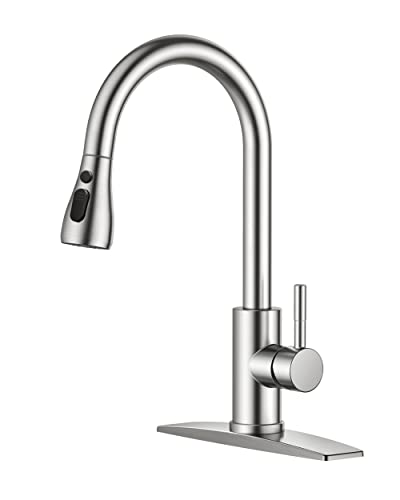
FORIOUS Kitchen Faucet with Pull-Down Sprayer, Brushed Nickel, High Arc
Badge: Best Classic Manual (Prose-Only)
Strengths
- A classic high-arc silhouette in brushed nickel stainless steel, the most conventional and broadly compatible design in this pool
- The listing names an unusually wide range of homes for it: farmhouse kitchens, campers, laundry rooms, RVs and bars
- Single handle plus deck plate makes it a straightforward like-for-like replacement on 1- or 3-hole decks
Trade-offs
- The specification is deliberately mainstream; shoppers wanting sensor tech or multiple spray modes should look at other picks
- No spray-mode count or certification line is stated in the listing summary
- High-arc clearance cuts both ways: tall pots fit, low cabinets may not
| Type | Pull-down sprayer kitchen faucet |
| Finish | Brushed nickel |
| Body | Stainless steel |
| Arc | Classic high arc |
| Handle | Single handle |
| Mounting | Deck plate for 1 or 3 hole |
| Named uses | Farmhouse, camper, laundry, RV and bar sinks |
The FORIOUS is a brushed nickel stainless steel pull-down faucet with a classic high arc, a single handle and a deck plate for 1- or 3-hole decks, and its listing aims it at farmhouse kitchens, campers, laundry rooms, RVs and bar sinks. It is the pool’s traditionalist: no sensor, no mode dial theatrics, just the high-arc pull-down format that became the default American kitchen faucet over the last decade. For a replacement buyer who wants the known quantity in a familiar finish, that restraint is the recommendation.
The FORIOUS opens this guide as the honest baseline: a classic high-arc pull-down with a single handle and not a sensor anywhere in its listing. Its prose review sets the standard the linked pick must beat, and for many kitchens it will not be beaten: no power, no sensing zone, no learning curve for guests. It is here so the sensor decision is made against the best manual case, not against a straw man, and it leaves without a link because this keyword belongs to a technology it does not claim.
Best for: Traditional replacement buyers wanting a classic high arc / Not suited for: Feature hunters wanting sensors or multiple modes
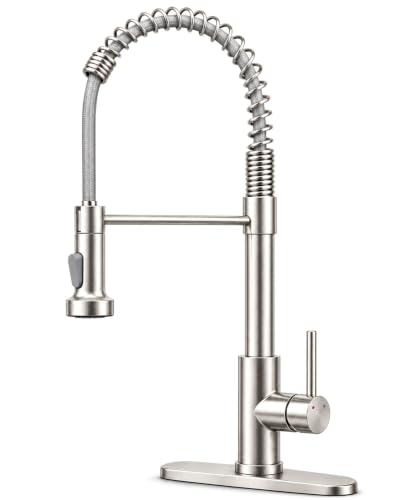
OWOFAN Kitchen Faucet with Pull-Down Sprayer, Brushed Nickel, Spring Design
Badge: Best Spring Manual (Prose-Only)
Strengths
- The exposed spring design is the defining semi-professional gesture: the sprayer docks in a coil you can aim and flex like a chef’s station faucet
- Lead-free, NSF certified stainless steel is stated plainly in the listing, the water-contact claim that matters most
- One handle and a 1- or 3-hole deck plate keep installation in ordinary replacement territory despite the dramatic looks
Trade-offs
- The spring silhouette is tall and industrial; it dominates a small or traditional kitchen visually
- A spring coil collects kitchen grease in its turns and needs a deliberate wipe-down routine
- The listing summary does not state spray modes, so this review promises none
| Type | Spring kitchen faucet with pull-down sprayer |
| Finish | Brushed nickel |
| Handle | 1 handle |
| Body | Lead-free stainless steel, NSF certified per listing |
| Mounting | 1- or 3-hole deck plate |
| Named uses | Farmhouse, RV, bar and laundry room sinks |
The OWOFAN is the pool’s true spring faucet: a brushed nickel, lead-free NSF certified stainless steel design with one handle, a pull-down sprayer carried in an exposed spring, and a deck plate for 1- or 3-hole decks, aimed at farmhouse, RV, bar and laundry sinks. The spring is not decoration. It is the working architecture borrowed from professional kitchens, letting the spray head travel and hold angles a fixed arc cannot, then dock back into the coil. That flexibility, in a certified lead-free body, is why it anchors guides built around working, flexible faucets.
The OWOFAN is the pool’s spring faucet, and its presence in a sensor guide makes a useful distinction: spring describes how the sprayer travels, sensor describes how the water starts, and a faucet can have either, both or neither. This one has the spring only. Its certified lead-free body and flexible docking make it the strongest manual alternative for working cooks, reviewed in prose because the keyword’s technology is absent from its listing, however good its mechanics are.
Best for: Cooks wanting genuine spring-faucet flexibility and certified materials / Not suited for: Small traditional kitchens or low-effort cleaning routines
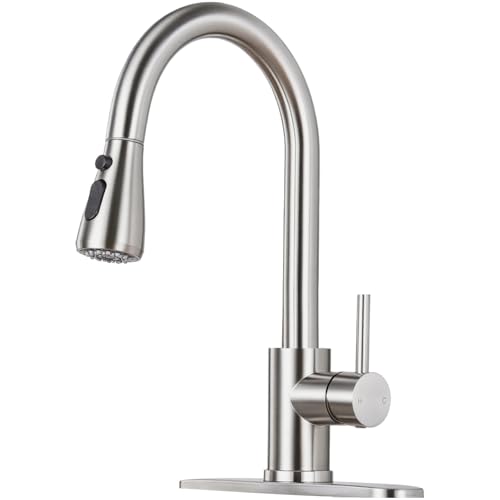
FEELSO Kitchen Faucet with Pull-Down Sprayer, Brushed Nickel, High Arc
Badge: Best Certified Manual (Prose-Only)
Strengths
- Lead-free NSF certified stainless steel stated in the listing gives it the same water-contact footing as the pool’s best-specified picks
- A high arc and single handle in a 1- or 3-hole format is the flexible mainstream configuration
- The listing’s named uses run from farmhouse kitchens to RVs, a breadth the deck format supports
Trade-offs
- No spray-mode count, swivel figure or cartridge type is stated in the listing summary, and this review invents none
- A newer brand name; the certified-materials claim is the reason to shortlist it, not brand history
- High-arc proportions need the usual vertical clearance check
| Type | Pull-down sprayer kitchen faucet |
| Finish | Brushed nickel |
| Body | Lead-free stainless steel, NSF certified per listing |
| Arc | High arc |
| Handle | Single handle |
| Mounting | 1 or 3 hole |
| Named uses | Farmhouse, laundry, RV and bar sinks |
The FEELSO is a brushed nickel high-arc pull-down faucet in lead-free, NSF certified stainless steel with a single handle and a 1- or 3-hole fit, positioned for farmhouse kitchens, laundry rooms, RVs and bar sinks. Its listing is sparing with secondary detail, stating no mode count or swivel figure, and this review follows that discipline. What it does state is the foundation: certified lead-free stainless construction in the format most replacement buyers need. In a category where the invisible material quality outlasts every visible feature, that is a defensible reason to buy.
The FEELSO’s claim on a reader is its certified lead-free stainless construction, stated plainly where many listings gesture. In a sensor guide it is prose-only for the simple reason that nothing in its listing describes a sensor. Its review exists because sensor shoppers still care what touches their water, and because some will conclude, correctly for their households, that certified materials and manual certainty beat electronics. That conclusion deserves a well-described faucet to land on.
Best for: Material-conscious buyers wanting a certified high-arc pull-down / Not suited for: Shoppers who want every secondary spec published
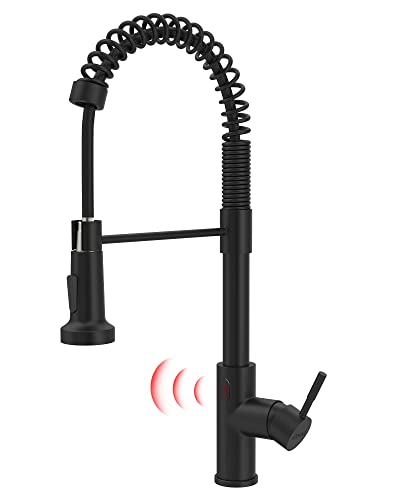
GIMILI Matte Black Touchless Kitchen Faucet with Spring Pull-Down Sprayer
Badge: Best True Sensor Pick
Strengths
- True motion-sensor, hands-free operation is stated outright in the listing, the defining technology of sensor faucet shopping
- It combines the sensor with a spring pull-down sprayer, the two most working-kitchen features in one unit
- Single-hole installation and a single handle keep the deck simple despite the technology
Trade-offs
- Matte black is a commitment finish that must agree with the rest of the kitchen
- Sensor faucets add power and electronics to maintain; the listing summary does not state the power arrangement
- The modern farmhouse spring look is assertive for a quiet traditional kitchen
| Type | Touchless kitchen faucet, spring pull-down sprayer |
| Finish | Matte black |
| Operation | Motion sensor activated, hands-free smart control |
| Handle | Single handle |
| Mounting | Single hole installation |
| Named style | Modern farmhouse kitchen sink use |
The GIMILI is a matte black touchless kitchen faucet whose listing states its technology plainly: motion sensor activated, hands-free smart control, with a spring pull-down sprayer, a single handle and single-hole installation in a modern farmhouse style. It is the rare unit that combines the two features working cooks ask for together, sensor operation for messy hands and a spring sprayer for flexible rinsing. Its review carries the standard sensor caveat honestly: electronics and power become part of faucet ownership in a way a manual cartridge never demands.
The GIMILI is the guide’s reason to exist: a matte black touchless faucet whose listing states motion sensor activation and hands-free smart control outright, paired with a spring pull-down sprayer and a single handle that keeps manual control in the design. Wave to start, wave to stop, handle when you prefer the handle. Its honest costs are the format’s costs, power to maintain and a sensing zone to keep clear, and its review carries both. Among six listings, this is the one the keyword actually describes.
Best for: Sensor-first buyers who also want a spring sprayer / Not suited for: Manual-simplicity seekers or chrome and nickel kitchens
Comllen Kitchen Faucet with Pull-Out Sprayer, Brushed Nickel
Badge: Best Compact Manual (Prose-Only)
Strengths
- The low-profile, small-format body is the honest answer for sinks under low cabinets or window sills where a high arc simply does not fit
- Brushed nickel over stainless steel is the finish-and-material pairing most kitchens in this guide are shopping for
- A pull-out sprayer on a single-hole mount with a deck plate covers both modern single-hole sinks and older decks without extra parts
Trade-offs
- Low profile means less clearance under the spout for tall stockpots than any high-arc pick here
- A pull-out hose travels through the spout body, so under-sink clearance for the hose loop matters
- A smaller brand name than the Delta, Moen or hansgrohe listings in these guides, so judge the specification rather than the badge
| Type | Pull-out sprayer kitchen faucet |
| Finish | Brushed nickel |
| Body | Stainless steel |
| Handle | Single handle |
| Profile | Low profile, small-faucet format |
| Mounting | Single hole, deck plate included |
The Comllen is a brushed nickel stainless steel kitchen faucet built around a pull-out sprayer, a single handle and a deliberately low, small profile, mounting through a single hole with a deck plate in the box. Its design premise is restraint: not every kitchen wants or can fit a tall arc, and this faucet is shaped for the ones that cannot. The pull-out head still gives directed rinsing around the basin, the single handle keeps temperature and flow on one control, and the brushed finish hides the water spots that polished finishes advertise.
The Comllen serves the small, low-clearance kitchens a sensor spring faucet would overwhelm, and its prose review makes that proportion argument plainly. It has no sensor, and in this guide that sentence ends the linking question while starting a useful one: whether your kitchen’s real constraint is dirty hands or low cabinets. If it is the cabinets, this compact pull-out is a better answer than the keyword’s technology, and an honest guide should be able to say so.
Best for: Compact kitchens, low-clearance sinks and single-hole replacements / Not suited for: Anyone who needs high-arc clearance for tall pots
hansgrohe Talis S Single-Handle Kitchen Faucet, Chrome, Pull-Out Sprayer
Badge: Best Premium Manual (Prose-Only)
Strengths
- hansgrohe is the engineering-led name in this pool, and the Talis S is a long-running line rather than a marketplace experiment
- A pull-out sprayer in a single-handle body is the compact, proven format for smaller sinks and secondary kitchens
- Chrome is the easiest finish to match with existing chrome hardware and appliances
Trade-offs
- Chrome shows water spots and fingerprints more readily than any brushed finish here
- The listing summary states no material grade, mode count or certification line, so none is claimed
- In brushed-nickel guides it is the deliberate finish exception, not a match
| Type | Pull-out sprayer kitchen faucet |
| Finish | Chrome |
| Handle | Single handle |
| Brand | hansgrohe Talis S line |
| Model | 06462000 |
The hansgrohe Talis S, model 06462000, is a chrome single-handle kitchen faucet with a pull-out sprayer from one of the most established names in European faucet engineering. Its case rests on design maturity: the Talis S format has been refined across a long production life, and the pull-out head keeps the body compact while still reaching around a basin. Chrome is both its distinction and its compromise, bright and easy to match, less forgiving of water spots than brushed finishes, and in finish-specific guides it must be judged as the alternative it is.
The hansgrohe Talis S closes the pool with the establishment case: a long-running chrome pull-out from an engineering-led brand, entirely manual. It is prose-only here because heritage is not a sensor. Its review serves the reader who arrives curious about touchless technology and leaves valuing proven mechanics more, a legitimate journey this guide respects. In guides built on other briefs the Talis S earns links on its merits; in this one, the keyword is a technology, and the technology is not in its listing.
Best for: Brand-led buyers wanting a proven pull-out in chrome / Not suited for: Brushed-nickel matchers or spot-free finish seekers
Comparison Table
The trait column separates the one stated sensor technology from five sets of manual virtues, so the comparison cannot be misread as six versions of the same thing.
| Pick | Badge | Standout trait | Watch out for | Amazon |
|---|---|---|---|---|
| FORIOUS Kitchen Faucet with Pull-Down Sprayer, Brushed Nickel, High Arc | Best Classic Manual (Prose-Only) | Classic high arc, deck plate, wide named uses | Mainstream spec; no modes or certs stated | Prose-only |
| OWOFAN Kitchen Faucet with Pull-Down Sprayer, Brushed Nickel, Spring Design | Best Spring Manual (Prose-Only) | Exposed spring design, lead-free NSF certified | Tall industrial look; coil needs wiping | Prose-only |
| FEELSO Kitchen Faucet with Pull-Down Sprayer, Brushed Nickel, High Arc | Best Certified Manual (Prose-Only) | Lead-free NSF certified stainless, high arc | Sparse secondary specs in listing | Prose-only |
| GIMILI Matte Black Touchless Kitchen Faucet with Spring Pull-Down Sprayer | Best True Sensor Pick | Motion sensor plus spring sprayer, matte black | Power and electronics upkeep; bold finish | Check on Amazon |
| Comllen Kitchen Faucet with Pull-Out Sprayer, Brushed Nickel | Best Compact Manual (Prose-Only) | Low-profile pull-out in brushed nickel, single hole | Limited spout clearance; hose loop needs under-sink room | Prose-only |
| hansgrohe Talis S Single-Handle Kitchen Faucet, Chrome, Pull-Out Sprayer | Best Premium Manual (Prose-Only) | Established hansgrohe line, chrome pull-out | Chrome shows spots; finish differs from brushed picks | Prose-only |
How to Choose a Sensor Kitchen Faucet
Shopping best sensor kitchen faucets starts with a definition, because the word sensor is used loosely in listings. A true sensor faucet starts and stops water from a motion sensor, hands-free, while you hold a chicken, a dough-covered bowl or a wriggling toddler. A faucet with a sensor-shaped bump and a manual soul is not that product. Read listings for the operational claim itself, motion activated, hands-free control, and treat anything vaguer as a manual faucet until proven otherwise.
Power is the second question, and the one listing summaries answer worst. Sensor faucets run on batteries, a mains adapter, or both, and the arrangement decides where the control box lives under your sink and what you will maintain in year three. If a listing does not state the power arrangement plainly, that silence is information: put the question to the product page before ordering, and prefer designs whose power story is published rather than discovered.
The manual override matters more than any demonstration video admits. Every sensor faucet should still work as a faucet when the sensor is sleeping, the batteries are flat or a guest cannot find the sensing zone. A proper single-handle manual control alongside the sensor is the mark of a design that respects real kitchens. Judge the picks here partly on that fallback, because the day you need it, you will need it with wet hands and no patience.
Underneath the electronics, judge the faucet as a faucet. Body material, cartridge, sprayer mechanics and mounting decide the decade; the sensor decides the delight. A certified lead-free stainless body with a sound cartridge will outlast several generations of sensor modules, and the sprayer, spring or pull-down in these picks, does the daily work. Buy the plumbing first and the technology second, in that order, and sensor ownership goes well.
Finally, consider who cooks. Sensor operation shines for messy, frequent, multi-tasking cooks and for households managing mobility or grip difficulties, where a wave is easier than a lever. It adds little for a careful cook who rarely touches the handle with dirty hands, and it adds a maintenance item either way. That honest self-assessment, more than any feature list, is what separates delighted sensor owners from annoyed ones.
How to Install and Use a Sensor Faucet Day to Day
A sensor faucet installs like a normal faucet plus one extra resident under the sink: the control and power unit. Plan its position before you begin, clear of the disposal, the hose loop and anything you store there, because you will visit it when batteries or settings need attention. The sequence below covers the standard single-hole or deck-plate installation.
- Shut off both supplies, drain and remove the old faucet, and clean the deck flat; fit the deck plate if the new unit covers spare holes.
- Mount the new faucet body and connect the supply lines as with any single-handle faucet, keeping the sensor wiring or control lines untrapped.
- Fit the control box and power source in the planned spot under the sink, with slack in every line and nothing resting on the wiring.
- Route the sprayer hose in a clear loop, turn the water on slowly, and check every joint with a dry hand before testing the electronics.
- Test the sensor with wet and dry hands, at different heights and speeds, and learn its sensing zone deliberately rather than by accident at dinner time.
- Test the manual override with the sensor undisturbed, so every adult in the house knows the faucet still obeys the handle.
Daily use rewards a small amount of choreography. Keep the sensing zone in mind when you park items on the deck, since a bottle stored in front of a sensor can cause both missed starts and ghost starts. Wipe the sensor window when you wipe the faucet; a grease-filmed sensor is a sensor on its way to seeming broken.
Treat the power source like the smoke-detector battery it resembles: note when it was fitted, and replace on schedule rather than at the moment of failure. The manual override will carry you through a flat battery without drama, but needing it daily defeats the purpose of the purchase.
Troubleshooting
Problem: the faucet starts when nobody is near it → check what sits in the sensing zone; reflective items and stored bottles near the sensor are the usual culprits, and moving them ends most ghost starts.
Problem: the sensor stops responding → wipe the sensor window first, then check the power source; a filmed window and a flat battery explain nearly every case.
Problem: water runs but weakly in sensor mode → clean the aerator and nozzle face for mineral build-up, exactly as with a manual faucet, before suspecting the electronics.
How to Read a Sensor Faucet Listing Without Being Fooled
Manufacturers know sensor is a search word, so it migrates into titles and bullet points attached to faucets whose operation is entirely manual. The reliable test is grammatical: look for the verb. Motion sensor activated, hands-free operation, starts with a wave: those are operational claims. Sensor-ready, smart design, touchless style: those are adjectives in search of a mechanism. The GIMILI’s listing passes the verb test in its title alone, which is why it stands linked here and the others do not.
Apply the same reading to power. A true sensor faucet must say, somewhere in its full listing, how it is powered, because it cannot work otherwise. A listing that never mentions power is telling you the sensor story is incomplete. Readers comparing the neighbouring technology brief can see the same discipline applied in Best Quality Single Kitchen Faucets.
The Kitchens Sensors Genuinely Transform
Sensor operation is not a universal upgrade; it is a targeted one. It transforms the kitchen where raw meat, bread dough, gardening soil and toddler hands meet the faucet daily, because those are the moments a handle is a contamination problem and a wave is a solution. It also serves cooks managing grip or mobility difficulties, for whom a lever’s resistance is a real barrier a sensor simply removes.
The kitchens it does not transform are equally identifiable: the careful cook who rarely dirties the handle, the household that will resent battery changes, the deck where bottles permanently crowd the sensing zone. For those readers this guide’s prose picks, a classic high arc, a compact pull-out, an established chrome design, are not lesser choices. They are the correct ones, and Best Ranked Kitchen Faucets Motionsense covers their family in full.
The cartridge is the faucet’s long-term fate. It is the part that meters every temperature adjustment and seals every shut-off, and it is the part that will eventually be replaced. Faucets built on widely used cartridge patterns, ceramic cartridges in particular, are simply easier to keep alive for a second decade, because the replacement part stays findable. When a listing names its cartridge type, that is a manufacturer expecting to be judged on longevity, and this guide treats it that way.
Deck thickness is the specification nobody measures and everybody should. Stone counters, undermount sinks with thick decks and added filtration holes all change whether a faucet’s mounting hardware can clamp properly. A faucet that fits a thin stainless deck may need an extension kit on a thick stone one. Checking the manufacturer’s stated maximum deck thickness against your own counter takes two minutes with a tape measure and prevents the most avoidable return in the category.
Finish care is simpler than the internet makes it sound. Brushed and stainless finishes want a soft cloth, mild soap and drying after heavy use in hard-water homes; abrasive pads and vinegar soaks are how finishes get damaged by their owners rather than by the water. Polished chrome tolerates a little more enthusiasm but records every fingerprint in the meantime. None of the picks in this guide needs exotic care, but all of them reward the thirty-second wipe that keeps mineral crust from taking hold around the base.
Think about the hose before the handle. On pull-down and pull-out models the hose lives under the sink, looping among cleaning bottles, disposal housings and water filters, and its freedom to travel decides whether the sprayer retracts cleanly or snags for years. Clearing a path for the hose loop during installation, and keeping stored bottles out of its swing, is the cheapest performance upgrade in this entire category and it costs nothing but ten minutes of tidying.
A note on spray modes, since several picks here offer three: the modes earn their keep in different sinks. The aerated stream fills pots without splashing, the wider spray rinses a basin’s corners, and any boosted or blade-style setting is for stuck food and nothing else. Households that mostly fill and rinse will live on the first two and should not pay a premium for exotic patterns; households that cook from scratch daily will use all three before the first week is out.
Installation realism matters more than installation marketing. A first-time installer working under a familiar sink, with the water shut off and the old faucet cooperative, can swap a modern single-hole or deck-plate faucet in a relaxed morning. A corroded twenty-year-old fitting changes that arithmetic completely, and there is no shame in the plumber’s number for that job. The faucet is not the expensive part of a bad installation; the leak discovered months later is.
Finally, a word about matching the rest of the room. A kitchen faucet is the most-touched fixture in the house and one of the most seen, sitting at eye level against the window or the backsplash. Finish families matter more than exact shade matching: brushed nickel, stainless and Spot Resist style finishes coexist happily, while a single polished chrome or matte black piece in an otherwise brushed room reads as deliberate only when it is repeated somewhere, in cabinet hardware, a light fixture or the soap dispenser beside it.
Water pressure deserves a plain word in any faucet guide, because it changes how every pick behaves. A pull-down sprayer that feels decisive in a house with strong municipal pressure can feel merely adequate on a well system or an upper floor, and the aerator and spray face are where that difference shows first. Before blaming a new faucet for a weak stream, check the aerator for construction debris after installation; a surprising share of weak-flow complaints are grit caught in the first week, not a defect in the faucet.
Think about who else uses the sink before you finalise the choice. A faucet is operated by everyone in the house, including the grandparent with arthritic hands, the teenager filling a bottle at midnight and the guest who has never met your sensor’s sensing zone. The most democratic designs, a lever that moves with two fingers, a sprayer that docks without a trick, a temperature arc that reads intuitively, succeed because nobody has to be taught them. Specialised designs can still be right, but choose them knowing who pays the learning cost.
The under-sink cabinet is part of the faucet whether listings admit it or not. Filtration systems, disposals, instant-hot tanks and the cleaning-bottle archive all compete for the same cubic foot the hose loop and control boxes need. Before ordering any model with extras, a sensor unit, a dispenser bottle, an oversized mounting assembly, open the cabinet and honestly survey the territory. Ten seconds of looking prevents the most common installation improvisation, which is the hose loop shortened by furniture it was never meant to meet.
Warranty language deserves the same close reading as the specification. What matters is not the headline duration but the coverage shape: whether the cartridge is included, whether the finish is covered separately, and whether the claim route runs through the maker or the marketplace seller. Established brands publish this plainly because it is part of their offer. Value brands vary, and a short, clear warranty honestly stated is worth more than a long one written to be admired rather than used.
Consider the second faucet effect. Kitchens increasingly have two water points, the main sink and a prep, bar or island station, and the two faucets will be compared daily by everyone who uses both. Matching finish families across the pair reads as design; matching the control philosophy reads as mercy, since nobody should have to remember which sink waves and which one levers. If a second station is even a future possibility, the choice you make at the main sink is quietly a choice about that one too.
Sound is the unlisted specification. A faucet’s stream striking a thin stainless basin at full pressure can be startlingly loud, while the same stream into a deep, damped sink is a murmur. Aerated streams soften both the sound and the splash, which is one reason they remain the default pattern on every pick in these guides. If your sink is shallow or your kitchen is open to a quiet room, weight the aerated stream and the gentler spray patterns more heavily than the mode count suggests.
There is a right way to think about price tiers without a single price in this guide, which is by what the tiers buy in this category. The lower tier buys the format with thinner documentation; the middle buys stated materials, cartridges and certifications; the upper tier buys those plus brand infrastructure, service networks, stocked parts and design iteration. None of the tiers buys immunity from a bad deck fit or a strangled hose. Spend first on the tier where the documentation appears, then on the brand if the decade matters to you.
Common Buying Mistakes
Sensor faucets punish vague shopping more than any other faucet type. These mistakes account for most disappointed owners of best sensor kitchen faucets.
- Buying a faucet described with sensor-adjacent words that is, on inspection, a manual faucet with styling.
- Never asking how the unit is powered until the control box is in your hands under the sink.
- Choosing a sensor model with no confident manual override for guests, children and flat-battery days.
- Letting the electronics excuse a weak foundation: an uncertified body or unknown cartridge under a clever sensor.
- Parking bottles and sponges permanently in the sensing zone, then blaming the faucet for erratic behaviour.
Notice what these mistakes have in common: none of them is about taste, and all of them are cheap to avoid before the purchase and annoying to fix after it. The faucet itself is rarely the problem in a disappointing installation. The unmeasured deck, the uncounted holes and the unconsidered hose path are. Ten minutes with a tape measure and a phone torch under the sink will do more for your satisfaction than another hour of reading reviews, including these ones.
Final Recommendation
If you came for a sensor faucet, buy the one that is one: the GIMILI, motion-activated and hands-free by its listing’s own words, with a spring sprayer and a manual handle for the days electronics rest. It is the only pick linked in this guide, deliberately. If the prose reviews have persuaded you that your kitchen is a manual kitchen, the classic FORIOUS high arc and the certified FEELSO are the strongest of those alternatives, bought with clear eyes.
Start your shortlist with GIMILI Matte Black Touchless Kitchen Faucet with Spring Pull-Down Sprayer — the linked picks that cover the widest range of readers in this guide — then use the detailed reviews above to narrow to the one that fits your sink, your deck and your daily routine.
Frequently Asked Questions
How does a sensor kitchen faucet actually work?
A motion sensor, usually near the base or spout, detects a hand or object in its zone and signals a solenoid valve to open the water; removing the hand closes it. The handle typically sets temperature and provides manual override. The GIMILI in this guide states the arrangement plainly in its listing: motion sensor activated, hands-free smart control, with a single handle alongside.
What happens when the power fails?
A well-designed sensor faucet keeps working manually through its handle, which is why this guide treats the override as a core feature rather than a footnote. The sensor rests until power returns. If a listing cannot tell you how the faucet behaves without power, treat that as a reason to choose a different model.
Are sensor faucets hygienic?
They remove the dirtiest touch in cooking: turning water on and off with hands covered in raw meat, dough or garden soil. That is a genuine hygiene benefit at the exact moment it matters. The faucet still needs normal cleaning, and the sensor window needs wiping like any other surface in a working kitchen.
Do sensor faucets waste water?
Used as intended, they save it: water runs while hands or dishes are in the zone and stops when they leave, instead of running through a whole hand-wash or rinse sequence. Ghost starts from items parked in the sensing zone are the waste case, and they are prevented by keeping the zone clear.
Can children and guests use one easily?
Guests manage once shown the zone, and children usually master it faster than adults. The manual handle remains the universal fallback, which is why this guide insists on it. Households with frequent elderly guests sometimes prefer a conventional single-handle faucet, and that is a legitimate choice rather than a failure of nerve.
Is a sensor faucet harder to install?
The plumbing is standard; the addition is the control and power unit under the sink, which needs a planned, dry, accessible spot. Allow a little extra time, keep wiring clear of the disposal and hose loop, and the job stays within confident DIY territory for a straightforward replacement.