Disclosure: topratedkitchenware.com is reader-supported. When you buy through links on our site, we may earn an affiliate commission from Amazon and other retailers, at no extra cost to you.
Where to buy
The six models below are the verified picks for this guide. Each name links to its Amazon listing, where you can check the latest price on Amazon, confirm the current configuration, and read the newest owner feedback before you decide.
- EAST OAK 30-Inch Electric Smoker with Mobility Stand, Polar Night
- Royal Gourmet SE2805 28-Inch Electric Smoker
- Traeger Pro 22 Wood Pellet Grill and Smoker
- Pit Boss 700 Carbon Series Wood Pellet Grill and Smoker
- Pit Boss 500 Carbon Series Wood Pellet Grill and Smoker
- Pit Boss 850 Navigator Series WiFi and Bluetooth Wood Pellet Grill and Smoker
Read the full guide ↓ for what “set and forget” honestly means at each level of automation, the limits of every pick, and the routine that makes hands-off smoking actually work.
The best set and forget smokers exist because of a simple truth about barbecue: the food needs hours, but the cook has a life. Traditional smoking asks for continuous attendance — a fire checked, fed, and adjusted from the first hour to the last. Set-and-forget smoking replaces that vigil with systems: a heating element or an auger-fed wood fire, governed by a thermostat or a digital controller, holding your chosen temperature while you sleep, work, or watch the game. This guide ranks six verified machines by how completely they deliver that promise, and it is honest about the spectrum. At one end sits a WiFi-connected pellet grill with a 30 lb hopper that can report to your phone across a genuinely long cook. At the other sits an analog electric cabinet with one dial — no automation in the electronic sense, but so simple and steady that “forgetting” it for hours at a time is exactly how owners use it.
Both fuel families in this guide qualify for the set-and-forget label in the true sense of the term, and it is worth saying why. An electric smoker holds temperature because a thermostat cycles its element against a set point — you set it, and the machine does the holding. A pellet smoker holds temperature because a digital controller meters wood pellets into a fire pot at exactly the rate the temperature demands — you set it, and the machine does the feeding and the holding. In both cases the temperature control is automatic and evidenced in each model’s verified listing data: digital controllers, thermostatic dials, timers, probes, and hoppers sized for long unattended runs. What differs between the six picks is how much else they automate — smoke supply, doneness monitoring, remote oversight — and how long they can run before a human needs to glance at them.
The ranking below weights three things: temperature autonomy (how precisely and reliably the machine holds a set point without you), supply autonomy (how long its fuel or chip load lasts before intervention), and information autonomy (whether the machine tells you what you need to know — through a probe, a display, or your phone — instead of making you open a door to find out). A smoker that scores on all three is one you can genuinely set and forget. A smoker that scores on the first alone is one you can set and mostly forget, checking in on a schedule. Both are legitimate; the guide labels which is which, pick by pick.
Key Takeaways
- Set-and-forget performance rests on automatic temperature control: every pick here holds its temperature by thermostat or digital controller, which is the verified evidence behind the label.
- The Pit Boss 850 Navigator is the most complete automation package in the pool — WiFi and Bluetooth monitoring, an LCD digital controller, a meat probe, and a 30 lb hopper for the longest unattended runs.
- Electric cabinets automate differently: no fire to feed at all, and the EAST OAK’s side chip loader stretches a single smoke load up to six times longer so even the smoke supply needs little attention.
- Hopper and chip-load size are the real “forget” limits: 13.5 lb hoppers need a mid-cook check on the longest sessions; 18 lb and 30 lb hoppers push that check much later.
- Built-in meat probes are the second half of forgetting — they replace door-opening with information, on the EAST OAK Polar Night, the Traeger, and all three Pit Boss models.
- The analog Royal Gourmet is the honest exception: one dial, no electronics, steady enough to leave for hours — set and forget by simplicity rather than by automation.
In this guide
Quick Picks
| Pick | Badge | Format | Area / supply | Automation highlight | Link |
|---|---|---|---|---|---|
| EAST OAK 30-Inch Electric Smoker, Polar Night | Best Electric Set-and-Forget | Electric vertical on stand | 725 sq in | Built-in probe; side loader runs up to 6x longer per load | Check on Amazon |
| Royal Gourmet SE2805 28-Inch Electric Smoker | Best Budget Simplicity | Electric vertical | 454 sq in | Analog dial, 1350W element, almost nothing to fail | Check on Amazon |
| Traeger Pro 22 Wood Pellet Grill and Smoker | Most Versatile | Wood pellet grill-smoker | 572 sq in; 18 lb hopper | Controller-fed wood fire; meat probe; 6-in-1 modes | Check on Amazon |
| Pit Boss 700 Carbon Series | Best Mid-Size Pellet | Wood pellet grill-smoker | 718 sq in; 13.5 lb hopper | LCD digital controller, 180°F to 500°F | Check on Amazon |
| Pit Boss 500 Carbon Series | Best Compact Pellet | Wood pellet grill-smoker | 543 sq in; 13.5 lb hopper | LCD digital controller in the smallest pellet footprint | Check on Amazon |
| Pit Boss 850 Navigator Series | Best for Longest Unattended Cooks | Wood pellet grill-smoker | 932 sq in; 30 lb hopper | WiFi and Bluetooth monitoring plus LCD controller | Check on Amazon |
How These Picks Were Chosen
Every pick was verified against its listing data, and admission to this guide required one specific kind of evidence: automatic temperature control stated or clearly embodied in the verified title. The pellet picks state digital controllers — LCD digital controllers on all three Pit Boss models, controller-fed operation with a meat probe on the Traeger — which is the strongest form of the evidence: a machine that senses temperature and meters fuel to hold it. The EAST OAK Polar Night pairs thermostatic electric heat with a built-in meat probe and a long-duration side chip loader. The Royal Gourmet SE2805 states analog temperature control with adjustable heat; it is included with its limitation stated openly in its review, because a thermostatic dial on a small, well-powered electric cabinet does hold temperature without attendance — it simply does so with less precision and no remote information.
Ranking then weighed the three autonomies described in the introduction. Supply autonomy was scored from verified figures only: hopper capacities of 13.5, 18, and 30 lb on the pellet side, and the EAST OAK’s up-to-six-times-longer chip load on the electric side. Information autonomy was scored from probes and connectivity actually stated in the titles — no app features, alerts, or integrations were assumed for models whose data does not mention them. Where a figure is not in the verified data, the guide does not invent it: you will find no claimed temperature-swing tolerances, no burn-rate numbers, and no runtime hours anywhere in this article, because none were verified. The judgments are therefore about architecture — what each machine is built to automate — rather than about fabricated measurements.
This is research-led guidance, not a hands-on endurance test, and the honesty rules of the series apply throughout: no prices, no fixed ratings, no invented specifications. If you are comparing this automation-first view with the broader market, our main guide to the category’s popular models and the loading-geometry discussion in Best Side Box Smokers provide useful counterpoints — the latter covering the manual firebox designs that sit at the opposite, fully attended end of the smoking spectrum.
The 6 Best Set and Forget Smokers, Ranked by How Completely They Let You Walk Away
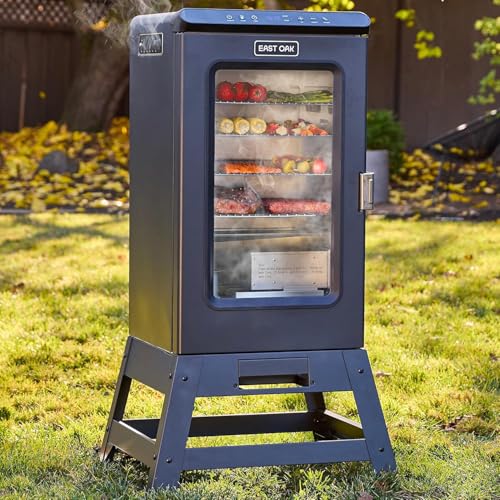
EAST OAK 30-Inch Electric Smoker with Mobility Stand, Polar Night
Badge: Best Electric Set-and-Forget
Strengths
- No fire to manage at all: the element holds temperature thermostatically while chips smolder.
- Side chip loader stretches one load up to six times longer — the smoke supply is automated in effect.
- Built-in meat probe reports doneness without a door opening.
Trade-offs
- No connectivity in the verified data: checking in means walking to the cabinet, not glancing at a phone.
- Chip smoke is milder than pellet smoke, and even a long load ends eventually on overnight cooks.
- The mobility stand adds footprint; this is a station machine, not a store-it-in-a-corner machine.
Mini spec box
- Format: 30-inch outdoor electric smoker on mobility stand
- Cooking area: 725 sq in
- Monitoring: built-in meat probe
- Smoke system: side chip loader, up to 6x longer uninterrupted smoke
- Finish: Polar Night
The electric path to set-and-forget is conceptually the purest: remove the fire entirely. With no combustion to feed, the only variables are the element’s thermostat, the chip supply, and the meat — and this EAST OAK variant addresses all three. The thermostat holds the cabinet; the side loader stretches the chip supply to as much as six times a standard tray’s run, reloadable from outside without dumping heat; the probe watches the meat. What remains for the cook is the genuinely human part: choosing the wood, timing the wrap, judging tenderness at the end. For overnight cooking, an electric cabinet also carries a quiet psychological advantage many owners cite — there is no live fire on the patio while the house sleeps.
The stand deserves its sentence in an automation guide because forgetting is easier when checking is pleasant: a cabinet at working height gets its probe read and its chips topped up without the crouch that makes owners postpone both. The honest ceiling of this pick is information range. Without WiFi or Bluetooth in its verified data, its automation ends at the patio door. If your version of forgetting involves leaving the house, the connected pellet pick below is your machine. If your version is a Saturday reclaimed while the smoker works ten steps away, this is the simplest complete answer in the guide.
Best for: overnight and all-day cooks who want zero fire management with probe monitoring / Not suited for: cooks who want to monitor a cook from across town

Royal Gourmet SE2805 28-Inch Electric Smoker
Badge: Best Budget Simplicity
Strengths
- One analog dial and a strong 1350W element: set the dial, and the small cabinet holds its range steadily.
- Almost no electronics means almost no automation failure modes — the system cannot crash, disconnect, or need an update.
- Compact 454 square inch cabinet heats and recovers quickly, suiting shorter unattended sessions.
Trade-offs
- Analog control holds a range, not a set point; this is “set and check occasionally,” the lightest form of forgetting in this guide.
- No probe, timer, or connectivity in the verified data — information autonomy is zero.
- Internal chip tray means smoke reloads require opening the door.
Mini spec box
- Format: 28-inch electric vertical smoker
- Cooking area: 454 sq in
- Power: 1350W
- Control: analog temperature control, adjustable heat
- Racks: 3 cooking grates
- Model: SE2805, black
Every set-and-forget guide needs its honesty anchor, and this is it. The SE2805 automates nothing in the digital sense. What it offers instead is the original form of unattended cooking: a small, well-powered electric box whose single dial, once you have learned its personality across a cook or two, holds a working temperature for hours while you do other things. For the category’s most common real sessions — ribs, chicken, a small shoulder, three to five hours — that is genuinely enough forgetting for most households, at the most accessible tier in this guide and with the fewest possible things to go wrong.
Choose it with clear eyes. Long overnight briskets are not its brief; temperature precision is not its claim; and you will open its door to add chips and to check the meat, because it gives you no other way to know. Paired with a basic leave-in thermometer of your own — the subject of our guide to Best Single Probe Thermometer For Smokers — it becomes a perfectly serviceable low-attention smoker. Judged as an automation product it finishes last here; judged as a simple appliance that lets you walk away for an afternoon, it earns its place.
Best for: shorter cooks, small households, and buyers who distrust electronics on principle / Not suited for: overnight cooks or anyone who wants the machine to report back

Traeger Pro 22 Wood Pellet Grill and Smoker
Badge: Most Versatile
Strengths
- Controller-fed wood fire: the auger meters pellets to hold your set temperature automatically.
- 18 lb hopper gives long unattended runs between fuel checks.
- Meat probe included, and 6-in-1 versatility means the automation serves grilling and roasting too.
Trade-offs
- No WiFi or Bluetooth in the verified data — monitoring happens at the grill.
- 572 square inches is mid-sized; crowd cooking needs batching.
- Stated 450°F maximum is the lower ceiling among the pellet picks here.
Mini spec box
- Format: wood pellet grill and smoker
- Cooking area: 572 sq in
- Fuel: wood pellets, 18 lb hopper
- Max temperature: 450°F per listing
- Monitoring: meat probe included
- Modes: grill, smoke, bake, roast, braise, BBQ
The Traeger’s automation story is the pellet format’s founding story: a real wood fire that feeds itself. The controller watches the fire pot’s temperature and turns the auger accordingly, which converts the most labor-intensive part of wood smoking — fire tending — into a setting. Layer the 18 lb hopper on top and the human’s remaining jobs on a long cook reduce to a hopper glance and a probe read. That the same machine grills, bakes, and roasts under the same controller makes it the versatility pick: one appliance to learn, one automation system to trust, across most of what a household cooks outdoors.
Its forgetting limit is range. Without stated connectivity, you cannot verify the cook from the couch, and on a genuinely long session you will visit the patio a few times — to check pellets, to wrap, to admire. Most owners describe that rhythm as the pleasure of the format rather than a chore, but if your definition of set-and-forget includes your phone, the Navigator below is built for you. As a balanced, proven expression of pellet automation, though, the Pro 22 remains the reference point the rest of the category is measured against.
Best for: households wanting one automated wood-fired machine for smoking and everyday grilling / Not suited for: cooks who require remote monitoring

Pit Boss 700 Carbon Series Wood Pellet Grill and Smoker
Badge: Best Mid-Size Pellet
Strengths
- LCD digital controller works across a wide stated range, 180°F to 500°F — precise low smoking and real roasting heat in one system.
- 718 square inches lets big cooks run unattended instead of in batches.
- Meat probe included for the doneness half of the equation.
Trade-offs
- 13.5 lb hopper is the joint-smallest here; the longest cooks need a planned refill check.
- No WiFi or Bluetooth in the verified data.
- Larger footprint than the 500 and the Traeger.
Mini spec box
- Format: wood pellet grill and smoker, Carbon Series
- Cooking area: 718 sq in
- Temperature range: 180°F to 500°F
- Control: LCD digital controller
- Fuel: wood pellets, 13.5 lb hopper
- Monitoring: meat probe included
- Finish: black
The 700’s automation case rests on its controller’s span. A digital system that works from 180°F to 500°F covers the full arc of a cook’s life — the low smoke phase, the long hold, the hotter finish — without the cook ever managing a transition manually. Set the phase, walk away, come back for the next phase. At 718 square inches, that hands-off control extends to genuinely large loads, which is where automation pays best: nobody wants to babysit a fire under a brisket and four racks of ribs, and with this machine nobody has to.
The discipline it asks in return is fuel awareness. Thirteen and a half pounds is a solid reserve, but the longest low-and-slow sessions will outlast a casual glance’s interval — build one hopper check into the middle of any cook past the half-day mark and the machine will never surprise you. It is the mid-size pellet sweet spot in this guide: materially more room than the Traeger and the 500, the same controller class as the Navigator, at the cost of the Navigator’s connectivity and fuel reserve.
Best for: hosts who run big cooks and want digital control across the whole temperature range / Not suited for: buyers who want the longest possible unattended fuel window

Pit Boss 500 Carbon Series Wood Pellet Grill and Smoker
Badge: Best Compact Pellet
Strengths
- The same LCD digital controller class as its bigger siblings, in the smallest pellet footprint here.
- Full stated range of 180°F to 500°F — no automation compromises for the size.
- 13.5 lb hopper matches the 700’s reserve despite the smaller 543 square inch body.
Trade-offs
- 543 square inches is the smallest pellet cooking area in the guide.
- No connectivity in the verified data.
- Compact pellet grills still need pellet storage and power — the footprint shrinks, the routine does not.
Mini spec box
- Format: wood pellet grill and smoker, Carbon Series
- Cooking area: 543 sq in
- Temperature range: 180°F to 500°F
- Control: LCD digital controller
- Fuel: wood pellets, 13.5 lb hopper
- Monitoring: meat probe included
- Finish: black
The 500 answers the buyer who wants pellet automation without pellet-grill sprawl. Its significance is what it does not cut: the controller is the same LCD digital class as the 700’s, the temperature range is the same 180°F to 500°F, the probe is included, and the hopper holds the same 13.5 lb. Only the cooking chamber shrinks, to 543 square inches — still ample for a couple’s brisket, two chickens, or several racks of ribs. For small patios and small households, this is set-and-forget without the storage problem, and it makes the strongest case in the guide that automation is a feature of the control system, not of the machine’s size.
Best for: small patios and small households wanting full pellet automation in a compact body / Not suited for: cooks who regularly feed a crowd in a single session

Pit Boss 850 Navigator Series Wood Pellet Grill and Smoker
Badge: Best for Longest Unattended Cooks
Strengths
- WiFi and Bluetooth connectivity: the only pick here whose verified data lets you monitor the cook remotely.
- 30 lb hopper — by far the largest fuel supply in the guide, built for overnight and all-day runs.
- 932 square inches of cook space under an LCD digital controller, with a flame broiler for direct-heat finishing.
Trade-offs
- The largest footprint and the most systems to learn; overkill for occasional small cooks.
- Connectivity depends on your patio’s signal — automation you cannot reach is automation you will not use.
- Premium tier of this guide, in size and in positioning.
Mini spec box
- Format: wood pellet grill and smoker, Navigator Series
- Cooking area: 932 sq in
- Temperature range: 180°F to 500°F
- Control: LCD digital controller; WiFi and Bluetooth
- Fuel: wood pellets, 30 lb hopper
- Monitoring: meat probe included
- Extra: flame broiler for direct-heat searing
The Navigator is what set-and-forget looks like with every layer switched on. Temperature autonomy: an LCD digital controller across 180°F to 500°F. Supply autonomy: thirty pounds of pellets, more than double the smaller Pit Boss hoppers, sized so that the longest home cooks finish on the fuel you started with. Information autonomy: WiFi and Bluetooth, so the cook reports to your phone — the only machine in this guide whose verified data supports checking a brisket from the grocery store. Add the largest cooking area here and a flame broiler for the finish, and it is the complete expression of the category’s promise.
The caveats are about fit, not function. It is a big machine that rewards a permanent patio spot and a household that cooks at volume; a couple smoking one chicken a month will use a fraction of it. And its signature feature presumes your outdoor space has the signal to support it — test your patio’s WiFi before you pay for connectivity you cannot use. For the cook who hosts, who smokes overnight, who wants the machine to carry the maximum share of the work, this is the guide’s ceiling and its recommendation at the premium end.
Best for: overnight cooks, hosts, and anyone who wants phone-level oversight of long sessions / Not suited for: small spaces, small households, or patios with weak WiFi
Comparison Table
| Pick | Temperature control | Supply autonomy | Monitoring | Area | Link |
|---|---|---|---|---|---|
| EAST OAK Polar Night | Thermostatic electric element | Chip load up to 6x longer, side reload | Built-in meat probe | 725 sq in | Check on Amazon |
| Royal Gourmet SE2805 | Analog dial, adjustable | Internal chip tray | None built in | 454 sq in | Check on Amazon |
| Traeger Pro 22 | Digital controller, auger-fed | 18 lb hopper | Meat probe | 572 sq in | Check on Amazon |
| Pit Boss 700 Carbon | LCD digital, 180–500°F | 13.5 lb hopper | Meat probe | 718 sq in | Check on Amazon |
| Pit Boss 500 Carbon | LCD digital, 180–500°F | 13.5 lb hopper | Meat probe | 543 sq in | Check on Amazon |
| Pit Boss 850 Navigator | LCD digital, 180–500°F | 30 lb hopper | Probe + WiFi/Bluetooth | 932 sq in | Check on Amazon |
How to Choose Your Level of Forgetting
The useful question is not “which smoker is most automatic?” but “what will I actually be doing while it cooks?” If the honest answer is sleeping, weight supply autonomy and monitoring above all: an overnight brisket needs fuel that outlasts the night (the Navigator’s 30 lb hopper, the Traeger’s 18 lb, or the EAST OAK’s long chip load) and a probe that tells you the truth in the morning. If the answer is “pottering around the house and garden,” mid-tier automation suffices — any digital pellet model or the probe-equipped EAST OAK will hold a cook while you check in on your own schedule. If the answer is “sitting on the patio anyway, drink in hand,” the Royal Gourmet’s analog simplicity stops looking like a compromise and starts looking like honesty: you were never going to forget the smoker, you just wanted it to stop demanding things.
Then match the machine to your failure tolerance. Automated systems fail in automated ways — an empty hopper, a lost connection, a tripped breaker — while simple systems fail simply. Every design in this guide also shares one dependency: electricity. Pellet augers, controllers, and electric elements all stop when the power does, so a household with flaky outdoor power should plan cooks accordingly. Finally, consider the information question separately from the control question. A smoker can hold temperature perfectly and still leave you blind; probes are what convert holding into knowing, and readers building their own monitoring setup for an analog machine will find the dedicated options in Best Single Probe Thermometer For Smokers.
How to Run a True Set-and-Forget Cook: The Overnight Brisket Routine
The routine matters as much as the machine. The evening before: fill the hopper completely or load the chip loader fresh, confirm pellets are dry, and place a drip plan under the brisket — automation does not repeal grease. Season the meat, and set it out while the smoker preheats and stabilizes at your smoking temperature for a full twenty minutes; a controller that has settled before the meat goes on will hold a visibly steadier line all night. Insert the probe into the thickest part of the flat, route the cable so the door or lid seals around it as designed, and record your starting point.
Then — the discipline — walk away. Set one planned check at the cook’s midpoint: hopper level, probe trend, nothing else. Resist the unplanned check; every lid opening on a pellet grill and every door opening on a cabinet costs heat the controller must repay, and on a cold night that repayment is the main source of the temperature drama owners blame on their machines. When the stall arrives, as it does on every brisket, your options are the automated cook’s options: wrap without panic, or hold course and let time work. The machine’s job is the temperature; yours is the patience.
Two refinements separate experienced hands-off cooks from hopeful ones. The first is the weather read: wind is the enemy of every controller in this guide, stealing heat from cabinets and grill lids alike, so the overnight setup includes a sheltered placement and, on genuinely cold nights, starting the cook an hour earlier than the recipe’s arithmetic suggests. The second is the fuel margin habit — never begin a long cook on a partial hopper or a half-used chip load, because automation multiplies whatever you give it, including a shortage. Topping up takes two minutes in the evening and removes the single most common cause of a ruined morning. Set-and-forget, done well, is really set-up-well-and-forget: the care moves to the front of the cook, and the cook’s remaining hours are your own.
In the morning, judge by probe tenderness rather than by the number on the display, rest the meat properly, and run the shutdown properly too: pellet grills get their cool-down cycle so the fire pot clears, cabinets get emptied of ash and grease while the memory of the cook is fresh. Troubleshooting, in the standard pattern. Problem: temperature sagging on a cold, windy night → shield the machine from wind and confirm the hopper is feeding; do not chase the dial. Problem: the cook is running hours behind plan → raise the set point moderately after wrapping rather than opening and fussing; steady heat finishes briskets, interventions delay them. Problem: a power flicker overnight → check the fire state before restarting a pellet grill, since a pot full of unburned pellets needs the manufacturer’s restart sequence, not a simple relight.
What Set-and-Forget Cannot Do
An honest guide ends the automation story with its limits. No machine in this guide wraps your brisket, judges bark color, feels for probe tenderness, or knows that your particular shoulder always runs two hours long. Automation holds the environment; the cook still owns the decisions. Smoke quality also remains a human input: pellet species, chip species, and load timing shape flavor in ways no controller chooses for you. And “forget” has a safety floor — these are heat-producing appliances that deserve a sensible placement, a clear perimeter, and an owner who is home and reachable even when not attentive. The cooks who love this category most are not the ones who ignore their smokers; they are the ones who have moved their attention from fire management to food judgment, which is where it belonged all along. For readers still deciding where they sit on the attended-to-automated spectrum, the manual end is documented in Best Side Burning Smokers, and general buying routes in Best Sites For Meat Smokers.
Electric Automation Versus Pellet Automation, Compared Honestly
The two formats automate the same variable — temperature — by opposite means, and the difference shapes daily life more than any specification. An electric cabinet automates by subtraction: there is no fire, so there is nothing to feed, ash out, or restart. The element cycles, the chips smolder down slowly, and the machine’s state changes so gradually that “checking in” mostly means reading a probe. Its automation failures are correspondingly gentle: a spent chip load means less smoke, not a lost cook, because the heat never depended on the chips. A pellet grill automates by management: a living wood fire is sensed, fed, and fanned by its controller, which is a more impressive trick and a more interruptible one. Its failure modes — an empty hopper, a jammed auger, a flame-out after a power flicker — are the fire’s failure modes, softened by engineering but never wholly removed.
Smoke follows the same split. Pellet smoke is fire smoke: continuous, wood-derived, and strongest at low temperatures where the fire smolders between feed cycles. Chip smoke is ingredient smoke: dosed by the load you chose, gentler, and finite. Cooks who prioritize depth choose pellets and accept the hopper discipline; cooks who prioritize tranquility choose electric and accept the milder profile. Neither group is wrong, and notably, neither group is tending anything — which is the entire premise of this category. The choice is not between automation and its absence but between two flavors of it.
Matching the Machine to Your Household’s Rhythm
Consider four households, because set-and-forget means something different to each. The overnight brisket household — cooking for gatherings, starting cooks the night before — should buy supply and information first: the Navigator’s 30 lb hopper and phone link, or the EAST OAK’s long chip load and probe if the patio lacks signal. The weeknight household, smoking chicken and ribs in the gaps of a working week, needs speed of readiness more than endurance: the compact Pit Boss 500 or the quick-heating Royal Gourmet fits a life where cooks are short and frequent. The second-home and cabin household needs robustness above features — machines that sit idle for weeks and then simply work — which argues for the electric cabinets and against leaving pellets stored in a hopper through a damp month. And the learning household, buying its first smoker, should weight forgiveness: a digital pellet model or the probe-equipped EAST OAK will carry a beginner through the first season’s mistakes, while the analog cabinet teaches the same lessons with less assistance and more character.
Notice what none of these households needed: the largest machine, or the most connected one, as a default. Automation spending follows the same rule as capacity spending — buy for the pattern of your actual cooks, and the machine disappears into your routine, which is precisely what set-and-forget was supposed to mean. Readers who entertain often may also want to glance at how the buying routes compare in Best Sites For Meat Smokers before settling on a retailer for a machine this size.
Common Buying Mistakes
- Buying connectivity before checking your patio’s signal. WiFi features are worthless where the grill cannot reach the router. Test the spot first.
- Ignoring hopper size because the controller sounds smart. Intelligence does not burn; pellets do. An empty 13.5 lb hopper ends a cook as surely as an untended fire.
- Assuming electric means imprecise and analog means useless. A thermostatic electric cabinet holds temperature genuinely automatically, and an analog dial on a small cabinet holds a workable range for hours. Judge the architecture, not the label.
- Forgetting the probe question. Temperature control without doneness information leaves you opening doors. Built-in probes on five of these six picks exist precisely to close that loop.
- Skipping the shutdown cycle on pellet grills. Automation includes the ending: the cool-down clears the fire pot and sets up the next cook. Cutting power early creates the next startup’s problem.
- Planning to forget a smoker in an unsafe spot. Hands-off cooking still needs clearance, a stable surface, and sensible placement. Automate the tending, not the judgment.
Final Recommendation
For the fullest set-and-forget experience, the Pit Boss 850 Navigator is the recommendation: the 30 lb hopper, WiFi and Bluetooth oversight, LCD control, and 932 square inches remove the most human tasks of any pick here. For the purest simplicity, the EAST OAK Polar Night removes the fire itself and adds a probe and a long-running chip loader. Between those poles, the Traeger Pro 22 is the balanced pellet choice and the Pit Boss 500 the compact one. Choose by what you will be doing while it cooks — that answer, honestly given, picks the right machine every time. And whichever you choose, keep the bargain the category offers: you give the machine the hours, and it gives you back your day. The cooking stays slow; your attention no longer has to.
Frequently Asked Questions
What does “set and forget” actually mean for a smoker?
It means the machine holds its cooking temperature automatically — by thermostatic element in an electric smoker, or by a digital controller metering pellets in a pellet smoker — so the cook does not tend a fire. It does not mean zero involvement: fuel or chips must be loaded, a probe should be watched at intervals, and finishing decisions remain yours. The six picks here span from phone-monitored automation to an analog dial that simply holds a steady range.
Can I really smoke a brisket overnight on these machines?
Yes, with the right pick and routine. You need fuel or chip supply that outlasts the night — the Navigator’s 30 lb hopper, the Traeger’s 18 lb hopper, or the EAST OAK’s extended chip load — a stabilized preheat, a probe in the meat, and one planned midpoint check. The Royal Gourmet’s analog dial and internal chip tray make it the one pick here we would not choose for an unattended overnight run. A final practical note: tell someone in the house the smoker is running, place it clear of anything combustible, and let the machine’s steadiness do the rest — overnight smoking with these systems is a routine thousands of owners repeat every weekend, not an experiment.
Electric or pellet: which is more hands-off?
Electric removes more tasks — there is no fire, no ash from combustion, and nothing to feed but chips — while pellet removes the same fire-tending but keeps a fuel supply to monitor. Electric wins on pure task count; pellet wins on smoke depth and on grill versatility. Both hold temperature automatically, which is the core of the set-and-forget promise.
How long will a hopper of pellets last?
It depends on the set temperature, the weather, and the machine, so this guide quotes no invented burn rates. What the verified figures tell you is relative capacity: 30 lb in the Navigator, 18 lb in the Traeger, and 13.5 lb in the two smaller Pit Boss models. As a routine, check the hopper at every planned cook checkpoint and never start a long cook on a partial hopper.
Do I need WiFi on a smoker?
Only if your version of forgetting involves distance. If you cook while at home, a good controller and a probe — as on the Traeger and the Pit Boss 500 and 700 — cover the need. If you want to verify a long cook from work, the store, or bed, the Navigator’s WiFi and Bluetooth are the feature that matters, provided your patio has the signal to support them.
What is the most common way a set-and-forget cook fails?
Running out of fuel. A pellet grill with an empty hopper loses its fire, and a cabinet with exhausted chips stops smoking even though its element keeps heating. The second most common failure is self-inflicted: repeated door and lid openings that force the controller into recovery cycles. Load fully, check on a schedule, and keep the door shut — the automation does the rest.
What happens to a set-and-forget cook if the power goes out?
Everything stops, because every machine here is electrically powered — elements, augers, and controllers alike. A brief flicker may only cost a pellet grill its fire, which then needs the manufacturer’s restart sequence rather than a blind relight, since the fire pot can hold unburned pellets. A long outage ends the cook’s controlled phase; food safety rules about time in the temperature danger zone then apply as they would to any interrupted cook. If outages are routine where you live, plan long cooks for stable weather and keep the smoker on a circuit you trust.
Is an analog electric smoker really set-and-forget?
In the light sense, yes. A thermostatic analog dial on a small electric cabinet holds a working temperature range for hours without attendance, which covers most afternoon cooks. It offers no precise set point, no probe, and no remote information, so this guide ranks it as the simplest form of the idea — set and check occasionally — rather than pretending it matches a connected pellet grill.


