Disclosure: topratedkitchenware.com is reader-supported. When you buy through links on our site, we may earn an affiliate commission from Amazon and other retailers, at no extra cost to you.
Where to buy
The quickest route to each pick on this best slow cookers cooks illustrated style shortlist is below. Linked picks go straight to their Amazon listing, where you can check on Amazon for the current details before you buy. Read the full guide ↓ first if you want the reasoning, because this guide judges slow cookers the way a test kitchen does: by what happens to the food.
- Crock-Pot Oval Manual Slow Cooker 7-Quart — Best Overall
- Crock-Pot Programmable Slow Cooker 7-Quart with MyTime — Best Programmable
- Hamilton Beach 6 Quart Slow Cooker (33665G) — Best Simple Pick
- Crock-Pot Programmable Slow Cooker 8-Quart, Black Stainless — Best for Big Batches
- Cosori Rice Cooker 10 Cup with Slow Cook — Best with Sauté
- Aroma Housewares 20 Cup Digital Rice Cooker and Slow Cooker (ARC-150SB) — Best Multitasker
A search for the best slow cookers cooks illustrated readers would approve of is a search for a particular kind of rigour. The test-kitchen tradition is not interested in feature lists; it is interested in why a braise works. It cooks the same stew in machine after machine, weighs the evaporation, probes the temperatures, tastes blind, and then rebuilds the recipe around what the equipment actually does. This guide is written from inside that tradition. It explains the cooking science a test kitchen applies to slow cookers, the equipment traits that science rewards, and then assesses six verified picks against those traits using only what their listings establish. One boundary is held throughout: no endorsement by any publication is claimed or invented for these models. What follows is the method, applied honestly — which is the most test-kitchen thing a guide can do.
The six picks give the method plenty to work with. Four are dedicated crock-style machines from Crock-Pot and Hamilton Beach, spanning a simple three-setting dial model, two programmable seven-quart models — one with mealtime scheduling and a locking transport lid — and an eight-quart programmable batch cooker. Two are rice-led multicookers from Cosori and Aroma whose verified listings include a slow-cook function, one of which can also sauté in the same pot. Between them they let a cook test every important test-kitchen question: Does shape matter? Does browning change the result? Does scheduling change the food, or only the logistics? Does thermal mass beat electronics?
The short answers, argued in full below: shape matters enormously for roasts; browning matters enormously for flavour and only one pick here can do it in the pot; scheduling changes the food whenever the alternative is overcooking; and thermal mass and electronics are two different honest answers to the same stability problem. Readers cooking at family scale can extend the same test-kitchen criteria to the larger formats in our Best Slow Cookers For Large Family guide, where capacity and batch behaviour get the same honest treatment.
Key Takeaways
- Test kitchens judge slow cookers by the food: moisture retention, evenness, and whether low really means gentle.
- Oval stoneware is the recipe-standard shape because roasts, birds and braises are written for it.
- Browning before the braise is the biggest flavour variable in slow cooking; the Cosori’s sauté function is the only in-pot option here.
- Scheduling features are culinary features when they prevent overcooking — a programmable finish protects texture.
- The Cosori and Aroma picks are rice-led multicookers with a verified slow-cook function; their round pots suit saucy dishes, not whole roasts.
- A manual dial model, properly filled and left alone, still produces reference-standard braises.
In this guide
Quick Picks
Six machines, six distinct answers to the test-kitchen questions. The badges below are used consistently through the detailed reviews, so you can move between this summary and the full sections without translating between two sets of labels.
| Pick | Badge | Best for | Link |
|---|---|---|---|
| Crock-Pot Oval Manual Slow Cooker 7-Quart | Best Overall | The recipe-standard oval stoneware format for braises and roasts | Check on Amazon |
| Crock-Pot Programmable Slow Cooker 7-Quart with MyTime | Best Programmable | Mealtime scheduling that protects texture, plus a locking lid | Check on Amazon |
| Hamilton Beach 6 Quart Slow Cooker (33665G) | Best Simple Pick | The reference size with three settings and dishwasher-safe parts | Check on Amazon |
| Crock-Pot Programmable Slow Cooker 8-Quart, Black Stainless | Best for Big Batches | Batch-scale braising with a 20-hour timer and automatic warm | Check on Amazon |
| Cosori Rice Cooker 10 Cup with Slow Cook | Best with Sauté | In-pot browning before the slow cook, inside an 18-in-1 machine | Check on Amazon |
| Aroma Housewares 20 Cup Digital Rice Cooker and Slow Cooker (ARC-150SB) | Best Multitasker | High-volume rice, steaming and slow cooking for large households | Check on Amazon |
How These Picks Were Chosen
This is a research-led guide, and it does not claim hands-on testing that did not happen — a disclosure a test kitchen would insist on. Picks were drawn from a verified product pool checked through the Amazon Creators API, which confirmed each product’s identity, brand, capacity, listed functions and image. The assessment then applies the criteria a recipe developer brings to equipment: Does the format fit the food the recipes describe? Does the control system hold the gentle temperatures braising science requires? Can the cook develop flavour before the long cook, or must that step happen elsewhere? Does the machine’s scheduling protect the finished dish? And does its capacity match the yields recipes are written at?
Specifications in the mini spec boxes come only from the verified listings. Where this guide discusses cooking science — collagen conversion, evaporation, the behaviour of starches and aromatics over long cooks — it is general culinary knowledge of the kind test kitchens publish and teach, applied to formats and features the listings verify. No publication’s verdict on any individual model is quoted or implied, because none was supplied in the verified data. That restraint is deliberate: the value of the test-kitchen approach is its reasoning, and reasoning can be shared honestly even where a specific lab result cannot. The companion feature inventory in our Best Slow Cookers Features breakdown lists what each machine offers in neutral terms for readers who want the specification view beside the culinary one.
Two of the six picks are multicookers rather than dedicated slow cookers, included because their verified titles list a slow-cook function or a slow cooker role. A test kitchen would not dismiss them for that; it would ask what their format does to the food, which is exactly how their reviews below are written.
The Cooking Science a Test Kitchen Brings to Slow Cookers
Low, steady heat and the collagen question
Slow cooking exists to convert collagen. The tough cuts this appliance is famous for — shoulder, shank, chuck, cheek — are rich in connective tissue that only turns to silky gelatin with time at gentle heat. Rush it and the meat is tough; boil it hard for hours and the muscle fibres wring themselves dry even as the gelatin forms, which is why a slow cooker’s low setting must be genuinely gentle rather than a disguised simmer. This is the first thing a test kitchen checks in any machine: not how fast it cooks, but how calmly. Heavy stoneware earns its place here through thermal mass, absorbing the heating element’s pulses and re-radiating them evenly, while sensor-driven electronic control, as in the Cosori’s fuzzy logic design, pursues the same calm by measurement and adjustment.
Moisture, lids and the evaporation budget
A slow cooker is a nearly closed system, and that changes recipe maths. An oven braise quietly evaporates; a slow cooker keeps almost everything, which is why recipes developed for one fail in the other without adjustment, and why test kitchens reduce liquid when adapting. Lid fit is therefore a cooking variable, not a cosmetic one: a lid that seats cleanly keeps the vapour cycle inside the pot, returning moisture to the food in a gentle self-basting loop. It is also why the discipline of not lifting the lid is culinary rather than superstitious — each lift breaks the cycle and costs the recovery time the recipe did not budget for.
Browning is a separate reaction, and it matters
No slow cooker browns. The moist environment that makes the appliance forgiving also caps temperatures at the food’s surface far below what browning reactions need. A test kitchen treats that as a design fact to cook around: brown the meat and aromatics first, in a skillet or a sauté-capable pot, and the slow cook that follows inherits flavours it could never create alone. Equipment that builds that step into the same vessel — the Cosori’s sauté function is the example in this guide — removes the friction that causes home cooks to skip the step, and skipped browning is the single commonest reason home slow cooking tastes flat. Everything else in this category is refinement; this is the variable that changes the dish.
The 6 Best Slow Cookers Cooks Illustrated Readers Would Shortlist
Each review follows the same pattern: the format’s culinary logic, its strengths and trade-offs at the stove, the verified specifications, and who should cook with it.

Crock-Pot Oval Manual Slow Cooker 7-Quart
Badge: Best Overall
Strengths
- Oval stoneware matches the geometry recipes are developed in: roasts and birds sit in the liquid as the recipe assumes.
- Stoneware’s thermal mass delivers the calm, even heat the collagen conversion rewards.
- The removable crock serves and stores, keeping the cook’s workflow as simple as the recipe intends.
Trade-offs
- Browning must happen in a separate skillet, adding a pan to wash.
- No timer, so finishing time is the cook’s responsibility — a recipe variable in itself.
- Seven quarts under-filled will not reproduce a recipe’s intended results.
At a glance
- Capacity: 7-quart, serves 8+ people
- Controls: high and low cook settings, warm setting
- Crock: removable oval stoneware
- Finish: Stainless steel
If a test kitchen had to choose one format to develop slow-cooker recipes in, it would choose this one, and the reason is geometry. The canonical slow-cooked foods — a pork shoulder, a whole chicken, a leg of lamb, a brisket — are oval, and in an oval crock they sit low in their braising liquid with the heat arriving evenly from the stoneware around them. Recipes written and tested in this format assume that immersion and that surface contact; move the same recipe to a deep round pot and the liquid distribution, and therefore the result, quietly changes. The seven-quart size completes the match, since it is the volume at which family-scale recipes are typically written.
The cooking itself is the reference standard. Stoneware’s mass smooths the heat into the gentle constancy that converts collagen without wringing out the meat, and the simple dial — high, low, warm — removes control error from the experiment entirely. There is a reason the test-kitchen tradition is conservative about this appliance: the classic format, properly filled and left alone, produces braises that fancier machines struggle to beat, because the physics was solved decades ago and the remaining variables are the cook’s.
Those variables are the honest caveats. Browning happens in a skillet first, because this pot cannot do it, and the cook who skips that step will taste the omission. Finishing time is also the cook’s own problem: without a timer, a recipe’s window must be planned around a person, which suits weekend and home-centred cooking and argues against unattended weekday use. Within its intended rhythm, though, this is the machine the recipes in your books silently assume you own.
Best for: recipe-following cooks whose slow cooking centres on roasts, birds and classic braises / Not suited for: unattended weekday cooking or cooks unwilling to brown separately.
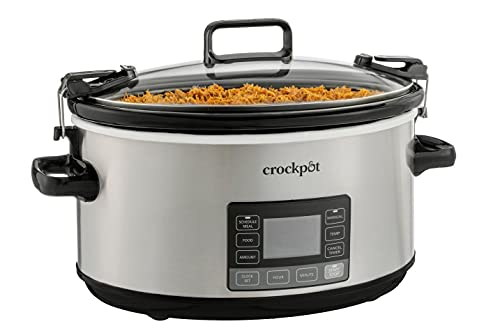
Crock-Pot Programmable Slow Cooker 7-Quart with MyTime
Badge: Best Programmable
Strengths
- MyTime scheduling targets the variable recipes cannot control: when the cook actually ends.
- Programmable repeatability means a tested recipe behaves the same on the tenth cook as the first.
- Locking lid preserves the moisture seal in transit, so a dish arrives as the recipe intended.
Trade-offs
- Scheduling cannot rescue a badly filled crock or an unbrowned stew; it manages time, not technique.
- Setup per cook is a small but real tax on the simple recipes.
- Electronics add long-term failure modes a dial does not have.
At a glance
- Capacity: 7-quart, feeds 9+
- Controls: programmable, MyTime technology adjusts cooking
- Lid: Cook & Carry locking lid
- Finish: Stainless steel
A test kitchen develops a recipe to a doneness window, and then real life cooks it an hour past that window because of traffic. This Crock-Pot’s MyTime technology is aimed precisely at that gap: you set the mealtime, and the machine adjusts its cooking cycle to be ready then. In culinary terms, that is not a convenience feature — it is texture protection. The difference between a braise held at its peak and one pushed ninety minutes beyond it is the difference between slices and shreds, between a sauce that coats and one that separates, and a scheduler that lands the finish on time is doing recipe work.
The supporting traits are the ones a recipe developer values. Programmable control repeats exactly, so a dish that worked once works again under the same programme — the reproducibility on which all published recipes depend. The Cook & Carry locking lid keeps the closed moisture system closed in transit, which matters because so much slow-cooked food is made to travel; a dish that sloshes and loses its lid seal on the drive arrives as a different, drier recipe. At seven quarts feeding nine or more, the capacity also matches the entertaining yields recipes are written at.
The limits are the honest ones. Scheduling manages the clock, not the cooking: an under-filled crock, unbrowned meat or a lifted lid will still produce the flawed dish, merely punctually. And the per-cook setup is a small friction that dial cooks never pay. For households whose mealtimes genuinely move, though, this is the pick that protects the recipe’s intent — the quality a professional cook would prize most, as the discussion in our Best Slow Cookers For Chefs guide makes clear from the working-kitchen side.
Best for: cooks who follow recipes closely but live on shifting schedules / Not suited for: fixed-routine households that gain nothing from scheduling.

Hamilton Beach 6 Quart Slow Cooker (33665G)
Badge: Best Simple Pick
Strengths
- Six quarts is the capacity at which the largest body of tested recipes is written, minimising scaling error.
- Glass lid supports the no-lift discipline that keeps the moisture cycle intact.
- Dishwasher-safe crock and lid remove the cleanup friction that stops recipes being repeated.
Trade-offs
- No in-pot browning, so the flavour step needs a skillet.
- Manual control makes finishing time the cook’s own variable.
- Capacity will not stretch to the largest roasts or crowd recipes.
At a glance
- Capacity: 6 quart
- Controls: 3 cooking settings
- Crock and lid: dishwasher-safe stoneware crock and glass lid
- Finish: Silver
- Model: 33665G
Test kitchens think in reference volumes, and six quarts is this category’s. More slow-cooker recipes are developed, timed and written at this size than any other, which gives the Hamilton Beach 33665G a quiet methodological advantage: follow a published recipe in it and you are cooking under the conditions the developer cooked under, with no scaling of liquid, time or surface area to second-guess. Its three settings continue the theme — the recipe says low or high, the dial offers low or high, and nothing in between can be mis-set.
The glass lid deserves a cook’s appreciation rather than a marketer’s. The moisture discipline that slow cooking demands — lid on, heat in, vapour cycling — is much easier to keep when curiosity can be satisfied by looking rather than lifting, and over a long cook the accumulated minutes of recovered heat are a real recipe variable. Add that the stoneware crock and lid are dishwasher-safe, and the machine closes the loop a test kitchen cares about: a recipe that is easy to clean up after is a recipe that gets cooked again, and repetition is where home cooks actually improve.
Its boundaries are the manual boundaries. Browning is outsourced to a skillet, finishing time is managed by a person, and the capacity stops short of crowd work. For the smaller household cooking from books and tested recipes at family scale, none of those boundaries binds often, and this is the most methodologically honest machine in the guide: it does the classic job at the classic size with nothing to hide behind.
Best for: recipe-driven cooks in small-to-mid households who value the reference size / Not suited for: crowd cooking or unattended timed finishes.
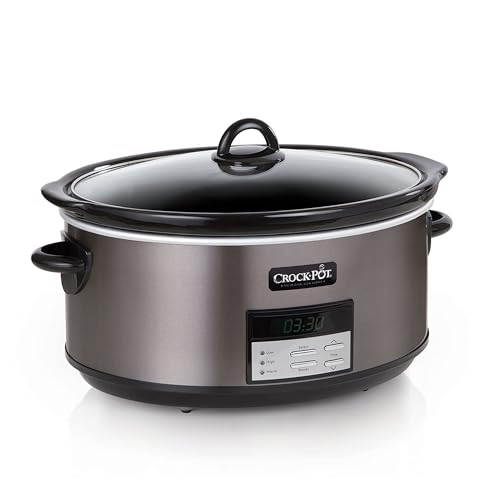
Crock-Pot Programmable Slow Cooker 8-Quart, Black Stainless
Badge: Best for Big Batches
Strengths
- Eight-quart capacity lets batch recipes run at full yield without scaling or splitting.
- A timer up to 20 hours covers the longest legitimate low cooks a recipe can call for.
- Automatic warm protects a full batch — the highest-stakes cook — from drifting past its window.
Trade-offs
- Batch scale magnifies recipe error: seasoning and liquid must be scaled thoughtfully, not merely doubled.
- Under-filled, its results will not match recipes tested at proper fill.
- The heaviest crock here, and the largest storage commitment.
At a glance
- Capacity: 8-quart, for 10+ people
- Controls: digital timer up to 20 hours, auto warm setting
- Crock and lid: dishwasher-safe lid and stoneware pot
- Finish: Black stainless steel
Batch cooking is where slow-cooker recipes meet arithmetic, and this eight-quart Crock-Pot is the machine that makes the arithmetic easy. Doubling a stew is not as simple as doubling every line — evaporation, seasoning and heat penetration all shift with volume — but starting from a vessel honestly sized for more than ten people removes the worst distortion, which is cramming a big recipe into a small crock or splitting it across two machines with two temperature personalities. Here the batch cooks as one dish, the way the recipe intends.
The controls respect the stakes. A digital timer running up to 20 hours covers the longest low cooks in the repertoire — the overnight beans, the biggest shoulders — and the automatic warm setting guards the finish, which matters most exactly when the batch is largest and the ingredient investment highest. A test kitchen would also note the dishwasher-safe stoneware pot and lid without embarrassment: at this scale, cleanup is a genuine production constraint, and a batch system that is miserable to wash gets used once.
The caution is reciprocal. A machine this size, cooked in at a fraction of its fill, will not reproduce any recipe’s tested behaviour, because the surface-to-volume relationship the recipe assumes has changed. Buy it to cook at its scale — weekly batches, big families, events — and it is the most recipe-faithful tool here for that work. Buy it for two-person dinners and no badge can save the results.
Best for: batch cooks and big families who scale recipes up as a system / Not suited for: small households cooking small loads.

Cosori Rice Cooker 10 Cup with Slow Cook
Badge: Best with Sauté
Strengths
- Sauté in the same pot is the one feature in this guide that changes flavour, not just logistics.
- Fuzzy logic control pursues the gentle, stable temperatures braising science asks for, by sensing rather than by mass.
- Ceramic-coated pot releases the fond and the finished dish alike, and cleans without soaking.
Trade-offs
- Round, deep bowl changes liquid distribution versus crock-written recipes; expect to adjust.
- Slow cooking is one mode among eighteen, so its recipes need the cook’s adaptation rather than blind trust.
- No oval geometry for whole roasts and birds.
At a glance
- Capacity: 10 cup uncooked, 20 cup cooked (rice measure)
- Functions: 18-in-1, including sauté and slow cook
- Control: fuzzy logic, 24-hour keep warm and delay timer
- Inner pot: ceramic coating, non-stick
- Included: stainless steel steamer basket
- Colour: Black
Every test kitchen has a short list of equipment traits that actually change outcomes, and in-pot browning sits at the top of the slow-cooking list. The Cosori is the only pick here that offers it: its verified 18-in-1 listing names sauté alongside slow cook, so the onions can soften and sweeten, the spices can bloom in fat, and the meat can take on colour in the very vessel that then braises it, capturing every bit of the fond that a transfer between pans leaves behind. For flavour, that single workflow outweighs every other feature in this guide combined.
The control story is the modern counterpoint to stoneware’s mass. Fuzzy logic sensing adjusts heat against the food’s actual behaviour, aiming at the same gentle stability by feedback rather than by thermal inertia, and the delay timer and long keep-warm extend that control across the schedule. Recipes built on grains and sauces — the curries, congees, soups and braised dishes of a rice-centred kitchen — are where this design is most at home, and the ceramic-coated pot keeps the starch-heavy end of that repertoire from becoming a cleaning punishment.
The adaptation tax is real and should be paid knowingly. Crock-written recipes assume a wide, shallow geometry; this bowl is round and deep, so liquid levels and timing need a cook’s adjustment on the first attempt of any dish, and whole roasts simply belong in another machine. Treat it as a different instrument that happens to share a technique, learn its behaviour across two or three forgiving dishes, and it rewards the effort — particularly at the sweet and sticky end of the repertoire, as our Best Slow Cookers For Dessert notes explore.
Best for: flavour-first cooks who brown religiously and cook saucy, grain-friendly dishes / Not suited for: whole-roast cooking or blind recipe transfer from crock books.

Aroma Housewares 20 Cup Digital Rice Cooker and Slow Cooker (ARC-150SB)
Badge: Best Multitasker
Strengths
- Digital control gives the repeatability recipe testing depends on: same programme, same result.
- Twenty-cup cooked capacity runs family-scale recipes at full yield across three cooking roles.
- Steamer role adds a parallel technique — vegetables and dumplings timed against the main dish.
Trade-offs
- The verified listing does not detail timer and warm behaviour, so recipe scheduling must be confirmed at the listing.
- Round pot geometry requires the same recipe adaptation as any multicooker.
- Oversized for small households, whose recipes will under-fill it.
At a glance
- Capacity: 20 cup cooked (10 cup uncooked)
- Functions: digital rice cooker, slow cooker, food steamer
- Exterior: stainless steel
- Model: ARC-150SB
- Colour: Black
The Aroma ARC-150SB brings a test kitchen’s favourite virtue to a big household: repeatability. Its digital controls run the same programme the same way every time, and in a kitchen where the same curry, the same lentils and the same soup rotate weekly for a crowd, that consistency is what turns a recipe from an event into a standard. The verified listing gives it three roles — digital rice cooker, slow cooker and food steamer — at a 20-cup cooked capacity, and the combination suits the way large families actually cook: a slow dish at the centre, rice in quantity, and steamed accompaniments timed alongside rather than queued.
In slow-cook mode the culinary logic mirrors the other multicooker here. The round pot is at its best with the saucy, spoonable repertoire, where geometry matters least and volume matters most, and a household that cooks those dishes at scale gets a single, capacious, digitally consistent tool for them. Aroma’s long history in rice cookers also counts methodologically: a maker that has refined one thermal job for decades tends to manage heat in its other modes with the same discipline.
The review’s honesty note is about evidence, not quality: the verified listing provided for this guide does not detail the machine’s timer or warm behaviour, so a cook planning recipes around precise scheduling should confirm those specifics at the listing before buying. What is established — capacity, roles, digital control, stainless format — fully supports the multitasker case for the large, rice-cooking household. What is not established is left, properly, as a question to verify rather than a virtue to assume.
Best for: large households wanting digital repeatability across rice, steaming and slow dishes / Not suited for: small households or roast-centred cooking.
Comparison Table
The table lines the picks up on the attributes a cook can verify from the listings. Use it with the science sections above: format and control are the columns that change the food.
| Pick | Capacity | Controls | Test-kitchen note | Link |
|---|---|---|---|---|
| Crock-Pot Oval Manual Slow Cooker 7-Quart | 7-quart, 8+ people | High, low and warm dial | Recipe-standard oval stoneware | Check on Amazon |
| Crock-Pot Programmable Slow Cooker 7-Quart with MyTime | 7-quart, 9+ people | Programmable, MyTime | Scheduling that protects the finish | Check on Amazon |
| Hamilton Beach 6 Quart Slow Cooker (33665G) | 6 quart | 3 settings, manual | The reference recipe size | Check on Amazon |
| Crock-Pot Programmable Slow Cooker 8-Quart, Black Stainless | 8-quart, 10+ people | Digital timer to 20 hours, auto warm | Full-yield batch cooking | Check on Amazon |
| Cosori Rice Cooker 10 Cup with Slow Cook | 10 cup uncooked rice measure | Fuzzy logic, delay timer | In-pot browning before the braise | Check on Amazon |
| Aroma Housewares 20 Cup Digital Rice Cooker and Slow Cooker (ARC-150SB) | 20 cup cooked | Digital | Repeatability at family volume | Check on Amazon |
How to Choose a Slow Cooker the Test-Kitchen Way
Start from three recipes, not from a feature list
Write down the three slow-cooked dishes your household makes or wants to make most, and judge every machine against them. Roasts and whole birds demand the oval crock format. Saucy braises and curries reward the multicooker’s browning and control. Batch dishes demand honest capacity with a timer and warm holding. This recipe-first method is how test kitchens buy equipment, and it prevents the classic error of purchasing the most decorated machine for a repertoire it does not fit.
Respect the fill line and the reference size
Recipes are developed at a fill level — roughly half to two-thirds of the vessel — and at common sizes, six and seven quarts above all. Buying the size your recipes assume removes a whole category of timing and liquid error. Households of two should think hardest here, because nearly every pick in this guide is a family-size machine; the sizing discussion in our Best Slow Cookers For 2 People guide works through how couples can adapt batch formats honestly, with leftovers as a feature rather than an accident.
Decide who manages time: you or the machine
Every recipe has a finish window, and something must own it. If a person will reliably be there, a dial is enough and its simplicity is a genuine culinary virtue. If the window must be hit unattended, programmable control — ideally scheduling to a mealtime — is recipe protection, and should be budgeted as such rather than as a luxury.
Plan the browning step before you buy
Decide whether you will brown in a skillet without resentment, or whether the step needs to live in the pot. Honest self-knowledge here is worth more than any other single decision, because the cooks who skip browning are the cooks who conclude, wrongly, that slow cooking is bland.
How to Use and Care for Your Slow Cooker
Cook the way the science says. Brown meat and aromatics first — in the Cosori’s sauté mode or a hot skillet for the crocks — and deglaze the pan into the pot so nothing is wasted. Layer dense vegetables low, near the heat; set meat above them; add liquid with restraint, remembering the closed system keeps it; and leave the lid shut. Add dairy, fresh herbs and quick vegetables near the end, rest the finished dish briefly, and season finally at the table end of the process, when the flavours have finished concentrating.
- Fill between half and two-thirds, and cut large joints to sit in the liquid rather than ride above it.
- Choose low for long cooks where tenderness is the goal; use high for shorter cooks where the recipe is built for it.
- Resist lifting the lid; check through glass where the model provides it.
- Hold on warm for serving windows only, then refrigerate leftovers promptly in shallow containers.
- Let stoneware cool before washing, and keep ceramic coatings free of metal utensils and abrasive pads.
Troubleshooting
Problem: the meat is tender but the sauce tastes washed-out → what to do: the dish missed its browning or its finish; next time sear properly and deglaze into the pot, and finish this batch with a brief uncovered simmer and a splash of acid to wake it up.
Problem: vegetables disintegrate while the meat is still firm → what to do: the vegetables were cut too small or added too early; cut them larger, place them under the meat, and hold delicate vegetables for the final hour.
Problem: a chicken dish is done hours before dinner and drying out → what to do: poultry has the narrowest window in slow cooking; choose dark meat for long cooks, and use a programmable finish or a shorter programme so the dish waits on warm briefly rather than cooking on.
Adapting Oven and Stovetop Recipes for the Slow Cooker
The test-kitchen adaptation rules are few and reliable. Reduce the liquid, because the closed pot returns moisture instead of evaporating it; a braise that swims in the oven should merely cradle in the crock. Keep the aromatics bold, since long gentle heat softens their edges, and add the bright notes — herbs, citrus, vinegar — at the end where they survive. Convert timing by texture rather than by formula: the dish is done when the meat yields, and the first attempt at any adaptation should be a supervised one, with notes taken. Dairy moves to the final stretch to avoid splitting, and thickeners go in late as a slurry so they gel in a sauce that has finished releasing its liquid. Follow those rules and the entire oven-braise canon — the largest and best-tested recipe library in this style of cooking — becomes available to every machine in this guide, which is a more valuable inheritance than any single feature. The designs that have carried that canon longest are honoured in our Best Slow Cookers Ever retrospective.
Test-Kitchen Notes on Poultry, Beans and Grains
Three ingredient families expose a slow cooker’s character faster than any stew, and a test kitchen reaches for all three when it wants the truth about a machine. Poultry is the strictest examiner. Chicken has a narrow window between safely cooked and dryly overcooked, and it punishes a machine whose low setting runs hot or whose finish is left unmanaged; this is why the scheduling picks earn genuine culinary credit in this guide, and why dark meat, which tolerates the long cook gracefully, is the test kitchen’s default recommendation for all-day recipes. A machine that handles a whole chicken in an oval crock without drying the breast has passed a real examination.
Beans examine patience and evenness. Dried beans need sustained, gentle, fully surrounding heat to soften uniformly, and an uneven cooker announces itself in a single spoonful — tender beans at the edge, chalky ones at the centre. They also reward the format’s make-ahead nature, since bean dishes improve as they sit, which makes them the ideal first cook in a new machine: cheap, forgiving of everything except uneven heat, and diagnostic of exactly that. Grains, finally, examine control. In the multicookers especially, the line between fluffy and porridge is a matter of absorbed liquid and resting time, and the machines with sensing control — the Cosori’s fuzzy logic is the example here — exist to walk that line without supervision. Judge any pick in this guide against the family your household cooks most: the machine that passes your examination is the right one, whatever it does with someone else’s.
A Note on Yield, Leftovers and the Second Day
Test kitchens judge a slow-cooked dish twice: at serving, and the next day. Many of the category’s signature foods — braises, beans, curries, soups — are demonstrably better after a night in the refrigerator, when flavours have married and the sauce has set and re-melted into itself. That has an equipment implication buyers rarely consider: the removable crock that goes from cooker to table to fridge, as the stoneware picks here do, is not merely convenient, it is part of the recipe’s intended arc, letting the dish rest in its own vessel without decanting losses. It also argues for honest capacity. A household that cooks once and eats twice should size for the full cook, not the single meal — one more reason the six and seven-quart formats dominate the tested literature, and one more variable to weigh before deciding that a smaller machine would do.
Common Buying Mistakes
- Buying features instead of format. Shape decides what the machine can cook well; no menu of modes changes a round pot into an oval one.
- Skipping the browning question. Decide before purchase where browning will happen, or accept flat flavours as the price of not deciding.
- Ignoring the recipe size. A cooker your recipes were not written for adds silent error to every dish until you recalibrate.
- Treating scheduling as a gadget. In recipe terms it is finish protection; households with moving mealtimes should weigh it as quality, not convenience.
- Lifting the lid and blaming the machine. The commonest technique error in the category, and the easiest to fix for free.
Final Recommendation
By test-kitchen criteria, the reference purchase is the Crock-Pot Oval Manual 7-Quart: the format recipes assume, the thermal mass braises reward, and nothing between the cook and the food. If your mealtimes move, protect the finish with the Crock-Pot Programmable 7-Quart with MyTime. If flavour development is your religion and your repertoire is saucy, the Cosori Rice Cooker 10 Cup earns its place by browning in the pot. Choose by the three recipes you cook most, fill the machine properly, brown before you braise — and the method, more than the model, will make the food taste tested.
Frequently Asked Questions
Why do test kitchens care so much about slow cooker shape?
Because shape decides how food sits in the braising liquid and how heat reaches it. Oval crocks match the geometry of roasts and whole birds, which is why recipes are developed in them; round, deep pots distribute liquid differently and suit soups, curries and shredded dishes better. The same recipe can genuinely cook differently in the two formats.
Does browning meat before slow cooking really matter?
Yes — it is the largest single flavour variable in the method. Browning creates roasted, savoury compounds that moist slow heat cannot produce, and deglazing carries them into the sauce. Cooks who skip it get tenderness without depth, which is why a sauté function or a willing skillet matters so much.
Why do slow cooker recipes use less liquid than oven braises?
Because the slow cooker is a nearly closed system. An oven braise evaporates steadily and concentrates; a lidded crock returns its moisture to the food. Adapting a recipe without reducing the liquid produces a thin, diluted sauce, which is the most common adaptation error.
Is low always better than high in a slow cooker?
Low is better for the collagen-rich cuts the appliance exists for, because gentle heat converts connective tissue without wringing out the meat. High has legitimate uses in shorter recipes designed for it. The test-kitchen rule is to follow the setting the recipe was developed at, since timing and texture were calibrated to it.
Can a multicooker replace a crock for recipe cooking?
For saucy dishes, with a cook’s adjustment for the different geometry, yes — and it adds browning and grain cooking the crock cannot do. For whole roasts and birds, the oval crock remains the format recipes assume. Many serious kitchens end up valuing both for different parts of the repertoire.
How do I know when a slow-cooked dish is actually done?
By texture, not by the clock alone. Collagen-rich meat is done when it yields easily to a fork while still holding its structure; vegetables should be tender without collapse. Use the recipe’s window as a guide, test at the early edge of it, and note your own machine’s pace for next time.


