Disclosure: topratedkitchenware.com is reader-supported. When you buy through links on our site, we may earn an affiliate commission from Amazon and other retailers, at no extra cost to you.
Where to buy
The six models below are the verified picks for this guide to the best slow cookers to purchase. Each name links to its Amazon listing, where you can check the latest price on Amazon, confirm the exact model variant, and review what is included before you spend anything.
- Crock-Pot Oval Manual Slow Cooker, 7-Quart
- Crock-Pot Programmable Slow Cooker with MyTime, 7-Quart
- Hamilton Beach 6 Quart Slow Cooker
- Crock-Pot Programmable Slow Cooker, 8-Quart Black Stainless
- Cosori Rice Cooker 10 Cup, 18-in-1 Multi-Cooker
- Aroma Housewares 20 Cup Digital Rice Cooker and Slow Cooker
Read the full guide ↓ for the detailed review of every pick, the honest limitations, and the checks that protect a purchase.
Searching for the best slow cookers to purchase means you have already decided to buy one, and the question left is the spender’s question: which model deserves the money, and how do you make sure the box that arrives is the machine you researched? That is a different question from “which slow cooker cooks best,” because in this category the cooking itself is reassuringly similar — gentle heat, a sealed pot, time. What separates a satisfying purchase from a regrettable one is fit: capacity against your household, controls against your routine, format against your kitchen, and the discipline to verify the exact variant at the listing before checkout.
This guide compares six verified models across the category’s real divide — traditional stoneware crocks from Crock-Pot and Hamilton Beach on one side, rice-cooker-format multi-cookers from Cosori and Aroma on the other — and badges each for the buyer it suits. Prices are deliberately not printed here, because they move; each pick links to its listing so you can check the latest price on Amazon at the moment you buy, which is the only moment a price is true. What the guide does give you is the tier logic: what stepping up actually buys in this category, what stepping down gives up, and where the value sits for different kinds of cooks.
Read the badges first, then your pick’s full review, then run the pre-purchase checks near the end before ordering. If your cooking centres on one-pot browning, the specialised guidance in the browning cluster is worth a detour, and if you are buying from outside the US market, the checks in Best Slow Cookers Uk come first, before any of this.
Key Takeaways
- Buy by fit and frequency: a slow cooker used weekly is good value at any tier; one used twice is expensive at any price.
- The manual 7-quart Crock-Pot is the simplest sound purchase for most families; the MyTime model buys scheduling, not better cooking.
- Stepping up in this category buys programming, capacity, locking lids and finishes — not more tender results.
- Multi-cookers from Cosori and Aroma replace several appliances; judge them on your whole counter, not on slow cooking alone.
- Verify the exact model, capacity and included parts on the listing before checkout; variants differ quietly.
- Check the latest price on Amazon for every pick — this guide prints no static prices, by design.
In this guide
Quick Picks
| Pick | Badge | Capacity and type | Buy it if | Listing |
|---|---|---|---|---|
| Crock-Pot Oval Manual Slow Cooker | Best Overall | 7-quart, manual stoneware | You want the classic family crock | Check on Amazon |
| Crock-Pot Programmable with MyTime | Best Programmable | 7-quart, programmable | Your eating time varies and the pot must adapt | Check on Amazon |
| Hamilton Beach 6 Quart Slow Cooker | Best Budget Pick | 6-quart, 3 settings | You want simple cooking and dishwasher cleanup | Check on Amazon |
| Crock-Pot Programmable 8-Quart | Best for Large Families | 8-quart, digital timer | You cook for 10+ or batch for the freezer | Check on Amazon |
| Cosori Rice Cooker 10 Cup, 18-in-1 | Most Versatile | 10 cup uncooked rice, multi-cooker | You want sauté, slow cook and rice in one machine | Check on Amazon |
| Aroma Housewares 20 Cup Digital | Best Multi-Use Value | 20 cup cooked, rice cooker format | Counter space is tight and rice is a staple | Check on Amazon |
Badges here are purchasing shortcuts, and they are used identically in the detailed reviews below, so the pick you identify in this table is the pick you will find assessed under the same badge further down.
How These Picks Were Chosen
The pool is six models with product data verified through the retailer’s catalogue information on 2026-11-20, spanning the brands and formats a real shopper encounters: three Crock-Pot stoneware designs at manual, programmable and extra-large levels, a Hamilton Beach mid-size classic, and two multi-cookers that include slow cooking among wider talents. Each model was assessed as a purchase, not just as an appliance — what it costs you in complexity and space, what it returns in capability, and how honestly its tier is earned.
Comparison criteria were capacity in each maker’s own units, control style and scheduling features, lid and insert design, cleanup claims stated in the verified titles, and the breadth of cooking each machine covers beyond slow cooking. This is research-led guidance from verified product data; it does not claim hands-on testing, and it prints no prices or ratings, because a buying guide that invents either has stopped guiding. Where a model’s data does not support a capability — an in-pot browning function, for instance — the review says so plainly, since discovering a missing function after delivery is the most common way a purchase in this category goes wrong.
One structural note for cross-shoppers: capacities in this pool speak two languages, quarts for stoneware and rice cups for the multi-cookers, and the numbers are not interchangeable. The reviews translate by household and dish rather than by false arithmetic. Buyers comparing against a strict budget ceiling will also find the tier discussion in Best Slow Cookers Under $50 useful alongside this guide.
The 6 Best Slow Cookers to Purchase

Crock-Pot Oval Manual Slow Cooker, 7-Quart
Badge: Best Overall
Strengths
- 7-quart oval stoneware serves 8+ per the verified title and takes whole chickens and large joints.
- Manual High, Low and Warm settings: nothing to programme, nothing electronic to fail.
- Removable stoneware serves at the table and stores in the fridge.
Trade-offs
- No timer or automatic warm shift — the schedule is yours to manage.
- No browning function; meat is browned in a pan first if the recipe wants it.
- Full stoneware is heavy to lift and to wash by hand.
Mini spec box
- Capacity: 7-quart, serves 8+ people, per verified title
- Settings: High, Low, Warm
- Insert: removable oval stoneware
- Finish: stainless steel
- Control type: manual
As a purchase, the manual Crock-Pot is the category’s reference point: the machine against which every upgrade must justify itself. What you are buying is a heating base, a heavy oval crock and a dial — and a design so settled that recipes, replacement parts and second-hand wisdom all assume it. For a family that slow-cooks weekly, it is close to a risk-free spend: the capacity covers Sunday roasts and weekday stews, the controls cannot confuse a guest or a teenager, and there is no feature on it you will pay for and never touch.
There is also a long-ownership argument that rarely appears in buying guides. A manual stoneware cooker has almost nothing in it that can become obsolete, unsupported or incompatible: no firmware, no app, no proprietary ecosystem, and a control interface a child can operate. Replacement stoneware and lids for mainstream crock designs have historically been easy to find, because the installed base is enormous. A purchase is not just the first year of dinners; it is the tenth year too, and on that horizon the simplest machine in the pool has the fewest ways to disappoint. Buyers who keep appliances for a long time — and slow cookers invite exactly that habit — should weigh this durability of concept, not just of materials.
The honest limitation is scheduling. A manual cooker started at 8 a.m. on Low is done when it is done; if your day runs long, dinner waits at temperature rather than shifting itself to warm. Cooks with unpredictable hours should look at the programmable picks below. Everyone else is buying simplicity that will still be working, unchanged, in a decade — and in a category full of panels and programmes, that is a deliberate, defensible purchase.
Best for: families who want the classic, dependable family crock / Not suited for: cooks who need the cooker to manage finishing times alone
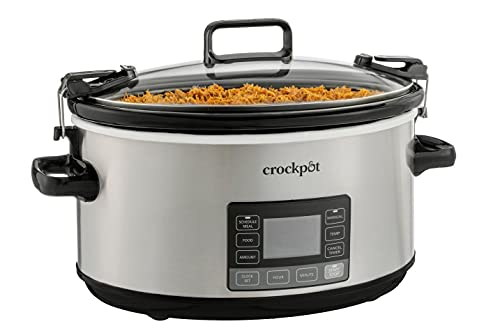
Crock-Pot Programmable Slow Cooker with MyTime, 7-Quart
Badge: Best Programmable
Strengths
- MyTime technology adjusts cooking to your schedule, per the verified title.
- Cook and Carry locking lid makes a full pot genuinely transportable.
- 7-quart capacity feeds 9+, per the verified title.
Trade-offs
- You pay a tier step for electronics a predictable household may never use.
- No in-pot browning function is claimed in the verified data.
- More controls mean a short learning curve a dial never imposes.
Mini spec box
- Capacity: 7-quart, feeds 9+, per verified title
- Technology named in title: MyTime, which adjusts cooking
- Lid: Cook and Carry locking lid
- Finish: stainless steel
- Control type: programmable
The MyTime Crock-Pot is the purchase for households whose dinner hour refuses to sit still. Its verified headline — technology that adjusts the cooking around when you want to eat — addresses the classic slow cooker failure mode, the meal ready at five for people home at seven. Add the locking Cook and Carry lid, which turns the cooker into the dish you bring, and the purchase case is coherent: you are buying time management and transport, two things the manual model deliberately does not sell.
One more purchasing detail belongs to this model specifically: the locking lid changes how the cooker is stored and carried, and it is worth confirming on the listing that the configuration offered is the Cook and Carry version described here, since similar programmable models exist without the locking hardware. Variant discipline matters most exactly where two versions look alike in photographs, and this is one of those places. A buyer who wants the transport feature should see it named in the listing title before ordering, not discover its absence when the box opens.
Judge the step-up honestly. The cooking underneath the electronics is the same gentle stoneware braise, so the premium buys convenience, not tenderness. If your household eats at a fixed hour and never carries a pot anywhere, that premium buys nothing and the manual pick is the smarter spend. If your evenings are variable and your weekends involve feeding people elsewhere, this is the best-aimed upgrade in the pool.
Best for: busy households with shifting schedules and food that travels / Not suited for: fixed-routine cooks who would pay for features they never touch

Hamilton Beach 6 Quart Slow Cooker
Badge: Best Budget Pick
Strengths
- Dishwasher-safe stoneware crock and glass lid, per the verified title.
- Three cooking settings cover the genuine repertoire of slow cooking.
- 6-quart size is the practical centre for smaller households.
Trade-offs
- No programmable timer or scheduling features.
- No browning function is claimed in the verified data.
- Fills fast when a large joint meets a full load of vegetables.
Mini spec box
- Capacity: 6 quart
- Settings: 3 cooking settings, per verified title
- Insert and lid: dishwasher-safe stoneware crock and glass lid
- Finish: silver
- Model: 33665G, per verified title
The Hamilton Beach is the pool’s value argument in its purest form: the essential appliance, honestly specified, with its one flourish spent exactly where owners feel it — cleanup. Both the crock and the lid are listed as dishwasher-safe, which means the true cost of a stew night, measured in evening effort, is lower here than anywhere else in the pool. The three settings are not a compromise list; they are the whole functional truth of slow cooking, and the 6-quart format suits the households most buyers actually live in.
As a purchase it suits first-time buyers especially well, because it tests the habit cheaply in complexity: if slow cooking becomes a weekly ritual, nothing about this machine will embarrass the cook; if it does not, little was spent learning so. Its limits are the absence of scheduling and a ceiling on batch size. Buyers certain they need either should step up within this guide rather than stretch this model past its design.
Best for: first-time buyers and smaller households valuing easy cleanup / Not suited for: schedule-driven cooks or regular crowd feeding
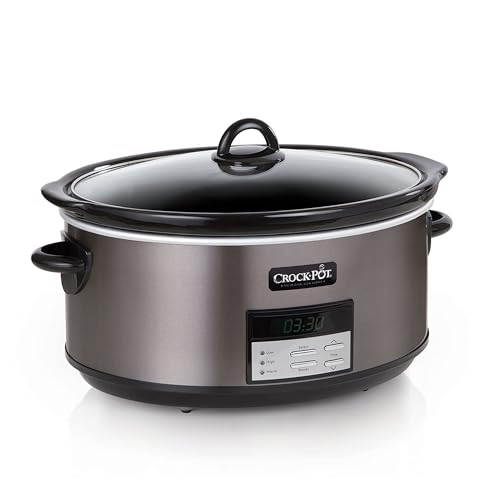
Crock-Pot Programmable Slow Cooker, 8-Quart Black Stainless
Badge: Best for Large Families
Strengths
- The pool’s largest capacity: 8 quarts, for 10+ people per the verified title.
- Digital timer up to 20 hours with auto warm, per the verified title.
- Dishwasher-safe lid and stoneware pot, per the verified title.
Trade-offs
- The largest footprint and the heaviest full lift in the pool.
- Oversized for couples — a half-empty big crock cooks less evenly than a right-sized one.
- No browning function is claimed in the verified data.
Mini spec box
- Capacity: 8-quart, for 10+ people, per verified title
- Timer: digital, up to 20 hours
- Warm: auto warm setting
- Insert and lid: dishwasher-safe stoneware pot and lid
- Finish: black stainless steel
Buying big is a decision about identity as much as capacity: this is the cooker for households that cook in quantity on purpose — extended families, batch cookers filling freezers, hosts whose stew is an event. The purchase earns its tier through the combination of the pool’s largest stoneware with real scheduling, a digital timer to 20 hours and an automatic move to warm, wrapped in a black stainless finish that keeps a very large appliance presentable on the counter it will dominate.
The caution is symmetrical: capacity you do not use is not neutral. Slow cookers perform best well-filled, so a couple buying 8 quarts for two-person stews gets worse results and a heavier wash for their money. Purchase this size because your cooking already demands it, not as insurance for hypothetical gatherings, and it is the most capable stoneware buy in the guide.
Best for: large families, batch cooks and entertainers / Not suited for: couples or small kitchens buying capacity just in case

Cosori Rice Cooker 10 Cup, 18-in-1 Multi-Cooker
Badge: Most Versatile
Strengths
- 18-in-1 programmes including Sauté and Slow Cook, named in the verified title — the pool’s only in-pot browning route.
- Fuzzy Logic control and a ceramic-coated non-stick inner pot.
- 24-hour keep warm, delay timer and a stainless steel steamer basket, per the verified title.
Trade-offs
- Capacity is in rice cups; its stew world is smaller than the stoneware picks’.
- A function-rich panel is the opposite of a dial’s simplicity.
- As a rice cooker first, it lacks a crock’s table presence for serving braises.
Mini spec box
- Capacity: 10 cup uncooked rice (20 cup cooked), per verified title
- Functions named in title: Sauté, Slow Cook, within 18-in-1 programmes
- Control: Fuzzy Logic
- Inner pot: ceramic coating, non-stick
- Extras named in title: 24-hour keep warm and delay timer, stainless steel steamer basket
- Colour: black
The Cosori asks to be purchased on a different ledger from the stoneware picks: not “a slow cooker,” but a consolidation. Eighteen programmes, a sauté function that browns in the pot before the slow cook, fuzzy-logic rice cooking, steaming, keep-warm and delay timing — for a small kitchen, this one appliance can retire a rice cooker, challenge a steamer and cover slow cooking for modest households in a single footprint. Buyers whose slow cooking is one job among many, and whose batches are small, get more total utility per cupboard inch here than from any crock in the pool.
Buyers should also note what the verified title does not claim, because a purchase made on a full picture lasts longer than one made on highlights. The Cosori’s data names no pressure function and no stoneware format; it is an atmospheric multi-cooker with a coated pot, and its slow cooking is the gentle, lidded kind. Shoppers arriving from the pressure-cooker aisle, where similar-looking machines promise speed, should register the difference before ordering: this machine’s promise is range and one-pot browning, not pressure speed.
The purchase discipline is to count honestly. Eighteen functions are worth paying for in proportion to the ones you will use monthly; a household that never cooks rice is buying a smaller slow cooker with a busy panel. And the cup-based capacity must be read as it is: this is a couple-and-small-family machine. Within those truths, it is the most versatile purchase in the guide, and the only one that browns its own meat — the speciality explored in Best Range Cookers Under $1000 territory for bigger ranges, but rare at this size.
Best for: small kitchens wanting one machine for rice, sauté, steaming and slow cooking / Not suited for: large-family braising or dial-simple operation

Aroma Housewares 20 Cup Digital Rice Cooker, Slow Cooker and Steamer
Badge: Best Multi-Use Value
Strengths
- Rice cooker, slow cooker and food steamer in one appliance, per the verified title.
- 20 cup cooked capacity handles rice for a crowd.
- Digital controls with a stainless steel exterior.
Trade-offs
- No sauté function is named in the verified title, so browning happens in a pan.
- Slow cooking is one role among three, in a rice-cooker format rather than a crock.
- Cup capacity does not translate directly to stew volume.
Mini spec box
- Capacity: 20 cup cooked (10 cup uncooked), per verified title
- Functions named in title: digital rice cooker, slow cooker, food steamer
- Exterior: stainless steel
- Model: ARC-150SB, per verified title
- Colour: black
The Aroma is the budget-conscious consolidator: three appliances in one digital box, aimed at kitchens where rice is cooked constantly, steaming is routine, and slow cooking is a welcome weekly extra. Purchased on those terms it is excellent value logic — the slow cooker function effectively arrives as a bonus on a machine the kitchen already justifies — and the 20-cup cooked capacity means the rice side never limits a crowd.
Its terms should be read as carefully as its badge. There is no sauté function in its verified data, the slow-cooking vessel is a rice-cooker pot rather than a stoneware crock, and its capacity language belongs to rice. A buyer whose heart is set on traditional braises should buy a crock; a buyer whose counter is full and whose rice cooker just died should buy this, and gain a slow cooker in the bargain.
Best for: rice-first households adding slow cooking without another appliance / Not suited for: traditional braise purists or in-pot browning seekers
Comparison Table
| Pick | Badge | Capacity | Controls | Standout feature | Listing |
|---|---|---|---|---|---|
| Crock-Pot Oval Manual | Best Overall | 7-quart | Manual dial | Classic oval stoneware | Check on Amazon |
| Crock-Pot Programmable MyTime | Best Programmable | 7-quart | Programmable | MyTime schedule adjustment, locking lid | Check on Amazon |
| Hamilton Beach 6 Quart | Best Budget Pick | 6-quart | 3 settings | Dishwasher-safe crock and lid | Check on Amazon |
| Crock-Pot Programmable 8-Quart | Best for Large Families | 8-quart | Digital timer | Largest capacity, 20-hour timer | Check on Amazon |
| Cosori 18-in-1 | Most Versatile | 10 cup uncooked rice | Fuzzy Logic digital | Sauté plus slow cook in one pot | Check on Amazon |
| Aroma 20 Cup Digital | Best Multi-Use Value | 20 cup cooked | Digital | Rice, slow cook and steam in one | Check on Amazon |
How to Choose the Right Slow Cooker to Purchase
Start with the dish, not the device. Write down the two or three things you will actually slow-cook in a normal month, with rough quantities. Family stews and whole chickens point to the 7-quart stoneware class; two-person curries and rice-based meals point to the multi-cookers; freezer-filling batches point to 8 quarts. This ten-minute exercise prevents the category’s two classic errors — buying a crock too small for the Sunday roast, and buying a vat that cooks a two-person stew badly because slow cookers perform best between half and three-quarters full.
Next, audit your schedule. If someone is home, or your eating hour is fixed, manual controls cost you nothing and simplify ownership. If the meal must finish when you arrive rather than when the timer was set, programmable models earn their tier: the MyTime’s schedule adjustment and the 8-quart’s long digital timer with auto warm exist precisely for unpredictable days. Be honest about which household you are; scheduling features are the most commonly paid-for and least commonly used in this category.
Then decide the format question: dedicated or multi? A dedicated stoneware crock does one job with the best geometry for it — broad, heavy, table-ready — and the multi-cookers do several jobs in one footprint, with slow cooking in a deeper, cup-measured vessel. Kitchens with cupboard room and a braising habit buy dedicated; kitchens counting appliances buy multi. Neither answer is a compromise when it is chosen deliberately, and both are when it is not.
Finally, run the tier logic. In this category, money buys capacity, programming, locking lids, finishes and extra functions — in roughly that order of usefulness — and it does not buy more tender meat, because gentle heat is gentle heat at every tier. So set your tier by the features your routine touches weekly, and let the rest go. The happiest purchases in this guide are not the most expensive ones; they are the ones where every paid-for feature has a weekly job.
How to Use and Look After a New Slow Cooker
A new slow cooker’s first month sets habits that decide years of results, so begin deliberately.
- Wash before first use. Remove the insert and lid, wash them in warm soapy water, and wipe the heating base with a damp cloth. Never immerse the base.
- Learn your fill lines. Cook between half and three-quarters full. Too little and food overcooks at the edges; too much and the lid lifts, heat escapes and timings drift.
- Layer in order. Firm root vegetables at the base near the heat, meat above them, delicate vegetables and dairy late. Slow cooking rewards assembly order because nothing gets stirred.
- Resist lifting the lid. Each peek releases the accumulated heat and extends the cook. Trust the timings; check near the end, not throughout.
- Use less liquid than oven recipes suggest. A sealed slow cooker loses almost nothing to evaporation. Excess liquid is the main cause of washed-out slow-cooked sauces.
- Finish actively. Rest braised meat in its liquor, reduce thin sauces in a pan, and add fresh herbs, citrus and dairy at the end where their flavour survives.
Care is equally simple and mostly about stoneware. Let inserts cool before washing to avoid thermal shock, soak rather than scour crusted edges, and use the dishwasher where the maker lists parts as dishwasher-safe — as the Hamilton Beach and the 8-quart Crock-Pot do in their verified titles. Coated multi-cooker pots want soft cloths to protect the surface. Store lids ajar or inverted so seals stay fresh, and check the cord and base feet once in a while; a slow cooker should be the most boringly reliable object in the kitchen.
Troubleshooting new-owner problems
Problem: food is cooked but the sauce tastes thin → too much liquid at the start, or the lid was lifted often. Reduce the sauce at the end this time; start with less liquid next time.
Problem: vegetables are firm while the meat is done → they were layered on top or cut too large. Put firm vegetables at the base, in smaller pieces, where the heat is strongest.
Problem: the cooker seems slow on Low and fast on High → that is normal behaviour, not a fault. Low and High reach similar final temperatures; High simply arrives sooner. Choose by your schedule, not by a notion of intensity.
Before You Check Out: the Purchase Verification List
Because listings aggregate variants, the last five minutes before ordering are worth more than an hour of comparison. Confirm the capacity in the listing title matches the model reviewed here — brands sell near-identical machines in several sizes. Confirm the control type: manual and programmable versions of similar crocks sit one click apart. Check what is in the box, particularly whether lids, inserts or accessories shown in images are included or sold separately. Read the dimensions against your cupboard and counter, especially for the 8-quart pick, whose footprint surprises buyers who shopped by photograph.
Then confirm the seller and the returns route, and check the latest price on Amazon at that moment rather than relying on any number seen earlier in your research — prices in this category move with seasons and promotions, which is exactly why this guide prints none. If the listing offers multiple colours or bundles, choose deliberately rather than accepting the default variant. Five careful minutes convert a good shortlist into the right box arriving at the door. Shoppers weighing adjacent categories will find the same verification habit pays off across Best Range Style Cookers and similar big-appliance guides.
What Stepping Up Buys, Tier by Tier
Within the stoneware family, the ladder is clear. The entry tier — the Hamilton Beach pattern — buys the complete slow-cooking function with the easiest cleanup. The middle tier — the manual 7-quart Crock-Pot — buys family capacity and the classic oval format. The programmable tier — the MyTime and the 8-quart — buys time management, transport security and, at the top, the largest volume. Nothing on that ladder buys a different quality of braise, which is liberating news for buyers: the cheapest rung that fits your household cooks your dinner exactly as tender as the top rung.
The multi-cookers are a separate ladder leaning against a different wall. Their tiers buy breadth: more programmes, smarter control, in-pot sautéing at the Cosori level. A household climbing that ladder is buying a smaller, busier, more capable countertop hub. The purchase mistake is mixing the ladders — paying multi-cooker money for a household that needed crock capacity, or crock money for a kitchen that needed consolidation. Decide which wall your kitchen leans on first; the rungs then choose themselves. Readers shopping strictly by a ceiling can cross-check the budget framing in Best Rank Electric Pressure Cookers for how a neighbouring category prices its tiers.
Stoneware or Multi-Cooker: the Format Decision in Depth
Every purchase in this guide reduces, sooner or later, to one fork: a stoneware crock that does a single job in the traditional way, or a multi-cooker that folds slow cooking into a wider repertoire. The fork deserves a slower walk than it usually gets, because the two formats differ in ways that only appear after months of ownership.
Geometry is the first difference. A stoneware crock is broad and relatively shallow, with an oval footprint shaped by roasts and whole birds. Food sits in a wide layer, sauces surround it evenly, and the vessel itself goes to the table looking like the dish it holds. A multi-cooker pot is round and deep, shaped by rice. Stews cook perfectly well in it, but whole birds do not fit its world, large joints must be cut down, and serving happens by ladling rather than by presenting the pot. Households whose slow cooking is built on whole cuts feel this difference weekly; households built on curries, soups and rice-based meals may never feel it at all.
Capacity language is the second difference, and the one most likely to ambush a purchase. Stoneware speaks quarts — brim-full quarts, so a working fill is roughly three-quarters of the headline. Multi-cookers speak rice cups, a measure of uncooked rice that swells dramatically, which makes a “20 cup” machine sound like a vat while its stew volume is modest. The only safe translation is through your own cooking: portions per meal, plus tomorrow’s lunch, plus the vegetables and liquid around the meat. Do that arithmetic once and both languages become legible.
The third difference is what else the money is doing. A crock’s price buys one capability, deeply fitted. A multi-cooker’s price is shared across rice, steaming, sautéing and slow cooking, so each individual job is funded by a fraction of the purchase — which is why multi-cookers win on value when the jobs are all used, and lose when they are not. The Cosori in this pool even adds the one capability stoneware lacks entirely, in-pot browning on its sauté function, which for some kitchens settles the fork on its own. The Aroma counters with simplicity and rice capacity. Neither is the “advanced” choice; they are answers to different kitchens.
Ownership texture is the last difference. A crock has a dial or a modest panel, a heavy insert and a lid; it asks to be filled, set and ignored, and it ages gracefully because there is little in it to age. A multi-cooker has a control panel to learn, programmes to explore and a coated pot to treat kindly; it rewards engagement and repays it with range. Buy the texture you will enjoy living with, because the machine you like using is the machine that gets used — and use, as this guide keeps insisting, is where the value lives.
Buying a Second Slow Cooker, or Buying One as a Gift
Two purchasing situations follow different logic from the first-time buy, and both are common enough to deserve direct advice. The second-cooker purchase happens when a household discovers its real pattern: the big crock is perfect for Sunday but absurd for Tuesday’s two-person curry, or holiday cooking needs a main braise and a side dish running at once. In both cases the right second purchase is the opposite end of your first — a smaller, simpler companion rather than a duplicate. A household anchored by the 8-quart Crock-Pot gains most from the Hamilton Beach’s modest footprint; a household anchored by a manual crock gains most from one programmable model that covers the unattended days.
The gift purchase inverts the priorities. For your own kitchen, features can be as idiosyncratic as your habits; for someone else’s, the safest gifts are the category’s settled designs — the manual 7-quart for a family setting up a kitchen, the Hamilton Beach for a first flat — because they ask nothing of the recipient, fit the largest number of recipes, and carry no learning curve to resent. Programmable and multi-cooker gifts land best when you know the recipient’s routine well enough to name the feature they will use; a function-rich machine given blind is a cupboard ornament with a control panel. When in doubt, gift capacity and simplicity, and let the recipient’s own second purchase be the clever one.
Both situations share one discipline with the first-time buy: verify the exact model on the listing, check the latest price on Amazon at the moment of ordering, and measure the storage it will live in. A second cooker competes for the cupboard the first one already fills, and a gift that does not fit the recipient’s shelf has failed before the first stew.
Common Buying Mistakes
- Buying capacity by headline number. Quart figures are brim measures and rice cups are a different system. Buy by portions and dishes.
- Paying for programming a fixed routine never uses. Scheduling is the most overbought feature in the category.
- Assuming a function the title never claims. If browning, searing or pressure matters to you, it must be named in the model’s own data.
- Ignoring the cupboard. An 8-quart crock that cannot be stored will not be used. Measure the shelf before the checkout.
- Shopping by a remembered price. Prices move; verify the current figure on the listing at the moment of purchase.
- Choosing the variant by default. Listings open on a default size or bundle that may not be the model you researched. Select deliberately.
Final Recommendation
For most households, the purchase to make is the Crock-Pot Oval Manual Slow Cooker, 7-Quart: the classic format, family capacity, and nothing paid for that will not be used weekly. If your evenings refuse a schedule, step up to the Crock-Pot Programmable with MyTime, whose adjustment technology is the one upgrade that changes daily life. If the budget is the point and cleanup is the chore you hate, the Hamilton Beach 6 Quart is the smartest modest spend in the pool.
Choose differently when your facts differ: the 8-quart Crock-Pot when quantity is your normal, the Cosori when one versatile machine must brown, steam, cook rice and slow-cook in a small kitchen, and the Aroma when rice rules the counter and slow cooking is the bonus. Every pick here was verified before it was recommended; run the checkout checks, confirm your variant, and buy once, properly.
Frequently Asked Questions
What size slow cooker should I purchase for a family of four?
The 6- to 7-quart class is the comfortable centre for a family of four: room for a whole chicken or a stew with vegetables, at the half-to-three-quarters fill where these machines cook best. Regular entertaining or batch cooking justifies the step to 8 quarts; couples often do better in the 6-quart or multi-cooker formats.
Is a programmable slow cooker worth purchasing over a manual one?
Only if your schedule needs it. Programming buys finishing-time management — timers, automatic warm, schedule adjustment — and changes nothing about the cooking itself. Households home at predictable hours gain nothing; households with variable days gain dinner insurance. Buy the feature when your calendar, not the brochure, asks for it.
Why does this guide not print prices?
Because appliance prices change constantly with promotions and seasons, and a printed price becomes misinformation. Each pick links to its listing so you can check the latest price on Amazon at the moment of purchase — the only moment any price is accurate. Judge tiers qualitatively here; verify figures there.
Should I purchase a multi-cooker instead of a dedicated slow cooker?
If counter space is scarce and you will genuinely use the other functions — rice, steaming, sauté — a multi-cooker is the rational purchase. If slow cooking is the main event and braises are large, a dedicated stoneware crock’s capacity and geometry serve better. The deciding factor is your real weekly cooking, not the function count.
What should I check on the listing before I buy?
Capacity and control type against the model reviewed, what is included in the box, dimensions against your storage, the seller and returns route, and the current price. Listings aggregate variants that differ quietly in size and features, so the exact configuration in your basket deserves a deliberate confirmation.
Do slow cookers use much electricity?
They are among the most frugal cooking appliances in the kitchen, drawing modest power over a long period rather than the heavy draw of an oven for the same dish. For households watching running costs, a slow cooker doing a weekly braise is one of the cheapest ways to cook it — another reason frequency of use, not purchase tier, decides value.
Is it worth purchasing an extended warranty or protection plan?
For simple stoneware models, usually not: the appliance has few failure points, and the purchase price tier rarely justifies the plan’s cost. For function-rich multi-cookers with electronic controls, the calculation is closer and depends on how heavily the machine will be used and what the plan actually covers — heating elements and control boards are the relevant parts. Read the plan’s terms on the listing as carefully as the product’s, and decide by your usage, not by checkout pressure.
When is the best time to purchase a slow cooker?
Demand and promotions in this category follow the cooking calendar: interest peaks in autumn and around major sale events, and older model years are often cleared when a refreshed version appears. Because prices move, the practical advice is to decide your model first using guides like this one, then check the latest price on Amazon across a short window rather than impulse-buying the first figure you see. A model chosen well and bought a week later beats a model chosen hastily at a discount.
Can I return a slow cooker if the size is wrong?
Returns depend on the seller and the marketplace terms shown on the listing at purchase, which is one more reason to verify before ordering rather than after. Measure your storage and your typical batch first; the right size chosen in advance beats the easiest returns policy afterwards.


