Disclosure: topratedkitchenware.com is reader-supported. When you buy through links on our site, we may earn an affiliate commission from Amazon and other retailers, at no extra cost to you.
Where to buy
The six models below are the verified picks for this guide. Each name links to its Amazon listing, where you can check the latest price on Amazon, confirm the current configuration, and read the newest owner feedback before you decide.
- EAST OAK 30-Inch Electric Smoker with Mobility Stand, Polar Night
- Royal Gourmet SE2805 28-Inch Electric Smoker
- Traeger Pro 22 Wood Pellet Grill and Smoker
- Pit Boss 700 Carbon Series Wood Pellet Grill and Smoker
- Pit Boss 500 Carbon Series Wood Pellet Grill and Smoker
- Pit Boss 850 Navigator Series WiFi and Bluetooth Wood Pellet Grill and Smoker
Read the full guide ↓ for the low-and-slow reasoning behind every ranking, the honest smoke-depth limits of each format, and the technique layer that matters more than the machine.
The best slow smokers are built around barbecue’s founding bargain: give tough, inexpensive cuts enough hours at low temperature, and time itself does what no marinade can — collagen melts into gelatin, fat renders slowly through the meat, and smoke has the long exposure it needs to become flavor rather than coating. “Slow” in this guide means the classic low-and-slow method, cooking in the gentle band around 225–250°F for sessions measured in half-days, and the six verified picks were ranked on how well their designs serve exactly that work: how steadily they hold the low band, how long their smoke supply lasts, how their capacity fits the big slow cuts, and how honestly their format’s smoke depth matches the promise.
Two families share the list, and they take different roads to the same temperature. The pellet grill-smokers — a Traeger and three Pit Boss models — burn real wood pellets under digital control, and their stated ranges begin at 180°F on the Pit Boss models, squarely in slow territory; a pellet fire smolders richest at these low settings, which is why low-and-slow is the format’s home ground. The two electric cabinets hold the low band with a thermostat instead of a fire, trading some smoke intensity for absolute steadiness and, in the EAST OAK’s case, a side chip loader that stretches one smoke load up to six times longer — a specification that matters enormously when the cook runs twelve hours and the smoke needs to run with it. Both families belong here because both genuinely cook low and slow; the reviews below are explicit about what each gives up.
A word on what this guide will not do. It will not quote cooking times as guarantees, because a brisket finishes when it finishes; it will not invent temperature-swing figures or burn rates that were not in the verified data; and it will not pretend an electric cabinet lays down smoke like a log fire. Slow cooking rewards honesty about equipment, because the cook lasts long enough for every exaggeration to be found out.
Key Takeaways
- Low-and-slow means holding roughly 225–250°F for many hours; every pick here is built to hold that band automatically, by digital pellet controller or electric thermostat.
- Pellet smokers smoke richest at low temperatures — the Pit Boss models state a range starting at 180°F — making them the natural slow-cooking format among the two here.
- Smoke duration is the hidden spec of slow cooking: the EAST OAK’s side loader (up to 6x longer per load) and the Navigator’s 30 lb hopper are the two longest smoke supplies in the guide.
- Capacity decides your slow menu: 932 and 718 square inch pellet grills take whole packer briskets comfortably; the 454 square inch Royal Gourmet asks for trimming or smaller cuts.
- Built-in meat probes appear on five of the six picks — essential, because slow cuts are judged by probe tenderness, not by clocks.
- Technique outranks hardware at this timescale: wrapping decisions, rest time, and patience through the stall change results more than any model choice.
In this guide
Quick Picks
| Pick | Badge | Format | Area / supply | Slow-cooking highlight | Link |
|---|---|---|---|---|---|
| EAST OAK 30-Inch Electric Smoker, Polar Night | Best Overall for Low-and-Slow | Electric vertical on stand | 725 sq in | Steady thermostatic low heat; chip load up to 6x longer; built-in probe | Check on Amazon |
| Royal Gourmet SE2805 28-Inch Electric Smoker | Best Budget Low-and-Slow | Electric vertical | 454 sq in | Simple analog dial; strong 1350W element for a small cabinet | Check on Amazon |
| Traeger Pro 22 Wood Pellet Grill and Smoker | Best Smoke Depth | Wood pellet grill-smoker | 572 sq in; 18 lb hopper | Real wood fire under controller; also grills and roasts | Check on Amazon |
| Pit Boss 700 Carbon Series | Best for Big Briskets | Wood pellet grill-smoker | 718 sq in; 13.5 lb hopper | LCD control from 180°F; room for a packer plus sides | Check on Amazon |
| Pit Boss 500 Carbon Series | Best Compact Slow Smoker | Wood pellet grill-smoker | 543 sq in; 13.5 lb hopper | Full 180°F to 500°F digital range in the smallest pellet body | Check on Amazon |
| Pit Boss 850 Navigator Series | Best for Overnight Cooks | Wood pellet grill-smoker | 932 sq in; 30 lb hopper | WiFi/Bluetooth oversight for cooks that run past bedtime | Check on Amazon |
How These Picks Were Chosen
Admission to this guide required a design that holds low temperatures automatically over long periods, evidenced in the verified listing data. The pellet picks qualify through their digital controllers and stated low range ends — 180°F on all three Pit Boss models — plus hopper capacities that determine how long the fire can be left alone. The Traeger’s controller-fed design and 18 lb hopper qualify it on the same logic. The electric cabinets qualify through thermostatic heat — an element cycling against a set point is inherently a low-and-slow instrument — and the EAST OAK adds the pool’s most relevant slow-cooking feature, a side chip loader rated by its maker at up to six times longer per load, reloadable without opening the door and collapsing the temperature you spent hours stabilizing.
Ranking weighed four slow-specific factors. First, low-band stability: digital pellet control and thermostatic electric heat both score; the analog Royal Gourmet scores lowest and its review says so. Second, smoke supply duration, scored strictly from verified figures — hopper pounds and the loader’s stated multiple — with no burn-rate arithmetic invented to convert them into hours. Third, fit for the canonical slow cuts: brisket, pork shoulder, ribs, in that order of spatial demand. Fourth, information: probes, because a twelve-hour cook is managed by internal temperature and tenderness. Where the verified data is silent — exact rack dimensions, swing tolerances — the guide stays silent too, and tells you to check the listing for the measurement that matters to your cut.
This is research-led guidance in the series’ usual terms: no fabricated testing, no prices, no fixed ratings. Readers whose slow cooking happens in genuinely small spaces will find the compact end of the wider category surveyed in Best Small Backyard Smokers, and those comparing electric cabinets specifically in Best Small Smokers Electric; this guide keeps its focus on the six verified machines that hold the low band best.
The 6 Best Slow Smokers for True Low-and-Slow Cooking
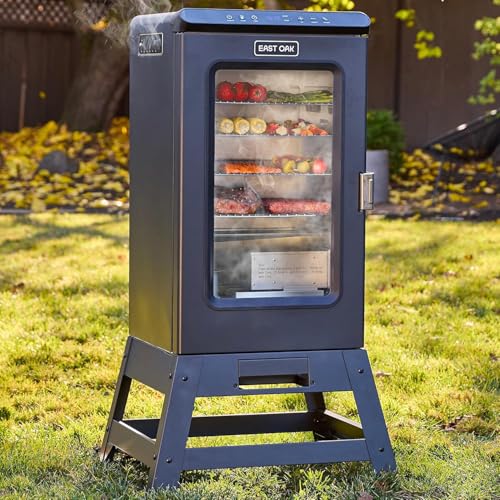
EAST OAK 30-Inch Electric Smoker with Mobility Stand, Polar Night
Badge: Best Overall for Low-and-Slow
Strengths
- Thermostatic electric heat is inherently steady in the low band — no fire behavior to manage across twelve hours.
- Side chip loader stretches one smoke load up to six times longer and reloads from outside, so long cooks keep their smoke and their heat.
- Built-in meat probe plus a 725 square inch cabinet on a stand: the full slow-cooking toolkit at working height.
Trade-offs
- Chip smoke is the mildest in this guide; bark and smoke depth will trail the pellet picks.
- Even a six-fold chip load can run out on the longest cooks — plan one reload.
- No connectivity in the verified data, so overnight checks happen in person.
Mini spec box
- Format: 30-inch outdoor electric smoker on mobility stand
- Cooking area: 725 sq in
- Monitoring: built-in meat probe
- Smoke system: side chip loader, up to 6x longer uninterrupted smoke
- Finish: Polar Night
Slow cooking is, at bottom, a stability contest: the machine that holds 225°F most uneventfully for the longest stretch gives the cook the fewest surprises, and an electric element under thermostatic control is the most uneventful heat source in barbecue. The Polar Night builds the rest of the slow brief around that core. The side loader answers the cabinet format’s historic weakness — chips that fade after a couple of hours — by stretching a load up to six times longer and letting you extend it further from outside the door. The probe closes the information loop. The stand, easy to dismiss as furniture, matters at hour ten when a heavy shoulder needs turning or wrapping: doing that work at waist height instead of in a crouch is a genuine quality-of-cook improvement.
Its ceiling is smoke intensity, and this guide will not blur it: if your reference brisket comes from a live-fire pit, a chip cabinet’s cleaner, gentler smoke will register as a compromise no matter how steady the temperature is. But slow cooking is a balance of variables, and for the many cooks whose failures have come from temperature chaos rather than smoke subtlety, this machine removes the variable that ruins cooks and keeps the one that merely nuances them. That is why it leads a low-and-slow ranking despite finishing last in smoke depth.
Best for: brisket and shoulder cooks who prize temperature steadiness and low effort over maximum smoke / Not suited for: smoke-depth purists, who should start at the Traeger below

Royal Gourmet SE2805 28-Inch Electric Smoker
Badge: Best Budget Low-and-Slow
Strengths
- A small cabinet with a strong 1350W element recovers its low temperature quickly after the door closes.
- Analog simplicity suits the shorter slow canon — ribs, chicken, small shoulders — without electronics to manage.
- 454 square inches across three grates is honestly sized for small households’ slow cooks.
Trade-offs
- Analog dial holds a range rather than a set point — the least precise low-band control here.
- Internal chip tray means smoke reloads cost a door opening and a temperature dip.
- Whole packer briskets exceed its geometry; plan trimmed or separated cuts.
Mini spec box
- Format: 28-inch electric vertical smoker
- Cooking area: 454 sq in
- Power: 1350W
- Control: analog temperature control, adjustable heat
- Racks: 3 cooking grates
- Model: SE2805, black
Not every slow cook is a brisket marathon. The weeknight-and-weekend canon — ribs that take an afternoon, a chicken taken low and slow for tenderness, a modest shoulder for pulled pork — fits inside this compact cabinet, and for those cooks its traits align well: the strong-for-size element brings the small chamber back to temperature briskly after loading, the dial asks nothing of the cook but a setting, and the whole machine stores where a full-size smoker cannot. Beginners often meet low-and-slow here first, and the format teaches the right lessons — patience, door discipline, judging by tenderness — at the gentlest tier in the guide; it is a natural companion to the starter-focused picks in Best Small Smokers For Beginners.
Its limits are the honest ones of size and control. The dial’s range-holding means your low band breathes a little with the weather, and the big brisket simply does not fit whole. Treat it as the small-canon slow smoker it is, and it will be used constantly; ask it to be an overnight brisket machine and you will be shopping again within the year.
Best for: ribs, chicken, and small shoulders in small spaces, and first low-and-slow lessons / Not suited for: whole packer briskets or precision-critical long cooks

Traeger Pro 22 Wood Pellet Grill and Smoker
Badge: Best Smoke Depth
Strengths
- A real wood fire, controller-fed: the deepest, most authentic smoke of any pick in this guide.
- Pellet fires smolder richest at low temperatures — slow cooking is this format’s strength, not its compromise.
- 18 lb hopper and an included meat probe complete the long-cook setup.
Trade-offs
- 572 square inches is mid-sized for a whole brisket plus accompaniments.
- No stated 180°F floor in its verified data, unlike the Pit Boss models’ explicit low end.
- Its 450°F stated ceiling matters for grilling, not for slow work — listed here only so grill-minded buyers note it.
Mini spec box
- Format: wood pellet grill and smoker
- Cooking area: 572 sq in
- Fuel: wood pellets, 18 lb hopper
- Max temperature: 450°F per listing
- Monitoring: meat probe included
- Modes: grill, smoke, bake, roast, braise, BBQ
If the EAST OAK wins on steadiness, the Traeger wins on the thing slow cooking exists for: smoke, laid down over hours by a genuine wood fire. Pellet combustion has a happy property at low settings — the fire cycles between smolder and flame, and the smolder phases produce the thin, flavorful smoke that long exposure turns into bark and depth. A controller holds the temperature while that chemistry happens, which is why the pellet format converted so many stick-burner skeptics: the fire is real, the tending is not. Across a brisket’s long arc, the 18 lb hopper keeps the fire fed with the fewest interventions of any pellet pick except the Navigator.
Choose it when flavor leads your priorities and your cooks are sized for a mid-format grill. Its versatility is a slow-cooking bonus too: the same machine that smokes all Saturday roasts Sunday’s chicken at higher heat, so the patio keeps one footprint. For smoke-first buyers, this is the recommendation; the steadiness-first buyers have the EAST OAK, and the guide’s honesty about that split is deliberate.
Best for: flavor-first cooks who want real wood smoke with controller steadiness / Not suited for: buyers needing the largest capacity or a stated ultra-low temperature floor

Pit Boss 700 Carbon Series Wood Pellet Grill and Smoker
Badge: Best for Big Briskets
Strengths
- 718 square inches swallows a whole packer brisket with room for a second item — the slow cook that decides this category.
- LCD digital controller states a range from 180°F, purpose-built headroom below the classic slow band.
- Meat probe included for the only doneness signal that matters at hour twelve.
Trade-offs
- 13.5 lb hopper: the longest cooks need one planned refill check.
- No WiFi or Bluetooth in the verified data.
- Big footprint for households whose slow cooks are small.
Mini spec box
- Format: wood pellet grill and smoker, Carbon Series
- Cooking area: 718 sq in
- Temperature range: 180°F to 500°F
- Control: LCD digital controller
- Fuel: wood pellets, 13.5 lb hopper
- Monitoring: meat probe included
- Finish: black
Brisket is the examination every slow smoker sits, and it is an examination of geometry as much as of heat. A whole packer is a long, awkward cut; cram it into a small chamber and it touches walls, cooks unevenly, and forces compromises before the fire is even lit. The 700’s 718 square inches give the cut air on all sides and leave room for the beans or the second protein that turns a cook into a meal. Underneath, the LCD controller works from a stated 180°F, so the low band is held by a system designed to operate there rather than at the bottom of its competence.
The single discipline is fuel: schedule one hopper check into the cook’s middle and the 13.5 lb reserve will not surprise you. For hosts whose slow cooking is a social event — the brisket that feeds twelve — this is the pick sized to the ambition, with pellet smoke depth the electric cabinets cannot match.
Best for: whole briskets, batch slow cooks, and hosts / Not suited for: small households or buyers wanting maximum unattended fuel reserve

Pit Boss 500 Carbon Series Wood Pellet Grill and Smoker
Badge: Best Compact Slow Smoker
Strengths
- Full slow credentials in a compact body: LCD digital control and a stated 180°F low end.
- 13.5 lb hopper matches the larger 700’s fuel reserve.
- 543 square inches covers the small household’s slow canon — shoulders, ribs, chickens — completely.
Trade-offs
- A whole large brisket is a squeeze; smaller packers or separated cuts fit better.
- No connectivity in the verified data.
- Compact pellet grills still demand the full pellet routine: dry storage, shutdown cycles, grease care.
Mini spec box
- Format: wood pellet grill and smoker, Carbon Series
- Cooking area: 543 sq in
- Temperature range: 180°F to 500°F
- Control: LCD digital controller
- Fuel: wood pellets, 13.5 lb hopper
- Monitoring: meat probe included
- Finish: black
The 500 makes the guide’s neatest argument: slow cooking quality lives in the control system and the fire, not in the sheet metal’s dimensions. It keeps the 700’s controller class, its 180°F floor, its probe, and its hopper size, and gives up only chamber volume. For the couple or small family whose slow cooks are a shoulder and a tray of beans, nothing of substance is lost, and a patio-sized footprint is gained — the same trade the compact end of Best Small Cheaper Smokers keeps rewarding. Buy it when your menu is small but your standards for the low band are not.
Best for: small households wanting uncompromised pellet low-and-slow in a compact grill / Not suited for: whole-packer brisket cooks or crowd feeding

Pit Boss 850 Navigator Series Wood Pellet Grill and Smoker
Badge: Best for Overnight Cooks
Strengths
- 30 lb hopper: the longest fuel supply here, sized for cooks that start at night and finish at lunch.
- WiFi and Bluetooth monitoring lets the cook check the brisket, not the brisket check the cook.
- 932 square inches and an LCD controller from 180°F — the largest slow stage in the guide, plus a flame broiler for finishing.
Trade-offs
- The biggest footprint and premium positioning of the six.
- Connectivity presumes usable patio WiFi.
- More machine than a monthly small cook can justify.
Mini spec box
- Format: wood pellet grill and smoker, Navigator Series
- Cooking area: 932 sq in
- Temperature range: 180°F to 500°F
- Control: LCD digital controller; WiFi and Bluetooth
- Fuel: wood pellets, 30 lb hopper
- Monitoring: meat probe included
- Extra: flame broiler for direct-heat searing
Slow cooking’s hardest scheduling problem is that the best brisket timeline starts the night before the meal. The Navigator is engineered directly at that problem: a hopper that holds thirty pounds, so fuel anxiety never sets the alarm; connectivity, so the one check you do make happens from bed; and a chamber large enough that the overnight brisket can share space with tomorrow’s sides. Its flame broiler, a grilling feature, earns a mention in a slow guide for the final act — a quick direct-heat finish for burnt ends while the flat rests.
It is, plainly, the most slow-cooking capacity and oversight in this guide in one machine, and its buyers should be the ones whose cooks justify it: frequent, large, and long. Occasional small-scale slow cooks are better served by every other pick here — a truth this guide is comfortable stating, because a slow smoker bought out of proportion to its menu tends to be a slow smoker rarely used.
Best for: overnight briskets, large batches, and cooks who monitor by phone / Not suited for: small patios, small households, or occasional use
Comparison Table
| Pick | Low-band control | Smoke supply | Area | Probe | Link |
|---|---|---|---|---|---|
| EAST OAK Polar Night | Thermostatic electric | Side loader, up to 6x per load | 725 sq in | Built-in | Check on Amazon |
| Royal Gourmet SE2805 | Analog dial | Internal chip tray | 454 sq in | None stated | Check on Amazon |
| Traeger Pro 22 | Digital controller, auger-fed | 18 lb hopper | 572 sq in | Included | Check on Amazon |
| Pit Boss 700 Carbon | LCD digital from 180°F | 13.5 lb hopper | 718 sq in | Included | Check on Amazon |
| Pit Boss 500 Carbon | LCD digital from 180°F | 13.5 lb hopper | 543 sq in | Included | Check on Amazon |
| Pit Boss 850 Navigator | LCD digital from 180°F | 30 lb hopper | 932 sq in | Included + WiFi/Bluetooth | Check on Amazon |
How to Choose a Slow Smoker: The Four Decisions
First, choose your smoke depth honestly. Pellet fire smoke is the deepest available in this guide; electric chip smoke is milder and cleaner. Neither answer is a failure — households divide genuinely on how much smoke they want on a Tuesday chicken — but buying a cabinet while dreaming of pit-style bark is the classic slow-smoker disappointment, and it is avoidable in one honest minute. Second, size for your signature cut. Shoulders forgive almost any chamber; ribs need rack length; a whole packer brisket needs the 700 or the Navigator, or the willingness to separate point and flat. Measure the cut, then the chamber — listing dimensions, not headline area, settle fit.
Third, count your smoke supply against your longest cook. Slow cooking’s defining risk is not temperature but duration: supplies that fade at hour six of a twelve-hour cook. The Navigator’s 30 lb hopper, the Traeger’s 18 lb, and the EAST OAK’s extended chip load exist to retire that risk; the 13.5 lb hoppers manage it with one planned check; the Royal Gourmet’s tray accepts it as the price of compact simplicity. Fourth, decide how you will know. Probe-equipped machines report the cook’s only vital sign continuously. The one pick without a stated probe, the Royal Gourmet, should be budgeted a separate thermometer from day one — a small addition that completes it.
Fifth, and most often skipped, plan for your weather. Slow cooks run through nights and seasons, and every machine here works harder in January than in June: cold air pulls heat from lids and cabinet walls, wind strips it faster, and controllers respond by burning more fuel — pellets empty sooner, elements cycle longer. None of this disqualifies any pick, but it changes the support act around them. A sheltered placement out of direct wind is worth more than any single feature upgrade, and winter cooks deserve a larger fuel margin and an earlier start. The households that cook low-and-slow year-round are not using different machines from everyone else; they are using the same machines with a placement and a plan that respect the season. When you evaluate a spot for your smoker, evaluate it at its worst — a windy, cold evening — rather than on the mild afternoon the delivery arrived.
How to Cook Low-and-Slow: The Method Behind the Machines
Trim and season the night before when you can; salt needs time, and a cold, dry surface takes smoke and forms bark better than a wet one. Bring the smoker to your target — 225–250°F is the classic band — and let it stabilize fully before the meat goes on; a machine still hunting for its temperature will spend the cook’s first hour repaying that haste. Place the meat fat-side according to your heat source’s direction (toward the heat protects the meat), insert the probe in the thickest part away from bone, and then practice the central discipline of the method: leave it alone. Smoke adheres best in the early hours while the surface is cool and moist, which is another reason the early cook deserves an undisturbed machine.
Expect the stall. Somewhere in the middle hours, evaporation from the meat’s surface will balance the heat going in, and the internal temperature will plateau — sometimes for hours. This is not failure and not a broken smoker. Your choices are to wait it out (the purist path, with the deepest bark) or to wrap the cut in foil or butcher paper with a splash of liquid (the pragmatic path, with a faster finish and softer bark). Both are legitimate; decide by your serving time, not by panic. Cook to tenderness, not to a number: the probe should slide into a brisket or shoulder with the resistance of warm butter, and that feel — learned across two or three cooks — is the true graduation of the low-and-slow cook.
Rest is a cooking stage, not a delay. A shoulder benefits from at least half an hour; a brisket, wrapped and held in a cooler, improves over one to two hours as juices redistribute and the texture sets. Slice brisket against the grain, pencil-thick for the flat and cubed for burnt ends from the point. Holding deserves its own word, because slow cooks rarely finish on the minute the guests arrive: a wrapped brisket or shoulder held in a dry cooler stays serving-hot for hours, which converts the cook’s great uncertainty — the finish time — into a manageable window. Cook to finish early and hold, rather than cooking to finish exactly on time; every experienced slow cook builds the schedule that way, and every one of these six machines supports it equally, because holding happens off the heat entirely. Troubleshooting, in the pattern worth keeping. Problem: the cook is hours behind schedule → raise the temperature moderately after wrapping rather than opening repeatedly; steady higher heat finishes meat, fussing does not. Problem: bark is pale and soft → the surface stayed too wet or the smoke phase was too short; dry the surface before the next cook and protect the early hours from spritzing. Problem: the meat tastes of little but smoke → the smoke ran too long or too thick; shorten the heavy-smoke phase and let the back half of the cook run clean. Readers adapting these methods to propane equipment will find the fuel-specific notes in Best Small Propane Smokers.
The Cuts, Ranked by What They Teach
Slow smokers reveal themselves cut by cut, and there is a natural curriculum. Pork shoulder comes first: cheap, forgiving, and nearly impossible to ruin at low temperatures — it teaches loading, smoke management, the stall, and pulling, all in one cook. Ribs come second, teaching time-and-bend judgment and the difference between bite-through and fall-apart. Chicken, taken low then finished hot where the machine allows, teaches smoke restraint — poultry absorbs smoke eagerly and punishes excess. Brisket comes last and teaches everything at once: trimming, patience, wrapping judgment, resting, and slicing. A machine that carries you through that curriculum without a failure attributable to its temperature control has earned its place, which is the standard this guide’s six were chosen against. The grill-smoker hybrids among them also handle the wider menu surveyed in Best Small Smokers Grill once the slow lessons are learned.
Smoke Management Across a Long Cook
Smoke is not a constant ingredient across a long cook; it is a front-loaded one. Meat takes on smoke most readily while its surface is cool, moist, and raw — the first portion of the cook — and progressively less as the surface dries, sets, and forms bark. This single fact reorganizes how a good slow cook is run on every machine in this guide. It means the early hours deserve your best smoke: fresh pellets burning in their smolder-rich low range, or a full chip load placed at the start rather than saved for later. It means late smoke additions buy little flavor and can cost you temperature stability if they require opening the cooker. And it means a cook whose smoke supply fades at hour seven has lost less than the anxious owner fears — by then the meat is largely done listening.
Quality matters as much as timing. The smoke you want is thin and pale, the kind that is almost hard to see; thick, white, billowing smoke carries the bitter compounds that make beginners conclude they dislike smoked food. On pellet grills, thin smoke comes naturally from a clean, well-fed fire at a steady setting — another argument for not chasing the temperature dial mid-cook. In chip cabinets it comes from restraint: a modest load, fully engaged and smoldering steadily, beats a heaped tray that smothers and billows. If you take one technique from this guide, take this: judge your smoke by its thinness, not its volume, and let the meat’s early hours do the flavor work.
Fuel and Chip Planning for Sessions That Run Past Ten Hours
Long cooks fail logistically more often than they fail culinarily, and the logistics are plannable. For pellet machines: begin every long cook on a full hopper, without exception — topping up is two minutes in the evening and removes the format’s one true failure mode. Store the reserve bag where you can reach it in the dark, keep pellets dry, and know your machine’s shutdown and restart behavior before you need it at hour nine. The Navigator’s 30 lb hopper exists to make this entire paragraph moot for most cooks; the 13.5 lb machines make it a single scheduled check; both are fine, provided the check is scheduled rather than remembered.
For the electric cabinets, the equivalent planning is the chip schedule and the door discipline that protects it. The EAST OAK’s loader stretches a load up to six times longer and — just as important — lets a reload happen from outside, so the smoke plan and the temperature plan stop interfering with each other. On tray-fed cabinets like the Royal Gourmet, accept the reload as a planned event: group it with the wrap, do it once, quickly, with the next load ready in hand, and let the element’s recovery do the rest. Across both formats, write the plan down — start time, wrap trigger, check times, rest window. Slow cooking spans too many hours for memory to be the system, and the cooks who look effortless are simply the ones whose plan lives on paper instead of in their heads.
Common Buying Mistakes
- Chasing smoke depth in the wrong format. Electric cabinets make fine, mild smoke. If pit-style bark is the goal, buy a pellet pick — or accept that no machine here is a stick burner.
- Sizing by headline area instead of the cut. Square inches are an abstraction; a brisket is a shape. Check chamber and rack dimensions against your signature cut.
- Ignoring smoke-supply duration. A twelve-hour cook on a two-hour chip tray or an unchecked hopper is a plan with a hole in it. Match supply to your longest session.
- Cooking by the clock. Slow cuts finish by tenderness. Owners who serve by schedule pressure either rush the rest or panic at the stall; build the schedule around the meat instead.
- Skipping the rest. Slicing a brisket straight off the smoker pours its juices onto the board. The rest is part of the recipe.
- Buying the biggest machine for the smallest menu. A 932 square inch grill smoking one chicken is not a flex; it is a storage problem. Size to your pattern.
Final Recommendation
For most households, the EAST OAK Polar Night is the slow-smoking recommendation: the steadiest low heat in the guide, a smoke supply built for long cooks, a probe, and a stand that makes hour-ten work comfortable. If smoke depth leads your priorities, choose the Traeger Pro 22; if brisket at scale is the mission, the Pit Boss 700 or the Navigator above it. Slow cooking rewards the cook who matches the machine to the menu and then gives the method time — every pick here will hold the low band while you do. Start with a shoulder, learn your machine’s habits across one forgiving cook, and let the brisket come when the routine is second nature. That sequence, more than any specification in this guide, is how good slow cooks are actually made.
Frequently Asked Questions
What temperature counts as low-and-slow?
The classic band is roughly 225–250°F, held for many hours. The Pit Boss models in this guide state a range beginning at 180°F, which gives headroom below the band for very gentle smoking phases; the electric cabinets hold the band thermostatically. What matters is not the exact number but the steadiness — hours in the band without excursions are what render fat and melt collagen properly.
How long does a brisket actually take?
Longer than most first-timers plan, and variable enough that this guide quotes no fixed schedule: size, starting temperature, wrapping, and the length of the stall all move the finish. Plan generously, start earlier than feels necessary, and use the rest period as your buffer — a brisket held properly after cooking forgives an early finish, while a late finish forgives nothing. Doneness is judged by probe tenderness, not by the clock.
Do electric smokers really work for low-and-slow?
Yes — temperature-wise they are arguably the steadiest tools for it, since an element under thermostatic control does not behave like a fire. The trade is smoke: chips give a milder, cleaner smoke than a pellet fire, and long cooks need the chip supply managed, which is why the EAST OAK’s extended side loader matters. If your palate wants deep smoke first, choose a pellet pick; if it wants steadiness first, the cabinets are legitimate slow smokers.
Why do pellet smokers smoke better at low temperatures?
Because of how the fire behaves. At low settings a pellet fire cycles between smoldering and burning as the controller meters fuel, and the smolder phases generate the richest smoke. At high settings the fire burns hot and clean, producing heat with relatively little smoke — which is why experienced pellet cooks run a low smoke phase first and raise the temperature to finish.
What is the stall, and should I wrap?
The stall is the plateau in the middle of a long cook, when evaporation from the meat’s surface cools it as fast as the smoker heats it. Wrapping in foil or butcher paper pushes through it faster, at some cost to bark firmness; waiting preserves bark and costs time. Neither is wrong. Decide by your serving schedule, and know that the stall happens on every machine — it is meat physics, not equipment failure.
Which pick should a beginner start with?
For pellet flavor with guidance, the Pit Boss 500 pairs digital control and a probe with a forgiving size. For the simplest possible introduction, the Royal Gourmet teaches the method at the smallest scale — ideally with a separate thermometer added. The EAST OAK suits the beginner who already knows brisket is the goal and wants the steadiest possible platform for it.
How do I keep a brisket moist over such a long cook?
Moisture in slow cooking comes mostly from the meat itself — rendered fat and melted collagen — protected by good decisions rather than added by gadgets. Keep the door shut so the cooking environment stays humid and steady. Wrap at the stall if you wrap at all, which traps the meat’s own moisture for the remainder of the cook. Rest the brisket properly before slicing, and slice it only when you are ready to serve, since cut surfaces dry quickly. A water pan, where a cabinet design includes one, adds ambient humidity and is a reasonable habit — but it is a supporting actor; temperature steadiness and an unhurried rest do the leading work.
Can these smokers also cook fast?
The pellet picks can: their stated ranges reach 450–500°F, and the Navigator adds a flame broiler for direct heat, so grilling and roasting sit comfortably in the same machine. The electric cabinets are specialists — their gift is the low band, and high-heat searing is not their work. Buy the pellet format if one machine must do both; buy the cabinet if slow is the whole brief.
What wood should I burn for slow cooking?
For long cooks, favor woods whose flavor builds gracefully over hours: oak as the neutral backbone, hickory for the classic barbecue register on pork and beef, and fruitwoods like apple or cherry when you want a gentler hand on poultry or fish. Mesquite is the exception to use with care — assertive in short cooks, it can dominate across a twelve-hour exposure. In pellets, choose a quality food-grade bag and keep it dry; in cabinets, the same species logic applies to chips, with load size mattering more than fine species distinctions at chip scale. Fresh, dry wood, in whichever form your machine burns, beats exotic wood stored badly.


