Disclosure: topratedkitchenware.com is reader-supported. When you buy through links on our site, we may earn an affiliate commission from Amazon and other retailers, at no extra cost to you.
Where to buy
The quickest route to each pick is below. Linked picks go straight to their Amazon listing so you can check the latest price on Amazon; picks marked prose-only failed a core requirement of this keyword — the detailed reviews explain exactly why, and they carry no purchase link so there is no confusion about the recommendation.
- SUPER EMPOWER 12V 100Ah LiFePO4 Battery, Group 24 (2 Pack) — check the latest price on Amazon
- yeagulch 12.8V 100Ah LiFePO4 Battery (Group 31) — check the latest price on Amazon
- VEMDIA 12V 100Ah LiFePO4 Battery (Group 31) — check the latest price on Amazon
- yeagulch 24V 314Ah LiFePO4 Battery — prose-only in this guide (see its review below)
- Qwenoer 22.2V–24V 10Ah Lithium Battery — prose-only in this guide (see its review below)
- dumfume 24V 100Ah LiFePO4 Battery — prose-only in this guide (see its review below)
Read the full guide ↓
The phrase best small 12 volt battery starter describes a specific moment in a system’s life: the first battery, the one everything else gets built around. Whether the system is an RV house bank, a boat’s electronics supply, a cabin solar setup, or a backup unit for home essentials, the starter battery sets the voltage, the case size, the charging profile, and the expansion path. Choosing it well means the system simply starts — every morning, every trip, every outage — and choosing it badly means troubleshooting a foundation while standing on it.
One honesty note belongs at the top. A true engine-cranking starter battery is a different product, built to deliver very short, very large bursts of current, and none of the deep-cycle batteries in this researched pool is marketed as a cranking battery. What this guide covers — and what most people searching this phrase actually need — is the starter battery for a 12 volt electrical system: the first deep-cycle battery that starts the system off. If you need to crank an engine, that is a separate purchase with separate specifications, and the final section of this guide explains how to tell the two jobs apart.
The pool divides cleanly. Three picks are genuine 12V LiFePO4 batteries that can anchor a small system from day one. Three are 24V products — two full-size storage batteries and one small project pack — that cannot serve as a 12V starter battery at all, and they are reviewed prose-only so you can see the voltage trap this category sets for hurried buyers.
Readers speccing a first system often compare formats across voltages, and Best Prices On 9 Volt Batteries covers the small-cell end of that landscape.
Key Takeaways
- A system starter battery is a foundation purchase: it fixes your voltage, case size, charger profile, and expansion path.
- Half this pool is 24V — reading nominal voltage before capacity is the single most important habit in this category.
- Matched pairs bought together age together; the two-pack pick is the strongest foundation for a growing 12V bank.
- Deep-cycle LiFePO4 suits system starting duty; engine cranking is a different job with different specifications.
- Low-temperature cutoff protects your first battery through its first winter — the season that kills neglected starter setups.
In this guide
Quick Picks
All six products researched for the best small 12 volt battery starter brief, at a glance. Badges match the detailed reviews that follow.
| Pick | Badge | Headline specification | Status |
|---|---|---|---|
| SUPER EMPOWER 12V 100Ah LiFePO4 Battery, Group 24 (2 Pack) | Best Overall — Matched Pair | Nominal voltage: 12V; Capacity: 100Ah per battery (2 pack); Energy: 1280Wh per battery | Linked |
| yeagulch 12.8V 100Ah LiFePO4 Battery (Group 31) | Best Single Battery | Nominal voltage: 12.8V; Capacity: 100Ah; Energy: 1280Wh | Linked |
| VEMDIA 12V 100Ah LiFePO4 Battery (Group 31) | Best for Solar-First Systems | Nominal voltage: 12V; Capacity: 100Ah; Case size: Group 31 | Linked |
| yeagulch 24V 314Ah LiFePO4 Battery | Prose-Only: 24V, Not 12V | Nominal voltage: 24V; Capacity: 314Ah; Energy: 8038.4Wh | Prose-only |
| Qwenoer 22.2V–24V 10Ah Lithium Battery | Prose-Only: Project Pack, Wrong Voltage Class | Nominal voltage: 22.2V–24V; Capacity: 10Ah; Chemistry: Lithium-ion (Li-ion) | Prose-only |
| dumfume 24V 100Ah LiFePO4 Battery | Prose-Only: 24V Storage Battery | Nominal voltage: 24V; Capacity: 100Ah; Energy: 2560Wh | Prose-only |
How These Picks Were Chosen
Screening for this keyword applied one hard filter before any scoring: nominal voltage. Only 12V-class batteries could be linked picks for a 12 volt starter role, so all three 24V products in the pool were set to prose-only regardless of quality. The surviving 12V batteries were then compared on the things that matter at the start of a system’s life: capacity and energy, BMS rating against realistic first-system loads, case size against standard compartments, stated expansion support for buyers whose systems will grow, and low-temperature protection for reliability across seasons. Specifications are taken from verified listing data; cycle figures are maker-stated and reported as such. This is research-led guidance, not hands-on testing, and no cranking performance is claimed for any pick because none of these deep-cycle products is sold as an engine starter battery.
The 6 Best Options for small 12 volt battery starter

SUPER EMPOWER 12V 100Ah LiFePO4 Battery, Group 24 (2 Pack)
Badge: Best Overall — Matched Pair
A starter battery purchase is really a purchase of confidence: the system has to wake up and work every time, including after a cold night and a week of sitting. This SUPER EMPOWER two-pack — two matched Group 24 100Ah LiFePO4 batteries, each 1280Wh with a 100A BMS and low-temperature cutoff — is the strongest starter foundation in the pool. Matched pairs matter at the beginning of a system’s life: identical age, identical behaviour, and stated 4P4S expansion support mean the bank you start with is the bank you can grow. Run them in parallel for a 200Ah 12V starter bank, and the system starts life with capacity most small installations never outgrow.
Look at the specification as a system rather than a headline. The nominal voltage of 12V and a energy of 1280Wh per battery defines what this battery can safely deliver hour after hour, while the stated cycle class tells you the duty it was built for. In a getting a small 12 volt system started — and keeping it starting reliably role, that combination matters more than any single number: a battery is only as useful as the weakest link between its capacity, its discharge ceiling, and the protection that keeps it alive when conditions turn cold, hot, or careless. Buyers who match those three things to their real load rarely think about the battery again, which is exactly the point.
Strengths
- Two matched batteries in one purchase — ready for a series pair or a parallel bank
- Group 24 cases are smaller than Group 31 for tight compartments
- Stated 4P4S expansion leaves room to grow the system later
Trade-offs
- You pay for two batteries even if your system only needs one
- Series use for higher voltage demands matched charging discipline
- Two units mean two sets of terminals and cables to install and maintain
| Nominal voltage | 12V |
|---|---|
| Capacity | 100Ah per battery (2 pack) |
| Energy | 1280Wh per battery |
| Case size | Group 24 |
| Chemistry | Lithium iron phosphate (LiFePO4) |
| BMS | 100A BMS |
| Protection | Low-temperature cutoff |
| Expansion | Supports 4P4S expansion, up to 20.48kWh |
Best for: buyers who need getting a small 12 volt system started — and keeping it starting reliably and whose loads fit this battery’s stated limits / Not suited for: buyers whose voltage, capacity, or discharge requirements fall outside the specification above
yeagulch 12.8V 100Ah LiFePO4 Battery (Group 31)
Badge: Best Single Battery
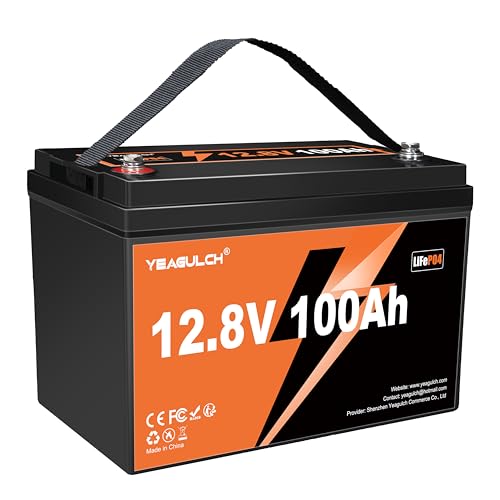
If one battery is the whole plan, the yeagulch Group 31 is the single-unit starter pick: 12.8V, 100Ah, 1280Wh, a 100A BMS, low-temperature protection, and a maker-stated 15000+ deep-cycle class. Starting duty is a pattern of regular draws and regular recharges, and a battery marketed around deep cycling fits that pattern. The Group 31 case drops into the commonest battery boxes in RVs, boats, and cabins, so the starter installation is usually a swap rather than a fabrication project. Choose it when the system is defined, modest, and unlikely to double in size next season.
The honest way to judge this battery is against the job named in this guide — getting a small 12 volt system started — and keeping it starting reliably. Its nominal voltage of 12.8V and a energy of 1280Wh is the figure to hold against your own load list. Everything else about the design, from the case format to the protection features, exists to make that central specification usable in the real world: in a compartment that gets hot in summer, on mornings when the temperature sits below freezing, and on the day someone connects a load bigger than the plan allowed. That is what the BMS is for, and it is why its rating appears in the spec box rather than in a footnote.
Strengths
- High stated cycle class suits daily-cycling solar and off-grid duty
- 100Ah and 1280Wh in a familiar Group 31 case simplifies upgrades from lead-acid
- Low-temperature protection is built in rather than left to the charger
Trade-offs
- Cycle-life figures are maker-stated under lab conditions, not a guarantee for your depth of discharge
- No self-heating, so sub-freezing charging waits on warmer conditions
- Brand support channels are thinner than legacy battery brands
| Nominal voltage | 12.8V |
|---|---|
| Capacity | 100Ah |
| Energy | 1280Wh |
| Case size | Group 31 (BIC) |
| Chemistry | Lithium iron phosphate (LiFePO4) |
| BMS | 100A BMS |
| Cycle class | 15000+ deep cycles (maker-stated) |
| Protection | Low-temperature protection |
Best for: buyers who need getting a small 12 volt system started — and keeping it starting reliably and whose loads fit this battery’s stated limits / Not suited for: buyers whose voltage, capacity, or discharge requirements fall outside the specification above

VEMDIA 12V 100Ah LiFePO4 Battery (Group 31)
Badge: Best for Solar-First Systems
The VEMDIA Group 31 matches the yeagulch on the fundamentals — 12V, 100Ah, a built-in 100A BMS, and a maker-stated 15000-cycle class — and its listing leads with solar systems and home energy, which is why it takes the solar-first badge here. A starter battery in a solar system lives a particular life: charged by day, drawn down by night, and expected to do it again tomorrow for years. That is precisely deep-cycle duty. Pair it with a correctly sized panel and a lithium-profile controller and the system starts — and keeps starting — with very little attention from its owner.
Two ownership details separate a good purchase from a frustrating one here. First, charging: this battery expects a lithium-profile charger or a charge controller set for LiFePO4, and using the right profile is the cheapest lifespan insurance available. Second, expectations: maker-stated cycle figures describe laboratory duty, so the sensible reading is comparative, not absolute. Set against those two disciplines, the nominal voltage of 12V and a case size of Group 31 and the overall design make this a battery you install, configure once, and then mostly ignore — the correct experience for a power component.
Strengths
- Standard Group 31 case fits the trays and boxes most upgraders already own
- 100A BMS covers typical RV, marine, and cabin continuous loads
- Maker-stated deep-cycle class suits daily solar cycling
Trade-offs
- Full-size case, so it saves weight over lead-acid but not space
- No stated low-temperature heating — cold charging relies on BMS cutoff behaviour
- A single unit cannot serve loads above its BMS discharge ceiling
| Nominal voltage | 12V |
|---|---|
| Capacity | 100Ah |
| Case size | Group 31 |
| Chemistry | Lithium iron phosphate (LiFePO4) |
| BMS | Built-in 100A BMS |
| Cycle class | 15000 deep cycles (maker-stated) |
| Intended use (maker-stated) | Solar systems, home energy, RVs, marine |
Best for: buyers who need getting a small 12 volt system started — and keeping it starting reliably and whose loads fit this battery’s stated limits / Not suited for: buyers whose voltage, capacity, or discharge requirements fall outside the specification above
yeagulch 24V 314Ah LiFePO4 Battery
Badge: Prose-Only: 24V, Not 12V
The yeagulch 24V 314Ah is an impressive battery in the wrong guide: 8038.4Wh, a 200A BMS, and maker-stated UL 1973 and UN38.3 certifications. It is prose-only because a starter battery for a 12 volt system must be a 12 volt battery. Doubling voltage is not a small mismatch that a cable can fix; every load, charger, and controller in a 12V system is built around the lower voltage. If you are actually designing a 24V system from scratch, this unit belongs on that shortlist instead — and the honest place for it is a 24V guide, not this one.
Look at the specification as a system rather than a headline. The nominal voltage of 24V and a energy of 8038.4Wh defines what this battery can safely deliver hour after hour, while the stated cycle class tells you the duty it was built for. In a getting a small 12 volt system started — and keeping it starting reliably role, that combination matters more than any single number: a battery is only as useful as the weakest link between its capacity, its discharge ceiling, and the protection that keeps it alive when conditions turn cold, hot, or careless. Buyers who match those three things to their real load rarely think about the battery again, which is exactly the point.
Strengths
- Native 24V output with very large single-unit capacity
- A 200A BMS matches the heavier continuous loads of a 24V system
- Maker-stated UL 1973 and UN38.3 certifications are named in the listing
Trade-offs
- 314Ah at 24V is a big, heavy unit — plan the compartment and lifting help
- Capacity this large is oversized for light-duty 24V use
- Single-unit failure takes the whole bank offline, unlike paired smaller units
| Nominal voltage | 24V |
|---|---|
| Capacity | 314Ah |
| Energy | 8038.4Wh |
| Chemistry | Lithium iron phosphate (LiFePO4) |
| BMS | 200A BMS |
| Cycle class | 15000+ deep cycles (maker-stated) |
| Certifications (maker-stated) | UL 1973, UN38.3 |
| Protection | Low-temperature protection |
Best for: buyers who need getting a small 12 volt system started — and keeping it starting reliably and whose loads fit this battery’s stated limits / Not suited for: buyers whose voltage, capacity, or discharge requirements fall outside the specification above
Qwenoer 22.2V–24V 10Ah Lithium Battery
Badge: Prose-Only: Project Pack, Wrong Voltage Class
The Qwenoer pack is prose-only on two counts: its 22.2V–24V output is the wrong voltage class for a 12V starter role, and at 10Ah with bare leads and an included project charger, it is a ride-on-toy and DIY electronics pack rather than a system battery. Starter duty demands capacity measured in tens of amp-hours at minimum and terminals built for real cable connections. This pack has a legitimate life in small projects; it simply cannot be the foundation of a 12V system, and recommending it as one would strand the buyer at the first cold morning.
The honest way to judge this battery is against the job named in this guide — getting a small 12 volt system started — and keeping it starting reliably. Its nominal voltage of 22.2V–24V and a chemistry of Lithium-ion (Li-ion) is the figure to hold against your own load list. Everything else about the design, from the case format to the protection features, exists to make that central specification usable in the real world: in a compartment that gets hot in summer, on mornings when the temperature sits below freezing, and on the day someone connects a load bigger than the plan allowed. That is what the BMS is for, and it is why its rating appears in the spec box rather than in a footnote.
Strengths
- Includes its matched charger, which suits small project builds
- Bare leads make it easy to wire into custom low-draw projects
- Compact pack for ride-on toys and electronics
Trade-offs
- A project pack, not a deep-cycle storage or propulsion battery
- 10Ah is far too little energy for trolling or household backup
- Lithium-ion chemistry rather than the LiFePO4 used by storage batteries
| Nominal voltage | 22.2V–24V |
|---|---|
| Capacity | 10Ah |
| Chemistry | Lithium-ion (Li-ion) |
| Included | 25.2V 2A charger |
| Connections | Bare leads wire and cable connector |
| Intended use (maker-stated) | Kids ride-on cars, DIY projects, solar panels, LED light strips, CCTV cameras |
Best for: buyers who need getting a small 12 volt system started — and keeping it starting reliably and whose loads fit this battery’s stated limits / Not suited for: buyers whose voltage, capacity, or discharge requirements fall outside the specification above
dumfume 24V 100Ah LiFePO4 Battery
Badge: Prose-Only: 24V Storage Battery
The dumfume 24V 100Ah completes the trio of prose-only entries, and its exclusion is purely about voltage: as a native 24V LiFePO4 battery with 2560Wh, a 100A BMS, and a maker-stated IP65 rating, it is a credible storage battery for a 24V system. In a 12V starter role it cannot be connected at all without conversion equipment that costs more than choosing the right battery in the first place. Half of this pool being 24V is a useful warning about this category generally: always read the nominal voltage in the title before the capacity, because the biggest number on the page is not the one that decides compatibility.
Two ownership details separate a good purchase from a frustrating one here. First, charging: this battery expects a lithium-profile charger or a charge controller set for LiFePO4, and using the right profile is the cheapest lifespan insurance available. Second, expectations: maker-stated cycle figures describe laboratory duty, so the sensible reading is comparative, not absolute. Set against those two disciplines, the nominal voltage of 24V and a energy of 2560Wh and the overall design make this a battery you install, configure once, and then mostly ignore — the correct experience for a power component.
Strengths
- Native 24V output removes series-pair balancing from the design
- Maker-stated IP65 rating suits exposed marine and outdoor mounting
- 2560Wh in a single unit keeps wiring simple
Trade-offs
- 24V output cannot power a 12V system without a converter
- 100A BMS is modest for the largest 24V inverter loads
- A single large unit is a single point of failure for the bank
| Nominal voltage | 24V |
|---|---|
| Capacity | 100Ah |
| Energy | 2560Wh |
| Chemistry | Lithium iron phosphate (LiFePO4) |
| BMS | Built-in 100A BMS |
| Cycle class | 15000 deep cycles (maker-stated) |
| Rating (maker-stated) | IP65 waterproof |
| Certifications (maker-stated) | UN38.3, UL1973 |
Best for: buyers who need getting a small 12 volt system started — and keeping it starting reliably and whose loads fit this battery’s stated limits / Not suited for: buyers whose voltage, capacity, or discharge requirements fall outside the specification above
Comparison Table
The six products side by side on the attributes that decide this category. No prices and no ratings — both change too often to print honestly; use the links to check the latest price on Amazon.
| Product | Voltage | Capacity | Chemistry | Status | Link |
|---|---|---|---|---|---|
| SUPER EMPOWER 12V 100Ah LiFePO4 Battery, Group 24 (2 Pack) | 12V | 100Ah per battery (2 pack) | Lithium iron phosphate (LiFePO4) | Linked | Check on Amazon |
| yeagulch 12.8V 100Ah LiFePO4 Battery (Group 31) | 12.8V | 100Ah | Lithium iron phosphate (LiFePO4) | Linked | Check on Amazon |
| VEMDIA 12V 100Ah LiFePO4 Battery (Group 31) | 12V | 100Ah | Lithium iron phosphate (LiFePO4) | Linked | Check on Amazon |
| yeagulch 24V 314Ah LiFePO4 Battery | 24V | 314Ah | Lithium iron phosphate (LiFePO4) | Prose-only | Prose-only |
| Qwenoer 22.2V–24V 10Ah Lithium Battery | 22.2V–24V | 10Ah | Lithium-ion (Li-ion) | Prose-only | Prose-only |
| dumfume 24V 100Ah LiFePO4 Battery | 24V | 100Ah | Lithium iron phosphate (LiFePO4) | Prose-only | Prose-only |
How to Choose: Best Small 12 Volt Battery Starter Buying Guide
Starter battery versus cranking battery: know which job you have
The word ‘starter’ causes real confusion in this category. An engine starter (cranking) battery is specified in cold cranking amps and built for seconds-long bursts; a deep-cycle battery is specified in amp-hours and built for hours-long draws. Using a deep-cycle lithium battery to crank an engine can trip its BMS or damage it, and using a cranking battery to run house loads kills it quickly through deep discharge. This guide is about the second job — starting a 12V electrical system. If your actual need is turning over an engine, shop by cranking specifications in the automotive category instead, and treat anything in this guide as the house battery that sits alongside it.
Size the foundation for the system you will have in two years
Starter purchases fail in two directions: bought too small, the battery becomes the ceiling on every future upgrade; bought wildly too large, money sits unused in a battery box. A practical method is to size for today’s loads with the watt-hour method, then ask one question — what is the single most likely addition in the next two years? A fridge, a bigger inverter, a second lighting circuit? If the answer has real weight, choose the pick with stated expansion support or the matched pair, so growth means adding a unit rather than replacing the foundation. If the system is genuinely finished, a single 100Ah battery is the honest, sufficient answer.
Why matched pairs beat mixed banks
Batteries wired together share work according to their condition. Two identical batteries bought together — same model, same production era, same first charge — share it evenly and age in step. A new battery paralleled with an older, weaker one inherits the weaker unit’s behaviour: the pair’s usable capacity and discharge behaviour drift toward the worse battery. This is why the two-pack leads this guide despite costing more on day one. For a starter purchase specifically, day one is the only moment when a perfectly matched bank is effortless to obtain; every later addition is a compromise by comparison.
The charger is part of the starter purchase
A starter battery installed with the wrong charger is a system that starts badly from its first week. LiFePO4 needs a lithium charging profile — correct absorption voltage, no equalisation stage, no lead-acid maintenance pulses. If the system charges from solar, the controller needs a lithium setting; from an alternator, a DC-DC charger with a lithium profile protects both the battery and the alternator; from mains, a lithium-rated charger is a modest one-time cost. Budget for the charger when you budget for the battery, and set every profile before the first charge, not after the first strange behaviour.
For the vehicle side of a 12V installation, Best Car Cover Chevy Volt is the companion read our automotive readers pair with this guide.
How to Commission a New 12V Starter Battery System
Commissioning is the unhurried hour that decides whether a starter system is boring for a decade. Start with the battery itself: unpack it, note its resting voltage with a multimeter, and give it a full charge on the correct lithium profile before it does any work. Batteries ship partially charged, and beginning service from a known full state makes every later runtime observation meaningful. While it charges, plan the physical installation — the battery secured against movement, terminals accessible for a wrench, cables routed without sharp edges or tension, and a fuse on the positive cable close to the battery, sized for the cable and the system’s maximum draw.
Connect in the safe order: loads and charger off, positive cable first, negative last, then verify polarity at the distribution point with the multimeter before energising anything. Bring loads online one at a time — lights, then pump, then inverter — and watch for anything that behaves oddly at first power. If the system has a battery monitor or shunt, calibrate it now, with the battery known-full, so its percentage readings start from truth. Label the cables and photograph the finished installation; the person troubleshooting it in three years, possibly you on a dark evening, will be grateful.
The first month is a shakedown, not a verdict. Check terminal tightness after the first few journeys or weeks, since new connections settle. Note roughly how the battery’s charge level moves through a normal day of use — that baseline is your early-warning system for the life of the installation, because a change in the pattern almost always means a changed load or a failing appliance, not a failing battery. Store the charger’s settings and the battery’s documentation with the photograph. A starter system commissioned this carefully rarely makes news again, which is the entire goal.
Problem: the new battery’s BMS trips when a big load starts → the load’s startup surge likely exceeds the discharge ceiling; start large loads one at a time, check whether the inverter is oversized for a single battery, and consider the parallel pair configuration.
Problem: the battery never seems to reach full charge → verify every charger and controller is actually set to a lithium profile; a lead-acid profile stops early or behaves oddly, and the setting is often buried two menus deep.
Problem: runtime in the first week is far below expectations → audit for a load left on continuously — an inverter idling overnight is the classic first-system mistake — before suspecting the battery.
Diagnostics-minded readers may also want Best Code Reader Chevy Volt when the project extends to the vehicle itself.
Cold Mornings: The Starter Battery’s Real Exam
Every battery system is reliable in mild weather. The starter battery earns its name in the cold: the first frosty morning when the cabin heater runs, the boat has sat for a fortnight, or the RV comes out of storage. Lithium batteries discharge happily in cold weather but must not be charged below freezing, which is why low-temperature cutoff — fitted to all three linked picks here — matters more for a starter battery than almost any other feature. It converts a potentially cell-damaging mistake into a simple delay: the system waits, the battery warms, charging resumes.
Cold also exposes weak foundations: marginal cable connections contract and loosen, and a battery that was barely big enough in September is visibly too small in January when heating loads join the list. The commissioning habits in the how-to section — tight terminals, a known-full start, a baseline of normal behaviour — are what let you tell a cold-weather quirk from a genuine fault. Buyers in genuinely cold regions should also note what none of these picks claims: self-heating. If your battery must charge in an unheated space through deep winter, that feature exists elsewhere in the market and is worth shopping for explicitly.
Building Out From the Starter Battery
A starter battery is chapter one, and the linked picks were chosen partly for how their stories continue. The matched pair can grow by parallel capacity or anchor a larger bank under its stated 4P4S expansion architecture; the single Group 31 units can be joined later by an identical sibling, with the caveat from the buying guide that a later addition never matches as perfectly as a pair bought together. Solar charging, a battery monitor, and a properly fused distribution panel are the usual chapter two, in whichever order your use demands.
What should not change is the foundation’s voltage and chemistry. A 12V LiFePO4 system should grow with 12V LiFePO4 units from the same maker and model line wherever possible. The three prose-only 24V products in this guide are a standing reminder of the alternative: impressive specifications that belong to a different system entirely. Systems, like houses, are cheap to extend and expensive to re-found — which is the whole argument for choosing the starter battery carefully.
And for budget 9V cells for alarms and meters in the same building, see Best Prices On Duracell 9 Volt Batteries.
Ownership Notes Worth Reading Before You Order
A starter battery also decides your monitoring options, and it is worth deciding early whether you will add a shunt-based battery monitor. State-of-charge percentage on a lithium battery cannot be read from voltage the way it roughly can with lead-acid, because the lithium discharge curve is so flat. Owners who skip a monitor learn to read their system’s behaviour instead — which works, but takes a season. Owners who fit the monitor during the original installation, while every cable is already off, get accurate numbers from day one for the price of one extra component fitted at the easiest possible moment.
Fusing deserves one more paragraph because starter systems grow informally: a spare terminal here, an extra socket there. Every conductor leaving the battery’s positive terminal should be fused for its own wire size, not for the system’s total. The main fuse protects the main cable; it cannot protect a thin unfused spur wire, which will simply become the fuse in a fault — by melting. A small fused distribution block fitted at commissioning keeps every later addition honest, and it is one of the cheapest safety upgrades in the whole system.
Finally, keep the paperwork. The battery’s manual, the charger’s settings, a photograph of the installation, and a note of the commissioning date sound like bureaucracy until the first warranty conversation or the first fault three winters later. Starter systems are long-lived; memories are not. The buyers who can state exactly what is installed, and how it was configured, resolve problems in an afternoon that take everyone else a week of guesswork.
There is a temptation, when a starter system works, to immediately load it with everything it might one day power. Resist it for the first few outings. A new system should be proven at its intended duty before it is stretched: run the fridge, the lights, and the normal loads through several full cycles and confirm the arithmetic from the buying guide matches reality. Every system has one surprise load — a pump that draws more than its label, a charger that runs all night — and it is far better to meet that surprise at home, with a meter in hand, than at a campsite or on the water.
Cable sizing is the other quiet foundation decision. Voltage drop grows with current and cable length and shrinks with conductor thickness, and a starter system built with undersized cable will show it as dim lights at the far end, an inverter that alarms under load, and motors that start reluctantly. The fix costs little at installation and a great deal later, when cables are buried behind panels. When the table of recommended sizes offers a choice, take the thicker cable: copper is bought once, while voltage drop is paid on every single cycle for the life of the system.
It is also worth deciding, on day one, where the system’s master switch lives and making sure everyone who uses the system knows it. A single, obvious disconnect that kills all loads is the difference between a minor incident and a damaged battery when something goes wrong — a chafed cable, a flooded compartment, a load that will not switch off. Starter systems are often used by family, guests, and crew who did not install them; the foundation you choose should be operable, and stoppable, by the least technical person aboard.
A word about resting voltage, because new owners often misread it. A LiFePO4 battery sits at a nearly flat voltage across most of its charge range, so a meter reading that looks reassuringly high can still mean the battery is half empty, and a reading slightly lower does not mean it is nearly flat. This is normal lithium behaviour, not a fault, and it is why this guide keeps returning to watt-hour accounting and proper monitoring rather than voltage guesses. Judge the starter battery by what it delivers over a day of real use, not by a single number on a multimeter.
And plan the second charger before you need it. Systems that charge from one source only — solar alone, or shore power alone — eventually meet the week when that source is unavailable: the stormy fortnight, the marina without a free outlet, the alternator fault. A starter installation that leaves physical and electrical room for a second charging path, even if it is only a modest mains charger kept in a locker, is resilient in a way that costs almost nothing at the foundation stage and a great deal as a retrofit.
Common Buying Mistakes
- Buying a 24V battery for a 12V system because the capacity number was bigger — half the pool for this guide would have been exactly that mistake.
- Confusing a system starter battery with an engine cranking battery, and expecting deep-cycle specifications to turn an engine over.
- Installing the battery with a lead-acid charger profile and concluding the battery is faulty when charging behaves strangely.
- Mixing a brand-new battery into an old bank and blaming the new unit for the pair’s reduced performance.
- Skipping the fuse on the positive cable because the system is ‘only small’ — small batteries can still deliver damaging current into a short circuit.
Two further mistakes show up after the purchase rather than before it. The first is treating cable and connections as an afterthought: undersized cable, loose terminals and corroded lugs all waste energy as heat and can make a healthy battery look weak, because the voltage the system sees is no longer the voltage the battery is delivering. Use cable sized for the run and the load, tighten terminals properly, and re-check them after the first few weeks as everything settles. The second is running the system with no way to see its state. Even a simple voltage check on a regular schedule tells you whether the battery is being refilled fully, drifting lower week by week, or sitting at a partial charge that will shorten its working life. Owners who look at that one number occasionally almost never meet the sudden, apparently mysterious failure that surprises owners who never look at all.
Final Recommendation
Start with the matched pair if the budget allows it: the SUPER EMPOWER two-pack is the best small 12 volt battery starter foundation in this pool because it begins the system’s life with two identical Group 24 batteries, honest capacity, and a stated expansion path. Systems grow; foundations should be built expecting it.
Start with the SUPER EMPOWER 12V 100Ah LiFePO4 Battery, Group 24 (2 Pack) if it matches your requirements.
The yeagulch 12.8V 100Ah LiFePO4 Battery (Group 31) is the alternative to weigh before you decide.
The VEMDIA 12V 100Ah LiFePO4 Battery (Group 31) is the alternative to weigh before you decide.
If one battery is genuinely the whole system, choose between the two Group 31 singles by duty: the yeagulch for general RV, marine, and cabin service with its deep-cycle emphasis, the VEMDIA if solar charging is the centre of the design. Either starts a 12V system properly. What neither this guide nor any honest one can do is make the three 24V products fit a 12V brief — check the voltage first, every time, and the rest of the decision becomes straightforward.
Related guides
Frequently Asked Questions
Can one of these batteries start my car or boat engine?
These are deep-cycle system batteries, not cranking batteries, and none is marketed with a cranking specification. Engine starting demands very high current for a few seconds, which is a different design brief and can trip a deep-cycle battery’s BMS. Use a battery specified for cranking for the engine, and one of these for the house or accessory system.
Why are 24V batteries in a 12V guide at all?
Because they were in the researched pool, and hiding them would teach nothing. They are reviewed prose-only, with no purchase links, to show exactly how easily a buyer skimming for capacity could order a battery that cannot be connected to their system. Voltage first, capacity second — that order prevents the mistake.
Is one 100Ah battery enough to start a small solar system?
For a modest system — lighting, device charging, a small fridge, fans — 1280Wh is a workable foundation, provided the solar array and controller are sized to refill it on an average day. The watt-hour method in the buying guide gives your personal answer; if your daily use lands well under the battery’s usable energy, one unit is an honest start.
Should I buy the two-pack even if I only need one battery today?
Only if growth is genuinely likely. A matched pair is the cleanest foundation and paralleling them gives a 200Ah bank immediately, but money spent on unused capacity is real. If the system is finished by design, a single battery plus a correct charger is the better-balanced purchase.
What charger do I need for a LiFePO4 starter battery?
Any charger — mains, solar controller, or alternator DC-DC unit — with a lithium or LiFePO4 profile. The essential points are the correct absorption voltage and the absence of lead-acid equalisation. Set the profile before the first charge; most ‘battery problems’ in new systems trace back to a charger still set for the old lead-acid battery.
How do I store the system over winter?
Charge the battery to a partial state of charge rather than full or empty, disconnect loads so nothing drains it slowly, and store it cool and dry. Check it every couple of months. Remember that charging below freezing is blocked by the battery’s protection, so do the top-up charge somewhere the battery can warm up first.
How do I know if my system has outgrown a single starter battery?
Watch the pattern rather than a single bad day. If the battery regularly ends the evening low despite a full day of charging, if you have started rationing loads you bought the system to run, or if a planned addition — a larger fridge, more lighting, a pump — would push daily use close to the battery’s usable energy, the foundation has become the limit. Outgrowing a starter battery is a sign the system succeeded, not that the first purchase was wrong. The correct response is the matched expansion the buying guide describes: add an identical battery of the same age and type where possible, re-check that the charger and cabling suit the larger bank, and resize the daily energy budget before assuming the new capacity has solved everything.
