Disclosure: topratedkitchenware.com is reader-supported. When you buy through links on our site, we may earn an affiliate commission from Amazon and other retailers, at no extra cost to you.
Where to buy
The six models below are the verified picks for this guide to the best small smokers serious eats readers — cooks who shop the way a rigorous food publication tests — should consider first. Each name links to its Amazon listing, where you can check the latest price on Amazon, confirm the current configuration, and read the newest owner feedback before you decide. One clarification belongs at the very top: Serious Eats is a publication, not a product line, and nothing in this guide is, or claims to be, that publication’s selection. What this guide borrows is a standard — judge smokers the way a serious test kitchen would, on temperature stability, honest specifications, and ease of use — and applies it to the verified pool.
- EAST OAK 30-Inch Outdoor Electric Smoker, Matte Black
- Traeger Pro 22 Wood Pellet Grill & Smoker
- EAST OAK 30-Inch Outdoor Electric Smoker with Mobility Stand, Polar Night
- Royal Gourmet SE2805 28-Inch Electric Smoker
- Masterbuilt 30-Inch Electric Vertical Smoker with Analog Control (MB20070210)
- Pit Boss 700 Carbon Series Wood Pellet Grill & Smoker
Read the full guide ↓ for the benchmark criteria in full, the scoring logic behind the ranking, a plain explanation of what temperature stability actually means in a chamber, and the honest limitations of every pick — including the two analog models and what their simplicity costs the cook who chooses them.
Searches for the best small smokers serious eats style are really searches for a method. The reader behind this keyword has usually read enough test-driven food writing to distrust superlatives, and wants a smoker chosen the way a good test kitchen chooses anything: define the criteria before touching the products, weight temperature stability above novelty, treat manufacturer claims as hypotheses, and prefer the tool that disappears into the work. This guide honours that intent literally. It is not affiliated with Serious Eats, it does not reproduce or imply that publication’s verdicts, and where its ranking might differ from any publication’s, the difference is argued from stated criteria rather than asserted. Small keeps its honest meaning here as everywhere in this programme: the compact end of the verified pool — 28- to 30-inch vertical electrics and the mid-size pellet class — not miniatures, which the pool does not contain.
The criteria, stated before the ranking so the ranking can be checked against them, are these. First, temperature stability: a smoker’s core promise is a held temperature over hours, and control systems are judged by how directly they serve that promise. Second, intervention cost: how often, and how invasively, the cook must disturb the chamber — loaders, probes, windows, and hoppers are scored as stability features, not conveniences. Third, specification honesty: whether the listing’s own stated figures are coherent and sufficient to judge the machine. Fourth, ease of use in the deep sense — not feature count, but the absence of friction across setup, cooking, cleaning, and storage. Fifth, proportion: capacity matched to household cooking rather than to a headline. Readers cross-shopping Best Small Stick Burner Smokers will recognise the same criteria applied there to a harder case, because live fire is where stability claims go to be humbled; the comparison clarifies what electric and pellet control are actually worth.
Key Takeaways
- This guide applies an editorial benchmark method — criteria fixed in advance, claims treated as hypotheses — and is not affiliated with, or a summary of, any publication’s picks.
- Temperature stability and intervention cost outrank features: the top picks are the machines that hold a line and leave the cook alone.
- Two analog models are included and judged fairly: simplicity is a real virtue, and its cost — manual temperature judgement — is stated, not hidden.
- The smallest models in the pool earn genuine respect under these criteria, because proportion and honesty are scored, not just capacity.
- Every specification in this guide comes from the verified listing titles; where a figure is absent, the guide says so instead of estimating, and where a claim is a manufacturer’s framing, the guide credits the mechanism and discounts the number.
In this guide
Quick Picks
| Pick | Badge | Why it earns its place | Listing |
|---|---|---|---|
| EAST OAK 30-Inch Outdoor Electric Smoker, Matte Black | Best Overall by Benchmark | Digital timer, long-interval loader, and wheels: the lowest intervention cost in the pool. | Check on Amazon |
| Traeger Pro 22 Wood Pellet Grill & Smoker | Best Pellet Performer | The pellet entry that best survives benchmark scrutiny: probe cooking and six-method range. | Check on Amazon |
| EAST OAK 30-Inch Outdoor Electric Smoker with Mobility Stand, Polar Night | Best for Long-Cook Consistency | Built-in probe plus a mobility stand: data and posture for the longest cooks in this guide. | Check on Amazon |
| Royal Gourmet SE2805 28-Inch Electric Smoker | Best Compact Footprint | The smallest stated area and the only 28-inch cabinet here — proportion, honestly served. | Check on Amazon |
| Masterbuilt 30-Inch Electric Vertical Smoker with Analog Control (MB20070210) | Best Analog Simplicity | One dial, no software: judged on what simplicity gives and what it quietly takes away. | Check on Amazon |
| Pit Boss 700 Carbon Series Wood Pellet Grill & Smoker | Best Capacity Performer | Digital pellet control at the pool’s larger end — capacity with its stability homework done. | Check on Amazon |
Benchmark-minded readers often run this shortlist against Best Smaller Smokers as a sanity check on proportion, and against Best Smoke Gas Smokers on control philosophy; both comparisons are worthwhile and neither is settled by brand reputation.
How These Picks Were Chosen
This guide is research-led, and it is transparent about what that means: the picks come from a verified pool for the smokers group, identities and listing details were confirmed against the listing information held for this programme, and no hands-on testing is claimed. A benchmark method does not require pretending to have run a test kitchen; it requires stating criteria in advance, applying them uniformly, and showing the work — which is what this section and the reviews do. Spec boxes contain only details present in the verified listing titles. Where a listing’s claims are marketing-shaped — a loader described as delivering several times longer smoking, for instance — the guide reports the claim as a design intent and judges the mechanism, not the multiplier.
Scoring followed the five criteria from the introduction, in order. Temperature stability potential was read from the control system: digital thermostatic control and pellet auger control score highest, because they close the loop between measurement and heat; analog control scores lowest on this axis, however charming its simplicity. Intervention cost was read from the hardware of disturbance: side loaders that feed chips with the door shut, probes that report without opening, windows that show without releasing, hoppers sized to the cook. Specification honesty was assessed on the listing itself — coherent figures, stated class and capacity, features named rather than implied. Ease of use was judged across the whole ownership arc, including stance and storage, because a smoker that is awkward to move is a smoker used less. Proportion closed the assessment: in a small-smokers guide, a mid-size area honestly framed outranks a large one apologetically framed.
Two consequences of the method deserve emphasis. First, the ranking is not a price ranking, a popularity ranking, or a brand ranking, and it deliberately places a house-name analog model fifth — the criteria, applied uniformly, put it there, and the review explains the arithmetic instead of laundering it. Second, the method is portable: readers who disagree with a weight — who value capacity over intervention cost, say — can re-derive their own order from the same reviews, which is precisely what a benchmark guide owes its audience. The accessory questions raised in Best Smoke Generator For Vertical Smokers were excluded from scoring altogether, because add-ons do not change what these cabinets are.
The 6 Best Small Smokers Serious Eats Readers Should Benchmark First

EAST OAK 30-Inch Outdoor Electric Smoker, Matte Black
Badge: Best Overall by Benchmark
Strengths
- Digital timer plus thermostatic electric control: the cook’s two clocks — heat and session — both managed by the machine.
- Side chip loader designed for long intervals on a single load, minimising chamber disturbance across a long cook.
- Wheels and the joint-largest area in this guide: ownership friction low, capacity proportionate.
Trade-offs
- No probe or window stated in the listing, so doneness checks are timed and occasional rather than continuous.
- The loader’s longevity claim is a manufacturer’s framing; the mechanism is sound, the multiplier unverifiable from a listing.
- Electric ceiling applies: this is a smoker, judged as one, with no grilling ambitions.
At a glance: 30-inch outdoor electric smoker as stated in the listing title; cooking area 725 sq. in.; side chip loader; digital timer (12-hour, per the listing); easy-rolling wheels; colour Matte Black.
Under benchmark criteria, this EAST OAK wins the guide the boring way: by having no weak axis. Its control story is complete — a thermostat for temperature, a timer for the session — and its intervention story is the pool’s best, because the loader’s entire design purpose is to stretch the time between necessary disturbances. Its capacity is the joint-largest here yet stays inside the compact class, and its wheels close the ownership arc by making storage a non-event. A test kitchen values exactly this profile: not the most exciting machine, but the one whose design decisions all point at the food.
The criticisms are the kind a benchmark is obliged to print. Doneness information is thinner here than on the probed EAST OAK below — you will open the door at planned intervals, and the guide’s how-to section teaches how to make those openings rare and brief. And the loader’s headline claim should be read as intent, not measurement. Neither point dents the ranking; both define the cook’s technique on this machine, which is what a review is for.
Best for: cooks who want the benchmark winner — stability and low intervention in one cabinet / Not suited for: cooks who want continuous probe data on long cooks; see the Polar Night below.

Traeger Pro 22 Wood Pellet Grill & Smoker
Badge: Best Pellet Performer
Strengths
- Probe-based cooking stated in the listing — the pellet format’s best answer to doneness uncertainty.
- Six stated cooking methods give it the widest tested repertoire in this guide: grill, smoke, bake, roast, braise, BBQ.
- Generous hopper for its class supports long cooks without mid-cook fuel anxiety.
Trade-offs
- Stated maximum temperature is the pellet field’s lower ceiling here, narrowing the hottest work.
- Pellet stability is auger-mediated — excellent when pellets are dry, poorer when they are not; fuel discipline is part of the machine.
- Horizontal format carries the largest placement footprint among the top performers.
At a glance: Cooking area 572 sq. in. as stated in the listing title; 6-in-1 versatility (grill, smoke, bake, roast, braise, BBQ); maximum temperature 450°F; pellet hopper 18 lb.; meat probe included.
A benchmark guide must let a pellet machine win its category honestly, and the Traeger Pro 22 does. Its claim on the pellet crown is not versatility alone — it is versatility disciplined by a probe, which converts the barrel’s range into repeatable results: the same instrument that minds a low smoke minds a roast. Its hopper, the larger of the two smaller pellet designs in this programme’s pool, respects the long cook. Judged purely as a smoker it is mid-size and steady; judged as a cooking system, it is the most complete in the guide.
The benchmark reservations are physical. Auger-fed stability is conditional on fuel quality in a way an electric element’s is not, so the pellet owner inherits a storage duty the electric owner never meets. The stated temperature ceiling, while ample for smoking and most grilling, is the field’s modest one. And the barrel’s footprint is real patio. None of this is hidden by the brand’s reputation, in either direction — which is the treatment every pick here receives, and why readers consulting Best Smokers And Grill Combo will find this model’s case argued on the same evidence there.
Best for: cooks who want one benchmarked machine across smoking and grilling / Not suited for: cooks who prize set-and-forget stability above versatility — the electrics hold a tighter line with less fuel discipline.
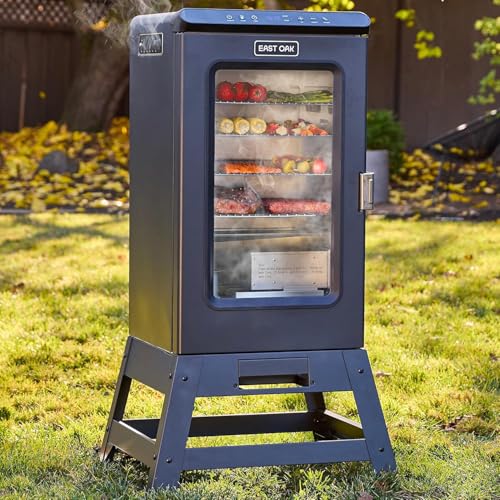
EAST OAK 30-Inch Outdoor Electric Smoker with Mobility Stand, Polar Night
Badge: Best for Long-Cook Consistency
Strengths
- Built-in meat probe: continuous doneness data with the door shut — the long cook’s most valuable instrument.
- Side chip loader designed for long uninterrupted smoke, pairing with the probe to minimise disturbance.
- Mobility stand raises and moves the cabinet, serving both posture and storage.
Trade-offs
- No window, so the cook’s information is numeric rather than visual.
- Shares the electric format’s ceiling: smoking only, at an element’s pace of recovery after openings.
- Stand assembly precedes the first cook.
At a glance: 30-inch outdoor electric smoker as stated in the listing title; cooking area 725 sq. in.; built-in meat probe; mobility stand; side chip loader; colour Polar Night.
Consistency is a data problem before it is a cooking problem, and this EAST OAK is the guide’s best instrumented electric. The probe reports the food’s interior continuously; the loader refreshes smoke without a door opening; the thermostat holds the chamber. Across a long cook, those three systems together produce the tightest information loop available in a cabinet of this class — the cook always knows, and rarely disturbs. Benchmarks reward exactly that, and cooks attempting their first brisket-style projects will feel the reward as confidence.
Its sibling at the top of this guide beats it on session structure — the timer — and matches it on area, which is why the order between them is close and honestly arguable; readers who weight probe data over session timing can reverse the pair with the method’s blessing. What neither sibling offers is a window, so visual learners should note the trade explicitly. On stance, the mobility stand is the more complete answer to the ground-cabinet problem, combining height with movement in a way pure leg kits and pure wheels each only half solve.
Best for: long-cook cooks who run their smokes by internal temperature / Not suited for: visual cooks who want to watch bark form — no pick in this guide’s top tier offers a window, and that gap is stated plainly.

Royal Gourmet SE2805 28-Inch Electric Smoker
Badge: Best Compact Footprint
Strengths
- The only 28-inch cabinet and the smallest stated cooking area in the guide — genuine proportion for small households.
- Stated power figure in the listing (1350W) is the kind of specification honesty benchmarks reward: a checkable number, plainly given.
- Three cooking grates keep the vertical format’s layered loading intact at the smaller scale.
Trade-offs
- Analog temperature control places temperature judgement on the cook — the stability axis scores lowest here, alongside the other analog pick.
- Adjustable heat by dial means cooks are supervised more closely than on any digital pick.
- Smaller area is a real ceiling for households that entertain.
At a glance: 28-inch electric smoker as stated in the listing title; cooking area 454 sq. in.; power 1350W; analog temperature control; three cooking grates; adjustable heat; vertical design; colour Black; model SE2805.
Benchmarks exist to protect unfashionable virtues, and this Royal Gourmet’s virtue is proportion. It is the smallest machine in the guide by both cabinet class and stated area, and for a one- or two-person household that is not a limitation — it is the correct size, heating a modest chamber efficiently and holding a couple of grates of food without the waste heat of a larger box. Its listing, notably, states a power figure, a small act of specification honesty that several grander listings omit, and this guide notices such things on purpose.
The cost is control. Analog adjustment means the cook is the thermostat: present, observant, nudging. Under this guide’s criteria that is a genuine deduction, and it is why a smaller, honest machine still ranks below the digital electrics rather than above them. Buyers whose households are small and whose style is attentive will find it the most rational purchase in the guide; buyers who want to load a smoker and leave it should not let its proportion talk them out of digital control.
Best for: small households with an attentive cooking style / Not suited for: set-and-leave cooks — every digital pick above holds its temperature with less of you.
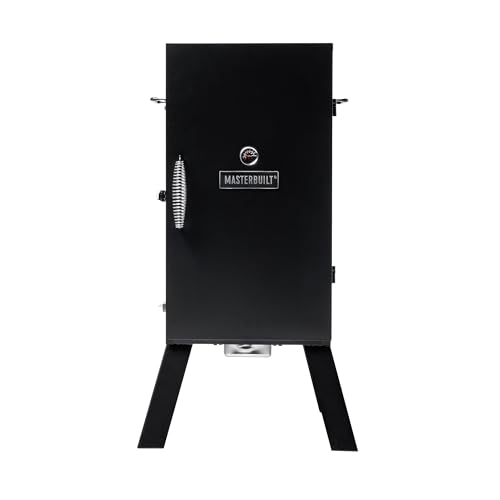
Masterbuilt 30-Inch Electric Vertical Smoker with Analog Control (MB20070210)
Badge: Best Analog Simplicity
Strengths
- Radical simplicity: one analog control, no software, no pairing, nothing to update — a machine whose entire interface is learned in a minute.
- Mid-small area suits household batches while keeping the cabinet compact.
- Electric heat still removes fire management; the analog question is only about fine temperature judgement.
Trade-offs
- Scores lowest on this guide’s first criterion: stability is cook-mediated, not thermostat-mediated.
- No probe, window, or loader is stated in the listing, so intervention cost is the guide’s highest.
- A famous badge earns it nothing here — the criteria are the criteria.
At a glance: 30-inch electric vertical smoker with analog temperature control as stated in the listing title; cooking area 535 sq. in.; chrome smoking racks; colour Black; model MB20070210.
This review is the method’s proof of impartiality. The Masterbuilt name carries real weight in this category, and under a reputation ranking this machine would sit near the top by reflex. Under benchmark criteria it sits fifth, and the arithmetic is not complicated: its control is manual, its checking is manual, and its refills are manual, so on stability and intervention — the guide’s first two criteria — it concedes ground to every digital pick. What it offers in exchange is the purest simplicity in the pool, and for cooks who distrust connected, layered appliances on principle, that offer is sincere and may be decisive.
There is also a defensible craft argument for it: an analog cabinet teaches temperature the way a manual camera teaches exposure, and cooks who learn on it develop judgement that transfers to every other smoker. A benchmark guide can respect that argument while still ranking the machine by outcomes for the median buyer. If your values weight learning and simplicity above held-temperature convenience, invert this pick with the digital Masterbuilts in the wider cluster and buy it with the method’s respect — the evidence in this review supports either reading, which is what evidence is for. The accessory debates in Best Smoke Generator For Small Smokers do not change this machine’s standing either way.
Best for: simplicity-first cooks and deliberate learners of temperature craft / Not suited for: buyers who want the machine to hold the line while they do other things.

Pit Boss 700 Carbon Series Wood Pellet Grill & Smoker
Badge: Best Capacity Performer
Strengths
- LCD digital controller and meat probe: the pellet stability toolkit, complete, at this guide’s larger end.
- Wide stated temperature range supports the full arc from low smoking to hot grilling.
- Largest pellet cooking space among this guide’s pellet picks, for households that genuinely cook at that scale.
Trade-offs
- Proportion is its deduction: in a small-smokers benchmark, its size is at the edge of the brief.
- Hopper capacity matches the smaller Pit Boss designs, so its larger grate inherits a mid-cook check on long sessions.
- A barrel’s placement footprint is the guide’s largest.
At a glance: Cooking space 718 sq. in. as stated in the listing title; temperature range 180°F to 500°F; LCD digital controller; meat probe; pellet hopper 13.5 lb.; colour Black.
The Pit Boss 700 closes the guide as the capacity case, argued fairly. Its control equipment is impeccable by this guide’s standards — digital auger control with a probe is the pellet format’s stability ideal — and its temperature range is the widest stated here. If the benchmark were only about control, it would rank with the Traeger. It ranks sixth because the benchmark is also about proportion, and a small-smokers guide must mean its adjective: this barrel serves the upper edge of household scale and asks the most patio of any pick.
That is a boundary judgement, not a quality judgement, and households at that upper edge — regular hosts, big families, batch cooks — should read this review as an endorsement with a sizing note rather than a dismissal. Within its scale it does its stability homework properly, which is more than many large machines in this market can claim. The hopper note is the one operational caution: plan long cooks with a mid-session pellet check, because the grate’s appetite and the hopper’s capacity were specified by different logics.
Best for: larger households that cook at the top of the small category’s scale / Not suited for: genuinely small patios, where its footprint contradicts the brief.
Comparison Table
| Pick | Control type | Stability story | Area (as listed) | Benchmark note | Listing |
|---|---|---|---|---|---|
| EAST OAK Matte Black | Digital with timer | Thermostat plus session timing | 725 sq. in. | Lowest intervention cost | Check on Amazon |
| Traeger Pro 22 | Pellet with probe | Auger control, probe-verified | 572 sq. in. | Widest repertoire | Check on Amazon |
| EAST OAK Polar Night | Digital with probe | Continuous internal data | 725 sq. in. | Tightest information loop | Check on Amazon |
| Royal Gourmet SE2805 | Analog | Cook-mediated | 454 sq. in. | Best proportion | Check on Amazon |
| Masterbuilt Analog | Analog | Cook-mediated | 535 sq. in. | Purest simplicity | Check on Amazon |
| Pit Boss 700 | LCD digital pellet | Auger control, probe-verified | 718 sq. in. | Capacity at the brief’s edge | Check on Amazon |
The table is the method in miniature: control type predicts stability, area states proportion, and the note column records the single judgement each pick will be remembered by when the details of its specification have faded from the reader’s mind. A reader who weights the columns differently can rebuild the ranking in a minute — and a guide that lets you do that has done its job.
How to Choose a Small Smoker by Benchmark Criteria
Adopt the method before the models. Write down your own weights for the five criteria — stability, intervention, honesty, ease, proportion — because the right smoker for a cook who hosts monthly is not the right smoker for a cook who smokes weekly for two, and no ranking, this one included, can know your weights. Then interrogate listings the way this guide did: does the title state the control type, the capacity, the checking instruments? A listing that cannot say how its machine holds temperature is asking you to buy a hope. Prefer stated figures to implied ones, mechanisms to multipliers, and designs whose every feature can be connected to the food by a sentence you can say out loud.
It is worth pausing on proportion, the criterion first-time benchmark shoppers most often skip. A smoker’s running character — its heat-up behaviour, its smoke density, its fuel appetite — is tuned to its chamber, and a chamber run habitually at a third of its capacity is a machine working outside its design centre. Right-sizing is therefore a performance decision, not a frugality decision: the household that cooks for four should benchmark the 454-to-572-square-inch class as its home territory and treat larger areas as a hosting decision to be made consciously, with the hosting frequency stated in actual dates per year rather than in hopes. Guides that rank by capacity first are quietly assuming your calendar; this one declines to.
Two traps deserve naming. The first is feature inflation: a long feature list is not a benchmark score, and several features in this category — timers without probes, windows without loaders — solve half a problem. Score the system, not the count. The second is reputation gravity: famous names earn scrutiny, not exemptions, as the analog Masterbuilt’s fifth place in this guide demonstrates. If a beloved brand’s model cannot state its stability story, the benchmark answer is to buy the model that can, whatever its badge. That discipline, applied consistently, is the entire difference between shopping and being sold to.
How to Run a Small Smoker to a Benchmark Standard
Method applies to cooking as much as to buying. Set up with the same rigour: level placement, a seasoned chamber, fuel stored dry, and one calibration cook — a forgiving load, chicken pieces or sausages — during which you simply observe how your machine’s display relates to the food’s progress. Record the observation. Benchmarks are built from records, and a cook with a notebook improves on a schedule that memory cannot match.
During cooks, hold the intervention line: load with spacing, let smoke establish thin and clean before delicate food enters, check by instrument at planned intervals, and open the chamber only with a purpose and a plan. Judge doneness by internal temperature and tenderness together, rest everything, and note the variables — wood, load, timing, weather — while the meal is eaten, not days later. Clean in the small increments that keep the chamber honest: racks wiped warm, ash and spent chips cleared cool, windows and probes kept readable. A benchmark is not a personality; it is a set of habits, and these are the habits.
Troubleshooting, methodically. Problem: results vary between identical cooks → list what actually changed before blaming the machine; wind, load size, chip freshness, and door openings explain most variance. Problem: temperature reads unstable → on electrics, check the seal and the openings; on pellet models, check fuel dryness and hopper flow before suspecting the controller. Problem: smoke flavour is harsh → reduce chip load, let the initial plume clear, and clean the chamber; bitterness is a technique finding, not a product verdict. Problem: food finishes unevenly → rotate rack positions between cooks in your notes until you know your cabinet’s geography, then load to it deliberately.
A final methodological note, offered because benchmark readers ask for it: this guide’s confidence is highest where its evidence is hardest — control types, stated figures, named mechanisms — and deliberately lower where judgement interpolates between them, as in the close order of the two EAST OAK siblings. Rankings that conceal their confidence gradient ask for more trust than any guide has earned; this one would rather show the seams and keep the trust it has.
What a Benchmark Cannot Tell You
There is one more limit, and it is temporal: benchmarks age. Control systems improve, listings are revised, and a model ranked on this season’s stated specification may be sold next season in a configuration this guide never saw. That is why every review here anchors itself to the listing as verified on the check date recorded in the guide’s sources, and why the final instruction of any benchmark is always the same: verify the current configuration at the listing before you buy, and let a changed specification change your conclusion. A method that cannot be re-run is not a method; it is a memory.
Honesty about method requires honesty about its limits. Criteria can rank stability, intervention, and proportion; they cannot rank the pleasure of a particular smoke flavour in your kitchen, the look of a cabinet on your patio, or the satisfaction of mastering an analog dial. Those are real values, and a reader who holds one of them dearly should let it outrank this guide’s order without apology — the reviews contain the evidence to support a different conclusion, deliberately. What the benchmark does guarantee is that whichever pick you choose, you will know what it is: its control story, its disturbance cost, its size in honest figures. In a category sold on adjectives, that knowledge is the actual product this guide sells.
Stability, Explained: What a Held Temperature Actually Means
Since stability tops this guide’s criteria, it deserves a plain explanation rather than incantation. A smoker holding temperature is performing a continuous negotiation between heat lost — through walls, seals, exhaust, and every door opening — and heat supplied. Digital electric cabinets negotiate with a thermostat and an element: crude tools, but fast and tireless, which is why their chambers settle into a narrow band and stay there. Pellet controllers negotiate with an auger and a fan, metering fuel in pulses; their band is slightly wider and their recovery after an opening is fuel-dependent, but their ceiling and range are greater. Analog cabinets negotiate through the cook, whose reaction time is measured in glances rather than seconds. None of these is magic, and none is exempt from physics: a full, cold load of meat will pull any chamber down while it absorbs heat, and wind will tax any seal. The benchmark question is never whether a machine defies physics, but how much of the negotiation it absorbs on the cook’s behalf — and on that question, in this pool, closed-loop control wins, auger control follows, and the dial asks the cook to be the loop.
Stability also has a flavour consequence that rarely gets printed: steady heat produces steady smoke. Chips smoulder evenly in a settled chamber and erratically in a swinging one, which is part of why the same wood tastes cleaner from a controlled cabinet. When this guide weights stability first, it is therefore weighting taste first by another name — the criterion is culinary, not merely mechanical, and cooks who have eaten from both a settled and a swinging chamber have already run the experiment that proves it.
Reading a Smoker Listing Like an Editor
The transferable skill in this guide is not the ranking; it is the reading. An editor approaches a listing with three passes. The first pass extracts only the checkable: dimensions and class, capacity in stated figures, control type, named features, included instruments. Anything that cannot be extracted — the adjectives, the lifestyle promises, the multipliers — is set aside, not believed or disbelieved, simply bracketed. The second pass checks coherence: do the figures agree with each other and with the machine’s class? Does the feature set form a system, or a pile? The third pass asks the ownership questions listings never volunteer: how are chips or pellets loaded, how is food checked, how does it stand, how does it store, what will you clean and how often? A listing that survives all three passes has earned a place on a shortlist; a listing that fails the first has told you everything by omission.
Apply that reading beyond this guide and the category becomes legible. You will notice which brands state power figures and which omit them, which describe mechanisms and which describe feelings, which size their claims to their class and which borrow grandeur from a bigger one. You will also notice your own responses becoming more consistent, because criteria do that: they turn shopping from a sequence of impressions into a repeatable judgement. That is the entire inheritance a benchmark tradition has to offer a home cook — not a list of approved products, but a way of seeing that keeps working after every product on this page has been replaced by its successor.
Common Buying Mistakes
The benchmark buyer’s mistakes are subtler than most, because they wear the costume of rigour: a spreadsheet of features with no weights, a criteria list copied from a guide — this one included — without asking whether it matches the cooking actually done at home. First, outsourcing judgement to a famous publication’s name — including the one in this guide’s title — instead of applying criteria to your own cooking. Second, counting features instead of scoring systems. Third, exempting a beloved brand from the questions asked of every other listing. Fourth, buying capacity as insurance against imaginary gatherings. Fifth, treating manufacturer multipliers as measurements. Sixth, skipping the calibration cook and the notebook, then concluding that a sound machine is inconsistent when the uncontrolled variable was the method.
Final Recommendation
By the stated criteria, the first choice is the EAST OAK 30-Inch Outdoor Electric Smoker in Matte Black: the lowest intervention cost and a complete control story. Cooks who run long projects by internal temperature should take its sibling, the EAST OAK Polar Night with its built-in probe, and households wanting one machine across smoking and grilling should take the Traeger Pro 22. Choose the Royal Gourmet for honest smallness, the analog Masterbuilt for principled simplicity, and the Pit Boss 700 when your household’s scale honestly reaches the brief’s upper edge. Whichever you choose, choose it by criteria you can state — that is the whole lesson of the search that brought you here.
Frequently Asked Questions
Is this guide affiliated with Serious Eats?
No. Serious Eats is a food publication; this guide is an independent buying guide that borrows a benchmark style — criteria stated in advance, claims treated as hypotheses, limitations printed — because the search phrase signals readers who value that standard. No pick here is presented as that publication’s selection, and readers should consult the publication itself for its own verdicts.
What criteria matter most when benchmarking a small smoker?
Temperature stability first, because it is the product’s core promise; intervention cost second, because every disturbance taxes the first; then specification honesty, whole-ownership ease of use, and proportion to your household’s real cooking. Feature counts, brand fame, and headline capacity are deliberately absent from the list.
Why do analog smokers rank low here if they are simpler?
Because the criteria weight held temperature and low intervention, and analog control delegates both to the cook. Simplicity is scored — it appears in the ease criterion and in these reviews’ respect for the analog picks — but it does not outweigh the stability it trades away for the median buyer. Cooks who weight simplicity first can re-rank from the same evidence, and the guide shows its work precisely so they can.
Are pellet smokers less stable than electric smokers?
They are stable by a different mechanism. A pellet controller meters fuel through an auger and holds temperature well when pellets are dry and flowing; an electric thermostat cycles an element and is indifferent to fuel condition beyond chip freshness. The pellet’s stability is therefore conditional on storage discipline, while the electric’s is closer to unconditional — a distinction benchmarks record without turning it into a verdict on the format.
How much should I trust claims like several times longer smoking from a chip loader?
As design intent, not as measurement. A side loader genuinely reduces door openings and stretches refill intervals — the mechanism is real and scorable. The multiplier is a manufacturer’s framing that a listing cannot verify, so this guide credits the mechanism and discounts the number. Apply the same rule to every claim in the category.
Why does this guide rank a lesser-known brand above a famous one?
Because the criteria were fixed before the ranking, and they measure control systems, disturbance costs, and stated specifications — none of which a badge can substitute for. The famous analog model in this guide is a sound machine ranked fifth on arithmetic, not on disrespect, and its review says exactly what would have to change for it to rank higher. A ranking that always confirms reputation is not a benchmark; it is a mirror.
How should I weigh capacity against control if I disagree with this order?
Re-derive it — the reviews give you the evidence. If your household cooks for crowds monthly, promote the Pit Boss 700 and the Traeger up your personal order and demote proportion in your weights; if you cook for two, promote the Royal Gourmet. The guide’s order is one weighting, argued openly. A reader who finishes with a different order for stated reasons has used the guide exactly as intended.
What is the best first cook to benchmark a new smoker?
A forgiving, instrument-friendly load: chicken pieces or a small shoulder, cooked with a modest chip load, checked by probe at planned intervals, with notes taken on load, wood, weather, and timing. The goal is a baseline — how your machine behaves in your space — against which every later cook can be compared. Benchmarks begin with baselines, in kitchens as in laboratories.


