Disclosure: topratedkitchenware.com is reader-supported. When you buy through links on our site, we may earn an affiliate commission from Amazon and other retailers, at no extra cost to you.
Where to buy
All six picks below carry Amazon links, and one fact must be stated before any of them: these are United States market listings. Their titles describe the machines in imperial measurements, they state no Australian voltage, plug, or certification information, and this guide will not invent any. What the links give an Australian beginner is the verified specification of each model — the starting point for checking local availability, local pricing, and, critically for the electric models, whether a locally supplied version exists that suits Australian 230–240 volt power. Read the Australia section of this guide before you buy anything; it is the most important section in it.
- Pit Boss 700 Carbon Series Wood Pellet Grill and Smoker — Best Overall for Australian Beginners
- EAST OAK 30-Inch Outdoor Electric Smoker, Polar Night — Best Electric for Beginners
- Traeger Pro 22 Wood Pellet Grill and Smoker — Most Versatile
- Pit Boss 500 Carbon Series Wood Pellet Grill and Smoker — Best Compact Pellet
- Royal Gourmet SE2805 28-Inch Electric Smoker — Best Compact Electric Start
- Pit Boss 850 Navigator Series Wood Pellet Grill and Smoker — Best for Large Gatherings
Read the full guide ↓
Finding the best smokers for beginners australia involves every question a beginner anywhere must answer — which fuel, how much supervision, what size — plus a second set of questions that are purely local. Australia runs on 230–240 volt power with its own plug type, its appliance market is supplied through local distributors and retailers rather than by every US listing, and its barbecue culture is strong, outdoors, and year-round in most of the country. A US guide pasted onto an Australian search helps nobody, so this guide is written in two layers: the beginner ranking itself, built on the verified specifications of six strong machines, and the Australian verification layer wrapped around it, which tells you exactly what to confirm locally — voltage and plug on the electric models, pellet and chip supply, warranty support, and total landed cost — before any of the rankings are allowed to spend your money.
That honesty cuts both ways. We will not claim that any model here is an Australian model, carries Australian certification, or is stocked by any particular local retailer, because the verified listings say none of those things. What we can say is which machines a beginner should shortlist and why, and what a pellet grill asks of its owner in a country where hardwood pellets are a specialty purchase in some regions and a hardware-store staple in others. The beginner fundamentals themselves are universal, and readers who want them without the local layer can read Best Smokers For Beginners Wood alongside this guide; the fuel education transfers completely, even where the plugs do not.
Key Takeaways
- These are US-market listings. No title here states Australian voltage, plug type, or certification — verify a locally supplied version before buying any electric model.
- Australia’s 230–240 volt supply makes the electric picks a verification exercise first and a purchase second; never plan around a travel adapter for a heating appliance.
- The Pit Boss 700 Carbon leads the beginner ranking on its verified merits: LCD control, a probe, 718 sq in, and a stated 180°F to 500°F range (about 82°C to 260°C).
- Pellet supply is a local question: confirm you can buy food-grade hardwood pellets conveniently in your area before choosing any pellet pick.
- Measurements in the listings are imperial; the conversions that matter — square inches to square centimetres, Fahrenheit to Celsius — are given where they help.
- Beginner virtues are the same in both hemispheres: supervision you can trust, a probe habit, forgiving first cooks, and a log.
In this guide
Quick Picks
| Pick | Badge | Why it stands out for Australian beginners | Link |
|---|---|---|---|
| Pit Boss 700 Carbon Series Wood Pellet Grill and Smoker | Best Overall for Australian Beginners | LCD digital control, a meat probe, 718 sq in, and a 180°F to 500°F stated range — pellet fire, automated for a first year. | Check on Amazon |
| EAST OAK 30-Inch Outdoor Electric Smoker, Polar Night | Best Electric for Beginners | 725 sq in, a built-in meat probe, a mobility stand, and a side chip loader rated for up to six times longer uninterrupted smoke — subject to local voltage verification. | Check on Amazon |
| Traeger Pro 22 Wood Pellet Grill and Smoker | Most Versatile | Six-in-one cooking, an 18 lb hopper, and a probe — the one-appliance answer, with a global owner community beginners can learn from. | Check on Amazon |
| Pit Boss 500 Carbon Series Wood Pellet Grill and Smoker | Best Compact Pellet | The 700’s controller, probe, and range in a 543 sq in frame — the pellet start for smaller Australian patios and courtyards. | Check on Amazon |
| Royal Gourmet SE2805 28-Inch Electric Smoker | Best Compact Electric Start | A stated 1350W element, analog adjustable heat, and three grates in a 28-inch cabinet — the simplest electric start, pending local power verification. | Check on Amazon |
| Pit Boss 850 Navigator Series Wood Pellet Grill and Smoker | Best for Large Gatherings | 932 sq in, WiFi and Bluetooth, a flame broiler, and a 30 lb hopper — the big-gathering machine for beginners with room and ambition. | Check on Amazon |
How These Picks Were Chosen
The beginner ranking uses the same criteria as our general beginner guide — feedback quality, interruption count, routine complexity, and forgiveness — applied to the verified specifications of the six models in this pool. Layered over that ranking is the Australian screen, which is not a ranking at all but a set of gates: a model earns an Australian beginner’s money only after its local version, local fuel supply, and local support have been verified, and this guide’s reviews flag which gate matters most for each machine. Pellet models face the fuel gate — pellets are a recurring purchase, and a beginner marooned without a convenient supply owns a sculpture. Electric models face the power gate, which is stricter: a heating appliance must be supplied for Australian voltage and plug standards by its maker or local distributor, full stop.
Specification discipline follows the house rules. Only listing-stated attributes are cited; conversions between imperial and metric are arithmetic and are labeled as conversions. No Australian pricing, availability, retailer, certification, or shipping claim appears anywhere in this guide, because none is in the verified data — and a guide that invents local facts for a market it cannot see is worse than no guide. This is a research-led comparison; the local verification steps it prescribes are deliberately concrete, because “check locally” without a checklist is advice that evaporates. Readers whose beginner interest is specifically in long cooks can extend the same shortlist through Best Smokers For Briskets, where the Pit Boss models’ endurance features are weighed in detail.
The 6 Best Smokers for Beginners Australia

Pit Boss 700 Carbon Series Wood Pellet Grill and Smoker
Badge: Best Overall for Australian Beginners
Strengths
- LCD digital control automates the pellet fire, so the Australian beginner learns smoking — temperature, probe, patience — without first learning fire-tending.
- 718 sq in (roughly 4,630 square centimetres) is family-and-friends capacity, and the stated 180°F to 500°F range (about 82°C to 260°C) covers the whole first-year menu.
- An included meat probe instruments the master skill from the first cook.
Trade-offs
- Pellet supply is the gate: confirm a convenient local source of food-grade hardwood pellets before this becomes your first smoker.
- The 13.5 lb hopper (about 6.1 kilograms) wants a check before the longest cooks.
- As a US listing, its local price, warranty handling, and support path must be verified through Australian channels rather than assumed.
Mini spec box
- Fuel: wood pellets
- Cooking space: 718 sq in
- Temperature range: 180°F to 500°F
- Controller: LCD digital controller
- Hopper: 13.5 lb
- Probe: meat probe included
The 700 Carbon leads this ranking because it is the most complete beginner specification in the pool, and because its fuel type sidesteps the strictest Australian gate. A pellet grill’s relationship with the power outlet is supervisory — the electricity runs the auger, fan, and controller — while its heat comes from wood, which makes the local questions about this machine mostly commercial rather than electrical: is it sold locally in a version intended for this market, what does it cost landed, and where do its pellets come from? Those are answerable questions, and a beginner who answers them gets a machine that teaches kindly: set the temperature on the LCD controller, watch the probe, and let the auger mind the fire through cooks that would defeat a first-timer on any manual fuel.
The cooking credentials bear repeating in local terms. The stated range runs from proper low-and-slow at the bottom to genuine grilling heat at the top, and 718 sq in is the size of a serious backyard session — a point worth pausing on in a country where the backyard session is a cultural institution and summer cooking moves outdoors for months. For the Australian beginner whose home has the space and whose area has the pellet supply, this is the shortlist’s head. Verify the local version and the fuel shelf first; then learn on it with confidence.
Best for: Australian beginners with patio space and a confirmed local pellet supply / Not suited for: anyone whose local pellet access is inconvenient — fuel logistics decide pellet ownership
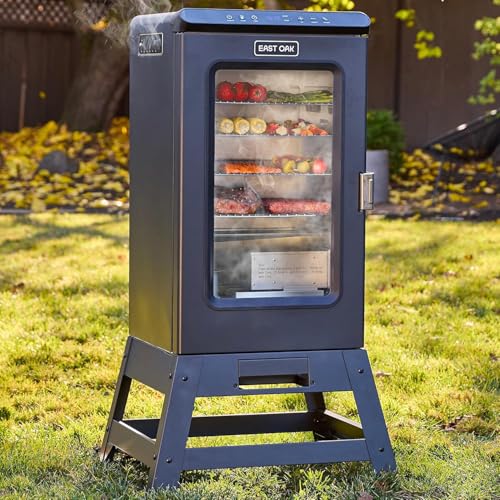
EAST OAK 30-Inch Outdoor Electric Smoker, Polar Night
Badge: Best Electric for Beginners
Strengths
- The beginner-friendliest electric specification here: a built-in meat probe, a side chip loader rated for up to six times longer uninterrupted smoke, and 725 sq in of forgiving room.
- The mobility stand suits Australian outdoor living — working height for loading, and easy movement between sun and storage.
- Electric routine is the simplest in smoking: an outlet, a handful of chips, a door that stays shut.
Trade-offs
- The power gate applies in full: the US listing states no Australian voltage or plug information, so a locally supplied version must be confirmed before purchase — this is a condition, not a footnote.
- No digital timer is stated; the schedule is the cook’s to keep.
- Wood chips are a recurring purchase whose local availability should be confirmed like pellets.
Mini spec box
- Fuel: electric element with wood chips (verify local version for Australian power)
- Cooking area: 725 sq in
- Chip loading: side chip loader, up to 6x longer uninterrupted smoke
- Probe: built-in meat probe
- Stand: mobility stand included
- Finish: Polar Night
As a piece of beginner equipment, the Polar Night EAST OAK is close to ideal: the probe teaches cooking to temperature, the loader teaches door discipline, and the capacity forgives the loading mistakes every first year contains. Its Australian review, however, must begin with the condition stated in its trade-offs, because an electric smoker is a heating appliance and heating appliances are where voltage stops being a detail. The listing in front of us is a US listing. It does not state that this model is supplied for Australian 230–240 volt power or fitted with an Australian plug, and no beginner should bridge that gap with an adapter or an assumption. The correct path is to find the model — or its local equivalent — through an Australian retailer or the maker’s local distributor, and buy the version made for this market.
If that path succeeds, the reward is the gentlest smoking education in this guide, in a format that suits the Australian pattern of long outdoor seasons: a cabinet that lives on the patio, loads at standing height on its stand, and produces a season of smoked dinners for the price of a bag of chips now and then. If the path fails — if no local version exists — the honest outcome is to choose a different electric cabinet that is locally supplied, using this review as the specification benchmark for what to look for. Either way, the review has done its job: it told you what good looks like, and it refused to sell you the wrong plug.
Best for: Australian beginners who can source the locally supplied version of a probe-and-loader electric cabinet / Not suited for: direct import on a US listing without voltage verification

Traeger Pro 22 Wood Pellet Grill and Smoker
Badge: Most Versatile
Strengths
- Six-in-one versatility — grill, smoke, bake, roast, braise, BBQ — makes it the one-appliance answer for a beginner household.
- The 18 lb hopper (about 8.2 kilograms) is the most forgiving fuel supply among the pellet picks here.
- An included meat probe and a large international owner community give a beginner both instrumentation and somewhere to ask questions.
Trade-offs
- The stated maximum temperature is 450°F (about 232°C) — ample for most cooking, below the Pit Boss models’ stated ceiling for the hardest searing.
- 572 sq in is mid-sized; the biggest gatherings will want the Navigator’s room instead.
- Local version, pricing, and pellet supply all require the same Australian verification as every pick here.
Mini spec box
- Fuel: wood pellets
- Cooking area: 572 sq in
- Hopper: 18 lb
- Maximum temperature: 450°F
- Probe: meat probe included
- Functions: grill, smoke, bake, roast, braise, BBQ
The Pro 22’s beginner case in Australia rests on two pillars: versatility at home, and community abroad. At home, the six-in-one proposition means the beginner’s single purchase covers the weeknight grill and the weekend smoke alike, and a machine used weekly teaches faster than a specialist used monthly. Abroad, the model’s enormous owner community is a genuine beginner asset in a market at a distance from the product’s home country: recipes, troubleshooting patterns, and technique discussions for this exact machine exist in a depth that thinner nameplates cannot match, and a first-year cook in Brisbane or Perth benefits from that library as much as one in Ohio.
The verification homework is unchanged — local version, landed cost, pellet shelf — and the specification checks are the honest ones: a mid-sized 572 sq in cooking area and a stated ceiling of 450°F that covers the great majority of cooking while conceding the extreme sear to its Pit Boss rivals. For the Australian beginner buying one appliance to do everything, with an interest in learning from a global crowd while they cook, the Pro 22 is the natural shortlist companion to the 700 Carbon, and choosing between them is a matter of hopper and functions versus area and range. Both are good answers; they are answers to slightly different households.
Best for: Australian beginners wanting one versatile appliance backed by a huge owner community / Not suited for: maximum-capacity hunters and the hardest searing

Pit Boss 500 Carbon Series Wood Pellet Grill and Smoker
Badge: Best Compact Pellet
Strengths
- Keeps the beginner essentials — LCD digital controller, meat probe, stated 180°F to 500°F range — in the smallest pellet frame here at 543 sq in.
- The 13.5 lb hopper matches the 700’s, so the compact version does not ration cook length.
- Its size suits the courtyards, townhouse patios, and smaller blocks common in Australian cities.
Trade-offs
- 543 sq in is a real ceiling for the biggest Australian gathering cooking; plan the menu to the machine.
- No connectivity is stated, so monitoring happens at the grill.
- The same pellet-supply and local-version verification applies as for its larger siblings.
Mini spec box
- Fuel: wood pellets
- Cooking space: 543 sq in
- Temperature range: 180°F to 500°F
- Controller: LCD digital controller
- Hopper: 13.5 lb
- Probe: meat probe included
Australian housing gives the compact pellet grill a genuine brief. Townhouse courtyards and modest suburban patios are where a large share of the country’s beginners actually cook, and the 500 Carbon is the pellet specification trimmed to that geography without trimming the education: same controller family, same probe, same wide stated range, same hopper as the 700, in a 543 sq in frame that parks where the 700 would crowd. For a couple or a small household, that is not the budget version of the idea — it is the right-sized version of it, and right-sizing is a beginner virtue this guide keeps recommending.
The Australian checks mirror its sibling’s: pellets on a local shelf, a locally supplied version with support you can reach, and a landed cost you have seen in local currency from a local seller rather than estimated from a US listing. Pass those gates and the 500 becomes the pellet start for space-conscious beginners — the machine that teaches automated fire, probe discipline, and smoke dosage in a footprint that respects the courtyard. It is also the natural stepping stone in the range: the beginner who outgrows it through success has the 700 and the Navigator waiting in the same family, with the same habits transferring intact.
Best for: Australian beginners in townhouses and smaller patios who want the full pellet routine / Not suited for: the largest gathering cooks

Royal Gourmet SE2805 28-Inch Electric Smoker
Badge: Best Compact Electric Start
Strengths
- The simplest electric start in the guide: analog adjustable heat, three cooking grates, and a 28-inch vertical cabinet that suits small outdoor spaces.
- The listing states its 1350W element openly — useful information for the local-version conversation an Australian buyer must have.
- Analog operation teaches the craft directly, with nothing digital between the beginner and the cabinet’s behavior.
Trade-offs
- The power gate is at its strictest here: wattage is a US-market figure, and only a locally supplied version intended for Australian power is an acceptable purchase.
- 454 sq in is the smallest area in the guide; crowd cooking outgrows it first.
- No built-in probe is stated, so a thermometer is part of the beginner kit.
Mini spec box
- Fuel: electric element with wood chips (verify local version for Australian power)
- Power: 1350W (as stated in the US listing)
- Cooking area: 454 sq in
- Control: analog temperature control, adjustable heat
- Grates: 3 cooking grates
- Form: 28-inch vertical, black
The SE2805 plays the same role in Australia as everywhere: the smallest, simplest, most direct start in electric smoking — a dial, an element, three grates, and a cabinet that fits the corners other machines cannot. For the beginner in a unit with a modest balcony (subject always to that building’s own rules about cooking appliances), or the first-home buyer with a small paved yard, its scale is the point. And its listing performs one small service the others do not: by stating its wattage plainly, it gives the Australian buyer the exact figure to carry into the local-version conversation with a retailer or distributor.
That conversation is not optional, and this review will not soften it. A US-market heating appliance and Australian mains power are not compatible by default, and the only acceptable SE2805 for an Australian beginner is one supplied for this market through proper channels. If that version exists at a sensible local price, the machine’s virtues — simplicity, size, directness — make it a charming first smoker. If it does not, the correct move is to take its specification as a shopping template and find the locally supplied cabinet that matches it. The beginner education is identical either way; only the badge on the door changes.
Best for: Australian beginners with small spaces who source the locally supplied version / Not suited for: any purchase route that skips voltage verification

Pit Boss 850 Navigator Series Wood Pellet Grill and Smoker
Badge: Best for Large Gatherings
Strengths
- 932 sq in is the largest cooking space here — in Australian terms, room for the full gathering: multiple large cuts with sides sharing the smoke.
- A 30 lb hopper (about 13.6 kilograms) and WiFi plus Bluetooth monitoring suit the long, social, all-afternoon cook.
- The flame broiler adds a direct-flame finish no other pick here offers.
Trade-offs
- It is the most machine a beginner can buy in this guide, and most beginners will use a fraction of it in year one.
- Pellet consumption scales with size; the local fuel supply question matters most for the biggest appetite.
- Local version, landed cost, and support verification all apply, at the largest scale in the guide.
Mini spec box
- Fuel: wood pellets
- Cooking space: 932 sq in
- Temperature range: 180°F to 500°F
- Controller: LCD digital controller with WiFi and Bluetooth
- Hopper: 30 lb
- Extra: flame broiler, meat probe included
The Navigator is in a beginner guide for the Australian beginner whose context justifies it: the big block, the extended family, the gathering culture where Christmas and summer weekends mean feeding a crowd outdoors. For that household, starting large is not indulgence but arithmetic — a smaller grill would be outgrown by the second gathering — and the Navigator’s beginner kindnesses are real: the same automated pellet control as its siblings, monitoring that reports to a phone while the host is socializing, and a hopper that treats an all-day cook as a single uninterrupted event. The flame broiler even covers the finishing work that gathering menus ask for.
The cautions scale with the machine. Its pellet appetite is the largest here, so the local fuel shelf matters most; its footprint and landed cost are the largest here, so the verification homework matters most; and its capacity will sit idle in any household whose gatherings are actually small, which is most households, most of the time. Our advice to the Australian beginner is the same as to beginners everywhere: buy for the cooking you will really do, with the Navigator reserved for the households whose “really do” is genuinely large. For them, it is a magnificent first smoker. For everyone else, it is year three’s reward — and the 700 or 500 will teach the same lessons on the way there. Readers planning event-scale cooking as a business rather than a family habit should read Best Smokers For Catering before treating any home machine as a commercial answer.
Best for: Australian beginners whose gatherings are genuinely large and frequent / Not suited for: typical small households in their first year
Comparison Table
| Pick | Fuel | Stated cooking area | Control | Australia-relevant note | Link |
|---|---|---|---|---|---|
| Pit Boss 700 Carbon | Wood pellet | 718 sq in | LCD digital | Verify local version and pellet supply | Check on Amazon |
| EAST OAK Polar Night | Electric + chips | 725 sq in | Electric cabinet control with built-in probe | Verify locally supplied version for AU power | Check on Amazon |
| Traeger Pro 22 | Wood pellet | 572 sq in | Pellet controller with probe | Large global owner community | Check on Amazon |
| Pit Boss 500 Carbon | Wood pellet | 543 sq in | LCD digital | Compact frame for courtyards | Check on Amazon |
| Royal Gourmet SE2805 | Electric + chips | 454 sq in | Analog, 1350W as listed | Strictest voltage verification applies | Check on Amazon |
| Pit Boss 850 Navigator | Wood pellet | 932 sq in | LCD digital with WiFi and Bluetooth | Largest fuel appetite — supply matters most | Check on Amazon |
How to Choose Your First Smoker in Australia
Work through three gates in order, and let the ranking in this guide operate only after all three are passed. Gate one is power, and it applies to the electric picks: confirm that the exact model is supplied in a version made for Australian 230–240 volt power with an Australian plug, through the maker’s local distributor or an Australian retailer. If the answer is no or unclear, the model is not a candidate, whatever its ranking — move to a locally supplied equivalent using the review as your specification template. Gate two is fuel: for pellet picks, find your pellet shelf before you find your grill — the retailer, the bag sizes, the wood varieties, the distance — because you will visit that shelf for as long as you own the machine. For electric picks, confirm the same for wood chips, a smaller but real dependency. Gate three is support: warranty handling, spare parts, and a seller you can contact in your own timezone and currency. A beginner’s first year generates questions and occasionally a warranty claim; both go better locally.
Only after the gates does the beginner ranking decide, and it decides on supervision and size as it does everywhere: digital pellet control or a probe-equipped electric cabinet for the gentlest start, analog simplicity for the hands-on learner, compact frames for courtyards and full-size frames for family yards. Climate deserves one local sentence: most of Australia offers a long outdoor cooking season, which argues for buying the machine you will use weekly rather than a seasonal compromise — and for remembering that summer cooks in the hotter regions are morning and evening affairs, where a timer, a probe, or remote monitoring earns its keep by keeping the cook out of the midday heat. Gentle projects like those in Best Smokers For Cold Smoking are also a fine way to use the cooler months once the basics are in hand.
Your First Cooks: The Beginner Routine, Australian Edition
The routine itself is hemisphere-proof. Assemble with the manual open, season the machine empty as directed, and run the forgiving first cook — a pork shoulder — with the probe in and the door or lid shut, logging preheat time, the stall, and the finish. Follow with chickens or ribs to learn smoke dosage, then repeat the shoulder changing one variable. The Australian variations are in the margins: in summer, start long cooks early in the day so the heavy hours land in the cooler morning; keep pellets and chips stored dry against coastal humidity, which swells pellets and dulls chips alike; and give the machine its shade where you can, because a cabinet working in full summer sun is managing a variable its designer in another hemisphere may have pictured more mildly.
Care follows the same pattern with local accents. Cool the machine fully before cleaning, keep water away from electricals and pellet mechanisms, and in coastal areas wipe exterior metalwork a little more often — salt air is a slow argument with every outdoor appliance, and a cover is the cheapest rebuttal. Three problems recur for Australian beginners in particular. Problem: pellets have swollen or the auger struggles → the fuel absorbed humidity in storage; move the bags into a sealed bin indoors and clear the system per the manual. Problem: an electric cabinet purchase is stalled on compatibility → that is the gate working as intended; source the local version rather than improvising around it. Problem: cooks run long in summer heat → the chamber is fighting direct sun; reposition into shade, start earlier, and lean on the probe rather than the schedule. None of these requires expertise — only the habit of treating local conditions as part of the recipe. Readers tempted by fire-based projects beyond this guide’s scope can explore Best Smokers For Camping for the outdoor-cooking landscape, with the same local-verification discipline applied.
The Australian Verification Checklist, In Full
Because it decides whether the rankings apply to you at all, here is the checklist assembled in one place. Power: is this exact model supplied for Australian voltage and plug, in writing, by a local channel? Fuel: can I buy the right pellets or chips within a reasonable trip, in the varieties I want, at a price I accept as a recurring cost? Cost: what is the total in Australian currency from the seller I will actually use, including any delivery — not an exchange-rate estimate from a US listing? Support: who handles a warranty claim, where do spare racks, probes, and parts come from, and how long do they take? Space and rules: does the machine fit my yard or courtyard with its clearances, and — for unit dwellers — do my building’s rules permit it at all? A model that passes all five is a confident beginner purchase. A model that fails one is a research project, and beginners have enough projects in the cooking itself.
Wood, Smoke, and the Australian Backyard
One pleasure of learning to smoke in Australia is that the country’s cooking culture already speaks the language: fire, wood, patience, and a crowd. The beginner here is not importing a foreign hobby so much as formalizing a local instinct, and that shows in the cooks that suit the first year — the same forgiving shoulders, chickens, and ribs as anywhere, joined by the seafood and lamb that Australian backyards have always done well and that take smoke beautifully at the gentle end of these machines’ ranges. The pellet picks add their own local footnote: pellet varieties are blends and single-wood products whose availability follows your region’s retailers, so the beginner’s wood education — which flavors suit which foods — is partly a tour of what your local shelf stocks. That is not a limitation so much as a terroir: every smoking culture in the world cooks with the wood it can get, and the Australian version of the craft is being written right now by the beginners this guide is for.
It is also worth saying plainly that the southern-hemisphere calendar rearranges the smoking year in the beginner’s favor. The long, hot Christmas season is gathering season, which means the Australian beginner’s highest-stakes cook arrives in summer rather than late autumn — plan the learning curve accordingly, with the forgiving curriculum cooks in the cooler months and the practiced confidence ready by December. The machines in this guide do not care which hemisphere they stand in; their controllers hold the same temperatures and their probes report the same numbers. What changes is the cook’s calendar, the fuel shelf, and the plug on the wall — and of those three, only the plug can truly stop a purchase, which is why this guide has spent so many of its words making sure it never stops yours by surprise.
What to Do While You Wait: Learning Before the Machine Arrives
The verification gates in this guide can take a little time — a distributor to contact, a retailer to visit, a fuel shelf to inspect — and that interval is not dead time for a beginner. It is when the reading happens: the three-cook curriculum, the probe discipline, the smoke-dosage restraint, all absorbed before the first machine makes them urgent. It is also when the space gets prepared — the level spot measured, the clearances confirmed, the storage corner for fuel bins cleared — so that arrival day is an unboxing rather than a negotiation with your own backyard. Beginners who use the waiting well tend to have calmer first cooks, because the only new thing on cook day is the cooking. And if the gates ultimately redirect you to a locally supplied equivalent of a pick in this guide, nothing from the waiting is wasted: the curriculum, the space, and the habits transfer to whatever badge ends up on the door, unchanged and entirely yours. Preparation, in smoking as in most crafts, is not the opposite of doing — it is the first and most transferable part of it.
Common Buying Mistakes
- Importing a US electric smoker on price alone. Voltage and plug compatibility are not accessories. Buy the locally supplied version or a locally supplied equivalent.
- Assuming pellet supply. Pellet availability varies by region. Find your shelf before you buy the grill that eats from it.
- Converting a US price and calling it the cost. Freight, currency, and local retail pricing make landed cost a local fact. Get it from a local seller.
- Skipping the support question. A beginner’s first warranty or parts need is a when, not an if. Know who answers before you need them.
- Ignoring humidity in fuel storage. Pellets and chips both suffer in damp storage, and much of Australia is humid. Sealed, indoor, dry — from the first bag.
- Buying gathering size for a courtyard. Match the frame to your real space and your real guest list; the compact picks in this guide exist because both are usually smaller than the dream.
Final Recommendation
For the Australian beginner who passes the verification gates, our first recommendation is the Pit Boss 700 Carbon: the most complete beginner specification here, with automated pellet fire, a probe, and room for the way Australians actually gather. If a locally supplied version of the EAST OAK Polar Night is available to you, it is the gentlest electric start in the guide, and the Traeger Pro 22 remains the versatile one-appliance answer with a world of owners to learn from. Let the gates decide eligibility and the ranking decide the rest — and let no listing, including the ones linked here, talk you past the power question. That discipline, more than any single machine, is what makes a first year of smoking in Australia a success story instead of a cautionary tale.
Frequently Asked Questions
Can I just buy the US model and use a plug adapter?
For a heating appliance, no — and this guide will not soften that. An adapter changes the plug’s shape, not the voltage, and an electric smoker’s element is exactly the wrong device to experiment with. The acceptable routes are a locally supplied version of the model or a locally supplied equivalent bought through Australian channels. Pellet grills also require their locally intended version for their electrical components and support, so treat every pick here as a verify-locally purchase.
Are wood pellets easy to buy in Australia?
It depends where you are, which is precisely why this guide makes it a pre-purchase check rather than an assumption. Larger centres generally support pellet supply through barbecue and hardware retailers, while regional buyers may rely on delivery. What matters is your shelf: find it, price a bag, and confirm the varieties you want before the grill that depends on it enters your life.
Why are all the measurements in this guide imperial?
Because the verified listings state them that way — square inches, Fahrenheit, pounds — and this guide cites specifications as published rather than silently converting them. Where a conversion genuinely helps an Australian reader, we give it and label it: the Pit Boss range of 180°F to 500°F is about 82°C to 260°C, and hopper weights convert at roughly 2.2 pounds to the kilogram.
Which pick suits a small Australian courtyard or townhouse patio?
The Pit Boss 500 Carbon among the pellet grills, and the Royal Gourmet SE2805 among the electric cabinets — the two compact frames in the guide, each keeping its category’s beginner essentials. Measure your space, confirm the manufacturer’s clearances can be honored, and for units, confirm the building’s rules on cooking appliances before either becomes more than a plan.
Does the Australian climate change how I should smoke?
At the margins, yes. Long summer cooks are best started early, with the machine shaded where possible; coastal humidity argues for sealed indoor fuel storage and a cover; and the long outdoor season in most regions rewards buying the machine you will use weekly. The core technique — probe discipline, door discipline, patience — is identical in both hemispheres.
What if a model I want is not sold locally at all?
Then use its review as a specification template and buy the locally supplied machine that matches it most closely: same fuel, same supervision features, similar stated capacity. The beginner virtues this guide ranks — automated control, a probe, a loader, forgiving size — are available across brands and markets. What is not transferable is a US listing’s plug, price, or warranty, and those are the parts that matter when something goes wrong.
Is smoking popular enough in Australia to find help as a beginner?
Yes — the country’s barbecue culture is deep, and low-and-slow cooking has a strong local following, clubs, retailers, and online communities. That is one more reason the global-community models in this guide are attractive to Australian beginners: between local barbecue culture and the international owner base for machines like the Pro 22, a first-year cook here is unusually well supported — provided the machine itself was bought through the local gates this guide insists on.


