Disclosure: topratedkitchenware.com is reader-supported. When you buy through links on our site, we may earn an affiliate commission from Amazon and other retailers, at no extra cost to you.
Where to buy
All six picks below were verified against the manufacturer listings for this guide to best smokers for first time smokers. Each name links to its Amazon listing, where you can check the latest price on Amazon, confirm the current configuration, and read the newest owner feedback before you decide. Beginners graduating to mixed menus will find the same cabinets ranked for breadth in Best Smokers For Grilling once the basics feel easy.
- EAST OAK 30-Inch Electric Smoker, Mist Silver
- RYHOFOUD 30-Inch Electric Smoker with Wheels
- Masterbuilt 30-Inch Analog Electric Smoker MB20070210
- EAST OAK 30-Inch Electric Smoker with Timer and Wheels, Matte Black
- EAST OAK 30-Inch Electric Smoker with Mobility Stand, Polar Night
- Royal Gourmet SE2805 28-Inch Electric Smoker
Read the full guide ↓ for the ranking logic, the honest limitations of every pick, and the checks that matter more than any headline claim.
The best smokers for first time smokers are not the biggest or the most advanced — they are the ones that forgive. A first smoking cook fails in predictable ways: the door opens too often because the beginner cannot see the food, doneness is guessed because there is no probe, smoke fades because the chip tray ran dry hours ago, and the whole experience feels like weather — something that happens to you. Every pick in this verified top six attacks at least one of those failure modes with stated hardware: built-in probes, viewing windows, long-run chip loaders, timers, wheels and stands that make handling easy, and in one case a single analog dial that reduces the first cook to its simplest possible form.
A reading note matters here: “first time smokers” means people smoking food for the first time, and this guide is written for them directly. All six picks are electric vertical cabinets from 454 to 725 square inches. Electric is the beginner-friendly fuel for a reason stated plainly: there is no fire to build or manage, temperature is set rather than coaxed, and the beginner’s whole attention can go where it belongs — on the food, the smoke and the clock — instead of on keeping a fire alive. Ambitious beginners may also enjoy Best Smokers For Home Chefs, which shows where this hobby leads.
The ranking balances two kinds of easy. Guided easy — probes, windows, timers — teaches fastest, because the beginner sees what is happening and connects action to result. Simple easy — the analog cabinet — asks least, and suits a beginner who wants the craft at its most basic. Both are legitimate first steps, and the reviews say honestly which kind each pick offers, including where a beginner will still need a separate thermometer or a little patience.
Key Takeaways
- Forgiveness is the beginner feature: probes stop guessing, windows stop door-opening, long-run loaders stop smoke gaps.
- All six picks are electric cabinets — no fire management stands between a beginner and the food.
- The EAST OAK Mist Silver is the most guided start: built-in probe, viewing window and a loader stated to run far longer per load.
- The analog Masterbuilt is the simplest start: one dial, modest size, nothing to configure.
- Start with forgiving food — pork shoulder, chicken, ribs — and judge your first cooks by internal temperature, not appearance.
- Buy the size of your household’s real cooking; the compact Royal Gourmet is a true starter, not a cut-down compromise.
In this guide
Quick Picks
Six verified electric cabinets ranked for a first smoking cook: guidance hardware first, simplicity a close second.
| Pick | Badge | Why it earns its place | Listing |
|---|---|---|---|
| EAST OAK 30-Inch Electric Smoker, Mist Silver | Best Overall for Beginners | Probe, window and a long-run loader remove the three classic beginner mistakes in one cabinet. | Check on Amazon |
| RYHOFOUD 30-Inch Electric Smoker with Wheels | Best for Learning by Watching | A clear window, water pan, drip trays and wheels make the learning process visible and forgiving. | Check on Amazon |
| Masterbuilt 30-Inch Analog Electric Smoker MB20070210 | Best Simple Starter | One analog dial and 535 square inches: the fewest decisions a first cook can involve. | Check on Amazon |
| EAST OAK 30-Inch Electric Smoker with Timer and Wheels, Matte Black | Best for Timed Practice | A digital 12-hour timer structures long cooks for a beginner who is still learning pacing. | Check on Amazon |
| EAST OAK 30-Inch Electric Smoker with Mobility Stand, Polar Night | Best Raised, Easy-Handling Pick | Built-in probe plus a mobility stand — doneness readings and easy handling in one package. | Check on Amazon |
| Royal Gourmet SE2805 28-Inch Electric Smoker | Best Compact Starter | The compact 28-inch, 454-square-inch starter for small households and small first cooks. | Check on Amazon |
Best Overall for Beginners — EAST OAK 30-Inch Electric Smoker, Mist Silver: Probe, window and a long-run loader remove the three classic beginner mistakes in one cabinet.
Best for Learning by Watching — RYHOFOUD 30-Inch Electric Smoker with Wheels: A clear window, water pan, drip trays and wheels make the learning process visible and forgiving.
Best Simple Starter — Masterbuilt 30-Inch Analog Electric Smoker MB20070210: One analog dial and 535 square inches: the fewest decisions a first cook can involve.
Best for Timed Practice — EAST OAK 30-Inch Electric Smoker with Timer and Wheels, Matte Black: A digital 12-hour timer structures long cooks for a beginner who is still learning pacing.
Best Raised, Easy-Handling Pick — EAST OAK 30-Inch Electric Smoker with Mobility Stand, Polar Night: Built-in probe plus a mobility stand — doneness readings and easy handling in one package.
Best Compact Starter — Royal Gourmet SE2805 28-Inch Electric Smoker: The compact 28-inch, 454-square-inch starter for small households and small first cooks.
How These Picks Were Chosen
Picks were verified against their full listing titles, and beginner suitability was scored only on stated facts: control type, probe and window fitment, loader design, timer, mobility features, included accessories and cooking area. No pick was credited with an app, a preset programme or a self-cleaning feature its title does not state. Where a beginner would still need something — an instant-read thermometer alongside an analog dial, for instance — the review says so.
The ordering puts guided learning first because most beginners quit over uncertainty, not difficulty: not knowing whether the food is done, whether the smoke is right, whether the temperature is holding. Hardware that answers those questions visibly — a probe readout, a window, a timer — converts anxiety into information. The simpler models follow for beginners whose uncertainty runs the other way, toward too many features. This is a research-led comparison of verified listings, written to be read before a first purchase and used again before a first cook. Large first gatherings raise the bird-fit question covered in Best Smokers For Large Turkeys — read it before volunteering for the holiday cook.
One expectation is set deliberately: a first smoker is a teacher as much as an appliance. The pick that shows a beginner the most about what smoking does will serve them longest, even if they later trade up in size.
The 6 Best Options for Best smokers for first time smokers

EAST OAK 30-Inch Electric Smoker, Mist Silver
Badge: Best Overall for Beginners
Strengths
- Built-in probe and viewing window minimise door openings
- Long-run side chip loader keeps smoke steady between checks
- 725 square inches handles bigger batches than most 30-inch cabinets
Trade-offs
- Corded electric cabinet, so an outlet defines where it can cook
- Silver finish shows smoke residue and fingerprints more than black
- Full-size cabinet needs a dedicated storage corner
Key specs from the listing
- Form: 30-inch vertical electric smoker
- Cooking area: 725 square inches
- Probe: built-in meat probe
- Window: clear viewing window
- Fuel: electric, wood chips via side loader, stated for up to 6x longer uninterrupted smoking per load
- Finish: Mist Silver
This is the Mist Silver version of EAST OAK’s interruption-reducing 30-inch cabinet: built-in meat probe, clear viewing window, and a side chip loader specified for much longer uninterrupted smoking per load, over 725 square inches of rack space. The feature set is aimed squarely at cooks who have learned that every door opening costs heat, smoke and time. With the probe reporting doneness and the window showing colour, most mid-cook checks happen with the seal intact, and the cabinet temperature stays where you set it.
For a first-timer, this cabinet answers the three beginner questions before they become mistakes: the probe says when the food is done, the window shows how it looks, and the long-run loader keeps smoke going while you learn pacing. Its 725 square inches sound advanced but operate gently — a beginner grows into the space rather than out of it. If one cabinet in this list could tutor a first season unaided, it is this one.
Best for: beginners who want guidance hardware from day one / Not suited for: beginners determined to learn with the fewest features possible
Check on Amazon to confirm the current configuration and included accessories.

RYHOFOUD 30-Inch Electric Smoker with Wheels
Badge: Best for Learning by Watching
Strengths
- Wheels make a full-size cabinet genuinely easy to reposition
- S-hooks suit hanging sausage and similar items inside the cabinet
- Water pan and drip trays are included for moisture and easier cleanup
Trade-offs
- Title does not state a digital controller or built-in probe, so temperature feedback is more basic
- Accessory-rich listings vary, so confirm the exact included set on the listing before ordering
- Still corded electric, so wheels move it between spots that have power
Key specs from the listing
- Form: 30-inch vertical electric smoker with wheels
- Accessories stated: water pan, wood chip tray, clear window, steel racks, S-hooks, drip trays
- Stated uses: meat, fish, sausage and jerky
- Fuel: electric, wood chips
The RYHOFOUD cabinet leans into practical accessories. Wheels under a 30-inch vertical smoker change how often you will bother to move it, and the stated kit — water pan, wood chip tray, clear window, steel racks, S-hooks and drip trays — covers the jobs this format is used for, from meat and fish to hanging sausage and making jerky. The S-hooks are the distinctive touch: hanging items smoke evenly and free up rack space below them. The clear window supports the same low-interruption routine as the probe-equipped models, even though no built-in probe is stated here.
Learning by watching is this model’s beginner gift: the clear window turns the cook into a visible process, the water pan and drip trays forgive fatty first attempts, and the wheels remove the physical struggle that discourages second cooks. The S-hooks invite a fun early experiment — sausages — that teaches smoke control in a short, low-stakes session. No probe is stated, so your own thermometer completes the starter kit.
Best for: visual learners and beginners who will move the smoker often / Not suited for: beginners wanting a built-in probe included
Check on Amazon to confirm the current configuration and included accessories.
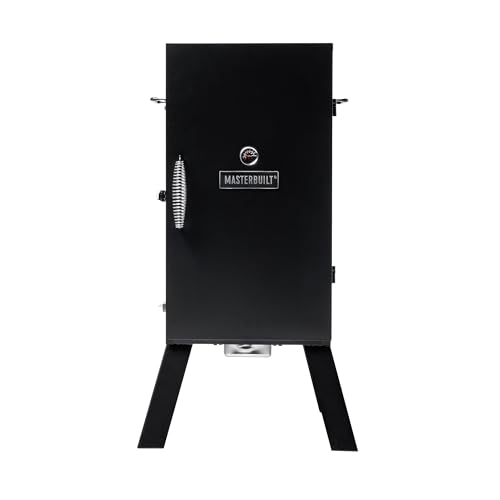
Masterbuilt 30-Inch Analog Electric Smoker MB20070210
Badge: Best Simple Starter
Strengths
- Analog dial is the simplest control in this group to learn and use
- 535 square inches is a manageable size for smaller households
- Masterbuilt vertical layout with chrome racks is a proven, easy format
Trade-offs
- Analog control is less precise than the digital models here
- Smallest cooking area in most of these lineups
- No side loader, window or probe is stated in the title spec
Key specs from the listing
- Form: 30-inch vertical electric smoker
- Cooking area: 535 square inches
- Racks: chrome smoking racks
- Controls: analog temperature control
- Model: MB20070210, black
This is the simplest Masterbuilt in the pool: an analog-dial 30-inch vertical cabinet with 535 square inches on chrome racks. There is no app, no digital display and no stated probe — you set the dial, load chips, and cook. That simplicity is a genuine feature for the right buyer. Fewer electronics means fewer setup steps and a control you can teach anyone in the household in a minute. The trade is precision: an analog dial holds a neighbourhood of temperature rather than an exact set point, so this cabinet rewards cooks who check with their own thermometer.
The analog Masterbuilt teaches the oldest way: set a dial, watch the food, judge with a thermometer. For a beginner who finds digital panels and apps off-putting, that reduction is the kindest feature here — the first cook involves the fewest possible decisions. Its 535 square inches keep early cooks modest in scale, which suits learning. What it asks in return is attention: without a probe or loader, the beginner is the monitoring system, and some beginners prefer exactly that honesty.
Best for: beginners who prefer one dial and their own thermometer / Not suited for: beginners who know door-opening is their weakness
Check on Amazon to confirm the current configuration and included accessories.

EAST OAK 30-Inch Electric Smoker with Timer and Wheels, Matte Black
Badge: Best for Timed Practice
Strengths
- Digital 12-hour timer suits long, planned cooks and overnight-style scheduling
- Easy-rolling wheels make a big cabinet simple to move and store
- Long-run chip loader plus 725 square inches is a strong batch-cooking combination
Trade-offs
- No built-in probe or viewing window is stated in the title spec
- Timer manages the cabinet, not the food, so doneness still needs a thermometer check
- Corded electric placement is limited by outlet reach
Key specs from the listing
- Form: 30-inch vertical electric smoker
- Cooking area: 725 square inches
- Controls: digital, with 12-hour timer
- Mobility: easy-rolling wheels
- Fuel: electric, side chip loader stated for up to 6x longer per load
- Finish: Matte Black
EAST OAK’s Matte Black model trades the probe-and-window package for a digital 12-hour timer and easy-rolling wheels, keeping the long-run side chip loader and the full 725 square inches. The timer is the headline for planners: set the cabinet for a long cook and let it manage the session length while you handle everything else. Wheels matter at this size, because a 30-inch cabinet that rolls is a cabinet you will actually put away between cooks instead of leaving it weathered in a corner.
The timer is a beginner’s pacing coach: long cooks stop being an expanse of uncertainty and become a scheduled session, with the cabinet managing duration while you learn everything else. The long-run loader protects smoke continuity, wheels make the big cabinet easy to live with, and 725 square inches leave room to grow. No probe or window is stated, so pair it with a thermometer and scheduled brief checks — the routine this model’s structure encourages.
Best for: beginners who like structure and timed sessions / Not suited for: beginners wanting to see the food without opening the door
Check on Amazon to confirm the current configuration and included accessories.
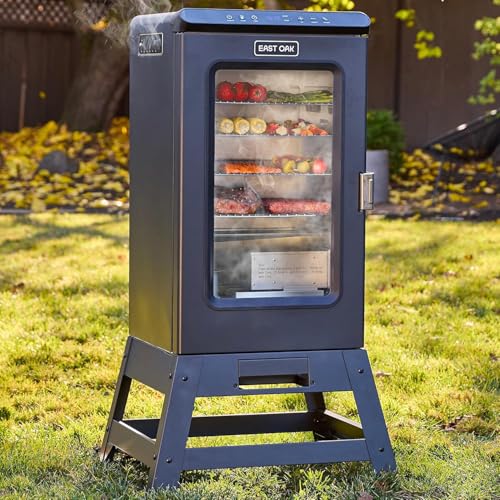
EAST OAK 30-Inch Electric Smoker with Mobility Stand, Polar Night
Badge: Best Raised, Easy-Handling Pick
Strengths
- Built-in probe supports closed-door cooking
- Mobility stand raises and moves the cabinet more easily than a floor-standing unit
- Long-run chip loader and 725 square inches suit bigger batches
Trade-offs
- No viewing window is stated in the title spec
- Stand adds parts to assemble and store
- Corded electric, so the stand can only move it between powered spots
Key specs from the listing
- Form: 30-inch vertical electric smoker on mobility stand
- Cooking area: 725 square inches
- Probe: built-in meat probe
- Fuel: electric, side chip loader stated for up to 6x longer uninterrupted smoke per load
- Finish: Polar Night
This EAST OAK variant combines the built-in meat probe and long-run side chip loader with a mobility stand, over the same 725 square inches as its siblings. The stand does two jobs: it lifts the cabinet to a friendlier working height and makes repositioning it a one-person task. The probe covers the information job, reporting internal temperature without a door opening. If you like the EAST OAK formula but expect to move the smoker between a garage, patio and storage spot, this is the configuration built for that pattern.
This EAST OAK pairs the beginner’s most valuable instrument — the built-in probe — with the mobility stand, which raises the cabinet to a friendly height and makes moving it a non-event. The long-run loader keeps smoke steady through a first long cook. For a beginner whose hesitation is half doneness-guessing and half appliance-wrangling, it removes both hesitations in one purchase.
Best for: beginners who want a probe plus easy handling and height / Not suited for: beginners on the tightest storage footprint
Check on Amazon to confirm the current configuration and included accessories.

Royal Gourmet SE2805 28-Inch Electric Smoker
Badge: Best Compact Starter
Strengths
- Most compact cabinet in this pool, at 28 inches and 454 square inches
- Stated 1350W element is strong for its size class
- Three grates keep the useful vertical stacking of larger models
Trade-offs
- Smallest capacity here, so big batches mean cooking in rounds
- Analog control is less exact than digital models
- No loader, probe or window is stated in the title spec
Key specs from the listing
- Form: 28-inch vertical electric smoker
- Cooking area: 454 square inches
- Power stated: 1350W
- Grates: 3 cooking grates
- Controls: analog temperature control, adjustable heat
The Royal Gourmet SE2805 is the compact option in this pool: a 28-inch vertical cabinet with 454 square inches across three grates and a stated 1350W element under analog control. It keeps the essential vertical-smoker virtues — stacked grates, a small footprint, simple operation — in the size that suits a small patio, a balcony-adjacent setup where local rules allow it, or a household that smokes modest amounts. The analog dial and adjustable heat keep the routine uncomplicated: set, load, and check with a thermometer as food approaches doneness.
The compact starter: 454 square inches across three grates in a 28-inch cabinet, with analog control and a stated 1350W element. For a beginner in a small household, everything about it is proportionate — smaller first cooks, easier storage, simpler cleaning — while the vertical format teaches the same lessons as its larger relatives. It is the right first smoker when the honest constraint is space, and a poor one only if your household regularly cooks for a crowd.
Best for: small households starting small / Not suited for: beginners planning to cook for groups from the start
Check on Amazon to confirm the current configuration and included accessories.
Comparison Table
For a beginner, compare what each cabinet tells you during the cook: probe, window, timer — or a single honest dial.
| Pick | Standout facts from the listing | Listing |
|---|---|---|
| EAST OAK 30-Inch Electric Smoker, Mist Silver | 725 sq in, built-in probe, viewing window, long-run side chip loader | Check on Amazon |
| RYHOFOUD 30-Inch Electric Smoker with Wheels | 30-inch cabinet on wheels, clear window, water pan, drip trays, S-hooks | Check on Amazon |
| Masterbuilt 30-Inch Analog Electric Smoker MB20070210 | 535 sq in, analog temperature dial, chrome racks | Check on Amazon |
| EAST OAK 30-Inch Electric Smoker with Timer and Wheels, Matte Black | 725 sq in, digital 12-hour timer, wheels, long-run side chip loader | Check on Amazon |
| EAST OAK 30-Inch Electric Smoker with Mobility Stand, Polar Night | 725 sq in, built-in probe, mobility stand, long-run side chip loader | Check on Amazon |
| Royal Gourmet SE2805 28-Inch Electric Smoker | 454 sq in, 1350W stated, analog control, 3 cooking grates | Check on Amazon |
The beginner’s table is really a guidance ladder. Probe-and-window models narrate the cook; the timer model schedules it; the window-and-wheels model shows it; the analog and compact models strip it to essentials. Choose the rung that matches how you like to learn, and the first cook will teach instead of test you.
How to Choose the Right Smoker for Your First Smoker
Decide how you learn best, honestly. If uncertainty is what puts you off a new skill, buy information: a built-in probe that reports doneness and a window that shows the food will carry your first season. If complexity is what puts you off, buy simplicity: the analog Masterbuilt asks you to set one dial and check food with your own thermometer, and many confident beginners prefer exactly that bargain. Both paths reach the same table of food; they differ in how the cook feels on the way.
Size your first smoker to your household, not your ambitions. A 725-square-inch cabinet is not harder to run than a 454-square-inch one — electric control sees to that — but it is bigger to store, clean and heat for a two-person cook. Beginners cook more often on a machine sized to their ordinary meals, and frequency is how beginners stop being beginners. The compact Royal Gourmet and the mid-size analog Masterbuilt exist in this list for exactly that reason.
Budget for the thermometer question. Models with a built-in probe answer doneness in the cabinet; models without one — the analog pair here — expect you to own an instant-read thermometer, which is inexpensive, useful far beyond smoking, and honestly part of the starter kit either way for spot checks. Add wood chips to the same first order: every model here smokes with chips, and a first cook delayed for want of a bag of chips is a silly, common story. Qualitative tier context for starter budgets is gathered in Best Smokers For Less Than 300.
Mobility and height are beginner features in disguise. A cabinet on wheels or a stand gets put away and brought out without a struggle, and a beginner who must wrestle a cabinet cooks less. The RYHOFOUD’s wheels, the EAST OAK Matte Black’s wheels and the Polar Night’s mobility stand all serve the habit-forming part of the purchase — the part that decides whether smoking becomes your thing.
Finally, plan the first menu before the machine arrives. Pork shoulder is the classic first cook because it forgives timing; chicken pieces and ribs follow well; fish and vegetables teach smoke control in short sessions. A beginner who starts with a brisket is choosing the hardest exam first. The how-to below is written as a first-cook script — follow it once, and the second cook is already yours.
Your First Smoke: A Beginner’s Step-by-Step
This sequence assumes no experience at all. Follow it literally the first time; improvise from the second. One legacy search phrase in this cluster, Best Smokers For Meat Gander Mountain, is best treated as a meat-focused list rather than buying advice for beginners.
- Choose a forgiving first food — a pork shoulder is the classic — and season it the night before, simply: salt, pepper, and one rub if you have one.
- Set the smoker up outdoors in open air on firm ground near its power point, fit the racks, water pan and drip trays, and load the chip tray or loader with dry chips.
- Switch on and preheat to your recipe’s temperature with the door closed; wait until the cabinet has settled rather than loading at the first reading.
- Put the food in, insert the probe into the thickest part if your model has one, close the door, and start a timer — then leave the door shut.
- Watch through the window or check the probe reading at planned intervals; add chips through the side loader where fitted instead of opening the door.
- Expect the middle hours to look uneventful — that is smoking working. Judge progress by internal temperature climbing slowly, not by appearance.
- When the probe reaches your recipe’s target and the meat feels tender when probed, take it out, wrap it, and rest it before pulling or slicing.
- Eat, then write down three things while you remember them: total time, how the smoke looked, and what you would change. That note is your second cook’s head start.
Temperature confidence grows from one habit: trust the probe over the clock. Recipes give times as estimates because cuts vary; internal temperature is the food’s own report. Beginners who internalise that single idea — cook to temperature, not to time — skip the most common first-year mistake entirely, whichever cabinet they own.
Cleaning is part of the lesson, and it is easier than its reputation: empty the cooled chip tray, wash racks and trays with hot soapy water, wipe the interior, and dry everything before storage. Ten unhurried minutes after a cook keeps flavours clean and makes the next setup feel easy — which, for a beginner building a habit, is a feature as real as any probe.
Troubleshooting
Problem: The temperature reading will not sit still → stop adjusting — electric cabinets settle in cycles around the set point, and constant changes chase a still-settling machine; give it twenty minutes of closed-door calm before concluding anything.
Problem: Smoke disappeared after the first hour → the chips have done their work — refill through the side loader where fitted; thin, steady smoke is the goal, and a cabinet pouring white smoke is overdoing it, not underdoing it.
Problem: The meat is taking far longer than the recipe said → that is normal variance, not failure — keep the door closed, confirm the probe placement is in the thickest part and not touching bone, and let temperature, not the schedule, call the finish.
Your First Five Cooks: A Learning Ladder
Cook one is the pork shoulder: forgiving, inexpensive to practise on, and triumphant when pulled. Cook two repeats it with one change — a different chip wood, say — so you learn what a single variable does. Cook three is chicken, which teaches shorter timing and the value of the water pan. Cook four is ribs, where the window and probe turn doneness from folklore into observation. Cook five is your choice repeated from the ladder’s favourite, cooked from your own notes rather than a recipe page. Outdoor temperature effects on a cook — a question every beginner asks by their third session — are discussed in Best Smokers For Meat When Outside Temperature.
That ladder is why guidance hardware ranks so highly here: each rung asks a question — is it done, is the smoke right, what changed — and a probe, window or timer answers visibly. A beginner on a guided cabinet learns five cooks’ worth in five cooks. A beginner on the analog cabinet learns the same lessons by thermometer and attention, slightly slower and arguably deeper. Choose the teacher whose style you will actually attend.
Common First-Cook Feelings, Answered Honestly
“Nothing is happening” is the first feeling, and it is correct: smoking is slow, quiet work, and the cabinet’s calm is the process, not a fault. “The smoke looks too thin” follows — thin and steady is right; billowing smoke can turn food bitter. “It smells done but the probe disagrees” is the moment the hobby teaches its core lesson: the probe is right, and patience is an ingredient.
By the second cook, the feelings change: setup is routine, the loader is loaded without thinking, and the beginner starts planning variations instead of fearing failures. Every pick in this list can carry a cook to that point. The ones with probes and windows get a nervous beginner there fastest; the simple ones get a confident beginner there cheapest in attention. Both arrivals count as success.
A beginner’s kit beyond the cabinet is short: wood chips, a thermometer if the model lacks a probe, heatproof gloves for racks and trays, foil for resting, and a notebook. None of it is exotic, all of it gets used every cook, and together it costs the beginner less frustration than any single accessory upgrade bought later in a panic.
Safety basics deserve one plain paragraph in a beginner guide: use the smoker outdoors in open air, keep it on firm ground away from anything flammable, let ashes and chip trays cool fully before disposal, and keep children and pets supervised around a hot cabinet. None of this is complicated, and all of it is habit from the first cook, not the fifth.
Expect the second-hand effect: beginners who buy a forgiving first cabinet tend to keep it even after upgrading, because a simple electric smoker remains the easiest way to add a second batch or a different food to a big cook. A first smoker chosen well is rarely replaced — it is joined.
Your second purchase after the smoker should be knowledge, in whatever form you actually consume: one good smoking cookbook, a saved set of reliable recipes, or a friend’s annotated notes. The internet’s volume is not a curriculum. A beginner with three trusted recipes cooked repeatedly learns faster than a beginner with three hundred saved links, because repetition is where judgement forms — and every cabinet in this list rewards exactly that kind of practice.
Smoke wood is the beginner’s cheapest education: one bag each of a mild and a stronger chip, used on the same food in successive cooks, teaches more about flavour than any article — including this one — can say in words. Cabinets make the experiment tidy, since chips are measured in handfuls and changed in minutes. Keep the variable count at one, note the difference, and your palate starts calibrating itself.
Expect the hobby’s social side to arrive uninvited: smoked food draws neighbours, family requests and event invitations at a rate no beginner predicts. A cabinet sized to your household handles the happy version of that problem; the cook ladder in this guide handles the skill version. Say yes to the gatherings — cooking for people is the fastest teacher there is, and the forgiving foods on the ladder travel well.
Budget honesty for beginners: the ongoing costs of this hobby are chips, ingredients and time, and all three are modest for electric cabinets. There is no expensive fuel habit to feed and no specialist supplier to depend on. That lightness is part of why electric cabinets dominate beginner recommendations — the hobby stays affordable enough to remain a pleasure rather than becoming a line item to justify.
One day the beginner label expires, usually mid-cook, when you catch yourself adjusting nothing because nothing needs adjusting and explaining the stall to a guest. The cabinet that taught you will still be standing there, and most owners keep it: as the second batch unit, the fish smoker, the easy weeknight option. Choose it as this guide suggests — for forgiveness now — and it will keep a role long after forgiveness is no longer the point.
If you are buying for someone else’s first smoker, borrow the gift logic from elsewhere in this series: include the chips, plan the first cook together, and choose guidance hardware unless you are certain they prefer simplicity. A beginner set up to succeed once usually succeeds for years.
A beginner should also know what not to buy yet: no second smoker, no arsenal of rubs, no specialised tools beyond the basics until the first five cooks are logged. The hobby’s early spending trap is real, and it usually springs from a difficult cook that equipment cannot fix. The ladder in this guide, run on any single cabinet here, produces the skill that later purchases can actually amplify.
Finding your people accelerates learning more than finding more content: a local barbecue group, a patient friend who smokes, or even the comments of fellow owners of your exact model will answer the questions beginners actually have — the ones about their cabinet, their climate and their cuts. Bring your notes when you ask; specific questions about a logged cook get specific answers, and vague ones get folklore.
Patience with yourself is the final beginner skill: the first brisket will not be the tenth, the first ribs may be merely good, and merely good smoked food is still a table people gather around happily. The ladder works because each cook is allowed to be a lesson rather than a verdict. Owners who grant themselves that patience almost always stay in the hobby; owners who demand mastery by the third cook often sell a perfectly good smoker.
Keep the setup ritual identical each time — same order, same checks, same layout of tools — until it disappears into habit. Ritual is how beginners borrow the calm of experienced cooks: the hands know the sequence, so the mind is free to watch the food. Every cabinet here supports that ritual equally, because the sequence belongs to the cook, not the machine.
By the end of a first season, revisit this guide’s shortlist with experienced eyes and notice how your judgements have changed: features that seemed like luxuries will read as tools, and simplicity will read as a choice rather than a limitation. That changed reading is the measure of what the first smoker taught you — and it is why the right first purchase matters less than starting, noting, and cooking again.
Common Buying Mistakes
Starting with brisket. The hardest cut is a poor first teacher. Begin with pork shoulder and earn the brisket.
Opening the door to check. Beginners open; cooks watch the probe and window. Every opening costs heat, smoke and time.
Cooking by the clock. Times in recipes are estimates. Internal temperature is the finish line — use the probe or a thermometer.
Too much smoke. Billowing smoke is not more flavour; it is bitterness arriving. Thin and steady wins.
Skipping the notes. Three lines after each cook compound into skill. Memory alone repeats the same first cook forever.
Final Recommendation
For most first-time smokers, the EAST OAK Mist Silver is the right teacher: a built-in probe to end guessing, a window to end door-opening, a long-run loader to keep smoke steady, and 725 square inches that will not be outgrown in the first year. If you would rather learn with the fewest possible decisions, the analog Masterbuilt is the honest alternative — one dial, a manageable size, and a thermometer of your own. For small households, the compact Royal Gourmet starts the hobby at the right scale. Start forgiving, take notes, and let temperature call the finish — the rest is practice.
Whichever cabinet you choose, give it the ladder: forgiving first foods, notes after every cook, and doneness judged by temperature. Five cooks from now, the beginner this guide was written for will be giving the advice. Check the listing for the current configuration and included accessories before ordering — probe and loader details are the specs that matter most here.
Start with the EAST OAK 30-Inch Electric Smoker, Mist Silver if it fits your situation, compare it against the Masterbuilt 30-Inch Analog Electric Smoker MB20070210 for the main alternative in this group, and keep the EAST OAK 30-Inch Electric Smoker with Mobility Stand, Polar Night in mind as the third direction worth a look before you order.
Frequently Asked Questions
What type of smoker is easiest for a beginner?
An electric vertical cabinet, for the reasons this whole list is electric: temperature is set rather than tended, there is no fire to manage, and features like probes and loaders are common. All six picks are electric cabinets.
Do I need a built-in meat probe?
You need temperature information; a built-in probe is the most convenient way to get it. The probe-equipped EAST OAK models include one. On models without, an instant-read thermometer of your own does the same job at each check.
What should a beginner smoke first?
A pork shoulder: it is forgiving of timing, feeds a group, and teaches the full arc of a long cook. Chicken and ribs follow well; save brisket until the routine is familiar.
How do I know when smoked meat is done?
By internal temperature at the thickest part, plus tenderness when probed. Colour and time mislead beginners; the probe reading is the evidence. Your recipe will state the target for the cut you are cooking.
Is a bigger smoker harder to learn on?
Not harder to operate — electric control is electric control — but bigger cabinets are more to clean and store, and heating one for a tiny cook feels wasteful. Size to your household’s ordinary meals.
How much smoke should I see?
Thin and steady. Heavy white billows usually mean too much wood burning too fast and can turn food bitter. A gentle, continuous wisp maintained through the cook is the goal every model here is built for.


