Every oven in this guide cooks with sunlight and nothing else. That sentence needs its boundaries drawn immediately, because the words solar oven get attached to a wide menagerie online. The picks below are complete, ready-made solar ovens and cookers whose makers publish a heat-collection mechanism, a ceiling temperature or power figure, and a cooking capacity for the exact model named. One of them — a hybrid — adds a small 12-volt electric element as a backup for cloud and darkness. Everything else here runs on photons alone: no propane, no charcoal, no mains electricity, no fuel of any kind to buy, carry or run out of. These are fuelless outdoor cooking appliances for camping, off-grid cabins, boats and emergency preparedness, and the guide treats them as exactly that.
Three product classes are excluded by design, and it is worth saying why. Indoor electric and gas ovens are a different category entirely — this site already covers them in depth — and no mains appliance appears here. Parabolic hotspot cookers, the satellite-dish designs that focus sunlight onto the base of an exposed pot, are also absent: they are powerful, but they are not ovens, because the maker sells no enclosed cooking chamber or fitted tray with them, and the cooking they do is stovetop work under a glare shield. Do-it-yourself kits and plans are excluded for the opposite reason — there is no manufacturer document to verify, and this guide’s entry condition is a maker document. What remains is a small, honest field: three families of heat collection, six products, and one shared dependence on the weather.
A note on how this site works before the list itself. Top Rated Kitchenware earns an affiliate commission when readers buy through links in its guides, at no extra cost to the buyer, and every pick below was verified against the manufacturer’s own product page, specification sheet or manual for the exact model named — the ceiling temperatures, tray capacities and weights printed by the maker, not the inflated paraphrase in a retail listing. That discipline matters more in this category than in most, because solar cooking attracts folklore. Sellers quote temperatures reached on one exceptional day at one exceptional latitude as though they were specifications, and capacities migrate between a product line’s sizes until a small cooker is described with its big brother’s tray. In this guide, a number appears only where the maker’s document for that model prints it.
In this guide
Quick picks: best solar ovens
| # | Product | Where to buy |
|---|---|---|
| 1 | My Solar Oven | Check on Amazon |
| 2 | GoSun Go | Check on Amazon |
| 3 | Haines 2.0 SunUp Solar Cooker | Check on Amazon |
| 4 | Sunflair Portable Solar Oven Deluxe | Check on Amazon |
| 5 | SolCook All Season Solar Cooker | Check on Amazon |
Three Ways to Trap Sunlight
The evacuated tube: a thermos that cooks
The tube family borrows its physics from the vacuum flask. Food sits on a tray inside a borosilicate glass tube whose double wall holds a vacuum, and vacuum is a superb insulator: heat that enters as sunlight struggles to leave as anything else. Parabolic reflectors on either side gather light from a wide arc of sky and pour it onto the tube, so the oven keeps working across a range of sun angles without constant re-aiming. The result is the highest documented ceilings in solar cooking — the maker of all three tube picks here publishes a maximum of 550 degrees Fahrenheit — and cooking behaviour closer to a small conventional oven than to a solar novelty: roasting, baking and steaming in a sealed, moist environment. The costs are capacity and fragility. A tube’s tray is long and narrow, its volume is quoted in ounces, and borosilicate, for all its thermal-shock tolerance, is still glass travelling in a vehicle.
What to Look for in a Solar Oven
Start with the mechanism, not the temperature headline
The single habit this guide exists to teach is reading the mechanism before the number. A ceiling of 550 degrees Fahrenheit in a vacuum tube and a ceiling of 285 degrees in a panel cooker are not two points on one scale of quality; they describe different cooking. The tube roasts and bakes small loads quickly, the way a countertop oven does. The panel simmers, braises and bakes slowly in a pot, the way a slow cooker does, and judging it by the tube’s ceiling is like judging a slow cooker by a grill’s sear temperature. Decide first which kind of cooking your household actually does outdoors — tray food in portions, or pot food in volume — and the field narrows to one family before any specification is compared. Every pick below states its family in its first paragraph, and the comparison table keeps the families in separate rows of the argument even where the numbers look comparable.
The Six Picks: Solar Ovens, Verified From the Makers’ Documents
GoSun Fusion — The Hybrid Tube That Keeps Cooking After the Sun Gives Up
The Fusion is the performance ceiling of this article and the only pick that refuses to stop at sundown. GoSun’s specification sheet describes the architecture plainly: a borosilicate evacuated tube fed by two parabolic reflectors, with an electric heating element integrated into the cooking tray that runs on 12 volts at 150 watts when sunlight is absent. The sheet gives a maximum temperature of 550 degrees Fahrenheit, an estimated 250 watts of cooking power under strong sun, and a cooking tray of 116 ounces — 3.43 litres — which makes this the largest tube in the guide by a wide margin. Dry weight is 14.5 pounds, and the open oven measures 22.8 by 17 by 13.34 inches. One documentation trap deserves naming in the open, because it is exactly the kind this guide exists to catch: GoSun’s own product-line comparison chart elsewhere credits the Fusion with a 145-ounce capacity, while the Fusion’s specification sheet states the tray at 116 ounces. This article uses the specification sheet’s figure, and buyers reading larger numbers elsewhere now know which document disagrees.
The hybrid design changes the planning logic of solar cooking rather than merely extending it. A pure-solar oven asks the cook to finish by late afternoon; the Fusion asks only that the day’s cooking begin under the reflectors, because anything the sun leaves unfinished — the stew not quite tender, the bread not quite risen — the 12-volt element can carry to completion from a vehicle battery or power station. That makes the Fusion the natural centrepiece of an emergency-preparedness kitchen, where its two power sources fail independently: cloud does not stop the battery, and a dead battery does not stop a clear sky. The tray’s size supports the role, holding a family meal rather than a snack, and the tube’s sealed environment cooks with the food’s own moisture, so roasts and braises emerge from a fuelless oven tasting like they came from a plumbed one. The costs are the ones the axis predicts: at 14.5 pounds it is a vehicle-carried appliance, the glass tube travels in its case or not at all, and the electric backup presumes a battery budget that must be planned like any other part of an off-grid system.
Strengths
- The only pick with two independent heat sources: vacuum-tube solar plus an integrated 12-volt, 150-watt element in the tray.
- The largest documented tray in the guide at 116 ounces (3.43 litres) per the maker’s specification sheet.
- Maker-documented ceiling of 550 degrees Fahrenheit with an estimated 250 watts under strong sun.
- The sealed tube cooks with the food’s own moisture, suiting roasts and braises as well as tray food.
Trade-offs
- At 14.5 pounds dry it is a car-camping and home-backup appliance, not a carried one.
- The electric backup needs a battery or power station budget planned separately; the oven alone does not store energy.
- The borosilicate tube is glass: it travels in its case, and careless packing is the one failure the design cannot forgive.
Who it suits: the preparedness-minded household and the off-grid cabin cook, for whom a cloudy evening must not cancel dinner. If your cooking plan already includes a power station, the Fusion is the oven that plugs into it — match the listing to the standalone oven rather than a power-bank bundle and check price on Amazon.

My Solar Oven — The Portable Box Oven for Any Cookware You Own
The My Solar Oven is the pick for the buyer who does not want to buy into a proprietary tray or pot system. The maker’s listing describes a portable solar oven that cooks at 350 to 400 degrees Fahrenheit, is made in the USA, and works with any oven-safe cookware you already own. That last point is the whole argument: the oven is a chamber, not a kit, so the pot, pan or Dutch oven already in your cupboard is the cooking vessel, and there is nothing else to purchase, size or replace. For a camper or emergency kit where every item must justify its weight, an oven that accepts ordinary cookware is a simpler proposition than a tube with its own tray.
The 350-to-400-degree range is what makes the pick a genuine oven rather than a warming box: it covers bread, roasting and the ordinary baking the other picks in this article are judged on. What it does not offer is the tube cookers’ speed or their 550-degree ceiling, and it is pure solar, so cloud and dusk end the cooking session just as they do for the Sport. The honest comparison is therefore between flexibility and peak performance. The tube picks cook faster and hotter in good sun but demand their own trays; this oven cooks at a real baking temperature with whatever you already own, and asks only that you bring a pot that fits.
Strengths
- Maker-stated 350-to-400-degree cooking range — a real baking temperature, not a warming range.
- Works with any oven-safe cookware you already own; no proprietary tray or pot to buy.
- Made in the USA, and portable by design rather than by accessory.
- No element, battery or fuel anywhere in the system: sun in, dinner out.
Trade-offs
- Pure solar means cloud and dusk end the cooking session; there is no fallback in the box.
- Below the tube cookers’ ceiling, so searing-hot, twenty-minute meals are not its job.
- Capacity is set by the cookware you bring, not by a tray the maker sized for you.
Who it suits: the camper or prepper who already owns oven-safe cookware and wants a portable solar oven without joining a proprietary tray system. If your kitchen already holds the pot, this is the oven that lets you use it under the sun.
Check price on Amazon: My Solar Oven

GoSun Go — A Two-Pound Personal Oven in a Hard Case
The Go takes the tube family’s physics down to the scale of a single person, and its specification sheet reads like a backpacking brief answered point by point. GoSun documents a weight of 2 pounds, a capacity of 13.5 ounces — 400 millilitres — a maximum temperature of 550 degrees Fahrenheit and a power figure above 50 watts, all packed into a hard EVA clamshell case measuring 14.17 by 7 by 3.37 inches when closed. Inside that case sits the same architecture as its larger siblings: a borosilicate vacuum tube, reflectors that unfold from the case itself, and a tray sized for one meal or one boil of water. Thirteen and a half ounces is a soup, a portion of rice and vegetables, a reheated stew, a mug-and-a-half of water brought to the boil — the arithmetic of one person’s lunch, stated without inflation.
What the Go is for becomes clear when it is set against the category it quietly replaces: the carried stove. A backpacker or bikepacker who cooks in strong-sun country ordinarily carries a stove plus a fuel canister whose weight grows with the trip’s length, because fuel is consumed by the day. The Go’s two pounds never grow. On a five-day traverse in desert sun, the solar oven is the lighter system by the second day and the only system by the fifth, and it asks for nothing at the resupply point. Its limits are the honest mirror of its virtues: one portion at a time, no cooking under cloud or canopy, and a glass tube that rides in the centre of the pack where other gear cannot crush it. The maker’s hard case is not packaging but part of the product — the clamshell is how a glass oven survives a rucksack — and buyers should treat a listing missing the case as an incomplete product, not a discount.
Strengths
- Two pounds total, in a hard EVA clamshell that protects the glass tube in a pack.
- The same documented 550-degree ceiling as the full-size tubes, at personal scale.
- Capacity of 13.5 ounces matches one real meal or one boil — no padded claims.
- Its weight never grows with trip length, unlike any stove-and-fuel system it replaces.
Trade-offs
- Strictly one person at a time; a second portion is a second session in the sun.
- Glass at the centre of a pack demands packing discipline on every move, not just careful ones.
- Accessory kits with silicone pans change the box contents; the bare oven and the kits are different listings.
Who it suits: the solo hiker, bikepacker or commuter who cooks for one in sun country and counts every pound twice. If your kitchen already fits in a rucksack, this is the only oven here that fits the same philosophy — verify the listing is the bare Go rather than an accessory kit and check price on Amazon.
Check price on Amazon: GoSun Go
Haines 2.0 SunUp Solar Cooker — The Panel That Cooks Around the Pot
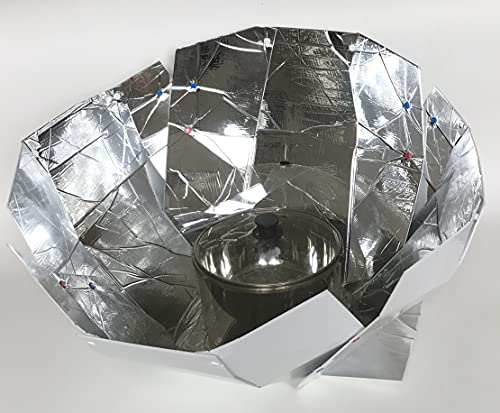
The Haines 2.0 is the article’s bridge between the families: a panel cooker whose maker has thought hardest about how panel heat actually reaches food. Haines Solar Cookers describes the design as panelbolic — a reflector of Mylar film over polyester foam whose curved arrangement distributes sunlight evenly around the base and sides of the pot instead of concentrating it at one scorching point, which is the classic panel failure this geometry exists to prevent. The panels adjust for low and high sun angles, the whole cooker folds flat for storage, and it weighs 29 ounces — a figure the maker states for the cooker alone, without the pot, and this article repeats it on the same terms. An insulating sleeve lifts and wraps the pot to hold the gathered heat. The version this pick specifies is the kit with the maker’s Dutch oven: a 4.5-quart stainless steel pot with a tempered glass lid, sized for the family cooking the panel family exists to serve. The maker’s performance figure is a quart of water brought to the boil in about forty minutes, depending on the sun.
One act of documentation discipline defines this pick, and it is stated plainly so the reader can hold the article to it: Haines does not publish a single ceiling temperature in degrees Fahrenheit for the 2.0 on its own product documentation, so this article prints none. Retailers and reviewers attach figures — 325, 350, 375 degrees all circulate — but none of them is the maker’s number, and a guide that bans invented specifications does not borrow them. What the maker’s evidence supports is the behaviour: a panelbolic field around a lidded steel pot, boiling water in strong sun at a documented pace, simmering and braising thereafter at slow-cooker tempo. Buyers who need a printed ceiling to trust a cooker should choose a tube; buyers who judge by the meal will find the Haines arrangement — even heat, a real pot, a glass lid to check progress without lifting it — the most conventional cooking experience in the article, at the price of the slowest warm-up here.
Strengths
- The panelbolic reflector spreads heat around the pot instead of focusing a single hotspot under it.
- The specified kit includes the maker’s 4.5-quart stainless Dutch oven with a tempered glass lid.
- Twenty-nine ounces for the cooker itself, folding flat; the insulating sleeve is part of the system.
- Panels adjust for low and high sun angles, widening the useful hours and seasons.
Trade-offs
- No maker-published ceiling temperature exists for this model, and this guide will not substitute a retailer’s figure.
- The forty-minute quart of boiling water is a strong-sun pace; panel cooking is the slowest warm-up in the article.
- The cooker-only version and the Dutch-oven kit are different listings; the pot is not automatically in the box.
Who it suits: the family camper who cooks in pots — soups, stews, rice, braises — and wants one flat-folding cooker to serve them all. If your outdoor menu is written in quarts rather than tray ounces, this is your pick — make sure the listing is the version with the Dutch oven kit included before you check price on Amazon.
Check price on Amazon: Haines 2.0 SunUp Solar Cooker

Sunflair Portable Solar Oven Deluxe — One Pound, One Box, the Whole Kit
The Sunflair Deluxe is the lowest-weight complete answer in the article, and its maker’s description is a study in doing one job thoroughly. Sunflair documents a folding panel-and-soft-box cooker with closed-cell insulation, a maximum temperature of 285 degrees Fahrenheit, capacity for four to eight people, and a weight of one pound two ounces, folding down to a package two by fifteen and a half by nineteen inches. The word Deluxe names a kit rather than a trim level: two collapsible silicone pots, an enamelware roasting pot, two heat-conducting baking trays, two roasting and dehydrating racks, an oven thermometer and a carrying bag, under a one-year warranty. Nothing else in this guide arrives so completely equipped, and nothing else asks so little of a shelf, a drawer or a luggage allowance — the folded Sunflair is closer to a place mat than to an appliance.
The 285-degree ceiling is the pick’s defining limit, and this article locks the Sunflair into the role that limit suits rather than apologising around it. It will not sear, it will not rush, and it must never be ranked against the tubes on speed. What it does — slowly, gently, for a crowd — is the cooking that low ceilings do best: simmered dishes in its silicone pots, baked goods that forgive a long rise, and dehydration, for which the included racks and the modest heat are precisely the specification a food dryer would choose. The thermometer in the kit matters more here than it would on a hotter oven, because cooking at the gentle end is cooking by temperature watched over time. Buyers should also note the smaller sibling, the Sunflair Mini, built for one or two people at the same ceiling; it is this article’s documented backup if the Deluxe listing ever disappears, not a silent substitute, because the capacity story of the pick would have to be rewritten around it.
Strengths
- One pound two ounces and folds to two inches thick — the lowest-weight and slimmest pick in the guide.
- The Deluxe kit is genuinely complete: two silicone pots, a roaster, trays, racks, thermometer and bag.
- Cooking capacity for four to eight people despite the weight of a water bottle.
- The low ceiling plus included racks make it the natural dehydrating pick for herbs and fruit.
Trade-offs
- 285 degrees Fahrenheit is the lowest ceiling here; speed and browning are simply not its trade.
- The soft construction wants shelter from wind and care around sharp kit in the same bag.
- The Mini is a different, smaller product; listings must be read to keep the Deluxe’s capacity story intact.
Who it suits: the weight-obsessed traveller, the small-flat dweller and the gardener with produce to dry, all of whom need capacity without bulk. If the whole cooker has to weigh about a pound and arrive as one complete box, the Deluxe is the pick — confirm the listing carries the full Deluxe kit rather than the oven alone and check price on Amazon.
Check price on Amazon: Sunflair Portable Solar Oven Deluxe
SolCook All Season Solar Cooker — The Rigid Panel With the Biggest Floor
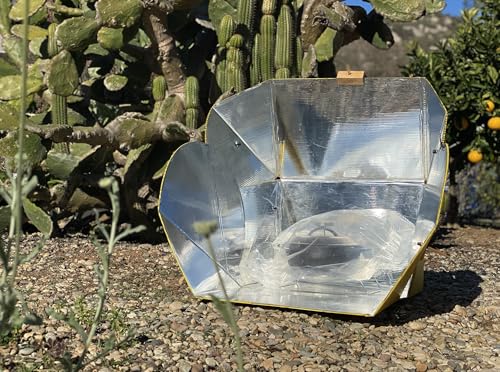
The SolCook All Season answers the panel family’s durability question with a different material. SolCook’s documentation describes a flat-folding panel cooker built from polypropylene fluteboard skinned with a UV-resistant reflective film — a rigid, water-resistant board rather than foam and film — which sets up at 28 by 28 by 24 inches around a cooking floor of 17 by 12 inches, large enough for a standard baking tray. It folds to a board half an inch thick, 24 inches wide and 48 inches long, weighs about four pounds, and arrives with the maker’s Sunsight aiming tool, a cooking rack and a reusable cooking bag. The panel angles adjust for the low sun of morning, evening and the shoulder seasons, which is the design’s namesake claim: not a higher ceiling, but a wider window of the year and the day in which panel cooking stays practical.
That floor size changes what a panel cooker can be asked to do. The Haines wraps a pot; the Sunflair cradles its own vessels; the SolCook’s seventeen-by-twelve floor takes the tray of vegetables, the flatbread, the baking pan that the other panels cannot host, which makes it the panel pick for groups cooking mixed loads at a base camp or a vehicle. Its documentation discipline mirrors the Haines pick’s: retail sources attach ceiling figures to this cooker that disagree with each other — 350 degrees in one place, 400 in another — and where the sources conflict, this guide prints no single ceiling at all, describing instead what the maker’s material supports, which is effective cooking and braising in good sun across an unusually wide range of sun angles. The four-foot folded board is the honest price of the rigid construction: it slides behind a seat or along a locker wall, but it does not disappear into a drawer the way the soft panels do, and buyers should measure their storage line before falling for the floor.
Strengths
- A 17-by-12-inch cooking floor that takes a standard baking tray — the largest work surface among the panels.
- Rigid fluteboard construction with UV-resistant film: water-resistant and built for repeated seasons.
- Adjustable panel angles and the Sunsight aiming tool widen the useful hours and shoulder seasons.
- Folds to a half-inch board and weighs about four pounds, with rack and cooking bag included.
Trade-offs
- The folded board is four feet long; storage is a line along a wall or locker, not a drawer.
- Retail ceiling figures for this cooker conflict, so no single maker-verified ceiling can be quoted for it.
- Panel tempo still applies: this is braising and baking at the sun’s pace, not tube speed.
Who it suits: the base-camp cook and the group caterer, feeding more people than a pot alone can serve. If your camp kitchen works from trays and pans as much as from pots, this floor is built for it — match the listing to the Camper configuration of the All Season before you check price on Amazon.
Check price on Amazon: SolCook All Season Solar Cooker
The Six at a Glance
| Pick | Heat-collection family | Maker’s ceiling or power figure | Capacity, as documented | Weight | Defining trait |
|---|---|---|---|---|---|
| GoSun Fusion | Evacuated tube + parabolic reflectors, hybrid | 550°F max; about 250W in strong sun; 150W 12V element | Tray 116 oz (3.43L) per spec sheet | 14.5 lb | The only pick that cooks without sun, on 12 volts |
| My Solar Oven | Portable box oven, pure solar | 350–400°F | Any oven-safe cookware you own | Portable | Baking temperature with no proprietary tray |
| GoSun Go | Evacuated tube, personal | 550°F max; 50+ W | 13.5 oz (400ml) | 2 lb | A one-person oven in a hard clamshell case |
| Haines 2.0 SunUp | Panelbolic panel | No maker ceiling published; boils 1 qt in about 40 min, sun permitting | Kit pot: 4.5 qt Dutch oven | 29 oz (cooker only) | Even heat wrapped around a family pot |
| Sunflair Deluxe | Folding panel / soft box | 285°F max | Cooks for 4–8 people; full kit of pots, trays and racks | 1 lb 2 oz | The lowest-weight complete kit in the guide |
| SolCook All Season Camper | Rigid folding panel | No single maker ceiling quotable; cooks and braises in good sun | Cooking floor 17 x 12 in | About 4 lb | The biggest floor and the widest sun-angle window |
Read the table the way the article was built: the family column is the argument, and the figures only mean something inside their family. The tubes trade capacity for ceiling and speed; the panels trade ceiling for volume and portability; the hybrid buys its way out of the trade with a battery. A buyer comparing a 550-degree tube against a 285-degree panel on the numbers alone is comparing a kettle’s boil time against a slow cooker’s braise — the foods, not the figures, should cast the vote.
Matching the Pick to Your Sky and Your Kitchen
Consider first the household building an emergency shelf. Its fear is not a slow lunch but a long outage, and its shelf probably already holds a power station. The Fusion is that household’s oven almost by definition: solar by day, 12-volt by night, with a tray big enough to matter and a sealed tube that cooks real meals rather than reheating drinks. The Sport joins the conversation only if the shelf’s budget or space refuses the hybrid’s weight, and it joins as a fair-weather supplement, not an equivalent.
Consider next the couple who camp where the sun is a reliable employee — desert sites, high plains, long summer evenings. Their cooking is fresh, portioned for two or three, and eaten outdoors at the sun’s pace by choice. The Sport was drawn for them: half the Fusion’s weight, nothing to charge, fast enough in their sky to feel like an appliance rather than a project. If one of them sometimes walks out alone for a night, the Go rides along as the personal version of the same idea, and the pair of tubes together still weigh less than the hybrid alone.
Frequently Asked Questions
How long does a solar oven actually take to cook a meal?
Under strong, direct sun, the makers’ own figures give the honest range: the My Solar Oven is listed cooking at 350 to 400 degrees Fahrenheit, and the Haines 2.0 is documented boiling a quart of water in about forty minutes. Both figures carry their condition — strong sun — and both stretch under cloud, low sun angles and winter latitudes. Plan solar meals the way the figures are written: start in late morning, allow a window rather than a moment for doneness, and choose dishes that hold well when the sun is generous and forgive when it is not.
Can a solar oven reach real baking and roasting temperatures?
The tube family can, on its makers’ documents: all three GoSun picks publish a maximum of 550 degrees Fahrenheit, which is genuine roasting territory reached under strong sun. The panel family cooks lower by design — the Sunflair’s maker states 285 degrees — and the Haines and SolCook publish no single ceiling this guide can quote, describing effective cooking and braising in good sun instead. The right question is therefore not whether solar ovens get hot, but which family’s documented temperatures match the food you intend to cook.
What happens to a solar oven on a cloudy day?
Five of the six picks slow down and eventually stop, because their only energy source has been withdrawn; that is a property of the category, not a failure of the products. The exception is the GoSun Fusion, whose integrated 12-volt element lets the same tray finish cooking from a battery or power station when the sky closes. Buyers whose cooking cannot wait on weather should either choose the hybrid or keep a second heat source alongside a pure-solar oven, which is how most experienced solar cooks actually run their kitchens.
Why is there no box oven among the picks?
Because the family’s defining product is no longer made. The All American Sun Oven’s maker, Sun Ovens International, has stopped production amid a restructuring, and the units still listed are old stock or used — a status this guide’s rules exclude, since a recommendation must point at a product that can be bought new with its maker behind it. The insulated-box design itself remains sound, and if a verifiable maker returns it to production, the design will earn a place in this article on its documents.
Is a solar oven worth it next to a small camp stove?
It answers a different problem. A stove offers heat on demand and burns fuel by the hour; a solar oven offers heat only when the sun serves and then charges nothing, forever, in complete silence. For short trips in unreliable weather the stove’s certainty wins. For long stays in sun country, for fuel-free emergency shelves, and for cooks who simply enjoy the discipline of cooking with the day, the oven’s arithmetic — zero running cost, zero resupply — compounds in its favour with every meal.
The Bottom Line
Solar cooking rewards the buyer who reads it as three families rather than one category. The tubes are small, sealed and startlingly hot; the panels are slow, capacious and nearly weightless; the hybrid stands between them with a battery in its pocket. Match the family to your food and your sky — GoSun’s Sport for speed at couple scale, the Fusion where dinner cannot depend on weather, the Go where every pound is argued over, the Haines around a family pot, the Sunflair where the whole kitchen must weigh a pound, the SolCook where a group’s trays need a floor — and verify every figure against the maker’s document for the exact model, because in this category the document is the only honest salesman. Choose the mechanism that matches your sky — tube for speed, panel for the pot, hybrid for the cloudy day — and a solar oven stops being a novelty and becomes the most silent appliance you own.