Disclosure: topratedkitchenware.com is reader-supported. When you buy through links on our site, we may earn an affiliate commission from Amazon and other retailers, at no extra cost to you.
Where to buy
The best space saving cookware sets solve a geometry problem: handles, lids and fixed shapes waste more kitchen volume than the pans themselves. The six sets below are ranked with that geometry in mind – one genuine detachable-handle system, several lean assortments that nest tightly, and honest notes on the picks that save less space than they promise. Each pick links to its live listing so you can check the latest price on Amazon.
- Cuisinart Chef’s Classic Stainless Steel Set, 17 pc (77-17N) — Best for Big Kitchens That Host
- Calphalon Classic Stainless Steel Cookware Set, 10-Piece — Best Conventional Value
- Cuisinart Chef’s Classic Stainless Steel Set, 7 pc (77-7P1) — Best True Compact Core
- CAROTE Tri-Ply Stainless Steel Cookware Set with Detachable Handle, 15 pcs — Best Space-Saving Design
- Cuisinart PureClad Triple-Ply Stainless Steel Cookware Set, 12-Piece (PCT-12) — Best Clad Space Performer
- EWFEN 3 Ply Stainless Steel Cookware Set, 11-Piece — Best Value Tri-Ply
Read the full guide ↓ for the research method, the detailed reviews, the comparison table, the buying guide and the care instructions.
Space saving in cookware is not a style; it is geometry. The best space saving cookware sets attack the three places kitchens actually lose volume: handles that force pans to store at full length, lids that sprawl, and assortments padded with vessels you will never nest because you never use them. A set that solves only one of the three is a partial answer wearing a full answer’s label.
This guide therefore ranks the verified pool by real storage behavior. The standout is a genuine system change – CAROTE’s detachable handles, which let tri-ply pans nest like bowls and travel from stove to oven to table without a handle dictating any of it. Around it sit the disciplined conventional sets: lean assortments of nesting stainless whose space saving comes from editing rather than engineering, plus one large set included honestly as the counterexample.
If your space problem is really a household-size problem, the tests in Best Small Cookware Sets overlap heavily with this page; here the lens stays on the cupboard, the drawer and the RV locker, in that order.
Key Takeaways
- Handles waste the most space in conventional sets – the detachable-handle CAROTE is the only structural solution in this guide.
- Lean assortments (7-11 pieces) save space by editing: fewer vessels, all nesting, nothing stored ‘just in case’.
- Lids are the hidden volume – plan a vertical or door-mounted lid home for any set you buy.
- Every pick nests by size and is induction compatible stainless, so the saved space is not bought with short lifespan.
- Measure your storage in three dimensions before ordering; depth is the dimension most sets fail.
In this guide
Quick Picks
| Pick | Badge | Why it made the list |
|---|---|---|
| Cuisinart Chef’s Classic Stainless Steel Set, 17 pc (77-17N) | Best for Big Kitchens That Host | 17-piece Chef’s Classic – capacity first, space second |
| Calphalon Classic Stainless Steel Cookware Set, 10-Piece | Best Conventional Value | 10-piece Calphalon, lean and nestable |
| Cuisinart Chef’s Classic Stainless Steel Set, 7 pc (77-7P1) | Best True Compact Core | 7-piece Chef’s Classic essentials |
| CAROTE Tri-Ply Stainless Steel Cookware Set with Detachable Handle, 15 pcs | Best Space-Saving Design | Detachable handles: nests flatter than any rival |
| Cuisinart PureClad Triple-Ply Stainless Steel Cookware Set, 12-Piece (PCT-12) | Best Clad Space Performer | 12-piece PureClad triple-ply, focused assortment |
| EWFEN 3 Ply Stainless Steel Cookware Set, 11-Piece | Best Value Tri-Ply | 11-piece EWFEN 3-ply with lids |
How These Picks Were Chosen
Selections come from the verified cookware-set pool, cross-checked against Amazon’s catalog data; only confirmed listings carry links and images. Scoring for this keyword weighted, in order: handle design and its storage consequences, assortment leanness, nesting behavior, and lid burden – then construction and cooking quality, using only specifications in the verified listing data.
Method honesty: this is a research-led guide, not a hands-on test, and storage claims here are geometric, drawn from assortment composition and handle design rather than from a tape measure in our own cupboard. Where a set saves space only by being small, we say so; where it saves space by design, we say that instead. The mobile version of this problem is covered in Best Rv Cookware Sets, where the detachable-handle logic earns its keep most visibly.
The 6 Best space saving cookware sets Candidates, Reviewed in Detail
Reviews lead with storage geometry – how the set actually occupies a cupboard – then cover cooking, then give the honest space limitation of each pick.

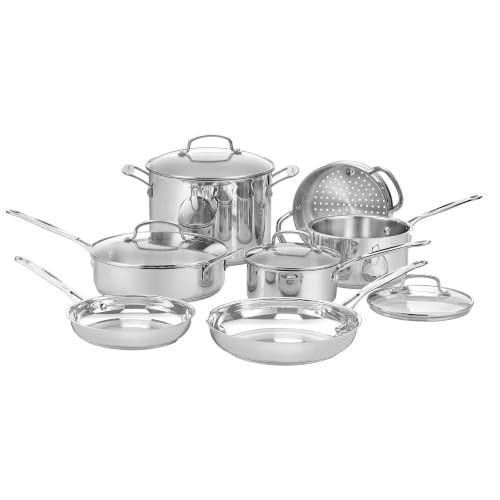
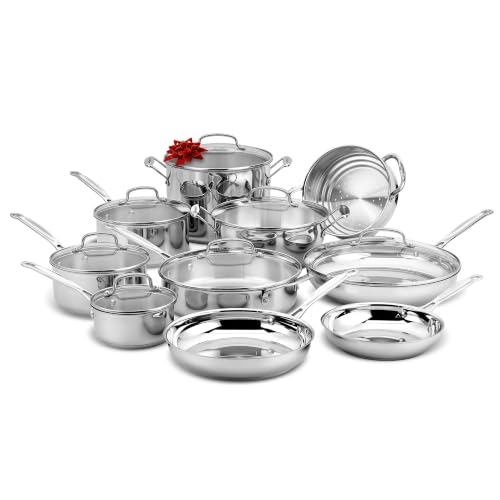
Cuisinart Chef’s Classic Stainless Steel Set, 17 pc (77-17N)
Badge: Best for Big Kitchens That Host
Strengths
- The largest Chef’s Classic assortment – few gaps for a busy kitchen
- Cool-grip handles across the set
- Induction compatible, oven safe and PFAS free
Trade-offs
- 17 pieces demand real storage space
- Overlaps its 11-piece sibling – some households will duplicate pieces they own
- Bonded-base style construction rather than full tri-ply cladding
Mini spec box: 17-piece set; Stainless steel construction; Induction compatible; Cool-grip handles; Oven safe; PFAS free.
The 17-piece Chef’s Classic takes the same formula as its 11-piece sibling – stainless construction, cool-grip handles, induction compatibility, oven safety, no PFAS coatings – and stretches the assortment to cover the edges: more saucepan capacity, more lids, more of the in-between sizes that a household cooking for guests or teenagers actually runs out of.
Whether that stretch is worth it depends entirely on your kitchen. If you regularly cook two sauces at once, host family dinners, or meal-prep in batches, the extra pieces stop being filler and start being the reason nothing waits for a washed pan. If your cooking is weeknight-simple, the same money buys the smaller set and leaves cupboard room to spare.
In daily cooking the depth of the assortment shows up on busy nights: a sauce reducing in one pan, vegetables in another, pasta in the big pot, and still a clean skillet for the protein. The honest limitation is the footprint – seventeen pieces with lids is a commitment of shelf and drawer space, and the set duplicates some sizes that smaller households will simply never run in parallel.
Inventory the assortment before you buy: at 17 pieces, this set’s value is in parallel capacity – multiple saucepans and lids that let a sauce, a side and a main move at once. If your cooking rarely runs two burners, the same budget buys its 11-piece sibling and leaves room in the cupboard. Storage deserves a plan as well: seventeen pieces with lids store best nested by size with lids filed vertically, and households that set that system up once find the big count stops feeling big within a week of daily use.
The counterexample, kept deliberately: seventeen fixed-handle pieces is what space saving is defined against. Buy it for capacity, with a storage plan, not for a small cupboard.
Best for: larger households and frequent entertainers who run several pans at once / Not suited for: small kitchens or cooks who rarely use more than three pieces simultaneously
Check on Amazon for the current listing, configuration and latest price.
Calphalon Classic Stainless Steel Cookware Set, 10-Piece
Badge: Best Conventional Value
Strengths
- Impact-bonded aluminum base spreads heat across the cooking floor
- Stay-cool handles for confident stovetop handling
- Oven safe to 450F per the listing title, covering most stove-to-oven recipes
Trade-offs
- Heat lives mainly in the base – sidewalls are plain stainless
- 10 pieces is a lean assortment for big households
- Bonded bases ask for sensible preheating rather than thermal shock
Mini spec box: 10-piece set; Impact-bonded aluminum base; Stay-cool handles; Oven safe to 450F (per API title); Stainless steel construction.
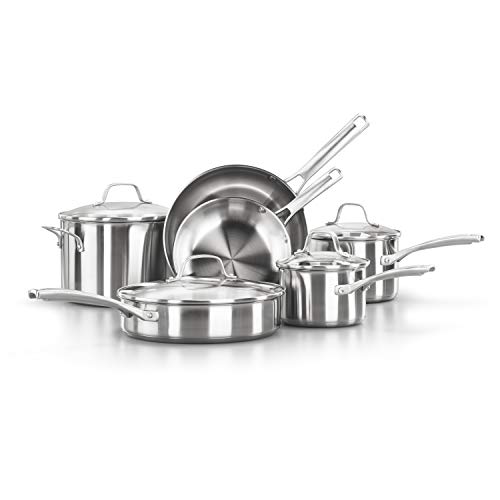
Calphalon’s Classic stainless set takes the other mainstream route to even heat: instead of cladding the whole pan, it impact-bonds an aluminum base onto stainless steel, putting the heat-spreading layer exactly where the burner delivers energy. For boiling, simmering and pan-frying – the work most home cooking consists of – that base does the heavy lifting well.
The stay-cool handles and the 450F oven rating from the listing title make the set an easy stove-to-oven citizen: start a frittata or a pan sauce on the burner and finish it under heat without changing vessels. The 10-piece count is deliberately lean, which suits cooks who would rather own fewer, better-chosen pieces.
Day to day this set behaves predictably: water comes to the boil evenly, sauces sit at a steady simmer without a scorched ring, and the pans move to the oven without drama. The honest limitation is sidewall cooking – a thick stew that needs gentle heat up the sides gets less help here than from a fully clad pan, and cooks who make a lot of those dishes should weigh the tri-ply options in this guide.
The bonded base deserves one clarification: impact bonding fuses the aluminum layer into the pan’s floor under pressure, which is why these bases sit flat and stay flat through years of thermal cycles when treated with ordinary care. The stated oven rating of 450F in the listing covers the great majority of stove-to-oven cooking – frittatas, finishes and braises included. Where the design asks something of you is preheating discipline: give the base a minute to come up to temperature evenly rather than blasting it, and it returns the favor with a scorch-free simmer.
Conventional space saving done well: ten nesting pieces, no filler, and a total footprint a single standard cupboard shelf can absorb.
Best for: everyday cooks who want even base heat, stay-cool handles and a lean piece count / Not suited for: cooks who rely on sidewall heat for slow braises and reductions
Check on Amazon for the current listing, configuration and latest price.

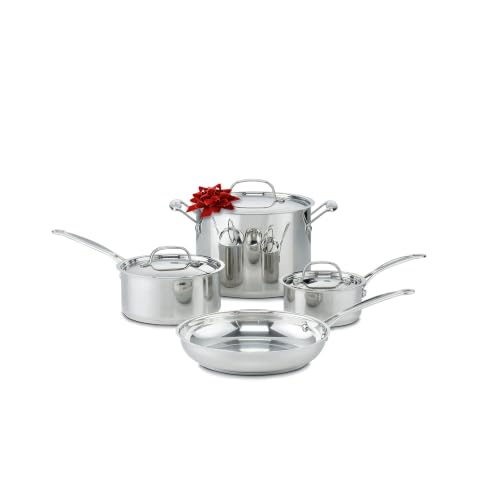
Cuisinart Chef’s Classic Stainless Steel Set, 7 pc (77-7P1)
Badge: Best True Compact Core
Strengths
- The compact Chef’s Classic – the essentials without filler
- Cool-grip handles and induction compatibility at the smallest footprint in this guide
- An easy first stainless set for one or two people
Trade-offs
- No spare capacity for entertaining or batch cooking
- Growing households will outgrow it and buy twice
- Same bonded-base style construction as its larger siblings
Mini spec box: 7-piece set; Stainless steel construction; Induction compatible; Cool-grip handles; Oven safe; PFAS free.
The 7-piece Chef’s Classic is the distillation of the line: the same stainless construction, cool-grip handles, induction compatibility and oven safety as the bigger sets, cut down to the pieces a single cook or a couple genuinely uses every week. Nothing in the box is decorative, which is exactly the point of a small set.
Small sets live or die on whether the included sizes match real meals, and this assortment is built around the core rotation – a skillet, saucepans and a stockpot-style piece – rather than specialty shapes. It is the set to buy when the alternative is a giant box whose bottom half never leaves the cupboard.
In daily cooking for one or two, the 7-piece set covers breakfast eggs, weeknight pasta, soups and reheating without a wasted motion, and cleanup is quick because everything is honest stainless. The honest limitation arrives the first time you cook for six: you will borrow pans or cook in sequence. Buy it as a deliberate starter or a compact-kitchen solution, not as a forever set for a growing family.
What the 7-piece set teaches better than any other pick here is assortment discipline: every included vessel maps to a weekly task, and there is no ‘aspirational’ piece waiting for a dinner party that never comes. For first kitchens it pairs naturally with a single later addition – most owners eventually add one larger stockpot or a second skillet as open stock, which is exactly how a small set should grow: by evidence, not by box size. The cool-grip handles and induction compatibility carry over from the larger Chef’s Classic sets, so nothing about the small version feels like a downgrade in the hand.
Seven pieces is the smallest storage ask in this guide – the whole set nests into the volume of its largest pot plus a lid solution.
Best for: singles, couples, dorms, RVs and compact kitchens wanting real stainless / Not suited for: families or entertainers who cook several dishes at once
Check on Amazon for the current listing, configuration and latest price.

CAROTE Tri-Ply Stainless Steel Cookware Set with Detachable Handle, 15 pcs
Badge: Best Space-Saving Design
Strengths
- Detachable handles let the pans nest and stack tightly
- Tri-ply construction at a value-oriented position in this guide
- Pans move from stovetop to table or oven without a handle in the way
Trade-offs
- You must attach and detach the handle as part of every use
- A shared-handle system is a habit some cooks never warm to
- Newer brand with a shorter track record than the legacy names here
Mini spec box: 15-piece set; Tri-ply stainless steel construction; Detachable handle system; Non-toxic cooking surface; Induction compatible.
CAROTE’s 15-piece set is built around one idea executed thoroughly: the handles detach. With the handle off, the tri-ply stainless pans nest inside each other, slide into shallow drawers and crowded cabinets, and go to the table or into the oven without a long handle dictating placement. For small kitchens it is the single most practical storage idea in this guide.
The construction underneath the trick is respectable – tri-ply stainless, induction compatible and a non-toxic bare-metal cooking surface with no coating to wear out. The detachable handle itself is the thing to think about: it clips on for cooking and off for storage, and cooks who like to shake a pan one-handed over high heat should be sure the system suits their style before committing.
In daily cooking the routine becomes: clip, cook, unclip, stack. Breakfast for one uses a single pan that then disappears into a drawer; a full dinner still works because the piece count is a real 15, not a token assortment. The honest limitation is that the handle ritual never fully disappears – on a rushed weeknight, reaching for the clip is one more step than grabbing a fixed handle, and some cooks will find that step charming and others will find it tiresome.
Living with the detachable system has a rhythm worth picturing: one handle lives in a drawer, clips onto whichever pan the meal needs, and comes off again for serving, oven finishing and storage. The pans themselves are tri-ply stainless, so the storage trick never asks you to accept thin metal as its price. Two habits make the system sing – dry the rim where the handle clips, so the connection stays positive, and plan two-pan dishes around handle swaps until the motion becomes automatic, which owners report happens within the first week or two of cooking.
The genuine article: handles off, the fifteen pieces nest like mixing bowls, fit shallow drawers, and stack in RV lockers that reject every fixed-handle rival here.
Best for: small kitchens, RVs and anyone whose storage problem is handles, not pans / Not suited for: cooks who toss pans one-handed or dislike clip-on hardware
Check on Amazon for the current listing, configuration and latest price.

Cuisinart PureClad Triple-Ply Stainless Steel Cookware Set, 12-Piece (PCT-12)
Badge: Best Clad Space Performer
Strengths
- Triple-ply construction through the pan body
- A focused 12-piece assortment with little filler
- Cuisinart’s clad know-how in a newer line
Trade-offs
- A newer line, so long-term owner history is still accumulating
- Premium-tier positioning among the sets here
- Heavier than bonded-base alternatives
Mini spec box: 12-piece set; Triple-ply (PureClad) stainless steel construction; Induction-ready stainless construction.
PureClad is Cuisinart’s newer triple-ply line, and the PCT-12 applies full clad construction to a disciplined 12-piece assortment. As with the MultiClad Pro, the point of triple-ply is heat that travels through the walls as well as the base, giving sauces and grains even treatment and giving the cook predictable response when the burner changes.
The set will appeal to cooks who like the clad concept but want a fresher design language than the long-running lines. The piece selection keeps the focus on core pots and pans, and the stainless surface is the usual honest bargain: durable and coating-free, asking for preheating technique in exchange for a pan that does not wear out.
In daily cooking the PureClad pieces behave like other good clad cookware: quick to respond, even at a simmer, and comfortable moving between stovetop and oven duties. The honest limitation is simply that it is a newer line – the design is sound and the construction is proven in principle, but it does not yet carry the decades of owner history behind the Chef’s Classic name, which matters to buyers who shop on track record.
PureClad’s triple-ply build places it in the same construction family as the MultiClad Pro, and the 12-piece assortment is chosen with similar discipline – core vessels, no obvious passengers. As the newer of Cuisinart’s clad lines, it offers a fresher design and the same fundamental physics: heat in the walls as well as the base, predictable response at the burner, and a bare stainless surface with no lifespan clock running. Cooks cross-shopping the two clad Cuisinart lines should decide on assortment fit and handle feel; the metallurgy argument between them is a draw.
Twelve clad pieces is a considered footprint – not minimal, but every vessel nests and the assortment carries no passengers.
Best for: cooks who want triple-ply performance in a focused, modern 12-piece set / Not suited for: buyers who only trust lines with very long owner track records
Check on Amazon for the current listing, configuration and latest price.

EWFEN 3 Ply Stainless Steel Cookware Set, 11-Piece
Badge: Best Value Tri-Ply
Strengths
- Full 3-ply construction at a value-oriented position
- Lids included across the 11 pieces
- Induction, oven and dishwasher friendly with no coating to protect
Trade-offs
- Less established brand than Cuisinart or Calphalon
- 11 pieces is a mid-size assortment – big families may want more
- Value tri-ply can run thinner than premium clad lines
Mini spec box: 11-piece set with lids; 3-ply stainless steel construction; Non-toxic cooking surface; Induction compatible; Oven and dishwasher safe.
EWFEN’s 11-piece set is the value route into genuine 3-ply stainless: the layered construction is the same concept the premium lines sell, the set ships with lids, and the pans are induction compatible, oven safe and dishwasher safe with a non-toxic bare stainless cooking surface.
Positioned honestly, this is the set for a buyer who has decided on tri-ply for its even heat and longevity but does not want to pay legacy-brand prices for it. The pieces cover the standard rotation – skillets, saucepans and larger pots – in the sizes a small-to-mid household uses weekly.
In daily cooking the EWFEN set asks for the standard stainless routine – preheat, oil, cook, and either hand-wash or let the dishwasher handle it – and returns even, predictable heat for weeknight work. The honest limitation is brand depth: a newer name means a thinner network of replacement lids, add-on pieces and long-term owner reports than the big brands offer, so you are trading ecosystem for value.
EWFEN’s value proposition is easiest to see in what it does not ask you to give up: the set is 3-ply, lidded, induction compatible, and rated for oven and dishwasher, with a non-toxic bare stainless surface. The savings versus legacy brands come from brand infrastructure, not from the pans’ concept. For a first tri-ply purchase or a second-home kitchen, that trade is often exactly right. The sensible ownership move is to confirm lid fit and replacement availability on the listing at purchase time, while the model is current and fully supported.
Eleven pieces with lids included: a mid-size footprint whose space story is discipline – standard nesting, no wasted shapes, nothing exotic to store.
Best for: value-focused buyers who want real 3-ply construction without legacy-brand pricing / Not suited for: cooks who want a deep accessory ecosystem and decades of brand history
Check on Amazon for the current listing, configuration and latest price.
Comparison Table
| Pick | Badge | Headline spec (from listing) | Standout trait |
|---|---|---|---|
| Cuisinart Chef’s Classic Stainless Steel Set, 17 pc (77-17N) | Best for Big Kitchens That Host | 17-piece set | 17-piece Chef’s Classic – capacity first, space second |
| Calphalon Classic Stainless Steel Cookware Set, 10-Piece | Best Conventional Value | 10-piece set | 10-piece Calphalon, lean and nestable |
| Cuisinart Chef’s Classic Stainless Steel Set, 7 pc (77-7P1) | Best True Compact Core | 7-piece set | 7-piece Chef’s Classic essentials |
| CAROTE Tri-Ply Stainless Steel Cookware Set with Detachable Handle, 15 pcs | Best Space-Saving Design | 15-piece set | Detachable handles: nests flatter than any rival |
| Cuisinart PureClad Triple-Ply Stainless Steel Cookware Set, 12-Piece (PCT-12) | Best Clad Space Performer | 12-piece set | 12-piece PureClad triple-ply, focused assortment |
| EWFEN 3 Ply Stainless Steel Cookware Set, 11-Piece | Best Value Tri-Ply | 11-piece set with lids | 11-piece EWFEN 3-ply with lids |
Compare footprints, not counts: the detachable-handle set’s fifteen pieces occupy less depth than most fixed-handle tens. The table’s headline specs help you see which sets were designed for storage and which merely happen to be small.
How to Choose Best space saving cookware sets
Audit your storage volume in liters, not vibes. Measure the shelf or drawer, then picture the set nested: the stack’s footprint is the largest pot’s diameter, its height the nested stack plus lids. Fixed handles add their full length to one dimension – which is why drawers reject sets that cupboards accept, and why the detachable system changes what is possible in shallow storage.
Decide your lid strategy before purchase. Options that work: a vertical file rack inside the cupboard, a door-mounted rack, or a dedicated shallow drawer. Options that fail: lids loose in the nest (they break the stack and the closure) and lids ‘stored’ on the cooktop. Every set here ships lids worth keeping; the space plan must include them or the set does not fit, whatever the pans do.
Then apply the editing rule: in a space-constrained kitchen, a vessel must be used monthly to justify its volume. The lean sets in this guide embody that rule; the deep ones defy it knowingly. If you entertain monthly, the defiance may be worth it – but call it capacity buying, not space saving, and give it the cupboard it needs. General construction quality benchmarks for step-up purchases are compared in Best Quality Cookware Sets Copper Inline Stainless Steel.
How to Store a Cookware Set in Minimum Space
Storage is a system, not a hope. These steps convert any set in this guide into its smallest honest footprint, and keep it that way while protecting the pans themselves.
- Nest by size, protect every base. Stack vessels largest to smallest with a cloth or felt disc between each pair. The stack’s footprint becomes one pot’s diameter; the protectors stop the density from scratching surfaces.
- Remove or rethink handles where possible. With a detachable-handle set, store handles in a drawer corner – the pans then stack like bowls. With fixed handles, alternate handle directions in the nest to halve the length penalty.
- File lids vertically. A simple rack or tension organizer turns lids from sprawl into a filing system. Vertical lids are findable lids, and findable lids get used instead of improvised around.
- Claim the dead spaces. The oven (if you rarely bake), the gap above cabinets for rarely used big pieces, and the toe-kick drawer are legitimate territory. Assign the monthly pieces there, not the daily ones.
- Defend the system monthly. Space creep is entropy: a stray pan here, a gift gadget there. A five-minute monthly audit keeps the set’s footprint the size you bought, not the size it drifts to.
Troubleshooting
Problem: the nested stack scratches cooking surfaces → metal on metal under pressure. Felt or cloth protectors between every pair end it – and they cost less than one pan.
Problem: the cupboard door will not close on the set → usually handle length, not pan volume. Re-nest with alternating handle directions, move lids to the door itself, or accept the drawer needs the detachable-handle solution.
Problem: the big stockpot fits nowhere → assign it the oven or the top-of-cabinet shelf if it is a monthly piece. A daily piece that fits nowhere means the set is wrong for the kitchen, not the kitchen for the set.
Detachable Handles: Gimmick or Genuine Solution?
The skepticism is healthy – cookware history is littered with clever mechanisms that failed in year two. The detachable handle earns a different verdict because the problem it solves is geometric and permanent: a fixed handle roughly doubles a pan’s storage length and prevents true nesting, forever, in every kitchen. Removing it converts pans into stackable vessels, full stop. The CAROTE set in this guide builds that system on tri-ply stainless, so the storage win does not cost cooking quality.
The honest costs are behavioral. You clip and unclip as part of cooking; one handle serves several pans, so two-pan tossing needs planning; and the mechanism is a moving part in a category that usually has none. For RVs, boats, dorms and shallow-drawer kitchens, the trade is decisively worth it. For a large kitchen with deep cupboards, it solves a problem you do not have – buy the lean conventional sets instead.
The Space You Save Is the Cooking You Gain
There is a second dividend to a compact set that listings never mention: counter and sink space during cooking. A kitchen whose pans live in one tight nest has clear counters for prep and a sink that is not a storage annex. Small-kitchen cooking stress is mostly logistics stress, and a set that stores small reduces it at every meal, not just on cupboard-cleaning day.
This is also why the editing rule beats the organizing rule. Organizers rearrange volume; editing removes it. The sets in this guide that save the most space do it by containing fewer, better-chosen vessels or by removing the handle problem entirely – both are forms of subtraction, and subtraction is the only strategy a small kitchen cannot outgrow.
Drawers, Lockers and One Cupboard: Fitting the Set to the Space You Have
Start from the container, not the catalog. A standard kitchen drawer is shallow: fixed-handle pans lie flat only one layer deep, which is why drawer kitchens are the detachable-handle set’s natural home – the CAROTE pans stack in a drawer like dinner plates’ deeper cousins, with the single handle filed alongside. Cupboard kitchens have the opposite geometry: depth is plentiful, height is the tax, and vertical lid filing plus a two-stack nest is the winning arrangement there.
RV and boat lockers add motion to the problem. A nested stack with no protruding handles is not merely compact in a moving kitchen, it is silent and secure, and the same logic serves small apartments near rail lines and anyone who has heard a badly stored pan at 3 a.m. The reviews in this guide flag which picks behave in which container; match the pick to your geometry and the space problem is solved structurally rather than by daily tidying. Best Reviewed Cookware Sets offers a critic-led cross-check for readers still torn between the engineered and the edited approaches.
Whatever the container, leave ten percent of it empty. A storage system filled to one hundred percent is a system that fails the first time a meal runs long and a hot pan needs a home mid-service. The sets that live smallest are the ones whose owners defend that margin – space saving is a discipline with a buffer, not a Tetris score.
Vertical Space: The Dimension Small Kitchens Forget
Most storage planning is horizontal – shelves and drawers – but small kitchens own a second axis. Wall rails take utensils and even a daily skillet out of the cupboard entirely; the inside of cupboard doors takes lids and flat tools; the gap between countertop and wall cabinets takes a knife strip and the board. Every item that moves vertical returns horizontal volume to the set, which is why the most space-efficient kitchens look less like they own less and more like they store in three dimensions.
Apply the axis to the set itself: the daily skillet can live on a rail or hook rather than in the nest, which shrinks the stored set by its most-used piece and puts that piece a hand’s reach from the stove. The detachable-handle pans go further – hung by their rims or stacked in the shallow drawer no fixed-handle pan could use. Space saving, pursued properly, is a whole-kitchen geometry, and the set is simply its largest single variable.
Boats and RVs deserve a specific mention: in a moving kitchen, a nested, handle-free stack is not just smaller, it is quieter and safer – nothing rattles at full length, nothing slides by its handle. The detachable-handle logic was practically invented for lockers that move, and land-based small kitchens inherit the benefit.
When measuring, include the box’s largest lid knob height in your stack estimate; knobs are the silent centimeter that stops drawers closing. Storing the largest lid upside down on its pot often reclaims exactly that centimeter.
A final discipline: photograph your stored set once it fits. Six months later, when the cupboard has drifted, the photograph is the standard you restore in five minutes – systems survive when the target state is visible.
Before you order, run one final simulation with a tape measure and your current pans: mark the nested footprint of your existing stack, then mark the footprint each candidate set would occupy using its largest pot’s diameter as the circle and its piece count as the height. The comparison, drawn on the actual shelf, settles arguments that weeks of listing-reading cannot – including the argument between the engineered answer and the edited one. Kitchens differ in the dimension that binds them, and the tape measure knows yours. What this guide can promise is that every set here was judged by that same standard: not how small it claims to be, but how small it will actually live in the space you measured.
The last space trick is subtraction at the source: every vessel in a space-saving kitchen should be able to name its monthly job. Run the audit on your current collection tonight and you will likely find the same cast most kitchens hide – the pan kept for a recipe cooked once, the pot that duplicates another at ninety percent, the lidless orphan that fits nothing. Releasing those three returns more volume than any organizer ever sold, and it clarifies what a replacement set must actually contain. The sets on this page were chosen to pass that audit as shipped: even the deep assortments can name a job for nearly every vessel, and the lean ones pass it trivially. Buy the set that passes your audit, store it by the system in this guide, and the smallest room in the house stops being the most frustrating one.
There is also a safety dividend to compact storage that deserves naming: a set that nests completely is a set that never lives on the cooktop for lack of anywhere else to go. Pans stored on burners get knocked, get heated empty by a wrong knob, and crowd the surface where hot work happens. Clearing the cooktop by giving the set a real home is the kind of improvement you feel once and then never notice again – which is the signature of every good storage system, and the true product this page is selling underneath the cookware.
Do the depth measurement with the drawer or cupboard physically open and a ruler in hand, not from memory in another room – kitchens are consistently shallower in reality than in their owners’ imaginations, and handles are consistently longer. Thirty seconds of measuring has saved more returns in this category than any review ever written, including this one. And when the measurement says a beloved set does not fit, believe it: geometry does not negotiate, and the set that fits the measured space will make you happier than the set that won the argument and lost the drawer.
If your space includes one awkward corner cupboard, give it the monthly pieces on a small turntable and reclaim the prime shelf for the daily nest. Corners stop being dead space the moment their contents rotate toward you, and the daily set stops competing with the holiday stockpot for the same square foot of kitchen.
One more container worth planning for is the holiday overflow: the single week a year when every vessel is out at once. A space-saving system survives it because the nest empties completely and refills in order – chaos in a well-designed system is temporary by construction, and by the first ordinary Tuesday the cupboard looks exactly as it did before the feast.
Measure the space carefully, file the lids vertically, nest the pans snugly, defend the margin always – four small disciplines that together are worth more than any single product feature in this category, including the clever detachable handle that headlines it.
Common Buying Mistakes
- Buying a deep assortment for a shallow drawer because the per-piece math looked good.
- Ignoring handles in the storage calculation – they are the dimension that fails.
- Storing lids loose and blaming the set for the cupboard chaos that follows.
- Nesting pans bare and scratching the surfaces the set’s value depends on.
- Keeping monthly-use vessels in daily space while daily vessels fight for the counter.
- Assuming ‘space saving’ on a listing means engineered for storage – most sets merely mean ‘small’.
Final Recommendation
If space is truly the constraint, the decision is short: the CAROTE detachable-handle set is the only structural solution here, and it wins. If you prefer conventional fixed handles, the 7-piece Chef’s Classic asks the least of your cupboard, the Calphalon and EWFEN 11-piece sets are the disciplined middle, and the PureClad 12-piece is the clad option that still respects a shelf. The 17-piece Chef’s Classic is a fine set bought for the opposite reason – capacity – so buy it with a storage plan or not at all.
Start your shortlist with Cuisinart Chef’s Classic Stainless Steel Set, 17 pc (77-17N), Calphalon Classic Stainless Steel Cookware Set, 10-Piece and Cuisinart Chef’s Classic Stainless Steel Set, 7 pc (77-7P1) — compare their current listings, configurations and latest prices, then commit to the one that matches your kitchen.
Frequently Asked Questions
What makes a cookware set space saving?
Three things: handles that do not dictate storage length (detachable is best), an assortment lean enough to nest completely, and a lid plan. Most sets marketed as space saving only deliver the second.
Do detachable handles feel secure when cooking?
On the CAROTE system the handle clips onto the pan rim for cooking and releases for storage. It is a different handling habit – plan two-pan moves around the shared handle – and it is the price of the storage gain.
How much space does nesting actually save?
A nested set’s footprint approaches its largest pot’s diameter, with height set by the stack. Versus side-by-side storage, that is commonly the difference between one shelf and an entire cupboard – handles and lids decide the rest.
Can I store a set in a drawer?
Yes, if depth allows the nested stack plus lids – and this is where detachable handles shine, because fixed handles usually make drawers impossible. Measure drawer depth against the stack before ordering.
Are space-saving sets durable enough for daily use?
The picks here are stainless, including tri-ply options, with no coatings to fail. Space saving in this guide is achieved by geometry and editing, not by thinning the metal.
What if I need one big pot as well?
Add it as open stock and store it in the oven or on a high shelf. One planned large piece does not break a space system; an oversized set does.