Disclosure: topratedkitchenware.com is reader-supported. When you buy through links on our site, we may earn an affiliate commission from Amazon and other retailers, at no extra cost to you.
Where to buy
All six picks in this guide to best space saving drip coffee makers are listed on Amazon, where you can check the latest price on Amazon, confirm the exact variant, and read the current listing details before ordering. Listings and bundles change, so match the full model name on the listing to the pick reviewed below. Orders are placed on Amazon under its normal delivery and returns terms.
- Best Reservoir Drip-Style Pick: Keurig K-Express Single Serve Coffee Maker, Black — Check on Amazon
- Keurig K-Express Single Serve Coffee Maker, Warm Stone — Check on Amazon
- Elite Gourmet Single-Serve Coffee Maker (EHC111A) — Check on Amazon
- Keurig K-Mini Mate Single Serve Coffee Maker, Black — Check on Amazon
- Tastyle Mini Single Serve Coffee Maker (K310IC) — Check on Amazon
- Keurig K-Express Single Serve Coffee Maker, Evergreen — Check on Amazon
Read the full guide ↓
Shoppers hunting the best space saving drip coffee makers usually mean one thing: the familiar, gentle extraction of drip brewing — hot water passing through coffee into the cup below — without surrendering the counter to a full-size carafe machine. This guide answers with the compact end of the drip family: single-cup drip-style brewers, grounds-capable minis and slim pod machines that drip-brew one mug at a time in a fraction of a carafe machine’s footprint.
An honesty note belongs at the top. None of these six is a batch carafe brewer, and that is deliberate: a twelve-cup drip machine cannot be space saving by any honest measure. What these picks save is exactly the space the carafe, the warming plate and the batch basket demand, while keeping drip’s essential character — a clean, filtered, mellow cup, brewed fresh each time rather than stewed in a pot.
Within that compact drip territory there is real variety: reservoir pod machines for speed, a grounds mini with a reusable filter for the purest drip routine, and a dual-format mini that drips from pods or grounds. The reviews judge each on footprint, drip-cup quality and the daily ritual it asks for.
The wider space-saving field is covered in Best Space Saving Coffee Makers, this guide’s parent roundup.
Key Takeaways
- Compact drip means single-cup drip-style brewing; the space saved is the carafe, the plate and the batch basket.
- Grounds-capable minis like the Elite Gourmet and the Tastyle give the truest drip routine in the smallest bodies.
- Pod machines drip-brew with the least effort and the most consistency, at pod cost per cup.
- Reservoir compacts like the K-Express save morning effort; fill-per-brew minis save the most inches.
- Judge fit by open-lid height and mug clearance, the two measurements that decide real kitchens.
In this guide
Quick Picks
Six picks, six different reasons to buy. Scan the badges for the short answer, then read the detailed reviews for the honest trade-offs — every pick here has at least one.
| Pick | Badge | Standout points | Check it |
|---|---|---|---|
| Keurig K-Express Single Serve Coffee Maker, Black | Best Reservoir Drip-Style Pick | Brew sizes: 3 sizes listed; Reservoir: 42 oz removable reservoir | Check on Amazon |
| Keurig K-Express Single Serve Coffee Maker, Warm Stone | Best in Warm Stone | Brew sizes: 3 sizes listed; Reservoir: 42 oz removable reservoir | Check on Amazon |
| Elite Gourmet Single-Serve Coffee Maker (EHC111A) | Best Pod-Free Drip Cup | Capacity: 14 oz single serve; Power: 600W | Check on Amazon |
| Keurig K-Mini Mate Single Serve Coffee Maker, Black | Best True Mini | Brew size: up to 12 oz per brew; Format: K-Cup pod single serve | Check on Amazon |
| Tastyle Mini Single Serve Coffee Maker (K310IC) | Best Grounds-and-Pod Mini | Brew sizes: 6 to 14 oz; Formats: K-Cup pods and ground coffee | Check on Amazon |
| Keurig K-Express Single Serve Coffee Maker, Evergreen | Best in Evergreen | Brew sizes: 3 sizes listed; Reservoir: 42 oz removable reservoir | Check on Amazon |
How These Picks Were Chosen
This guide was built by taking the verified pool and filtering it through the keyword’s two tests: drip-style brewing and a genuinely space-saving format. Every pick brews by passing hot water through coffee into a single cup — the drip principle — in a body far smaller than a carafe machine, and every size, capacity and format quoted comes from the product’s verified listing.
The selection is research-led, based on verified listing data and the documented behaviour of each brewing format, and it is transparent about its boundary: readers who need a multi-cup carafe should not buy anything here, and the reviews say so. Within the compact drip brief, picks were ranked by footprint, then by how completely they cover the daily drip routine.
Drip drinkers comparing methods should also read Best Simple Drip Coffee Makers for the uncomplicated end of drip brewing.
The Picks: best space saving drip coffee makers in detail

Keurig K-Express Single Serve Coffee Maker, Black
Badge: Best Reservoir Drip-Style Pick
Strengths
- The 42 oz removable reservoir covers several cups between refills, unlike fill-every-time mini brewers
- The Strong Brew button gives a real strength lever for drinkers who find standard pods weak
- Three brew sizes plus travel-mug clearance cover a desk mug and a commute cup with one machine
Trade-offs
- A reservoir machine is wider and deeper than the smallest one-cup brewers
- Pod brewing locks you into pod buying and pod waste unless you add a reusable filter
- No grounds basket is listed, so loose coffee is not the native format here
Key specs (from the verified listing)
- Brew sizes: 3 sizes listed
- Reservoir: 42 oz removable reservoir
- Feature: Strong Brew button
- Cups: travel mug friendly
- Pods: works with all K-Cup pods
- Finish: black
The K-Express in black is the balanced version of the Keurig single-serve idea: big enough reservoir to feel convenient, small enough body to stay a counter appliance rather than a counter occupation. The 42 oz removable tank is the practical centre of the design — it lifts out for filling at the sink, and its capacity means a two-coffee morning for two people does not start with a refill. The Strong Brew button is the other meaningful feature, slowing the brew to extract more from the same pod, which matters because the most common complaint about pod coffee is thinness. Three brew sizes handle the range from a small strong cup to a travel mug, and the removable drip tray creates the clearance tall mugs need. As a black appliance it disappears into most kitchens and offices, which is precisely why this finish is the default recommendation for shared spaces where a colour would be one person’s taste imposed on everyone.
The black K-Express leads this drip list because most drip drinkers converting from a carafe machine want the ritual gone but the morning speed kept: its reservoir delivers one-touch drip-style cups back to back, which is the closest a compact machine comes to the old pot’s convenience.
Best for: everyday pod drinkers who want fewer refills and a strength option in a mainstream finish / Not suited for: minimalists chasing the absolute smallest footprint, or grounds-only brewers
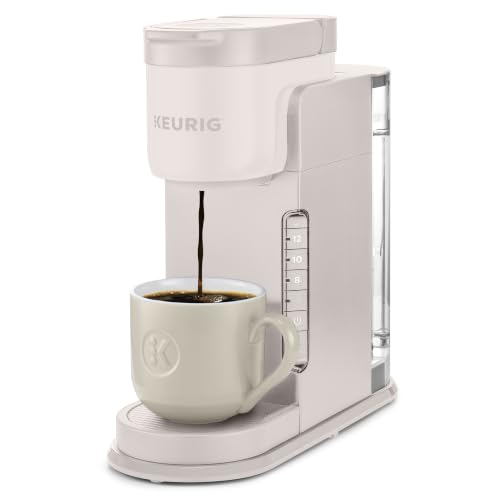
Keurig K-Express Single Serve Coffee Maker, Warm Stone
Badge: Best in Warm Stone
Strengths
- Identical K-Express convenience — 42 oz reservoir and Strong Brew — in a softer, kitchen-friendly finish
- The light Warm Stone tone shows splashes and dust less starkly than gloss black
- Three brew sizes and travel-mug clearance cover the full daily range
Trade-offs
- Functionally identical to the other K-Express finishes, so the choice is purely cosmetic
- A light finish shows coffee drips more visibly until wiped
- Still a reservoir machine, so it is compact rather than truly mini
Key specs (from the verified listing)
- Brew sizes: 3 sizes listed
- Reservoir: 42 oz removable reservoir
- Feature: Strong Brew button
- Cups: travel mug friendly
- Pods: works with all K-Cup pods
- Finish: Warm Stone
Everything said about the K-Express platform applies here — the 42 oz removable reservoir, the three brew sizes, the Strong Brew button, the travel-mug-friendly tray — and the Warm Stone finish is the entire difference. That is not a criticism: finish is a legitimate buying factor for an appliance that sits on display every day, and a warm off-white body suits the pale woods, white tiles and stone counters of many current kitchens better than black plastic does. It also changes the cleaning psychology slightly, because coffee splashes show sooner on a light surface, which tends to mean the machine actually gets wiped more often and stays fresher. Performance, pod compatibility and footprint are the platform’s, so the honest way to choose between the K-Express finishes in this guide is simple: pick the colour you want to look at, because the coffee will be the same. Buyers splitting the difference between two finishes should remember the reservoir size and Strong Brew matter daily; the colour matters when you notice it.
The Warm Stone K-Express makes the same drip case in the finish that suits bright, compact kitchens. Its reservoir platform is the pragmatic choice when the machine will be seen all day in a small, pale room.
Best for: buyers who want K-Express convenience in a light, warm finish that suits pale kitchens / Not suited for: buyers who need the smallest possible machine, or who prefer dark appliances

Elite Gourmet Single-Serve Coffee Maker (EHC111A)
Badge: Best Pod-Free Drip Cup
Strengths
- The reusable filter brews your own grounds or loose-leaf tea, so there are no pods to buy at all
- One-touch operation and auto shut-off make it genuinely set-and-forget for a single mug
- A 14 oz brew fills a travel mug in one cycle, and the compact body travels well
Trade-offs
- One mug at a time, with a refill of water for every brew
- 600W is gentle power, so it is not the fastest brewer in this guide
- Grounds brewing means a filter to empty and rinse after every cup
Key specs (from the verified listing)
- Capacity: 14 oz single serve
- Power: 600W
- Operation: one-touch brewing
- Filter: reusable filter for grounds and loose-leaf tea
- Safety: auto shut-off listed
- Care: dishwasher-safe parts listed
- Model: EHC111A
The Elite Gourmet EHC111A is the traditionalist in this line-up: a small one-touch brewer that works with loose grounds in a reusable filter instead of pods. That single choice changes the economics and the waste profile of every cup — any bag of ground coffee works, loose-leaf tea works, and nothing single-use goes in the bin. The 14 oz capacity is aimed squarely at the travel-mug routine: brew straight into the mug, let the auto shut-off handle the machine, and leave. At 600W it heats modestly rather than rapidly, which is the honest trade for its size and simplicity, and the brew is a straightforward drip-style cup rather than a pressurised pod extraction. Dishwasher-safe parts keep the weekly clean easy, though the filter itself wants a rinse after each use so old grounds never flavour the next cup. For a dorm desk, a bedside table, an RV shelf or a one-person office, this is the format that asks the least: little space, little money per cup, little to learn.
The Elite Gourmet is the drip purist’s space saver: loose grounds, a reusable filter, water dripping through into a single mug — the classic drip method at its smallest honest scale, with no pods anywhere in the system.
Best for: solo drinkers who want grounds-based coffee with no pod cost and the smallest simple footprint / Not suited for: multi-cup households, or pod drinkers who want zero cleanup per cup
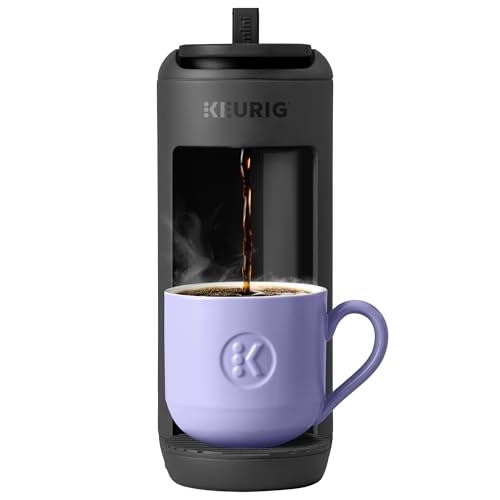
Keurig K-Mini Mate Single Serve Coffee Maker, Black
Badge: Best True Mini
Strengths
- One of the smallest footprints of any pod brewer — it fits where reservoir machines cannot
- Fill-per-brew water handling means no stale reservoir water and nothing to descale as often
- True one-button simplicity suits dorms, offices and guest corners
Trade-offs
- Every single brew starts with adding water — there is no reservoir to draw from
- Pods only in its native format, so grounds need a separate reusable solution
- A 12 oz ceiling rules out the largest travel mugs in one brew
Key specs (from the verified listing)
- Brew size: up to 12 oz per brew
- Format: K-Cup pod single serve
- Design: compact portable design listed
- Context: small spaces, dorms and offices listed
- Finish: black
The K-Mini Mate is Keurig reduced to its essence: a pod, a cup of water, a button. There is no reservoir at all — you pour in exactly the water for one brew, up to 12 oz — and that omission is what makes the machine so small and so portable. It also quietly solves a hygiene point reservoir owners know well: water never sits in the machine between uses, so every brew starts fresh and the whole unit wipes down in seconds. The costs of the format are equally clear. Back-to-back cups for guests turn into a fill-brew-fill rhythm, and there is no Strong Brew programme or size menu beyond the water you add — strength control is simply using less water for the same pod. For a dorm room, a studio shelf, a workshop bench or a seldom-used guest room, those costs barely register, while the tiny footprint registers every day. This is the machine for people whose coffee habit is one good cup at a time.
The K-Mini Mate is the smallest drip-style pod option here, and its space claim is total: no reservoir, no carafe, no plate. For the tightest counters in this guide’s audience, it is the reference point.
Best for: the tightest counters, dorm desks and occasional pod drinkers who value size over speed / Not suited for: households brewing several cups in a row every morning
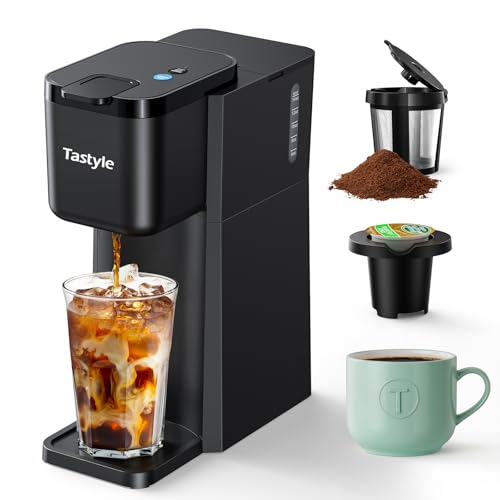
Tastyle Mini Single Serve Coffee Maker (K310IC)
Badge: Best Grounds-and-Pod Mini
Strengths
- Brews both pods and grounds, so one mini machine covers two buying habits
- A dedicated iced-coffee function answers the summer use case most minis ignore
- The 6 to 14 oz range spans a small strong cup to a full travel mug
Trade-offs
- Mini format means adding water far more often than reservoir machines
- A recipe book is a nice extra, but the machine’s drinks still depend on the coffee you put in
- Less established brand support than the biggest pod names
Key specs (from the verified listing)
- Brew sizes: 6 to 14 oz
- Formats: K-Cup pods and ground coffee
- Drinks: hot and iced coffee
- Extras: recipe book included
- Power: 120V
- Model: K310IC, version 2.0
- Finish: Classic Black
The Tastyle K310IC packs more formats into a mini body than most machines twice its size attempt: K-Cup pods when convenience rules, ground coffee when choice or cost rules, and an iced-coffee mode for the months when hot coffee loses its appeal. The 6 to 14 oz brew range is well judged — the low end makes a concentrated small cup that stands up to milk or ice, and the top end fills a travel mug without a second cycle. The included recipe book signals the intended audience: someone setting up a first small coffee corner in a dorm, an RV, a small office or a studio kitchen, who wants ideas for using the machine beyond the basic cup. As with every mini, the compromise is water handling — there is no large reservoir to forget about, so filling becomes part of the ritual. Buyers who drink one or two cups a day rarely mind; buyers running a family breakfast queue should look at the reservoir machines in this guide instead.
The Tastyle earns its place by dripping from either format — grounds for the classic routine, pods for the rushed one — plus an iced mode, all in a mini body that a carafe machine’s owner will find startlingly small.
Best for: space-tight drinkers who want pods, grounds and iced coffee from one mini machine / Not suited for: households brewing many cups back to back, or brand-loyal pod buyers

Keurig K-Express Single Serve Coffee Maker, Evergreen
Badge: Best in Evergreen
Strengths
- Full K-Express convenience — reservoir, three sizes, Strong Brew — in a distinctive green finish
- The 42 oz tank removes the fill-every-cup chore of mini brewers
- A coloured appliance anchors a coffee corner and hides plain-counter monotony
Trade-offs
- Evergreen is a taste commitment; it will not blend into every kitchen
- Same mid-size footprint as the other reservoir models in this guide
- Pod format only in native use, with pod waste to manage
Key specs (from the verified listing)
- Brew sizes: 3 sizes listed
- Reservoir: 42 oz removable reservoir
- Feature: Strong Brew button
- Cups: travel mug friendly
- Pods: works with all K-Cup pods
- Finish: Evergreen
The Evergreen K-Express is mechanically the same machine as its black and Warm Stone siblings — 42 oz removable reservoir, three brew sizes, Strong Brew button, travel-mug clearance — wearing the most characterful finish of the three. Evergreen suits kitchens leaning into the current deep-green cabinet and plant-filled look, and it turns a commodity appliance into a deliberate part of the room. Buyers should choose it with eyes open: a strong colour is delightful when it matches the room and vaguely annoying when a future move changes the room, while the coffee never changes at all. On the daily merits, the platform’s strengths are convenience and consistency — the reservoir ends per-cup filling, the Strong Brew answers thin-pod complaints, and the size range covers desk mug to travel mug. If your shortlist is entirely K-Express models, the decision really is this simple: the finish is the feature, so buy the one that makes your counter look intentional rather than accidental.
The Evergreen K-Express closes the list as the reservoir option with the most character, for drip converts who want the compact platform and a kitchen that does not look like everyone else’s.
Best for: K-Express buyers who want the convenience platform in a bold, nature-toned finish / Not suited for: renters or minimalists who prefer appliances that disappear visually
Comparison Table
The table below puts the six best space saving drip coffee makers picks side by side on the attributes that decide daily satisfaction. It deliberately carries no prices and no ratings — both change too often to print honestly; use the links to check the current listing.
| Pick | Badge | Format | Key detail | Check it |
|---|---|---|---|---|
| Keurig K-Express Single Serve Coffee Maker, Black | Best Reservoir Drip-Style Pick | Brew sizes: 3 sizes listed | Reservoir: 42 oz removable reservoir | Check on Amazon |
| Keurig K-Express Single Serve Coffee Maker, Warm Stone | Best in Warm Stone | Brew sizes: 3 sizes listed | Reservoir: 42 oz removable reservoir | Check on Amazon |
| Elite Gourmet Single-Serve Coffee Maker (EHC111A) | Best Pod-Free Drip Cup | Capacity: 14 oz single serve | Power: 600W | Check on Amazon |
| Keurig K-Mini Mate Single Serve Coffee Maker, Black | Best True Mini | Brew size: up to 12 oz per brew | Format: K-Cup pod single serve | Check on Amazon |
| Tastyle Mini Single Serve Coffee Maker (K310IC) | Best Grounds-and-Pod Mini | Brew sizes: 6 to 14 oz | Formats: K-Cup pods and ground coffee | Check on Amazon |
| Keurig K-Express Single Serve Coffee Maker, Evergreen | Best in Evergreen | Brew sizes: 3 sizes listed | Reservoir: 42 oz removable reservoir | Check on Amazon |
How to Choose the Right Option for Best space saving drip coffee makers
Start with the water question, because it quietly decides more than any feature list. Machines split into reservoir designs, which hold several cups of water ready to brew, and fill-per-brew designs, which take exactly one cup of water at a time. Reservoir machines win on speed and rhythm — the morning becomes pod in, button pressed, coffee out — while fill-per-brew machines win on freshness and size, since water never sits inside the machine and there is no tank dictating the footprint. Neither is better in the abstract; the right answer is the one that matches how many cups you brew in a row and how much counter you can honestly give up.
Next, settle the format question: pods, grounds, or both. Pods buy consistency and zero cleanup at the price of ongoing pod cost and single-use waste. Grounds buy choice — any coffee, any roast, ground your way — at the price of a filter to empty and rinse. Dual-format machines end the argument in mixed households but add size and parts. Be honest about which cost you will still be happy paying in six months, because the machine will ask for it every single day, and a format you resent is a machine you stop using.
Then size the machine to the mug, not the marketing. Check the largest cup or travel mug you actually use, and confirm the machine brews that volume in one cycle and physically fits the mug under the spout with the drip tray in place or removed. A brewer that needs two cycles to fill your commute mug will annoy you twice a day. Capacity math works the same way for reservoirs: divide the tank size by your usual brew size to get real cups between refills, and decide whether that number fits your household’s morning.
Finally, weigh the ownership costs nobody lists on the box. Pod machines need descaling and a pod supply chain in your cupboard. Grounds machines need filters emptied and baskets washed. Grinders need periodic cleaning or their flavour slowly muddies. Cold brew jars need fridge space and planning. The best machine in this guide is not the one with the longest feature list; it is the one whose daily and weekly chores fit the time and space you actually have, because coffee equipment succeeds or fails on routine, not on specifications.
Our survey of Best Small Space Coffee Makers adds fridge and drawer strategies to the counter machines here.
How to Set Up and Brew Your First Week of Coffee
A good first week with a new coffee maker is mostly about removing variables, so the routine becomes automatic before you start experimenting. Work through the setup once, carefully, and the machine will reward you every morning after.
- Run a plain water cycle first: fill the machine with fresh water and brew a full cycle with no coffee, discarding the result, to rinse the internal paths before your first real cup.
- For pod machines, seat the pod firmly and close the lid fully before brewing; for grounds machines, use a level, even bed of grounds in the filter so water passes through uniformly instead of channelling.
- Match the water to the cup: brew the size you will actually drink, because a small brew diluted in a large mug tastes weaker than a correctly sized brew every time.
- If your machine offers a strong or bold setting, try the same coffee with and without it on consecutive days — that single comparison teaches you more than any description of the feature.
- For cold brew jars, fill the filter with coarse grounds, add cold water slowly, seal the jar, and steep in the fridge; remove the filter before serving so the brew stops extracting and stays smooth.
- Empty grounds and pods the same day you brew, rinse the parts that touched coffee, and leave lids open to dry — most off flavours in week two are simply residue from week one.
- At the end of the week, descale or deep-clean if your water is hard and the machine signals it, and note the settings that produced your favourite cup so the routine is repeatable.
Troubleshooting
Problem: Coffee tastes weak and watery → what to do: use a smaller brew size for the same pod or grounds dose, engage the strong setting if fitted, and check that the water is fully hot before judging the result
Problem: Coffee tastes bitter or harsh → what to do: shorten the steep for presses and cold brew, avoid the strong setting with dark roasts, and make sure old grounds residue is not flavouring the new cup
Problem: The machine brews slowly or splutters → what to do: mineral scale is the usual cause — run a descaling cycle, rinse the pod holder or filter basket, and refill with fresh water
From Carafe to Cup: What Changes When Drip Goes Single
Drip drinkers switching from a carafe machine to a compact single-cup brewer notice three changes, two welcome and one not. The welcome changes are freshness — every cup is brewed to order instead of ageing on a plate — and space, the subject of this guide. The unwelcome change is throughput: a household that drank from a shared pot now brews sequentially, and a four-person breakfast becomes a small production line. Reservoir compacts soften that change the most, which is why they lead this list.
Flavour shifts subtly too. Single-cup drip tends to taste brighter and cleaner than pot coffee at the end of its plate life, simply because it is minutes old rather than an hour old. Drinkers who loved the mellow depth of a just-brewed pot lose nothing; drinkers whose habit was the third hour of the pot will find the fresh cup different — and, once adjusted, usually preferable.
For flavour-first drip research, see Best Taste Coffee Drip Makers and what drives drip cup quality.
Keeping Drip Flavour in a Compact Machine
Compact drip machines live or die by the same variables as their full-size ancestors: fresh coffee, a sane ratio and clean equipment. Grounds minis reward a consistent scoop and a level bed; pod machines reward choosing the brew size that matches the pod rather than stretching one pod across the largest setting, which is the compact era’s version of a weak second pot. Both reward a weekly rinse of everything coffee touched, because small machines concentrate residue in small baskets where it flavours a larger share of each cup.
Water temperature is the variable compact machines control least visibly, so give any new machine its full heat-up before judging it, and pre-warm a heavy ceramic mug in winter. These are small disciplines, but drip has always been a method where small disciplines are the entire difference between a good cup and a merely brown one.
Building a Coffee Corner That Actually Works
A coffee corner fails in predictable ways: the machine fits but the mug does not, the pods live in another room, the water jug is across the kitchen, and every cup becomes a small obstacle course. The fix is to arrange the corner around the sequence of making one cup — water, coffee, machine, mug, bin — within arm’s reach and in that order. Measure the space with the machine’s lid fully open, not closed, because pod and filter access happens upward, and cabinets that clear the closed machine may still block the open one.
Power and water deserve the same forethought. A corner near a sink shortens every refill and rinse; a corner far from one turns maintenance into a chore that gets skipped. Leave a small landing zone beside the machine for the mug you are filling and the one you just finished, and store a week’s coffee supply in the corner itself rather than restocking daily from a distant cupboard. Corners arranged this way get used daily and cleaned willingly; corners arranged around appearance alone quietly migrate back to the kettle.
Hot Coffee, Iced Coffee and the Machines That Do Both
Iced coffee exposes the weakness of ordinary hot brewing: hot coffee poured over ice melts it, diluting the drink at exactly the moment it should taste strongest. Machines with a dedicated iced function answer by brewing a smaller, more concentrated hot coffee designed to land on ice and finish at drinking strength — a genuinely different brew, not a marketing label. Cold brew answers the same desire from the opposite direction, extracting slowly in cold water for a smooth, naturally mellow concentrate that dilutes to taste and keeps for days in the fridge.
Choosing between them is choosing a rhythm. Iced-mode machines make one glass on demand, in minutes, with no planning. Cold brew jars make a pitcher with a day of foresight and serve from it all week. Households that drink iced coffee daily in summer often end up with both rhythms available — a jar in the fridge for the everyday glass and a hot brewer for mornings — while occasional iced drinkers are better served by a single machine with an iced setting than by dedicating fridge space to a pitcher.
What Changes When a Second Coffee Drinker Arrives
Many of the machines in this guide are bought by one person and inherited by a household, and the friction points are predictable. Fill-per-brew minis turn into a queue when two people need coffee in the same ten minutes. A single favourite pod becomes a negotiation. Reservoir size, unimportant for one, suddenly decides whether the second person starts their morning refilling someone else’s machine. None of this is a reason to overbuy at the start — it is a reason to notice which specification you would upgrade first, because that is the honest signal of what your household actually values.
The graceful upgrades are usually format flexibility and reservoir capacity, in that order. A dual-format machine ends the pods-versus-grounds negotiation permanently, and a larger reservoir ends the refill queue. Batch machines re-enter the conversation when the household drinks together at the same time, because one pot beats four sequential single cups on any busy morning. Buying for the household you have, while knowing the upgrade path if it grows, is the balanced way through a category where every design is a deliberate trade.
Water, Ratios and Why Your Coffee Tastes Different at Home
The most common reason home coffee disappoints is not the machine but the ratio — the balance of coffee to water. Pod machines fix that ratio inside the pod, which is their hidden virtue: the dose is consistent, so the main lever left to you is brew size, and choosing a smaller size for the same pod is the reliable way to get a stronger cup. Grounds machines hand the ratio back to you, which is freedom and responsibility at once; a heaped, uneven scoop one day and a level scoop the next will produce two different coffees from the same bag.
Water itself is the second variable. Very hard water scales machines and can mute flavour; very soft or distilled water under-extracts and tastes flat. Ordinary filtered tap water is the practical sweet spot for most homes, and it slows scale at the same time. Temperature is the third variable, and it is the one you control least — which is why letting a machine heat fully before judging a cup matters, and why pre-warming a cold mug in winter genuinely changes the drink in the cup.
The Honest Guide to Pod Waste and Grounds Waste
Every format in this guide creates a different kind of waste, and pretending otherwise helps nobody. Single-use pods are the visible problem: one small container per cup, convenient and consistent, but a steady stream of material that most local recycling streams handle poorly. Reusable pod filters cut that stream sharply for drinkers willing to fill and rinse them, at the cost of the zero-effort routine that made pods attractive. Grounds brewing produces no packaging per cup beyond the coffee bag, and spent grounds compost readily, but it asks for a filter routine — reusable filters avoid paper waste entirely, while paper filters add a small, compostable cost per cup.
Cold brew and French press sit at the low-waste end: a reusable steel filter, grounds that compost, and nothing else per batch. The fair conclusion is not that one format is virtuous and another is not; it is that waste is a real, recurring cost of a daily habit, and it deserves the same honest line in your decision as money and counter space. Choose the waste profile you can sustain without resentment, because a routine you abandon in month two wastes the whole machine.
Care, Cleaning and Making It Last
Coffee makers age through two enemies: mineral scale and old coffee oil. Scale builds inside heaters and lines wherever water is hard, gradually slowing brews and lowering temperature until coffee tastes thin no matter what you change. Descaling on the maker’s schedule — or monthly in very hard water areas — prevents almost all of it, and it is far easier than rescuing a heavily scaled machine. Coffee oil is the quieter enemy: it coats baskets, carafes, filters and press screens, and old oil turns rancid and flavours fresh coffee from the first sip. A weekly wash of everything the coffee touched, with hot soapy water and a full rinse, keeps the flavour honest.
Storage habits matter as much as washing. Keep beans and grounds away from heat and light, keep pods in a dry cupboard rather than above the steaming machine, and never leave brewed coffee sitting on a warming plate or in a press on its grounds for hours — both continue extracting and stewing long after the good flavours are out. Machines left unused for weeks should be emptied, rinsed and stored dry with lids open. None of this is elaborate; it is a few minutes a week, and it is the entire difference between a machine that still makes coffee you look forward to in year three and one that mysteriously disappoints by month six.
The thermal-carafe branch of drip is covered in Best Thermal Drip Coffee Makers.
Common Buying Mistakes
- Expecting a carafe from a compact. These machines drip-brew one cup at a time by design. Households needing a shared pot should buy a carafe machine and find its space honestly.
- Stretching pods across the largest brew size. One pod at the biggest setting is the compact equivalent of a weak pot. Brew the size the pod suits, twice if needed.
- Skipping the rinse because the machine is small. Small baskets concentrate old-coffee residue. A weekly wash matters more, not less, at this scale.
- Measuring the counter but not the cabinets. Open-lid height decides fit in most small kitchens. Measure the working space, not the parking space.
- Judging the first cup. Compact machines need a water-only rinse cycle and a fair heat-up before their flavour is judged.
At a Glance: Who Each Pick Suits
If you have read this far and want the whole guide compressed into one screen, this map matches each pick to the buyer it serves and the buyer it would frustrate. It repeats the verdicts from the detailed reviews in shorthand — use it to confirm a choice, not to skip the trade-offs entirely.
- Best Reservoir Drip-Style Pick — Keurig K-Express Single Serve Coffee Maker, Black: best for everyday pod drinkers who want fewer refills and a strength option in a mainstream finish; not suited for minimalists chasing the absolute smallest footprint, or grounds-only brewers.
- Best in Warm Stone — Keurig K-Express Single Serve Coffee Maker, Warm Stone: best for buyers who want K-Express convenience in a light, warm finish that suits pale kitchens; not suited for buyers who need the smallest possible machine, or who prefer dark appliances.
- Best Pod-Free Drip Cup — Elite Gourmet Single-Serve Coffee Maker (EHC111A): best for solo drinkers who want grounds-based coffee with no pod cost and the smallest simple footprint; not suited for multi-cup households, or pod drinkers who want zero cleanup per cup.
- Best True Mini — Keurig K-Mini Mate Single Serve Coffee Maker, Black: best for the tightest counters, dorm desks and occasional pod drinkers who value size over speed; not suited for households brewing several cups in a row every morning.
- Best Grounds-and-Pod Mini — Tastyle Mini Single Serve Coffee Maker (K310IC): best for space-tight drinkers who want pods, grounds and iced coffee from one mini machine; not suited for households brewing many cups back to back, or brand-loyal pod buyers.
- Best in Evergreen — Keurig K-Express Single Serve Coffee Maker, Evergreen: best for K-Express buyers who want the convenience platform in a bold, nature-toned finish; not suited for renters or minimalists who prefer appliances that disappear visually.
Final Recommendation
For most drip drinkers downsizing, the K-Express — in black for neutrality or Warm Stone for a bright kitchen — is the smoothest landing: reservoir convenience, drip-style cups, and a footprint a carafe machine cannot approach. It is the recommendation to beat in this guide.
Choose the Elite Gourmet for the purest small drip routine with your own grounds, the K-Mini Mate for the absolute smallest pod footprint, the Tastyle when grounds, pods and iced all need one mini body, and the Evergreen K-Express when the compact platform should also be the kitchen’s splash of colour.
To revisit the top of the list: Keurig K-Express Single Serve Coffee Maker, Black and Keurig K-Express Single Serve Coffee Maker, Warm Stone — confirm the exact model and variant on the listing before ordering.
And the slow, manual end of the family appears in Best Slow Drip Pour Over Coffee Makers.
Frequently Asked Questions
Are single-cup machines really drip coffee makers?
In method, yes: they pass hot water through coffee into the cup below, which is the drip principle, and grounds models with a filter basket reproduce the classic routine exactly at one-cup scale. What they are not is batch carafe brewers — the distinction is throughput, not method.
How much space does a compact drip machine save?
It saves the carafe’s depth, the warming plate and the batch basket — typically the difference between a full counter run and a single shelf-width of counter. The exact saving depends on your old machine, but it is the largest single saving available to a drip drinker who stays electric.
Which compact drip option tastes most like a carafe machine?
A grounds mini with a reusable filter, brewed with your usual coffee at a consistent ratio, comes closest, because the method and the coffee are both unchanged — only the batch size shrinks. Pod machines taste like pod coffee: consistent and clean, but a different profile.
Can these machines handle a family’s breakfast?
Sequentially, yes; simultaneously, no. Reservoir models brew back-to-back cups fastest and suit families best. A household that truly drinks together at one moment should keep a carafe machine for that moment and use a compact for the rest of the day.
Do compact drip machines need descaling?
Yes, on the same schedule as any heated coffee machine — scale does not care how small the heater is. Removable reservoirs make the routine easier, and filtered water stretches the interval in hard-water homes.
What mug sizes work with compact drip brewers?
Standard mugs and most travel mugs, using the removable drip tray for height where the design allows. Check your tallest mug against the listed clearance before buying, because mug fit is the daily detail that decides whether a compact machine feels effortless.


