The enameled cast iron Dutch oven has two failure modes that have nothing to do with cooking. The first is weight: a five-and-a-half-quart iron pot typically weighs twelve pounds or more before a single onion goes in, and a full one, carried from oven to counter in mitts, is a genuine lift. The second is the enamel itself — a glass coating over iron that chips when a metal spoon knocks the rim, stains around the edges, and asks to be treated as the most fragile object in the kitchen despite being the heaviest. A stainless steel Dutch oven is the standing answer to both complaints. Built from clad metal — an aluminum core bonded between stainless layers — it weighs roughly half as much, shrugs off metal utensils and dishwashers, never chips because there is no coating to chip, and still sears, braises, bakes bread, and simmers soup in the same one-pot sequence. This guide compares six of them on the axes that actually separate one clad pot from another: how the metal is built, how much the pot holds, what the lid is made of, how hot the oven is allowed to get, and how the pot behaves on induction.
The six pots below were chosen to span the category’s real decision points rather than to repeat one design at six prices. Four are fully clad and two carry their tri-ply construction in the base alone, so the construction argument can be followed through actual products. Capacities run from five quarts to nine. Five lids are stainless and one is glass, with stated oven limits from 450 to 600 degrees Fahrenheit depending on the part — a spread wide enough to matter and narrow enough to compare honestly. Two brands appear twice, in different constructions and sizes, because the difference between a maker’s clad and disc-base offerings is itself one of the things a buyer is paying to understand. Every specification quoted — capacity, oven limit, construction, induction status — is the manufacturer’s own published figure for the exact model named.
One honesty note before the picks. This page may earn an affiliate commission when readers buy through links, and that commission is what funds the work behind it. The comparisons are built from manufacturer specifications, construction documentation, model codes, and published buying research — clad structures, stated oven limits, capacities, and lid materials as the brands themselves document them — reasoned through carefully rather than gathered by cooking in these pots. Where a figure comes from a brand’s own literature, the text says so, so you can weigh it accordingly. Prices move constantly, so no figures are printed here; each pick ends with a prompt to check the current price on Amazon.
In this guide
Quick picks: best stainless steel dutch ovens
| # | Product | Where to buy |
|---|---|---|
| 1 | Tramontina Signature 5-Qt | Check on Amazon |
| 2 | All-Clad D3 5.5-Qt | Check on Amazon |
| 3 | Cuisinart MultiClad Pro 5.5-Qt | Check on Amazon |
| 4 | Viking Contemporary 5.2-Qt | Check on Amazon |
| 5 | Cuisinart Chef's Classic 5.5-Qt | Check on Amazon |
| 6 | Tramontina Pro-Line 9-Qt | Check on Amazon |
What stainless gives up, and what it buys
The honest trade comes first, because it decides who should keep reading. Cast iron holds heat longer than clad stainless: once an iron pot is hot, its mass smooths out temperature swings when cold ingredients land in it, and it radiates steadily through a long braise. A clad stainless pot, with a fraction of the mass, responds faster in both directions — it heats quicker, cools quicker when the burner drops, and dips further when a cold roast goes in. In an oven braise, where the surrounding air does most of the work and the lid stays on for hours, that difference narrows to something most cooks will never detect in the finished dish. On the stovetop, it shows up as a pot that asks for a touch more attention to burner settings. Stainless also shows its cooking: fond browns visibly on the pale surface, proteins stick until they release, and the interior takes on heat tint and water marks that enamel hides. None of that is damage, but a buyer who wants a pot that looks new forever should know the surface keeps a diary.
What the trade buys is considerable. Half the weight changes who can cook with the pot and how often it gets used — a full stainless Dutch oven is a one-person carry, where the iron equivalent is a two-mitt negotiation. There is no enamel to chip, craze, or stain, no seasoning to maintain, and no rust if the pot is put away damp. Stainless is non-reactive, so a tomato braise or a wine-heavy stew can sit in it overnight in the refrigerator without picking up flavours or pitting the surface. Metal utensils, steel wool, the dishwasher, and the broiler (on the models rated for it) are all permitted. And the clad construction that defines the better half of this list spreads heat up the sidewalls, so a soup simmers at the edges instead of only above the burner ring. For cooks whose iron pot mostly lives in the cupboard because lifting it is a chore, the lighter pot that gets used weekly is the better pot, whatever the spec sheet says.
One boundary deserves precision, because it is where the two materials genuinely part company: long, slow cooking on the stovetop at the edge of a simmer. Iron’s mass forgives a burner that cycles or runs hot, holding the braise in a narrow band while the cook is elsewhere. Clad stainless, lighter and quicker to answer the dial, asks for a burner that can truly hold low — or for the oven, where the question disappears entirely because the air, not the base, governs the temperature. Cooks whose signature dishes are four-hour stovetop braises on an aggressive gas range should weigh that honestly. Cooks who braise in the oven, simmer soups, bake bread, and boil pasta — the majority pattern in most kitchens — will find the lighter pot equal to every task and easier at all of them.
What to look for in a stainless steel Dutch oven
Clad walls versus a disc on the bottom
Construction is the first and most consequential split in this category, and it is invisible in a product photograph. A fully clad pot bonds its aluminum core through the entire body — floor and walls alike — so heat travels up the sides and the whole vessel cooks, not just the base. A disc-base pot welds a thick encapsulated disc of aluminum under a single-layer stainless body: the floor heats evenly, but the walls are plain stainless, a poor conductor, so the sides lag behind and a stew can simmer at the bottom while the upper layer barely moves. Disc construction is not a defect — it is cheaper to make, the pots are often lighter, and for soups and pasta water the difference is academic. It matters for braises that fill the pot, for sauces that scorch at a hot floor under cool walls, and for anything reduced on the stovetop. Four of the six picks here are fully clad; two carry disc or tri-ply bases, and the text says which is which every time, because paying clad prices for a disc pot is the commonest mistake in this category.
Capacity: quarts are servings, roughly
Manufacturers state capacity to the brim, and nobody cooks to the brim. A useful working rule is that a Dutch oven does its best work two-thirds full, which turns the stated numbers into real ones: a 5-quart pot braises comfortably for four, a 5.5-quart stretches to five or six with sides, and a 9-quart is the batch-cooking and holiday size — double stews, whole birds with room around them, seafood boils, and the pot of beans that becomes a week of lunches. Diameter matters alongside depth: a wide, shallow 5.5-quart casserole sears a double row of chicken thighs in one layer, where a narrower, deeper pot of the same volume forces a second batch. The picks below span 5 to 9 quarts, and each pick’s entry states plainly which cooking pattern its proportions serve, because the right capacity is a question about your recipes, not about the biggest number on the shelf.
The lid sets the oven limit
Every pot in this guide is oven safe, but the number on the box belongs to the weakest part, and the weakest part is usually the lid. A stainless steel lid is just more of the pot — the clad models here carry stated limits of 500, 550, and 600 degrees Fahrenheit, lids included. A glass lid trades that ceiling for visibility: tempered glass lets a cook watch a braise without lifting the lid and dumping the steam, but it caps the oven temperature well below the pot body’s own rating, and it rules out the broiler entirely. Read oven limits per model and per part, never as a category average: in this line-up, one pick’s glass lid holds it to 450 degrees while its own body is rated to 600, and merging those into a single vague “oven safe” would misstate both. Bread bakers in particular should note the lid figure, because a Dutch oven preheated empty at high temperature is the standard bread method, and the lid is in the oven for every minute of it.
Lid fit and the steam seal
A Dutch oven works by trapping its own weather: moisture evaporates from the food, condenses on the lid, and rains back, which is why a well-fitting lid matters more than any single feature after construction. On the steel-lidded picks here, the seal is metal on metal — a machined rim meeting a rolled edge — and its quality shows in how little steam escapes at a simmer and how much condensation the lid returns instead of dripping down the pot’s exterior. Glass lids seal with the same rim logic and add visibility, at the cost of the temperature ceiling already discussed. One marketing claim deserves a cool eye: no plain stainless lid bastes in any special way beyond condensing steam, whatever a listing implies; the dimpled, self-basting lids belong to particular enameled designs, and their absence here is not a defect, because a tight plain lid does the same work more simply.
Induction needs a magnetic exterior
Stainless steel by itself is not necessarily magnetic, which is why induction compatibility is a construction detail rather than an assumption. Fully clad pots solve it with a magnetic stainless exterior layer; disc-base pots solve it with a magnetic capsule in the base. All six picks here are documented by their makers as induction compatible, but the quality of the marriage varies: a wide, flat base that sits flush on the glass couples better than a slightly domed one, and a disc whose diameter is much smaller than the pot’s footprint heats a ring rather than the whole floor on an induction hob. If induction is your primary cooktop, favour the picks whose base is the full width of the pot, and match the pot’s base diameter to your largest element — an oversized pot on a small element cooks unevenly no matter how good its cladding is.
Weight and handles: judge the pot full, not empty
Empty weights in this guide run from a little over four pounds to just under six — all of them dramatically lighter than iron — but the honest test is the full pot: five quarts of stew adds roughly ten pounds to whatever the scale said empty. Two short loop handles are the correct design at these weights, and the differences are in the details: cast handles with a wide grip take a mitt without crowding, riveted handles do not loosen the way screwed handles can, and a helper handle opposite the main grip turns a pour into a controlled tip instead of a spill. Note also what the handles are made of — on every pick here they are stainless steel, which is why the oven limits stay high; a phenolic or silicone-coated handle would have dragged the ceiling down, and its absence is a feature worth checking on any pot outside this list.
Interiors, rims, and care
The cooking surface on all six picks is uncoated 18/10 or 18/8 stainless — the numbers describe the chromium and nickel content of the alloy, and both are food-safe, non-reactive grades; the practical differences between them are smaller than the marketing suggests. What matters more is finish and edge: a brushed interior hides the scratches of daily use better than a mirror one, a rolled or tapered rim pours without dribbling down the pot’s side, and flared edges shed less condensation onto the stovetop when the lid comes off. Care is the category’s quiet advantage. Every pick is documented as dishwasher safe, though hand washing keeps the exterior bright longest; heat tint — the blue-gold rainbow that appears after a dry, hot sear — is cosmetic and lifts with a vinegar wipe or a powdered stainless cleanser, and baked-on fond releases if the pot is deglazed or left to soak. There is no seasoning to repair and no coating to baby, which is precisely the point of buying the material.
The three tiers, and what each step buys
The six picks fall into three tiers, described in words because the figures move too fast to print. The budget tier — the Chef’s Classic — buys the material and the checklist: stainless throughout, a sound encapsulated base, a steel lid, induction readiness, and a 500-degree rating, with the savings taken out of the walls. The mid-range tier — the two Tramontina picks — buys construction and scale: full cladding in the Signature’s case, commercial capacity in the Pro-Line’s, each from a line built for volume use. The premium tier — the All-Clad and the Viking — buys ceilings and finish: the highest oven ratings in the guide, the most refined exteriors, and handles and lids finished to a standard the working tiers do not attempt. The useful insight is that the tiers buy different things rather than more of the same thing, so the right tier is the one whose purchase matches your cooking — a budget disc-base pot under a daily soup is not a compromise at all.
The six picks at a glance
The table below compresses the decision axes — construction, capacity, lid, and the manufacturer’s stated oven limit — into one view. It is deliberately qualitative: the numbers that appear are the ones the makers themselves publish, and the oven-limit column names the part that sets the ceiling where the lid is the limit.
| Pick | Construction | Capacity | Lid | Stated oven limit | Best for |
|---|---|---|---|---|---|
| Tramontina Signature Tri-Ply Clad | Full tri-ply clad | 5 qt | Stainless steel | 500°F | The all-round default |
| All-Clad D3 Stainless | Full tri-ply clad | 5.5 qt | Stainless steel | 600°F, broiler | Highest-heat cooking |
| Cuisinart MultiClad Pro Casserole | Full tri-ply clad | 5.5 qt | Stainless steel | 550°F, broiler | Wide sears, shallow braises |
| Viking Contemporary 3-Ply | Full 3-ply clad | 5.2 qt | Glass | 600°F body, 450°F with lid | Watching the braise |
| Cuisinart Chef’s Classic | Encapsulated disc base | 5.5 qt | Stainless steel | 500°F | The budget starting point |
| Tramontina Pro-Line | Tri-ply base | 9 qt | Stainless steel | 500°F | Batch cooking |
The picks in detail

Tramontina Signature Tri-Ply Clad 5-Qt — the clad default
The Tramontina Signature is the pick that makes the category’s argument in its simplest form. The construction is true tri-ply clad — an aluminum core bonded between stainless layers from the base to the rim, in the configuration Tramontina documents under model code 80116/025DS — so the sidewalls carry heat instead of merely containing food, and a braise simmers evenly up the full depth of the pot. The lid is stainless steel, the handles are riveted stainless, and the whole assembly is rated by the maker for oven use to 500 degrees Fahrenheit, which covers braising, roasting, and the standard bread-baking preheat without a moment’s arithmetic. It is induction compatible, dishwasher safe, and certified to NSF standards, a commercial-kitchen benchmark that few home pots bother to meet.
At five quarts it sits at the compact end of the family sizes, and that is a deliberate fit rather than a shortcoming. Five quarts two-thirds full is a braise for four with leftovers, a full batch of soup, or a no-knead loaf with headroom to rise — the everyday workload of most kitchens, in a pot light enough, at a little over four pounds empty, to live on the stovetop rather than in a low cupboard. The mid-range tier is the other half of the appeal: this is the construction of the premium picks — full cladding, steel lid, high oven ceiling — without the premium nameplate, and the Brazilian-made Signature line has been the value reference in clad cookware for years for exactly that reason.
Ownership details reinforce the value case. The Signature line is made in Brazil, carries Tramontina’s lifetime warranty, and — unusually at this tier — is certified for commercial food service, a statement about how the pot is built rather than where it will be used. The interior is unadorned stainless with a smooth finish that deglazes cleanly, and the pot’s modest footprint suits the smaller ovens and crowded stovetops of apartment kitchens, where the five-quart size is not a limitation but the correct dimension. It is, in short, the pick against which the others must justify themselves: the premium pair must show what their extra money buys, and the budget pick must show what its savings cost.
The compromises are the honest ones for the class. Five quarts will not take a double batch or a very large bird, and cooks who regularly feed six should look at the larger picks below. The 500-degree ceiling, while ample for braising and bread, is not the highest here, and the pot is not the one for broiler finishing. And like all uncoated stainless, it will show heat tint and ask for a deglaze or a soak after a hard sear. None of these are surprises; they are the standard terms of the material, stated plainly.
Strengths
- Full tri-ply cladding, base to rim — the sidewalls cook, not just the floor.
- Stainless lid and a stated 500°F oven rating that covers bread and braises.
- NSF certified, induction compatible, and dishwasher safe.
- Light for the class — a little over four pounds empty.
Trade-offs
- Five quarts is the everyday size, not the crowd size.
- Oven ceiling is mid-pack; no broiler role.
- Uncoated interior shows heat tint and needs deglazing after hard sears.
Who it suits: households of two to four who cook braises, soups, and bread weekly and want one clad pot that simply becomes the default. If a chipped, heavy enamel pot is what you are replacing, this is the stainless equivalent that asks the fewest compromises — begin the comparison when you check price on Amazon.
Check price on Amazon: Tramontina Signature 5-Qt

All-Clad D3 Stainless 5.5-Qt — the premium benchmark
The All-Clad D3, documented under model 4500, is the reference pot of American clad cookware: tri-ply construction with an aluminum core, a brushed stainless exterior, and a stainless lid, made in Pennsylvania in the line that effectively created the category. Its headline figure is the oven rating — All-Clad states 600 degrees Fahrenheit, including broiler use, the highest ceiling in this guide by a clear margin. That number is not trivia. It is what lets the pot preheat empty for bread at temperatures that would endanger a lesser lid, finish a braise under the broiler without a pan swap, and treat every recipe’s temperature instruction as a non-issue. Where the other picks ask the cook to know their limits, the D3 mostly removes the question.
The 5.5-quart capacity is the family centre of the category, and the D3’s proportions — a wide floor for browning, walls tall enough for a proper braise — suit the sear-then-simmer sequence that defines Dutch oven cooking. The handles are the brand’s characteristic contoured design, riveted, and sized for mitts. Everything about the pot is built to the same brief: no coatings, no glass, no plastic, nothing with a service life shorter than the pot itself. It is also, unavoidably, the premium tier of this list, and the honest framing is that the money buys the oven ceiling, the finish, and a construction with a decades-long track record rather than a different class of cooking — a 350-degree braise does not know which clad pot it is in.
Context matters for the model code. The 4500 sits within the D3 line — All-Clad’s original three-ply construction — and buyers cross-shopping the brand will meet a five-ply sibling line at a higher tier; the brief here is the D3, whose balance of core thickness, weight, and ceiling is the documented reference, and the claims in this entry belong to it alone. The pot is made in the United States, carries the brand’s lifetime warranty, and holds its parts and replacement ecosystem better than any rival in this guide, which is a real, if unglamorous, component of a buy-once purchase: lids and matching pieces remain available across decades.
Buyers should also know the D3’s manners. The brushed exterior shows fingerprints less than a mirror finish but the interior, polished, shows every sear — fond is visible, which many cooks count as information rather than mess. The pot is heavier than the Tramontina Signature above, though still roughly half the weight of an iron equivalent, and its handles, while secure, are shaped in a house style some hands find narrow under a full load. None of this displaces it as the benchmark; it defines what the benchmark costs, in money and in minor ergonomic opinions.
Strengths
- Stated 600°F oven and broiler rating — the highest ceiling here, lid included.
- Full tri-ply clad construction from the line that defined the category.
- 5.5-quart family capacity with a wide browning floor.
- All-metal build with no component that ages faster than the pot.
Trade-offs
- Premium tier; the price buys ceiling and finish more than different cooking.
- Polished interior displays every fond mark and heat tint.
- Contoured handles are a love-it-or-not shape under a full, heavy load.
Who it suits: the buy-once cook who bakes bread at high heat, finishes dishes under the broiler, and measures a pot’s life in decades. If the highest oven ceiling in the line-up is the feature your cooking actually uses, the D3 is the pick — confirm the model 4500 listing when you check price on Amazon.
Check price on Amazon: All-Clad D3 5.5-Qt

Cuisinart MultiClad Pro 5.5-Qt — the wide casserole
The MultiClad Pro entry in this list is sold as a casserole rather than a Dutch oven, and the distinction is the pick. Where the classic Dutch oven shape is a deep cylinder, this 5.5-quart vessel is wide and comparatively shallow — a rondeau profile with a broad floor and low walls, wearing a tight-fitting stainless cover. Cuisinart’s construction is genuine triple-ply with what the brand calls Heat Surround technology: the aluminum core runs up the sidewalls, so the wide floor’s heat does not stop at the base. The stated oven rating is 550 degrees Fahrenheit, broiler included — second only to the All-Clad here — and the line is documented as induction compatible.
That geometry earns its place on a specific and common cooking pattern. Browning is floor-space work: short ribs, chicken thighs, and lamb shanks sear in a single uncrowded layer in this pot, where a narrower 5.5-quart would force two batches and a steamed, grey first round. The shallow depth then suits the braise that follows — liquid comes halfway up the pieces rather than drowning them — and suits oven work generally, since a wide, low vessel slides onto a middle rack with clearance to spare and presents a broad surface for gratins and baked pasta. The cast stainless handles are the updated design, wide-gripped at both sides for the two-handed lift a full casserole demands, and the tapered rim pours sauces without the dribble down the exterior.
The casserole shape has a professional pedigree worth noting: the wide, low rondeau is the braising vessel of restaurant kitchens, where it moves from range to oven to table in a single service, and its proportions are optimised for exactly the sear-braise-finish sequence home cooks borrow from that world. In a domestic kitchen the same proportions pay off in storage — the low body uses a shelf a deep Dutch oven cannot — and at the table, where a wide, shallow vessel serves a braise more gracefully than a deep pot ladled from above. Cuisinart backs the line with a lifetime warranty, and the brushed exterior is the practical choice for a pot handled daily, since it does not record every fingerprint the way a mirror finish does.
The trade-offs follow from the same shape. A shallow pot is the wrong tool for deep jobs: tall stockpots’ work — big-batch soup, pasta water for a crowd, a whole bird submerged — belongs to deeper vessels, and this one’s evaporation rate over a long uncovered simmer is higher than a deep pot’s, so reductions happen faster whether or not that was the plan. The wide footprint also crowds a small stovetop, overhanging neighbouring burners. And as a casserole it will be cross-shopped against Cuisinart’s own Dutch-oven-shaped pieces; the brief here is explicit that the wide, covered casserole is the pick, not a substitute to be swapped at the listing stage.
Strengths
- Wide floor sears a full batch in one layer — the braise starts properly.
- Full triple-ply construction with heat carried up the sidewalls.
- Stated 550°F oven rating, broiler safe, stainless cover.
- Low profile fits crowded ovens and presents well at the table.
Trade-offs
- Shallow depth is wrong for stocks, big soups, and submersion cooking.
- Faster evaporation over long uncovered simmers.
- Wide footprint can crowd a compact stovetop.
Who it suits: cooks whose Dutch oven work is mostly braises that begin with a serious sear — short ribs, shanks, chicken in wine — and who have been batching browning in a deeper pot for years. If a wide floor and a 550-degree ceiling match the way you actually cook, this casserole is the shape to check price on Amazon.
Check price on Amazon: Cuisinart MultiClad Pro 5.5-Qt
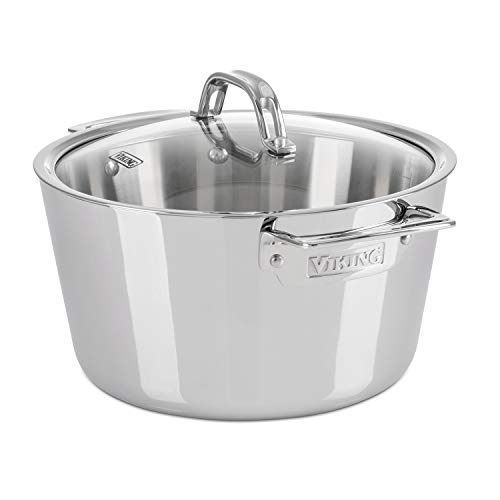
Viking Contemporary 3-Ply 5.2-Qt — the one with the glass lid
Every other pick in this guide wears a steel lid; the Viking Contemporary wears glass, and that single material choice reorganises the pot’s strengths. The body is full 3-ply clad — an 18/8 stainless interior, an aluminum core, and a magnetic stainless exterior that makes it induction ready — in the line’s conical Contemporary profile, which flares gently from base to rim. Viking rates the pot body for oven use to 600 degrees Fahrenheit, matching the highest figure here. The glass lid, however, is rated to 450 degrees, and so 450 is the pot’s real ceiling whenever the lid is on — which, for a Dutch oven, is most of the time. This guide states both numbers wherever the pick is discussed, because quoting only the 600 would misdescribe the product.
What the glass buys is information. A braise under glass can be watched — the simmer’s pace judged, the liquid level checked, the moment a sauce breaks caught early — without lifting the lid and releasing the steam that a Dutch oven exists to trap. For new cooks learning what a bare simmer looks like, and for any cook tending a dish that misbehaves when disturbed, that window is a working feature, not a garnish. Viking adds its own refinements: handles designed with a heat break that keeps them cooler on the stovetop, a vented lid rim, and a mirror finish that presents the pot as tableware as much as cookware. At 5.2 quarts it sits in the same everyday family band as the other mid-size picks, and at a premium tier alongside the All-Clad.
The Contemporary profile deserves a sentence of its own, because it is functional rather than decorative. The conical flare — narrower at the base, wider at the rim — gives the pot a broader top opening for stirring and serving than its floor diameter suggests, and it sheds the lid’s condensation back toward the walls rather than onto the centre of the food. It also means the Viking’s effective cooking surface at the top is larger than its browning floor, a proportion that suits sauced dishes and anything finished with a gentle steam. Buyers comparing it directly with the All-Clad should frame the choice cleanly: the D3 buys temperature ceiling and an all-steel build, the Viking buys visibility and shape, and both buy full cladding — the difference is in what the lid is for.
The costs are the lid’s, mostly. Four hundred fifty degrees excludes the hottest bread preheats with the lid on and excludes the broiler altogether, so the bread baker’s standard method needs the lid left off the preheat or a different pot. Glass is also the one breakable component in an otherwise all-metal line-up — it is tempered and built for the job, but a dropped steel lid dents where a dropped glass lid ends. And the conical walls, while they pour and stir beautifully, give a slightly narrower floor than a straight-sided pot of the same capacity, which shows up when browning a full batch of meat.
Strengths
- Glass lid lets a braise be monitored without losing steam or heat.
- Full 3-ply clad body, induction ready, rated to 600°F on its own.
- Heat-break handles and a finish that goes to the table.
- Conical profile stirs and pours cleanly.
Trade-offs
- Glass lid caps real oven use at 450°F and rules out the broiler.
- The lid is the one breakable part in an all-metal category.
- Flared walls mean a narrower browning floor than straight-sided rivals.
Who it suits: cooks who tend their braises — learners calibrating a simmer, and anyone whose dishes suffer when the lid comes off for a look. If seeing the food is worth a lower oven ceiling, the Viking is the honest version of that trade, so check price on Amazon.
Check price on Amazon: Viking Contemporary 5.2-Qt

Cuisinart Chef’s Classic Stainless 5.5-Qt — the budget doorway
The Chef’s Classic, model 655-26, is the budget tier of this list, and it earns its place by being honest about what the money removes. The construction is the disc-base design described earlier: a pure aluminum core encapsulated in the base, spreading heat across the floor, under a single-layer stainless body. The walls, therefore, do not conduct the way clad walls do — a stew’s upper layer warms by convection through the liquid rather than through the metal — and the guide’s construction axis exists precisely to say so. What the design keeps is everything else on the checklist: a stainless steel lid, riveted cool-grip handles with a helper handle for the loaded lift, a tapered drip-free rim, induction-ready base, dishwasher safety, and a stated oven rating of 500 degrees Fahrenheit.
For a large share of real Dutch oven cooking, the disc base’s limitation barely registers. Soups, chilis, curries, pasta sauces, and beans — liquid dishes that stir themselves by convection — cook on the floor and in the liquid, and the Chef’s Classic handles them with the same even base heat as pots costing far more. The 5.5-quart capacity matches the family centre of this list, and the mirror finish and straightforward lines make it the least intimidating pot here: no construction story to learn, no ceiling to memorise beyond a round 500 degrees, nothing to chip. As the first stainless Dutch oven in a kitchen leaving nonstick or enamel behind, it is a rational place to start.
Two smaller virtues round out the case. Interior measurement markings are a documented feature of the line, a mundane detail that earns its keep every time a stock is reduced to a mark rather than a guess, and the mirror finish — whatever its fingerprint habits — makes this the most conventionally handsome pot in the budget class. The base deserves one practical note: the encapsulated disc is sized to the pot’s floor, so on induction it couples across the full footprint rather than a narrow ring, which is the usual weakness of cheap disc designs and one this line avoids. For a first stainless pot, bought to learn the material’s habits, those are the right corners to have left uncut.
The boundaries show in the dishes that lean on the walls. A braise packed to the rim, a sauce that must not scorch at the floor while the top stays cool, a bread bake that benefits from heat radiating off the sides — these are clad-pot jobs, and the Chef’s Classic does them adequately rather than evenly. The single-layer walls also lose heat faster, so a low simmer may need a slightly kinder burner setting to hold steady. Buyers should hold the line on identity here: this pick is the disc-base 655-26, and Cuisinart sells clad pots under other line names at other tiers — the value of this pick is exactly that it is not one of them.
Strengths
- Budget tier with the full checklist: steel lid, 500°F rating, induction-ready.
- Encapsulated base spreads heat evenly across the floor.
- Helper handle and tapered rim make a full pot manageable.
- Simple, uncoated, dishwasher-safe — nothing to chip or maintain.
Trade-offs
- Disc base, not clad: sidewalls do not conduct heat.
- Full-to-the-rim braises and wall-dependent baking are merely adequate.
- Thinner walls shed heat faster; simmers need a steadier burner hand.
Who it suits: cooks whose Dutch oven repertoire is soups, chilis, and sauces, and who want out of enamel or nonstick without paying clad prices. If the budget is real and the cooking is liquid-led, this is the stainless starting point — check price on Amazon.
Check price on Amazon: Cuisinart Chef's Classic 5.5-Qt
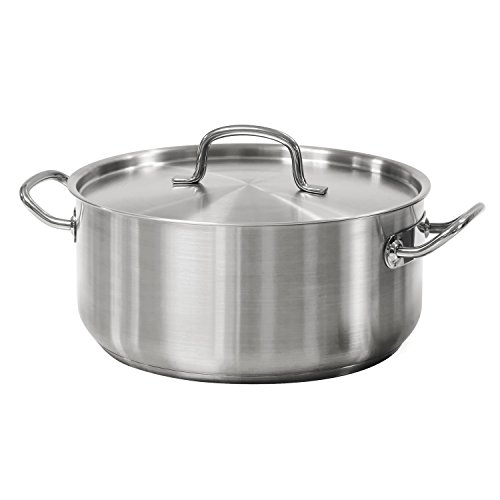
Tramontina Pro-Line 9-Qt — the big-batch pot
Nine quarts is a different category of object, and the Tramontina Pro-Line is built for it: a commercial-leaning line, NSF certified, with riveted cast stainless handles sized for a genuinely heavy lift and a stainless lid that seals a very wide pot. Its construction should be stated with the same precision as the smaller picks: the Pro-Line’s tri-ply technology lives in the base, not in full-height cladding, so the floor heats with clad evenness while the tall walls are stainless alone. The stated oven rating is 500 degrees Fahrenheit, the pot is induction compatible, and at under six pounds empty it weighs less than an enameled iron pot half its volume — the single most persuasive number in its favour, because a full nine quarts of anything is a serious carry.
The use case writes itself. This is the pot for the double batch of chili that fills the freezer, the whole chicken with vegetables around it rather than squeezed against it, the seafood boil, the stock that simmers all afternoon, and the holiday side dish that used to require two pots and a rotation schedule. Tramontina’s Pro-Line is aimed at professional-style use, and it shows in the priorities: capacity, durability, and handles that assume mitts and weight, over finish and finesse. For a large household, a batch cook, or anyone who hosts at scale, it replaces the borrowed-second-pot routine entirely.
The commercial lineage shows in the specification choices. NSF certification, cast rather than stamped handles, and a lid fitted with the deliberate weight of a pot meant to be opened many times a day all point the same direction: this is equipment specified for throughput. Home cooks who preserve, who cook for a congregation or a team, or who simply refuse to split a recipe across two vessels will recognise the type immediately. It also reframes the guide’s weight argument at scale — the Pro-Line full of stock is a heavy lift by any standard, but its iron equivalent at this volume would be close to unliftable, which is precisely why commercial kitchens made this material switch generations ago.
Its trade-offs are size’s own. Nine quarts needs a large burner to heat its wide floor evenly, a deep sink or a tolerant dishwasher arrangement to wash, and cupboard space that small kitchens may not have; stored inside another pot is the usual answer. The base-only cladding matters more at this scale, too — a pot this tall, filled this full, is exactly the geometry where clad walls would help, and cooks doing rim-full braises as their main pattern should weigh the smaller fully clad picks instead. And for a household of two, it is simply too much pot: food swims, reductions race, and the everyday 5-quart earns its keep. Capacity is a fit question, and this pick is the answer only when the answer is large.
Strengths
- Nine quarts ends the double-batch and borrowed-pot problem.
- Under six pounds empty — lighter than iron pots half its size.
- Tri-ply base, NSF certified, riveted cast handles built for weight.
- Stainless lid and a stated 500°F oven rating.
Trade-offs
- Tri-ply is in the base only; the tall walls are single-layer stainless.
- Demands a large burner, a big sink, and real storage space.
- Oversized for small households and everyday two-person cooking.
Who it suits: batch cooks, large households, and hosts whose recipes keep outgrowing a five-quart pot. If the pot has been the bottleneck every time you cook for a crowd, nine quarts is the fix — settle the storage question first, then check price on Amazon.
Check price on Amazon: Tramontina Pro-Line 9-Qt
Cooking in clad stainless: the adjustments worth making
Stainless rewards a slightly different hand than enamel or nonstick, and three habits cover most of it. First, preheat the empty pot briefly before the oil goes in, and the oil before the food: a properly warmed stainless surface releases proteins far more willingly than a cold one, and much of the material’s sticky reputation is really a cold-pan problem. Second, treat fond as an ingredient. The browned layer a sear leaves on stainless is not a cleaning failure; deglazed with wine, stock, or water, it becomes the base of the braise’s sauce, and the pale interior makes its colour easy to judge — one of the quiet advantages over dark enamel, where fond is invisible until it burns. Third, moderate the burner. Clad metal responds quickly, so the violent heat used to hurry an iron pot along overshoots in stainless; medium and medium-high do most of the work, and a simmer, once found, holds with less input than cooks expect.
Two further notes belong to the oven. A stainless Dutch oven preheated empty for bread should be heated with its lid’s rating in mind, not the body’s — the table in this guide names the limiting part for exactly that reason. And because clad pots shed heat faster than iron once they leave the oven, a braise served from the pot at the table benefits from a trivet and the lid kept on between servings; the food stays at temperature by its own mass, but the long tail of a dinner party is where the iron pot’s heat retention honestly earns its reputation. None of these adjustments is difficult; they are simply the material’s terms, and they are worth stating because most disappointed stainless buyers were never told them.
See also: best dutch ovens for van life
Matching the pick to your kitchen
The six picks resolve into a short decision tree. If you want one pot that does everything well and disappears into daily use, the Tramontina Signature is the default: full cladding, the everyday size, a mid-range tier. If your cooking runs hot — bread at high preheats, broiler finishes — the All-Clad D3’s 600-degree ceiling is the only figure of its kind here, and the MultiClad Pro’s wide casserole shape is the specialist for sear-first braises at a 550-degree ceiling. If you cook by eye and resent lifting lids, the Viking’s glass is the feature, bought with a 450-degree lid limit stated in the open. If the budget leads and the cooking is liquid-led, the Chef’s Classic covers the checklist at the entry tier. And if capacity is the recurring failure, the Pro-Line’s nine quarts close the question. Weight threads through all of it: every pick here can be carried full by one person with mitts, which is the founding reason to choose the material at all.
Frequently asked questions
Is a stainless Dutch oven as good as enameled cast iron for braising?
For the braise itself, yes, with one honest caveat. In a lidded oven braise, the surrounding air and the liquid do the cooking, and clad stainless performs the same work at half the weight. Cast iron’s real advantages are heat retention at the table and a slower temperature dip when cold ingredients are added on the stovetop. Stainless answers with faster response, no chippable coating, and a pot one person can carry full — which is why the choice is about cooking pattern, not cooking quality.
Which of these pots can go under the broiler?
Only the ones whose makers rate the whole vessel, lid included, for it. In this guide that is the All-Clad D3, stated to 600 degrees Fahrenheit including broiler use, and the Cuisinart MultiClad Pro, stated to 550 degrees and broiler safe. The glass-lidded Viking is excluded by its lid regardless of its body’s rating, and the 500-degree picks should be treated as oven-only unless the maker’s documentation for the exact model says otherwise.
Why does food stick to stainless, and how do cooks prevent it?
Stainless has no release coating, so protein bonds to a cold or under-oiled surface until its crust forms and lets go. The standard technique is a brief empty preheat, then oil, then food left undisturbed until it releases on its own. What remains — the fond — is deliberate: deglazed into the dish, it is the flavour base of braises and pan sauces, and its visibility on the pale surface is information an enamel interior hides.
Do all six picks work on induction?
Yes — each maker documents induction compatibility, achieved two ways: a magnetic stainless exterior on the fully clad pots, and a magnetic encapsulated base on the disc-base models. The practical check is fit, not chemistry: match the pot’s base diameter to your element, because a wide pot centred on a much smaller induction ring heats unevenly whatever its construction.
How do you clean heat tint and stuck-on fond from stainless?
Heat tint — the blue-gold rainbow after a dry, hot sear — is a cosmetic oxide layer, removed with a vinegar wipe or a powdered stainless cleanser. Fond and baked-on residue release with a soak or by simmering water in the pot, and every pick here is documented as dishwasher safe, though hand washing keeps exteriors brightest. There is no seasoning to restore and no coating to protect, which is the material’s standing advantage.
The bottom line
A stainless steel Dutch oven is not a lesser iron pot; it is a different answer to the same question, trading thermal mass for a pot that one person can lift, abuse, and put in the dishwasher for decades. Buy the construction before the brand: full cladding if your braises fill the pot and your baking leans on the walls, a disc base if your cooking is liquid-led and the budget leads with it. Mind the lid, because the lid sets the ceiling. Sized and specced that way, the right clad pot stops being equipment you manage and becomes the pan the hand reaches for without thinking — and a kitchen, in the end, is mostly the sum of what the hand reaches for.