Disclosure: topratedkitchenware.com is reader-supported. When you buy through links on our site, we may earn an affiliate commission from Amazon and other retailers, at no extra cost to you.
Where to buy
The picks below are the verified shortlist for this guide to best stove cooktops gas. Each linked name takes you to its Amazon listing, where you can check the latest price on Amazon, confirm the current configuration, and read the newest owner feedback before you decide. Picks covered without a link are labelled unlinked in their reviews, with the reason stated plainly.
- ThermoMate Heavy 36-Inch Gas Cooktop — Best Overall
- VEVOR Gas Cooktop 30 Inch, 5 Burners — Best for Smaller Kitchens
Read the full guide ↓ for how each pick performs, where each one compromises, and which households each one actually suits.
Choosing among the best stainless steel gas cooktops starts with a confession this guide makes up front: only two picks in the verified shortlist for this search are actually gas cooktops, and both are linked in full. The other four are portable induction burners. Rather than dress them up as gas, this guide reviews them honestly as unlinked alternatives, because a reader comparing technologies deserves the comparison — labelled as what it is. Best Ratings For Gas Cooktops
That honesty shapes everything below. The two linked decks — a 36-inch ThermoMate and a 30-inch VEVOR, both stainless, both convertible between natural gas and LPG, both with thermocouple flame protection — are the answer to the keyword as written. The unlinked entries answer the neighbouring question many readers are really asking: what if my kitchen cannot take gas at all? Read the linked reviews as the shortlist and the unlinked reviews as the escape route, and you will get more from this guide than from one that pretends six identical products exist. Best Recommended Gas Cooktops
Key Takeaways
- Only two verified picks are true stainless steel gas cooktops — the ThermoMate 36-inch and the VEVOR 30-inch — and both are linked; the four portable induction burners are covered without a link and clearly labelled.
- Both gas decks are NG/LPG convertible with thermocouple protection, so either can follow you from a natural-gas house to a propane cabin or RV.
- Size is the first decision: 36 inches buys pan elbow room, 30 inches fits the standard cutout most kitchens already have.
- Stainless over open flame needs a wipe-down habit — grates off, spills lifted before they bake — in exchange for flame control no electric surface matches.
- If your building forbids gas work, a portable induction burner is a legitimate zero-installation alternative, but it is a different technology, not a substitute with the same character.
In this guide
Quick Picks
| Pick | Badge | Headline spec |
|---|---|---|
| ThermoMate Heavy 36-Inch Gas Cooktop | Best Overall | 5 Italy Sabaf burners |
| VEVOR Gas Cooktop 30 Inch, 5 Burners | Best for Smaller Kitchens | 5 burners |
| Duxtop 1800W Portable Induction Cooktop, Gold 8100MC | Unlinked: Portable Induction Alternative | 1800W |
| Duxtop Portable Induction Cooktop, Silver 9600LS | Unlinked: Touch-Control Alternative | 1800W |
| AAOBOSI Portable Induction Cooktop | Unlinked: Fine-Control Alternative | 1800W |
| OneSetNuf 1800W Portable Induction Cooker | Unlinked: Push-Button Alternative | 1800W, dual IGBT control |
Read the table with the badges in mind: the two gas decks carry the recommendation for anyone who can install gas, while the four unlinked badges describe the role each induction burner could play if gas is off the table. No unlinked pick has a link anywhere in this guide, by design.
Notice what the headline specs quietly tell you. The gas picks talk about burners, fuel conversion and flame protection; the induction picks talk about watts, levels and timers. Those are two different languages for two different kinds of cooking, and the rest of this guide keeps them translated side by side rather than merged. Best Stainless Steel Gas Cooktops
How These Picks Were Chosen
This guide was built research-first. That filter is why this article links two products and discusses six.
The comparison work behind the scenes weighed burner count and layout, deck material and grade, fuel flexibility, and the safety hardware named in each listing. Where a listing made a claim — five Sabaf burners, 304 stainless, a stated BTU total — the review repeats only that claim and attributes it to the listing rather than dressing it up as a lab result. This is a research-led guide, not a hands-on test, and it does not pretend otherwise.
Unlinked handling follows the same discipline. A pick that failed the core match still gets a full, fair review of what it actually is, because readers cross-shopping gas against induction are common and deserve real information. What it does not get is a purchase link inside a guide whose keyword it does not answer. Best Two Burner Gas Cooktops
The 6 Best Options for Best stove cooktops gas

ThermoMate Heavy 36-Inch Gas Cooktop
Badge: Best Overall
Strengths
- Five Italy Sabaf burners give a genuine spread of flame sizes, from a wide high-output centre burner down to a small simmer burner for sauces
- 304 stainless steel deck is the heavier, more corrosion-resistant grade most buyers actually want over a gas flame
- Thermocouple protection cuts the gas if a flame blows out, and NG/LPG convertibility means it can run on natural gas now and propane later
Trade-offs
- A 36-inch built-in deck needs a full-size cutout and a proper gas line, so it is a renovation decision rather than a weekend swap
- Five burners across 36 inches still crowd when three large pans compete for the front row at once
- Stainless around open flame shows heat tinting and splatter honestly, so it asks for a wipe-down habit after frying
| Spec | Detail |
|---|---|
| Format | 36-inch built-in gas cooktop |
| Burners | 5 Italy Sabaf burners |
| Surface | 304 stainless steel |
| Fuel | Natural gas / LPG convertible |
| Safety | Thermocouple protection, CSA certified |
If the phrase stove cooktops gas means, to you, a proper built-in deck with real flame under real pans, this ThermoMate is the centre of this guide. The five Sabaf burners are the detail that matters most: Italian-made burners are known for clean, even flame rings, and having five of them across a 36-inch deck lets a household run a stockpot, a wide skillet and a small saucepan at the same time without the usual musical-chairs shuffle between front and back burners.
The 304 stainless construction is the second reason it leads. Around open flame, cheaper thin decks can oil-can and discolour; a heavier stainless deck resists that, and the material shrugs off the acidic splashes — tomato, vinegar, citrus — that pit lesser finishes. Cleanup is the familiar gas routine: lift the grates, wipe the sealed deck, and deal with the burner caps before residue bakes on. It is more work than wiping glass, and this guide will not pretend otherwise, but it is the trade every gas cook knowingly makes for flame control.
Who should skip it? Anyone without a gas line, anyone renting, and anyone whose cutout is a standard 30 inches. For a household already plumbed for gas and cooking for four or more people most nights, though, this is the pick that behaves like the centre of a working kitchen rather than an appliance you work around.
Best for: Homes with a gas line and a 36-inch cutout that cook several pans at once / Not suited for: Renters, 30-inch cutouts, or kitchens with no gas supply
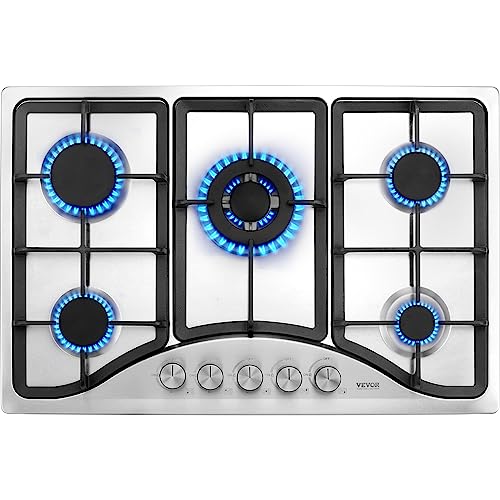
VEVOR Gas Cooktop 30 Inch, 5 Burners
Badge: Best for Smaller Kitchens
Strengths
- Five burners fitted into a 30-inch footprint, which suits standard cutouts in smaller kitchens and apartments
- Stated 12250 BTU total output with NG/LPG convertibility, so it can serve a flat, an RV or a cabin on propane as well as a house on natural gas
- Stainless steel design with thermocouple protection, the flame-failure safety feature that matters most on a compact deck
Trade-offs
- Five burners in 30 inches means pan handles and wide skillets compete for space sooner than on a 36-inch deck
- Total output is shared across the deck, so running every burner hard at once is not its natural working mode
- A built-in unit still needs a cutout, a gas connection and clearances checked before it can replace an old cooktop
| Spec | Detail |
|---|---|
| Format | 30-inch built-in gas cooktop |
| Burners | 5 burners |
| Output | 12250 BTU (total, per listing) |
| Fuel | NG / LPG convertible |
| Safety | Thermocouple protection |
The VEVOR answers the most common version of this search: a household wants gas, wants more than the tired four burners it already has, but only has a 30-inch hole in the counter. Fitting five burners into that footprint is a real packaging achievement, and for the apartment, RV and small-house cooks the listing names, it turns a cramped deck into one that can hold a kettle, a skillet and a saucepan in a single session.
Convertibility is its quiet strength. A cooktop that runs on natural gas in a house and on LPG in a cabin or RV follows the owner instead of tying the purchase to one address, and the thermocouple protection matters even more in small spaces, where a blown-out flame in a closed kitchen is a more serious event. The stainless deck wipes down the same way any gas deck does: grates off, spills lifted before they carbonise, burner caps kept clear.
Be honest with yourself about pan size before choosing it. If your cooking leans on a very wide skillet or a large wok as the main event, the 36-inch ThermoMate above gives that pan more elbow room. If your pans are ordinary and your cutout is 30 inches, this is the gas deck that fits your kitchen as it actually is.
Best for: 30-inch cutouts, apartments, RVs and cabins wanting five gas burners / Not suited for: Cooks whose main pans are very wide, or anyone needing a plug-in portable
Duxtop 1800W Portable Induction Cooktop, Gold 8100MC
Badge: Unlinked: Portable Induction Alternative
Strengths
- A single portable induction burner adds a fast, precise cooking zone without any gas work at all
- The gold finish version of Duxtop’s long-running 8100MC design stands out from the usual black glass crowd
- Countertop format stores in a cupboard, which suits occasional overflow cooking at holidays
Trade-offs
- It is not a gas cooktop in any sense — no flame, no burners, and it only heats induction-compatible pans
- One zone cannot replace a multi-burner deck for a family dinner service
- Covered here as unlinked, so there is no link or photo for it in this guide
| Spec | Detail |
|---|---|
| Format | Portable single-burner induction cooktop |
| Power | 1800W |
| Model | 8100MC / BT-180G3 |
| Finish | Gold |
This Duxtop appears in a gas guide for one honest reason: it was in the verified shortlist for this search, and rather than link it as something it is not, this guide reviews it in prose as the alternative some readers actually need. If you landed here while comparing stove cooktops gas options but your building forbids gas work, a portable induction burner is the zero-installation way to add a serious cooking zone today.
As a burner in its own right, the 8100MC formula is simple and proven: full countertop power, a flat glass surface that wipes clean, and heat that responds instantly when you lift the pan or drop the setting. What it cannot do is char a pepper over open flame, cradle a round-bottom wok, or run when the power is out — the three classic reasons gas loyalists stay with gas. Read it as a supplement or a stopgap, not a substitute.
Best for: Adding one portable zone where gas installation is impossible / Not suited for: Anyone who specifically wants open-flame gas cooking
Duxtop Portable Induction Cooktop, Silver 9600LS
Badge: Unlinked: Touch-Control Alternative
Strengths
- LCD sensor touch controls give a flat, wipe-clean control surface with no knobs to trap grease
- Full-power portable induction heating in a silver finish that suits lighter kitchens
- A single self-contained zone that can live on a counter, in a dorm or in an RV with shore power
Trade-offs
- Induction, not gas — it fails the core request of this search and is therefore unlinked here
- Touch controls can be fiddly with wet or floury fingers compared with a gas knob you can grip
- Needs magnetic cookware; aluminium and copper pans without an induction base will not heat
| Spec | Detail |
|---|---|
| Format | Portable single-burner induction cooktop |
| Power | 1800W |
| Controls | LCD sensor touch |
| Model | 9600LS / BT-200DZ |
The 9600LS is the touch-control sibling in Duxtop’s portable line, and its review here follows the same honest rule as the gold model above: it is a capable burner, it is simply not a gas cooktop, so it carries no link in a guide whose keyword asks for gas. Readers cross-shopping the two technologies will still learn something useful from it, because its strengths are almost a mirror image of gas: instant electronic control and a sealed flat surface, against no flame character at all.
In daily use the flat panel is the story. Spills sheet across glass instead of pooling around burner caps, and a single wipe restores it. The compromise is tactile: a gas knob can be turned by feel, mid-sear, with a pan in the other hand, while a touch panel wants a dry fingertip and your eyes for a moment. Neither is better in the abstract — they suit different cooks — but only one of them is gas, and this guide keeps that line bright.
Best for: Readers comparing technologies who value a sealed, wipe-clean surface / Not suited for: Gas purists and anyone cooking through power cuts
AAOBOSI Portable Induction Cooktop
Badge: Unlinked: Fine-Control Alternative
Strengths
- Twenty temperature and power levels plus four preset modes give unusually fine control for a portable burner
- A four-hour timer suits long, low simmering that a portable unit is often bought for
- Compact format aimed squarely at apartments, RVs and outdoor cooking with a power source
Trade-offs
- Portable induction again — no gas, no flame, and no place in a linked gas shortlist
- A single zone with a portable footprint limits pan diameter and multi-pan cooking
- Preset modes help most when your cooking matches them; wok-style high-heat work is not its home ground
| Spec | Detail |
|---|---|
| Format | Portable single-burner induction cooktop |
| Power | 1800W |
| Levels | 20 temperature and power levels |
| Timer | 4-hour timer, 4 preset modes |
AAOBOSI’s portable burner earns its unlinked place here on the strength of its control count. Twenty levels of temperature and power is more granularity than most cooks ever use, but for the jobs portables are bought for — holding a sauce at a bare simmer, keeping a fondue or a slow braise exactly where it should sit for hours — fine steps and a four-hour timer are exactly the right tools.
None of that changes the fuel question, and this guide will not blur it: there is no burner ring, no ignition, no flame to read by eye. A cook choosing gas for the theatre and feedback of fire should pass over this entry; a cook who mainly needs one obedient extra zone, and who has induction-ready pans, may find this the most practical paragraph in the article. That split verdict is precisely why it is reviewed in full but linked nowhere.
Best for: Precise low-and-slow portable cooking in small spaces / Not suited for: Open-flame cooking or multi-pan family meals
OneSetNuf 1800W Portable Induction Cooker
Badge: Unlinked: Push-Button Alternative
Strengths
- Push-button controls are positive and glove-friendly, a real contrast with touch panels and gas knobs alike
- Dual IGBT power control and eighteen temperature settings aim at steadier commercial-style output
- A ten-hour timer and stainless housing suit long service jobs like stock, canning prep and event cooking
Trade-offs
- A commercial-style portable induction unit — capable, but not a gas cooktop, so unlinked in this guide
- Its working style is single-zone and countertop, not a built-in multi-burner deck
- Stainless housing still surrounds a glass cooking surface that needs flat-bottomed, induction-ready pans
| Spec | Detail |
|---|---|
| Format | Portable single-burner induction cooker |
| Power | 1800W, dual IGBT control |
| Settings | 18 temperature settings |
| Timer | 10-hour timer |
| Controls | Push-button |
The OneSetNuf closes the unlinked bench with the most workmanlike design of the four: physical push-buttons, a stainless housing, an eight-inch coil and a timer that runs to ten hours. It reads as a tool for people who cook in volume in temporary places — market stalls, halls, big family gatherings — where a deck at home cannot follow.
Set against the two linked gas decks, its lesson is about choosing the constraint you prefer. Gas asks for a line, ventilation and grate-cleaning, and repays you with flame. This unit asks for a socket and the right pans, and repays you with portability and a timer. Both are legitimate kitchens; they are just not the same purchase, and a guide to stove cooktops gas serves you best by saying so plainly.
Best for: Event and volume cooking away from a fixed kitchen / Not suited for: Replacing a built-in gas deck
Comparison Table
| Pick | Badge | Format | Best for |
|---|---|---|---|
| ThermoMate Heavy 36-Inch Gas Cooktop | Best Overall | 36-inch built-in gas cooktop | Homes with a gas line and a 36-inch cutout that cook several pans at once |
| VEVOR Gas Cooktop 30 Inch, 5 Burners | Best for Smaller Kitchens | 30-inch built-in gas cooktop | 30-inch cutouts, apartments, RVs and cabins wanting five gas burners |
| Duxtop 1800W Portable Induction Cooktop, Gold 8100MC | Unlinked: Portable Induction Alternative | Portable single-burner induction cooktop | Adding one portable zone where gas installation is impossible |
| Duxtop Portable Induction Cooktop, Silver 9600LS | Unlinked: Touch-Control Alternative | Portable single-burner induction cooktop | Readers comparing technologies who value a sealed, wipe-clean surface |
| AAOBOSI Portable Induction Cooktop | Unlinked: Fine-Control Alternative | Portable single-burner induction cooktop | Precise low-and-slow portable cooking in small spaces |
| OneSetNuf 1800W Portable Induction Cooker | Unlinked: Push-Button Alternative | Portable single-burner induction cooker | Event and volume cooking away from a fixed kitchen |
The comparison table makes the split in this guide visible at a glance: two built-in gas decks with burners and fuel conversion, four portable induction units with watts and timers. If you are skimming, let the Format column do the work — it is the honest dividing line of the whole shortlist.
Within the gas pair, the choice is footprint and pan room. Within the induction four, the choice is control style: push-buttons, touch panel, fine levels or long timer. Cross-category comparisons only make sense at the level of your kitchen’s constraints — gas line or no gas line — which the buying guide below takes up directly.
How to Choose: Best stove cooktops gas
Start with the fuel question, because it decides everything else
A gas cooktop needs three things your kitchen either has or does not: a gas supply, a cutout it fits, and ventilation you are comfortable with. If all three are present, the two linked decks in this guide are your real shortlist and the only remaining question is size. If any one is missing — a rental agreement, an all-electric building, a landlord who says no — no amount of product research changes it, and the portable induction entries become the practical path. Deciding this first saves you from falling in love with a deck you cannot install.
Fuel flexibility softens the decision more than it used to. Both linked decks convert between natural gas and LPG, so a move from a plumbed house to a propane property does not orphan the appliance. Conversion is a fitter’s job, not a casual adjustment, but knowing the hardware supports it protects the purchase against changes in circumstance. Best Radiant Cooktops 36inch
Thirty inches or thirty-six: measure the cooking, not just the hole
The cutout measurement is the easy part — both decks here are built-in units with a stated width, and your counter either matches or can be altered by a professional. The harder measurement is your pan collection. Line up the skillets, woks and stockpots you actually use together on your busiest night and ask how they would sit across five burners in 30 inches versus 36. The extra width is not luxury; it is the difference between handles clearing each other and a nightly negotiation.
Household size is a fair proxy. One or two cooks with ordinary pans will rarely feel the 30-inch deck’s limits, and the VEVOR’s five burners in that footprint are genuinely useful. Households cooking for five or six, or cooks whose style is several pans moving at once, will spend the 36-inch deck’s extra room every single day.
What stainless steel over gas really asks of you
Stainless is the right material around flame — heat-tolerant, non-reactive, repairable — and the ThermoMate’s 304 grade is the version of it professionals specify. What it asks in return is rhythm: grates lifted and the deck wiped while spills are still spills, burner caps kept clear, and an acceptance that heat tinting near burners is patina, not damage. Cooks who fry daily and clean weekly will find gas stainless shows every day of that week.
Compare that honestly with the induction alternative’s housekeeping: a flat glass wipe and pans that must be magnetic. Neither regime is hard; they are hard for different people. Choose the one whose chores you will actually do, because the cooktop you clean is the one that stays pleasant to cook on. Best Reated Induction Cooktops
Safety hardware worth insisting on
Thermocouple protection appears in both linked listings, and it is the feature to insist on in any gas deck: if a flame blows out or boils over, the thermocouple cools and the gas supply closes. In a small or closed kitchen that is not a luxury. Ask the same question of any gas cooktop you consider beyond this guide, and walk away from decks that cannot answer it.
Ventilation is the other half of gas safety. Open flame produces combustion by-products and a great deal of steam and grease vapour, and a working extraction path — ideally vented outside — is part of the installation, not an accessory. Budget and plan for it alongside the deck itself, especially in apartments and RVs where the VEVOR’s compact brief is attractive.
How to Live With a Gas Cooktop: Setup Checks, Daily Use and Care
A built-in gas cooktop is installed once and used for years, so the how-to that matters is less about the fitting day — which belongs to a qualified gas fitter — and more about the checks and habits that follow it. These steps assume professional installation and focus on what the owner does from the first evening onward.
- On day one, have the installer demonstrate ignition on every burner and show you the flame: a healthy gas flame is mostly blue with a defined cone, not lazy, yellow and wandering.
- Learn your deck’s geography by cooking a simple meal on each burner in turn — which burner boils fastest, which simmers lowest, and where your largest pan sits without crowding its neighbours.
- After cooking, once grates are cool enough to handle, lift them and wipe the stainless deck before residue dries; a soft cloth and warm soapy water handle almost everything at this stage.
- Weekly, remove burner caps and check the ports are clear; a pin or soft brush clears a blocked port that is making a flame lopsided — never enlarge a port with a drill or wire.
- Monthly, test the thermocouple’s world indirectly by simply confirming each burner still ignites promptly and holds its flame at the lowest setting; a burner that keeps clicking or dies at low settings needs a service visit, not patience.
- If you ever smell gas with all burners off, do not troubleshoot: turn off the supply if you safely can, ventilate, leave, and call your gas provider or emergency line from outside.
For the unlinked induction burners in this guide, daily care is simpler — wipe the glass, keep the vents underneath unobstructed, and store the unit fully cool — but the deeper point stands for both technologies: the first month of habits decides whether a cooktop stays pleasant for a decade. Best Recommended 36 Viking And Wolf Cooktops
Troubleshooting
Problem: a burner clicks but will not light after cleaning → the cap is usually seated slightly crooked or still damp — reseat it squarely, let it dry fully, and try again before suspecting the igniter.
Problem: flames are yellow and sooty on one burner → a blocked or misaligned burner port is the common cause — clean the cap and ports once cool; if it persists, book a gas service rather than cooking on a sooting flame.
Problem: the smallest burner will not hold a low simmer → the minimum setting may simply be too strong for delicate work — move the pan to the deck’s designated simmer burner, or use a heat diffuser for sauces that must barely move.
Gas Character: What Flame Gives You That Surfaces Cannot
There is a reason the gas-versus-induction argument never dies: flame gives feedback no dial reproduces. You can see a gas flame, hear it change, tilt a pan into it to catch an edge, char a pepper or a tortilla directly over it, and keep cooking through a power cut. Woks with round bottoms sit in flame the way they were designed to. For cooks raised on gas, these are not romantic details — they are technique.
Induction answers with speed, precision and a cool, clean surface, and for many households that answer wins. This guide’s structure — gas linked, induction honestly labelled — is built for readers still deciding which set of virtues matches their cooking. Neither technology is the future and the other the past; they are different tools, and the best purchase is the one whose strengths overlap your actual weeknight habits.
Planning the Installation Around a Built-In Deck
A built-in cooktop touches three trades: the countertop it sits in, the gas line that feeds it, and the extraction above it. Measure the existing cutout before ordering, confirm the gas supply’s position and pressure with your fitter, and decide the ventilation route at the same time — discovering any of these on installation day is how projects stall with a hole in the counter.
Clearances deserve the same forethought. Combustible surfaces, overhead cupboards and the distance to walls all have requirements that your fitter will apply, and compact kitchens — exactly where a 30-inch deck appeals — are where those requirements bite hardest. A short conversation before purchase is worth more than any single product feature in this guide.
Reading Burner Layouts Like a Cook, Not a Catalogue
Burner layouts reward a cook’s eye more than a spec sheet. What matters is the relationship between burners: a large burner placed where your biggest pan can sit without its handle crossing a second flame, a small burner reachable without leaning over a boiling pot, and enough separation that two wide pans are not forced into sharing one corner. When you study a deck’s photograph, place your own pans on it mentally, in the order your busiest recipe demands them.
Simmer quality is the quiet divider between good and great gas decks. High output is easy to advertise; a burner that holds a flame low and stable enough to keep a sauce at a bare tremble, without dying or needing constant relighting, is the one you will praise weekly. Listings rarely quantify it, which is why the reviews in this guide pay attention to burner type and range rather than headline power alone.
Grate design shapes daily life more than buyers expect. Continuous grates let you slide a heavy pot from a fierce burner to a gentle one without lifting it — a kindness to wrists and to sauces — while individual grates are lighter to lift for cleaning. Neither is universally better; the right answer depends on whether you move heavy pans more often than you deep-clean.
Ignition sounds trivial until it is not. A deck that lights first time, every time, with a positive click and an immediate flame becomes invisible in your routine. One that clicks repeatedly trains you to dread starting a meal. It cannot be judged from a listing, which is one more reason this guide sticks to verified claims and frames the rest as questions to check in owner feedback before you buy.
Finally, think about the deck’s second decade, not its first week. Burner caps, grates and knobs are the parts that age; designs from established product lines tend to keep those spares findable. A cooktop is closer to furniture than to a gadget — buy the one whose layout, material and support you can imagine living with long after the novelty has worn off.
Common Buying Mistakes
- Ordering a built-in deck before measuring the existing cutout — 30 and 36 inches are not interchangeable, and countertop alteration is a cost, not a detail.
- Falling for a stainless-look finish and calling it stainless steel; this guide unlinked’d four picks for exactly that confusion, because finish is not material.
- Ignoring ventilation until after installation, then discovering the kitchen fills with steam and combustion by-products every dinner.
- Choosing burner count over burner layout — five burners your pans cannot use together are worth less than four that fit your cooking.
- Treating NG/LPG conversion as a DIY afternoon; it is a fitter’s job with jets and adjustments, every time.
- Letting the first month’s spills bake onto a gas deck, then blaming stainless for being hard to clean.
Most of these mistakes share one root: deciding the product before deciding the kitchen. Measure the space, confirm the fuel, plan the extraction — then the shortlist in this guide narrows itself, and the remaining choice is the pleasant one between two good decks.
Final Recommendation
For the reader this search describes — a kitchen that can take gas and wants it in stainless — the ThermoMate 36-inch is the first recommendation: five Sabaf burners, 304 stainless, flame protection and fuel conversion in the size that gives pans room to work. It is the deck this guide would install in a family kitchen and stop thinking about.
Choose the VEVOR instead when the cutout is 30 inches, the kitchen is small, or the setting is an apartment, RV or cabin on propane — it keeps the five-burner, stainless, protected formula in the footprint you actually have. And if gas turns out to be impossible in your home, the unlinked induction reviews above are your honest detour: different technology, clearly labelled, and genuinely capable in its own right.
Check on Amazon: ThermoMate Heavy 36-Inch Gas Cooktop · Check on Amazon: VEVOR Gas Cooktop 30 Inch, 5 Burners
Frequently Asked Questions
Are the portable induction burners in this guide gas cooktops?
No — and the guide says so at every step. They were in the verified shortlist for this search, so they are reviewed in full as unlinked alternatives with no links, while the two linked picks are genuine stainless steel gas cooktops.
What does thermocouple protection do on a gas cooktop?
It watches the flame. A thermocouple sits in the flame’s heat; if the flame goes out, the sensor cools and the gas valve closes, so unburned gas does not keep flowing into the kitchen. Both linked decks in this guide list it.
Can these gas cooktops run on propane as well as natural gas?
Both linked listings state NG/LPG convertibility. Conversion involves changing jets and settings and should be done by a qualified gas fitter, not treated as a user adjustment.
Is 304 stainless steel worth specifying on a gas deck?
It is the more corrosion-resistant grade commonly used in professional kitchens, and around flame, splashes and daily scrubbing it holds its appearance better than thinner, lower-grade decks. The ThermoMate in this guide lists it explicitly.
How hard is a stainless gas cooktop to keep clean?
The routine is simple but regular: lift the grates, wipe the deck after cooking before spills bake on, and keep burner caps and ports clear. Cooks who do that little and often find stainless easy; cooks who leave it for weeks find it stubborn.
When should I choose induction instead of gas?
When you cannot install gas — rentals, all-electric buildings — or when a cool surface, precise electronic control and wipe-clean glass matter more to you than open-flame technique. The unlinked reviews in this guide cover that path honestly.


