Disclosure: topratedkitchenware.com is reader-supported. When you buy through links on our site, we may earn an affiliate commission from Amazon and other retailers, at no extra cost to you.
Where to buy
Every brewer in this guide is sold through Amazon, and each link below opens the product page where you can verify the capacity, infuser design, and heating claims in the maker’s own words. The six picks are glass teapots that all work as brewers — vessels with removable infusers that give you control over the steep — and they range from an 18.6 oz solo brewer to a 50 oz family pot. Read the full guide below for how brewing method changes what you should buy, and which of the six matches the way you make tea.
- CNGLASS Glass Teapot Stovetop Safe, 20.3 oz — Check on Amazon
- DRNKNSTX Enchanted Tea Pot with Tea Infuser, 20 oz
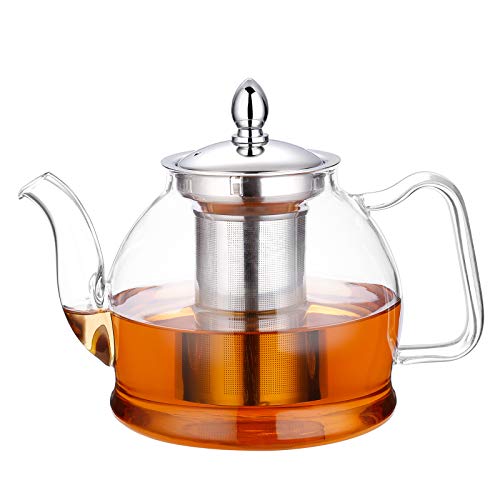
- HIWARE Glass Teapot with Removable Infuser, 1000 ml
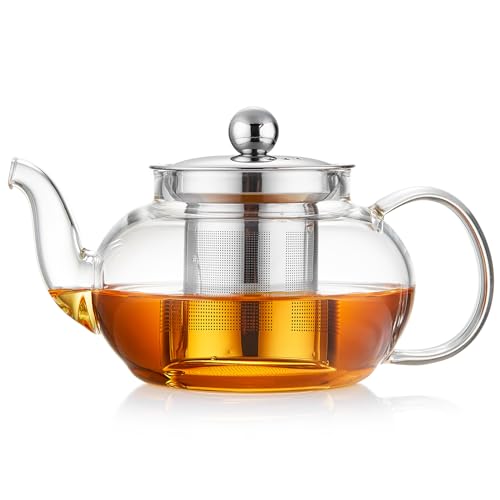
- PARACITY Glass Teapot Stovetop, 18.6 oz / 550 ml
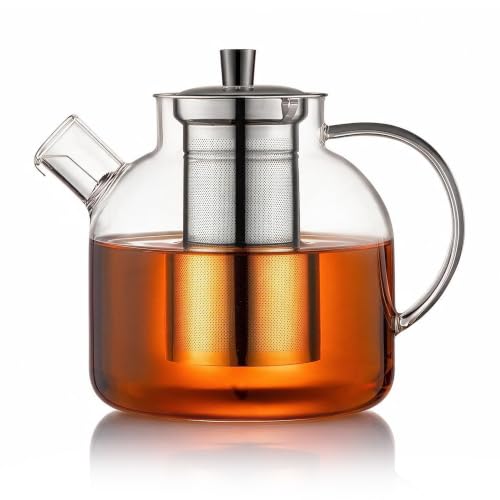
- Ehugos Glass Teapot with Removable Infuser, 1500 ml / 50 oz
- Teabloom Stovetop & Microwave Safe Glass Teapot, 40 oz
Read the full guide ↓
How to use this guide in two minutes: name your brewing method — one family pot, repeated solo infusions, blooming display, or a first pot for a beginner — find the badge that matches it in the Quick Picks table, and read that review plus the How to Choose section before ordering. Readers with more time should not skip the four-methods section: it is the part of this guide most likely to change what you buy, because many shoppers arrive wanting a teapot and leave understanding they wanted a brewer sized for a method they had never named.
A note on how this guide is organized: the reviews run from the smallest brewers to the largest, because in brewing, size is method — a 20 oz pot and a 50 oz pot are not the same tool at different scales but different tools answering different questions. If you already know your method, the Quick Picks badges will route you in seconds. If you are still deciding how you brew, read the method sections before the reviews; they will tell you which two or three pots deserve your close attention, and the rest of the guide will confirm the choice rather than make it for you.
The best teapots and brewers share one defining trait: control. A teapot holds tea; a brewer lets you decide exactly how the tea is made — how much leaf, how hot the water, how long the steep, and the precise moment it ends. Every pick in this guide is a glass teapot with a removable infuser, which is the simplest brewing control there is: the leaf goes in the basket, the basket comes out when the cup is right. But brewing styles differ — a solo drinker re-steeping whole-leaf oolong all afternoon needs a different vessel than a family brewing one strong pot at breakfast — so this guide reviews six brewers across the size range and judges each by the brewing it does best. We also cover the methods themselves: western-style pot brewing, short repeated infusions, cold brewing, and blooming-tea presentation, so you can match a method to a pot with confidence. For a method-by-method companion, readers focused specifically on technique will find Best Teapots For Brewing Tea the natural next read; this page is the hardware shortlist that makes those techniques possible.
Key Takeaways
- The HIWARE 1000 ml glass teapot is our best all-round brewer: family capacity, a removable infuser, and a maker-rated stovetop design that heats and brews in one vessel.
- Brewing control is mostly infuser control. Every pick here has a removable infuser, and the differences that matter are mesh fineness and basket room.
- Small brewers (18.6–20.3 oz) suit solo drinkers and repeated-infusion styles; large brewers (40–50 oz) suit one-shot family pots.
- Steel infusers — the PARACITY’s 18/8 basket is the clearest example — filter fine teas cleanly; glass infusers keep whole-leaf and blooming teas visible.
- Three of these brewers are maker-rated for stovetop heating (HIWARE, CNGLASS, Ehugos) and the Teabloom adds a microwave rating, so several can heat their own brewing water.
- Every capacity in this guide is quoted from the maker’s listing, and every heating claim is the maker’s own — a brewer should be bought on verified facts, not on assumptions about what glass can do.
- Brewing is a repeatable skill before it is an art: the same leaf, water, and timing in the same pot should give the same cup, and every pick here is chosen to make that consistency easy to reach.
In this guide
Quick Picks
| Pick | Badge | Capacity (from maker listing) | Brewing strength | Link |
|---|---|---|---|---|
| CNGLASS Glass Teapot | Best Compact Brewer | 20.3 oz | One-vessel heat and brew | Check on Amazon |
| DRNKNSTX Enchanted Tea Pot | Best Gift Brewer | 20 oz | Beginner-friendly steeping | Check on Amazon |
| HIWARE Glass Teapot | Best Overall Brewer | 1000 ml | Family pots, blooming and loose leaf | Check on Amazon |
| PARACITY Glass Teapot | Best Solo Brewer | 18.6 oz / 550 ml | Fine filtration, repeated infusions | Check on Amazon |
| Ehugos Glass Teapot | Best Large Brewer | 1500 ml / 50 oz | Big-batch brewing with steel filtration | Check on Amazon |
| Teabloom Glass Teapot | Best for Blooming Tea | 40 oz | Display brewing, kettle-and-pot in one | Check on Amazon |
How These Picks Were Chosen
We selected from maker-verified listings of glass teapots with removable infusers, and judged them as brewers first: how precisely can the drinker control leaf, water, and time in this vessel? Capacity, infuser type, and heating claims are reported exactly as the makers state them — the HIWARE, CNGLASS, and Ehugos listings claim stovetop safety, the Teabloom claims stovetop and microwave safety, and the PARACITY is positioned by its maker for stovetop travel use, while the DRNKNSTX is a steeping brewer to be filled from a kettle. Nothing is invented and no hands-on testing is claimed; this is a research-led guide in which each review names the brewing style the pot serves best, its genuine strengths, and one honest limitation. We deliberately kept the size spread wide — solo to family — because brewing method and pot size are inseparable, a point the method sections below develop. Readers equipping a full tea shelf can also consult Best Teapots For All Tea for coverage organized by tea type.
The 6 Best Teapots and Brewers

CNGLASS Glass Teapot Stovetop Safe, 20.3 oz
Badge: Best Compact Brewer
Strengths
- Heats and brews in one compact vessel — maker-rated stovetop safe at 20.3 oz.
- Removable infuser covers loose leaf and blooming tea per the maker.
- Small volume heats fast and brews a fresh cup on demand, ideal for repeated small brews.
Trade-offs
- Infuser material is not specified in the listing, so filtration fineness is unconfirmed.
- 20.3 oz caps at two modest cups — no batch brewing.
- Stovetop use still requires moderate heat and a matched burner.
Mini spec box: Capacity 20.3 oz · Body: clear glass · Infuser: removable · Heating: stovetop safe per maker listing · Teas: loose leaf and blooming per maker listing.
As a brewer, the CNGLASS makes a distinctive argument: the shortest path between water and tea. Because its maker rates it stovetop safe, the brewing sequence collapses — fill the pot, heat it on the burner, add the infuser, steep, pour — with no kettle, no transfer, and no cooling while water travels between vessels. For compact brewing that matters twice: small volumes lose heat fastest in transfer, so a one-vessel 20.3 oz brew holds its temperature more honestly than a kettle-poured one; and a small pot encourages the freshest brewing habit of all, which is brewing little and often rather than one large pot nursed for hours. The clear body supports both loose leaf and blooming tea per the maker, and the removable infuser gives the timing control that defines a brewer rather than a jug. The open question is filtration: the listing does not name the infuser material, so drinkers of fine-cut teas should verify on the product page. For whole-leaf drinkers in small kitchens, this is the most self-contained brewer in the guide.
Best for: small kitchens and whole-leaf drinkers who want heat-and-brew in one pot / Not suited for: batch brewing or confirmed fine-mesh filtration needs.

DRNKNSTX Enchanted Tea Pot with Tea Infuser, 20 oz
Badge: Best Gift Brewer
Strengths
- A brewer designed to be given: themed glass pot with an infuser steeper, positioned as a gift for tea lovers.
- 20 oz is a forgiving learning size for a first loose-leaf brewer.
- Visible unfurling leaf makes the brewing process itself the entertainment.
Trade-offs
- Steeping only — no heating claim, so a kettle must join the gift or already exist.
- Themed design is a taste decision made on someone else’s behalf.
- Advanced brewers will want finer control than a novelty-led pot offers.
Mini spec box: Capacity 20 oz · Body: glass · Infuser: tea infuser / steeper included · Positioning: loose-leaf tea maker and gift for tea lovers (per maker listing).
Brewing is a skill, and the DRNKNSTX is the brewer as invitation. Its maker positions it plainly — a magic teapot for loose-leaf diffusers, a glass tea maker, an ideal gift for tea lovers — and every part of that pitch is about lowering the threshold to a first real brew. The 20 oz size forgives a beginner’s dosing, the glass turns the leaves’ unfurling into the visible reward that keeps a new drinker brewing, and the included infuser means the gift is a complete brewing kit the moment hot water exists. Judged strictly as a brewer it is a simple steeping vessel: no heating claim, no mechanism, no fine-control story — and that simplicity is the point for its audience. The buyer should supply the context the pot cannot: confirm the recipient has a kettle, and add a forgiving whole-leaf tea that brews well across a range of timings. Given that, this is the pick most likely to create a new tea drinker, which is a brewing achievement no specification can match.
Best for: gift buyers introducing someone to loose-leaf brewing / Not suited for: experienced brewers who want heating or fine filtration control.
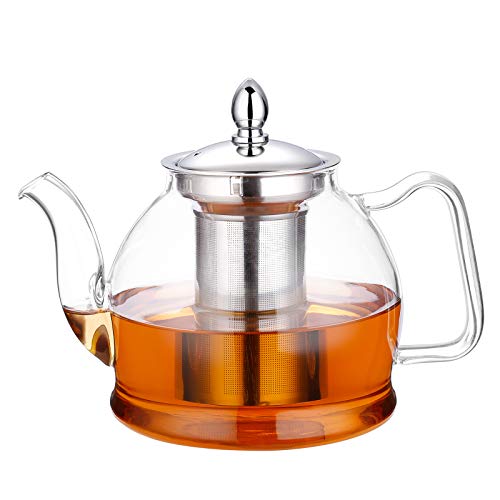
HIWARE Glass Teapot with Removable Infuser, 1000 ml
Badge: Best Overall Brewer
Strengths
- The complete family brewer: 1000 ml, removable infuser, maker-rated stovetop safe.
- Set-style presentation for blooming and loose leaf teas covers the two most social brewing styles.
- One vessel heats and brews a full household round with no transfer.
Trade-offs
- A full litre in glass is a heavy pour for some drinkers.
- Too large for solo brewing; small volumes in a big pot steep unevenly.
- Needs a burner matched to its base when heating.
Mini spec box: Capacity 1000 ml · Body: glass · Infuser: removable · Heating: stovetop safe per maker listing · Positioning: blooming and loose leaf tea maker set (per maker listing).
The HIWARE earns the overall brewer title because family brewing is where control is hardest to keep, and its design keeps it. Brewing a litre for several drinkers multiplies every variable — more leaf, more water, longer pours, later cups sitting longer — and the HIWARE’s answers are structural: a removable infuser so the steep ends for everyone at the same moment, a stovetop rating so the litre is heated in the vessel it brews in rather than transferred and cooled, and a clear body so the strength of a big brew can be judged at a glance before the first cup is poured. Its maker positions it as a set for blooming and loose leaf teas, and at 1000 ml a blooming tea has the depth to open fully, turning the family pot into a table centerpiece rather than a utility. The limitations are the honest physics of scale: a full pot is heavy, and a solo drinker should not buy it. For households that brew together, though, no other pick in this guide controls a full round this completely — it is the brewer we would build a family tea routine around, and the reference point for the Best Teapots For Boiling Water discussion of heating family volumes in the pot itself.
Best for: families and hosts who brew a full pot in one round / Not suited for: solo drinkers or anyone who finds a litre pour unwieldy.
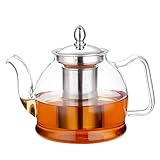

PARACITY Glass Teapot Stovetop, 18.6 oz / 550 ml
Badge: Best Solo Brewer
Strengths
- Removable 18/8 stainless steel infuser — the finest filtration in this guide, in a borosilicate solo pot.
- 18.6 oz / 550 ml is sized for repeated single-mug infusions, the solo brewer’s core method.
- Maker positions it for camping and travel, so it brews well away from a full kitchen.
Trade-offs
- Glass remains glass when traveling — padded packing required.
- Strictly one-drinker capacity; no sharing without a second brew.
- Small pots cool faster, so long slow sessions need a warm-up routine.
Mini spec box: Capacity 18.6 oz / 550 ml · Body: borosilicate glass · Infuser: removable 18/8 stainless steel · Positioning: blooming and loose leaf tea brewer for camping and travel (per maker listing).
Solo brewing is a distinct discipline — small volumes, frequent re-steeps, one drinker’s palate as the only judge — and the PARACITY is its best instrument in this guide. The reason is filtration: its removable infuser is 18/8 stainless steel, the finest-filtering basket here, which means the solo drinker’s full range stays open, from fine-cut morning blends to the whole-leaf oolongs that reward three or four infusions from the same leaves. At 550 ml, each infusion is exactly one mug, poured fully, with nothing sitting and stewing between rounds — the rhythm that makes repeated-infusion brewing work. The borosilicate body and the maker’s camping-and-travel positioning extend that rhythm beyond the kitchen to cabins and car camps, with the honest caveat that glass travels in padding or not at all. Solo drinkers at home will find it just as apt: it is the brewer for someone who treats tea as a practice rather than a beverage, and who wants the cleanest cup a small pot can produce.
Best for: solo drinkers who re-steep whole leaf and want fine filtration / Not suited for: households brewing for more than one person at a time.

Ehugos Glass Teapot with Removable Infuser, 1500 ml (50 oz)
Badge: Best Large Brewer
Strengths
- The largest brewer here — 1500 ml / 50 oz — with a removable stainless infuser for clean big-batch cups.
- Maker-rated stovetop safe, so batch water heats in the brewing vessel.
- Hand-crafted large format gives blooming and whole-leaf teas maximum room.
Trade-offs
- A full 50 oz glass pot is a committed two-hand pour.
- Big-batch brewing forgives nothing: dosing errors scale with the pot.
- Far more pot than a solo or couple routine can use well.
Mini spec box: Capacity 1500 ml / 50 oz · Body: glass · Infuser: removable, stainless · Heating: stovetop safe per maker listing · Positioning: large pot for blooming and loose leaf tea (per maker listing).
The Ehugos is the batch brewer, and batch brewing is its own craft: when the pot holds 50 oz, the leaf dose is measured in tablespoons, the steep serves a crowd with different patience levels, and the last cup is poured long after the first. The Ehugos’s design answers with the two features batch brewing actually needs — a removable stainless infuser, which filters a large volume cleanly and exits in one motion so the whole batch stops steeping together, and a stovetop rating that lets the batch’s water heat where it will brew. Its hand-crafted large format also gives whole-leaf and blooming teas the most room of any pot here, which at this scale doubles as presentation for a table. The discipline it demands is proportion: dose for the full volume, taste before pouring, and accept that a 50 oz mistake is a large one. For gatherings, offices, and households that brew by the pot rather than the cup, it is the most capable brewer in this guide; for everyone else, it is a specialty tool to admire and correctly skip.
Best for: gatherings and households brewing large batches / Not suited for: solo drinkers and couples.

Teabloom Stovetop & Microwave Safe Glass Teapot, 40 oz
Badge: Best for Blooming Tea
Strengths
- The display brewer: removable glass infuser and 2 blooming teas included, positioned as a 2-in-1 kettle and tea maker.
- Stovetop and microwave safe — heat brewing water by either route.
- 40 oz suits a small group’s shared pot with presentation built in.
Trade-offs
- Glass infuser filtration is coarser than steel for fine-cut teas.
- 40 oz is mid-scale: large for solo brewing, modest for a crowd.
- Its display talents are wasted on purely functional drinkers.
Mini spec box: Capacity 40 oz · Body: glass · Infuser: removable glass · Heating: stovetop and microwave safe per maker listing · Includes: 2 blooming teas · Positioning: 2-in-1 tea kettle and tea maker (per maker listing).
Teabloom brews for the eyes first, and says so: its maker calls this 40 oz pot the tea purist’s choice, builds it as a 2-in-1 kettle and tea maker, and includes two blooming teas so the first brew demonstrates the idea. The glass infuser is the key brewing decision — where steel would filter finer, glass keeps the chamber transparent, so a blooming tea opens unobstructed and whole leaves can be watched as they unfurl and color the water. As a brewer it is also the most heating-flexible pot here, rated for stovetop and microwave, which makes it the rare display pot that is also a practical daily one for loose leaf and bagged tea. The trade-off is the familiar one: fine-cut teas shed particles through a glass infuser, and drinkers whose daily cup is a fine blend should choose the PARACITY’s or Ehugos’s steel instead. For tea as an occasion — guests, gifts, slow weekend pots — the Teabloom is the brewer that turns making tea into the event itself, and it anchors the presentation end of the range surveyed in Best Teapots For All Budgets.
Best for: blooming-tea and whole-leaf drinkers who brew for an audience / Not suited for: fine-cut tea drinkers who need steel-mesh filtration.

Comparison Table
| Pick | Capacity | Infuser | Heating (per maker) | Brewing role | Link |
|---|---|---|---|---|---|
| CNGLASS Glass Teapot | 20.3 oz | Removable infuser | Stovetop safe | Compact heat-and-brew | Check on Amazon |
| DRNKNSTX Enchanted | 20 oz | Infuser steeper | Fill with heated water | Gift / beginner brewing | Check on Amazon |
| HIWARE Glass Teapot | 1000 ml | Removable infuser | Stovetop safe | Family brewing | Check on Amazon |
| PARACITY Glass Teapot | 18.6 oz / 550 ml | Removable 18/8 steel | Stovetop positioning | Solo repeated infusions | Check on Amazon |
| Ehugos Glass Teapot | 1500 ml / 50 oz | Removable stainless | Stovetop safe | Large batches | Check on Amazon |
| Teabloom Glass Teapot | 40 oz | Removable glass | Stovetop & microwave safe | Blooming display | Check on Amazon |
How to Choose a Teapot Brewer
Choose by method first, because method dictates everything else. If you brew one pot at a time in the western style — a measured dose, a single steep, cups poured together — then capacity is your headline spec and the HIWARE or Ehugos, sized to your household, are your candidates. If you brew in short repeated infusions, re-steeping the same leaves through an afternoon, you want the opposite: a small pot that empties fully each round, which is the PARACITY’s design brief, with the CNGLASS close behind. If you brew blooming teas, the vessel is a stage and the Teabloom’s glass infuser is the point. If you are buying for a beginner, forgiveness is the spec that matters, and a simple, visible, right-sized brewer like the DRNKNSTX teaches fastest.
Then check the two mechanical details. Filtration: fine-cut teas and rooibos need fine steel mesh; whole-leaf teas need basket room more than fineness; when a listing does not specify the infuser material, as with the CNGLASS, verify before ordering. Heating: decide whether the brewer must make its own hot water — the stovetop-rated HIWARE, CNGLASS, and Ehugos, plus the microwave-rated Teabloom, can — or whether a kettle already covers it. A brewer chosen in that order, method then mechanics, will still be the right pot when your tea taste evolves, because methods outlast preferences.
One last check costs nothing and prevents the most avoidable return in the category: measure your shelf and your mug before ordering. A brewer’s stated capacity is the water it holds brim-full, and its working capacity — what it brews comfortably with the infuser in and room to pour — is always a little less. If your mug is a large one and your pot’s brim capacity barely covers it, size up within the same method rather than discovering the shortfall at the first pour. The two minutes with a measuring jug are the cheapest research in this entire guide.
How to Brew: Four Methods in These Pots
Western pot brewing is the default: leaf in the infuser at roughly one teaspoon per 8 oz of water, water just off the boil for black tea and cooler for green, one steep of a few minutes, infuser out, cups poured. The HIWARE and Ehugos are built for this at household scale. Repeated short infusions invert the proportions: more leaf, less water, steeps measured in well under a minute at first and lengthening as the leaves open, with the same leaves giving round after round. The PARACITY’s solo size and full-pour design suit this method best — pour every drop each round so the leaves rest between infusions rather than stewing. Cold brewing uses the same pots differently: leaf and cold water in the pot, infuser in, and hours in the refrigerator rather than minutes on the counter; glass is ideal because nothing flavors the water, and the result is a smooth, sweet brew that forgives almost any timing. Blooming presentation is the Teabloom’s method: hot water over a flowering tea in a clear chamber, the infuser glass or removed so nothing cages the bloom, and the pot carried to the table as the centerpiece.
Troubleshooting. Problem: later infusions taste thin → the leaf is spent or the water cooled; refresh with hotter water and accept that every leaf has a final round. Problem: the first cup is strong and the last is weak → the pot was poured slowly without the infuser removed; take the infuser out and pour promptly. Problem: bitterness in a big batch → the dose scaled but the time did not shrink; large volumes hold heat and extract efficiently, so taste a large pot earlier than a small one.
Brewing Control: Leaf, Water, Time, and the Infuser
Every brewing method is a negotiation among four variables, and a good brewer is simply a pot that keeps all four in your hands. Leaf quantity is the strongest lever: doubling the leaf with a short steep gives a richer, sweeter cup than a small dose left long, because time extracts bitterness out of proportion. Water temperature is the second lever and the one that decides green and white teas entirely — too hot and no timing skill can save the cup. Time is the lever beginners overuse, because it is the only one a clock can measure; the reviews above keep steering you toward leaf and temperature first for that reason. The infuser is the physical form of control itself: it holds the leaf in the water, gives whole leaves room according to its size, filters according to its mesh, and — most importantly — ends the negotiation the moment you lift it out. Judge every brewer, including the six here, by how completely it hands you those four levers, and you will never buy a prettier pot that brews a worse cup.
Brewing for One Versus Brewing for a Crowd
The deepest divide in brewing is not leaf or temperature — it is audience. Brewing for one is an act of iteration: you taste, adjust, and taste again, and the pot that serves it best is small enough to empty completely and honest enough to show you what it is doing. That is the PARACITY’s world, and the CNGLASS’s. Mistakes in a solo pot are cheap — a mug’s worth of tea and two minutes — so solo brewing is where skills are built, and a beginner who starts small learns faster than one who starts with a litre. Brewing for a crowd is an act of commitment: the dose is large, the steep happens once, and the cups are poured for people whose tastes you are guessing at. That is the HIWARE’s and Ehugos’s world, where the skills are proportion and timing — dose for the full volume, pull the infuser for everyone at once, and pour promptly so the first and last cups resemble each other.
Between those poles sits the couple’s pot, the 27–40 oz band where the Teabloom in this guide lives, and it is genuinely the hardest size to buy well because it must do both jobs passably: empty fully for one drinker on a solo morning, and stretch to a shared pot in the evening. Households that mostly brew together should buy for the crowd they are; households that mostly brew alone should buy solo and let guests trigger a second brew. The recurring mistake — buying the crowd pot for a solo life — produces the same mediocre half-filled brews in brewing as it does in every other teapot category, which is why this guide keeps returning to the same sentence in different words: the brewer should match the routine, not the aspiration.
Keeping a Brewer in Service: Infusers, Glass, and Daily Habits
A brewer’s performance degrades in exactly two places: the infuser and the glass. The infuser fails by accumulation — fine leaf dries in the mesh, oils build, and eventually the basket flavors a brew before the water does. The countermeasure is a rhythm, not a product: empty the basket while it is warm, rinse it under running water, let it dry fully in the open air rather than sealed inside the pot, and give it an occasional soak in warm water with a little baking soda when the mesh looks filmed. Steel baskets like the PARACITY’s tolerate this routine indefinitely; glass infusers like the Teabloom’s ask only for a gentler hand. Mechanisms and strainers deserve the same attention at their joints and edges, where residue hides longest.
The glass fails by shock and by scratch. Shock is thermal — boiling water into a freezing pot, a hot pot onto a cold counter — and the warm-up and trivet habits in this guide’s brewing sections are the entire defense. Scratches come from abrasives and from storage collisions, and they matter beyond looks: a scratched pot clouds, and a cloudy pot takes away the visibility that makes glass worth owning. Store the brewer where pans cannot reach it, wash it with a soft sponge, and descale it gently if your water is hard. Do those things and a glass brewer’s tenth year tastes like its first — which, for a tool whose entire job is not flavoring your tea, is the highest praise available.
Tea-by-Tea Brewing Notes for These Pots
Black tea is the baseline every brewer here handles well: fully boiled water, a standard dose, a confident steep, and any of the six pots will produce it — choose among them by audience size alone. Green tea separates the field. It wants water well off the boil and a steep you can watch, and glass becomes a functional advantage rather than an aesthetic one: the color of a green brew tells an experienced eye when to lift the infuser, and the small pots — PARACITY and CNGLASS — give the tightest control because their volumes respond fastest to adjustment. White tea behaves like a more delicate green, rewarding the same small, watchful brewing and punishing boiling water even faster.
Oolong is the brewer’s exam. Whole leaves expand to fill surprising volumes, so basket room becomes the deciding spec, and the repeated-infusion method is where oolong repays attention — short steeps, full pours, the same leaves across an afternoon. The PARACITY’s solo format suits a personal oolong session; the Teabloom’s open glass chamber suits a shared one where the unfurling is part of the pleasure. Herbal blends and rooibos flip the priority to filtration: their fine particles demand steel mesh, which points to the PARACITY and Ehugos, and their tolerance for boiling water and long steeps makes them the most forgiving practice teas for a new brewer owner. Blooming teas, finally, are brewed by the Teabloom’s rules — clear chamber, gentle water, an audience — and every other pot here can serve them adequately while only one was designed around them. Read your tea shelf, then read the reviews again: the match between your two most-drunk teas and a pot’s infuser is the most predictive fact in this entire guide.
One more variable deserves its own paragraph because no pot can fix it: the water itself. Tea is mostly water, and water that tastes of chlorine, or that has been boiled and reboiled until it is flat and mineral-heavy, will limit every brewer in this guide equally. Start each brew with fresh cold water, heat only what the pot needs, and if your tap supply is heavily treated, let a simple filter jug stand between the tap and the kettle. It is the least glamorous advice in this guide and, in hard-water and city-water homes, frequently the one that improves the cup most — more than a new pot, a finer infuser, or a rarer leaf. Brewers control leaf, temperature, and time; the water is the ingredient you bring, and it deserves the same deliberateness.
Common Buying Mistakes
- Buying a pot before choosing a method. A batch pot and a repeated-infusion pot are opposite tools. Decide how you brew, then buy.
- Ignoring infuser mesh. Fine teas in a coarse infuser mean sediment in every cup; whole leaves in a cramped basket mean a strangled brew.
- Scaling the leaf but not the judgment. Big pots extract efficiently; taste earlier, not later, as volume grows.
- Leaving the infuser in “to keep it strong.” Strength comes from leaf quantity. Time past the point only adds bitterness.
- Assuming heating claims. Only maker-rated brewers go on a stove. Check the listing, as this guide does for every pick.
- Judging a brewer by its first brew. Every pot has a learning curve of two or three brews. Adjust one variable at a time before blaming the vessel.
Final Recommendation
For most households, the HIWARE 1000 ml is the best teapot brewer in this guide — family capacity, clean infuser control, and water heated in the vessel itself. Solo brewers who re-steep should choose the PARACITY; batch brewers and hosts, the Ehugos; blooming-tea drinkers, the Teabloom; small kitchens wanting one compact heat-and-brew pot, the CNGLASS; and gift buyers, the DRNKNSTX. Pick by the method you actually practice, and the brewer will disappear into the ritual — which is what the best brewing equipment does. A closing thought for readers torn between two finalists: choose the one whose size matches your ordinary day, even if the other matches your best day. Brewing equipment earns its place in the hundreds of ordinary brews, and a pot that is right on a Tuesday morning will still be right at a celebration, while the reverse is rarely true. And if both finalists fit your routine, let the infuser decide: it is the part of the brewer your tea will actually meet, three times a day, for years.
Frequently Asked Questions
What makes a teapot a “brewer”?
Control. A brewer gives you command of leaf quantity, water temperature, steep time, and the moment extraction ends — in practice, that means a removable infuser sized for the leaf, in a pot sized for the drinkers. All six picks here qualify; their differences are scale, filtration, and heating, not the presence of control.
Which of these brewers is best for repeated infusions?
The PARACITY. Its 18.6 oz size empties fully into one mug each round, and its 18/8 stainless steel infuser handles both fine and whole leaf across many re-steeps. The CNGLASS is the alternative when you also want to heat the water in the pot.
Can I cold brew in a glass teapot?
Yes — cold brewing is one of glass’s strengths, since the material adds no flavor during the long refrigerated steep. Use the infuser to hold the leaf, fill with cold water, refrigerate for several hours, and lift the infuser out when the taste is right. Any pot in this guide can do it.
How many times can I re-steep loose leaf?
It depends on the leaf: whole-leaf oolongs and many green teas give several worthwhile infusions, while fine-cut black teas usually give one strong brew and a weaker second. Lengthen each successive steep slightly and stop when the cup tastes thin rather than bitter — the leaf tells you when it is done.
Do any of these brewers heat their own water?
Yes, per their makers: the HIWARE, CNGLASS, and Ehugos are listed as stovetop safe, the Teabloom as stovetop and microwave safe, and the PARACITY is positioned for stovetop travel use. The DRNKNSTX is a steeping brewer to fill from a kettle. Always confirm the claim on the product page before the first heating.
What size brewer should a beginner start with?
A forgiving one: around 20 oz, with a visible brew and a simple infuser — the role the DRNKNSTX was designed for, with the CNGLASS as the step up when the beginner also needs stovetop heating. Small pots teach quickly because each brew is cheap, fast, and fully poured.
How do I learn my new brewer’s timing?
Brew the same tea, the same way, for the first week, changing exactly one variable per day — first the steep time, then the leaf quantity, then the water temperature if your tea is delicate. A brewer reveals its character across that week: how fast its size extracts, how its infuser handles your leaf, how its pour behaves. Most disappointment with a new pot is really an unfinished first week; finish it before you judge, and the pot you almost returned often becomes the pot you would not replace.
Is a glass brewer suitable for an office?
Yes, with the right pick. An office brewer needs a small footprint, a complete pour into one mug, and an infuser that lifts out cleanly over a desk — the CNGLASS and PARACITY fit that brief, and the Teabloom’s microwave rating suits offices where a kettle is shared but a burner does not exist. Keep a small saucer for the wet infuser and a soft cloth for drips, and the desk setup stays as tidy as the kitchen one.
What is the single most common brewing mistake these pots can prevent?
The forgotten steep. More home tea is ruined by leaf left sitting in hot water while life happens than by any error of leaf or temperature — and the removable infuser, present in every pick in this guide, exists precisely to end that failure mode. Lift the basket out when the brew is ready and the pot holds finished tea rather than a continuing extraction; that one habit, more than any purchase, is what separates a brewer’s cup from a jug’s.
Should a beginner learn on a small brewer or a family-size one?
A small one, without much doubt. Small brews are cheap experiments: a single mug’s worth of leaf, a few minutes, and an immediate verdict, repeated until the variables make sense. A family-size pot multiplies the cost of every lesson and hides timing errors inside a large volume. Learn on the small pot, keep it for solo sessions forever, and add the family brewer when your skill — and your audience — has genuinely grown into it.