Disclosure: topratedkitchenware.com is reader-supported. When you buy through links on our site, we may earn an affiliate commission from Amazon and other retailers, at no extra cost to you.
Where to buy
All six pots in this guide to the best teapots for oolong are sold through Amazon, and every linked pick below goes straight to its product page so you can confirm the current capacity, infuser style, and availability before ordering. Start with the short list, then read the full guide for the expansion-room and multiple-infusion guidance that oolong demands.
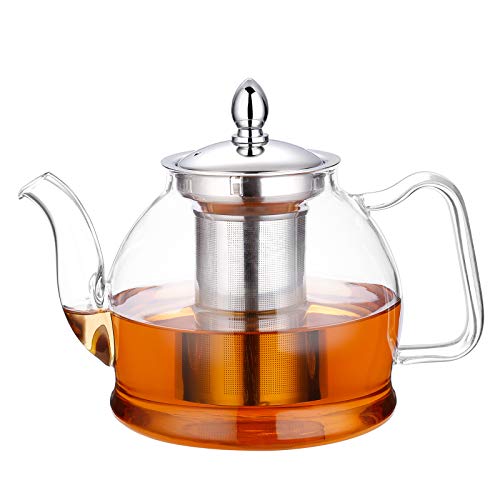
- HIWARE 1000ml Glass Teapot with Removable Infuser — Check on Amazon
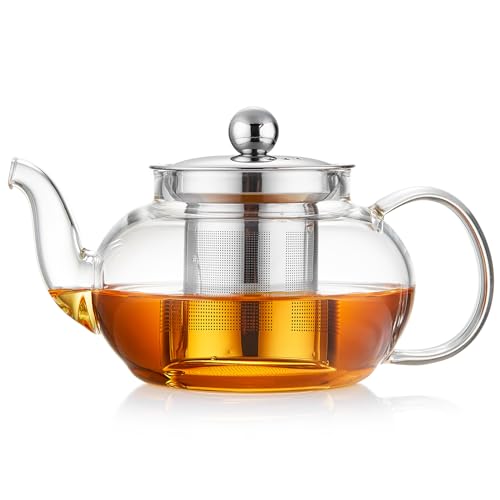
- PARACITY Glass Teapot Stovetop, 18.6 oz
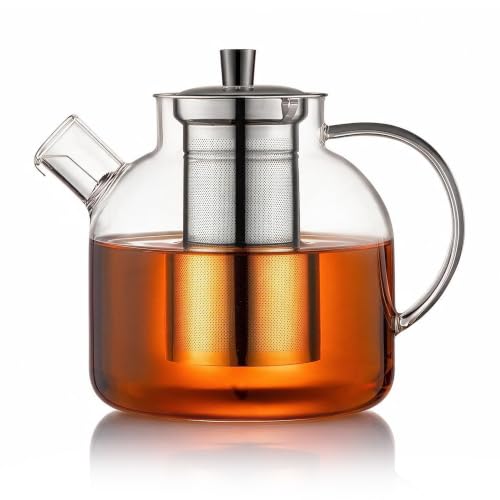
- Ehugos 1500ml Glass Teapot with Removable Infuser
- Teabloom Glass Teapot, 40 oz, with Glass Infuser
- DOPUDO Small Glass Teapot with Infuser, 18 oz
- STNTUS Glass Teapot, 40 oz, with Infuser and Strainer
Read the full guide ↓
Oolong is the tea that tests a teapot’s manners. Rolled oolong leaves arrive as tight pellets and leave as full, unfurled leaves many times their dry size, and they are brewed not once but repeatedly — the same leaves giving infusion after infusion, each a little different. The best teapots for oolong therefore need three things at once: a basket with genuine room for expansion, a clean lift-out so each short infusion can be separated from the leaves the moment it is ready, and a size that suits drinking in rounds rather than in one long soak. Every pot in this guide is a glass infuser pot for loose leaf tea, and glass brings oolong a particular gift: you can watch the leaves unfurl, which is both the pleasure of this tea and the most practical gauge of how far an infusion has progressed.
A word of honesty about tradition, as with any tea that has one. Gongfu brewing — the small-pot, high-leaf, many-infusions method developed for oolong — traditionally uses tiny clay pots or a gaiwan, and no pot in this guide pretends to be those. What these glass pots offer is the gongfu logic adapted to a Western kitchen: generous leaf, short timed infusions, leaves separated between rounds, and enough capacity to share the sequence with a friend. For the many drinkers who love oolong’s flavour but brew it alongside the rest of life, that adaptation is not a compromise — it is the version that actually happens daily. If you are comparing formats for other teas as well, our general guide to Best Teapots For Loose Leaf Tea sets out the shared fundamentals, while this page follows oolong’s specific demands.
Key Takeaways
- The HIWARE 1000ml glass teapot is our first choice for oolong at home: a roomy pot with a removable infuser and stovetop-safe glass per its listing, suited to shared rounds of repeated infusions.
- Expansion room is oolong’s first requirement — rolled leaves need a basket they can unfurl in without packing tight.
- Multiple infusions need a clean lift-out: every pick here has a removable infuser, so each round can be separated on time.
- Smaller pots suit concentrated solo sessions; the 40–50 oz pots suit sharing a long sequence with guests.
- Glass turns oolong’s unfurling into a visible brewing gauge — use it to judge each infusion.
In this guide
Quick Picks
| Pick | Badge | Capacity from listing | Infuser noted in listing | Link |
|---|---|---|---|---|
| HIWARE Glass Teapot | Best Overall | 1000ml | Removable infuser | Check on Amazon |
| PARACITY Glass Teapot | Best for Solo Sessions | 18.6 oz / 550ml | Removable 18/8 stainless steel infuser | Check on Amazon |
| Ehugos Glass Teapot | Best for Long Shared Sessions | 1500ml / 50 oz | Removable stainless infuser | Check on Amazon |
| Teabloom Glass Teapot | Best for Watching Leaves Unfurl | 40 oz | Removable glass infuser | Check on Amazon |
| DOPUDO Small Glass Teapot | Best Compact Pick | 18 oz / 530ml | Removable 18/8 steel infuser | Check on Amazon |
| STNTUS Glass Teapot | Best for Groups | 40 oz / 1200ml, 4–6 cups | Infuser with stainless steel strainer | Check on Amazon |
Badges reflect oolong fit — expansion room, infusion handling, and session style — rather than general teapot merit.
How These Picks Were Chosen
This is a research-led guide. We compared the verified listings in this glass teapot group and checked every specification quoted here against the listing title itself. For oolong, the weighting ran: basket format suitable for expanding leaves, lift-out cleanliness for repeated infusions, capacity spread from solo to shared sessions, and heating claims only where stated. Where a listing does not name its infuser’s material — the HIWARE listing, for instance — we say so plainly and judge the pick on the attributes its listing does support.
We also applied the same tradition-honesty filter used elsewhere in this series: these are modern glass pots for home oolong brewing, selected because their format supports the tea’s real requirements — room, separation, repetition — not because they imitate traditional vessels. A drinker whose practice deepens toward formal gongfu may add a gaiwan or small clay pot later; nothing bought from this guide becomes useless when that happens, because a glass pot remains the household’s general brewer. The related discipline of timed steeping is developed further in Best Teapots For Steeping Tea, which oolong drinkers will find directly relevant.
The 6 Best Teapots for Oolong
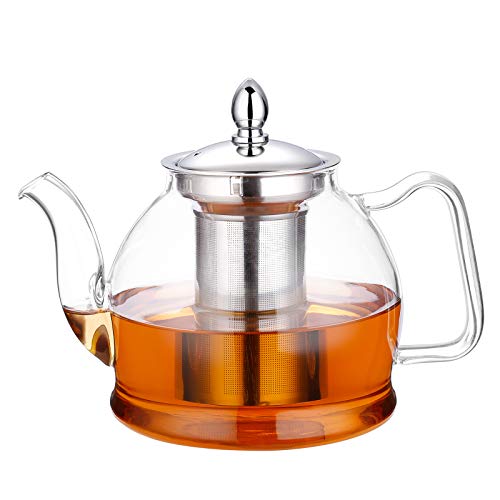
HIWARE 1000ml Glass Teapot with Removable Infuser
Badge: Best Overall
Strengths
- 1000ml body gives rolled oolong leaves the water volume and basket context to open properly across a session.
- Removable infuser makes the repeated lift-out rhythm of oolong brewing simple.
- Listing states stovetop-safe glass, so fresh hot water for later infusions can be heated in the same vessel between rounds.
Trade-offs
- The listing does not state the infuser material.
- A litre is generous for a concentrated solo session; solo drinkers will brew it part-full.
- Like all glass, it asks for careful handling around the sink.
Mini spec box: Capacity 1000ml · Removable infuser · Stovetop safe per listing · Made for blooming and loose leaf tea.
The HIWARE leads because oolong sessions are usually shared and always sequential. A litre pot lets two or three drinkers move through several infusions of the same leaves without the brewer constantly returning to the kettle, and the removable infuser performs the one action oolong cannot do without: separating leaf from liquor cleanly, round after round. Through the glass you watch the rolled leaves open across the session — tight in the first infusion, half-open by the third, fully unfurled near the end — and that visual record tells you where the leaves are in their life better than any timer.
Who it suits: oolong drinkers who brew for two or more, and solo drinkers who enjoy long sessions. The honest limitation is concentration: gongfu-style brewing uses a high leaf-to-water ratio in a small vessel, and a litre pot brewed part-full approximates rather than replicates that. For flavour-first home brewing, though, its combination of room, separation, and same-vessel reheating is the most complete in this guide.
Best for: shared oolong sessions with repeated infusions / Not suited for: strict traditional gongfu practice.
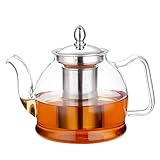

PARACITY Glass Teapot Stovetop, 18.6 oz
Badge: Best for Solo Sessions
Strengths
- Removable 18/8 stainless steel infuser stated in the listing — clean separation and fine filtration for broken leaf between rounds.
- Compact 18.6 oz / 550ml size supports the higher leaf-to-water ratio solo oolong brewing rewards.
- Borosilicate glass shows the leaves opening infusion by infusion.
Trade-offs
- The small basket is the tightest here for very large rolled leaves; dose bulky oolongs modestly.
- One drinker’s volume; sharing means small cups and frequent rounds — which oolong tolerates, but guests should expect it.
- Small pots cool faster across a long session.
Mini spec box: Capacity 18.6 oz / 550ml · Borosilicate glass · Removable 18/8 stainless steel infuser · For blooming and loose leaf tea · Camping and travel positioning.
For the solo oolong drinker, the PARACITY’s proportions are the argument. A smaller water volume against a generous measure of leaf is the home brewer’s route to gongfu-like concentration, and the stated steel infuser lifts out cleanly between the short infusions that method runs on. Watching a rolled oolong open inside 550ml of clear water, round by round, is the closest this guide comes to the meditative core of oolong practice — and the pot’s travel positioning means the ritual can go where you go.
Who it suits: solo drinkers who brew oolong attentively and often. The honest limitation is basket room for the largest rolled styles: if your favourite oolong unfurls into very big leaves, dose a little lighter so the leaves can move, or step up to the HIWARE’s volume. Judged on its own terms — concentration, separation, clarity — it is the connoisseur’s pick in this set.
Best for: concentrated solo oolong sessions / Not suited for: sharing with several guests.

Ehugos 1500ml Glass Teapot with Removable Infuser
Badge: Best for Long Shared Sessions
Strengths
- 1500ml / 50 oz — enough volume for a table to travel through a whole oolong session together.
- Removable stainless infuser stated in the listing.
- Stovetop safe per listing, useful for keeping fresh hot water coming across many infusions.
Trade-offs
- Large volume dilutes the concentration purists prize; use a generous leaf dose to compensate.
- Hand-crafted large glass is delicate and heavy when full.
- Overkill for solo brewing.
Mini spec box: Capacity 1500ml / 50 oz · Removable stainless infuser · Stovetop safe per listing · Hand crafted · For blooming and loose leaf tea.
Some oolong drinking is an event: friends, a special tea, and an hour of infusions. The Ehugos is built for that table. Fifty ounces means the session never stalls for want of water volume, the stainless infuser keeps the repeated separations clean, and stovetop-safe glass lets the brewer refresh the heat in the serving vessel itself. Brewed with a confident hand — plenty of leaf, infusions kept short — a big pot can hold its quality across a long session surprisingly well.
Who it suits: hosts and households who make oolong a social ritual. The honest limitation is the solo and purist cases: concentration is harder to achieve at this scale, and no one should buy a 50 oz pot for a daily solo habit. As the session pot alongside a smaller daily brewer, it completes the set.
Best for: long, shared oolong sessions / Not suited for: solo concentration brewing.

Teabloom Glass Teapot, 40 oz, with Glass Infuser
Badge: Best for Watching Leaves Unfurl
Strengths
- Removable glass infuser inside glass walls — nothing between your eye and the leaves opening.
- Stovetop and microwave safe per listing; a 2-in-1 kettle and tea maker format.
- Includes 2 blooming teas per the listing, a bonus for visual tea drinking generally.
Trade-offs
- Glass infuser slots are typically less fine than steel mesh — less relevant for oolong’s large leaves than for fine teas.
- Glass components need careful handling.
- 40 oz suits small groups rather than concentrated solo brewing.
Mini spec box: Capacity 40 oz · Removable glass infuser · Stovetop and microwave safe per listing · Includes 2 blooming teas · 2-in-1 kettle and tea maker.
If oolong is partly a spectator sport for you — and for many drinkers it honestly is — the Teabloom is the seat with the best view. The all-glass path means a rolled oolong’s slow unfurling is fully visible from the first infusion to the last, and that spectacle doubles as information: leaf expansion is the session’s progress bar. At 40 oz it pours for a small group, and its flexible heating claims make water management across rounds easy.
Who it suits: visual brewers and small-group hosts. The honest limitation is that glass-on-glass components ask for a careful hand at the sink, and the filtration trade-off, while minor for oolong’s large leaves, exists. For this tea specifically, the trade is well judged — oolong is the family least troubled by a glass infuser and most rewarded by transparency.
Best for: watching and sharing oolong’s unfurling / Not suited for: rough-and-tumble daily handling.


DOPUDO Small Glass Teapot with Infuser, 18 oz
Badge: Best Compact Pick
Strengths
- Compact 18 oz / 530ml body for concentrated one-to-two-person oolong brewing.
- Removable 18/8 steel infuser stated in the listing — precise separation for short infusions.
- Listing frames it for individual loose-leaf brewing, matching the solo session pattern.
Trade-offs
- Small basket: very bulky rolled leaves need a modest dose to expand freely.
- No stovetop claim in the listing; heat water in a kettle — which suits oolong’s temperature adjustments anyway.
- Not a serving pot for groups.
Mini spec box: Capacity 18 oz / 530ml · Borosilicate glass · Removable 18/8 steel infuser · Sized for individual brewing.
The DOPUDO makes the same solo argument as the PARACITY with a dedicated-brewer emphasis: a compact pot, a stated steel infuser, and a size that encourages the generous leaf dosing oolong loves. Its natural home is a permanent oolong corner — desk, counter, or tea tray — where the same leaves are re-infused through a working morning or a quiet evening. The kettle-based routine suits oolong well, since later infusions often want water a touch hotter than the first.
Who it suits: dedicated solo oolong drinkers with a fixed brewing spot. The honest limitation mirrors the PARACITY’s — basket room for the biggest leaves, and no hospitality capacity. Between the two small steel-infuser pots, choose by which design you would rather handle daily; functionally they are close cousins, and both serve this tea properly.
Best for: a permanent solo oolong station / Not suited for: groups or the bulkiest leaves at full dose.

STNTUS Glass Teapot, 40 oz, with Infuser and Strainer
Badge: Best for Groups
Strengths
- Infuser plus a stainless steel strainer stated in the listing — clean pours even as leaves break down in later infusions.
- 40 oz / 1200ml listed at 4–6 cups, the group size for a shared session.
- Stovetop safe per listing for easy water refreshment.
Trade-offs
- Two filtration parts to rinse after long sessions.
- Group volume works against concentrated brewing unless the leaf dose rises with it.
- Large format for a solo drinker.
Mini spec box: Capacity 40 oz / 1200ml · 4–6 cups per listing · Infuser with stainless steel strainer · Stovetop safe per listing · For loose tea.
Long oolong sessions have a housekeeping problem: by the fifth infusion, leaves shed fragments, and pours can carry debris. The STNTUS answers with its second line of defence — the stainless steel strainer behind the infuser — keeping group pours clean from the first round to the last. Forty ounces at four to six cups matches the social session exactly, and stovetop-safe glass keeps the water supply simple for the brewer playing host.
Who it suits: groups who brew oolong together and drinkers who value a clean final pour. The honest limitation is the extra part to wash and the concentration ceiling of any large pot. For the household whose oolong is a shared evening ritual, those are fair trades. More group-oriented options are surveyed in Best Teapots For Tea Lovers.
Best for: clean pours across long group sessions / Not suited for: concentrated solo brewing.
Comparison Table
| Pick | Capacity | Filtration from listing | Heating noted in listing | Link |
|---|---|---|---|---|
| HIWARE | 1000ml | Removable infuser | Stovetop safe | Check on Amazon |
| PARACITY | 18.6 oz / 550ml | 18/8 stainless steel infuser | Stovetop format | Check on Amazon |
| Ehugos | 1500ml / 50 oz | Stainless infuser | Stovetop safe | Check on Amazon |
| Teabloom 40 oz | 40 oz | Glass infuser | Stovetop and microwave safe | Check on Amazon |
| DOPUDO | 18 oz / 530ml | 18/8 steel infuser | Heat water separately | Check on Amazon |
| STNTUS | 40 oz / 1200ml | Infuser plus steel strainer | Stovetop safe | Check on Amazon |
How to Choose a Teapot for Oolong
Expansion room first. Rolled oolong is the most dramatic expander in the tea world. Dry pellets should sit loosely in the basket — as a working rule, no more than about a third of its volume — or the leaves will pack, channel the water, and extract unevenly. Strip-shaped oolongs are less extreme but still swell substantially. If your favourite style is a tightly rolled ball oolong, weight basket room as heavily as capacity itself.
Separation second. Oolong is brewed in sequences, and each infusion must end decisively. A removable infuser that lifts cleanly, drains quickly, and can sit somewhere sensible between rounds is the mechanism of the whole method. Test your candidate pot mentally: five lift-outs in an hour, each one-handed while you hold a cup in the other. The pot that makes that easy is the pot that fits oolong.
Size by session style. Concentrated solo brewing — high leaf, small water, many rounds — points to the 18 oz steel-infuser pots. Shared sessions point to 1000ml and above, with the leaf dose scaled up to keep the liquor honest. The error to avoid is the middle compromise used at full volume with a solo-sized dose: thin tea and tired leaves.
Water logistics matter. A long session drinks a lot of hot water. Stovetop-safe listings let you refresh heat in the pot itself; a kettle alongside does the same job with more temperature control. Either way, plan the water before the guests arrive — oolong sessions stall when the brewer is forever waiting on a boil.
Think in tiers qualitatively. Compact steel-infuser pots sit at the accessible end, versatile mid-size pots in the middle, and large hand-crafted or presentation pots at the premium end. For oolong, spend first on the basket and the right size; the tea itself will consume the rest of your budget happily for years.
How to Brew Oolong in an Infuser Teapot
- Warm the pot and cups with hot water and discard it — oolong is served in small volumes that lose heat quickly.
- Add a generous measure of leaf to the basket; oolong rewards a fuller basket than other teas, while still leaving room to expand.
- Rinse the leaves with a splash of hot water and discard it immediately — this wakes the leaves and washes away dust.
- Fill with hot water — near boiling for roasted oolongs, a little cooler for greener, lightly oxidised styles — and steep briefly, well under a minute for the first infusions of rolled teas.
- Lift the basket out completely, drain briefly, and pour the round in full. Do not leave liquor sitting on the leaves.
- Return the basket and repeat, adding a little time to each subsequent infusion and refreshing the water’s heat as needed.
- Continue until the leaves give a pale, thin infusion — good oolongs give many rounds; let the leaves, watched through the glass, tell you when they are spent.
Troubleshooting. Problem: the first infusion tastes harsh → shorten it, or cool the water slightly for greener styles. Problem: infusions taste thin despite generous leaf → the basket is likely overpacked and channelling; dose a little less so water can circulate. Problem: later infusions turn flat early → refresh with hotter water and give them more time; leaves need increasing encouragement as the session progresses.
Green Oolongs Versus Roasted Oolongs in the Pot
Oolong spans a spectrum, and the two ends brew differently enough to matter. Green, lightly oxidised oolongs — the floral, buttery styles — want slightly cooler water, shorter infusions, and gentle handling; their leaves open into large, soft leaves that fill a basket completely, so expansion room is critical and the small pots must be dosed with restraint. Roasted oolongs — darker, toastier, more forgiving — accept water near boiling, give their flavour generously, and suit the bigger pots and longer shared sessions. A household that drinks both ends should own its pot decision from the green end: the pot that gives green oolong room and control will handle roasted oolong without complaint, while a pot bought only for roasted styles may crowd and overheat the delicate ones. Through glass, the two ends even look different — pale gold liquor and bright green leaves at one end, amber liquor and russet leaves at the other — and learning to read those colours is most of oolong literacy.
The Session Mindset: Brewing Oolong as a Sequence
New oolong drinkers often treat the first infusion as the tea and the rest as leftovers. Experienced drinkers know the session is the tea: the first infusion is aromatic and brisk, the middle infusions are the deepest and most balanced, and the late infusions soften into sweetness. Judged as a sequence, buying decisions change — the pot’s job is not to produce one perfect cup but to conduct five to eight good ones, which is why separation, water logistics, and the brewer’s comfort across an hour matter more than any single specification. Set the session up properly: leaves, hot water supply, cups warmed, the basket’s resting dish in place, and somewhere to pour off the rinse. Then let the sequence unfold without rushing it. The pots in this guide were chosen to support exactly that unhurried structure, at scales from one drinker to a table.
Serving Oolong to Guests Who Know It — and Guests Who Do Not
For guests who know oolong, the glass pot’s transparency is a shared pleasure: everyone can see the leaves’ state and anticipate each round. Serve in small cups, pour in full rounds, and let the session’s arc be the entertainment. For guests who do not know it, a brief framing helps — explain that the same leaves will be brewed repeatedly and that each cup will differ, then start with a friendly, roasted style whose flavour needs no education. The large pots earn their keep here: the Ehugos and STNTUS formats let the host brew generously without leaving the table to manage water. Either way, oolong’s built-in theatre — the unfurling leaves, the changing cups — makes it the easiest special tea to serve, provided the pot supports the sequence rather than fighting it.
Storing Oolong and Handling Leaves Between Sessions
Oolong keeps better than green tea but still rewards care: sealed, dark, dry, and away from strong aromas, with roasted styles more patient than green ones. Buy the green end in smaller quantities and drink it while it is vivid. Within a session, keep the drained basket covered between infusions so the leaves stay warm and moist rather than drying at the edges. Across days, do not stretch one dose of leaves over multiple days — a session’s leaves are finished when the session ends, both for flavour and for simple freshness. The spent leaves, fully unfurled, are also a diagnostic: even opening suggests even extraction, while leaves still balled at the session’s end suggest the basket was too crowded or the water too cool — information worth carrying into the next session’s dose.
Care and Cleaning for Oolong Pots
Oolong is kind to pots: it leaves less film than black tea and no stubborn residue, provided the basket is emptied the same day. Rinse pot and basket in hot water, brush the mesh gently if fragments lodge, and dry with the lid off. Roasted oolongs can leave an aroma in a basket that a rinse will not fully clear; a bicarbonate soak resets it before a delicate green oolong session. Glass’s neutrality is a genuine asset for drinkers who range across the oolong spectrum — nothing from yesterday’s roasted session should appear in today’s floral cup. Protect the pot from thermal shock in the usual way: warm before brewing, never plunge hot glass into cold water, and store it where heavier cookware cannot clip it.
Oolong Alongside Other Teas in One Household
Few households drink only oolong, and the pot bought for it will inevitably serve other teas. The good news is that oolong’s requirements — room, separation, visibility — are a superset of most teas’ needs, so an oolong-capable pot is a capable general pot. The adjustments are in technique, not equipment: less leaf and longer steeps for black teas, cooler water for greens, a prompt basket wash after anything spiced or smoked. Households that also drink fine-cut teas should note the filtration point in reverse: a basket roomy for oolong may be coarse for rooibos-style needles, which is why the stated steel-mesh small pots appear in this guide as the crossover picks. Our infusion-focused guide to Best Teapots For Infusion Tea Like Rooibos covers that fine end of the spectrum in detail.
Oolong Styles by Region: What Your Favourite Asks of the Pot
Oolong’s geography maps loosely onto brewing demands. High-mountain Taiwanese oolongs are typically green, tightly rolled, and intensely aromatic — they want the cooler end of oolong water, short infusions, and maximum expansion room, and they reward the small steel-infuser pots when brewed solo. Fujian’s roasted rock teas are darker and more mineral, comfortable with hotter water and longer sessions, and they suit the mid-size and large pots where a table can follow the session’s arc. Phoenix-style oolongs from Guangdong are famously aromatic and can turn assertive if over-steeped, so separation discipline matters more than size. Blended and flavoured oolongs — milk oolong styles and scented varieties — sit between the poles and forgive most reasonable routines. The lesson for buyers is to name your region before you name your pot: a drinker devoted to high-mountain teas should optimise for room and control at small scale, while a rock-tea household can optimise for volume and warmth across a long evening. One pot can serve both, but it should be chosen from the demanding end of your own shelf.
The Aroma Cup and Other Serving Traditions, Adapted
Traditional oolong service sometimes separates aroma from drinking — a tall aroma cup to smell, a small cup to drink from — because oolong’s fragrance is half its offering. A home brewer with a glass pot can honour the same instinct without special equipment: pour a little of each infusion into a warmed cup, lift it, and actually smell it before drinking, and notice how the fragrance migrates from floral to fruity to toasty across the session. The glass pot supports this contemplative layer better than opaque vessels do, because sight joins smell — the liquor’s deepening colour and the leaves’ progressive opening give the nose context. None of this is required for a good cup, but oolong is the tea that most rewards a minute of attention per infusion, and building that minute into your routine is the difference between drinking oolong and experiencing it. The pots in this guide, chosen for clean separation and visibility, are designed to make that minute easy to take.
Oolong for Beginners: A Gentle Entry Point
Beginners are often told oolong is an expert’s tea, which is half true and wholly unhelpful. The forgiving entry is a roasted oolong in a mid-size pot: water near boiling, a moderate dose, infusions of half a minute or so, and no anxiety — roasted styles forgive timing errors that would punish a green tea. Brew the same leaves four or five times in that first session and taste the arc; that single experience teaches more than any article, including this one. From there, move toward the green end gradually, shortening infusions and cooling the water a little, and use the glass to watch what changes. Equipment-wise, a beginner needs nothing beyond one pot from this guide, a kettle, and a small notebook’s worth of curiosity. The HIWARE pattern — roomy, separable, reheatable — is the most forgiving classroom; the small steel-infuser pots are where the same drinker graduates to concentration and precision. Start where your confidence is, and let the tea set the syllabus.
Buying Oolong Itself: Freshness, Form, and What to Ask
The pot can only express what the leaf contains, so a short word on buying oolong belongs in any honest guide. Prefer suppliers who name the tea’s style and region and sell in quantities you will finish while it is lively — green oolongs fade fastest and deserve small, frequent purchases, while roasted styles keep more patiently. Rolled oolongs should look tight and uniform; strip styles should look intact rather than dusty. Store as you would any fine tea: sealed, dark, dry, and far from the spice rack. When a session disappoints, run the diagnostic in order — leaf age, dose, basket room, water heat, infusion time — before questioning the pot, because in practice the pot is the least variable part of the system. The drinkers who get the most from the equipment in this guide are the ones who treat leaf buying as part of the same craft as brewing.
Oolong Across the Day and the Year
Oolong’s versatility shows in how it colonises a drinker’s calendar. A concentrated solo session suits the morning’s quiet; a shared pot suits the afternoon; roasted styles sit comfortably alongside food in the evening in a way delicate greens do not. Across the year, green oolongs sing in spring when their floral character matches the season’s appetite, while roasted oolongs come into their own in colder months when their warmth is welcome. Iced oolong, brewed strong and chilled or cold-brewed slowly in a large glass pot, is a summer revelation — smooth, fragrant, and entirely without bitterness when the basket is lifted before chilling. The pot ladder in this guide maps onto that calendar: small pots for the concentrated mornings, the litre class for afternoons, the big vessels for iced batches and gatherings. Owning the size that matches your commonest season is the practical goal; the rest can be improvised with second brews.
How Oolong Drinkers Actually Use Two Pots
Talk to households where oolong is a serious habit and a two-pot pattern usually appears. The small pot — an 18 oz steel-infuser brewer like the PARACITY or DOPUDO — handles the concentrated solo sessions where the drinker is studying a tea: high dose, short rounds, full attention. The large pot — the HIWARE, STNTUS, or Ehugos — handles the social sessions where the tea is the accompaniment rather than the subject: lower concentration, longer rounds, conversation in the foreground. Neither pot is the backup for the other; each is the specialist for its session type, and both get used weekly. If your oolong life contains both session types, buying the pair deliberately beats buying one mid-size pot that serves each session adequately and neither beautifully. Start with the pot for your commonest session, add the second when the other session starts feeling compromised, and you will have assembled, in two purchases, what many drinkers take years of compromise to learn.
Troubleshooting a Whole Oolong Session
Individual infusions have their fixes, covered earlier; whole sessions have patterns worth recognising. A session that starts wonderful and fades by the third infusion usually has a water problem — the supply cooled, so later rounds under-extract; keep the kettle cycling or use a stovetop-safe pot to refresh heat between rounds. A session that starts harsh and mellows suggests the early infusions were too hot or too long for a green style — begin gentler, since you can always add heat and time later but cannot remove them. A session that never lifts at all, across every adjustment, is usually telling you about the leaf rather than the brewing: age and storage flatten oolong in ways no technique reverses. And a session where every infusion differs wildly points to an overpacked or under-filled basket channelling the water — reset the dose, give the leaves room, and the sequence will stabilise. Reading a session this way, as a narrative with a cause, is the skill that separates experienced oolong drinkers from recipe followers, and a clear glass pot — where dose, expansion, and colour are all visible — is the best classroom for learning it.
A Final Note on Patience
Oolong is the tea of patience — leaves that open slowly, sessions that unfold over an hour, skills that build over months. The pot you choose should support that tempo rather than rush it, and every pick in this guide does its part: room to open, clean separation, and a clear view of the process. Buy the size that matches your sessions, brew attentively, and let the leaves set the pace.
Common Buying Mistakes
- Under-dosing a big pot. Large volumes need proportionally generous leaf, or every infusion tastes like a rumour.
- Packing the basket tight. Rolled leaves need room; a jammed basket extracts unevenly and can taste harsh and thin at once.
- Leaving liquor on the leaves between rounds. Each infusion must be fully separated, or the session’s timing collapses.
- Judging oolong by its first infusion alone. The middle rounds are the tea’s centre; a pot should be assessed across a whole session.
- Using one water temperature for the whole spectrum. Green oolongs want restraint; roasted oolongs want heat. Adjust per tea, not per habit.
Final Recommendation
For most oolong drinkers, start with the HIWARE 1000ml glass teapot: room for the leaves, clean separation for the rounds, and water heated in the same vessel. Whichever pot you choose, judge it across a complete session with a tea you know well — first infusion to last — because oolong equipment proves itself over sequences, not single cups, and a pot that conducts a whole session gracefully has earned its place regardless of where it sits in the range. Choose the PARACITY or DOPUDO for concentrated solo sessions — both state steel infusers in compact bodies — the Ehugos or STNTUS for long shared sessions, and the Teabloom when watching the leaves unfurl is half the point. Give any new pot a full session with a tea you know before judging it; oolong reveals equipment slowly, across infusions, exactly as it reveals itself.
Frequently Asked Questions
What makes a teapot good for oolong specifically?
Room for rolled leaves to expand, a removable infuser that separates each infusion cleanly, and a size matched to your session style. Oolong is brewed repeatedly from the same leaves, so the pot’s job is conducting a sequence, not making a single steep.
How many infusions should oolong give?
Good oolong commonly gives several — often four to eight depending on the tea, the dose, and the water. Increase the steep time gradually across the session and refresh the water’s heat; the leaves are spent when an infusion comes out pale and thin despite a longer steep.
Can I brew oolong in a glass teapot?
Yes — glass is neutral, rinses clean between sessions, and shows the leaves unfurling, which helps you judge each infusion. Traditional clay pots and gaiwans remain the formal tools of gongfu practice, but a glass infuser pot handles home oolong brewing very well.
What water temperature suits oolong?
Near boiling for roasted oolongs, and somewhat cooler for green, lightly oxidised styles. If a green oolong tastes harsh, cool the water slightly; if a roasted oolong tastes muted, use it hotter and give the infusion a little more time.
Why does my oolong taste weak in a large teapot?
Almost always dose: large volumes need proportionally more leaf. Oolong’s home method uses a generous leaf-to-water ratio; a litre pot with a small-pot dose will taste thin no matter how long it steeps.
Should oolong leaves be rinsed?
A brief rinse with hot water, discarded immediately, is customary: it warms and wakes the leaves and washes away surface dust. It also gives you a first look at how the leaves will open, which informs your dosing for the session.
What size teapot is best for oolong for one person?
A compact pot in the 18 oz class, brewed with a generous dose, gives the concentration solo oolong rewards. The PARACITY and DOPUDO in this guide are built to that pattern.
Can I cold-brew oolong?
Yes — oolong cold-brews beautifully. Put the leaves in the basket, fill the pot with cold water, and refrigerate for several hours. The result is smooth, sweet, and fragrant, with none of the bitterness hot brewing can produce. Large glass pots suit the method because the batch is generous and the colour developing through the fridge door is part of the pleasure.