Disclosure: topratedkitchenware.com is reader-supported. When you buy through links on our site, we may earn an affiliate commission from Amazon and other retailers, at no extra cost to you.
Where to buy
All six pots in this guide to the best teapots for tea and coffee are sold through Amazon, linked below. Every one is a glass teapot with a removable infuser — the configuration that earns a place in a two-drink household, because the same vessel that steeps loose leaf tea can heat the water for pour-over coffee, steep coarse-ground coffee immersion-style, and serve either drink at the table without carrying flavours the way porous materials do. Read the full guide below for an honest account of what a teapot does well for coffee, where it genuinely cannot compete with dedicated coffee gear, and how to run one pot for both drinks without every cup tasting faintly of the other.
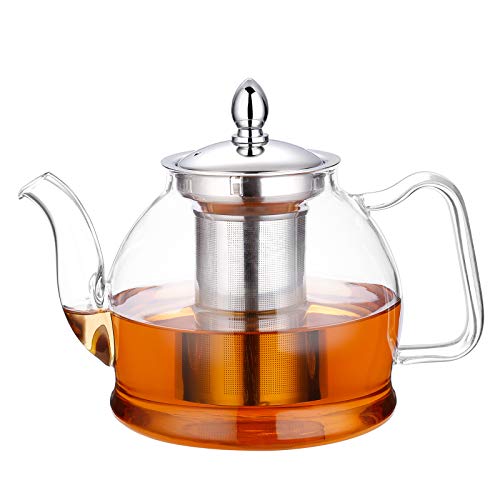
- Ehugos Glass Teapot with Removable Infuser, 1500 ml / 50 oz — Check on Amazon
- Teabloom Stovetop & Microwave Safe Glass Teapot, 40 oz
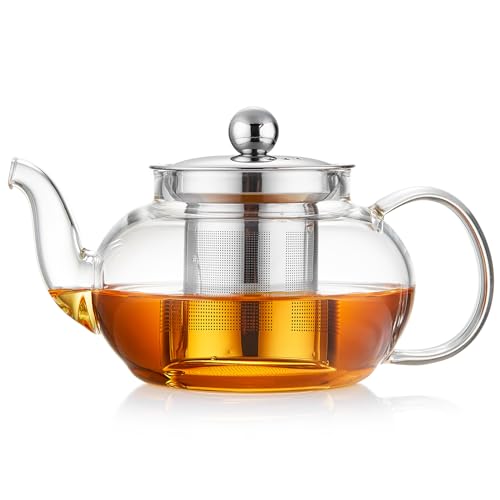
- DOPUDO Small Glass Teapot with Infuser, 18 oz / 530 ml
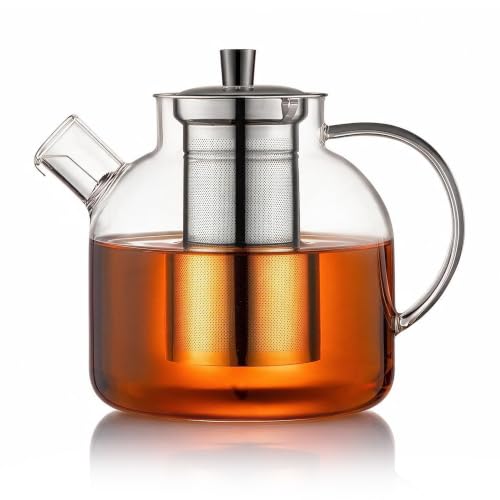
- STNTUS Glass Teapot, 40 oz / 1200 ml, Stovetop Safe
- Enchanti Tea Pot, One Touch Glass Teapot with Infuser, 27 oz / 800 ml
- Teabloom Celebration Glass Teapot & Kettle, 27 oz
Read the full guide ↓
Most kitchens that run on hot drinks are divided households. One person measures loose leaf by the spoon and talks about water temperature; the other grinds beans before they are fully awake and regards tea as hot leaf water. The best teapots for tea and coffee are the peace treaty in that kitchen: a single glass vessel, honest about both jobs. For tea, the case is straightforward — an infuser pot is the native tool, and every pick here is built for loose leaf and blooming teas. For coffee, the case needs care, and this guide makes it carefully. A glass teapot is an excellent water heater and server for pour-over coffee, a workable immersion brewer for coarse grounds that you steep and strain, and a poor substitute for a French press, a moka pot, or any espresso machine — there is no plunger and no pressure, and we will not pretend otherwise. What it offers instead is range: one pot, on one burner, covering the morning’s coffee and the afternoon’s tea, in glass that rinses clean of coffee oils instead of hoarding them. If that is the flexibility your counter is missing, start with our first choice, the Ehugos 1500 ml, and read on for the six ways this pool divides the work.
Key Takeaways
- Glass is the right shared material for a two-drink pot: it does not absorb coffee oils or tea tannins, so a proper wash fully resets it between drinks.
- For coffee, these pots shine as stovetop water heaters and servers for pour-over, and as steep-and-strain immersion brewers for coarse grounds — not as French press or espresso substitutes.
- Capacity splits the pool: the Ehugos at 1500 ml serves a mixed table; the DOPUDO at 18 oz serves one person both drinks across the day.
- The Teabloom 40 oz, with its glass infuser, is the easiest pot to keep flavour-neutral between tea and coffee duty.
- Flavour discipline matters more than gear: rinse promptly, deep-clean the infuser weekly if it sees coffee, and never let coffee sit in the pot into the afternoon tea hour.
- Four of the six listings claim stovetop safety, which is what lets the pot heat pour-over water in the same vessel you then brew or serve in.
In this guide
Quick Picks
| Pick | Badge | Capacity | Coffee role | Link |
|---|---|---|---|---|
| Ehugos Glass Teapot | Best Overall for Two-Drink Households | 1500 ml / 50 oz | Heats and serves for a full table | Check on Amazon |
| Teabloom Glass Teapot 40 oz | Best for Flavour Purity | 40 oz | Glass infuser rinses neutral fastest | Check on Amazon |
| DOPUDO Small Glass Teapot | Best for One Person, Both Drinks | 18 oz / 530 ml | Solo steep-and-strain cups | Check on Amazon |
| STNTUS Glass Teapot | Best for the Daily Rotation | 40 oz / 1200 ml | Spout strainer catches coffee sediment | Check on Amazon |
| Enchanti Tea Pot | Best One-Touch Convenience | 27 oz / 800 ml | Tea-first pot that serves coffee drinkers at the table | Check on Amazon |
| Teabloom Celebration | Best for Serving and Showing | 27 oz | Stovetop kettle duty plus table service | Check on Amazon |
Every badge here is awarded on the two-drink brief: how the pot handles tea is table stakes, so the badges grade the coffee side, the changeover between drinks, and the size of the audience.
How These Picks Were Chosen
This guide is research-led. We worked from a verified pool of glass teapots, read every maker’s listing in full, and recorded only what the listings state — capacities, infuser materials, stovetop and microwave claims, and how each pot is positioned. No specification in this article comes from anywhere else, and a sources file behind the article lists each product title we relied on, checked on the date recorded there.
The two-drink brief imposed three tests beyond ordinary teapot quality. The first was the changeover test: how completely can this pot be reset from coffee to tea? Glass bodies pass by nature, since glass is non-porous; the differences live in the infuser, where glass beats mesh for shedding coffee oils, and in the hardware count, where every extra strainer is one more part to wash between drinks. The second was the water test: can the pot heat its own water? A teapot that is stovetop safe doubles as the kettle for pour-over coffee, which is the single most valuable coffee job a teapot can do, so listings claiming stovetop safety scored accordingly — and where a listing makes no such claim, as with the DOPUDO and the Enchanti, we say so in the review and frame the pot as a brewer and server used with separately heated water. The third was the honesty test: we looked for any temptation to oversell the coffee side and resisted it in writing. None of these pots presses, pumps, or pressurises, and the reviews below keep the coffee claims to what immersion steeping, water heating, and serving can truthfully deliver. Readers whose households lean harder toward the tea side of the treaty may also enjoy Best Teapots For Tea Lovers, where this same pool is graded purely as an enthusiast’s tea tool.
One more consideration shaped the ranking: the order of the morning. In most two-drink homes coffee goes first, because coffee drinkers are in a hurry and tea drinkers are brewing a ritual. A pot that serves the day well must therefore survive being a coffee vessel at dawn and a tea vessel by eleven without carrying the dawn into the eleven o’clock cup — which is why the changeover test, not any single brewing test, sits at the top of our method, and why the final ranking rewards the pots that reset fastest and most completely.
We also weighed the social reality of the purchase. A two-drink pot is usually bought by one partner for a shared kitchen, often as a gift, and it succeeds if both people actually use it. That favoured clear glass — coffee drinkers trust what they can see, tea drinkers watch leaves and blooms — and capacities that map onto real rounds: a mug for one, a pot for two, a full vessel for a table where both drinks are poured from the same hand.
The 6 Best Teapots for Tea and Coffee
Six glass pots, one shared brief. Read the badges as job assignments: each pot has a role in a two-drink kitchen, and the reviews say plainly where each one’s coffee duty ends.

Ehugos Glass Teapot with Removable Infuser, 1500 ml
Badge: Best Overall for Two-Drink Households
Strengths
- The pool’s largest capacity at 1500 ml / 50 oz — enough to pour tea for some and coffee-service water for others from a single heating.
- Stovetop safe per the maker listing, so it heats the water it then brews or serves with; one vessel covers the kettle’s job too.
- Removable stainless infuser keeps loose leaf contained for tea and coarse grounds contained for immersion coffee.
Trade-offs
- Full, it is a heavy two-handed pour in glass; fill to the round you are serving, not to the brim by habit.
- The listing does not grade the infuser’s steel, and coffee oils are harder on hardware than tea — the weekly deep-clean in our care section matters here.
- Its size is wasted on a solo drinker; the DOPUDO below exists for that kitchen.
Mini spec box
- Capacity: 1500 ml / 50 oz
- Body: glass, stovetop safe per maker listing
- Infuser: stainless, removable (grade not stated in listing)
- Positioned for: large pots of blooming and loose leaf tea
Picture the weekend breakfast this pot was born for: one person wants a proper pot of loose leaf, another wants pour-over coffee, a third will take whichever is ready first. The Ehugos heats a litre and a half of water on the stove; part of it goes through the coffee dripper, the infuser goes into the rest, and both drinks reach the table from one heating, one vessel, one wash-up. That is the whole two-drink argument at its most practical, and no smaller pot in this pool can run it. For immersion coffee — coarse grounds steeped in the infuser and lifted out — the capacity also forgives experimentation: there is room for a generous coffee-to-water ratio without crowding the basket. The honest limitations are weight and hardware care. A full 1500 ml of water in glass is a committed lift, and coffee will test the ungraded stainless infuser with oils that tea never produces; rinse it the same hour and deep-clean it weekly, as our how-to section describes, and it will stay neutral. Households that entertain across the drinks divide could pair this pick with the serving ideas in Best Teapots For Tea Lovers, since a big clear pot at a brunch table tends to convert the curious in both directions.
Best for: mixed households and brunch tables / Not suited for: solo drinkers or anyone who dislikes a heavy pour

Teabloom Stovetop & Microwave Safe Glass Teapot, 40 oz
Badge: Best for Flavour Purity
Strengths
- Glass infuser instead of metal mesh: coffee oils rinse off glass completely, so the afternoon tea tastes like tea, full stop.
- Stovetop and microwave safe per the listing — heat water on the burner for pour-over, or in the microwave for a single mug’s worth.
- Arrives with two blooming teas, and the all-glass brew path is the prettiest way to watch them open.
Trade-offs
- Glass infusers filter less finely than steel mesh, so immersion coffee from fine grounds will carry sediment; grind coarse.
- The glass infuser wants careful handling at the sink, especially with wet, soapy hands.
- At 40 oz it serves two drinkers well but will not run a full mixed table alone.
Mini spec box
- Capacity: 40 oz
- Body: glass, stovetop and microwave safe per maker listing
- Infuser: removable glass infuser
- Includes: 2 blooming teas
- Positioned as: 2-in-1 tea kettle and tea maker
Flavour carryover is the quiet killer of two-drink arrangements: the tea that tastes faintly of breakfast coffee, the coffee with a ghost of yesterday’s jasmine. It happens in porous materials and in fine mesh that traps oils, and the Teabloom is engineered around the problem — an all-glass brew path that a hot rinse genuinely resets. That makes it the purist’s pick for households where the same pot brews coffee in the morning and a delicate white or green tea later, the drinks most easily bullied by residue. Its heating flexibility is the other half of the appeal: the listing claims both stovetop and microwave safety, so it can be the pour-over kettle at breakfast and the quick single-cup heater at midnight. The trade-offs are real but narrow. Immersion coffee must be ground coarse, because a glass infuser will not strain like fine mesh, and the infuser itself is the most delicate object in this guide. If your household’s drinks are bold — black tea, dark roasts — carryover barely registers and the Ehugos’s capacity may serve you better; if your teas are subtle and your coffee is daily, this is the pot that keeps the peace. Community threads collected under Best Teapots Reddit return to this exact pot style whenever the topic is one vessel for both drinks, usually for the same glass-on-glass reason.
Best for: flavour-sensitive drinkers alternating drinks daily / Not suited for: fine-ground immersion coffee or rough handling


DOPUDO Small Glass Teapot with Infuser, 18 oz
Badge: Best for One Person, Both Drinks
Strengths
- Compact 18 oz / 530 ml borosilicate pot sized for one person’s mug — the natural unit of a work-from-home drinks routine.
- Removable 18/8 steel infuser, a well-graded stainless that handles both tea leaves and coarse coffee grounds.
- Small size is a changeover virtue: it washes and dries in a minute, so coffee at nine never haunts tea at three.
Trade-offs
- Its listing makes no stovetop claim, so plan on heating water separately — a kettle for the pour-over, then the pot for steeping and serving.
- Strictly solo capacity; a second drinker means a second brewing.
- Small glassware lives dangerously on crowded desks; give it a coaster corner of its own.
Mini spec box
- Capacity: 18 oz / 530 ml
- Body: borosilicate glass (no stovetop claim in listing)
- Infuser: removable 18/8 steel
- Positioned for: individual loose leaf tea brewing
The DOPUDO is the two-drink pot for a household of one — or for the one serious drinker in a household of the indifferent. Its working day writes itself: morning coffee steeped coarse in the infuser and poured over a mug, a rinse at the sink, and by afternoon the same little pot is brewing loose leaf at a desk, with no flavour debt carried between the two because the whole thing washes in under a minute and the 18/8 infuser sheds oils honestly. The absence of a stovetop claim in its listing is the one planning constraint, and we flag it rather than smooth it over: this pot is a brewer and server, not a kettle, so it pairs with whatever already heats your water. For a solo drinker that is barely a compromise — the kettle was already on the counter — and in exchange you get the pool’s tidiest footprint and its fastest changeover. It is also the natural travel-brain choice for a second home or a studio kitchen, a context our rust-focused sister guide explores for its sibling pots under Best Teapots For Stove No Rust.
Best for: solo drinkers running both drinks daily / Not suited for: couples, or anyone wanting to heat water in the pot

STNTUS Glass Teapot, 40 oz / 1200 ml
Badge: Best for the Daily Rotation
Strengths
- Stovetop safe per the listing at a true daily size — 40 oz, framed by the maker as four to six cups.
- Infuser plus a stainless steel strainer at the pour: the second filter is genuinely useful for immersion coffee, catching sediment the basket lets through.
- Glass body resets fully between drinks with a normal wash.
Trade-offs
- Two hardware pieces means the longest wash-up of the pool when changing drinks — rinse both, every time.
- The listing does not grade the strainer’s steel, so coffee oils demand the prompt-rinse habit.
- Mid-size compromise: not the biggest for parties, not the smallest for a desk.
Mini spec box
- Capacity: 40 oz / 1200 ml
- Body: glass, stovetop safe per maker listing
- Hardware: infuser with stainless steel strainer
- Positioned for: loose tea, four to six cups
If the two-drink pot in your house will work every single day rather than perform at weekends, the STNTUS is the configuration to beat. Its quiet advantage for coffee is the strainer at the spout: immersion coffee’s one flaw is sediment in the cup, and this pot filters twice — once at the infuser, once at the pour — which produces a noticeably cleaner cup from coarse grounds than any single-basket pot in this pool. For tea the same arrangement forgives broken leaf and bag drinkers who tear the bag. The size is the daily sweet spot: enough for a couple’s morning in either drink, small enough that brewing fresh beats reheating. The cost of the double filtration is a double wash, and in a two-drink household the wash is the ritual that protects the next drink, so treat the extra thirty seconds as the subscription fee for the cleaner cup. The ungraded strainer steel asks for the same prompt-rinse discipline as the Ehugos’s infuser. Households comparing traditional alternatives for the table might browse Best Teapots From England for the classic shapes, but for the daily rotation — coffee, rinse, tea, rinse, repeat — this modern glass workhorse is the pragmatic centre of the pool.
Best for: daily two-drink households that value a clean cup / Not suited for: anyone who resents washing two filter pieces

Enchanti Tea Pot, One Touch Glass Teapot with Infuser, 27 oz
Badge: Best One-Touch Convenience
Strengths
- Positioned by its maker as a one touch tea maker — the convenience-first design in the pool for loose leaf without ceremony.
- 27 oz / 800 ml is the two-mug size: enough for a couple, or for one tea drinker hosting one coffee drinker at the table.
- Sold as a tea gifts set, so it arrives dressed for giving — a realistic way two-drink pots enter mixed households.
Trade-offs
- Its listing makes no stovetop claim; treat it as a brewer and server with water heated separately.
- It is the most tea-first design here — coffee duty is serving and table duty rather than brewing, unless you steep coarse grounds in the infuser.
- Gift-set positioning means part of what you pay for is presentation rather than capacity.
Mini spec box
- Capacity: 27 oz / 800 ml
- Body: glass
- Infuser: included, for loose leaf tea
- Positioned as: one touch tea maker, tea gifts set
Every pool needs the pot that gets chosen by the person who does not read guides — and in two-drink households that person often buys the Enchanti, because it is packaged as a gift and promises loose leaf tea without a learning curve. Its role in this guide is honest and specific: it is a tea-first brewer whose 27 oz of clear glass also serves a coffee drinker gracefully at the table — hot water for a dripper, a serving vessel that looks intentional next to a cafetière, a pot that makes the tea drinker’s ritual look like hospitality rather than a separate hobby. You can steep coarse coffee in its infuser, and for an occasional cup that works; as a daily coffee brewer, the stovetop pots above are stronger. What the Enchanti does best is lower the temperature of the whole negotiation: it is pretty, it is simple, it arrives gift-ready, and it asks nothing of the coffee drinker while giving the tea drinker a proper loose leaf tool. If your household’s divide is less about brewing science than about counter diplomacy, start here — and if you are shopping for where such sets sit alongside traditional pots, Best Place To Find Teapots maps the wider landscape.
Best for: gifts and tea-first households adding coffee service / Not suited for: daily coffee brewing or stovetop heating
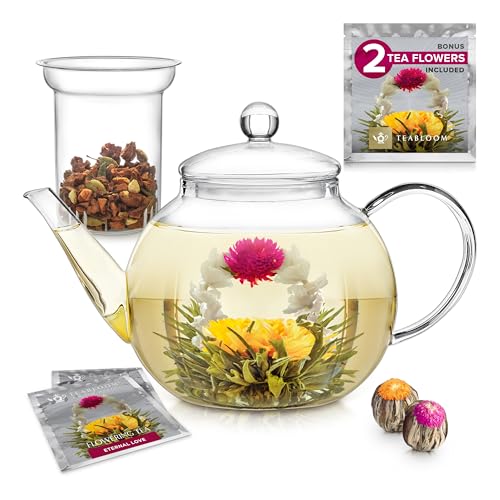
Teabloom Celebration Glass Teapot & Kettle, 27 oz
Badge: Best for Serving and Showing
Strengths
- Stovetop and microwave safe per the listing, with heat-resistant glass — it heats water like a kettle, then stays on the table as the server.
- Removable glass infuser keeps the brew path all-glass and flavour-neutral between drinks.
- Includes two blooming teas and is built for loose leaf, bagged, and blooming tea alike — the most versatile tea brief in the pool.
Trade-offs
- 27 oz is a two-person ceiling; it will not carry a full table the way the Ehugos does.
- The glass infuser, as with its larger sibling, filters less finely than mesh — grind coffee coarse.
- Showpiece glass invites careful handling; it is not the pot to hand to a chaotic kitchen.
Mini spec box
- Capacity: 27 oz
- Body: heat-resistant glass, stovetop and microwave safe per maker listing
- Infuser: removable glass infuser
- Includes: 2 blooming teas
- Positioned for: loose leaf, bagged, and blooming tea
The Celebration is the smaller Teabloom, and in a two-drink kitchen it plays the kettle-server role better than anything else here. Because its listing claims stovetop safety, it heats the pour-over water; because the infuser is glass and removable, the same vessel then brews a blooming tea that performs through the clear wall while the coffee drinker is still on their first cup. That sequence — kettle, then showpiece — is the two-drink ritual at its most graceful, and the included blooming teas mean the performance can start the day the box opens. Its limits are the family’s limits: a glass infuser that wants coarse coffee and gentle hands, and a 27 oz capacity that suits a couple rather than a crowd. Choose it when the table is small and the ritual matters; choose its 40 oz sibling when flavour purity at a larger size matters more, and the Ehugos when the headcount does. As a gift into a divided household it is arguably the safest object in this guide — beautiful enough to be welcomed by the tea drinker, useful enough at breakfast to be forgiven by the coffee drinker.
Best for: couples who love the ritual and the show / Not suited for: large tables or fine-ground coffee
Comparison Table
| Pick | Capacity | Heats its own water | Infuser | Best two-drink role | Link |
|---|---|---|---|---|---|
| Ehugos | 1500 ml / 50 oz | Yes — stovetop safe | Stainless | Full-table water heating and brewing | Check on Amazon |
| Teabloom 40 oz | 40 oz | Yes — stovetop and microwave | Glass | Flavour-neutral daily alternation | Check on Amazon |
| DOPUDO | 18 oz / 530 ml | No claim — heat separately | 18/8 steel | Solo desk rotation | Check on Amazon |
| STNTUS | 40 oz / 1200 ml | Yes — stovetop safe | Infuser plus spout strainer | Cleanest immersion coffee cup | Check on Amazon |
| Enchanti | 27 oz / 800 ml | No claim — heat separately | Infuser, one touch design | Tea-first gift and table service | Check on Amazon |
| Teabloom Celebration | 27 oz | Yes — stovetop and microwave | Glass | Kettle-to-table ritual for two | Check on Amazon |
The “heats its own water” column is the one to shop by if pour-over coffee is part of your morning: a stovetop-claimed pot replaces the kettle, while the two unclaimed pots simply ask you to keep the kettle you already own.
How to Choose a Teapot for a Tea-and-Coffee Household
Start by deciding which coffee job you actually need the pot to do, because the three jobs are not interchangeable. If the job is heating water for a pour-over dripper, you need a stovetop claim and a capacity that covers your dripper’s brew — four of these six pots qualify, and the Ehugos and STNTUS do it at family scale. If the job is brewing coffee in the pot itself, you are really choosing an immersion brewer: grounds steep in hot water inside the infuser and are lifted out, which wants coarse grounds, a few patient minutes, and the finest filtration you can get — the STNTUS’s double filter wins that specific contest, while the glass-infuser Teablooms trade a little sediment for perfect flavour neutrality. If the job is serving — carrying coffee or coffee water to the table in something that matches the tea service — then every pot here qualifies and you should choose on looks, size, and how it feels in the hand of the person who pours.
Next, audit your changeover tolerance honestly. The household that rinses the pot the moment it empties can run any configuration in this pool, including the double-hardware STNTUS. The household that leaves the morning pot in the sink until evening should buy glass-on-glass — a Teabloom — because dried coffee oil in a steel mesh infuser is exactly how a tea pot acquires a permanent coffee accent. There is no shame in either household; there is only mismatch, and mismatch is what this choice is really about.
Finally, size for the overlap, not the extremes. The pot gets used most on ordinary mornings when one or two people drink, sometimes the same drink, sometimes not. That is why the 27–40 oz middle of this pool will suit most readers, why the Ehugos earns its place for genuine multi-drinker homes, and why the DOPUDO — so easy to dismiss as small — is the right answer for the very common case of one person who drinks both, at a desk, all day. If your search widens beyond glass, the sourcing notes in Best Place Tp Find Teapots explain what to verify on any listing before trusting it with two drinks.
How to Run One Pot for Both Drinks: The Daily Method
- Heat water in the pot if its listing claims stovetop safety, on medium heat; otherwise heat in your kettle and pour into the warmed pot.
- For tea: add the infuser and leaves once the water is at your tea’s temperature, steep off the heat, and lift the infuser out the moment the tea is ready — never leave leaves sitting while coffee is discussed.
- For pour-over coffee: use the pot purely as your kettle, pouring in a slow spiral over the dripper; the glass spout control on these pots is genuinely adequate for the job.
- For immersion coffee: coarse grounds go in the infuser, hot water over them, steep several minutes, lift the infuser slowly and let it drain, then pour — through the STNTUS’s strainer if yours has one — and expect a cup closer to a cafetière in spirit than to filter coffee.
- The changeover wash: empty the pot completely, rinse pot and infuser hot, and wash with a soft sponge and ordinary detergent. Glass needs no ceremony — just completeness. Nothing may sit.
- Weekly, if the infuser sees coffee: a soak in warm water with a little baking soda lifts the oil film that daily rinsing misses, and keeps the next delicate tea honest.
- Store the pot empty, dry, and with the lid ajar. A pot stored dry and open wakes up neutral; a pot stored closed and damp wakes up with opinions.
Troubleshooting
Problem: the tea tastes faintly of coffee → the infuser is holding oil. Deep-clean it with the baking soda soak, rinse the pot hot, and brew a throwaway cup of hot water through the empty infuser before the next real tea.
Problem: immersion coffee is muddy → the grind is too fine for an infuser. Go coarser, let the pot rest a minute before pouring so sediment settles, and pour in one slow motion rather than topping up the cup twice.
Problem: coffee brewed in the pot tastes weak → immersion needs time and a generous ratio. Steep longer before lifting the infuser, and use more coffee rather than finer grounds, which only adds mud.
What a Teapot Cannot Do for Coffee (and Why That Is Fine)
A teapot has no plunger, so it cannot press grounds the way a cafetière does; no sealed chamber, so it cannot build the pressure espresso is defined by; and no shower head or bloom valve, so it cannot replicate a machine’s extraction. Immersion coffee from an infuser pot is its own honest style — full-bodied, forgiving, a little sediment-prone — with a lineage older than most coffee gadgets, closer to the cupping bowl and the campfire pot than to the café. Households that need espresso still need an espresso machine, and this guide will not talk them out of one. What the teapot replaces is the second kettle, the second server, and the second ritual competing for the same burner and the same shelf — and in most two-drink kitchens, that consolidation, not any single cup, is the actual prize.
A Realistic Two-Drink Day, Run From One Pot
Guides are easy; Tuesday is the test. So here is the shared pot’s actual working day in a house where one person drinks coffee and the other drinks tea, using the stovetop mid-size configuration most readers will buy. At seven, the pot goes on the burner with water for two. The coffee drinker gets the first pour through a dripper — or, on the immersion plan, the coarse grounds go into the infuser while the tea drinker is still deciding between the black tea and the green. By half past, both drinks exist, the infuser is in the sink rather than in the pot, and the pot itself has been rinsed while it was still warm, which is when rinsing is effortless. At eleven the pot heats water again, this time purely for tea; because the morning’s coffee never sat in it, the green tea tastes like green tea, a small sentence that represents the entire value of the system. Mid-afternoon, someone makes coffee again — immersion this time, because the dripper’s papers ran out, which is the kind of improvisation a versatile pot quietly absorbs. The pot is washed properly at the end of the day, two minutes with a sponge, and stored open. Nothing in that day required talent. It required a pot that heats, steeps, strains, and rinses — and a household agreement that the rinse is part of the recipe.
Notice what the day did not include: no reheating of stale drinks, because the pot was sized to the rounds actually drunk; no flavour archaeology, because nothing was left to sit; and no second vessel colonising the counter, which in a small kitchen is not an aesthetic preference but a spatial fact. Scale the day up to the Ehugos and it becomes a weekend with guests. Scale it down to the DOPUDO and it becomes one person’s desk, with the same rhythm in miniature. The method survives scaling because it was never really about the pot — it is about treating one good vessel as the kitchen’s hot-drinks department and running it with a little rhythm.
Why Glass Wins the Shared Pot Job (and Where It Loses)
The alternatives deserve their hearing. A stainless steel teapot is tougher than anything in this pool and brews tea beautifully, but it hides its interior: you cannot see whether coffee oil is building in the seams, and in a shared pot, unverifiable cleanliness becomes a recurring argument that glass simply deletes — the pot is visibly clean or visibly not. Ceramic is flavour-neutral and lovely, but it is opaque for the same reason, heavier at these capacities, and its infusers are often the coarsest of all. Cast iron is a commitment object: magnificent heat retention, real presence, and a seasoning-and-drying discipline that makes the glass pot’s rinse-and-store routine look like nothing; it is also the worst imaginable vessel to ask to alternate with coffee, since its interior care rules are written entirely around tea. Plastic-bodied brewers are light and cheap in spirit even when not in price, and they hold odours in a way that ends the two-drink experiment within a week.
Where glass loses, it loses honestly: it can break, it holds heat less long than iron or a double wall, and it asks for medium heat and a trivet rather than a slammed-down landing on a cold counter. Those are handling costs, paid in attention. What it returns is the only brew path in the category that is simultaneously non-porous, visible, neutral, and — in the stovetop-claimed picks — able to heat its own water. For a pot whose entire job is to be trusted by two different drinkers, trust is the specification that matters, and glass is the material that can be verified at a glance, every single time.
Common Buying Mistakes
- Expecting French press results from an infuser pot. There is no plunger; plan for steep-and-strain coffee and grind coarse.
- Grinding fine for immersion brewing, then blaming the pot for mud. The filter you have decides the grind you need.
- Letting coffee sit in the pot until the afternoon and brewing tea in the residue. The changeover wash takes two minutes; skipping it costs the whole concept.
- Assuming every glass teapot can heat water on the stove. Two pots in this pool make no stovetop claim — check the listing, not the silhouette.
- Buying the biggest pot for a two-person rotation, then reheating stale coffee and stewed tea all day instead of brewing fresh at the right size.
- Storing the pot closed with the infuser inside after coffee day. It wakes up smelling of coffee, and so does the next tea.
Final Recommendation
For the typical divided household, buy the Ehugos 1500 ml: it heats the water, brews the tea, serves the coffee drinkers, and does it all at a size that ends the two-kettle era. If your teas are delicate and your changeover discipline is shaky, choose the Teabloom 40 oz instead and let its glass infuser forgive what your routine will not. Solo drinkers should take the DOPUDO and its one-minute wash; sediment-averse immersion brewers should take the STNTUS and its double filtration; gift-givers should take the Enchanti or the Celebration and let presentation do the persuading. One pot can absolutely serve two drinks — provided you ask it to do the jobs it is actually built for.
Frequently Asked Questions
Can you really brew coffee in a teapot?
Yes, by immersion: coarse grounds steep in the infuser in hot water and are lifted out, producing a full-bodied cup with a little sediment — similar in spirit to a cafetière without the plunger. What a teapot cannot do is espresso or true press coffee, and any guide claiming otherwise is selling you something.
Will coffee ruin the pot for tea?
Not in glass. Coffee oils cling to mesh infusers and porous materials, but a glass body rinses completely clean, and a weekly baking soda soak keeps a steel infuser neutral. The Teabloom pots, with glass infusers, are the most forgiving of all.
Which of these pots can heat water for pour-over coffee?
The four whose listings claim stovetop safety: the Ehugos, the Teabloom 40 oz, the STNTUS, and the Teabloom Celebration — the two Teablooms add microwave safety as well. The DOPUDO and Enchanti listings make no stovetop claim, so pair them with a kettle.
What grind should I use for coffee in an infuser pot?
Coarse — the coarsest you have. Infusers and spout strainers are not paper filters, and fine grounds will pass through as sediment and over-extract into bitterness while they sit. Coarse grounds steep cleanly and lift out tidily.
Is a glass teapot better than a metal one for two drinks?
For the changeover, yes: glass is non-porous, shows you exactly how clean it is, and carries no flavour between drinks. Metal pots brew tea perfectly well but hold coffee oils in seams and mesh more stubbornly, and they hide residue you cannot see.
Should we keep separate infusers for tea and coffee?
You can, and in a high-volume household it is a tidy solution — one basket that only ever sees coffee, one that only sees tea. But with glass bodies and a real changeover wash it is a luxury rather than a necessity, and with the glass-infuser Teabloom pots the question disappears entirely, since there is no mesh to dedicate. Start with one infuser and honest washing; dedicate a second only if your teas are delicate and your coffee is daily and dark.
How big should a two-drink pot be?
Match it to the number of drinkers at the shared moment, not the total household. One person: the DOPUDO’s 18 oz. Two people: the 27–40 oz middle of the pool. A full mixed table: the Ehugos at 1500 ml, the only pot here that heats and serves for everyone at once.