Disclosure: topratedkitchenware.com is reader-supported. When you buy through links on our site, we may earn an affiliate commission from Amazon and other retailers, at no extra cost to you.
Where to buy
These are the verified picks for this guide. Each linked name goes to its Amazon listing, where you can check the latest price on Amazon and confirm the current configuration before you decide.
- Oklahoma Joe’s Highland Reverse Flow — Best Overall
- Oklahoma Joe’s Longhorn — Best for Large Brisket Cooks
- Oklahoma Joe’s Highland — Best Classic Offset
- Realcook 800 Offset — Best for Backyard Parties
- Royal Gourmet CC1830S — Best Workstation Layout
- Dyna-Glo Wide Body Vertical Offset — Best Vertical Footprint
Start with our top pick: Check on Amazon. Read the full guide ↓ for the detailed reviews, the buying checklist, and the how-to layer.
The search for the best texas charcoal smokers starts with a style, not a product. Texas charcoal smoking — above all in its Central Texas form — is a discipline of restraint: beef seasoned boldly but simply, smoke from a clean wood-and-charcoal fire, heat held low and steady for as long as a brisket demands, and no sauce doing the work the fire should have done. The cooker that serves that style is the offset: a firebox on the side, a chamber for the meat, and a cook who manages the space between them. All six picks in this guide are charcoal offset smokers in that tradition.
A note on honesty before the ranking. None of these cookers is presented here as being from Texas, and this guide makes no origin claims for any product — the listings themselves do not make them either. Texas in this guide names the cooking style you are shopping for: offset geometry, charcoal and wood fire, brisket-first capacity, and the patience the method requires. Judged on those terms, the pool sorts cleanly, from the big reverse flow flagship down to a vertical smokehouse design that takes the style onto small patios.
What separates the picks is how each one handles the three problems every Texas-style cook faces. First, evenness: a brisket is thick at one end and thin at the other, and a chamber with a harsh hot spot punishes that shape. Second, capacity: packer briskets are long, ribs are longer, and party cooking stacks items across a whole day. Third, fire control: charcoal gives the base heat, wood gives the smoke, and the cooker’s firebox design decides how gracefully you can tend both without disturbing the meat. Every review below scores its pick against those three problems and names the trade-offs plainly.
Readers building a Texas setup on a budget will also want the price-tier shortlists in this cluster, such as Best Offset Smokers Under $300 and Best Offset Smokers Under $400, while readers who want the style without the price lens can go straight to Best Texas Offset Smokers. This guide stays with the charcoal question itself: which of these six cookers runs a Texas fire best.
Read the Quick Picks for the shortlist, then the detailed reviews before you decide. In Texas cooking the cooker is only half the equation — the other half is a clean fire and the discipline to leave the lid closed — but the right half makes the other half much easier to learn.
Key Takeaways
- Texas here names a cooking style — offset geometry, charcoal and wood fire, brisket-first cooking — not a claim about where any product is made.
- The Highland Reverse Flow leads on evenness and size: 1,093 sq. in. with a baffle that smooths the chamber from end to end.
- Classic offsets like the Longhorn and the standard Highland keep the natural temperature gradient, which skilled cooks use deliberately.
- Stated capacity runs from 783 to 1,093 sq. in.; the vertical Dyna-Glo states no figure in its title, so verify its dimensions before buying.
- Charcoal is the heat foundation and wood splits are the smoke; every pick here is built for that partnership.
- Work surfaces matter on brisket day — the Royal Gourmet’s front and side tables are a real advantage, not trim.
In this guide
Quick Picks
| Pick | Badge | Cooking area | Why it stands out | Link |
|---|---|---|---|---|
| Oklahoma Joe’s Highland Reverse Flow | Best Overall | 1,093 sq. in. cooking area | Reverse flow design routes heat and smoke under a baffle before it crosses the food, evening out the chamber | Check on Amazon |
| Oklahoma Joe’s Longhorn | Best for Large Brisket Cooks | 1,060 sq. in. cooking area | 1,060 sq. in. of cooking area, a close second in this pool, in a classic long offset layout | Check on Amazon |
| Oklahoma Joe’s Highland | Best Classic Offset | 900 sq. in. cooking area | 900 sq. in. is honest brisket-plus capacity in the pool’s most classic offset format | Check on Amazon |
| Realcook 800 Offset | Best for Backyard Parties | 800 sq. in. cooking space | 800 sq. in. of cooking space, stated plainly in its title, sized for a brisket plus party extras | Check on Amazon |
| Royal Gourmet CC1830S | Best Workstation Layout | 783 sq. in. cooking area | Front and side tables build the serving and staging surface right into the cooker | Check on Amazon |
| Dyna-Glo Wide Body Vertical Offset | Best Vertical Footprint | vertical wide-body chamber (area not stated in its title) | Vertical wide-body design stacks cooking space upward, saving patio floor area | Check on Amazon |
How These Picks Were Chosen
This is a research-led guide. Picks come from the verified pool for this category, every Amazon link uses an ASIN confirmed against listing data, and every specification in a spec box appears in the product’s own title or listing details. No hands-on claims are invented, no cooking-area figure is guessed, and where a title is silent — the vertical Dyna-Glo gives no square-inch number — the review says so and tells you what to check instead.
The Texas lens set the weighting. Brisket capacity and chamber evenness lead, because those decide whether the style’s signature cook succeeds. Fire access and work surfaces follow, because a fourteen-hour cook is an endurance event for the cook as well as the meat. Badges were assigned after ranking, and each review carries three honest trade-offs. A pick can be excellent and still be wrong for you; the trade-off lists are where that judgment lives.
The style itself was treated with the same care as the products. Texas charcoal smoking is described here as a method — offset fire, simple seasoning, smoke as an ingredient — and never as a marketing origin for a cooker whose listing does not claim one. That restraint is deliberate: a guide that invents heritage for products would soon invent specifications too, and this one does neither.
The 6 Best Texas Charcoal Smokers, Reviewed
Six charcoal offsets, six ways to run a Texas fire. The flagship evens the chamber for you; the traditionalists hand the job to your skill; the party and workstation picks optimize the day around the cook. Choose by the problem you most want solved.

Oklahoma Joe’s Highland Offset Reverse Flow Charcoal Smoker and Grill
Badge: Best Overall
Texas brisket is a long argument between fire and time, and the Highland Reverse Flow is built to settle it evenly. Its reverse flow design sends heat and smoke from the firebox beneath a baffle plate, across the full length of the chamber, and only then up through the cooking space — so the end of the chamber far from the fire cooks much closer to the firebox end than on a standard offset. For brisket, where one end drying out while the other lags is the classic frustration, that evenness is the whole point.
Strengths
- Reverse flow design routes heat and smoke under a baffle before it crosses the food, evening out the chamber
- 1,093 sq. in. is the largest cooking area in this pool — true multi-brisket room
- Offset charcoal format is the classic Texas working layout: fire in the box, meat in the chamber
Trade-offs
- The biggest cooker here needs the biggest patio footprint and the most fuel per session
- Reverse flow baffles add a surface to clean and keep seasoned
- Even heat reduces the hot-end gradient some cooks like to exploit for different cuts
| Type | Reverse flow offset charcoal smoker and grill |
|---|---|
| Model line | Highland |
| Cooking area | 1,093 sq. in. |
| Color | Black |
At 1,093 square inches, this is the pool’s largest cooking area, and it changes what a Texas-style session can be: two packer briskets laid flat with airflow between them, or one brisket with pans of beans and rows of sausage sharing the smoke. Charcoal forms the steady base of the fire, wood splits ride on top for the post-oak-style smoke character Texas cooking is known for, and the reverse flow path smooths the spikes that fire tending usually creates. You still tend the fire — this is an offset, not an appliance — but you tend it to maintain, not to rescue.
Choose the Highland Reverse Flow if brisket is your main event and consistency across the whole chamber is what you are buying. It suits cooks graduating from smaller offsets who have felt the hot-end problem personally and want the design that answers it.
Best for: brisket-focused cooks who want the most even chamber and the most room / Not suited for: small patios or cooks who only smoke one small cut at a time

Oklahoma Joe’s Longhorn Offset Charcoal Smoker and Grill
Badge: Best for Large Brisket Cooks
The Longhorn is the traditionalist’s pick: a long, classic offset with 1,060 square inches of cooking area and nothing between the fire and the food but distance and smoke. That direct path creates the gradient old-school Texas cooks grew up managing — hotter near the firebox, gentler at the far end — and in skilled hands the gradient is not a flaw but a tool, letting one chamber hold a brisket point, a flat, and a pan of beans each in the zone that suits it.
Strengths
- 1,060 sq. in. of cooking area, a close second in this pool, in a classic long offset layout
- Traditional direct-path airflow keeps the firebox-end gradient that experienced pitmasters cook with deliberately
- Smoker and grill combo covers brisket days and direct-heat days with one unit
Trade-offs
- Classic offset airflow means a real temperature difference between the firebox end and the far end
- Large chamber and long cooks mean generous charcoal and wood consumption
- No reverse flow baffle, so evenness is the cook’s job, not the design’s
| Type | Offset charcoal smoker and grill |
|---|---|
| Model line | Longhorn |
| Cooking area | 1,060 sq. in. |
| Color | Black |
Charcoal anchors the fire with steady heat while wood splits supply the smoke, and the Longhorn’s length gives that smoke time to settle and mellow before it leaves. Brisket cooks will appreciate the room to keep the point toward the heat and the flat away from it, rotating once if the cook calls for it. Because there is no baffle doing the evening-out for you, your fire discipline shows directly in the result — which is exactly why traditionalists prefer it, and exactly why beginners should read the how-to section twice.
Pick the Longhorn if you want the classic Texas offset experience at near-maximum capacity and you trust your fire management more than a baffle. It is also the natural step for a cook moving up from the standard Highland who wants more room without changing style.
Best for: experienced cooks who want classic offset airflow and near-top capacity / Not suited for: beginners who want the cooker itself to even out temperatures

Oklahoma Joe’s Highland Offset Charcoal Smoker Grill
Badge: Best Classic Offset
If the reverse flow model is the Highland refined, this is the Highland original: 900 square inches, a side firebox, and the straightforward airflow that made the offset the default cooker of Texas-style backyard barbecue. It earns Best Classic Offset because it is the design in its purest form in this pool — no baffle, no twist, just a chamber, a fire, and a cook learning to run both.
Strengths
- 900 sq. in. is honest brisket-plus capacity in the pool’s most classic offset format
- Standard Highland layout is the reference design many Texas-style home cooks learn on
- Charcoal smoker and grill combo keeps weeknight grilling on the same unit
Trade-offs
- Smaller than the two picks above it, so double-brisket sessions are tighter
- Standard airflow keeps the firebox-end hot zone the cook must manage
- No reverse flow path; evenness comes from placement and rotation
| Type | Offset charcoal smoker grill |
|---|---|
| Model line | Highland |
| Cooking area | 900 sq. in. |
| Color | Black |
Nine hundred square inches hold a full packer with room for a water pan and a second, smaller item, which covers the great majority of real Texas-style home sessions: one brisket done properly beats two briskets done crowded. The charcoal fire responds predictably, wood splits add the smoke, and the hot end near the firebox sears sausage and finishes chicken while the far end treats brisket gently. Everything about the cook is manual, visible, and learnable — the feedback loop that turns a beginner into a pitmaster over a season of Saturdays.
Choose the standard Highland if you are buying your first serious offset for Texas-style cooking, or if you prefer the classic design’s simplicity and feedback. It is the pool’s teaching cooker and, for one-brisket households, very possibly its forever cooker too.
Best for: first-time offset buyers who want the classic design and honest capacity / Not suited for: cooks who regularly run two large briskets in one session

Realcook Charcoal Grill with Offset Smoker, 800 Sq. In.
Badge: Best for Backyard Parties
Texas barbecue is social food — brisket is sliced in front of people, not plated in private — and the Realcook 800 is the pool’s party pick. Its barrel chamber and 800 square inches of cooking space are sized for the real shape of a Texas-style gathering: a brisket smoking from morning, ribs joining at midday, sausage links filling the gaps, and the grill side ready when guests want something hot and fast.
Strengths
- 800 sq. in. of cooking space, stated plainly in its title, sized for a brisket plus party extras
- Barrel format gives a long, even lane for ribs and sausage rows
- Positioned for backyard parties and weekend gatherings, which is where Texas-style cooking lives socially
Trade-offs
- Smaller chamber than the Oklahoma Joe’s picks above it
- No baffle or reverse flow feature is named in its title
- Party-sized versatility means specialists may want a more single-minded brisket cooker
| Type | Charcoal grill with offset smoker |
|---|---|
| Format | Barrel offset smoker combo |
| Cooking space | 800 sq. in. |
| Use settings named | Backyard parties, weekend barbecues, gatherings |
The barrel lane suits the party menu: ribs lie flat in a row, sausages line up along the edges, and the offset firebox keeps smoke production separate from the food so you can open the chamber to serve without disturbing the fire. Charcoal keeps the base heat honest through a long afternoon of door openings — and party cooking means many door openings — while wood splits restore the smoke each time the fire is fed. It will not match the two big Oklahoma Joe’s models for sheer brisket volume, and this guide will not pretend otherwise; it trades that volume for a size and format that fit ordinary backyards and ordinary Saturdays.
Pick the Realcook if your Texas cooking is measured in guests fed rather than competitions entered. It is the right size for a household whose smoker works hardest on weekends with friends in the yard.
Best for: hosts cooking brisket, ribs, and sausage for backyard gatherings / Not suited for: high-volume cooks who need two-brisket capacity as a routine

Royal Gourmet CC1830S BBQ Charcoal Grill and Offset Smoker
Badge: Best Workstation Layout
The CC1830S is the organizer’s offset. Front and side tables, an adjustable charcoal pan, a side door for fire access, and a lid thermometer are all named in its title, and together they describe a cooker designed around the cook’s movements rather than just the meat’s. Texas-style sessions are long, and the difference between a calm cook and a chaotic one is usually staging: where the tray lands, where the knife lives, how fast you can reach the fire.
Strengths
- Front and side tables build the serving and staging surface right into the cooker
- Adjustable charcoal pan and side door give the cook direct, convenient fire access
- Lid thermometer is built in, a useful at-a-glance reference during long cooks
Trade-offs
- 783 sq. in. is the smallest chamber in this pool
- Built-in lid thermometers are a reference, not a replacement for a probe at grate level
- Wooden-style table surfaces and extra hardware ask for cover discipline in wet climates
| Type | Charcoal grill and offset smoker |
|---|---|
| Model | CC1830S |
| Cooking area | 783 sq. in. |
| Extras | Front and side table, side door, lid thermometer |
| Fire control | Adjustable charcoal pan |
| Use setting named | Outdoor camping |
The adjustable charcoal pan is the performance feature: raising or lowering the coal bed changes the fire’s intensity without rebuilding it, which helps when a brisket cook needs a gentle correction rather than a fresh chimney of coals. The side door makes that access cleaner still. The lid thermometer gives a quick chamber reference when you walk past — treat it as a trend indicator and confirm with a grate-level probe for decisions, a habit this guide recommends with every cooker here. At 783 square inches the chamber is the pool’s smallest, so plan one brisket at a time and let the tables carry the rest of the production.
Choose the CC1830S if your cooks are productions — multiple items staged, sliced, and served in sequence — and you want the cooker to provide the counter space. Solo brisket cooks and methodical hosts will feel the design working for them all day.
Best for: organized cooks who value work surfaces and easy fire access / Not suited for: cooks who need maximum chamber volume above all else
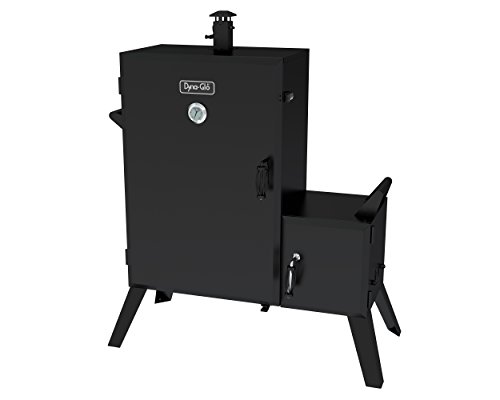
Dyna-Glo Wide Body Vertical Offset Charcoal Smoker
Badge: Best Vertical Footprint
Every other pick in this guide stretches horizontally; the Dyna-Glo Wide Body stands up. Its vertical offset design keeps the firebox at the side, as an offset should, but stacks the cooking chamber upward — a genuinely different answer for Texas-style cooks whose constraint is patio floor space rather than appetite. A wide-body vertical chamber holds a surprising amount of food on its levels, from ribs and chickens to pans of beans, without asking for a long stretch of deck.
Strengths
- Vertical wide-body design stacks cooking space upward, saving patio floor area
- Offset charcoal firebox keeps the classic smoke source separate from the food
- Vertical format suits hanging and multi-level cooking arrangements
Trade-offs
- Its title states no cooking-area figure, so verify dimensions against your cuts before buying
- Vertical chambers cook differently by level; food placement and rotation matter more
- Long, flat packer briskets may need trimming or creative placement compared with a long barrel
| Type | Wide body vertical offset charcoal smoker |
|---|---|
| Model | DGO1890BDC-D |
| Color | Black |
Heat and smoke rise through a vertical chamber, so levels cook at different rates and the cook manages that by placement: items needing more heat lower, delicate items higher, with a rotation midway for evenness. It is a different skill from barrel cooking — closer to running a smokehouse than a pit — and many cooks love it for exactly that reason. One honest caution for the brisket-first buyer: a whole packer is a long, flat cut, and a vertical chamber may ask you to trim or separate point and flat to fit it well. This guide flags that rather than discovering it for you on delivery day, and notes the title states no square-inch figure, so check the listed dimensions against the cuts you cook most.
Pick the Dyna-Glo if your patio is small, your menu is varied, and you like the smokehouse style of cooking on levels. Barrel traditionalists cooking whole packers every time should stay with the horizontal picks above it.
Best for: small patios and cooks who like multi-level vertical smoking / Not suited for: brisket purists who always cook whole, untrimmed packers
Comparison Table
| Pick | Badge | Cooking area | Standout feature | Link |
|---|---|---|---|---|
| Oklahoma Joe’s Highland Reverse Flow | Best Overall | 1,093 sq. in. cooking area | Reverse flow baffle, largest chamber | Check on Amazon |
| Oklahoma Joe’s Longhorn | Best for Large Brisket Cooks | 1,060 sq. in. cooking area | Classic long offset, near-top capacity | Check on Amazon |
| Oklahoma Joe’s Highland | Best Classic Offset | 900 sq. in. cooking area | The original Highland design | Check on Amazon |
| Realcook 800 Offset | Best for Backyard Parties | 800 sq. in. cooking space | Barrel format for parties | Check on Amazon |
| Royal Gourmet CC1830S | Best Workstation Layout | 783 sq. in. cooking area | Front and side tables, adjustable charcoal pan, lid thermometer | Check on Amazon |
| Dyna-Glo Wide Body Vertical Offset | Best Vertical Footprint | vertical wide-body chamber (area not stated in its title) | Vertical wide-body footprint | Check on Amazon |
Read the table as a map of philosophies: engineered evenness at the top, traditional gradient in the middle, and format answers — party barrel, workstation, vertical — for cooks whose constraints are space and workflow rather than chamber physics.
How to Choose a Texas-Style Charcoal Smoker
Decide how much evenness you want to buy and how much you want to earn. A reverse flow design spends engineering on a level chamber; a classic offset spends nothing and hands the gradient to you. Neither is cheating and neither is pure — they are different relationships with the fire. If your briskets keep finishing unevenly and it frustrates you, buy the baffle. If you enjoy reading a chamber and placing food by instinct, the classic design will feel like home, and the Longhorn and Highland above are its best expressions here.
Size for the brisket, then for the party. A single packer fits every pick in this guide. The real question is the second item: the ribs, the beans, the sausage, the second brisket on the big weekends. Stated areas run from 783 to 1,093 square inches; be honest about how often the big day actually happens. A cooker bought for a twice-a-year party and cursed the other fifty weekends for its size is a common and avoidable mistake. Readers weighing the bigger end of the market sometimes cross-check with Best Offset Smokers Under $2000 to see what the top tier adds.
Interrogate the firebox routine. You will add charcoal, add splits, and clear ash many times per cook. How does each design let you do that? A side door, an adjustable charcoal pan, and clean access turn those chores into rhythm; awkward access turns them into temperature crashes. In the store or on the listing, walk yourself through a midnight fuel addition in your head, in the dark, half asleep. The cooker that makes that moment easy is the cooker you will still love in year three.
Plan the slice-and-serve station. Texas brisket is carved to order, in front of guests, which means the cooker’s surroundings matter: a table for the board, room for trays, light after dark. The Royal Gourmet builds tables in; the others ask you to provide them. Either way, decide before the first cook, not during it.
Match the format to the patio. Long barrels need long walls; the vertical Dyna-Glo needs a fraction of the floor. Measure with the lid and doors open, allow clearance from anything combustible, and remember a hot firebox radiates — give it air on every side.
How to Cook Brisket, Texas Style, on a Charcoal Offset
Trim and season with restraint. Trim the packer to a smooth, aerodynamic shape, removing hard fat that will never render and squaring the flat so its edges do not scorch. Season the Texas way: coarse salt and coarse black pepper, applied evenly and given time to settle into the surface. The style’s confidence is that beef, smoke, fire, and patience need no help from a dozen spices.
Build a clean fire first. Start with a charcoal base, let it establish, then add wood splits and wait until the smoke runs thin and pale before the meat goes on. Thick white smoke at the start is unburned fuel looking for somewhere to deposit itself, and that somewhere will be your brisket. Put the meat on when the fire is honest, fat side oriented according to where your cooker’s heat pushes hardest, and close the lid with a plan to leave it closed.
Run the long middle patiently. Hold a low, steady cooking temperature, feed the fire in small amounts on a rhythm, and resist opening the chamber to admire the bark. When the bark is set and deeply colored and the cook reaches its natural stall — the long plateau where evaporation cools the meat — you may wrap in butcher paper, the Texas crutch, to push through while keeping the bark’s texture. Foil works faster but steams the bark soft; paper is the traditional compromise.
Finish by feel, rest like it matters. A brisket is done when a probe slides into the flat with almost no resistance, like warm butter — a tenderness test, not a number. Then rest it, wrapped, for a long, unhurried period. More briskets are ruined by impatient slicing than by any error at the fire. Slice the flat against the grain, turn the point and slice it the other way, and serve promptly.
Troubleshooting. Problem: bark tastes bitter and looks sooty → the fire smoldered; use drier wood, smaller splits, and more air, and wait for clean smoke before the meat goes on. Problem: the flat dries while the point is perfect → your chamber gradient is at work; position the point toward the heat next time, or choose the reverse flow pick if the pattern repeats. Problem: the cook runs hours long → check fuel quality, wind exposure, and how often the lid opened; long cooks are usually lost to small heat leaks repeated all day.
The Texas Charcoal Method: Fire, Wood, and Patience
Central Texas barbecue grew up around German and Czech meat markets, wood fires, and beef that needed nothing but smoke and time — and its modern backyard form keeps that skeleton. Charcoal’s role in it is worth understanding: a charcoal base gives the fire a steady, bankable heat that pure stick-burning demands constant skill to match, while wood splits burned on that base supply the smoke flavor that defines the style. It is a partnership, and every cooker in this guide is built for it.
Oak is the style’s signature smoke wood — clean, medium, and forgiving over very long cooks — with hickory and pecan as common variations and mesquite used sparingly for its intensity. Whatever you burn, dryness is non-negotiable: seasoned wood, split to a size that ignites fully, fed little and often. The smoke you want is nearly invisible; if you can see thick clouds, you are tasting them, and not in a good way.
The last ingredient is the one no listing can sell: patience structured as a schedule. Start earlier than feels reasonable. Build slack into the plan so the brisket rests while guests arrive, rather than the guests waiting while the brisket finishes. Texas cooks are famous for calm at serving time, and the calm is just arithmetic done the night before. Cooks who find the charcoal method demanding sometimes look at hybrid designs for weeknight relief — Best Grills That Can Be Charcoal And Electric is the cluster’s entry point for that comparison — but for brisket day, the live fire is the point.
Planning a Texas-Style Cookout Around One Smoker
A Texas-style gathering runs on the smoker’s timeline, so build the menu backwards from the brisket. The brisket starts early and rests long, which makes it the anchor; ribs need the middle hours; sausage needs only a short smoke and can fill gaps; beans improve by sitting under the meat and catching its drippings. Sequence those items on one chamber and a single cooker feeds a crowd in waves, each wave arriving as the previous one is sliced.
Think about holding as carefully as cooking. Rested brisket, kept wrapped and warm, is forgiving; sliced brisket is not — it dries and cools from the moment the knife moves. Slice to order, in batches the size of the line in front of you, and let the point wait whole until its turn. Set the carving board where guests can see it, because in this style the slicing is part of the hospitality.
Finally, plan the fire like a host, not just a cook. Stage charcoal and splits within arm’s reach before guests arrive, keep a water pan filled, and know your refuel rhythm so tending the fire looks like part of the show — because it is. The cooks who seem to socialize through an entire brisket day are not neglecting the fire; they have simply arranged everything so the fire needs them briefly, predictably, and never urgently.
Seasoning and Caring for a Charcoal Offset
Before its first brisket, every cooker in this guide deserves a proper seasoning burn. Wipe the interior down, coat the cooking surfaces lightly with a high-heat cooking oil, and run a moderate charcoal fire for a few hours with the chamber empty. The burn accomplishes three things at once: it clears away manufacturing residue, it lays down the first protective layer of polymerized oil on the steel and grates, and it teaches you — at zero risk to any meat — how your particular firebox responds when you feed it, starve it, and open its vents. Treat that first burn as rehearsal, because that is exactly what it is.
Routine care is mostly ash discipline. Ash looks harmless and is not: left sitting in a firebox it absorbs moisture from the air and holds that moisture against the steel, quietly corroding the part of the cooker that lives the hardest life. Once a fire is completely cold, empty the ash, brush the grates while they still remember the cook, and wipe grease from the chamber floor before it builds into a stale layer that flavors the next cook badly or, worse, catches. A few minutes after every session is the cheapest longevity any of these cookers will ever get.
Between cooks, store the smoker covered, in the driest spot your property offers, with enough ventilation that condensation does not turn the cover into a raincoat worn inside out. Check the firebox and the baffle — on the reverse flow pick — most often when you inspect, because those surfaces cycle the hottest. And keep a simple rhythm across the season: a deep clean and a light re-seasoning of the grates whenever cooks start tasting like the ghosts of previous cooks. Texas barbecue’s other tradition is equipment that lasts for decades in the same family, and it lasts because somebody emptied the ash. Be that somebody and the cooker you buy from this guide will still be running long after the brisket technique it taught you has become your own tradition to hand down.
Common Buying Mistakes
Assuming Texas on the label means Texas in fact. This guide claims no origin for any pick, because the listings do not. Buy the geometry, capacity, and fire access — the things that actually cook brisket — and let the style live in your method.
Buying maximum size for a minimum habit. The biggest chamber is the right answer for regular multi-brisket cooks and an expensive, fuel-hungry answer for a household that smokes one rack of ribs a month.
Ignoring the gradient instead of choosing a side on it. Evenness (reverse flow) versus a working gradient (classic offset) is the pool’s central fork. Drifting into either by accident, then fighting it for years, is the mistake; choosing deliberately is the fix.
Skipping the dimension check on the vertical pick. The Dyna-Glo’s title states no cooking area. If a whole packer is your signature cook, verify how it fits before this space-saving design saves space in the wrong way.
Burning whatever wood is cheapest. Wet, green, or resinous wood will defeat the best cooker in this guide. Budget for seasoned hardwood as part of the purchase, the same way you budget for the brisket itself.
Final Recommendation
For the brisket-first cook this guide is written for, the choice is the Oklahoma Joe’s Highland Reverse Flow: the largest chamber in the pool and a baffle design that removes the offset’s oldest frustration. It gives a Texas-style cook the two things the style values most — room, and an even fire’s results — while still demanding the live-fire craft that makes the food worth eating.
Choose the Longhorn if you want the classic gradient and near-equal size, and the standard Highland if you are learning the craft on the original design. The Realcook owns party day, the Royal Gourmet owns the organized workstation, and the Dyna-Glo owns the small patio. Whichever lands in your yard, season it, burn dry wood, start earlier than you think, and slice to order — that is the whole Texas secret, and it was never really a secret.
Traditionalists should compare the runner-up directly before deciding: Check on Amazon for the Longhorn and its classic airflow.
One last word of encouragement for the cook still standing between this guide and a first offset: every pitmaster whose brisket you admire started with a fire that misbehaved, a stall that panicked them, and a flat that sliced drier than they hoped. The cookers above will not skip that education for you, and you should be glad — the education is the hobby. What they will do is make sure the lessons come from your fire craft, not from equipment that was never up to the lesson.
Frequently Asked Questions
Are these smokers made in Texas?
This guide makes no origin claim for any pick, because the product listings do not state one. Texas in the keyword and in this guide refers to the cooking style — offset charcoal fire, brisket-first cooking, simple seasoning, clean wood smoke — and every pick is evaluated on how well it serves that style.
What is reverse flow, and do I need it for brisket?
In a reverse flow smoker, heat and smoke travel under a baffle to the far end of the chamber before crossing the food, which evens out temperatures. You do not need it — generations of brisket were cooked on classic offsets — but it removes the hot-end problem, which is why the Highland Reverse Flow leads this guide.
Charcoal or wood — what actually burns in these smokers?
Both together. Charcoal provides the stable base heat; wood splits added to the fire provide smoke flavor. All six picks are charcoal cookers designed for that combination. Keep the fire small, hot, and well aired so the smoke stays clean and thin.
How long does a brisket take on an offset?
Plan on a long cook — most of a day for a full packer — plus a substantial rest. The exact timeline depends on the brisket’s size, your fire’s steadiness, and whether you wrap through the stall. Build the schedule with slack: a rested brisket waiting on guests is a success, and the reverse is a stress no one ordered.
Can a vertical smoker really cook Texas style?
Yes, with placement discipline. The Dyna-Glo’s vertical offset keeps the same fire arrangement and cooks on levels; the difference is managing level-to-level variation and fitting long cuts. For ribs, chickens, and pans it is excellent. For whole untrimmed packers every weekend, a long barrel is the easier tool.
What wood should I burn for Texas-style smoke?
Seasoned oak is the classic choice — clean and medium over long cooks. Hickory and pecan are common variations; mesquite is powerful and best used sparingly. Whatever the species, dryness matters most: seasoned splits that ignite fully make clean smoke, and wet wood makes bitter food on any cooker.
Do I need a separate thermometer if one pick has a lid thermometer?
A lid thermometer, like the one named on the Royal Gourmet, is a useful quick reference, but it reads air at the lid, not at grate level where the meat cooks. A probe thermometer at the grate and in the meat remains the reliable setup for brisket decisions.


