Disclosure: topratedkitchenware.com is reader-supported. When you buy through links on our site, we may earn an affiliate commission from Amazon and other retailers, at no extra cost to you.
Where to buy
Shoppers comparing the best thermal coffee makers with no beeping usually want two things at once: an honest shortlist and a clear view of what each option actually is. The six products below are the verified options for this guide; picks whose verified type matches this keyword’s core carry Amazon links; the rest are reviewed in full but presented prose-only, and the sources file records why.
- BLACK+DECKER CaféCraft 12-Cup Thermal Coffee Maker, Hot & Iced — Best Quiet-Morning Programmable; 12 cup, thermal drip coffee maker.
- Cuisinart 12-Cup PerfecTemp Thermal Carafe Coffee Maker with 1-4 Cup Setting — Best for Small Batches; 12 cup, thermal drip coffee maker.
- BUNN 55200 CSB3T Speed Brew Platinum Thermal Coffee Maker, 10-Cup — Best for Speed; 10 cup, thermal drip coffee maker.
- Hamilton Beach Flexbrew Advanced 5-in-1 Drip & Single Serve Coffee Maker, 12 Cup Thermal — Most Versatile; 12 cup thermal (plus single serve), drip and single serve combo coffee maker.
- Veken 34oz French Press Coffee Maker, 1 L — Best Manual Alternative; 34 oz (1 L), french press. Prose-only in this guide.
- Keurig K-Express Single Serve K-Cup Pod Coffee Maker, Black — Best Single-Cup Alternative; 42 oz reservoir; single serve, single serve pod coffee maker. Prose-only in this guide.
A note on honesty before the list: alert tones are rarely printed in listing titles, and none of the verified titles here state a beep specification. The four thermal machines are linked because they are the right product type; the guide’s quiet-morning sections explain exactly how to confirm alert behavior on any of them before you commit.
Read the full guide ↓
The search for the best thermal coffee makers with no beeping usually starts at about five in the morning, when a ready-tone that seemed harmless in the shop has just woken a baby, a partner or a dog. Alert beeps are a small specification with an outsized effect on household peace, and they sit inside a bigger decision: a thermal carafe machine, so the coffee waits quietly for you instead of a warming plate — and instead of repeated end-of-cycle announcements.
This guide is built in two honest layers. First, the shortlist itself: four verified thermal-carafe machines are linked, because thermal is the core of the keyword, plus two prose-only alternatives — a French press, which is silent by nature because it has no electronics at all, and a single serve pod machine — reviewed in full but carrying no links, because neither is a thermal coffee maker. Second, the beeping question itself is handled straight: no listing title in this pool states an alert specification, so rather than inventing one, the guide shows you how to verify tones, volumes and mute options on any model before it reaches your counter.
If silence is truly non-negotiable, the press is the guaranteed route. If you want a programmable thermal pot, the linked four are the right machines to interrogate with the checks in this guide. The same shortlist from the purely thermal angle, without the alert discussion, is our guide to Best Thermal Coffee Makers Reddit.
Key Takeaways
- Four verified thermal-carafe machines are linked; a French press and a pod machine are reviewed prose-only because they are not thermal coffee makers.
- No pool listing states a beep specification, so this guide claims no model is beep-free — it teaches you how to verify alert behavior instead.
- A manual French press is the only guaranteed-silent brewer here, because it has no electronics to beep.
- Thermal carafes suit quiet mornings twice over: no warming plate, and coffee that waits without repeated reheating cycles.
- Programmable machines raise the beep question most — the ready alert is the feature to check on any timed model.
- Ask the seller, check the manual for alert settings, and prefer models whose tones can be turned off where that is documented.
In this guide
Quick Picks
| Pick | Badge | Capacity | Type |
|---|---|---|---|
| BLACK+DECKER CaféCraft 12-Cup Thermal Coffee Maker, Hot & Iced | Best Quiet-Morning Programmable | 12 cup | Thermal drip coffee maker |
| Cuisinart 12-Cup PerfecTemp Thermal Carafe Coffee Maker with 1-4 Cup Setting | Best for Small Batches | 12 cup | Thermal drip coffee maker |
| BUNN 55200 CSB3T Speed Brew Platinum Thermal Coffee Maker, 10-Cup | Best for Speed | 10 cup | Thermal drip coffee maker |
| Hamilton Beach Flexbrew Advanced 5-in-1 Drip & Single Serve Coffee Maker, 12 Cup Thermal | Most Versatile | 12 cup thermal (plus single serve) | Drip and single serve combo coffee maker |
| Veken 34oz French Press Coffee Maker, 1 L | Best Manual Alternative | 34 oz (1 L) | French press |
| Keurig K-Express Single Serve K-Cup Pod Coffee Maker, Black | Best Single-Cup Alternative | 42 oz reservoir; single serve | Single serve pod coffee maker |
Badges here sort by morning style: programmable convenience, small-batch flexibility, outright speed, format versatility — and two honest alternatives that solve the noise problem by leaving the thermal category altogether.
How These Picks Were Chosen
This guide is research-led. Every pick comes from a verified product pool checked against Amazon’s catalog data on 2026-11-21: the brand, model and product type in each listing title were confirmed before a product could be recommended, and only picks whose confirmed type matches the core of this keyword carry purchase links. Where a pool product turned out to be a different kind of machine — a press beside drip brewers, a pod machine beside thermal pots — it is reviewed honestly in full but presented prose-only, with no link and no image, and the reduction is recorded in the article’s sources file.
The comparison itself weighed the things that decide daily satisfaction with this class of machine: carafe or cup capacity against household size, programmability against real routines, brew strength control against the beans people actually buy, and the cleaning burden each format quietly imposes. No hands-on testing is claimed; this is a structured comparison of verified specifications and established category knowledge, written so you can see exactly why each pick earned its badge — and where each one will frustrate you.
The 6 Best thermal coffee makers with no beeping Picks, Reviewed in Detail
The four thermal machines come first, in pool order, followed by the two prose-only alternatives. For the thermal picks, the review angle is the quiet morning: what the machine does at the end of a cycle, what you can and cannot verify about its alerts, and how its format fits a household that values silence.

BLACK+DECKER CaféCraft 12-Cup Thermal Coffee Maker, Hot & Iced
Badge: Best Quiet-Morning Programmable
The BLACK+DECKER CaféCraft pairs a 12-cup thermal carafe with something most thermal drip machines skip: a hot and iced brewing range, so the same machine that keeps a morning pot hot can brew over ice in the afternoon. It is programmable, which matters for early starts, and the thermal carafe means the hot coffee it makes is not sitting on a burner between cups.
For a quiet household, the CaféCraft’s programmability cuts both ways: a pot brewed before anyone wakes is a gift, but any end-of-cycle tone arrives in a sleeping house. The listing title does not state its alert behavior, so treat the manual’s sound settings as a pre-purchase check — look for an alert-off option in the documentation before ordering, and remember its iced mode gives the same machine a loud-afternoon job where tones do not matter.
Thermal brewing lives or dies on what happens after the water turns off. A glass carafe on a warming plate keeps cooking the coffee, which is why the last cup from a plate-held pot tastes stewed; an insulated carafe simply holds the heat the coffee already has, so the flavor you brewed is the flavor you pour an hour later. The trade is discipline: pre-warm the carafe with hot water on cold mornings, rinse it soon after the pot is finished, and never leave coffee sitting in it overnight, because yesterday’s oils become tomorrow’s first-cup bitterness.
Strengths
- Brews both hot and iced coffee from one machine
- Programmable for morning routines
- Thermal carafe instead of a warming plate
Trade-offs
- Iced brewing still needs the right ice and ratio discipline from the user
- A dual-purpose machine has more settings than a basic drip brewer
- Thermal carafe care is on the user — no plate keeps it warm if left unrinsed
| Specification | Detail |
|---|---|
| Capacity | 12 cup |
| Type | Thermal drip coffee maker |
| Key features (from listing) | Programmable; hot and iced brewing; thermal carafe |
| Construction | Thermal carafe |
Best for: Households split between hot mornings and iced afternoons / Not suited for: Minimalists who want a single-button drip machine
Check on Amazon to check the latest price on Amazon and confirm the current configuration before you buy.

Cuisinart 12-Cup PerfecTemp Thermal Carafe Coffee Maker with 1-4 Cup Setting
Badge: Best for Small Batches
This Cuisinart 12-Cup PerfecTemp model adds the setting small households actually use: a 1-4 cup mode that adjusts the cycle for a partial pot, so a Tuesday half-batch is not just a watered-down version of the Sunday full pot. Brew strength control and programmability round out a machine aimed at households whose pot size changes day to day, and the thermal carafe keeps whatever you brew off a hot plate.
The 1-4 cup setting matters to quiet households more than it first appears: brewing a small pot properly means fewer second cycles, fewer alerts and less coffee reheated into bitterness. This Cuisinart’s strength control and programmability make it the flexible thermal option, but as with every pick here, its alert tone is not stated in the listing — verify the documented sound options rather than assuming silence.
Thermal brewing lives or dies on what happens after the water turns off. A glass carafe on a warming plate keeps cooking the coffee, which is why the last cup from a plate-held pot tastes stewed; an insulated carafe simply holds the heat the coffee already has, so the flavor you brewed is the flavor you pour an hour later. The trade is discipline: pre-warm the carafe with hot water on cold mornings, rinse it soon after the pot is finished, and never leave coffee sitting in it overnight, because yesterday’s oils become tomorrow’s first-cup bitterness.
Strengths
- 1-4 cup setting handles small batches properly
- Brew strength control for lighter or bolder pots
- Thermal carafe protects flavor after brewing
Trade-offs
- You must remember to engage the small-batch setting
- Full-size machine even when you mostly brew small
- Thermal carafe adds hand-washing to the routine
| Specification | Detail |
|---|---|
| Capacity | 12 cup |
| Type | Thermal drip coffee maker |
| Key features (from listing) | PerfecTemp thermal carafe; 1-4 cup setting; brew strength control; programmable |
| Construction | Thermal carafe |
Best for: Households that alternate between full and partial pots / Not suited for: Anyone who always brews the same amount
Check on Amazon to check the latest price on Amazon and confirm the current configuration before you buy.

BUNN 55200 CSB3T Speed Brew Platinum Thermal Coffee Maker, 10-Cup
Badge: Best for Speed
The BUNN CSB3T Speed Brew Platinum is the speed entry in this pool: BUNN’s Speed Brew approach keeps water ready so a 10-cup thermal pot brews far faster than a cold-start drip machine, and the stainless steel build with a thermal carafe suits counters where the machine works every single day. It is the pick for people whose complaint about drip coffee is the wait, not the taste.
Speed is a silence strategy of its own: the BUNN’s fast full pot shortens the whole noisy window of grinding, brewing and waiting that wakes light sleepers. Its simpler, workhorse character also means fewer electronic flourishes than feature-led rivals, though this guide claims nothing about its specific tones because the listing does not state them. What is stated — stainless build, thermal carafe, 10 cups — is exactly what a daily-brewing quiet household needs.
Thermal brewing lives or dies on what happens after the water turns off. A glass carafe on a warming plate keeps cooking the coffee, which is why the last cup from a plate-held pot tastes stewed; an insulated carafe simply holds the heat the coffee already has, so the flavor you brewed is the flavor you pour an hour later. The trade is discipline: pre-warm the carafe with hot water on cold mornings, rinse it soon after the pot is finished, and never leave coffee sitting in it overnight, because yesterday’s oils become tomorrow’s first-cup bitterness.
Strengths
- Speed Brew design is built around fast full pots
- Stainless steel construction suits heavy daily use
- Thermal carafe holds the pot’s heat after the fast brew
Trade-offs
- 10 cup capacity is smaller than the 12 cup rivals here
- A ready-water design uses standby energy to stay fast
- Fewer programmable frills than the feature-led models
| Specification | Detail |
|---|---|
| Capacity | 10 cup |
| Type | Thermal drip coffee maker |
| Key features (from listing) | Speed Brew fast brewing; stainless steel; thermal carafe |
| Construction | Stainless steel with thermal carafe |
Best for: Impatient households that brew a full pot daily / Not suited for: Occasional brewers who would rather have a cold-start machine
Check on Amazon to check the latest price on Amazon and confirm the current configuration before you buy.
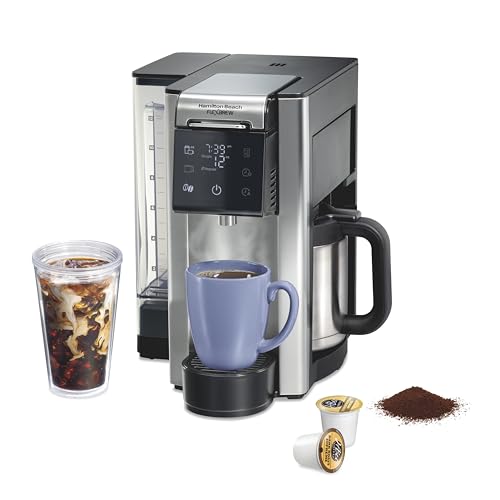
Hamilton Beach Flexbrew Advanced 5-in-1 Drip & Single Serve Coffee Maker, 12 Cup Thermal
Badge: Most Versatile
The Hamilton Beach Flexbrew Advanced 5-in-1 is two machines sharing one reservoir: a 12 cup thermal programmable drip side for the household pot, and a single serve side that takes pods or grounds for one mug at a time, hot or iced. The 60 oz removable reservoir feeds both, which is why this is the natural bridge pick whenever a household cannot agree on one brewing format.
The Flexbrew is the household-compromise pick: a thermal pot for slow mornings and a single serve side for the one person awake at five. That split actually helps the noise problem, because the early riser can brew a single quiet cup and leave the pot — and any alerts — for later. Its complexity is the cost, and its alert behavior, like the others, should be confirmed in the manual before purchase.
Combo machines exist for households that argue. One drinker wants a pod before a commute, another wants a pot on weekends, a third brews grounds because they buy beans from a local roaster. A shared reservoir and a shared footprint settle the argument, at the cost of complexity: two brew paths to descale, two sets of parts to rinse, and controls that take a week to become automatic. If your household genuinely brews both ways every week, that trade is worth it; if not, a single-format machine will always feel simpler.
Strengths
- Full thermal drip pot and single serve in one footprint
- Takes both pods and grounds on the single serve side
- 60 oz removable reservoir is easy to fill and clean
Trade-offs
- The most complex machine in this pool to learn
- Two brew paths mean two sets of parts to keep clean
- Overkill if your household only ever brews one way
| Specification | Detail |
|---|---|
| Capacity | 12 cup thermal (plus single serve) |
| Type | Drip and single serve combo coffee maker |
| Key features (from listing) | 5-in-1 drip and single serve; hot and iced; 12 cup thermal programmable drip side; pods and grounds; 60 oz removable reservoir |
| Construction | Thermal carafe (drip side) |
Best for: Mixed households that need a pot some days and a pod others / Not suited for: Single-format households that value simplicity
Check on Amazon to check the latest price on Amazon and confirm the current configuration before you buy.
Veken 34oz French Press Coffee Maker, 1 L
Badge: Best Manual Alternative
The Veken is a 34 oz French press: thickened glass, a stainless steel press assembly, and a design that keeps plastic away from the brewed coffee. It makes a rich, full-immersion cup with no electricity at all — but it is a press, not a thermal drip machine: there is no insulated carafe, no programmability, and the coffee should be poured off once pressed or it keeps extracting.
The Veken press is reviewed prose-only because it is not a thermal coffee maker — but on the narrow question of beeping, it is the strongest product in this guide, because a manual press cannot beep at all. If your household’s rule is absolute silence, immersion brewing with hot water from a kettle is the zero-electronics answer, at the cost of manual effort and no insulated holding.
Immersion brewing is the oldest controlled method in this guide: grounds steep in hot water, then a press separates them. The cup is heavy-bodied because paper never filters the oils out, and the skill is in the timing — pour the water, wait, press slowly, and decant everything at once. Leave pressed coffee sitting on its grounds and it keeps extracting toward bitterness, which is why press drinkers pour into mugs or a serving vessel the moment the plunge is done.
Strengths
- Full-immersion brewing gives a heavy, rich cup
- No plastic touching the coffee during brewing
- Works anywhere, with no power or pods involved
Trade-offs
- Not a thermal carafe machine — coffee does not stay hot for hours
- Glass beaker needs careful handling
- Grounds disposal and washing are entirely manual
| Specification | Detail |
|---|---|
| Capacity | 34 oz (1 L) |
| Type | French press |
| Key features (from listing) | Thickened glass; stainless steel brewer; no plastic touching the coffee |
| Construction | Thickened glass and stainless steel |
Best for: French press lovers who decant and drink promptly / Not suited for: Anyone shopping for a thermal carafe drip machine
Prose-only in this guide: this pick does not carry a purchase link here because its confirmed type does not match this keyword’s core — see the sources file for the reasoning. It is reviewed in full so the comparison stays honest.
Keurig K-Express Single Serve K-Cup Pod Coffee Maker, Black
Badge: Best Single-Cup Alternative
The Keurig K-Express in black is the straightforward pod machine in this pool: three brew sizes from a 42 oz removable reservoir, a Strong Brew button for a bolder cup, and travel mug clearance for the morning commute. It brews one cup at a time into your mug — there is no carafe at all, thermal or otherwise — which is exactly why it sits in a different category from the thermal pot machines it is listed beside.
The K-Express is prose-only here because a single serve pod machine is not a thermal coffee maker. It is included because many no-beeping shoppers land on single serve as their compromise: one quick cup for the person who is awake, nothing held warm, nothing announced to a household. Its cup-by-cup format solves the early-morning problem socially rather than thermally — and pod running costs are its standing trade-off.
Pod brewing trades control for certainty. The dose, grind and packing are decided for you, the machine handles temperature and pressure, and the result is the same cup on a tired Tuesday as on a fresh Saturday. What you give up is everything a pot brewer takes for granted: batch size, strength by ratio, and coffee that waits for you. Judge a pod machine on reservoir size, cup clearance and how honestly its strong setting performs, because those are the variables the format actually leaves you.
Strengths
- Fast, consistent single cups with almost no cleanup
- Strong Brew button helps pods taste less watery
- 42 oz reservoir covers several cups between refills
Trade-offs
- No carafe — it cannot brew or hold a pot
- Pod format costs more per cup than ground coffee over time
- Not a thermal machine in any sense
| Specification | Detail |
|---|---|
| Capacity | 42 oz reservoir; single serve |
| Type | Single serve pod coffee maker |
| Key features (from listing) | 3 brew sizes; 42 oz removable reservoir; Strong Brew button; travel mug friendly; works with all K-Cup pods |
| Construction | Plastic body, removable reservoir |
Best for: Solo pod drinkers who want one mug at a time / Not suited for: Households shopping for a thermal carafe brewer
Prose-only in this guide: this pick does not carry a purchase link here because its confirmed type does not match this keyword’s core — see the sources file for the reasoning. It is reviewed in full so the comparison stays honest.
Comparison Table
| Pick | Capacity | Type | Key features |
|---|---|---|---|
| BLACK+DECKER CaféCraft 12-Cup Thermal Coffee Maker, Hot & Iced — Check on Amazon | 12 cup | Thermal drip coffee maker | Programmable; hot and iced brewing; thermal carafe |
| Cuisinart 12-Cup PerfecTemp Thermal Carafe Coffee Maker with 1-4 Cup Setting — Check on Amazon | 12 cup | Thermal drip coffee maker | PerfecTemp thermal carafe; 1-4 cup setting; brew strength control; programmable |
| BUNN 55200 CSB3T Speed Brew Platinum Thermal Coffee Maker, 10-Cup — Check on Amazon | 10 cup | Thermal drip coffee maker | Speed Brew fast brewing; stainless steel; thermal carafe |
| Hamilton Beach Flexbrew Advanced 5-in-1 Drip & Single Serve Coffee Maker, 12 Cup Thermal — Check on Amazon | 12 cup thermal (plus single serve) | Drip and single serve combo coffee maker | 5-in-1 drip and single serve; hot and iced; 12 cup thermal programmable drip side; pods and grounds; 60 oz removable reservoir |
| Veken 34oz French Press Coffee Maker, 1 L — prose-only | 34 oz (1 L) | French press | Thickened glass; stainless steel brewer; no plastic touching the coffee |
| Keurig K-Express Single Serve K-Cup Pod Coffee Maker, Black — prose-only | 42 oz reservoir; single serve | Single serve pod coffee maker | 3 brew sizes; 42 oz removable reservoir; Strong Brew button; travel mug friendly; works with all K-Cup pods |
The table makes the category lines visible: four thermal carafe machines, one manual press, one pod machine. Compare within the thermal four on capacity and features; treat the last two rows as alternative strategies, not rivals.
How to Choose a Thermal Coffee Maker When Beeping Matters
Verify the alert, do not assume it. Listing titles almost never state beep behavior, and none in this pool do. Before buying any programmable thermal machine, find its manual online and search it for alert, tone, sound and beep settings; check whether the ready alert can be reduced or switched off, and ask the seller directly if the documentation is silent. A machine whose tones cannot be silenced is the wrong machine for a light-sleeping household, however good its carafe is.
Decide how silent is silent enough. There are three tiers. Guaranteed silence means no electronics: a French press or other manual brewer. Practical quiet means a thermal machine whose alerts you have verified can be turned off, brewing into an insulated carafe that then waits without further cycles. Accepted noise means a standard programmable machine whose single ready tone your household tolerates. Name your tier first; the shortlist sorts itself afterwards. This keyword also appears in the variant form Best Thermal Coffee Makers Without Beeping, which carries the same verified shortlist.
Let the thermal format do quiet work. A thermal carafe removes the warming plate from the morning entirely — no plate cycling, no second brew to replace stewed coffee, no reason for the machine to announce itself twice. Brew once, close the lid, and the pot waits. That is a large part of why this keyword pairs thermal with no beeping: both halves are about a calmer kitchen.
Match capacity and settings to your real mornings. Small-batch settings (the Cuisinart), speed (the BUNN), iced range (the CaféCraft) and format-splitting (the Flexbrew) each solve a different household’s morning. The right pick is the one whose strength matches the mornings you actually have.
How to Set Up a Quieter Morning Coffee Routine
- Load the machine the night before. Water, filter and grounds in the evening means the morning is one button — or one timer — instead of a noisy preparation performance.
- Pre-warm the thermal carafe. A quick hot-water swirl while you dress means the pot holds its heat longer, so nobody brews a second, alert-announcing cycle.
- Brew once, at the right size. Use small-batch settings for small mornings rather than brewing a full pot and reheating cups, which multiplies both noise and bitterness.
- Close the carafe and move it. A sealed thermal pot on the table ends the machine’s shift; the kitchen can go back to sleep even if you cannot.
- Rinse the carafe when the house wakes. Same-day rinsing keeps yesterday’s oils out of tomorrow’s pot and takes thirty seconds.
Troubleshooting. Problem: the ready alert wakes the house → check the manual for an alert-off or volume setting first; if none exists, brew with a manual press on early mornings and keep the machine for weekends. Problem: coffee is lukewarm by the second cup → pre-warm the carafe and brew a fuller pot, since small volumes lose heat fastest. Problem: the second cup tastes stewed → it sat too long; brew smaller, more often, using the small-batch setting. Shoppers whose core need is a pod-free routine should also see Best Single Serve Coffee Makers With No Pods.
Why Coffee Makers Beep — and What You Can Actually Do About It
Manufacturers add alert tones for honest reasons: a finished brew, an empty reservoir, a carafe left off the base. In a showroom those beeps read as helpful; in a sleeping household at dawn they read as an alarm. Because tones are a software setting on many machines and a fixed behavior on others, the only reliable route is documentation — the manual’s sound or alert section tells you whether your model can be muted, and community owner reports can confirm it when manuals are vague. For the all-steel angle on this category, compare Best Stainless Steel Thermal Coffee Makers before you decide.
Where a tone cannot be silenced, work around the schedule instead of fighting it: set programmable machines to finish after the household’s lightest sleeper usually wakes, keep a manual press for the earliest shift, or let the first riser brew a single serve cup — the strategy two of this guide’s prose-only alternatives exist to serve. Silence is a system, not a single product feature.
The Manual Escape Hatch: Brewing With No Electronics at All
It is worth stating plainly, because no-beeping shoppers sometimes miss it: the only brewers that cannot beep are the ones with nothing to beep with. A French press, a pour over dripper or a stovetop pot reduces the morning to kettle, water and grounds. The Veken press in this guide represents that route — full-immersion coffee, rich and quiet, in exchange for manual effort and coffee that should be decanted promptly rather than held.
Many households land on a hybrid: the thermal machine for family mornings and weekends, the press for the dawn shift. That is a sensible endpoint, and it is why this guide reviews the press in full despite its prose-only status — the honest answer to a keyword sometimes includes the edge of the category, clearly labeled.
A word about ‘quiet’ marketing. Brewers are sometimes described as quiet when the claim refers to pump or brew noise rather than alert tones — two different sounds with two different fixes. Brew noise lasts a minute and is muffled by distance; an alert tone is designed to carry through a house. When you verify a model, ask specifically about end-of-cycle and alert sounds, not about general quietness, or you may solve the wrong problem beautifully.
Where the Machine Lives Changes How Loud It Is
Placement is the cheapest sound control you own. A brewer on a stone counter in an open-plan kitchen announces itself to every bedroom; the same machine on a wooden board, in a corner away from the hallway axis, loses much of its carry. Keep the thermal carafe’s serving spot on the table rather than beside the machine, and the morning’s center of gravity moves away from the appliance entirely. None of this replaces a mute setting — but households that combine a verified-quiet machine with thoughtful placement rarely think about beeps again.
The Dawn Test: Trying a Machine’s Mornings Before You Commit
If you can trial a machine — a return window, a floor model, a friend’s counter — run the dawn test. Set it for the earliest brew your household would schedule, stand in the nearest bedroom doorway, and listen to the full cycle including its end. What carries through a house is rarely the brewing; it is the alert at the finish and the clatter of setup, which is why this guide separates the two problems so carefully. A machine that passes the dawn test in a real doorway has told you more than any specification sheet, including the silent ones in this pool.
Households that cannot trial should simulate the decision: place the current machine where the new one would live, note what wakes whom for a week, and let that diary — not hope — arbitrate between the programmable picks and the manual route.
Grinding is the other dawn noise. Beeping gets the blame in this keyword, but in many houses the grinder wakes more sleepers than any alert. The quiet-morning system this guide describes works best whole: grind the evening before if your palate accepts it, or accept a brief grind and eliminate the beep, rather than solving one sound and declaring victory. The thermal picks here reward the evening-before pattern in every respect — loaded machine, ground coffee, silent dawn, hot pot.
Guests change the calculation. A household optimized for silent dawns may still want the programmable pot at full voice when guests fill the spare room and nobody is sleeping lightly. That is another argument for verifying a mute setting rather than buying a permanently silent machine: flexibility serves both the ordinary week and the exceptional one. Check, in the manual, whether alert settings are remembered between uses or must be reset — a small detail that decides whether the setting survives real life.
What to Do While You Decide: This Week’s Quiet Routine
You do not need a new machine to start sleeping better tomorrow. Move tonight’s setup out of the bedroom’s acoustic path, load whatever brewer you own before bed, and let the first riser handle the only noisy minute. If a press or a kettle already lives in your kitchen, draft it for the earliest shift this week and observe whether the household actually misses the machine at dawn. Many readers of this keyword discover their answer in that experiment: the early shift goes manual permanently, and the thermal machine — chosen from the linked four, alerts verified — takes the hours when the house is awake to enjoy it.
Sound travels through structure, not just air. A brewer’s alert reaches bedrooms through doorways and hallways, but its vibrations also travel through counters and shared walls. Placing a machine on a mat or board, away from the wall behind it, dulls both paths a little — not enough to rescue a loud alert, but enough to matter at the margins for the verified-quiet machines in this guide. Combine placement, a checked mute setting and the thermal format’s single daily cycle, and the dawn problem usually dissolves into a non-issue within a week.
Weekend mode is a real requirement. The schedule that governs a quiet household’s weekdays collapses on weekends, when nobody needs a 5 a.m. pot and everybody resents one. Programmable picks earn their place partly by being easy to leave unprogrammed — a machine whose timer is a deliberate act rather than a default. When you run the manual check on the linked four, note how the program is armed and cleared; the household that can silence Saturday in two seconds will still love its machine in month six.
The kettle deserves a line in a no-beeping guide. The manual route’s one powered accomplice is the kettle, and kettles vary in their own clicks and whistles. If your household commits to the press for its earliest shift, the kettle’s behavior joins the audit — most are simple and brief, and a stovetop kettle with the whistle unused is the traditional silent partner. It is a small point, but this keyword rewards households that audit the whole dawn, not just the appliance with the word ‘coffee’ on it.
Common Buying Mistakes
Buying capacity for the household you wish you had. A 12 cup thermal pot for a one-mug drinker means stale half-pots or wasted coffee; a 14 oz single serve for a four-person house means a morning queue. Count the cups your home actually drinks on a weekday and buy for that number, not for holidays.
Ignoring what happens after brewing. Coffee quality is decided as much by holding as by brewing. A warming plate stews, a thermal carafe protects, a pod machine sidesteps the question entirely. Shoppers who compare only brew features and never holding methods are disappointed by the second cup, not the first.
Skipping the cleaning math. Every format bills you in maintenance: carafes to rinse, reservoirs to descale, press screens to scrub, pod needles to clear. The machine you will actually clean weekly beats the superior machine you will clean never.
Trusting a feature word without checking the specification. Programmable, thermal, strong and timed all mean specific things. Read the confirmed specification — capacity, carafe type, brew sizes — rather than the marketing adjective, which is exactly the discipline this guide applied when it downgraded mismatched picks to prose-only.
Final Recommendation
If a programmable thermal pot is the goal, interrogate the linked four with the manual check in this guide and choose on capacity and features: the Cuisinart for small-batch flexibility, the BUNN for speed, the CaféCraft for hot-and-iced range, the Flexbrew for mixed formats. If silence is absolute and non-negotiable, the honest recommendation is the manual route — the prose-only Veken press cannot beep, because nothing in it can make a sound at all.
Either way, buy the alert behavior you have verified, not the silence you have assumed.
To act on this guide: start with the BLACK+DECKER CaféCraft 12-Cup Thermal Coffee Maker, Hot & Iced; start with the Cuisinart 12-Cup PerfecTemp Thermal Carafe Coffee Maker with 1-4 Cup Setting; start with the BUNN 55200 CSB3T Speed Brew Platinum Thermal Coffee Maker, 10-Cup — each link lets you check the latest price on Amazon and confirm the current configuration.
Frequently Asked Questions
How can I tell if a thermal coffee maker beeps before I buy it?
Check the model’s manual online for alert, tone or sound settings, and look for an option to turn the ready alert off or down. Listing titles rarely state beep behavior — none in this guide’s pool do — so documentation and direct seller answers are the reliable sources, not marketing copy.
Which pick in this guide is guaranteed not to beep?
The Veken French press, reviewed prose-only because it is not a thermal coffee maker. It has no electronics at all, so it cannot produce an alert tone. Every electronic machine’s alert behavior must be verified in its manual; this guide claims beep-free operation for no powered model.
Why pair a thermal carafe with a no-beeping requirement?
Both halves calm the morning. A thermal carafe holds coffee without a warming plate, so the machine brews once and finishes, instead of cycling and announcing reheats — and the pot can move to the table while the kitchen stays quiet.
Does a programmable coffee maker have to beep when the pot is ready?
Many do sound a ready alert, but on some models the manual documents a way to reduce or disable it. That setting is model-specific and is not stated in listing titles, which is why this guide directs you to the manual check before purchase rather than asserting it for any pick.
What if my household needs coffee before everyone wakes?
Use the hybrid routine: the first riser brews manually or single serve — the two prose-only strategies in this guide — and the thermal pot is brewed for the household’s normal hour. It keeps dawn silent without giving up the shared pot later.
Is the Keurig in this guide a thermal coffee maker?
No. The K-Express is a single serve pod machine with no carafe, reviewed prose-only as an alternative strategy for early risers. The linked picks — the CaféCraft, the Cuisinart, the BUNN and the Flexbrew’s drip side — are the thermal coffee makers in this guide.


