Disclosure: topratedkitchenware.com is reader-supported. When you buy through links on our site, we may earn an affiliate commission from Amazon and other retailers, at no extra cost to you.
Where to buy
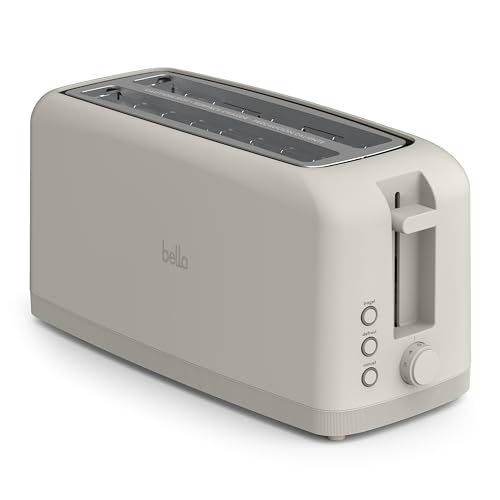
This keyword makes one specific demand — four large pieces of bread, toasted at the same time — and exactly one machine in the verified pool is built to meet it: the bella Fits-Anywhere Slim Toaster, whose listing confirms four-slice capacity in an extra-long, extra-wide slot. It carries the purchase links in this guide. The other five picks are two-slice toasters; they are reviewed in full as prose-only entries because, whatever their other virtues, they cannot toast four large pieces simultaneously, and pretending otherwise would be the oldest trick in this category.
- bella Fits-Anywhere Slim 4-Slice Toaster — the pool’s only four-slice machine, with an extra-long and wide slot for large pieces
- BLACK+DECKER 2-Slice Toaster with Extra-Wide Slots — prose-only for this lens (extra-wide slots and an extra lift lever, but two slices per cycle)
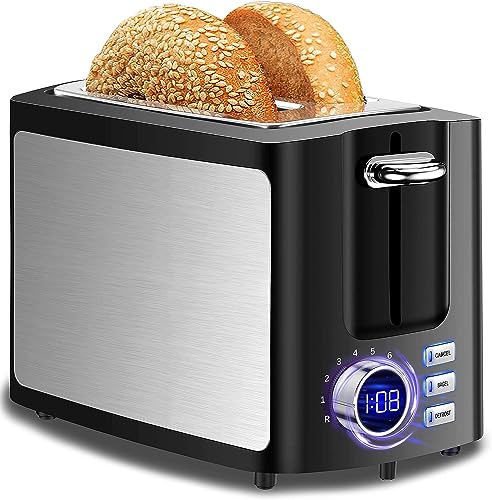
- Hommater 2-Slice Smart Toaster with LCD Countdown — prose-only for this lens (nine shades and a countdown for batch timing, but two slices per cycle)
- Amazon Basics 2-Slice Toaster — prose-only for this lens (extra-wide slots and defrost, but two slices per cycle)
- Elite Gourmet ECT1027B Cool-Touch Toaster — prose-only for this lens (1.25-inch extra-wide slots for large pieces, but two slices per cycle)
- Hamilton Beach 22634 Extra-Wide Slot Toaster — prose-only for this lens (toast boost and auto shutoff for batch work, but two slices per cycle)
Read the full guide ↓
Searches for the best toasters for four large pieces of bread come from a specific breakfast: four people, or two very hungry ones, eating together, with bread that is not the small uniform kind. That breakfast exposes the two-slice toaster’s founding compromise. Two pieces toast while two wait, the first pair cools or toughens while the second pair browns, and the cook performs a small, daily act of triage that nobody chose. A true four-slice machine ends the triage — but only if its slots also fit large pieces, because four small slots merely relocate the problem. In the verified pool, cross-checked against the Creators API on 2026-11-20, one listing answers both halves of the demand at once: four-slice capacity and an extra-long, extra-wide slot. This guide is therefore honest in a way category pages rarely are. It recommends one machine for the stated job, and then it does something equally useful: it reviews the five two-slice alternatives properly, because some households that arrive with this search will decide, on reflection, that two cycles of an excellent wide-slot toaster suit their kitchen, their counter and their budget of patience better than a larger machine does. Both conclusions are respectable. What is not respectable is blurring the difference between them, so this guide never does.
The batch mathematics deserve thirty seconds before the reviews. Two cycles of a two-slice machine do not take twice the clock time of one four-slice cycle in practice, because the second cycle runs in a heat-soaked cavity and browns faster — a phenomenon this guide teaches you to exploit rather than suffer, by stepping the shade down for round two and by sequencing which eaters get which round. Even so, simultaneity is simultaneity: four pieces that finish together can be served together, buttered together and eaten at the same temperature, and for the family breakfast and the brunch table that togetherness is the entire point. The daily setting for all of it is the shared home kitchen, whose broader equipment questions are gathered in Best Toasters For Home Use.
Key Takeaways
- Only the bella confirms four-slice capacity in this pool, and its slot is extra-long and wide — it is the sole linked pick.
- The other five picks toast two slices per cycle; they are reviewed prose-only, with their batch-work virtues honestly assessed.
- Four large pieces need both halves of the spec: slice count and slot size. Four small slots would not answer this keyword.
- Two-cycle households can close much of the gap with sequencing — heartiest slices first, shade stepped down for round two.
- The bella’s listing states no shade count or named functions, so the purchase is a format purchase and should be made as one.
- Counter fit is part of the decision: a four-slice long-slot machine needs a long run of counter, albeit a slim one.
In this guide
Quick Picks
| Pick | Badge | Slices per cycle | Slot claim | Link |
|---|---|---|---|---|
| bella Fits-Anywhere Slim 4-Slice Toaster | Best — The Only True Four-Slice Pick | 4 | Extra long and wide | Check on Amazon |
| BLACK+DECKER 2-Slice Toaster with Extra-Wide Slots | Best Two-at-a-Time With Lift | 2 | Extra-wide | Prose-only — two slices per cycle |
| Hommater 2-Slice Smart Toaster with LCD Countdown | Best Two-at-a-Time With Timing | 2 | Wide | Prose-only — two slices per cycle |
| Amazon Basics 2-Slice Toaster | Best Simple Two-at-a-Time | 2 | Extra wide | Prose-only — two slices per cycle |
| Elite Gourmet ECT1027B Cool-Touch Toaster | Best Measured Slots, Two at a Time | 2 | 1.25-inch extra-wide | Prose-only — two slices per cycle |
| Hamilton Beach 22634 Extra-Wide Slot Toaster | Best Two-at-a-Time With Boost | 2 | Extra-wide | Prose-only — two slices per cycle |
How These Picks Were Chosen
The six picks are the programme’s verified toasters pool, cross-checked against the Creators API on 2026-11-20. For this keyword, the link test was deliberately blunt: a pick earned a purchase link only if its listing confirms it can toast four pieces in one cycle — that is, a four-slice capacity — with slots suited to large pieces. One listing passes: the bella states four-slice capacity and an extra-long, extra-wide slot in the same product name. The other five listings all state two-slice formats in theirs. Two-slice machines can, of course, produce four pieces of toast across two cycles, and the reviews credit the features that make them good at that batch work — lift levers, countdowns, defrost buttons, cool-touch cabinets. But a keyword that asks for four pieces at once is a capacity claim, and this guide treats capacity claims the way it treats every claim: as true only where the listing says so.
The method is research-led, with the limits stated openly. We did not run timed breakfast trials, and no cycle times in seconds appear in this guide, because no listing in the pool publishes them and we do not invent measurements. What we compared were confirmed capacities, slot claims, control ranges and the batch-relevant features around them, and we built the how-to section around the physics every owner can verify at home: heat soak, sequencing and holding. The size conversation continues in Best Toasters For Large Pieces Of Bread, where the pieces themselves, rather than their count, take the lead.
Best Toasters for Four Large Pieces of Bread: Full Reviews
The linked review comes first in the assigned order, and it is the only one that answers the keyword directly. The five prose-only reviews that follow are written for the reader who decides two cycles are acceptable — they compare batch-work virtues, not simultaneous capacity, and they never pretend to be what they are not.

bella Fits-Anywhere Slim Toaster, 4 Slice
Badge: Best — The Only True Four-Slice Pick
Strengths
- Four slices per cycle — the keyword’s core demand, confirmed in the listing
- Extra-long and wide slot, so the four pieces can be genuinely large ones
- Slim Fits-Anywhere profile keeps a four-slice machine counter-friendly
Trade-offs
- Shade count and named functions are not stated in its listing
- One long slot format means four pieces share one cycle’s behaviour
- A long footprint still needs a long stretch of counter
Mini spec box
- Format: 4-slice pop-up toaster, slim profile
- Slot: extra long and wide
- Finish: Oatmilk
- Shade settings: not stated in listing
- Named functions: not stated in listing
The bella is not the best compromise in this guide; it is the only direct answer in it, and its review can therefore be refreshingly simple. Four large pieces of bread, at the same time: the listing confirms a four-slice capacity, and the slot those slices enter is described as extra long and wide, which is the geometry large pieces need — long enough for a wide artisan slice to lie properly, wide enough for thick cuts to enter without a squeeze. The combination is rarer than it should be. Plenty of four-slice machines divide a standard toaster into four standard slots, which solves headcount and ignores bread; this one’s format was conceived around the pieces themselves. The slim body completes the practical case, sliding a four-slice machine into the narrow counter runs of real kitchens, where a conventional deep four-slice box would consume the workspace it was bought to serve. For the family breakfast, the brunch table and the household that simply refuses to eat in shifts, this is the machine the keyword describes.
The honesty paragraph is about documentation. The listing that so clearly states capacity and slot geometry states almost nothing else: no shade count, no bagel or defrost function, no lift or shutoff behaviour. A buyer is therefore purchasing a confirmed format with unconfirmed controls, and should calibrate expectations accordingly — the first week will involve learning the machine’s browning behaviour by experiment, because the listing gives no numbers to start from. There is also a shared-cycle consideration inherent to a single long slot: four pieces rise or fall together, so a table split between pale and dark preferences must negotiate one setting per round, where two-slice households can run two settings in parallel cycles. Neither point overturns the verdict for the household that asked this keyword’s question. They asked for four large pieces at once, and one machine here does it. Check the latest price on Amazon, confirm the format on the current listing, and measure your counter run before ordering.
Best for: families and brunch tables that eat together, with large loaves / Not suited for: buyers who need documented shade and function specifications
BLACK+DECKER 2-Slice Toaster with Extra-Wide Slots
Badge: Best Two-at-a-Time With Lift
Strengths
- Extra-wide slots take large pieces two at a time without a squeeze
- Extra lift lever retrieves tall pieces safely between rounds
- Seven shade settings help match round two to round one
Trade-offs
- Two slices per cycle — four large pieces means two rounds, always
- No defrost function is named for frozen stock
- No auto shutoff claim
Mini spec box
- Format: 2-slice pop-up toaster
- Slots: extra-wide
- Shade settings: 7
- Named functions: bagel mode
- Convenience: extra lift lever; removable crumb tray
- Capacity for this keyword: 2 pieces per cycle (prose-only)
Judged as a batch worker rather than a simultaneous machine, the BLACK+DECKER has real merits for the four-piece breakfast. Its extra-wide slots accept the large pieces themselves without protest, two at a time, and its extra lift lever earns its keep in round-based service, where tall pieces are retrieved repeatedly and haste accumulates; the lever keeps every retrieval at arm’s length from the heat. Seven shade settings give the batch cook a finer tool for the guide’s central batch skill — stepping down for the second, heat-soaked round so that round two matches round one instead of overshooting it. The bagel mode extends the same two-at-a-time competence to the round branch of the breakfast table.
None of that changes the arithmetic that makes it prose-only here: four large pieces are two cycles, and the first pair will be cooling while the second browns, whatever the cook’s skill. Households for whom that is a genuine problem — the sit-down-together family, the brunch host — should buy the bella and be done. Households whose four pieces are eaten by people drifting through a kitchen across twenty minutes will find this machine’s two-at-a-time rhythm entirely natural, and its traditional virtues considerable. Choose it knowingly, as a batch toaster, and it will not disappoint; choose it hoping it is secretly a four-slice machine, and it will, daily.
Best for: staggered households happy to toast in two rounds / Not suited for: anyone who needs four pieces simultaneously
Hommater 2-Slice Smart Toaster with LCD Digital Countdown Timer
Badge: Best Two-at-a-Time With Timing
Strengths
- Countdown display turns two-cycle batch work into a schedulable routine
- Nine shade settings make matching round two to round one precise
- Reheat function refreshes round one while round two runs
Trade-offs
- Two slices per cycle, in a wide rather than extra-wide or long slot
- Largest pieces face the standard-format fit question
- A display to maintain in a busy batch kitchen
Mini spec box
- Format: 2-slice pop-up toaster, wide slot
- Display: LCD digital countdown timer
- Shade settings: 9
- Named functions: bagel, defrost, cancel, reheat
- Capacity for this keyword: 2 pieces per cycle (prose-only)
If a two-slice machine must run a four-piece breakfast, the Hommater is the one that suffers least from the assignment, because its virtues are exactly the batch virtues. The countdown display converts the two-cycle routine from guesswork into scheduling: the cook can see when round one lands, start eggs against round two, and have the table converge instead of collide. Nine shade settings make the heat-soak adjustment — the step down for round two — a precise, repeatable move rather than a dial’s shrug. And the reheat function is the batch worker’s quiet triumph: round one’s pieces, refreshed rather than re-toasted while round two browns, arrive at the table in something close to the condition simultaneity would have given them. No other pick in the pool assembles that trio.
The limits remain structural. Two slices are two slices; the slot is wide rather than extra-wide or long, so the largest pieces face the same fit question as in any standard format; and a household that eats four large pieces together every day is working around its appliance rather than with it. The Hommater is the connoisseur’s answer to a problem the bella simply deletes — which makes it the right prose-only recommendation for smaller households whose four-piece mornings are occasional, timed and worth choreographing, and the wrong one for families whose four-piece mornings are daily and democratic.
Best for: small households with occasional, choreographed four-piece mornings / Not suited for: daily four-at-once family service
Amazon Basics 2-Slice Toaster
Badge: Best Simple Two-at-a-Time
Strengths
- Extra-wide slots handle large pieces two at a time
- Defrost button covers frozen slices in a batch routine
- Cord wrap suits kitchens where the toaster is fetched per use
Trade-offs
- Two slices per cycle
- Six browning settings — the least precise heat-soak adjustment in the pool
- No lift assistance or reheat for batch polish
Mini spec box
- Format: 2-slice pop-up toaster
- Slots: extra wide, for bagels
- Browning settings: 6
- Power: 900W
- Named functions: defrost, cancel and bagel buttons
- Convenience: removable crumb tray; cord wrap
- Capacity for this keyword: 2 pieces per cycle (prose-only)
The Amazon Basics is the uncomplicated batch worker: extra-wide slots that accept large pieces, a defrost button for the frozen half of the routine, cancel within reach, and a cord wrap for the many households where a second toaster — or the only toaster — lives in a cupboard and is deployed for the big breakfast rather than resident for it. That deployment pattern is more common than kitchen photography admits, and for it, this machine’s simplicity is a feature: buttons that need no explanation to a helping relative, a specification stated in full, nothing to configure. Four large pieces emerge in two honest rounds, and the second round’s heat-soak adjustment is made with the same six settings that do everything else.
Those six settings are also its batch limitation, because matching round two to round one is a finer operation than six steps comfortably express, and there is no reheat function to polish round one while round two runs. It is prose-only here for the founding reason — two slices per cycle — and within that constraint it is a perfectly rational economy: the household that toasts four large pieces twice a month, for visitors, loses little to the two-round routine and gains a simple, storable machine. The household that does it daily should read the bella’s review again.
Best for: occasional four-piece mornings and cupboard-stored simplicity / Not suited for: daily simultaneous service
Elite Gourmet ECT1027B 2-Slice Cool-Touch Toaster
Badge: Best Measured Slots, Two at a Time
Strengths
- Slots measured at 1.25 inches — large pieces fit verifiably, two per cycle
- Cool-touch cabinet suits the crowded, hands-on batch routine
- Cancel function and thick-bread handling named in the listing
Trade-offs
- Two slices per cycle
- Six shade settings for the round-matching adjustment
- No defrost function is named
Mini spec box
- Format: 2-slice pop-up toaster
- Exterior: cool-touch, black finish
- Slots: 1.25-inch extra-wide
- Shade settings: 6
- Named functions: cancel; bagels and thick bread handling
- Model: ECT1027B
- Capacity for this keyword: 2 pieces per cycle (prose-only)
The Elite Gourmet brings two distinctive assets to batch work. The first is certainty of fit: its slots are the pool’s only measured ones, at 1.25 inches, and its listing names thick bread outright, so the large pieces in a four-piece breakfast are known to fit — two at a time — rather than hoped to. The second is its cool-touch cabinet, whose value rises with the number of cycles: a batch morning is a handling morning, with the cook steadying, reaching past and working around the machine repeatedly, and a forgiving exterior quietly de-risks every pass. In a family kitchen where the four pieces belong to four people standing nearby, that cabinet is worth more than several features ranked above it elsewhere.
It remains, structurally, a two-slice machine with a six-step range and no named defrost, which makes its batch routine the plainest of the prose-only set: two rounds, a manual shade step-down, and round one kept warm by covering rather than by any machine assistance. Households whose four-piece mornings centre on children will find its wider family case in Best Toasters For Kids; households whose mornings centre on simultaneity itself should return to the bella. Its prose-only status is purely a capacity verdict, and on every other axis this is one of the pool’s most likeable machines.
Best for: fit-certain batch work in busy family kitchens / Not suited for: simultaneous four-piece service
Hamilton Beach 22634 Extra-Wide Slot 2-Slice Toaster
Badge: Best Two-at-a-Time With Boost
Strengths
- Toast boost makes repeated retrieval of large pieces safer and quicker
- Defrost button and seven browning shades support the two-round routine
- Auto shutoff stands guard over a distracted batch cook
Trade-offs
- Two slices per cycle
- Width claimed rather than measured
- No reheat function for round one
Mini spec box
- Format: 2-slice pop-up toaster, extra-wide slot design
- Shade settings: 7 browning shades
- Named functions: bagel and defrost buttons; auto shutoff; toast boost
- Crumb tray: slide-out
- Finish: Kitchen Makeover Blue
- Model: 22634
- Capacity for this keyword: 2 pieces per cycle (prose-only)
The Hamilton Beach is the prose-only pick that a batch cook would design. Toast boost matters twice per four-piece breakfast, lifting each round’s large pieces clear for a quick, safe hand-off. Defrost covers the frozen version of the routine. Seven shades give the round-matching adjustment a finer grain than the six-setting models manage. Auto shutoff is the feature whose value scales with distraction, and no morning is more distracted than one in which four pieces, two rounds, eggs, coffee and four people are being converged by one cook. Even the slide-out crumb tray plays its part across a high-throughput morning, because large rustic pieces shed accordingly.
And still: two slices per cycle, which is why this review sits in the prose-only set despite describing arguably the most complete two-slice specification in the pool. The distinction this guide maintains is not between good and bad machines but between kinds of answer — the Hamilton Beach is the best answer to a slightly different question, namely how well a two-slice toaster can serve a four-piece appetite. Households in genuinely shared, high-turnover kitchens, including the semi-professional edge explored in Best Toasters For Restaurants, will recognise its virtues; households asking this keyword’s exact question should buy the one machine that answers it exactly.
Best for: capable two-round service in busy, distracted kitchens / Not suited for: four-at-once service
Comparison Table
| Pick | Slices per cycle | Slot claim | Shade settings | Batch-work edge | Link |
|---|---|---|---|---|---|
| bella Fits-Anywhere Slim | 4 | Extra long and wide | Not stated | True simultaneous service | Check on Amazon |
| BLACK+DECKER 2-Slice | 2 | Extra-wide | 7 | Extra lift lever | Prose-only |
| Hommater 2-Slice Smart | 2 | Wide | 9 | Countdown timing; reheat | Prose-only |
| Amazon Basics 2-Slice | 2 | Extra wide | 6 | Simple buttons; cord wrap | Prose-only |
| Elite Gourmet ECT1027B | 2 | 1.25-inch extra-wide | 6 | Measured fit; cool-touch body | Prose-only |
| Hamilton Beach 22634 | 2 | Extra-wide | 7 | Toast boost; auto shutoff | Prose-only |
How to Choose When Four Large Pieces Are the Brief
Decide first whether simultaneity is a requirement or a preference, because the entire choice hangs on it. It is a requirement when the four pieces are eaten together by people who sit down together — family breakfasts, brunch tables, shared houses with a single sitting — and when the pieces are large enough that holding the first round warm degrades it, as thick rustic slices do when they steam under a cover. It is a preference when the eaters arrive across a span of minutes, when the cook enjoys the ritual, or when four-piece mornings are occasional. Requirement points to exactly one machine in this pool; preference opens the field to the two-slice picks, judged then on batch virtues: lift for retrieval, steps for round-matching, defrost for frozen stock, reheat for polish.
Then verify the two fits. The bread fit: measure your largest piece and hold it against the slot claims — extra long and wide for the bella, measured inches where the Elite Gourmet offers them, directional claims elsewhere treated as promises for standard large bread rather than guarantees for the extreme loaf. The counter fit: a four-slice long-slot machine needs a long, if slim, run of counter, and the household that cannot give it one has its answer made for it. On tiers, the logic is qualitative and simple — simultaneous capacity is a format step up, worth taking when the sitting-together breakfast is your household’s real shape, and wasted when it is not.
Whichever machine you run, agree the serving order before the first lever goes down: who eats from round one, who from round two, and whose preference sets each round’s shade. Thirty seconds of planning at the start is the difference between a breakfast that flows and one that negotiates, and it costs nothing but the decision to have the conversation while the kettle boils rather than while the toast cools.
How to Run a Four-Piece Breakfast Well on Any Machine
On the bella, the craft is loading and negotiation: arrange the four pieces evenly in the long slot, agree the table’s shade compromise before the lever goes down — mixed preferences can be handled by toasting to the paler preference and giving the darker loyalists a brief second pass for their pieces alone — and serve straight from the pop, because four pieces cooling together wait for no one. On a two-slice machine, the craft is sequencing. Toast the heartiest, thickest pieces first; they hold heat and texture best. Step the shade down one notch for round two, because the cavity is heat-soaked and browns faster. Keep round one standing in a rack or tented loosely — never stacked flat, never sealed in a container, both of which steam the faces soft — and where a reheat function exists, refresh round one briefly as round two finishes rather than re-toasting it. Butter at the table, not in the kitchen, so the crisp faces survive the journey.
Care scales with throughput. A four-piece routine sheds four pieces’ worth of crumbs, so the weekly tray emptying becomes genuinely weekly in family service; wipe slot rims of butter smears before they bake on; and let a machine that has run back-to-back rounds cool before it is moved or stored. Troubleshooting follows three patterns. Problem: round two browns noticeably darker than round one → heat soak, the most predictable effect in toasting; step down a shade for every subsequent round. Problem: round one is cold by the time round two lands → the holding method steamed or chilled it; stand pieces in a rack in a warm spot, tent loosely, and use reheat where fitted. Problem: one piece in a shared long-slot round browns faster than its neighbours → it was the thinnest or the driest; group pieces of similar thickness in the same round, and let mixed rounds be the exception rather than the system.
One more household type belongs in the census: the host. Some kitchens toast four large pieces not daily but decisively — the weekend with guests, the holiday breakfast, the morning after a celebration when the house is full and the bread is good. For hosts, the calculus differs from the daily family’s, because the machine’s value concentrates into fewer, higher-stakes mornings, and its cost — counter length — is paid daily. The bella’s slimness is the host’s friend here, minimising the daily cost, and its format delivers the high-stakes morning outright. Hosts with very occasional full houses, by contrast, should honestly price the two-round routine with a borrowed second toaster or a good batch worker from the prose-only set; a full house twice a year does not need a resident four-slice machine, and the counter will thank the decision on the other three hundred mornings.
Who Actually Needs Four at Once — and Who Is Better Off Without It
The honest census is shorter than marketing suggests. Four-at-once is transformative for the household that eats together daily: the family with school and work departures synced to one sitting, the shared house with a communal weekend breakfast, the brunch host whose reputation rests on everyone eating at the same temperature. It is merely nice for the couple who occasionally host, and it is actively wrong for the small household that toasts four pieces twice a month and would trade the bella’s counter length, every other day of the month, for a compact two-slice machine that fits its kitchen and its life. Small-space readers in particular should weigh the trade carefully, and the compact-living discussion in Best Toasters For Small Spaces takes it up directly. The keyword asks a precise question, and this guide has given it a precise answer; but the best purchase is the one that answers the question your kitchen actually asks, three hundred mornings a year.
The Brunch Test: What Four-at-Once Actually Changes
Picture the same breakfast run both ways. On a two-slice machine, the cook is a traffic controller: the first pair goes down, eggs are started against a guess, the first pair comes up and must be parked somewhere that will not ruin it, the second pair goes down into a hotter cavity than the first pair met, and the table assembles in instalments, with the cook eating last and lukewarm. None of this is a disaster — households have done it for generations — but every stage of it is a small tax on the meal. On the four-slice machine, the sequence collapses: one loading, one cycle, one pop, and the cook sits down with everyone else. The eggs still need timing and the coffee still needs making, but the toast stops being the critical path. That collapse is the entire product being sold by the format, and it is why this guide treats capacity as a claim to verify rather than a vibe to imply: the benefit is real, specific and completely absent from a machine that cannot do it.
The brunch test also reveals the format’s second-order benefit: consistency across the table. Four pieces from one cycle share one cavity state and one setting, so the table eats the same toast — a small, civilised equality that two-cycle service can only approximate with shade discipline and reheating. For households whose breakfasts are social events, that equality, as much as the saved minutes, is what four-at-once buys.
Heat, Throughput and the Shared Cycle
A four-piece cycle moves more bread through the same physics, and two consequences follow for the owner. The first is crumb and residue volume: four large pieces shed proportionally more than two, and the long slot’s greater length gives debris more places to settle, so the weekly tray routine and rim wipe carry more weight in this format’s keeping than in any other in the pool. The second is heat behaviour across a morning of repeated rounds — a brunch for eight is two four-piece cycles, and the second cycle inherits the first’s heat exactly as a two-slice machine’s does, so the step-down discipline in the how-to section applies with the same force. Neither consequence is a drawback; both are simply the operating manual of throughput. The household that understands them gets the format’s full value; the household that expects a four-slice machine to abolish physics will be surprised by the same physics, at larger scale.
Living With the Long-Slot Format Day to Day
Outside the headline breakfast, the bella’s format has a daily personality worth describing. A long slot is a flexible space: it takes two ordinary slices with room to spare, one very large slice laid centrally, or the four-piece load it was bought for, and that flexibility means the machine rarely feels oversized for small jobs in the way a deep four-slot box can. Its slim depth keeps it against the wall and out of the workspace, and its length makes it a natural home for the bread board beside it — a small kitchen-geography point that owners of long machines consistently mention and buyers consistently fail to anticipate. The format’s daily cost is the one already recorded: control documentation is thin, so the household calibrates by experience in the first week and thereafter runs on habit. For most family kitchens that trade — geometry now, calibration once — is the right one, and it is the trade this keyword’s searchers are, knowingly or not, asking to make.
Preference Diplomacy: One Cycle, Four Opinions
The shared cycle’s one real friction deserves its own diplomacy, because every four-person table contains a browning spectrum. The workable conventions are few and learnable. The median convention: toast to the middle preference and let the pale end enjoy the warmth and the dark end accept the compromise — best when the spectrum is narrow. The two-round convention: run the long slot twice with two pieces each time at two settings, which surrenders simultaneity but keeps capacity in reserve for the days it matters — best when the spectrum is wide and the eaters are patient. The top-up convention: toast all four to the paler preference, serve the pale loyalists, and return the dark loyalists’ pieces for a short second pass — best when the dark end is a minority of one or two, and the reason the cancel function matters even on a family machine. None of these conventions requires equipment beyond the format itself; they require only that the household pick one before the hungry morning rather than negotiating it during. Two-slice households, incidentally, get preference diplomacy free — parallel cycles are parallel settings — which is the two-slice format’s one genuine counter-argument and worth weighing honestly if your table’s spectrum is very wide.
Common Buying Mistakes
- Counting slots without checking their size. Four pieces must be large pieces; slot geometry is half the keyword.
- Letting a two-slice listing borrow four-slice language. Per-cycle capacity is a number in the product name; read it.
- Ignoring the shared-cycle compromise. One long slot means one setting per round; mixed-preference tables should plan for it.
- Holding round one badly. Stacked or sealed toast steams itself soft; rack it, tent it, or reheat it.
- Forgetting heat soak. Round two at round one’s setting is a darker round; step down.
- Buying capacity for a calendar that does not need it. Occasional four-piece mornings are served well by two good rounds.
Final Recommendation
For the household that asked this question literally, the recommendation is the pool’s only direct answer: the bella Fits-Anywhere Slim Toaster, with four-slice capacity in an extra-long, extra-wide slot and a slim body that respects the counter — check the latest price on Amazon and confirm the format on the current listing before ordering. If your four-piece mornings are staggered or occasional, choose your batch worker instead: the Hommater for countdown timing and reheat, the Hamilton Beach for boost and shutoff, the BLACK+DECKER for its lift lever, the Elite Gourmet for measured fit and cool sides, or the Amazon Basics for storable simplicity. Either way, buy the capacity your breakfast actually uses, and the mornings will take care of themselves.
A closing observation for the undecided: capacity is the one toaster property that cannot be improvised later. Shade habits can be learned, loaves can be chosen, counters can be rearranged — but a two-slice machine will never toast four pieces at once, and a four-slice machine will never be smaller. Decide the capacity question on the evidence of your own breakfasts, and every other decision in this guide becomes easy.
Frequently Asked Questions
Is the bella really the only four-slice option in this guide?
Yes. Its listing is the only one in the verified pool that states four-slice capacity; the other five products state two-slice formats in their own names. That is why it is the only linked pick, and why the others are assessed honestly as two-cycle batch workers.
Can a two-slice toaster handle four large pieces well enough?
For staggered eaters and occasional occasions, yes — with sequencing: heartiest pieces first, shade stepped down for the second round, and the first round racked or reheated rather than stacked. What it cannot do is land all four pieces at the same moment, which is the specific thing this keyword asks for.
Does the bella toast four different shade preferences at once?
Its listing describes a single extra-long slot format, so plan on one setting per round. Mixed-preference tables can toast to the paler preference and give darker loyalists a short second pass, or run two rounds of two preferences — the same negotiation any shared cycle requires.
How much counter does a four-slice long-slot toaster need?
More length than depth: the bella’s slim profile is designed for narrow runs, but the run must still be long. Measure the stretch of counter you can give it, keep open air above the slot, and compare against the machine’s footprint on the current listing before ordering.
Why does the second round always brown faster?
Heat soak. The cavity and elements retain heat between cycles, so each subsequent round starts hotter than the last. It affects every toaster in this guide, two-slice and four-slice alike, and the correction is always the same: step the shade down as the rounds accumulate.
Is a four-slice toaster worth it for a household of two?
Only if the two of you eat together, eat large bread, and eat it often — two people can absolutely generate a four-piece breakfast. If your mornings are staggered or your bread is standard, a two-slice machine with the right slot geometry will serve you better and take less counter. Capacity should follow the sitting, not the headcount alone.
How should I arrange four different-sized pieces in one round?
Group by thickness rather than by eater. Pieces of similar thickness brown on a similar schedule, so a round of equals finishes evenly, while a mixed round forces one setting onto two different problems. If the table’s pieces vary, run the thickest round first — it holds its heat best while the thinner round follows.
Can the bella toast just two slices?
Its format is a single extra-long slot rated for four slices, so two slices are simply a lighter load of the same space; nothing in the format requires a full load. Households often find the long slot at its most convenient exactly here — two large slices laid out with room to spare.
What if my large pieces are frozen?
Prefer a machine with a confirmed defrost function for the frozen routine — among the prose-only picks, the Hommater, Hamilton Beach and Amazon Basics confirm one, while the bella’s listing does not state its functions. Frozen four-at-once service is the one brief where a two-slice defrost routine may serve a household better than an unspecified four-slice cycle.