Disclosure: topratedkitchenware.com is reader-supported. When you buy through links on our site, we may earn an affiliate commission from Amazon and other retailers, at no extra cost to you.
Where to buy
If you are shopping for the best toasters for sourdough bread, start from what the loaf demands. Sourdough makes two demands no title in this pool names directly: room for wide, thick, irregular slices, and enough browning control to crisp a moist, open crumb without scorching its sugars. So this guide links the six verified picks on the traits their titles do state — wide and extra-wide slots, one measured slot width, one extra long slot, shade ranges from six to nine, and defrost for freezer-stored loaves — and it says plainly, here and in every review, that no pick is a dedicated sourdough appliance. Judge them as slot-and-control machines matched to sourdough’s geometry.
- Hommater 2 Slice Wide Slot Smart Toaster — 2 slice; wide slot, LCD countdown timer, 9 shade settings, defrost for frozen loaves
- Amazon Basics 2 Slice Toaster — 2 slice; extra wide slots, defrost button stated, 6 browning settings, 900W stated
- Elite Gourmet ECT1027B 2-Slice Cool-Touch Toaster — 2 slice; 1.25-inch extra-wide slots — sized for the thick cut — 6 shades, cool-touch
- Hamilton Beach 22634 Extra-Wide Slot Toaster — 2 slice; extra-wide slot, 7 shades, defrost button stated, Toast Boost, auto shutoff
- bella Fits-Anywhere Slim Toaster — 4 slice; extra long and wide slot — the boule’s middle slices fit whole — slim body
- BLACK+DECKER 2-Slice Toaster with Extra-Wide Slots — 2 slice; extra-wide slots, bagel mode, 7 shade settings, extra lift lever
Read the full guide ↓ for the detailed reviews, the buying guide, the how-to section and the questions readers ask most.
The best toasters for sourdough bread start from what sourdough does to a toaster. A boule slice is wide in the middle and narrow at the ends, thick because the loaf rewards a doorstep cut, moist because the crumb holds water, and quick to scorch because a long fermentation leaves sugars near the surface. A standard narrow slot fails it on shape; a weak shade range fails it on finish. The machine that serves sourdough well is therefore not a special machine — it is a wide-slot machine with real browning control, and preferably a long slot for the loaf’s longest slices.
The verified pool maps onto those needs unusually well. The bella brings the only extra long and wide slot, in a four-slice body, for the boule’s middle slices. The Elite Gourmet states a measured 1.25-inch slot width and positions itself for thick bread in its own title. The Hommater offers nine shade settings and a countdown timer for the crumb-versus-crust balancing act, and three picks state defrost functions for the freezer storage that home bakers rely on between bakes. Readers who arrived from the general question of Best Long Slice Toasters That Cancel One Side will find the same machines here, re-judged entirely on crust and crumb.
The usual series rules hold: Creators API verification on 2026-11-20, specs only from the verified titles, no prices, no fixed ratings, and no invented sourdough modes — none of these titles claims one, and the guide will not pretend otherwise. What it offers instead is a precise account of which stated trait does which sourdough job.
Key Takeaways
- Sourdough needs width first, thickness room second, and browning control always — in that order.
- The bella’s extra long and wide slot is the only verified fit for a boule’s longest middle slices, and it toasts four at a time.
- Elite Gourmet’s stated 1.25-inch slot width is the checkable answer for thick doorstep cuts.
- The Hommater’s nine shades and countdown timer suit sourdough’s narrow window between pale and scorched.
- Defrost matters: three picks state it, and most home-baked sourdough is toasted from the freezer.
- No title here claims a sourdough setting — buy slot geometry and control, not a label that does not exist in this pool.
In this guide
Quick Picks
| Pick | Badge | Key verified trait | Check |
|---|---|---|---|
| Hommater 2 Slice Wide Slot Smart Toaster | Best Overall — Control for Crust and Crumb | 2 slice; wide slot, LCD countdown timer, 9 shade settings, defrost for frozen loaves | Check on Amazon |
| Amazon Basics 2 Slice Toaster | Best for the Freeze-and-Toast Routine | 2 slice; extra wide slots, defrost button stated, 6 browning settings, 900W stated | Check on Amazon |
| Elite Gourmet ECT1027B 2-Slice Cool-Touch Toaster | Best for Thick Doorstep Cuts | 2 slice; 1.25-inch extra-wide slots — sized for the thick cut — 6 shades, cool-touch | Check on Amazon |
| Hamilton Beach 22634 Extra-Wide Slot Toaster | Best for Mixed Home-Baked and Shop Bread | 2 slice; extra-wide slot, 7 shades, defrost button stated, Toast Boost, auto shutoff | Check on Amazon |
| bella Fits-Anywhere Slim Toaster | Best for Big Boules and Batch Breakfasts | 4 slice; extra long and wide slot — the boule’s middle slices fit whole — slim body | Check on Amazon |
| BLACK+DECKER 2-Slice Toaster with Extra-Wide Slots | Best Familiar Pick for Wide Sourdough Slices | 2 slice; extra-wide slots, bagel mode, 7 shade settings, extra lift lever | Check on Amazon |
How These Picks Were Chosen
The six picks were verified through the Creators API and then scored against a sourdough rubric written before ranking: slot width claim, slot length claim, measured thickness room, shade range, defrost availability and retrieval help for irregular slices. That rubric explains the ordering — the long-slot bella and the measured-width Elite Gourmet score on geometry, the Hommater on control, and the remaining wide-slot machines on completeness of the everyday routine.
Two honesty notes. First, this is research-led guidance: no loaves were baked for this guide, and statements about how sourdough behaves are baking knowledge applied to stated machine traits, not test results. Second, sourdough varies — a tight-crumbed sandwich sourdough toasts almost like ordinary bread, while a wet, open-crumbed boule is the demanding case this guide shops for. If your loaf is the gentle kind, most of this pool serves you; the Best Toasters For Large Pieces Of Bread guide covers the long-slice end of the same problem in full.
The 6 Best Toasters for Sourdough Bread in Detail
Each review names the sourdough job the pick’s verified traits perform — geometry, thickness, control, defrost or retrieval — and the sourdough job they do not.
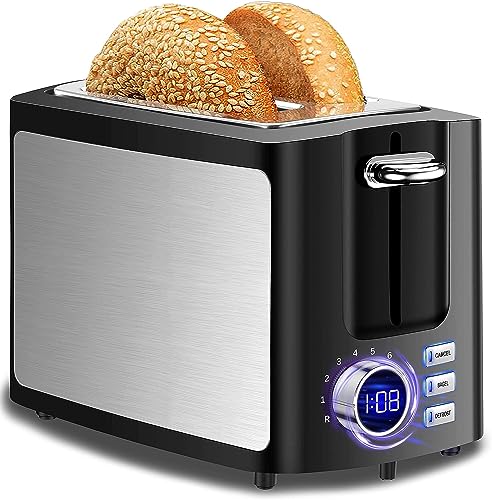
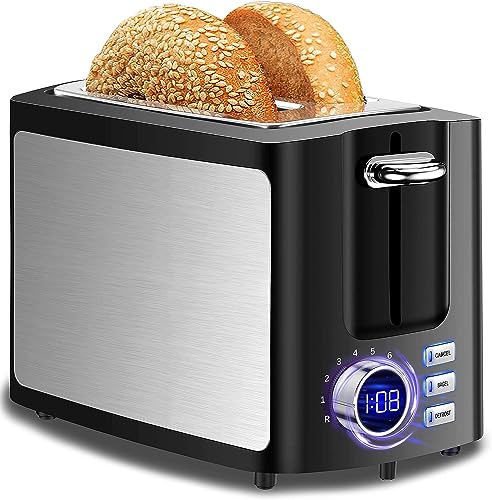
Hommater 2 Slice Wide Slot Smart Toaster
Badge: Best Overall — Control for Crust and Crumb
The Hommater is the control-rich option in this pool: a two-slice wide-slot toaster with an LCD digital countdown timer, nine shade settings — the widest shade range in the group — and bagel, defrost, cancel and reheat functions. The countdown display matters more than it sounds, because it turns shade selection from guesswork into a repeatable number you can read at a glance. Its slot is described as wide, not long or extra-wide, and the title states no wattage.
Sourdough’s toasting window is narrow: the moist crumb needs time to crisp while the caramelised crust sits one shade away from bitter. The Hommater’s nine settings divide that window more finely than any rival here, and the countdown display converts one morning’s success into every morning’s setting — a real virtue when the same loaf is toasted across a week. Its slot is the caution: plain ‘wide’ is the pool’s most modest claim, so bakers of large boules should measure their middle slices against the buying guide’s advice before committing, and keep the bella in view if length is the issue.
Strengths
- Nine shade settings walk the narrow line between crisping sourdough’s crust and scorching its sugars
- Countdown timer makes a perfected setting repeatable loaf after loaf
- Defrost function matches the slice-and-freeze routine of home bakers
Trade-offs
- Slot is ‘wide’, not extra-wide or long — the very biggest boule middles may not fit
- No wattage stated
- Two slices at a time
Verified specs from the listing title
- Configuration: 2 slice
- Slots: Wide slot
- Display: LCD digital countdown timer
- Shade settings: 9
- Functions: Bagel, defrost, cancel, reheat
Check on Amazon for the current listing details.
Best for: sourdough households whose slices fit a wide slot and who toast to a precise finish / Not suited for: big-boule bakers whose middle slices need verified length or extra width

Amazon Basics 2 Slice Toaster
Badge: Best for the Freeze-and-Toast Routine
The Amazon Basics two-slice is the pool’s plain-spoken value machine, and its title is unusually informative: extra wide slots sized for bagels, six browning settings, defrost, cancel and bagel buttons, a removable crumb tray, a cord wrap, and — uniquely in this group — a stated power figure of 900W. That wattage is worth noting precisely because it is the only one verified here; for the other five picks, power simply is not in the title data, and this guide leaves it blank rather than guessing.
Most home sourdough is not toasted fresh; it is sliced, frozen, and toasted slice by slice through the week, because a boule stales faster than a household eats it. Judged on that real routine, the Amazon Basics is quietly complete: extra wide slots for the thick cut, a defrost button for the frozen start, and a published wattage for shoppers comparing heating power honestly. Its six browning settings are the compromise — sourdough rewards finer steps — so the technique section’s advice to start light and step up applies doubly here. Bakers in small kitchens will also note the cord wrap, a virtue the Best Toasters For Small Spaces guide weighs for this same machine.
Strengths
- Extra wide slots take thick sourdough cuts that narrow slots reject
- A stated defrost button serves the freezer storage home bakers actually use
- 900W is published — the pool’s only stated power figure
Trade-offs
- Six browning settings is coarse control for a fast-scorching crumb
- Extra wide, not long — boule middles may still overhang
- Only one finish is stated
Verified specs from the listing title
- Configuration: 2 slice
- Slots: Extra wide, sized for bagels
- Browning settings: 6
- Buttons: Defrost, cancel, bagel
- Power: 900W — the only wattage stated in this pool
- Cleaning: Removable crumb tray
- Storage: Cord wrap
- Finish: Black and silver
Check on Amazon for the current listing details.
Best for: freeze-and-toast sourdough households that want a simple, fully stated machine / Not suited for: precision browners who need more than six settings

Elite Gourmet ECT1027B 2-Slice Cool-Touch Toaster
Badge: Best for Thick Doorstep Cuts
Elite Gourmet’s ECT1027B is the only pick in this pool that puts a number on its slot width: 1.25-inch extra-wide slots, in a cool-touch black body with six shade settings and a cancel function. The title explicitly positions it for bagels and thick bread, which makes its width claim the most checkable in the group — a shopper with a ruler and a favourite loaf can verify the fit claim in a way that vague ‘wide slot’ language never allows.
Sourdough is at its best thick — a doorstep slice crisps outside and stays tender within — and thickness is a jam risk in slots that only claim adjectives. The Elite Gourmet replaces the adjective with 1.25 inches, so a baker can measure the cut at the board and know. That is the whole case, and for thick-cut households it is enough: verified room for the slice sourdough wants to be. The limits are length and finesse — standard slot length, six shades — so pair it with the technique below: centre the slice, start a shade light, and let the crust, not the timer, tell you when it is done.
Strengths
- A stated 1.25-inch slot width you can check against your thickest cut
- Its own title names thick bread as the intended load
- Cool-touch body suits bakers whose toaster shares a crowded worktop
Trade-offs
- Standard length — the boule’s longest middles overhang
- Six shades is mid-pack control
- No named defrost mode in the title
Verified specs from the listing title
- Configuration: 2 slice
- Slot width: 1.25 inch extra-wide slots — the only measured slot width in this pool
- Shades: 6
- Body: Cool-touch, black
- Functions: Cancel; positioned for bagels and thick bread
- Model: ECT1027B
Check on Amazon for the current listing details.
Best for: thick-cut sourdough households that measure their slices / Not suited for: long-boule households and frozen-loaf routines needing stated defrost
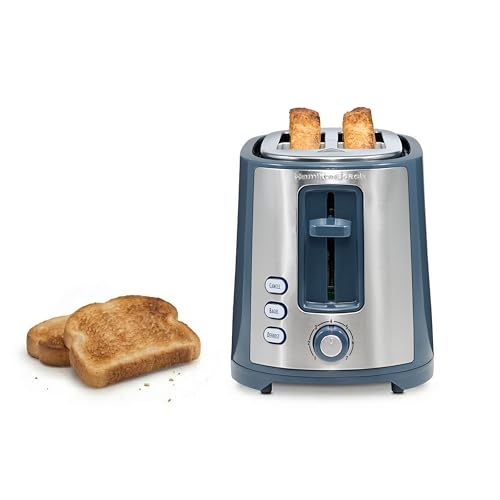
Hamilton Beach 22634 Extra-Wide Slot Toaster
Badge: Best for Mixed Home-Baked and Shop Bread
Hamilton Beach’s 22634 pairs an extra-wide slot with the pool’s most safety-and-retrieval-minded feature set: seven browning shades, bagel and defrost buttons, auto shutoff, a slide-out crumb tray, and Toast Boost, which lifts smaller slices higher so they can be grabbed without tongs or fingertips near the elements. The Kitchen Makeover Blue finish is also the boldest colour in the group. The title claims width, not length, and states no wattage.
Many kitchens run two bread economies: the weekend sourdough and the weekday sandwich loaf, plus the sourdough’s own small end slices that wide slots love to swallow. The Hamilton Beach is the pool’s peacemaker for that mix — extra-wide slot and a stated defrost button for the sourdough, Toast Boost to lift the heels and small pieces back out, and auto shutoff for the baker whose attention is on the oven, not the toaster. It concedes length to the bella and fine control to the Hommater, and in exchange asks the fewest daily compromises of any pick here.
Strengths
- Extra-wide slot covers both sourdough and ordinary loaves in one machine
- Defrost button stated, for the frozen half of the sourdough routine
- Toast Boost retrieves the small end slices that wide slots strand
Trade-offs
- No length claim — long middles still overhang
- Seven shades without a countdown display
- Blue finish is a bold choice for a baker’s kitchen
Verified specs from the listing title
- Configuration: 2 slice
- Slots: Extra-wide slot
- Browning: 7 shades
- Buttons: Bagel and defrost
- Safety: Auto shutoff
- Retrieval: Toast Boost
- Cleaning: Slide-out crumb tray
- Finish: Kitchen Makeover Blue
- Model: 22634
Check on Amazon for the current listing details.
Best for: households mixing sourdough with everyday bread in one machine / Not suited for: single-loaf sourdough purists who want maximum control or length

bella Fits-Anywhere Slim Toaster
Badge: Best for Big Boules and Batch Breakfasts
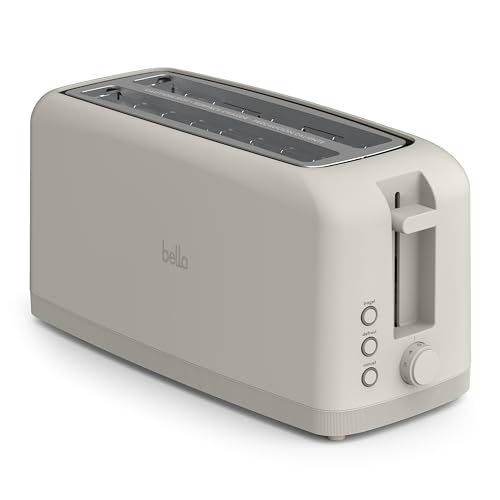
The bella is the pool’s only long-slot machine: its verified title describes a four-slice toaster built around an extra long and wide slot, in a slim Fits-Anywhere body finished in Oatmilk. That slot geometry is the whole story here — length is the dimension standard two-slice slots run out of first. The title states no shade count, no wattage and no bagel or defrost mode, so this guide does not invent any of them; what is verified is the slot shape, the four-slice capacity and the slim footprint claim in the product’s own name.
For the baker whose boule is the point, the bella is the geometric answer: the middle slices of a round loaf are the widest and longest bread in domestic baking, and this is the pool’s only slot that claims both dimensions, four slices at a time. It ranks fifth here only on its silences — no stated shade count and, unusually for this guide’s priorities, no stated defrost — which matter to the freeze-and-toast majority. Fresh-loaf households, and anyone whose sourdough is served in a batch at a table, should promote it to first place without hesitation; the long-format context in the Best Long Slot Toasters Uk guide shows the same machine judged purely on length.
Strengths
- Extra long and wide slot stated — the only verified home for a boule’s longest slices
- Four-slice capacity toasts the whole family’s sourdough in one round
- Slim body leaves worktop room for the board, the butter and the loaf itself
Trade-offs
- No shade count stated — browning granularity is unverified
- No defrost mode stated, a gap for freezer-stored loaves
- Oatmilk is the stated finish
Verified specs from the listing title
- Configuration: 4 slice, extra long and wide slot
- Form: Slim, Fits-Anywhere design
- Finish: Oatmilk
- Shade settings: Not stated in the verified listing title
- Power: Not stated in the verified listing title
Check on Amazon for the current listing details.
Best for: boule bakers toasting fresh, and families eating sourdough together / Not suited for: freeze-and-toast households that need a stated defrost function
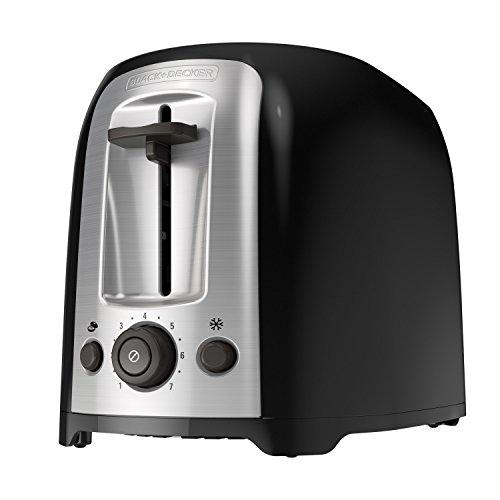
BLACK+DECKER 2-Slice Toaster with Extra-Wide Slots
Badge: Best Familiar Pick for Wide Sourdough Slices
BLACK+DECKER’s entry is a straightforward two-slice machine whose verified title leads with extra-wide slots, then adds the practical details: a bagel mode, seven shade settings, an extra lift lever for retrieving smaller or awkward slices without reaching into a hot slot, and a removable crumb tray. Nothing in the title claims a long slot, so its case rests on width, shade range and that lift lever — a combination aimed at thick, wide bread rather than long loaves.
The BLACK+DECKER closes the list as the conventional wide-slot option, and its sourdough case rests on width and retrieval: roomy slots for wide slices, seven shades for crust correction, and a lift lever for the loaf’s small ends. Its honest weakness for this keyword is the missing defrost — the title states a bagel mode but no defrost function, and frozen storage is the sourdough norm — so fresh-loaf households are its audience, while freezer households should choose among the three picks that state defrost. Shoppers comparing it against the long-slot specialists will find the contrast drawn fully in the Best Long Toasters guide.
Strengths
- Extra-wide slots accept wide sourdough slices and bagels alike
- Seven shade settings give reasonable correction for a fast-darkening crust
- Extra lift lever retrieves low end-slices without tools
Trade-offs
- No defrost function is stated — a real gap for frozen sourdough
- Width only; no length claim
- Two slices at a time
Verified specs from the listing title
- Configuration: 2 slice
- Slots: Extra-wide
- Shade settings: 7
- Modes: Bagel mode
- Retrieval: Extra lift lever
- Cleaning: Removable crumb tray
Check on Amazon for the current listing details.
Best for: fresh-loaf households with wide slices and a simple routine / Not suited for: frozen-loaf households — no defrost is stated
Comparison Table
| Pick | Badge | Key verified trait | Check |
|---|---|---|---|
| Hommater 2 Slice Wide Slot Smart Toaster | Best Overall — Control for Crust and Crumb | 2 slice; wide slot, LCD countdown timer, 9 shade settings, defrost for frozen loaves | Check on Amazon |
| Amazon Basics 2 Slice Toaster | Best for the Freeze-and-Toast Routine | 2 slice; extra wide slots, defrost button stated, 6 browning settings, 900W stated | Check on Amazon |
| Elite Gourmet ECT1027B 2-Slice Cool-Touch Toaster | Best for Thick Doorstep Cuts | 2 slice; 1.25-inch extra-wide slots — sized for the thick cut — 6 shades, cool-touch | Check on Amazon |
| Hamilton Beach 22634 Extra-Wide Slot Toaster | Best for Mixed Home-Baked and Shop Bread | 2 slice; extra-wide slot, 7 shades, defrost button stated, Toast Boost, auto shutoff | Check on Amazon |
| bella Fits-Anywhere Slim Toaster | Best for Big Boules and Batch Breakfasts | 4 slice; extra long and wide slot — the boule’s middle slices fit whole — slim body | Check on Amazon |
| BLACK+DECKER 2-Slice Toaster with Extra-Wide Slots | Best Familiar Pick for Wide Sourdough Slices | 2 slice; extra-wide slots, bagel mode, 7 shade settings, extra lift lever | Check on Amazon |
For sourdough, read the table’s traits as jobs: defrost stated (Hommater, Amazon Basics, Hamilton Beach), measured thickness (Elite Gourmet), length (bella), retrieval (BLACK+DECKER’s lever, Hamilton Beach’s Boost). Most households need two of those jobs done well, rarely all five.
How to Choose a Toaster for Sourdough Bread
Shop for the slice your loaf actually produces
A boule’s slices change across the loaf: small rounds at the ends, wide ovals in the middle. Shop for the middle — the largest slice is the one that decides fit — and measure it in length, width and thickness at your preferred cut. Width maps to the extra-wide claims carried by four picks here; thickness maps to Elite Gourmet’s stated 1.25 inches; length maps only to the bella’s extra long slot. A sandwich-loaf sourdough relaxes all three, which is why gentle-loaf households can shop the whole pool while boule bakers cannot.
Browning control is a sourdough feature
Fermentation leaves sourdough’s crust primed to darken, and its crumb moist enough to need the time. That combination punishes coarse controls: the jump between two adjacent settings on a six-step dial can cross the whole window from perfect to scorched. Nine settings (Hommater) narrow the jump; seven (BLACK+DECKER, Hamilton Beach) are workable; six (Amazon Basics, Elite Gourmet) demand the start-light technique in the how-to section. A countdown timer, unique to the Hommater here, adds repeatability — once a wet, open crumb has been perfected at a setting, the number is the recipe.
LIST:Geometry first: does the biggest slice fit the stated slot claims?||Defrost second: is a defrost function stated, if your loaf lives in the freezer?||Control third: how many shade settings, and can you repeat the winner?||Retrieval last: can you lift small end slices out of a wide slot safely?
- Geometry first: does the biggest slice fit the stated slot claims?
- Defrost second: is a defrost function stated, if your loaf lives in the freezer?
- Control third: how many shade settings, and can you repeat the winner?
- Retrieval last: can you lift small end slices out of a wide slot safely?
The freezer decides more than the badge does
Because sourdough stales quickly, most of it is toasted from frozen — and frozen slices change the purchase. A stated defrost function (Hommater, Amazon Basics and Hamilton Beach carry one in their titles; the bella and the BLACK+DECKER do not state one, and the Elite Gourmet names no defrost mode) thaws before it toasts, protecting the crumb from the dried-out result of a single long cycle. If your routine is freezer-based, treat defrost as a core requirement and let it reorder the badges; if you bake small loaves eaten fresh in two days, ignore it entirely and buy geometry.
A note on crumb moisture and settings, because it explains most sourdough disappointment: a slice cut from a fresh, still-warm loaf carries far more moisture than the same loaf a day later, and a frozen slice carries its moisture differently again. Expect to run two settings in your head — one for fresh, one for frozen — and write them on the recipe card or the freezer bag until they are habit. Machines with a countdown display make the pair of numbers visible; machines with a simple dial make them positions to memorise. Either works, provided the household agrees on the numbers instead of re-litigating them every morning.
How to Toast Sourdough: Fresh, Frozen and Thick-Cut
Sourdough rewards a slightly different technique from sandwich bread. These steps assume a slice that fits your slot; fit itself is the buying guide’s job.
- Cut evenly and generously: a thick, level slice toasts more evenly than a thin wedge, and level cutting starts with a fully cooled loaf
- Centre the slice in the slot so the wide middle is not riding one wall
- Start one shade lighter than your instinct: sourdough’s crust darkens suddenly near the end of the cycle
- From frozen, use the defrost function where stated; without one, run a short first cycle, rest the slice a minute, then finish to colour
- Rest the toast on a rack, not a plate, so the crisped crust does not steam itself soft
- Butter at the table, not before toasting — fats on the surface scorch and smoke in the slot
Troubleshooting
Problem: crisp edges, pale soft centre → the slice is thick and moist; drop one shade and add a short second cycle rather than raising the shade, which scorches the edges first. Problem: the crust turns bitter-dark while the crumb is still cool → the setting is too high for a fermented crust; step down a full setting and let time, not intensity, do the work. Problem: the middle slice will not fit → it is a geometry verdict, not a technique problem; toast it under the grill this once, and treat a long or extra-wide slot as the real fix at replacement time.
Why Sourdough Toasts Differently: A Short Baking Briefing
Three properties of the loaf drive everything in this guide. Moisture: a well-made sourdough crumb holds more water than a sandwich loaf, so the toaster spends the first part of the cycle drying before it can crisp. Sugars and acids: long fermentation leaves the crust chemically primed for browning reactions, so the last part of the cycle accelerates. Structure: an open crumb exposes more surface, which crisps beautifully and burns locally at the thin webs between holes. A toaster cannot change any of this; it can only offer room for the slice and fine enough control to stop the cycle inside a narrow window — which is why this guide ranks geometry and shade range above every other feature.
Toaster or Grill: The Honest Boundary
Some sourdough moments belong to the grill or a hot pan rather than any pop-up slot: the slice too wide for every machine here, the cheese-topped open sandwich, the garlic-rubbed bruschetta style where the surface, not the slot, does the work. The pop-up toaster’s territory is the daily slice — breakfast toast, the soup accompaniment, the freezer slice revived — done quickly, evenly and without supervision. Buy the machine for that territory, keep the grill for the exceptions, and the bella-versus-grill question resolves itself: the long slot exists so that fewer of your loaf’s slices count as exceptions.
Reading a Loaf: Matching the Machine to Your Bake
Not all sourdough asks the same of a toaster, and a minute spent reading your own loaf repays itself at the checkout. A high-hydration, open-crumbed boule is the demanding case: wide middles, a moist interior, a crust that races. A tin-baked sandwich sourdough is the gentle case: standard geometry, a tighter crumb, browning much like ordinary bread. A seeded or fruit-studded loaf adds a third behaviour — its inclusions darken and occasionally scorch ahead of the crumb, arguing for finer shade steps and a lighter hand. Name your case honestly and the ranking in this guide re-sorts itself: boule bakers live at the geometry end, tin bakers at the routine end, seeded-loaf bakers in the Hommater’s fine-control territory.
The baker’s own habits matter as much as the loaf. If you slice the whole boule at once and freeze it — the rhythm this guide assumes for most households — the defrost question dominates and three picks separate themselves. If you keep the loaf on the board and cut fresh for two days, defrost is irrelevant and retrieval and width take over. Neither habit is more virtuous; they are simply different purchases wearing the same keyword, and the reviews above are written so that each habit can find its own first choice without reading against the grain of someone else’s breakfast.
Small Truths About Toasting Sourdough, Gathered
Some of what this guide knows about sourdough fits no section, so it is gathered here as small truths. A loaf sliced at the bakery comes home more even than most home slicing, and evenness is half of even toasting. The crust that shatters pleasingly at the table is the same crust that sheds the crumbs that fill the tray, so the tray rhythm matters more for sourdough households than for any other. A slice reheated briefly in a warm oven can rescue toast that sat too long, but no rescue exists for a scorched fermented crust — prevention, in the form of a lighter first cycle, is the only cure. Butter belongs on sourdough toast the moment it lands, because the open crumb drinks it in a way sandwich bread never will.
More truths, of the machine kind: a toaster lives longer when its slots are not used as a knife rack during retrieval, and sourdough’s torn heels tempt exactly that sin — the lift features in this pool exist to forgive it. Frozen slices should meet the slot dry, not rinsed or misted, whatever a video suggests. A crumb tray emptied weekly keeps the burnt-sugar smell of old sourdough crumbs out of fresh toast, a flavour fault easily mistaken for a machine fault. And the setting that perfects your loaf will not perfect your neighbour’s, because hydration is a fingerprint; the numbers in this guide are a method, not a recipe.
Two truths belong to the baker rather than the buyer. First, the loaf you toast on day three is not the loaf you baked on day one: staling firms the crumb and concentrates the sugars, so day-three slices toast faster and darker at the same setting, and the wise household keeps a fresh setting and a keeping setting. Second, sourdough forgives a modest toaster more readily than it forgives an impatient one — a mid-range machine worked with the start-light technique will out-toast a flagship worked carelessly, because the loaf’s narrow window rewards attention more than wattage. Buy the best geometry and control you reasonably can, then spend the real currency, which is the first week’s calibration, and the combination will serve the bake for years.
Storing the Loaf So the Toaster Can Do Its Job
The toaster’s work begins the day before, in how the loaf is stored. Sourdough kept in a plastic bag softens its crust and steams its own crumb, arriving at the slot in the worst condition for crisping; kept in a cloth bag, a bread box or cut-side down on the board, it stays dry at the surface and toasts the way this guide assumes. Slices destined for the freezer should be frozen separated — a sheet of baking paper between slices for the first hour — so that a single slice can be taken without thawing the loaf’s whole week, and they should be frozen on the day of slicing, while the crumb is still at its best. None of this is toaster advice in the narrow sense, and all of it decides what the toaster is given to work with: the finest slot and the finest shade range in this pool cannot crisp a slice that arrives soggy from its storage, and the humblest machine here will shine on a slice that was stored like it mattered.
A Word for the Sandwich-Loaf Baker
Everything in this guide was weighted toward the demanding case, the free-form boule, and a reader who bakes sourdough in a tin may fairly ask whether the rankings apply to them at all. They do, with the geometry clauses relaxed: a tin loaf’s slices are standard in length and width, so every slot claim in the pool is sufficient, and the purchase collapses to the routine questions — defrost if you freeze, shade range if you fuss, retrieval if your household toasts heels and halves. That is not a lesser purchase; it is an easier one, and the tin baker can choose the Hommater for its control or the Amazon Basics for its completeness with a clear conscience, knowing the boule baker’s constraints were never theirs to pay for.
Common Buying Mistakes
- Shopping for the end slices. The boule’s middle slices decide fit; buy for the largest slice, not the average one.
- Ignoring defrost. If your loaf lives in the freezer, a stated defrost function is a core feature — three picks here state one, three do not.
- Cranking the shade for a pale centre. Sourdough’s crust scorches before its moist centre crisps; use a lighter setting and a second short cycle.
- Cutting warm bread. Slices from a warm loaf gum, tear and wedge in the slot; cool the loaf fully before slicing for the freezer or the toaster.
- Expecting a sourdough mode. No title in this pool claims one; the honest purchase is slot geometry plus shade control.
- Storing toast on a plate. A large crisped slice steams itself soft in a minute; a rack preserves the crust you toasted for.
Final Recommendation
The Hommater is this guide’s first recommendation for most sourdough households: nine shade settings and a countdown timer are the finest tools here for sourdough’s narrow browning window, with a stated defrost for the freezer routine — provided your slices fit its wide slot, which the tape measure must confirm. The Amazon Basics is the routine-complete alternative, and the Elite Gourmet the thick-cut specialist with the pool’s only measured slot.
Promote the bella to first place the moment your loaf is a large boule eaten fresh in batches: it is the only verified long slot, and geometry outranks control when the slice otherwise does not fit. The Hamilton Beach is the mixed-bread peacemaker, and the BLACK+DECKER the fresh-loaf traditionalist — wide, simple, and honestly short of a defrost claim.
Shortlist again, in the order most readers should consider them: Hommater 2 Slice Wide Slot Smart Toaster, Amazon Basics 2 Slice Toaster, Elite Gourmet ECT1027B 2-Slice Cool-Touch Toaster. Check the current listing for each before deciding, because finishes and bundle details change over time.
Frequently Asked Questions
What kind of toaster is best for sourdough bread?
A wide-slot toaster with fine browning control, and a long slot if your loaf is a boule. Sourdough slices are wide, thick and irregular, and the crumb browns on a narrow window, so slot geometry and shade range do the work that a dedicated mode — which no pick in this pool claims — would only pretend to do.
Will a whole boule slice fit in these toasters?
The middle slices of a large boule are the hardest fit in domestic bread. The bella’s extra long and wide slot is the only verified claim aimed at them; the extra-wide two-slice picks take wide slices whose length stays near standard. Measure your boule’s middle slice and compare it honestly with each pick’s stated claims before ordering.
How thick should I cut sourdough for toasting?
Thick enough to stay tender inside — and no thicker than your slot verifies. The one measured slot in this pool is the Elite Gourmet’s 1.25 inches, so a cut comfortably below that is the checkable benchmark; thicker doorstep cuts belong to the grill. Evenness matters as much as thickness: a level slice browns level.
Should I toast sourdough from frozen or thaw it first?
From frozen, with help. Three picks here state a defrost function (Hommater, Amazon Basics, Hamilton Beach), which thaws before toasting and protects the crumb. Without defrost, run a short first cycle, rest the slice, then finish to colour. Thawing on the counter first tends to dry the slice’s surface unevenly.
Why does my sourdough toast scorch so quickly?
Long fermentation leaves its crust primed to brown, and an open crumb exposes thin webs that darken first. The fix is a lighter setting than sandwich bread, stepped up gradually — the reason this guide values the Hommater’s nine settings — rather than a high setting watched anxiously.
Does wattage matter for sourdough?
Power affects how fast the surface heats, which interacts with scorching, but this guide can only verify one figure: the Amazon Basics states 900W, and the other titles publish none. Treat any wattage-based sourdough advice for the other five as unverified, and lean on shade control, which every pick here does state.
Can these toasters handle sourdough sandwich loaves too?
Easily — a pan-baked sourdough sliced to sandwich dimensions is the gentle case, well inside every slot claim in this pool. The demanding case that shaped the rankings is the free-form boule; if your sourdough comes from a tin, choose on control and routine features instead of geometry.
Why does sourdough toast faster at the edges than in the middle?
The edges are thinner, drier and closer to the elements, while the moist centre spends the early cycle drying out. A level, generously thick cut narrows the gap, centring the slice keeps both faces honest, and a slightly lower shade with a short second cycle finishes the centre without punishing the edges — the technique this guide repeats because it is the one that works.
Is sourdough better toasted in a toaster or a pan?
For the daily slice, the toaster: faster, unattended and even. A dry pan or a grill earns its place for the slices that exceed every slot, for cheese-topped and garlic-rubbed variations, and for the cook who wants a fried, crisped surface rather than a toasted one. The two tools divide the loaf between them rather than competing for it.