Disclosure: topratedkitchenware.com is reader-supported. When you buy through links on our site, we may earn an affiliate commission from Amazon and other retailers, at no extra cost to you.
Where to buy
Asking about the best type of pressure cookers is really asking which design fits your cooking: the classic all-rounder, the feature-loaded pro model, the compact mini, or the safety-first challenger. Every pick below is an electric countertop model from the verified pool — that is where home pressure cooking has moved — and each represents a distinct type rather than a trim level. Start with this shortlist, then read the reviews to see which type matches your household size and your appetite for features.
- Instant Pot Duo 6 Qt 7-in-1 Electric Pressure Cooker — the reference 7-in-1 all-rounder that defined the category
- Cosori Pressure Cooker 6QT, 9-in-1 — the 9-in-1 with sous vide and 12 listed safety features
- Instant Pot Duo Mini 3 Quart 7-in-1 Electric Pressure Cooker — the 3-quart mini for one or two people
- Instant Pot Pro 6 Qt 10-in-1 Electric Pressure Cooker — the 10-in-1 pro tier for frequent cooks
- Instant Pot Duo Plus 6 Qt 9-in-1 Electric Pressure Cooker — the 9-in-1 middle ground between Duo and Pro
- Instant Pot Rio Mini 4 Qt 7-in-1 Electric Pressure Cooker — the newer 4-quart compact
Read the full guide ↓ for the detailed reviews, the comparison table, and the cooking and care guidance that decides which of these machines actually fits your kitchen and your routine.
Pressure cookers used to mean a rattling stovetop pot your grandmother warned you about. Today the question behind the best type of pressure cookers is a genuine design choice: electric countertop multi-cookers have split into clear types — the all-rounder, the pro model, the mini, the safety-led challenger — and picking the right type matters more than picking within one. This guide reviews the six verified electric models in the pool as type representatives, so you can decide which family of machine fits your kitchen before you worry about individual models. Readers whose main use is grains should also see Best Small Pressure Cookers For Rice.
One honest boundary first: the verified pool contains electric countertop cookers only, so no stovetop pressure cooker is reviewed or linked here. Stovetop models still exist and suit some cooks — they reach higher pressure and last for decades — but they demand supervision, and the electric types below trade a little of that raw pressure for timers, safety systems and walk-away convenience. That trade is why electrics dominate home kitchens now.
Size is the second axis of type: this pool runs from a 3-quart mini to full 6-quart family machines. The functions overlap heavily across sizes, which is precisely the point — type is about the combination of size, feature depth and safety design, not about any single number on the box.
Key Takeaways
- All six verified picks are electric countertop multi-cookers; the ‘types’ that matter are all-rounder, pro, plus, mini and safety-led challenger.
- The Instant Pot Duo (6 Qt, 7-in-1) is the reference type — the baseline every other electric pressure cooker is compared with.
- Feature depth is the tier ladder: 7-in-1 Duo, 9-in-1 Duo Plus and Cosori, 10-in-1 Pro with sous vide.
- Size is a type decision: 3- and 4-quart minis suit one or two people; 6 quarts is the family standard.
- Safety is engineered, not hoped for: modern electrics carry multiple listed safety features — Cosori spells out twelve.
In this guide
Quick Picks
| Pick | Badge | Why it stands out |
|---|---|---|
| Instant Pot Duo 6 Qt 7-in-1 Electric Pressure Cooker | Best Overall | The reference all-rounder: 7-in-1, 6 Qt, stainless steel, and the deepest recipe ecosystem in the pool. |
| Cosori Pressure Cooker 6QT, 9-in-1 | Best for Safety-Conscious Cooks | 9-in-1 with sous vide, a ceramic-coated pot and twelve listed safety features — the reassurance pick. |
| Instant Pot Duo Mini 3 Quart 7-in-1 Electric Pressure Cooker | Best Compact Pick | The full Duo formula at 3 quarts — the right type for singles, couples and side dishes. |
| Instant Pot Pro 6 Qt 10-in-1 Electric Pressure Cooker | Best Premium Pick | 10-in-1 with sous vide and pro-tier controls — for cooks who pressure-cook several times a week. |
| Instant Pot Duo Plus 6 Qt 9-in-1 Electric Pressure Cooker | Best Middle Ground | 9-in-1 middle ground: more than a Duo, less commitment than a Pro. |
| Instant Pot Rio Mini 4 Qt 7-in-1 Electric Pressure Cooker | Best Newer Compact | The newer 4-quart compact: core functions, apartment-friendly footprint. |
How These Picks Were Chosen
Picks were drawn from the job’s verified pool, each cross-checked through the Creators API with ASIN, title and image recorded in the accompanying sources file. Because the keyword asks about types, we deliberately kept one representative of each electric type the pool offers rather than six near-identical mid-size machines — you will find the all-rounder, the plus, the pro, two compacts of different generations and the safety-led Cosori.
Comparison criteria were the axes that define type: capacity, function count and kind (does it sous vide? make yogurt? sterilize?), pot material, safety-feature design, and the ecosystem behind the machine — recipes, accessories and replacement parts such as sealing rings. Accessory shoppers can extend any of these with Best Steamer Basket For Electric Pressure Cookers.
This is research-led guidance built on verified specifications and documented design, not hands-on lab testing, and we do not claim otherwise. Where a type’s reputation rests on years of ownership patterns — the Duo’s ubiquity, the minis’ small-batch logic — we describe it as such.
We also weighted what ownership actually involves over years: whether the pot and lid come apart for washing, whether the sealing ring — the one true consumable in every electric pressure cooker — is easy to source for that brand, and whether the control panel can be understood by a tired cook at six in the evening. Type is not only a spec-sheet concept; it is the shape of the machine’s whole life in your kitchen, and the reviews below keep returning to that life rather than to launch-day feature lists.
The 6 Best Pressure Cookers, Type by Type

Instant Pot Duo 6 Qt 7-in-1 Electric Pressure Cooker
Badge: Best Overall
The Instant Pot Duo is the machine that defined the modern electric pressure cooker: six quarts, seven functions in one, a stainless steel body, and an ecosystem of recipes and accessories deeper than any rival in this pool. Its slow-cook, rice and yogurt modes make it a genuine multi-cooker rather than a single-trick pressure pot, and the saute function means a stew can be browned and pressure-cooked in the same vessel. For most households asking which type of pressure cooker to start with, the Duo is the reference answer — the baseline everything else is compared against.
As a type, the Duo is the ‘standard electric multi-cooker’: medium-large pot, core function set, moderate controls, maximum ecosystem. Choosing this type means choosing compatibility — with recipes written for it, accessories sized for it, and troubleshooting advice that assumes it. For a first pressure cooker, that surrounding infrastructure is worth as much as any single feature, which is why the all-rounder remains the default recommendation for the undecided.
Living with the Duo type means living inside an ecosystem: when a recipe says ‘manual, ten minutes, natural release’, it was probably written on this platform, and that shared language removes the translation work other brands impose. The type’s weakness is the mirror of its strength — the design is mature to the point of conservatism, so buyers chasing the newest interface ideas should look at the pool’s newer entries while accepting a thinner recipe commons.
Strengths
- The reference design — deepest recipe and accessory ecosystem here
- Saute-then-pressure in one pot builds real flavor
- Stainless steel build and 6 Qt family size
Trade-offs
- Interface is functional rather than intuitive at first
- Slow-cook mode runs differently from a dedicated slow cooker
- Sealing ring absorbs odors and needs periodic replacement
At a glance:
- Capacity: 6 Qt
- Functions: 7-in-1 — pressure cook, slow cook, rice, yogurt, steam, saute, warm, sterilize as listed
- Body: stainless steel
- Extras: app with recipes as listed
Best for: households wanting the most complete all-round answer in this pool / Not suited for: buyers whose needs fall outside this guide’s category entirely
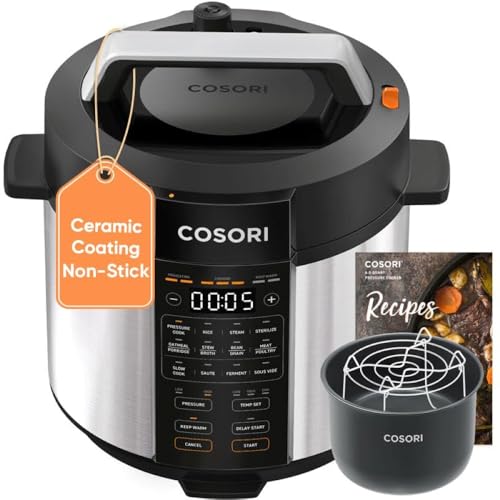
Cosori Pressure Cooker 6QT, 9-in-1
Badge: Best for Safety-Conscious Cooks
The Cosori 9-in-1 is the safety-and-features challenger: six quarts, a ceramic-coated pot, twelve listed safety features, 1100 watts, and a function list that reaches sous vide alongside the expected rice, slow cook and saute modes. Sous vide in a pressure cooker is the interesting line on the spec sheet — it signals a machine aimed at cooks who want precision options, not just speed. The ceramic coating answers the nonstick question the way the COMFEE’ does, and the safety-feature count is pitched at buyers who are nervous about pressure and want the reassurance spelled out.
The Cosori represents the challenger type: match the leader’s core, then differentiate on the anxieties buyers actually voice — coating materials and safety. Its ceramic-coated pot answers the nonstick question, its twelve listed safety features answer the pressure question, and sous vide answers the enthusiast question. If your hesitation about pressure cooking is safety rather than usefulness, this is the type designed to talk you through it.
The Cosori’s ownership story hinges on its pot and its reassurance: ceramic coating changes daily cleaning from a soak to a wipe for most dishes, and the spelled-out safety systems change the emotional register of pressure cooking for households that arrived nervous. If either of those is your household’s story, the challenger type is not a compromise pick — it is the pick, and the Instant Pot ecosystem is the only thing you are knowingly trading away.
Strengths
- Sous vide mode is rare in this class and price band
- 12 listed safety features reassure first-time pressure cooks
- Ceramic-coated pot avoids conventional nonstick
Trade-offs
- Sous vide in a cooker is less precise than a dedicated circulator
- Ceramic coatings need gentler utensils than steel
- Brand ecosystem is thinner than Instant Pot’s
At a glance:
- Capacity: 6QT
- Functions: 9-in-1 — rice, slow cook, sous vide, saute as listed
- Pot: ceramic coating
- Safety: 12 safety features
- Power: 1100W
- Finish: stainless steel, silver
Best for: everyday cooks who value consistency over ceremony / Not suited for: tinkerers who want maximum manual control

Instant Pot Duo Mini 3 Quart 7-in-1 Electric Pressure Cooker
Badge: Best Compact Pick
The Duo Mini takes the Instant Pot formula and shrinks it honestly: three quarts, the same 7-in-1 function list, stainless steel, and the app ecosystem behind it. Three quarts is the right size for one or two people, for side dishes alongside a main cooked elsewhere, and for small kitchens where a 6-quart machine would dominate the counter. It pressure-cooks, slow-cooks rice, steams, sautes and makes yogurt exactly like its bigger sibling — the difference is batch size and footprint, not capability, which is what makes it a real type of pressure cooker in its own right rather than a toy version.
The Duo Mini defines the compact type: identical philosophy, honest shrinkage. Compact pressure cookers make sense as a type because pressure cooking scales down gracefully — beans for two, rice for a side, yogurt in small jars — and because a 3-quart machine earns counter residence that a 6-quart would lose to the cupboard. Apartment cooks and couples should start their shortlist with this type, not with a full-size machine bought on ambition.
The Mini’s quiet virtue is frequency: a cooker small enough to live on the counter gets used for the small jobs — two portions of beans, a side of grains, a single batch of yogurt — that a big machine’s setup overhead quietly discourages. Owners of compact pressure cookers consistently report cooking more varied food, not less, and that frequency effect is the compact type’s real specification, invisible on any box.
Strengths
- Full 7-in-1 capability in a 3-quart footprint
- Right-sized batches for one or two people
- Same recipe ecosystem as the full-size Duo
Trade-offs
- 3 quarts rules out family batches and big cuts
- Too small for some standard pressure-cooker accessories
- Per-batch efficiency drops if you cook for a crowd
At a glance:
- Capacity: 3 quart
- Functions: 7-in-1 mini — pressure, slow rice cook, steam, saute, yogurt, warm, sterilize as listed
- Body: stainless steel
- Extras: free app with recipes as listed
Best for: buyers whose priority matches this pick’s headline strength / Not suited for: households needing a different format than this pick offers

Instant Pot Pro 6 Qt 10-in-1 Electric Pressure Cooker
Badge: Best Premium Pick
The Instant Pot Pro is the enthusiast tier of the line: six quarts, ten functions including sous vide, and a design aimed at cooks who use a pressure cooker several times a week and want more control over each cook. Rice and grains get dedicated attention, the saute is stronger, and the whole machine is built to be the kitchen’s workhorse rather than its occasional helper. If the Duo is the reference type, the Pro is the upgraded type — same category, more headroom — and the price positioning in this pool reflects that honestly: it is the premium-tier electric pressure cooker here.
The Pro is the enthusiast type: more functions, stronger saute, sous vide, and controls aimed at repeat users who cook under pressure several times a week. The type’s logic is frequency — features that are decoration on a monthly machine become workflow on a daily one. If you already own a basic cooker and feel its limits, this is the type you are feeling them against. Compare its electric siblings in Best Small Pressure Electric Cookers for the wider field.
The Pro type asks to be judged on workflow rather than features: stronger saute means browning without a second pan, sous vide means the machine covers a technique otherwise needing another appliance, and the interface assumes a cook who repeats dishes and refines them. If that description sounds like your kitchen’s direction of travel, the premium is buying headroom you will grow into; if it sounds like someone else’s kitchen, it is buying decoration.
Strengths
- 10-in-1 range including sous vide is the widest here
- Built for frequent, heavy use
- Dedicated rice and grains programs
Trade-offs
- Premium-tier positioning — overkill for occasional use
- More functions mean more interface to learn
- 6 Qt still will not feed a very large gathering alone
At a glance:
- Capacity: 6 Qt
- Functions: 10-in-1 — pressure, slow cook, rice and grains, steam, saute, sous vide, yogurt, warm, sterilize as listed
- Finish: black
Best for: households that will use this pick’s full feature range / Not suited for: minimalists who will never use the extra features

Instant Pot Duo Plus 6 Qt 9-in-1 Electric Pressure Cooker
Badge: Best Middle Ground
The Duo Plus sits between the Duo and the Pro: six quarts, nine functions, stainless steel, and the full Instant Pot recipe ecosystem. It adds capability over the base Duo — more programs, a more informative interface generation — without stepping all the way to the Pro’s enthusiast pricing tier. For a household that has outgrown a basic cooker, or is buying once and buying properly, the Plus is the middle type that often makes the most sense: the same trusted platform, a longer feature list, and no function you are paying for purely as decoration.
The Duo Plus is the step-up type, and its existence teaches the main lesson of this guide: within one brand’s line, types are separated by interface and program depth, not by cooking power. The Plus buyer wants the trusted platform with a longer program list and a clearer display generation. If the Duo reads as slightly basic and the Pro as slightly much, the Plus is the type engineered for exactly that feeling.
The Duo Plus rewards a specific buyer: the one who read the Duo’s reviews, wanted a clearer interface and a few more programs, and stopped before the Pro’s enthusiast pricing. That is a larger group than marketing admits, and the Plus exists because step-up logic is real — most households do not need the best type, they need the type one rung above basic, bought once and kept for years.
Strengths
- 9-in-1 range covers everything most households use
- Same trusted Duo platform and ecosystem
- Stainless steel 6 Qt family size
Trade-offs
- Close enough to the Pro that the step-up tempts
- Interface generation sits between two designs
- Sealing ring and lid parts are ongoing consumables
At a glance:
- Capacity: 6 Qt
- Functions: 9-in-1 — pressure, slow cook, rice, yogurt, steam, saute, warm, sterilize as listed
- Body: stainless steel
- Extras: app with recipes as listed
Best for: smaller kitchens and lighter routines / Not suited for: large households cooking at full volume daily

Instant Pot Rio Mini 4 Qt 7-in-1 Electric Pressure Cooker
Badge: Best Newer Compact
The Rio Mini is Instant Pot’s newer compact answer: four quarts — a useful step up from the 3-quart Mini — with seven functions covering pressure, slow cook, rice, steam, saute, yogurt and keep-warm. Four quarts is a quietly smart size: big enough for a small family’s main dish, small enough to live on the counter of an apartment kitchen. As a type, it represents the modern compact multi-cooker — fewer novelty functions, the core list done properly, and a footprint that respects how people actually cook on weeknights.
The Rio Mini represents the newest compact generation: four quarts instead of three, a trimmed core function list, and a design that assumes apartment kitchens and weeknight cooking. As a type it signals where the category is heading — compacts growing slightly to cover small families, novelty functions dropped, the essentials polished. Buyers choosing between the two minis are choosing between the proven 3-quart and the roomier, newer 4-quart interpretation of the same idea.
The Rio Mini’s four quarts quietly fix the 3-quart’s one recurring complaint — a whole chicken or a family-of-three stew that almost fits — while keeping the compact type’s counter manners. As the newer design it also represents the category’s current thinking: fewer novelty programs, the core list polished. Buyers choosing between the two minis should choose by that one extra quart and by which generation’s interface they prefer, because the cooking itself is a draw.
Strengths
- 4 Qt size splits the difference between mini and full-size
- Core 7-in-1 list covers daily cooking
- Counter-friendly footprint for apartments
Trade-offs
- Still too small for large-batch meal prep
- Newer line, so long-term track record is shorter
- Fewer programs than the Pro and Plus tiers
At a glance:
- Capacity: 4 Qt
- Functions: 7-in-1 — pressure, slow cook, rice, steam, saute, yogurt, keep warm as listed
- Finish: black
Best for: buyers who want the pool’s most distinctive option / Not suited for: buyers who prefer the safest, most conventional choice
Comparison Table
| Pick | Format | Capacity (as listed) | Standout trait | Link |
|---|---|---|---|---|
| Instant Pot Duo 6 Qt 7-in-1 Electric Pressure Cooker | All-rounder multi-cooker | 6 Qt | The reference all-rounder: 7-in-1, 6 Qt, stainless steel, and the deepest recipe ecosystem in the pool. | Check on Amazon |
| Cosori Pressure Cooker 6QT, 9-in-1 | Safety-led multi-cooker | 6QT | 9-in-1 with sous vide, a ceramic-coated pot and twelve listed safety features — the reassurance pick. | Check on Amazon |
| Instant Pot Duo Mini 3 Quart 7-in-1 Electric Pressure Cooker | Compact multi-cooker | 3 Quart | The full Duo formula at 3 quarts — the right type for singles, couples and side dishes. | Check on Amazon |
| Instant Pot Pro 6 Qt 10-in-1 Electric Pressure Cooker | Pro multi-cooker | 6 Qt | 10-in-1 with sous vide and pro-tier controls — for cooks who pressure-cook several times a week. | Check on Amazon |
| Instant Pot Duo Plus 6 Qt 9-in-1 Electric Pressure Cooker | Step-up multi-cooker | 6 Qt | 9-in-1 middle ground: more than a Duo, less commitment than a Pro. | Check on Amazon |
| Instant Pot Rio Mini 4 Qt 7-in-1 Electric Pressure Cooker | Compact multi-cooker | 4 Qt | The newer 4-quart compact: core functions, apartment-friendly footprint. | Check on Amazon |
The table’s real message is that capacity splits the pool into two families — 6-quart family machines and 3- to 4-quart compacts — while function count ladders each family from core to pro. Choose the family by household size first, then the rung by how often you will actually pressure-cook.
How to Choose the Right Type of Pressure Cooker
Decide electric versus stovetop first, even though this guide’s verified pool is electric. Stovetop pressure cookers reach higher pressure, work on any hob including induction with the right base, and can last decades — but they need watching, adjusting and confidence. Electric types trade peak pressure for automation: set the program, and sensors manage pressure, time and the switch to keep-warm. For most home cooks, and certainly for first-time pressure cooks, the electric trade is the right one.
Then size the pot by your real batches. Pressure cookers should not be filled beyond their max line — roughly two-thirds for most foods, less for foaming grains and beans — so a 6-quart pot delivers about four quarts of actual stew. Singles and couples genuinely do better with the 3- and 4-quart compacts: smaller batches come to pressure faster and the machine stays on the counter. Families and batch cookers should not go below six quarts.
Function lists deserve skepticism and a menu check. The useful core — pressure cook, saute, slow cook, rice, steam, yogurt, keep warm — appears across the pool; the differentiators are sous vide (Cosori, Pro), sterilize modes (Duo family) and program depth. Buy the rung whose extra functions match dishes you actually cook; a function you use weekly is a feature, and one you use never is a surcharge. Rice-heavy households may also weigh Best Small Pressure Cookers For Rice.
Finally, consider the ownership layer: sealing rings absorb odors and need replacing, lids have valves that need cleaning, and accessory ecosystems differ sharply by brand. The Instant Pot types benefit from the deepest third-party and recipe support; challenger types like the Cosori compete on pot material and safety design. Neither is a wrong answer — but buy the ecosystem knowingly.
How to Pressure Cook Safely and Well
Every electric type in this guide shares the same operating grammar, and learning it once makes any of them feel familiar. The sequence is always: build flavor, add liquid, seal, program, release — and the release method is a cooking decision, not an afterthought.
Liquid is non-negotiable: pressure comes from steam, and steam needs water or thin liquid in the pot before the lid seals. Thick sauces go in after pressure cooking, or layered on top without stirring, so the base stays thin enough to boil. That single rule prevents most of the error messages new owners meet.
- Saute aromatics, spices and meats first when the recipe benefits — browning in the pot builds the flavor pressure cooking cannot create on its own.
- Add at least the minimum thin liquid your machine’s manual specifies, and deglaze the pot bottom so nothing stuck-on scorches.
- Load ingredients without passing the max fill line — stay lower for beans, grains and anything that foams.
- Seal the lid, set the valve to sealing, and choose the program and time for your ingredient type.
- Choose the release deliberately: natural release for meats and foamy foods, quick release for vegetables and delicate items.
- Open away from your face, check doneness, then thicken or reduce with saute if the dish needs it.
Natural versus quick release is the skill that separates decent pressure cooking from great pressure cooking. Natural release keeps meats relaxed and prevents foamy liquids from spraying through the valve; quick release protects green vegetables and seafood from the extra minutes of cooking a slow release adds. Many recipes split the difference — ten minutes natural, then quick — and the types in this pool all support that rhythm.
Care keeps the safety system honest: wash the sealing ring and check it for cracks, keep the steam valve and anti-block shield clear, and wipe the rim where the seal sits. A spare ring — one for savory, one for sweet — is the accessory experienced owners buy first, ahead of almost everything in Best Stackable Pans For Pressure Cookers.
Troubleshooting:
- Problem: the pot will not come to pressure → check the sealing ring is seated, the valve is set to sealing, and there is enough thin liquid to generate steam.
- Problem: a burn or scorch message appears → something stuck to the base, usually after sauteing; deglaze thoroughly and keep thick sauces layered on top, unstirred, until after the cook.
- Problem: liquid sprays from the valve on release → the food was foamy or the pot overfilled; let it release naturally for 10 minutes first next time and respect the lower fill line for grains and beans.
Best type of pressure cookers: the electric family tree, explained
Strip the marketing away and the electric types sort into four ideas. The all-rounder (Duo) optimizes balance and ecosystem. The step-up and pro types (Duo Plus, Pro) optimize depth — more programs, better interfaces, sous vide — for cooks whose frequency justifies them. The compacts (Duo Mini, Rio Mini) optimize footprint and batch honesty for small households. And the challenger type (Cosori) optimizes reassurance: coatings and safety features foregrounded. Every buying argument in this category is really an argument about which of those four optimizations matches your kitchen.
That framing also tells you when to stop climbing tiers. If you pressure-cook twice a month, the all-rounder’s balance beats the pro’s depth every time; if you cook under pressure four nights a week, the pro’s interface and saute strength stop being luxuries. Type choice is frequency choice, stated honestly.
What about stovetop and smart pressure cookers?
Two neighbouring types sit outside this verified pool and deserve honest context. Stovetop pressure cookers — the original type — reach higher pressure, sear harder and outlast electrics, at the cost of supervision; cooks who want that route should research dedicated stovetop lines, including the gas-stove angle in Best Stainless Steel Pressure Cookers For Gas Stove. Smart, app-connected electrics add remote control and guided recipes; the pool here is deliberately the mainstream, non-connected heart of the market, and readers set on connectivity can compare Best Smart Pressure Cookers.
Neither omission changes this guide’s conclusion for most households: a mainstream electric multi-cooker, sized honestly and chosen by frequency, is the type that will actually get used — and a pressure cooker that gets used is the only kind that earns its shelf.
Pressure, release and time: the physics every type shares
All electric types cook the same way: a sealed pot, steam pressure raising the boiling point, and food cooking faster and wetter than any open pot allows. The differences between types are management differences — how pressure is controlled, how the cook is timed, how release is handled — layered over identical physics. That is why technique transfers between brands so completely, and why a cook who learns release discipline on a Duo can walk up to a Cosori or a Pro and be competent in one session.
Release deserves its reputation as the master skill. Natural release lets pressure fall slowly, keeping meats relaxed and foamy pots calm; quick release stops cooking fast for vegetables and seafood; and the hybrid — ten minutes of patience, then the valve — covers most real recipes. No type in this pool automates that judgment away, which is honest: it is a cooking decision, and the machines rightly leave it with the cook.
Electric versus stovetop: the honest comparison
Stovetop pressure cookers reach higher pressure, sear with real pan heat, work during power cuts and can serve for decades with gasket changes. Electric types answer with automation: sensors hold pressure without hob-watching, timers end the cook and hold food warm, and safety systems layer interlocks a stovetop pot cannot match. For weeknight family cooking the electric trade wins on convenience; for canning-adjacent, high-pressure or off-grid work the stovetop keeps its crown — and this guide’s pool, being entirely electric, makes no claim to that crown.
Cost of ownership tilts electric too, in an unexpected way: the recipe and accessory ecosystem around the electric types — this pool’s Instant Pot entries above all — lowers the learning cost to nearly zero, while stovetop technique is learned from books and patience. Neither path is wrong, but they are different hobbies wearing the same name, and choosing the type is really choosing which hobby, if any, you want.
Matching type to signature dishes: a practical map
Types stop being abstract when they meet menus. The household whose rotation is beans, braises and batch grains lives in the all-rounder’s home ground, and the Duo type will feel less like a purchase than like an obviousness. The household that cooks a whole chicken on Sunday, yogurt on Wednesday and a precision egg experiment on Saturday is describing the Pro type’s week — frequency and variety together are what its premium actually buys.
The safety-led challenger maps to the household that has been pressure-curious for years and never bought: the barrier was never usefulness, it was trust, and trust is a specification the Cosori’s design takes seriously. The compacts map to the smallest kitchens and the most honest appetites — one or two people who cook real food nightly and refuse to let a 6-quart machine colonize their counter to do it.
Read your own last month of dinners against those maps and the type chooses itself. That exercise — menu first, machine second — is the opposite of how appliances are usually sold, and it is why this guide is organized by type rather than by brand: the type is the decision that survives contact with your actual cooking.
Accessories and the second purchase every owner makes
Every pressure-cooker type generates the same second purchase: a spare sealing ring, usually followed by a steamer basket and, for enthusiasts, stackable pans that cook two dishes at once. Budgeting for that second purchase at buying time changes the type calculus slightly — ecosystems with cheap, available rings and baskets lower the lifetime cost of the machine, which is one more reason the reference type’s ubiquity is a genuine feature rather than a marketing artifact.
The discipline is to buy accessories for dishes you already cook, not for the cook you imagine becoming. A basket that steams the vegetables you eat weekly earns its drawer; a specialty insert bought for a hypothetical cuisine becomes the drawer’s permanent resident. Types differ in how much accessory temptation they generate — the pro and reference types most of all — and knowing that in advance is a small but real ownership advantage.
Common Buying Mistakes
Type-level mistakes are more expensive than model-level ones, because they cannot be fixed by an exchange within the same wrong category.
- Buying a 6-quart machine for a one-person household, then leaving it in the cupboard because it dominates the counter.
- Paying for the pro tier’s ten functions when your real rotation uses three.
- Ignoring the fill-line rule and judging a cooker harshly for overfill problems it was never designed to handle.
- Choosing by function count instead of by pot material, safety design and ecosystem — the things you live with daily.
- Skipping the spare sealing ring and wondering why Thursday’s curry haunts Sunday’s yogurt.
Final Recommendation
For most households, the all-rounder type is the answer, and the Instant Pot Duo is its reference model: buy it unless you have a specific reason not to. Small households have that reason — take the Duo Mini or the roomier Rio Mini instead. Safety-anxious and coating-conscious buyers should take the Cosori’s challenger type seriously, and frequent cooks who already know they will live in the machine should climb straight to the Pro, with the Duo Plus as the sensible middle rung.
Whichever type you land on, learn the release methods and the fill rules in the first week. Pressure cooking rewards that small investment more than any feature on any box.
Notice, finally, what this pool’s composition says about the market: five of six types are one brand’s family tree, and the sixth is a challenger competing on trust. That is the actual shape of electric pressure cooking today — a dominant platform with a long tail of specialists — and a buyer who understands the shape can shop it calmly, choosing a rung on the tree or a reason to step off it, rather than drowning in a hundred near-identical listings.
Whichever rung you choose, spend the first week on technique — releases, fill lines, deglazing — rather than on new recipes. Type differences are real but second-order; technique is first-order, and it transfers to every pressure cooker you will ever own.
There is a final, unfashionable variable worth naming before the recommendations close: repairability and parts. Pressure cookers wear exactly three things — the sealing ring, the float valve’s small parts, and eventually the pot’s coating or finish. Types backed by deep parts channels, the reference platform above all, convert those wear events into errands; thinner ecosystems can convert them into replacements. Over a ten-year life that difference can outweigh a feature tier, and experienced owners shop it deliberately.
If this guide leaves you with a single image, let it be the ladder: core all-rounder at the base, step-up and pro rungs above, compacts to the side for smaller households, and the challenger alongside competing on trust. Every pressure-cooker listing you ever meet hangs somewhere on that ladder, and placing it takes seconds once the ladder is in your head. Shop by rung, cook by technique, and the category never has to feel confusing again.
Choose once, choose by type, and then give the machine the one thing no tier can supply for you: a month of regular use, during which its programs stop being a list and become your kitchen’s habits.
That is the whole method: type first, technique always, and a machine sized to the household it will actually feed.
Start here: Instant Pot Duo 6 Qt 7-in-1 Electric Pressure Cooker (Best Overall); Cosori Pressure Cooker 6QT, 9-in-1 (Best for Safety-Conscious Cooks); Instant Pot Duo Mini 3 Quart 7-in-1 Electric Pressure Cooker (Best Compact Pick).
Frequently Asked Questions
What is the best type of pressure cooker for a beginner?
A mainstream electric multi-cooker — the all-rounder type represented by the Instant Pot Duo. Automation handles pressure and timing, safety systems are layered, and the recipe ecosystem assumes a beginner is holding the book.
Are electric pressure cookers as powerful as stovetop ones?
Stovetop models typically reach higher pressure and sear harder, but electrics compensate with automation, timers and safety systems. For home cooking — beans, stews, grains, stocks — electric results are effectively equivalent for most dishes.
What size pressure cooker does a family need?
Six quarts is the family standard in this pool: with the two-thirds fill rule it yields roughly four quarts of stew, enough for a family dinner with leftovers. One- and two-person households are better served by the 3- and 4-quart compacts.
Is sous vide in a pressure cooker worth having?
It is a genuine bonus on the Cosori and the Instant Pot Pro, useful for occasional precision cooking. Dedicated circulators remain more precise, so buy it as a secondary feature, never as the main reason for the machine.
How long do sealing rings last and why keep a spare?
Rings are consumables that absorb odors and eventually lose elasticity; keeping a spare — ideally one for savory and one for sweet dishes — prevents both failed seals and flavor transfer between meals.
Can a pressure cooker replace a slow cooker and rice cooker?
The multi-cooker types here all slow-cook and cook rice, so for many households yes. Dedicated slow cookers still win for set-and-forget stoneware cooking, and dedicated rice cookers for daily grain texture — the types overlap, they do not erase each other.


