Disclosure: topratedkitchenware.com is reader-supported. When you buy through links on our site, we may earn an affiliate commission from Amazon and other retailers, at no extra cost to you.
Where to buy
Slow cookers have quietly split into types, and choosing among the best types of slow cookers matters more than choosing between two near-identical models. The verified pool below contains one representative of each major type: a schedule-adjusting programmable, a classic manual stoneware, a big programmable crowd machine, and three electric multi-cookers whose slow-cook modes compete with dedicated machines. Start with this shortlist, then read the reviews type by type to find which design philosophy matches your kitchen.
- Crock-Pot Programmable Slow Cooker with MyTime, 7-Quart — the programmable type with MyTime schedule adjustment and a locking lid
- Hamilton Beach 6 Quart Slow Cooker, 33665G — the manual stoneware type — three settings, glass lid, family size
- Crock-Pot Programmable Slow Cooker, 8-Quart, Black Stainless Steel — the big programmable type: 8 quarts, 20-hour digital timer, auto warm
- Instant Pot Duo 6 Qt 7-in-1 Electric Pressure Cooker — the multi-cooker type: pressure plus slow cook in one stainless pot
- Cosori Pressure Cooker 6QT, 9-in-1 — the ceramic-pot multi-cooker type with sous vide and 12 safety features
- Instant Pot Duo Mini 3 Quart 7-in-1 Electric Pressure Cooker — the compact multi-cooker type: the full formula at 3 quarts
Read the full guide ↓ for the detailed reviews, the comparison table, and the cooking and care guidance that decides which of these machines actually fits your kitchen and your routine.
Ask ten cooks what a slow cooker is and you will get one answer — a crock, a lid, a dial — that is about fifteen years out of date. The search for the best types of slow cookers reflects a category that has branched: manual stoneware originals, programmable machines that manage a workday schedule, and multi-cookers that slow-cook as one talent among many. This guide reviews the six verified machines in the pool as type specimens — one or two per branch — so the comparison teaches the category while it ranks the products. Small-format shoppers can continue into Best Small Crock Pot Slow Cookers once the types are clear.
The branches differ in what they ask of you. A manual cooker asks for presence: someone home to start, stop or stir. A programmable cooker asks for trust and a little setup, then manages the schedule itself. A multi-cooker asks for counter commitment and repays it by absorbing three other appliances’ jobs. None of the three is simply ‘best’ — each is best at a different household’s week.
Every pick was verified through the Creators API, and the guide is research-led: verified specifications and design, compared by type. Where a type’s reputation comes from long ownership patterns — stoneware’s durability, multi-cookers’ versatility — we say so, and where a type has a real weakness, like multi-cooker slow modes behaving differently from stoneware, we say that too.
Key Takeaways
- Three types cover the category: manual stoneware, programmable stoneware, and multi-cookers with slow-cook modes.
- Programmable is the weekday type: the MyTime Crock-Pot adjusts to your schedule, and the 8-quart Crock-Pot adds a 20-hour timer with auto warm.
- Manual is the value type: the Hamilton Beach cooks as well as anything here when someone is home to run it.
- Multi-cookers (Instant Pot Duo, Cosori, Duo Mini) slow-cook inside a pressure platform — versatile, with a different heating character from stoneware.
- Size still rules: the pool runs from a 3-quart compact multi to an 8-quart crowd crock — pick the type and the size together.
In this guide
Quick Picks
| Pick | Badge | Why it stands out |
|---|---|---|
| Crock-Pot Programmable Slow Cooker with MyTime, 7-Quart | Best Programmable Pick | Programmable type flagship: MyTime adjusts cooking to your schedule; locking lid; feeds 9+. |
| Hamilton Beach 6 Quart Slow Cooker, 33665G | Best Manual Family Pick | Manual type benchmark: 6 quarts of dishwasher-safe stoneware under a glass lid. |
| Crock-Pot Programmable Slow Cooker, 8-Quart, Black Stainless Steel | Best for Crowds | Programmable type at crowd scale: 8 quarts, digital timer to 20 hours, auto warm. |
| Instant Pot Duo 6 Qt 7-in-1 Electric Pressure Cooker | Best Multi-Cooker Type | Multi-cooker type reference: 7-in-1 with slow cook among pressure, rice and yogurt modes. |
| Cosori Pressure Cooker 6QT, 9-in-1 | Best Safety-Led Multi-Cooker | Multi-cooker type, safety-led: ceramic-coated pot, sous vide, twelve listed safety features. |
| Instant Pot Duo Mini 3 Quart 7-in-1 Electric Pressure Cooker | Best Compact Multi-Cooker | Multi-cooker type, compact: the 7-in-1 formula at 3 quarts for small households. |
How These Picks Were Chosen
Picks come from the job’s verified pool, each cross-checked through the Creators API with ASIN, title and image recorded in the sources file. Because the keyword asks about types, selection favored coverage: two programmable stoneware machines of different sizes, one manual benchmark, and three multi-cookers spanning the reference, safety-led and compact interpretations of that type.
Comparison criteria were type-defining: control system (dial, programmable, schedule-adjusting, multi-function interface), cooking vessel (stoneware versus metal pot), capacity and shape, transport and serving behavior, and what else the machine does when it is not slow-cooking. Timer-focused readers will find the scheduling angle developed further in Best Timer Slow Cookers.
This is research-led guidance, not hands-on lab testing. Type characterizations — stoneware’s gentle heat, multi-cookers’ versatility, programmable machines’ schedule value — rest on verified design and documented behavior, stated as such.
Type coverage also meant protecting the reader from a subtle trap: multi-cookers advertise slow cooking prominently, and a types guide could easily let their function counts swamp the dedicated machines. We weighted slow-cooking character — vessel, heat pattern, schedule behavior — ahead of total function counts, which is why a three-setting manual machine stands in this guide as a benchmark rather than a footnote. The category is healthier understood that way, and so are its buyers.
The 6 Best Slow Cookers, Type by Type

Crock-Pot Programmable Slow Cooker with MyTime, 7-Quart
Badge: Best Programmable Pick
The MyTime Crock-Pot is the programmable answer to the slow cooker’s oldest problem: food that is ready hours before you are. Its MyTime technology adjusts the cooking cycle to finish at the time you set, rather than cooking for a fixed block and sitting — and the Cook & Carry locking lid makes the 7-quart crock genuinely transportable to a potluck without a trunk full of stew. Feeding nine or more, it is sized for families and gatherings, and programmability at this capacity is what separates a weekday tool from a weekend-only appliance.
Within the programmable type, the MyTime design is the thoughtful end: rather than a fixed countdown, it adjusts the cooking curve to the finish time you set, which is the difference between a timer and a schedule. As the type’s representative it makes the strongest case that electronics earn their place in a slow cooker — not as decoration, but as the feature that lets a working household use the machine on weekdays at all.
The MyTime’s type lesson deepens with use: schedule-adjusting cooking changes what gets slow-cooked, because dishes that never fit a fixed window — the five-hour braise on a nine-hour day — suddenly fit. Owners of programmable types routinely report cooking more varied food, not merely more convenient food, and that menu expansion is the type’s hidden return on its premium.
Strengths
- MyTime adjusts the cook to finish when you need it
- Locking lid makes a full 7-quart crock transportable
- Programmable control suits unattended weekday cooking
Trade-offs
- Large footprint and a heavy crock when full
- Programmable features cost more than the manual equivalent
- Oversized for one- and two-person everyday meals
At a glance:
- Capacity: 7-quart, feeds 9+
- Technology: MyTime — adjusts cooking to your schedule
- Lid: Cook & Carry locking lid
- Finish: stainless steel
Best for: households wanting the most complete all-round answer in this pool / Not suited for: buyers whose needs fall outside this guide’s category entirely

Hamilton Beach 6 Quart Slow Cooker, 33665G
Badge: Best Manual Family Pick
The Hamilton Beach 33665G is the straightforward family slow cooker: six quarts of dishwasher-safe stoneware under a glass lid, three cooking settings, and no agenda beyond doing the job for years. The glass lid is a small but real advantage over opaque designs — you can check a stew’s progress without lifting the lid and dumping the heat and moisture the slow cook depends on. Six quarts feeds a family with leftovers, which is precisely the slow-cooking use case: cook once, eat twice, and let the second day taste better than the first.
The Hamilton Beach represents the manual type at its most honest: stoneware, glass, three settings. Judged as a type, manual’s argument is that slow cooking is simple enough not to need management — heat, time and a heavy crock do the work — and that every electronic added is a future failure point bought with money that could have bought capacity. For home-based cooks, that argument wins often.
Manual’s counter-argument strengthens with time rather than weakening: a stoneware crock and a dial have almost no obsolescence in them, no interface generation to date, no electronics to orphan. In a category where machines serve for a decade, the manual type’s simplicity compounds — every year it survives is a year the programmable premium must justify itself against a rival that simply never breaks.
Strengths
- 6-quart stoneware suits family dinners plus leftovers
- Glass lid lets you check progress without losing heat
- Crock is dishwasher-safe for easy cleanup
Trade-offs
- Three settings only — no timer or programming
- Manual control means planning around the cook
- Stoneware is heavy when full
At a glance:
- Capacity: 6 quart
- Settings: 3 cooking settings
- Crock: dishwasher-safe stoneware
- Lid: glass
- Finish: silver
Best for: everyday cooks who value consistency over ceremony / Not suited for: tinkerers who want maximum manual control

Crock-Pot Programmable Slow Cooker, 8-Quart, Black Stainless Steel
Badge: Best for Crowds
The 8-quart programmable Crock-Pot is the big programmable type: a digital timer that runs up to twenty hours, an automatic switch to warm when the cook ends, dishwasher-safe lid and crock, and capacity for ten or more people in black stainless steel. This is the slow cooker for the household that cooks for crowds — holiday sides, team dinners, freezer-filling weekends — and needs the machine to manage itself while the host does everything else. The auto-warm is the feature that earns its keep at this size: a twenty-hour window and a warm hold mean the food is safe and ready whenever the gathering actually sits down.
The 8-quart programmable shows the type at crowd scale, where programmability stops being convenience and becomes logistics: a twenty-hour timer window and auto warm mean the machine absorbs the uncertainty of gatherings — late guests, long games, second helpings at nine. As a type specimen it proves the programmable branch scales from weekday family dinners to events without changing its essential character.
At eight quarts, the programmable type also becomes serving infrastructure: the crock holds temperature through a buffet line, the warm setting guards the second round, and the timer that managed the cook manages the event. Hosts should read this pick as equipment for gatherings first and a weeknight cooker second — its size argues the same — and households that host monthly will extract value no smaller machine can offer.
Strengths
- 8-quart capacity feeds 10+ — the crowd size in this pool
- Digital timer up to 20 hours plus auto warm
- Dishwasher-safe lid and crock simplify big-batch cleanup
Trade-offs
- Very large and heavy, especially full
- Storage space is a real commitment
- Oversized for everyday small meals
At a glance:
- Capacity: 8-quart, for 10+ people
- Timer: digital timer up to 20 hours
- Feature: auto warm setting
- Parts: dishwasher-safe lid and crock as listed
- Finish: black stainless steel
Best for: buyers whose priority matches this pick’s headline strength / Not suited for: households needing a different format than this pick offers

Instant Pot Duo 6 Qt 7-in-1 Electric Pressure Cooker
Badge: Best Multi-Cooker Type
The Instant Pot Duo is the machine that defined the modern electric pressure cooker: six quarts, seven functions in one, a stainless steel body, and an ecosystem of recipes and accessories deeper than any rival in this pool. Its slow-cook, rice and yogurt modes make it a genuine multi-cooker rather than a single-trick pressure pot, and the saute function means a stew can be browned and pressure-cooked in the same vessel. For most households asking which type of pressure cooker to start with, the Duo is the reference answer — the baseline everything else is compared against.
The Duo is the multi-cooker type’s reference specimen, and its slow-cook mode is the type’s test case: it works, it is genuinely useful, and it heats from a metal pot with a different character from stoneware’s all-around gentleness — most owners find the results excellent for braises and slightly different for delicate dishes. The type’s real argument is arithmetic: one footprint doing the work of a pressure cooker, rice cooker, steamer and slow cooker.
The Duo’s slow-cook mode carries one more type truth: in a multi-cooker, slow cooking is a program, and programs have personalities — heating curves and temperature targets set by engineers optimizing for many jobs. Dedicated stoneware has one personality, set by physics. Neither is a defect, but cooks migrating between types should expect a calibration period, and the first stew in a new type should be a familiar one.
Strengths
- The reference design — deepest recipe and accessory ecosystem here
- Saute-then-pressure in one pot builds real flavor
- Stainless steel build and 6 Qt family size
Trade-offs
- Interface is functional rather than intuitive at first
- Slow-cook mode runs differently from a dedicated slow cooker
- Sealing ring absorbs odors and needs periodic replacement
At a glance:
- Capacity: 6 Qt
- Functions: 7-in-1 — pressure cook, slow cook, rice, yogurt, steam, saute, warm, sterilize as listed
- Body: stainless steel
- Extras: app with recipes as listed
Best for: households that will use this pick’s full feature range / Not suited for: minimalists who will never use the extra features
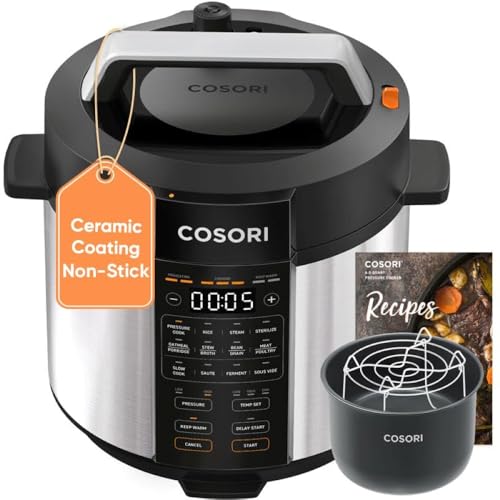
Cosori Pressure Cooker 6QT, 9-in-1
Badge: Best Safety-Led Multi-Cooker
The Cosori 9-in-1 is the safety-and-features challenger: six quarts, a ceramic-coated pot, twelve listed safety features, 1100 watts, and a function list that reaches sous vide alongside the expected rice, slow cook and saute modes. Sous vide in a pressure cooker is the interesting line on the spec sheet — it signals a machine aimed at cooks who want precision options, not just speed. The ceramic coating answers the nonstick question the way the COMFEE’ does, and the safety-feature count is pitched at buyers who are nervous about pressure and want the reassurance spelled out.
The Cosori shows where the multi-cooker type is heading: ceramic coatings answering material concerns, safety features foregrounded, and sous vide stretching the type toward precision cooking. As a slow cooker it shares the type’s metal-pot character; as a type specimen it demonstrates that the branch now competes on trust and materials, not just function counts.
Cosori’s type position — the trust challenger — extends to slow cooking in a specific way: the ceramic pot is the vessel material anxious buyers ask about, and its presence in a multi-cooker means the slow-cook mode inherits the answer. For households whose hesitation is materials rather than menus, this is the multi-cooker that removes the objection, and that removal is a genuine product feature even though it cooks nothing by itself.
Strengths
- Sous vide mode is rare in this class and price band
- 12 listed safety features reassure first-time pressure cooks
- Ceramic-coated pot avoids conventional nonstick
Trade-offs
- Sous vide in a cooker is less precise than a dedicated circulator
- Ceramic coatings need gentler utensils than steel
- Brand ecosystem is thinner than Instant Pot’s
At a glance:
- Capacity: 6QT
- Functions: 9-in-1 — rice, slow cook, sous vide, saute as listed
- Pot: ceramic coating
- Safety: 12 safety features
- Power: 1100W
- Finish: stainless steel, silver
Best for: smaller kitchens and lighter routines / Not suited for: large households cooking at full volume daily

Instant Pot Duo Mini 3 Quart 7-in-1 Electric Pressure Cooker
Badge: Best Compact Multi-Cooker
The Duo Mini takes the Instant Pot formula and shrinks it honestly: three quarts, the same 7-in-1 function list, stainless steel, and the app ecosystem behind it. Three quarts is the right size for one or two people, for side dishes alongside a main cooked elsewhere, and for small kitchens where a 6-quart machine would dominate the counter. It pressure-cooks, slow-cooks rice, steams, sautes and makes yogurt exactly like its bigger sibling — the difference is batch size and footprint, not capability, which is what makes it a real type of pressure cooker in its own right rather than a toy version.
The Duo Mini proves the multi-cooker type scales down without losing its identity: same seven functions, three quarts. As a slow cooker it suits the small household’s two-portion braise — a job oversized stoneware does badly, since a near-empty big crock cooks fast and dries edges. Type and size interact, and the Mini is the pool’s clearest illustration.
The Duo Mini’s type lesson is about fill bands: slow cookers of every type behave best between half and three quarters full, and small households in big crocks live permanently below that band. A 3-quart multi-cooker puts a two-person braise inside the band — which is why its slow-cooked results often please owners more than the same recipe from an oversized dedicated machine. Right-sizing is a type feature, and the Mini is its proof.
Strengths
- Full 7-in-1 capability in a 3-quart footprint
- Right-sized batches for one or two people
- Same recipe ecosystem as the full-size Duo
Trade-offs
- 3 quarts rules out family batches and big cuts
- Too small for some standard pressure-cooker accessories
- Per-batch efficiency drops if you cook for a crowd
At a glance:
- Capacity: 3 quart
- Functions: 7-in-1 mini — pressure, slow rice cook, steam, saute, yogurt, warm, sterilize as listed
- Body: stainless steel
- Extras: free app with recipes as listed
Best for: buyers who want the pool’s most distinctive option / Not suited for: buyers who prefer the safest, most conventional choice
Comparison Table
| Pick | Format | Capacity (as listed) | Standout trait | Link |
|---|---|---|---|---|
| Crock-Pot Programmable Slow Cooker with MyTime, 7-Quart | Programmable stoneware | 7-quart | Programmable type flagship: MyTime adjusts cooking to your schedule; locking lid; feeds 9+. | Check on Amazon |
| Hamilton Beach 6 Quart Slow Cooker, 33665G | Manual stoneware | 6 quart | Manual type benchmark: 6 quarts of dishwasher-safe stoneware under a glass lid. | Check on Amazon |
| Crock-Pot Programmable Slow Cooker, 8-Quart, Black Stainless Steel | Programmable stoneware | 8-quart | Programmable type at crowd scale: 8 quarts, digital timer to 20 hours, auto warm. | Check on Amazon |
| Instant Pot Duo 6 Qt 7-in-1 Electric Pressure Cooker | Multi-cooker (slow-cook mode) | 6 Qt | Multi-cooker type reference: 7-in-1 with slow cook among pressure, rice and yogurt modes. | Check on Amazon |
| Cosori Pressure Cooker 6QT, 9-in-1 | Multi-cooker (slow-cook mode) | 6QT | Multi-cooker type, safety-led: ceramic-coated pot, sous vide, twelve listed safety features. | Check on Amazon |
| Instant Pot Duo Mini 3 Quart 7-in-1 Electric Pressure Cooker | Multi-cooker (slow-cook mode) | 3 Quart | Multi-cooker type, compact: the 7-in-1 formula at 3 quarts for small households. | Check on Amazon |
The table sorts the category cleanly: stoneware types on one side — manual for value, programmable for schedules — and multi-cookers on the other, trading stoneware character for versatility. Your household’s week, not the feature list, picks the side.
How to Choose the Right Type of Slow Cooker
Choose by presence first. If someone is home most days — retired, home-working, or cooking mainly at weekends — the manual type gives you everything that matters for the least money and the fewest parts. If the house empties at eight and fills at six, the programmable type is not an upgrade but a requirement: a manual cooker cannot be trusted with a ten-hour absence on a recipe written for six, while a programmable one adjusts or holds warm.
Choose by menu second. Households whose slow cooking is one dish among many pressure, rice and steam jobs should look hard at the multi-cooker type — one machine, one footprint, acceptable-to-excellent results at everything. Households whose slow cooking is the main event, week in and week out, taste the difference stoneware makes and should stay with a dedicated type. Recipe-driven shoppers can browse Best Small Recipe Slow Cookers for the dish-first view.
Size and shape are type decisions too. Oval stoneware fits whole cuts and chickens; round pots suit soups and stews; capacity should match your ordinary batch with the crock between half and three quarters full, the band where slow cookers behave best. The pool’s spread — 3-quart multi to 8-quart crock — exists because households genuinely differ that much.
Finally, weigh the vessel. Stoneware serves at the table, retains heat through a meal, and dishwashes easily in the picks here; metal multi-cooker pots sear and saute in place, which stoneware cannot, but come off the table less gracefully. The vessel question quietly decides how the machine feels to live with, long after the type debate is forgotten. Stoneware devotees can go deeper in Best Stoneware Slow Cookers.
How to Slow Cook Well in Any Type
Technique travels across types better than recipes do: the habits below flatter stoneware and multi-cooker alike, and most slow-cooking disappointment traces to skipping one of them.
The two governing ideas are fill level and restraint — a crock in its happy fill band, and a lid that stays closed so the gentle heat and moisture the method depends on are not vented away.
- Fill the vessel between half and three quarters full; below that band food dries and overcooks, above it the cook runs uneven and risks overflow.
- Layer by density: hard root vegetables at the bottom near the heat, meats in the middle, delicate items on top.
- Add dairy, fresh herbs and quick-cooking vegetables in the final 30-60 minutes, not at the start.
- Keep the lid closed — every lift costs the cooker a noticeable chunk of recovered heat time.
- On programmable models, set the finish or duration before you leave and confirm the automatic warm switch.
- Rest braises 15 minutes before serving, and skim or reduce the liquid if the dish needs body.
Multi-cooker owners should learn their machine’s slow-cook personality in the first weeks: metal pots heat from the base, so an occasional stir on long cooks — where the recipe allows — evens things out, and the low setting’s character may differ from a stoneware low. One calibration stew teaches more than a month of guessing.
All types reward the same finishing habits: a squeeze of acid, fresh herbs, or a knob of butter at the end wakes up flavors that long cooking melds together. Slow cooking builds depth; finishing builds brightness, and the combination is the whole craft. Vegetable planners should see Best Vegetables For Slow Cookers for timing by type.
Troubleshooting:
- Problem: the dish is watery → too much added liquid for a sealed environment; slow cookers lose almost no moisture, so cut recipe liquid and reduce at the end with the lid off.
- Problem: meat is tender but bland → it was never browned and never finished; sear before loading where the type allows, and finish with acid and fresh herbs.
- Problem: food overcooks on workdays → the cook is longer than the recipe or the crock is underfilled; move to a programmable type, or size the batch and crock to each other.
Best types of slow cookers: a field guide to the three branches
The manual branch is the original: stoneware, a dial, and physics. Its modern survival is not nostalgia — it is the rational choice wherever presence is free. The programmable branch adds time management, from simple countdown-and-warm designs to the schedule-adjusting MyTime approach, and it owns the commuting household. The multi-cooker branch adds everything else: pressure speed, rice programs, steaming, yogurt — slow cooking as one talent in a versatile machine.
Notice what the branches share: a sealed vessel, gentle heat and time. The type debate is never about whether the food cooks — all three branches cook it — but about who manages the hours and what else the footprint earns. Framed that way, most households can locate themselves on the map in one honest sentence about their weekdays.
Where the types are heading
The category’s edges keep moving: programmable stoneware grows more schedule-aware, multi-cookers grow more material-conscious — ceramic pots, safety storytelling — and connected models, compared in Best Wifi Slow Cookers, add remote control above the programmable rung. None of that movement obsoletes the manual crock, which is the surest sign the types are niches rather than generations.
For buyers, the trend line argues for buying the type that fits now rather than the type that might fit a hypothetical future kitchen. Slow cookers last for years; a machine matched to your actual week will still be right when the next feature wave arrives.
Stoneware versus metal: the vessel divide inside the types
Underneath the control debate sits a material one. Stoneware heats gently and evenly from all sides, holds heat at the table, and forgives long cooks; it also cannot sear, and it is heavy and breakable. Metal multi-cooker pots sear and saute in the same vessel the pressure cook uses, clean easily and travel light; they heat from the base, which gives their slow-cook mode a slightly different personality that owners learn in the first month. Neither vessel is the ‘real’ slow cooking — both are, with different manners.
The vessel question also decides serving: a stoneware crock goes to the table and keeps second helpings warm by sheer mass, while a metal pot usually means plating in the kitchen. Households that eat family-style should weight that difference heavily; it shapes every meal the machine ever makes, long after the type debate that produced the purchase is forgotten.
Schedules, presence and the sociology of the slow cooker
Slow cookers are schedule machines disguised as cooking machines: the food was never the hard part. The manual type assumes a household with presence; the programmable type manufactures presence electronically; the multi-cooker type assumes the household wants one machine to manufacture several kinds of presence at once. Reading the category this way explains its sales better than any feature chart — and it tells a buyer exactly which question to answer first: not ‘what will I cook?’ but ‘who is home, and when?’
That is also why gifts of slow cookers misfire so often: the giver buys a type for the recipient’s imagined life rather than their actual one. The six specimens in this guide cover the realistic lives — commuter, home-based, host, minimalist, maximalist, small household — and matching the life to the type remains the entire art of the purchase.
Maintaining each type: rings, crocks and lids
Ownership care divides by type as cleanly as cooking does. Stoneware wants gentle handling, no thermal shocks, and a check for hairline cracks as the years pass; its lids and knobs are its fragile points. Multi-cookers want ring discipline — washing, drying, eventual replacement — plus clean valves and rims where the pressure seal lives. Programmable stoneware adds only a panel to keep dry and a clock to reset after outages.
None of it is onerous, and all of it is cheaper than replacement: the households that keep slow cookers for a decade are not lucky, they are habitual. Five minutes of care after a cook — vessel washed, seal checked, lid stored ajar so nothing ferments in the dark — is the whole secret, and it applies to every type in this guide equally.
One month in: how each type settles into a kitchen
A month with the manual type is a month of rhythm: the crock lives where it lives, the two or three house dishes rotate through it, and the machine’s total demand on its owner is a dial turned twice a day. Households that chose it for presence discover its second virtue — it teaches slow cooking itself, because nothing is automated away and every result is legibly connected to a choice the cook made.
A month with the programmable type is a month of recovered weeknights: the cooker stops being weekend equipment and starts absorbing Tuesdays, which is where its value compounds. A month with a multi-cooker is a month of negotiation — the machine keeps proposing new jobs, some stick and some do not, and by the month’s end the household knows whether it bought a slow cooker with extras or a kitchen system with a slow-cook mode. All three months end in good dinners; they just end in different kitchens.
That is the final form of this guide’s advice: do not ask which type is best, ask which month you want to live. The six specimens above were chosen so that every honest answer to that question has a machine waiting for it.
Slow cooking through the seasons: why the type choice ages well
A slow cooker’s year has seasons: winter braises and bean pots, spring’s lighter stews, summer days when the crock cooks without heating the kitchen the way an oven would, and autumn’s batch cooking for the freezer. The types ride those seasons differently — stoneware’s gentle heat suits the winter end, multi-cookers stretch furthest across the summer’s steamed and pressure-cooked detours, programmable machines serve the school-year schedule most heavily — but every type in this guide earns a full year, which is more than most appliances can claim.
That seasonal durability is the last argument for choosing by type rather than by deal: a machine matched to your household’s year will still be right when the seasons turn, while a machine bought for one season’s enthusiasm becomes the cupboard’s tenant by the next. Buy for the year, and the years follow.
Common Buying Mistakes
Type-level mistakes outlast model-level ones, because the wrong branch cannot be fixed by a different brand within it.
- Buying a manual cooker for a commuting schedule, then blaming slow cooking itself for overcooked dinners.
- Buying a multi-cooker for daily stoneware-style braises and missing the crock character you actually wanted.
- Choosing capacity by the biggest party rather than the ordinary batch, and living outside the happy fill band.
- Counting functions instead of mapping them to your real weekly menu.
- Forgetting transport: if the cooker travels to gatherings, a locking lid matters more than a twelfth program.
Final Recommendation
If your household runs on a workday schedule, the programmable type is the answer — the MyTime Crock-Pot for family-plus-potluck duty, the 8-quart programmable for crowds. If someone is home and value matters, the manual Hamilton Beach is the type’s honest benchmark and will out-cook its price for years. If counter space is the scarce resource and your menu is wide, a multi-cooker — the Duo for ecosystem, the Cosori for materials and safety, the Duo Mini for small households — earns one footprint with many talents.
Name your week honestly — who is home, what gets cooked, how big the batches are — and the right type selects itself from this guide’s six specimens.
And one practical closing note for every type: whichever machine you choose, cook a familiar dish first — not a new recipe — so the only variable in the first outing is the cooker itself. Type differences announce themselves clearly against a known baseline, and a household that calibrates once cooks confidently for years.
One more consideration belongs in the final reckoning, because it decides more purchases than any feature: storage. A slow cooker that lives on the counter gets used; one that must be fetched from a high cupboard gets used at holidays. Measure the resting place before the cooking place — the 8-quart crock and the 3-quart multi are both excellent machines that fail in kitchens with nowhere for them to live.
It is also worth stating plainly what a slow cooker will not do, whatever its type: it will not brown like a pan unless it is a multi-cooker with a saute mode, it will not rescue a badly seasoned dish, and it will not make a four-hour recipe in two because the day ran late. Types rearrange convenience; they do not repeal cooking. The households happiest with their machines are the ones whose expectations were set by guides that said so — which is why this one does.
Set against those limits, the category’s promise remains remarkable: a vessel, gentle heat and time, arranged so that dinner cooks while life happens elsewhere. Manual, programmable or multi — the types are three ways of keeping that promise, and the six machines above keep it in six distinct accents. Choose the accent that sounds like your kitchen.
There is a reason the slow cooker, in all its types, has outlived flashier appliances decade after decade: it asks almost nothing and returns dinner. The types in this guide are simply the current answers to the only question that has ever mattered in this category — whose time will the cooking use, yours or the machine’s? Answer that, and you have chosen your type; the rest is recipes.
A household that has read this far does not need a verdict so much as a nudge: look at your last four Tuesdays. If the house was empty until dinner, you are a programmable household. If someone was home and cooking was the day’s pleasure, you are a manual household. If the counter is crowded and the menu is restless, you are a multi-cooker household. The six machines above are waiting in that order — pick yours, fill it to its happy band, and let dinner take care of itself.
Choose well, and enjoy it for years to come.
Dinner, in other words, is already decided — it is waiting in a crock, at the right temperature, at the right hour, in whichever of these six forms your household chose. That quiet reliability, repeated across hundreds of evenings, is the slow cooker’s real specification, and every type in this guide delivers its own version of it.
Start here: Crock-Pot Programmable Slow Cooker with MyTime, 7-Quart (Best Programmable Pick); Hamilton Beach 6 Quart Slow Cooker, 33665G (Best Manual Family Pick); Crock-Pot Programmable Slow Cooker, 8-Quart, Black Stainless Steel (Best for Crowds).
Frequently Asked Questions
What are the main types of slow cookers?
Three: manual stoneware cookers with dial controls, programmable stoneware cookers with timers and automatic warm holds, and electric multi-cookers that slow-cook as one function among pressure cooking, rice, steaming and more. This guide reviews verified examples of each.
Do multi-cookers slow-cook as well as dedicated slow cookers?
Very well for most dishes, with a different character: metal pots heat from the base rather than stoneware’s all-around gentleness. For daily, dedicated braising, stoneware still has its devotees; for mixed menus, the multi-cooker’s versatility usually wins.
Is a programmable slow cooker worth it over a manual one?
If your household is out all day, yes — the schedule management and automatic warm hold are the difference between using the cooker weekly and rarely. If someone is home, the manual type cooks just as well for less.
What size slow cooker does a family need?
Six to seven quarts covers a family with leftovers — the Hamilton Beach and MyTime Crock-Pot sit there. Crowds point to the 8-quart programmable; one or two people are better served by the 3-quart Duo Mini’s multi-cooker format.
Can a slow cooker sit on warm all day?
Warm holds are bridges of a few hours, designed to keep food at a safe serving temperature between finishing and eating — not all-day storage. Programmable models state their hold durations; plan arrivals inside them.
Which type is best for taking food to gatherings?
A programmable stoneware model with a locking lid — the MyTime Crock-Pot in this pool is built for exactly that, with its Cook & Carry lid and crowd capacity.


