Disclosure: topratedkitchenware.com is reader-supported. When you buy through links on our site, we may earn an affiliate commission from Amazon and other retailers, at no extra cost to you.
Where to buy
This guide to the best vacuum sealers for sous vide cooking lists only countertop external sealers, each verified for this guide and linked so you can check the latest price on Amazon. The first pick’s own listing names sous vide cooking outright; the rest earn their places on seal quality, wet-food control and the bag systems that cooking from a bag depends on.
- FoodSaver FM2100 Vacuum Sealer Machine — Best Overall for Sous Vide Cooking. Named for the job by its maker, with roll storage and a cutter.
- FoodSaver V4400 2-in-1 Vacuum Sealer Machine — Best Automatic. Automatic bag detection for seams a long cook can trust.
- FoodSaver Compact Vacuum Sealer Machine — Best Compact. Its listing names sous vide as a core use.
- FoodSaver PowerVac Compact VS0150 — Best for Vertical Storage. A dry-and-wet compact that stands upright between cooks.
- ROUUO Vacuum Sealer 95kpa — Best for Wet and Long Cooks. Pulse control and a removable drip tray for seasoned portions.
- Bonsenkitchen Vacuum Sealer Machine — Best Simple. A compact external system whose listing names sous-vide work.
Read the full guide ↓ for badges, trade-offs, a comparison table and a complete cook’s workflow from seasoning to searing.
The best vacuum sealers for sous vide cooking are really cooking equipment, and they should be judged the way cooking equipment is judged: by what lands on the plate. A bath cook succeeds or fails in three places — the seasoning that the bag holds against the food for hours, the even contact that lets water cook every surface identically, and the seal that must survive the full cook without letting the bath in or the juices out. A sealer for this work is therefore not a storage accessory borrowed by the kitchen; it is the first step of the recipe. This guide chooses on that basis, weighting moist-food control, seam consistency and bag-length freedom above the storage virtues that dominate ordinary sealer reviews.
It also assumes the way people actually cook this way at home: a few portions on a weeknight, a larger piece at the weekend, and — for the organised — a freezer of sealed portions that turn future dinners into a bath and a sear. Each pattern stresses the seal differently. Weeknight portions stress convenience; weekend joints stress bag length and seam strength; freezer pipelines stress consistency across dozens of bags. The six machines below cover the three patterns between them, and their reviews say plainly which pattern each one serves best. Cooks comparing the sealing-first view of the same field will find it in our Best Vacuum Sealers For Sous Vides companion, which treats the near-identical shelf from the plural keyword’s angle of batches and backups.
Key Takeaways
- The FM2100 leads: its maker names sous vide cooking in the listing, and its roll storage makes cooking bags to measure.
- The ROUUO is the wet-cooking specialist, with pulse control for seasoned and marinated portions and a drip tray that washes after.
- The V4400’s automatic detection is a cooking feature: seams made identically are seams that survive identically, hour after hour.
- Season in the bag, chill juicy portions before sealing, double-seal long cooks, and inspect every seam against the light.
- Finish outside the bag: a sealed cook gives perfect doneness, and a hot, fast sear after drying the surface gives the crust the bath cannot.
- Only cooking-rated bags belong in the bath, and established time-and-temperature guidance governs every cook.
- Keep the sealer, film and clips together beside the bath’s home; a method whose tools live together is a method that gets used on ordinary evenings, not just occasions.
In this guide
Quick Picks
| Pick | Badge | Format | Cooking note |
|---|---|---|---|
| FoodSaver FM2100 | Best Overall for Sous Vide Cooking | External | Sous vide cooking named in listing |
| FoodSaver V4400 2-in-1 | Best Automatic | External, 2-in-1 | Automatic bag detection |
| FoodSaver Compact | Best Compact | Compact external | Sous vide named in listing |
| FoodSaver PowerVac VS0150 | Best for Vertical Storage | Compact external | Dry and wet food stated |
| ROUUO Vacuum Sealer 95kpa | Best for Wet and Long Cooks | External | Pulse mode, removable drip tray |
| Bonsenkitchen Vacuum Sealer | Best Simple | Compact external | Sous-vide named in listing |
How These Picks Were Chosen
This is a research-led guide, not a test kitchen. Each pick’s format, stated modes and included supplies were verified against its current listing, then weighted for cooking: whether the maker names sous vide work, how wet and seasoned food is handled, how repeatable the seams are, and whether the bag system makes cooking lengths easily. Only verified products are listed and linked. Where a listing does not name sous vide — the V4400 and the PowerVac — the reviews say so and rest on format and wet-food capability, because a guide that upgrades a maker’s claims into promises would fail at exactly the point where a cook, mid-recipe, needs it most. The trade view of the same equipment questions appears in our Best Professional Vacuum Sealers overview for readers equipping beyond the home.
The 6 Best Vacuum Sealers for Sous Vide Cooking

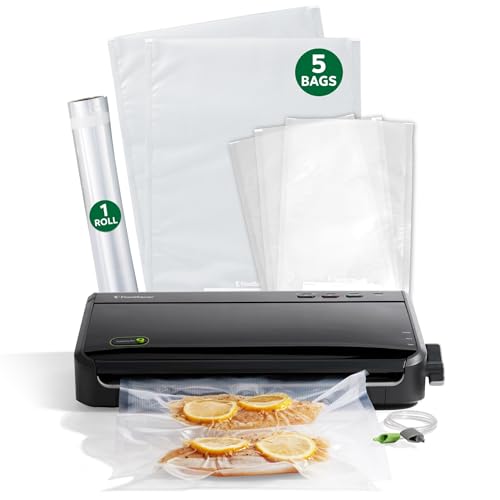
FoodSaver FM2100 Vacuum Sealer Machine
Badge: Best Overall for Sous Vide Cooking
Strengths
- The maker’s listing names sous vide cooking — the clearest statement of purpose in this list.
- Roll storage and a cutter produce cooking bags at the length each recipe actually needs, from a single fillet to a whole small joint.
- Dry and moist one-touch cycles cover plain and seasoned portions, and the included hose extends the station to marinade containers.
Trade-offs
- A full countertop body must share space with the bath container.
- No pulse mode, so the wettest portions depend on chilling and headroom.
- One-touch automation is quick rather than staged around very irregular shapes.
Spec box — verified from listing: Format: external sealer. Controls: one-touch. Storage: roll storage with cutter. Modes: Dry and Moist. Included: accessory port and hose, starter bags and roll. Stated use includes sous vide cooking.
Some recommendations require an argument; this one mostly requires reading the listing. The FM2100 is sold for the exact job in this guide’s title, and its equipment matches the sale: a roll system for cooking lengths, a moist cycle for the seasoned reality of bath food, one-touch operation for a step that should take minutes before a cook measured in hours. In a working kitchen it becomes the bath’s partner appliance — the machine that seasons, bags and files the freezer pipeline on a Sunday, then seals the single weeknight portion without ceremony on a Wednesday. Its starter roll and bags mean the first cook happens the day it arrives, which matters more to forming the habit than any specification.
Its conditions are the familiar two: counter space, and technique with very wet bags. Cooks who marinate heavily before the bath should read the ROUUO’s review below before deciding, since pulse control is a real advantage there. For the broad centre of sous vide cooking — seasoned portions, ordinary juices, cooks of every length — the FM2100 is the most complete and most honestly described tool in the list.
Best for: regular bath cooking of every pattern / Not suited for: the smallest counters or heavy pre-bath marinating without pulse
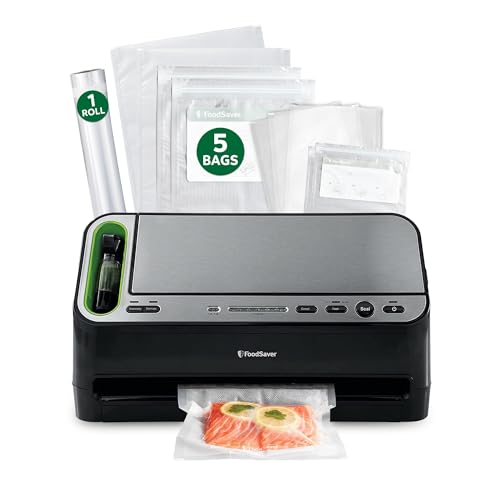
FoodSaver V4400 2-in-1 Vacuum Sealer Machine
Badge: Best Automatic
Strengths
- Automatic bag detection defends the seam — the single component a long cook cannot replace mid-recipe.
- The 2-in-1 format handles marinade and prep containers as well as cooking bags.
- A starter kit is included for immediate first cooks.
Trade-offs
- Sous vide is not named in its listing; the case rests on sealing consistency and format.
- Rolls are stored outside the machine.
- A wet seal zone still defeats automation; edges must be loaded dry.
Spec box — verified from listing: Format: external sealer, 2-in-1 design. Feature: automatic vacuum sealer bag detection. Included: starter kit.
Cooking magnifies small sealing errors because cooking gives them time. A seam that would hold a freezer month may still be the seam that admits water at hour three of a bath, which is why this guide treats consistency as a cooking specification. The V4400’s detection exists to make the fiftieth seam resemble the first, and for the batch cook — the household that seals a week of dinners in one session — that resemblance is the difference between a pipeline and a gamble. Its container flexibility suits the marinating and prep work that surrounds a cooking programme, keeping one machine at the centre of the method.
The evidence note stands as written in the spec box: the maker does not name the bath for this model. Buyers who share this guide’s format judgement get the most reassuring long-cook machine here; buyers who want the maker’s own words should take the FM2100 or the Compact, and lose nothing by the preference.
Best for: batch cooks and long cooks where seam consistency is everything / Not suited for: buyers wanting sous vide named in the listing
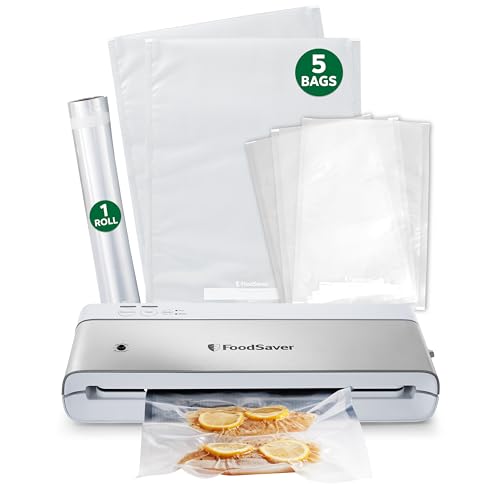
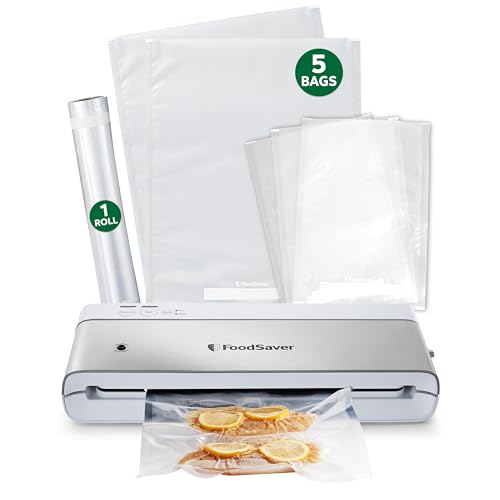
FoodSaver Compact Vacuum Sealer Machine
Badge: Best Compact
Strengths
- Sous vide is named as a core use in the maker’s listing.
- A small white body coexists with a bath container on a modest counter.
- Bags and a roll are included, covering portion bags and cut lengths alike.
Trade-offs
- Compact width means large joints are portioned before cooking.
- No pulse or roll storage is stated; wet technique and a drawer of film are part of ownership.
- Batch pipelines run at a compact pace.
Spec box — verified from listing: Format: compact external sealer. Colour: white. Included: airtight bags and roll. Stated uses: sous vide and airtight food storage.
Sous vide’s natural home is the small kitchen, where its quiet container and exact results outperform the oven it often replaces — and the Compact is the sealer that respects that home’s arithmetic. Named for the work by its maker, supplied for both bag styles, and small enough to vanish into a cupboard while the bath occupies the counter for hours, it covers the cooking of a small household completely. Two steaks, a pair of chicken breasts, vegetables for the same meal: this is its repertoire, performed without a single wasted inch of kitchen.
Scale is its only argument with the reader. A household graduating to whole joints and freezer pipelines will graduate past it, to the FM2100 in most cases. Until that day, it is the proportionate, maker-endorsed choice, and proportion is an underrated virtue in kitchen equipment.
Best for: small households cooking sous vide regularly / Not suited for: whole large joints or heavy batch pipelines
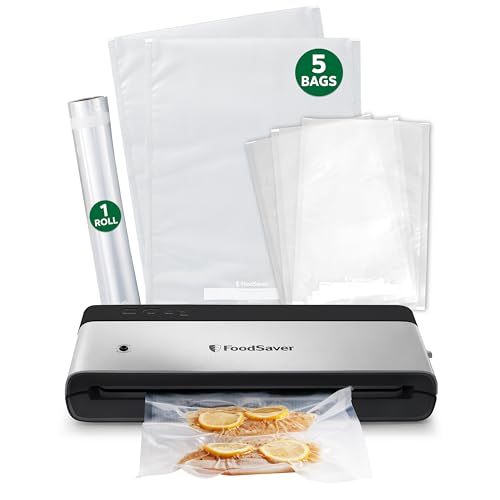
FoodSaver PowerVac Compact Vacuum Sealing Machine VS0150
Badge: Best for Vertical Storage
Strengths
- Stated for both dry and wet food, covering plain and seasoned bath portions.
- Vertical storage returns its footprint between cooks — the days the bath is not running.
- A simple, uncluttered machine for cooks who value the method over the equipment.
Trade-offs
- Sous vide is not named in its listing.
- Compact width and pace apply, as with the other small machines.
- No roll storage, detection or pulse is stated.
Spec box — verified from listing: Model: VS0150. Format: compact external sealer with vertical storage. Finish: stainless steel and black. Stated foods: dry and wet.
Between cooks, a sous vide kitchen is just a kitchen, and the PowerVac is designed for the between. Standing upright in a narrow space, it leaves the counter to ordinary life and returns for the five minutes of sealing each cook requires. Its wet-and-dry coverage handles the seasoned portions that are bath cooking’s norm, and its simplicity suits cooks whose interest is the plate, not the apparatus. Many good cooking tools are exactly this: present when needed, invisible otherwise.
It makes the list’s most modest claim and keeps it. If your cooks grow longer, wetter or more numerous, the machines above and below it in this list are the growth path. If your cooking is a few portions a week in a small kitchen, the PowerVac’s storage logic may matter more to your satisfaction than any feature it lacks.
Best for: small kitchens with a few bath cooks a week / Not suited for: long, wet or batch cooking as the main machine

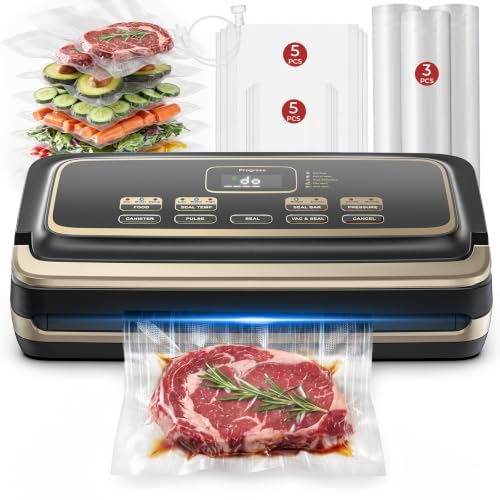
ROUUO Vacuum Sealer 95kpa Food Sealer
Badge: Best for Wet and Long Cooks
Strengths
- Pulse mode seals marinated and juicy portions under the cook’s eye, stopping liquid before the seam.
- A removable drip tray makes a seasoned, messy sealing session cleanable in a minute.
- Roll storage, a cutter, dry and moist modes and generous starter film suit both single cooks and pipelines.
Trade-offs
- Sous vide is not named in its listing; its case is wet control and format.
- Its strong stated draw must be pulsed with delicacy around soft foods.
- It is a station-sized machine, not a cupboard compact.
Spec box — verified from listing: Stated vacuum: 95kpa. Stated power: 230W. Modes: Dry/Moist and Pulse. Features: built-in bag storage and cutter, removable drip tray. Included: 3 bag rolls and 10 bags.
The hardest bags in sous vide cooking are the delicious ones: chicken in a spiced marinade, pork in a citrus mix, anything that enters the bath already wet with its own flavour. Those bags are where cooks learn that a standard cycle can pull the recipe into the seal and the bath into the bag. The ROUUO is the answer this list offers: pulse the draw in stages, watch the liquid climb, seal while the seam is still dry — and when a session’s enthusiasm escapes anyway, lift out the drip tray and wash the evidence away. Its roll system feeds the long bags that whole cuts and long cooks want, and its moist mode handles the ordinary seasoned run without supervision. For the cook whose bath work leans wet, marinated and ambitious, it is the most capable tool here, and the natural partner to the marinade technique surveyed in this programme’s wider sealing guides, including the reusable-bag options collected under Best Reviewed Small Vacuum Sealers With Reusable Bags.
Respect its strength and its evidence. The maker does not name the bath; the recommendation is a control judgement, and the control is real. Cooks who marinate before they cook will not need the point argued twice.
Best for: marinated portions, wet cooks and long cooks / Not suited for: hands-off users or the smallest counters
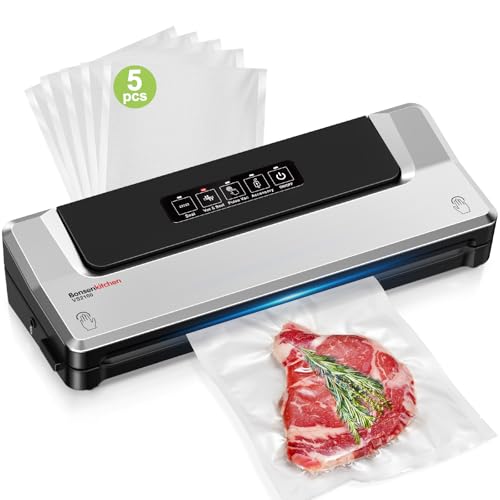
Bonsenkitchen Vacuum Sealer Machine
Badge: Best Simple
Strengths
- Its listing names sous-vide among its work, alongside meal prep and storage.
- A simple compact external system with multiple modes keeps the cooking step uncomplicated.
- Small silver body stores away while the bath runs for hours.
Trade-offs
- Only five bags are included; a cooking household should stock film from the start.
- No pulse, cutter or roll storage is stated, so wet portions use technique and bags are pre-cut.
- Compact pace suits portions, not pipelines.
Spec box — verified from listing: Format: compact external vacuum system. Finish: silver. Modes: multiple modes for meal prep. Included: 5 vacuum bags. Stated uses: kitchen food storage and sous-vide.
The Bonsenkitchen is the list’s argument that sous vide cooking does not require a flagship. Its maker names the work, its modes cover the prep rhythm around it, and its compact body fits the kitchens where the method most often lives. For a cook sealing a few portions a week — plainly or lightly seasoned, in pre-cut bags, at a relaxed pace — it performs the whole job and asks almost nothing in return except a stocked bag drawer.
Its boundaries are supply and control. Order film before the first cook, because five bags are a tasting menu, not a pantry; and use the freeze-first or chill-and-headroom technique for genuinely wet portions, since no pulse button stands guard. Within those honest lines, it is the simplest named route into bath cooking in this guide, and many kitchens need nothing more. Readers cross-checking the wider field can compare it against the roundups gathered under Best Reviewd Vacuum Sealers in this programme’s index.
Best for: simple, occasional bath cooking in compact kitchens / Not suited for: wet batches or pipelines without stocked film
Comparison Table
| Pick | Badge | Sous vide named by maker | Standout verified feature | Check |
|---|---|---|---|---|
| FoodSaver FM2100 | Best Overall for Sous Vide Cooking | Yes | Roll storage, cutter, moist mode | Check on Amazon |
| FoodSaver V4400 2-in-1 | Best Automatic | Not stated | Automatic bag detection | Check on Amazon |
| FoodSaver Compact | Best Compact | Yes | Bags and roll included | Check on Amazon |
| FoodSaver PowerVac VS0150 | Best for Vertical Storage | Not stated | Stores vertically, dry and wet | Check on Amazon |
| ROUUO 95kpa | Best for Wet and Long Cooks | Not stated | Pulse mode, removable drip tray | Check on Amazon |
| Bonsenkitchen | Best Simple | Yes | External system, multiple modes | Check on Amazon |
How to Choose a Vacuum Sealer for Sous Vide Cooking
Choose by recipe before you choose by machine. If your bath cooking is plain and seasoned portions of ordinary size, every machine here cooks happily, and the decision collapses to footprint: roll-fed FM2100 for a dedicated counter, Compact or PowerVac for a small one, Bonsenkitchen for the simplest life. If your cooking leans marinated, sauced or otherwise wet, control becomes the criterion and the ROUUO’s pulse moves to the top of the list. If your cooking is batch-based — a freezer pipeline feeding weeknight baths — consistency and length rule, which argues for the V4400’s detection or the FM2100’s roll system, with bags treated as a stocked pantry item rather than an accessory.
Then choose by cook length. Short cooks forgive almost everything; long cooks audit seams, and the household that regularly cooks tough cuts for many hours should buy for that audit: inspected seams, double seals, bags with length to spare, and a machine whose fiftieth cycle matches its first. Finally, choose by the rest of the method’s furniture. The bath container, the rack or clips, the finishing pan for the sear — the sealer must share a counter and a routine with all of them, and the machine that fits the routine will be used for the midweek fish as faithfully as for the weekend joint. Equipment that fits the life gets cooked with; the rest gets listed for sale, barely used, every January.
How to Cook Sous Vide From a Sealed Bag: the Full Workflow
Begin before the bag. Choose the cut and portion it as it will be served, because the bag preserves the portion’s shape into the finished dish. Season in the bag — salt, sturdy herbs, aromatics, a measured little fat or marinade — and rest seasoned portions in the fridge where time allows, since the bag’s even contact starts its work before the water is warm. Chill juicy portions until firm at the surface. Then seal: a bag with generous length, the seal zone blotted dry, folds smoothed out of the seam, the moist cycle or a pulsed draw for wet food, and a seam inspected against the light, doubled for long cooks. Lower the bag into the bath slowly, watch it for the first minute, and clip or weight it if it shows any wish to float; a submerged, still bag is an evenly cooking bag. Cook to established guidance for the food and its thickness, neither improvising times nor treating the bath’s precision as permission to hold food warm indefinitely.
One refinement belongs in every cook’s version of this workflow: the resting pause between bath and sear is also the moment to ready everything else. The bath’s great gift to a dinner is time that does not need watching, and cooks waste it when they treat the finish as a scramble. Set the table, finish the vegetables, warm the plates if your household is that household, and let the sear be the last, brief, attended act of an otherwise calm production. Guests notice the calm as much as the crust, and they are both, in their way, products of a bag that was sealed properly hours before anyone arrived.
The finish is where the method earns its applause, and it happens outside the bag. Lift the portion out, open the bag away from the steam, and dry the surface thoroughly — a wet surface cannot sear, and the sear is the texture the bath, by its nature, cannot give. Sear hot and fast in a pan, under a grill or with a torch, resting the food as the cut requires, and use the bag’s juices, strained and briefly cooked, as the beginning of a sauce rather than a bin-bound extra. Clean the sealer’s seal area while the food rests; seasoned sessions leave their evidence, and the next cook’s seam deserves a clean bar. That full arc — season, chill, seal, inspect, cook, dry, sear — is the recipe this guide’s machines exist to serve, and a household that runs it twice will run it weekly.
Troubleshooting cooks
Problem: the finished food tastes seasoned at the edges and plain in the centre → the portion was thick and the bag time short; give thick cuts their full fridge rest after seasoning, and score nothing, rush nothing — contact is even, but salt still travels at its own pace.
Problem: water in the bag after the cook → either a seam channel or the food’s own juice, which is normal in quantity; distinguish by the seam’s appearance, double-seal long cooks, and remember that a spoonful of juice is cooking, while a bag half full of bath water is a failed seam.
Problem: the sear will not form after the bath → the surface was wet; dry it patiently with towels, let it stand a few minutes, and sear in a properly hot pan — the bath gave you perfect doneness, and only dryness stands between it and a crust.
Cooking the Classics: Where the Seal Matters Most
Steak is the method’s advertisement and the seal’s easiest exam: a flat cut, a dry-to-moist cycle, seasoning that the bag holds in perfect contact, and a finish that takes ninety seconds in a smoking pan. The sealer’s contribution is the absence of air, which lets the whole surface cook at the bath’s word, and the freezer pipeline, which lets a steakhouse cut wait in the freezer without losing its nature. Chicken is the exam in discipline: longer cooks, juicier portions, bones that test film, and a food-safety standard that tolerates no casualness about times, temperatures or chilling leftovers. The seal’s contribution is integrity across the full cook, and the cook’s contribution is respecting the guidance the method publishes. Fish is the exam in gentleness: a watched, partial draw that settles the bag without crushing the fillet, a short and exact cook, and an appreciation that the same machine which evacuates a brisket bag completely must be persuaded, by pulse or by restraint, to stop early for a piece of salmon.
Vegetables, eggs and the method’s quieter repertoire reward the seal differently. Vegetables sealed with a little fat and seasoning cook in their own juices at temperatures a pan cannot hold so evenly, and they ask the bag for length and the cook for patience rather than force. Desserts and custards in jars belong to the accessory side of these machines — the hoses and container modes on picks like the FM2100 — and remind the buyer that a cooking sealer is a small system, not a single trick. Across the repertoire, the pattern holds: the more ambitious the cook, the more the seam, the length and the wet control matter, and the less any headline specification does. That is why this guide’s badges are written in the language of cooks rather than the language of pumps.
Bags for Cooking: Length, Film and the Reseal Question
Cooking bags are not storage bags with ambition; they are a working part of the recipe. Use only film whose maker rates it for cooking, keep a dedicated stock for the bath, and cut generously: length is headroom for the seam, room for the bag to sit naturally in the water, and the option — often used — to open a bag, taste or add, and reseal for the remainder of a cook. Rolls beat pre-cuts for cooks who vary their portions, which is to say for cooks; pre-cuts beat rolls for the household whose portions never vary, which is to say for almost nobody, though the included bags in several of these picks are a fair way to learn which household you are. One question divides experienced cooks: whether to reuse a cooking bag for a second cook. The safe, simple answer for raw-meat bags is no — film is the cheapest ingredient in the entire method, and its economy is never worth a question mark over a meal. Bags that held only vegetables, washed and dried with genuine care, are the reader’s own judgement call; this guide’s judgement, stated plainly, is that the bath’s whole appeal is precision, and precision begins with a bag above suspicion. The wider family of bag systems, including the chamber-style pouches used with machines like those in our Best Vacuum Bag Sealers survey, follows the same rule: rated film, right length, no doubts.
Meal Prep With the Bath: a Week of Dinners, Sealed on Sunday
The most persuasive argument for a cooking-grade sealer is a single organised Sunday. Consider the shape of it: proteins bought in family quantities, portioned as the week’s recipes demand, seasoned in their bags — one with a dry rub, one in a yoghurt marinade, one plain with herbs — sealed, labelled and frozen flat. Across the week, each bag travels from freezer to fridge the night before, then into the bath after work, then out for a two-minute sear while vegetables cook by ordinary means. The dinners taste cooked, because they are; the weeknights feel easy, because the decisions were all taken on Sunday. No other kitchen system offers that ratio of weekday ease to weekend effort, and the sealer is the hinge the whole ratio swings on, because every later step depends on a bag that was sealed once, properly, days before.
Run the system with a cook’s realism. Not every night wants the bath: keep two nights for fresh, fast cooking, and let the sealed pipeline carry the nights when time is short and standards are not negotiable. Rotate the freezer stock ruthlessly, because a pipeline is a flow, not a hoard, and the oldest bag should always be the next bag cooked. Keep the seasoning repertoire small and repeated — four or five combinations your household loves — since repetition is what turns prep into rhythm, and rhythm is what survives a busy month. And write the week’s plan where the cook can see it, because a freezer of anonymous seasoned bags is a quiz, while a freezer with a list is a menu. Households that adopt even a modest version of this system consistently report the same surprise: the sealer they bought for a cooking technique became the organiser of their entire weeknight kitchen, which is a larger job than any listing promises and the real reason this category rewards buying well once.
Water Baths, Containers and the Rest of the Setup
A sealer does not cook alone, and a balanced guide should place it in its working company. The bath itself may be a dedicated container with a lid — which reduces evaporation across long cooks and steadies the water’s surface around your bags — or any deep pot the immersion heater can serve; the sealer’s demands on it are only that bags fit submerged with room to circulate. Clips, racks and weights, already mentioned as the cure for floating, deserve a permanent home beside the machine, because a bag that wants to float announces itself in the first minute, when the cure must be at hand rather than in a drawer across the room. A resting rack and towels at the finish, a hot pan that can take a sear without complaint, and tongs that can lift a wet bag without piercing it complete the station. None of this is elaborate, and that is the point: sous vide cooking’s reputation for gadgetry is mostly undeserved, and the true kit — heater, container, sealer, clips, pan — is smaller than the kit for a roast dinner.
Where the sealer sits in that kit matters to how often the method is used. Beside the container’s storage place is ideal; in a cupboard on the other side of the kitchen is tolerable; in a box in another room is a quiet decision to cook this way rarely. Two of this list’s picks — the vertical-storage PowerVac and the little Compact — exist precisely for kitchens where the sealer’s parking place is the contested question, and their presence in a cooking guide is deliberate: a slightly simpler machine that lives within reach will produce more and better cooks than a flagship that must be fetched like luggage. Judge your shortlist, in the end, standing in your own kitchen, looking at the counter your bath will occupy. The right machine is visible in that picture; the wrong one, however capable, is the one that has to be imagined into a space it does not fit.
Common Buying Mistakes
The first mistake is treating the sealer as a storage purchase and discovering, mid-recipe, that cooking needed wet control and length. The second is sealing marinated portions on a full automatic cycle and feeding the marinade to the seam. The third is cooking in film never rated for the bath. The fourth is skipping the seam inspection and the first-minute watch, the two cheapest quality controls in the method. The fifth is forgetting the finish — serving bath food unseared and concluding the method is bland, when the method was only ever half applied. The sixth is buying a compact for a pipeline, or a station for two fillets, when this list contains the honest scale for each.
Before ordering, run the counter test one last time in your head: the bath container where it will sit, the sealer within arm’s reach of it, the film in the drawer beneath, the clips in the same drawer, the finishing pan on the hob. A setup that assembles itself in the imagination that smoothly will assemble itself on a Friday evening, and a Friday-evening method — repeated, relaxed, exact — is what every machine in this guide is ultimately for. Buy for that evening, and the specifications will take care of themselves.
Final Recommendation
Whichever you choose, cook something the day it arrives — a single steak, a pair of chicken breasts, anything — because the method teaches itself in one cook, and a machine that has already produced one good dinner has crossed the only threshold that separates equipment from furniture. Keep the film stocked, the routine written once on a card inside the cupboard door, and the bath’s clips in the sealer’s drawer, and the second cook will already feel like the twentieth.
For sous vide cooking, buy the FoodSaver FM2100: named for the job, roll-fed for cooking lengths, and equipped for both dry and moist portions. If your cooking leans marinated and wet, buy the ROUUO Vacuum Sealer 95kpa for its pulse control and washable drip tray. For a small household’s regular cooks, the FoodSaver Compact is the proportionate, maker-named choice.
Frequently Asked Questions
What makes a vacuum sealer good for sous vide cooking specifically?
Three things, in order: a seam that stays perfect for the full cook, control with wet and seasoned food, and bags at cooking length. Makers that name sous vide in the listing — three of the picks here do — have designed for that brief; machines with pulse or moist control and roll systems meet it by capability. Vacuum headlines, by contrast, decide almost nothing that reaches the plate.
Should I season before sealing or after cooking?
Season sturdy flavours in the bag — salt, hard herbs, aromatics, marinades — where hours of even contact do real work, and add delicate finishes after the sear, where they stay bright. Thick cuts deserve a fridge rest in the sealed, seasoned bag before the bath. The bag makes both schools possible; the recipe, not the machine, should choose between them.
How long can food cook in a sealed bag?
As long as established guidance allows for that food and thickness — and no longer than your own discipline about warm holding permits. Long cooks are where this guide’s double-seal and inspection advice applies, and where consistent machines earn their price. Treat any cook measured in many hours as a planned operation with guidance open on the counter, not as an improvisation.
Can I sear food before sealing it for the bath?
You can, and some cooks do for particular effects, but the common and cleaner arc is bath first, sear after: the bath delivers exact doneness, the final sear delivers crust, and a pre-sear’s crust softens during hours in a moist bag. If you experiment with pre-searing, chill the food fully before sealing so the seam stays clean, and expect a different, softer result rather than a better one.
Why did my bag leak during a long cook?
Almost always the seam: a wrinkle channel, a moisture line from a wet loading, or film stressed by a bone edge. Prevention is the liturgy of this guide — dry seal zone, smoothed folds, inspected seam, second seal for long cooks, bones padded — and detection is the first-minute watch, which turns a leak from a ruined dinner into a two-minute reseal.
Do I need a roll-fed machine, or are pre-cut bags enough?
Pre-cuts are enough for a household whose portions are uniform and modest. Rolls become the right answer the moment portions vary — a whole joint one week, single fillets the next — or a freezer pipeline begins, because length is the variable cooking keeps demanding. Several picks here include both, which is the sensible way to discover your own pattern before committing to a stock.
Can I cook vegetables and proteins in the same bath session?
Yes, and it is one of the method’s quiet efficiencies, provided each food gets its own bag and its own correct treatment. Seal vegetables and proteins separately, since their times and finishing differ, add bags to the bath in the order their cooking requires, and keep each bag submerged and identified — a label or a coloured clip earns its keep here. The sealer’s role is unchanged: clean seams, right lengths, no air. A mixed session run this way produces a whole dinner from one container of water, which is the outcome that converts sceptical households to the method faster than any single perfect steak.
How do I use the juices left in the bag after cooking?
Treat them as a sauce that has already started. Pour the bag’s juices into a small pan, skim or strain them as the dish requires, and reduce them briefly — which also settles any food-safety question about juices that have been warm — before finishing with butter, stock, wine or herbs as the recipe suggests. Meat cooked in its own seasoned juices produces a remarkably complete base, and throwing it away is the one waste this economical method regularly commits. If you do not use them at once, chill them promptly and treat them as you would any fresh stock: briefly kept, thoroughly reheated, and never left to linger warm on the counter.
Is sous vide cooking with a handheld-sealed bag advisable?
This guide’s pool for the cooking keyword is all countertop machines, and for cooking — as opposed to small-scale sealing — that is the right class: heat-made seams, cut lengths and moist control. Handheld systems have their place in small, short work elsewhere in this programme’s guides, but a cook building a bath repertoire should start, as this list does, at the counter.