Disclosure: topratedkitchenware.com is reader-supported. When you buy through links on our site, we may earn an affiliate commission from Amazon and other retailers, at no extra cost to you.
Where to buy
The best vacuum sealers for weed solve a gentle-vacuum problem, not a maximum-vacuum one: air and odour must go, while the flower itself must not be crushed. This list favours machines with pulse or staged control, plus two handhelds for small amounts, all verified and linked so you can check the latest price on Amazon. This guide covers storage only, for readers in places where keeping cannabis at home is legal, and it follows local-law-first common sense throughout.
- ROUUO Vacuum Sealer 95kpa — Best for Control. Pulse mode lets you stop the draw before buds are compressed.
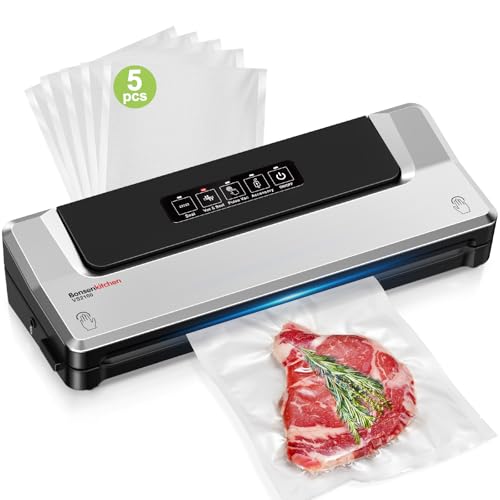
- Bonsenkitchen Vacuum Sealer Machine — Best Simple Compact. A straightforward external system for modest, dry batches.
- UPRUBE Vacuum Sealer 95kPa — Best for Repeatable Portions. Pulse mode and a digital timer for identical small packs.
- Chef Preserve Compact Vacuum Sealer — Best Handheld for Small Amounts. A portable handheld with thirty reusable bags.
- VACLER Vacuum Sealer Machine — Best Automatic for Dry Storage. Smart modes, a cutter, twenty bags and a hose for jars.
- FoodSaver Mini Handheld Vacuum Sealer — Best for Quick Small Batches. A cordless handheld that lives on its dock, ready for a gram-scale job.
Read the full guide ↓ for badges, trade-offs, a comparison table and the gentle-sealing technique that protects both potency and structure.
The best vacuum sealers for weed solve a problem no other food category sets in quite the same form. Dried flower is valuable, fragile and aromatic, and it declines by exactly the forces vacuum sealing controls — air exchange, odour escape and careless handling — yet it is damaged by the very strength that makes a sealer excellent for meat. A full, hard draw that would delight a butcher will compress buds into a dense puck, break delicate structures and squeeze the material against itself for the whole of its storage. So this category inverts the usual hierarchy: control beats power, gentleness beats speed, and the winning machines are the ones that let the operator stop the vacuum at the moment the air is out and the flower is still itself. Pulse modes, staged draws and small-bag systems are the heroes of this list, and raw vacuum figures are treated, pointedly, as a reason for care rather than celebration.
The second theme is discretion and order. Sealed packs contain odour far better than jars opened weekly or bags merely zipped, they portion a larger amount into dated, single-purpose amounts that are not repeatedly disturbed, and they store flat and dark in a way loose material never does. Readers keeping larger amounts should also weigh the trade-level perspective in our Best Professional Vacuum Sealers overview, since the line between a careful home stash and a small inventory is mostly a line about volume and rotation. For the home scale this guide addresses, the six machines below divide the work by amount: countertop machines for portioning a harvest or a large purchase, handhelds for the small, frequently handled amounts.
Key Takeaways
- The ROUUO and UPRUBE lead on control: their pulse modes let you evacuate in stages and stop before compression damages the flower.
- Never run a full automatic cycle on loose flower and walk away; the correct seal is snug, not crushed, and it is made by eye.
- Portion into the amounts you actually open — a large bag reopened weekly defeats the seal’s purpose every time it is opened.
- The handhelds, Chef Preserve and the FoodSaver Mini, suit small amounts and reusable-bag routines at fridge-or-cupboard scale.
- Store sealed packs cool, dark and undisturbed, labelled with strain and date if those matter to you; light and warmth age herb faster than air alone.
- Use the dry setting, keep every trace of moisture out of the bag, and let properly cured material — never damp material — meet the sealer.
- Rehearse on a small amount first and open the pack a week later to inspect your own seals; keeping is a craft, and the rehearsal is where its one real skill — stopping at snug — is learned.
In this guide
Quick Picks
| Pick | Badge | Format | Storage-relevant feature |
|---|---|---|---|
| ROUUO Vacuum Sealer 95kpa | Best for Control | External | Pulse mode, drip tray, roll storage |
| Bonsenkitchen Vacuum Sealer | Best Simple Compact | Compact external | Multiple modes, simple system |
| UPRUBE Vacuum Sealer 95kPa | Best for Repeatable Portions | External | Pulse mode, digital timer |
| Chef Preserve Compact | Best Handheld for Small Amounts | Handheld | Thirty reusable bags included |
| VACLER Vacuum Sealer Machine | Best Automatic for Dry Storage | Compact external | Smart modes, hose for jars |
| FoodSaver Mini Handheld | Best for Quick Small Batches | Cordless handheld | Charging dock, marinate setting |
How These Picks Were Chosen
This is a research-led guide. Each pick’s format, stated modes and included supplies were verified against its current listing, and the field was weighted for dry-herb storage: staged or pulse control first, dry-cycle suitability second, small-portion practicality third, and headline vacuum strength last — a deliberate inversion of the usual order, for the reasons the introduction gives. Only verified products are listed and linked. No pick’s maker markets it for this use, and this guide does not pretend otherwise; the recommendations are capability judgements about gentle, controllable sealing, stated as such, in the same spirit as the wider comparisons gathered under Best Reviewd Vacuum Sealers in this programme. Storage advice here assumes properly cured, dry material and a legal home context; it is not advice about production, processing or the law, which varies and governs.
The 6 Best Vacuum Sealers for Weed

ROUUO Vacuum Sealer 95kpa Food Sealer
Badge: Best for Control
Strengths
- Pulse mode is the whole argument: draw air in short bursts, watch the bag settle, and seal at snug — before compression starts.
- Dry mode, built-in roll storage and a cutter let you make small bags to measure, which is how herb should be portioned.
- A removable drip tray and generous starter rolls make it a complete station for a large portioning session.
Trade-offs
- Its stated draw is the strongest here, so the full automatic cycle is exactly what flower should not receive unattended.
- Pulse sealing a large amount, bag by bag, is attentive work; this is not a set-and-forget machine for this use.
- Station-sized body for what may be an occasional job.
Spec box — verified from listing: Stated vacuum: 95kpa. Stated power: 230W. Modes: Dry/Moist and Pulse. Features: built-in bag storage and cutter, removable drip tray. Included: 3 bag rolls and 10 bags.
It may look paradoxical to give the strongest machine the top badge in the gentlest category, until the pulse mode enters the sentence. Power under a thumb is control; the ROUUO lets its operator take the bag down in stages, pausing as the film settles around the flower, and fire the seal at the precise point where air has left and structure has not. No automatic cycle in this list can make that judgement, because the judgement is visual and varies with every bag’s contents. Add roll-fed bag-making — small bags, sized to real portions, rather than flower rattling in oversized pre-cuts — and a dry cycle for the actual sealing, and the machine becomes the most capable herb-storage station here by a clear margin.
The discipline it demands is absolute: with this much draw available, a distracted full cycle will compress a bag before you look up. Buy it for the pulse button, use the pulse button, and the strength becomes irrelevant — a reservoir you visit in sips. Buyers who know they will not watch should choose a gentler machine below and accept its ceiling instead.
Best for: careful portioning of larger amounts, bag by bag / Not suited for: unattended automatic sealing of flower
Bonsenkitchen Vacuum Sealer Machine
Badge: Best Simple Compact
Strengths
- A simple compact external system with multiple modes covers dry storage without a learning curve.
- Its gentler, compact-class draw is, for once, a virtue: less violence available to delicate material.
- Small silver body stores away between occasional sessions.
Trade-offs
- No pulse mode is stated, so compression control depends on bag size, fill level and stopping the cycle as the machine allows.
- Only five bags are included; portioning a real amount needs stock ordered ahead.
- No roll storage or cutter is stated, so bags are pre-cut sizes.
Spec box — verified from listing: Format: compact external vacuum system. Finish: silver. Modes: multiple modes for meal prep. Included: 5 vacuum bags. Stated uses: kitchen food storage and sous-vide.
The Bonsenkitchen suits the keeper whose amounts are modest and whose sessions are occasional: a purchase divided into a handful of dated bags, sealed on a dry cycle, filed in a dark cupboard. Its simplicity is well matched to the job’s real risks, which are not subtlety failures but housekeeping ones — damp material, oversized bags, no labels. A compact machine that is easy to fetch and easy to run will be used carefully; a complicated one will be used rarely and hurriedly, and herb storage punishes hurry more than it punishes simplicity.
Manage its one real limitation with fill discipline: do not overfill bags, leave the flower room to settle without being pressed, and watch every cycle rather than trusting it. Within those habits it is a sound, proportionate tool, and for small stashes it may be the most honest purchase in the list.
Best for: modest amounts and occasional, careful sessions / Not suited for: precise compression control on valuable flower

UPRUBE Vacuum Sealer for Food, 95kPa
Badge: Best for Repeatable Portions
Strengths
- Pulse mode gives the same staged, watched control as the ROUUO, for compression-safe sealing.
- A digital timer makes portion after portion identical — the requirement when a larger amount becomes many small, equal packs.
- Built-in cutter and bag storage with a ten-foot roll keep small-bag production self-contained.
Trade-offs
- A fast stated draw reaches the compression point quickly; pulse in short bursts and watch.
- No drip tray is stated, though dry work rarely needs one.
- The nine-in-one feature set takes a practice bag or two to learn.
Spec box — verified from listing: Stated vacuum: 95kPa. Stated speed: 12L/min. Stated power: 135W. Modes: dry, moist and pulse, 9-in-1. Features: easy-tear cutter, bag storage, digital timer. Included: 10 ft bag roll.
Where the ROUUO is the artist’s tool, the UPRUBE is the production clerk’s — and good storage needs the clerk. Dividing a larger amount into equal, dated portions is repetitive work where consistency compounds: bags evacuated to the same gentle point keep identically, stack identically and rotate without surprises. The timer is the feature that delivers that sameness once the operator has found, by eye, the right stopping point on the first bag; pulse refines it; the roll system feeds it. Keepers who portion for months ahead, or who keep several varieties in parallel and need the packs to behave as a set, will find this the most satisfying machine here. The format’s wider family is surveyed in our Best Vacuum Bag Sealers guide for readers comparing bag systems as much as machines.
Learn its tempo on a practice bag of something worthless before the real material is under the film. A fast machine teaches its lesson in one bag, and the lesson — short bursts, early seal — is the whole skill this category requires.
Best for: equal, dated portions at volume / Not suited for: operators who will not practise the pulse tempo first

Chef Preserve Compact Vacuum Sealer for Food
Badge: Best Handheld for Small Amounts
Strengths
- A gentle handheld draw is naturally compression-kind to small amounts of flower.
- Thirty reusable bags are included — a complete small-stash system that can be opened, used and resealed.
- Portable and drawer-sized; the tool meets the material where it is kept.
Trade-offs
- Not the tool for portioning a large amount or for the longest storage; countertop seals are the long-keeping standard.
- Reusable bags will carry aroma over time; dedicate bags to this use rather than rotating them with food.
- Fixed bag sizes from its system, not cut-to-measure.
Spec box — verified from listing: Format: handheld, portable. System: reusable vacuum bags. Included: machine plus 30 reusable vacuum bags.
At the small end of keeping, the Chef Preserve is close to ideal. Its draw is gentle by design, its bags are made to be reopened — which matches how a small amount is actually used, a little at a time — and the whole system lives in a drawer rather than demanding a station. A keeper with a modest amount, refreshed regularly, gets air exclusion, odour containment and portion tidiness without ever meeting the compression problem that dominates the countertop discussion, because a handheld simply does not pull hard enough to create it. The thirty included bags mean varieties or dates can be kept in parallel without a supply order.
Its horizon is the honest limit: for amounts measured in months of storage, or a large purchase divided for the season, the countertop machines’ seals keep better and their cut bags fit better. Use the handheld for the living stash and the countertop for the archive, and each tool is doing the work it was born for — a division this programme also recommends in its survey of Best Reviewed Small Vacuum Sealers With Reusable Bags.
Best for: small, regularly used amounts in reusable bags / Not suited for: large-amount portioning or the longest storage

VACLER Vacuum Sealer Machine for Food
Badge: Best Automatic for Dry Storage
Strengths
- Smart modes in a compact automatic body make dry-cycle storage sessions simple and repeatable.
- A bag cutter and twenty included bags support small, right-sized packs from the first session.
- The included vacuum hose extends the system to compatible jars — the other classic way to keep flower, with air drawn from a rigid container that cannot compress anything.
Trade-offs
- Automatic cycles need watching with flower; use the gentlest suitable mode and modest fills.
- No pulse mode is stated, so its control is coarser than the two pulse picks.
- Compact class: large sessions take longer than on the production picks.
Spec box — verified from listing: Format: compact external sealer, automatic. Modes: 6-in-1 smart modes including Rice, Wet and Dry. Included: bag cutter, 20 bags, vacuum hose.
The VACLER earns its badge on versatility. For bags, its automatic dry sealing in a compact body covers the ordinary stash with minimal fuss, provided fills are modest and cycles are watched as this guide insists. For jars, its included hose opens the rigid-container route that many experienced keepers prefer for their best material: a jar cannot crush its contents, the seal is the lid’s, and the container can be opened and re-evacuated in seconds. A machine that serves both philosophies — film for the archive, jars for the current best — is a genuinely useful centre for a storage routine, and its compact footprint suits the cupboard-scale reality of home keeping.
Its control is the coarse kind — modes rather than a pulse under your thumb — so valuable, delicate material deserves either your closest attention on its gentlest cycle or a route through the jar and hose instead. Used with that awareness, it is the most flexible pick here.
Best for: mixed bag-and-jar storage routines / Not suited for: fine compression control on delicate flower in bags
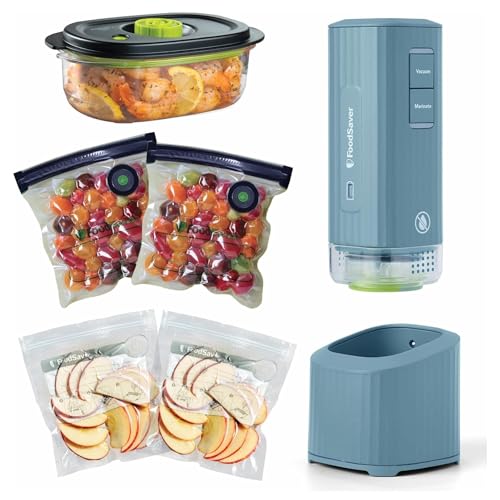
FoodSaver Mini Handheld Vacuum Sealer
Badge: Best for Quick Small Batches
Strengths
- Cordless and dock-kept, it seals a small amount in seconds, at the cupboard, without setting up a station.
- A gentle handheld draw suits delicate material at small scale.
- Its reusable-bag format matches amounts that are opened and resealed across days.
Trade-offs
- Small batches only; a large amount would be slow, bag by small bag.
- Its marinate setting is a food feature this use does not need — judge it here on its sealing alone.
- Depends on its charge, so the dock habit is part of ownership.
Spec box — verified from listing: Format: cordless handheld. Features: marinate setting, charging dock. Colour: blue. Stated uses: freezer, storage, sous vide, meal prep.
The Mini is the impulse-scale tool: the small amount that arrives, the little remainder that should be kept properly rather than loosely, the single variety you want separated tonight. Its virtue is that proper storage happens at all in those moments, because the tool is charged, present and finished in seconds. Handheld gentleness, a reusable bag, a label — and a small amount is stored to a standard that loose keeping never reaches. For keepers whose amounts are always small, it can honestly be the only sealer they need, a conclusion the broader comparisons in our Best Vacuum Food Sealers Compare survey reach for several small-format tools.
Do not stretch it into an archive machine. Long storage and large amounts belong to the countertop picks, and this guide’s structure — handhelds for the living stash, countertop seals for the keeping — is the most useful sentence in it after the pulse rule itself.
Best for: very small amounts and quick, frequent reseals / Not suited for: archives, large amounts or long storage
Comparison Table
| Pick | Badge | Format | Compression control | Check |
|---|---|---|---|---|
| ROUUO 95kpa | Best for Control | External | Pulse, staged by eye | Check on Amazon |
| Bonsenkitchen | Best Simple Compact | Compact external | Gentler compact draw, watched cycles | Check on Amazon |
| UPRUBE 95kPa | Best for Repeatable Portions | External | Pulse plus timer consistency | Check on Amazon |
| Chef Preserve | Best Handheld for Small Amounts | Handheld | Gentle by design | Check on Amazon |
| VACLER | Best Automatic for Dry Storage | Compact external | Mode-based, plus jar route via hose | Check on Amazon |
| FoodSaver Mini | Best for Quick Small Batches | Cordless handheld | Gentle by design | Check on Amazon |
How to Choose a Vacuum Sealer for Storing Weed
Start with amount, because amount chooses the format before any feature does. Small, living amounts — the kind opened weekly — belong in handheld reusable-bag systems, where gentleness is automatic and resealing is free. Larger amounts being divided for keeping belong on a countertop machine, where the decision narrows to control: pulse if the material is valuable and delicate, which is to say almost always, with the ROUUO for watched artistry and the UPRUBE for identical repetition. The VACLER enters when your routine mixes bags with jars, since its hose serves both. The Bonsenkitchen enters when the amount is modest, the sessions are rare and the budget of attention is small.
Then choose by your own honesty about watching. Pulse control is only control if a person is standing there using it; a keeper who seals while doing three other things should deliberately choose a gentler machine whose worst case is survivable. Finally, choose the bag stock as part of the machine: small bags in quantity, because portioning is the system, and a keeper who runs out of small bags will seal one large one and spend the season reopening it — the single most common way good storage quietly fails. The machine, the portions and the dark cupboard are one purchase, and should be made as one.
How to Seal Dried Herb Without Crushing It, Step by Step
Begin with the material, not the machine: only properly cured, dry flower should be sealed, because sealing damp material locks in the condition you least want to preserve. Work in a clean, dry space with clean, dry hands and equipment. First, divide the amount into the portions you will actually open — by week, by occasion, by variety — and let that division, not the bag sizes you happen to own, lead. Second, choose or cut bags a little larger than each portion, so the flower can settle without being pressed into place. Third, fill loosely, keeping the seal zone completely clear and dry. Fourth, on a pulse machine, draw in short bursts, watching the film settle; on an automatic machine, use the dry cycle and stay with it; on a handheld, seat the nozzle and let its gentle draw finish. Fifth, stop and seal at snug — the moment the bag holds the flower gently and air is out, well before the contents are compressed into a solid shape. Sixth, inspect: the pack should look like flower in a fitted bag, not like a brick. Seventh, label with variety and date where those matter, and store the packs flat, in the dark, somewhere cool and undisturbed. Eighth, rotate honestly, oldest first, and when a pack is opened, either finish it as the current supply or reseal the remainder promptly rather than letting it live half-open.
A note on hands and tools during the session itself: handle flower as little and as gently as the portioning allows, work over a clean tray so nothing valuable is lost to the counter, and keep each variety’s session separate, with its own bags and its own label written before the first bag is filled rather than after the last. Sessions that mix varieties at one counter produce the mislabelled packs that haunt archives, and the haunting is always discovered at the worst moment — when a pack is opened in company, or when the keeper’s records and the pack’s contents first disagree. Order at the counter is not fussiness in this category; it is the entire difference between an archive and a drawer of mysteries.
For jars, the rhythm is simpler: fill the jar without packing it down, fit the compatible lid or attachment as the system directs, draw the air out with the hose until the lid seals, label the jar, and store it in the same cool darkness. Jars suit the material you are currently enjoying, opened and re-evacuated across days; bags suit the archive behind it. Many settled keepers run exactly that two-tier system, and the VACLER’s presence in this list is a nod to how well it serves both tiers from one compact machine.
Troubleshooting herb storage
Problem: packs come out compressed and the flower is damaged → the draw ran too long; switch to pulse in shorter bursts, fill bags a size larger, and seal earlier, at snug rather than tight.
Problem: a stored pack smells tired or the material seems dull early → check the storage before the seal: light, warmth and repeated disturbance age herb faster than a sound seal can protect it; move the archive somewhere cool and dark and rotate it less, not more.
Problem: a bag slowly relaxes over weeks → a micro-leak at the seam or a puncture from a sharp stem; keep stems from pressing the film, double-seal archive packs, and store packs flat without weight or friction on them.
Storage Conditions: the Cupboard Is Half the System
A perfect seal stored badly loses to a decent seal stored well, and a buying guide for keeping should say so at full length. The enemies after air are light, heat and disturbance. Light degrades the very compounds keeping exists to preserve, so the archive belongs in genuine darkness — a closed cupboard, a drawer, an opaque container for the packs themselves — not on a shelf that looks tidy in photographs. Heat accelerates every ageing process the seal has slowed, so the coolest stable place in the home, away from appliances and sunny walls, is the right address; avoid anywhere with wide temperature swings, since cycling invites condensation mischief that a sealed bag cannot argue with. Disturbance is the quiet third enemy: every handling flexes packs, works seals and tempts an opening, so the archive should be somewhere the keeper goes deliberately, weekly at most, rather than a place brushed past daily.
Organisation is the keeper’s half of the machine. Packs labelled by variety and date, filed oldest-forward, in portions matched to use — that is the entire system, and it costs nothing but the habit. Keep a simple note of what is stored where, especially when the archive holds several varieties, because a sealed pack reveals nothing through the film and memory, once again, is the least reliable instrument in the house. And keep the living supply separate from the archive in fact, not just in intention: one current pack or jar in the kitchen’s orbit, the rest undisturbed in the dark. That separation is what lets the archive do its slow, quiet work, and it is the difference between keeping as a system and keeping as a pile.
Bags, Jars or Both: Choosing Your Keeping Format
Film bags are the archive format: cheap per portion, flat-stacking, portion-exact and, sealed well, the longest-keeping option in this guide. Their costs are attention — the pulse discipline — and single use, since a bag that has held aromatic material should not wander into food service afterwards. Jars are the living format: rigid, reusable, incapable of crushing anything, and reopened and re-evacuated in seconds with a hose-equipped machine, at the price of bulk and of a seal that depends on a lid rather than a welded seam. Reusable handheld bags sit between the two: gentler and reopenable like a jar’s routine, flat and portioned like film, with keeping quality suited to weeks rather than seasons.
Most keepers who stay with the hobby settle, as this guide has hinted, into both: jars or reusable bags for the current supply, film for the archive, and a machine — or a pair, one countertop and one handheld — that serves the two tiers without strain. The choice is not a loyalty test. It is a matching exercise between the amount you keep, the rate you use it and the attention you will honestly pay, and the six picks in this list were chosen so that every honest answer to those three questions has a machine waiting for it. Readers comparing keeping formats across the whole market will find the same conclusion in the roundups collected under Best Vacuum Food Sealers Consumer Reports in this programme’s index: control and conditions, not power, decide how well dried material keeps.
Curing and Condition: the Seal Preserves the State You Give It
Every storage guide eventually arrives at the same uncomfortable truth: a sealer is a preserver, not an improver. Material sealed at its best, properly cured and dried to the point its keeper judges right, will be recognisably itself months later, because the bag’s whole talent is preventing change. Material sealed damp, harsh or unfinished will be preserved in exactly that condition, with the same fidelity, and no machine in this list can reach inside the film and finish a cure that never happened. That is why this guide’s how-to begins with the material rather than the equipment, and why experienced keepers spend more of their attention before the seal than after it: the even, patient drying and curing, the judgement of when a batch is ready, the discipline not to archive a batch early because the sealer is sitting there looking efficient.
Condition also decides the sealing itself. Over-dry material is brittle, and brittle material is the most compression-sensitive of all, which is why the pulse rule matters most for the driest, most valuable flower. Material at a balanced dryness settles under the film with a little give and forgives a fraction more draw. A keeper who learns to read that difference — and to set the pulse tempo by the batch in front of them rather than by habit — has learned the one skill that separates careful keeping from mere packaging. The machines here can all execute that skill; none can supply it. Buy the control, then become the controller, and the archive will reward the partnership in the only currency it has: material that opens, months later, as if very little time had passed at all.
Keeping Several Varieties Without Chaos
Variety is where home keeping grows up. One variety in one jar needs no system; four varieties across two tiers — current jars and an archive — need exactly the organisation this guide has been quietly building: portions matched to use, every pack and jar labelled with variety and date at the moment of sealing, a written note of what lives where, and rotation that respects dates rather than enthusiasm. The failure mode is familiar to anyone who has kept more than one of anything: unlabelled packs that must be opened to be identified, which defeats the seal; a favourite variety consumed while an older one waits, which defeats the rotation; and a current jar refilled from the wrong archive pack, which defeats the keeper’s own records. Each failure is prevented by the same thirty seconds at the counter — label first, seal second — and by nothing else.
The two-tier structure helps here as well. Archive packs, sealed in film and filed by variety in date order, should be touched only to promote one pack at a time into the living tier, where a jar or a reusable bag takes over for the days of actual use. That promotion rhythm keeps the archive sealed and the living supply fresh, and it makes the inventory note almost self-writing: what was promoted, when, and what remains. Keepers who run their varieties this way describe the same satisfaction as cooks with a good freezer pipeline — the sense that the collection is managed rather than merely possessed — and they get it from the same unglamorous sources: portions, labels, dates and a machine whose control they trust.
Common Buying Mistakes
The first mistake is buying the strongest sealer and running it on automatic, then blaming the machine for crushed flower that the pulse button existed to prevent. The second is sealing one large bag and reopening it all season, which converts an archive into a repeatedly disturbed pile with extra steps. The third is sealing material that was not fully dry and cured, and preserving its dampness faithfully for months. The fourth is storing the archive in light and warmth because the cupboard was convenient, then judging the seals for the cupboard’s damage. The fifth is skipping labels across several varieties and dates. The sixth is buying a countertop station for a gram-scale habit, or a handheld for a harvest-scale one, when this list contains the honest scale for each.
One last piece of housekeeping before the recommendations: whatever you buy, run its first session on a small, low-stakes amount and open that pack a week later to inspect your own work. Is the flower intact, the seal still snug, the condition where you left it? That single rehearsal teaches your hands the machine’s tempo and proves your storage corner’s conditions, and it costs almost nothing compared with learning the same lessons on the whole archive at once. Keeping, like every other craft in this programme’s guides, rewards the keeper who practises small before committing large.
Final Recommendation
Store the machine, its film and your labels together, and the whole routine — portion, pulse, seal, file — stays a single, unhurried quarter hour rather than a project that has to be assembled from three rooms before it can begin. That convenience is not a small thing in a keeping routine, because routines that are easy to start are the ones still running, unchanged, a year later.
For keeping dried herb well, buy the ROUUO Vacuum Sealer 95kpa if you portion larger amounts and will use its pulse control with the attention it deserves; buy the UPRUBE Vacuum Sealer 95kPa if your portions must be identical and numerous. For a mixed bag-and-jar routine, the VACLER Vacuum Sealer Machine is the flexible centre. For small, living amounts only, a handheld — the Chef Preserve or the FoodSaver Mini — is not the compromise choice but the correct one.
Frequently Asked Questions
Will vacuum sealing crush my buds?
It can, if a strong machine runs a full cycle unattended — which is why this guide’s top picks are pulse machines and its first rule is to seal at snug, not at maximum. Drawn in stages and stopped by eye, a vacuum bag holds flower gently with the air out and the structure intact. A gentler handheld avoids the question almost entirely at small scale. The damage people report is a technique outcome, not a technology verdict.
How long does vacuum-sealed herb keep?
Far longer than loosely stored herb, because the seal removes the air exchange that stales it and contains the aroma that otherwise escapes. The honest variables are the material’s condition at sealing — dry and properly cured is non-negotiable — and the storage conditions afterwards: cool, dark and undisturbed. Keepers who control those variables measure good keeping in months; treat any exact promise, from any source, as a rough guide rather than a guarantee.
Should I freeze vacuum-sealed herb?
For most home keeping, a cool dark cupboard is the better default: freezing introduces condensation risk when packs are handled and thawed, and delicate structures can turn brittle in deep cold. Some keepers freeze long archives successfully with careful, undisturbed handling and a full thaw in the sealed bag before opening. If you freeze, commit to the discipline; if you will handle packs often, keep them cool and dark instead, where the seal’s work is not fighting the thaw cycle.
Are jars better than bags for storing weed?
They are better at different tiers. A jar with the air drawn out cannot crush anything, reopens and reseals in seconds, and suits the current supply you are using across days. A well-sealed bag portions exactly, stacks flat and keeps longest, which suits the archive. Most settled routines use both, and the VACLER in this list — with its hose for jars and its cutter for bags — is recommended precisely because it refuses to make you choose a single philosophy.
How small should portions be?
As small as your actual opening rhythm: the amount you would naturally finish before you would want the next pack open. For most keepers that means modest, single-purpose packs rather than one archive bag, because every opening restarts a pack’s exposure clock. When in doubt, portion smaller; two small packs keep better than one large pack opened twice, and the film they cost is the cheapest insurance in the whole system.
Does vacuum sealing remove the smell completely?
A sound seal in proper film contains odour far better than jars opened regularly or merely zipped bags, which is one of the main reasons keepers adopt it. Complete is a strong word, though: film quality, seal quality and storage handling all play a part, and packs stored in a closed container in a cupboard are more discreet than packs stored loose. Judge your setup by the standard you actually need, and keep the archive somewhere private as a matter of ordinary good practice — and always within whatever your local rules require.
Should I add anything to the bag to manage humidity?
Keepers disagree, and this guide’s position is conservative: the seal’s job is to hold the condition the material was sealed in, so the first task is to seal material at the condition you actually want, rather than asking an additive to correct it afterwards. If you do use a humidity-control product made for this purpose, follow its maker’s guidance, keep it from pressing directly against delicate flower where it could mark it, and note it on the label so the pack’s history is honest. What no keeper should do is seal first and investigate later; condition is decided before the film closes, which is the argument of this guide’s curing section in miniature.
Can I use the same sealer for food and for herb storage?
The machine, yes, with ordinary cleaning of the seal area between duties. The bags, no: dedicate film and reusable bags to each use, since aromatic material perfumes its bag permanently, and neither your food nor your herb will thank you for the exchange. Keep the two stocks in separate places with their labels on, and the shared machine will serve both pantries without either noticing the other.