Disclosure: topratedkitchenware.com is reader-supported. When you buy through links on our site, we may earn an affiliate commission from Amazon and other retailers, at no extra cost to you.
Where to buy
Shoppers comparing the best vegetable rice cookers usually want two things at once: an honest shortlist and a clear view of what each option actually is. The six products below are the verified options for this guide; each name links to its Amazon listing so you can check the latest price on Amazon before you decide.
- Sweetcrispy 16-in-1 Electric Pressure Cooker, 8QT — Best for Big Batches; 8 quart, electric pressure cooker / multicooker (16-in-1).
- AROMA Digital Rice Cooker, 4-Cup Uncooked / 8-Cup Cooked, ARC-914SBD — Best Steam-Over-Rice Design; 4-cup uncooked / 8-cup cooked (2 Qt), digital rice cooker and steamer.
- Cosori Rice Cooker 10 Cup, Fuzzy Logic, 18-in-1 — Best Overall; 10-cup (20-cup cooked), fuzzy logic rice cooker (18-in-1).
- BLACK+DECKER Rice Cooker, 6-Cup Cooked — Best Budget Simplicity; 6-cup cooked, rice cooker with steaming basket.
- AROMA Rice Cooker, 3-Cup Uncooked / 6-Cup Cooked, ARC-363NG — Best for Small Households; 3-cup uncooked / 6-cup cooked (1.5 Qt), rice cooker and multicooker.
- Zojirushi NS-ZCC10 Neuro Fuzzy Rice Cooker and Warmer — Best for Grain Texture; Not stated in listing title, neuro fuzzy rice cooker and warmer.
Every pick below cooks rice and vegetables together — the differences are capacity, how the steaming is arranged, and how intelligently the machine manages mixed loads.
Read the full guide ↓
The best vegetable rice cookers solve a specific weeknight problem: getting grains and vegetables onto the plate at the same moment, from one pot, with nobody watching either. The method is steam-over-rice — vegetables sit in a basket or tray above the cooking grains, the rice’s own steam cooks them, and everything finishes together. This guide compares six verified machines that do it, from an 8 quart multicooker that can feed a crowd to a fuzzy-logic rice cooker that adjusts itself when your vegetables add extra moisture to the pot.
Choose by how you actually eat. If vegetables steam above rice three nights a week, basket design and capacity dominate. If your vegetables are usually folded through the rice — pilaf style, mixed grains, vegetable fried rice bases — the cooker’s grain intelligence matters more than its basket. Both cooking styles are covered below, pick by pick. Rice specialists for brown rice are compared in Best Small Brown Rice Cookers. Pressure-cooker routes to rice are in Best Small Pressure Cookers For Rice.
Key Takeaways
- Steam-over-rice is the core technique: vegetables cook in the rice’s steam and finish at the same moment as the grains.
- A stainless steamer basket (Cosori) is the durability pick; included plastic baskets work but age faster.
- Fuzzy and Neuro Fuzzy logic help mixed loads, because vegetables release moisture that fixed timers cannot anticipate.
- Cut vegetables to even sizes and add tender greens late — no cooker can fix uneven prep.
- Capacity decides everything: 6-cup cooked feeds a side dish; 8 quart and 10-cup machines feed a family main.
In this guide
Quick Picks
| Pick | Badge | Capacity | Type |
|---|---|---|---|
| Sweetcrispy 16-in-1 Electric Pressure Cooker, 8QT | Best for Big Batches | 8 quart | Electric pressure cooker / multicooker (16-in-1) |
| AROMA Digital Rice Cooker, 4-Cup Uncooked / 8-Cup Cooked, ARC-914SBD | Best Steam-Over-Rice Design | 4-cup uncooked / 8-cup cooked (2 Qt) | Digital rice cooker and steamer |
| Cosori Rice Cooker 10 Cup, Fuzzy Logic, 18-in-1 | Best Overall | 10-cup (20-cup cooked) | Fuzzy logic rice cooker (18-in-1) |
| BLACK+DECKER Rice Cooker, 6-Cup Cooked | Best Budget Simplicity | 6-cup cooked | Rice cooker with steaming basket |
| AROMA Rice Cooker, 3-Cup Uncooked / 6-Cup Cooked, ARC-363NG | Best for Small Households | 3-cup uncooked / 6-cup cooked (1.5 Qt) | Rice cooker and multicooker |
| Zojirushi NS-ZCC10 Neuro Fuzzy Rice Cooker and Warmer | Best for Grain Texture | Not stated in listing title | Neuro Fuzzy rice cooker and warmer |
Badges sort the six by role: batch size, steaming hardware, grain intelligence and simplicity — read the role first, then the review.
How These Picks Were Chosen
This guide is research-led. Every pick comes from a verified product pool checked against Amazon’s catalog data on 2026-11-21: the brand, model and product type in each listing title were confirmed before a product could be recommended, and only picks whose confirmed type matches the core of this keyword carry purchase links. Where a pool product turned out to be a different kind of machine from the one this keyword names, it is reviewed honestly in full but presented prose-only, with no link and no image, and the reduction is recorded in the article’s sources file.
The comparison weighed the things that decide daily satisfaction with this class of cooker: capacity against household size, the functions you will actually run each week against menu padding, inner-pot material against cleaning habits, and the long-term ownership picture — parts, support and how the machine ages. No hands-on testing is claimed; this is a structured comparison of verified specifications and established category knowledge, written so you can see exactly why each pick earned its badge — and where each one will frustrate you.
The 6 Best vegetable rice cookers Picks, Reviewed in Detail
Each review covers the machine’s rice-and-vegetable method specifically: how the steaming is arranged, how it handles mixed loads, and where its limits show.

Sweetcrispy 16-in-1 Electric Pressure Cooker, 8QT
Badge: Best for Big Batches
The Sweetcrispy is the capacity play in this pool: an 8 quart, 16-in-1 electric pressure cooker with a dozen presets, a ceramic pot and a function list that explicitly includes rice steaming, saute, soup and yogurt, with a recipe book in the box. Eight quarts is party and big-family territory — whole batches of rice with vegetables steaming above them are exactly what that volume is for.
For vegetables, the Sweetcrispy’s scale is the feature: 8 quarts swallows a family-size load of rice with a deep layer of vegetables steaming in its steamer function — broccoli, carrots, squash and green beans for a crowd, in one cycle. It is the pick for households where ‘rice and vegetables’ is the main event, not a side.
Pressure cooking works by trapping steam: the sealed pot raises the boiling point of water, so food cooks at a higher temperature than an open pot allows, and tough ingredients soften in a fraction of their usual time. The skills that matter are liquid discipline — enough water to build steam, never so much that the pot overfills — and release discipline, letting pressure fall naturally for meats and grains or releasing it quickly for vegetables you do not want to overcook. Master those two habits and the appliance becomes predictable; ignore them and every recipe feels like a gamble.
Strengths
- 8 quart capacity is the largest in this guide
- Ceramic pot and a wide preset range cover rice, steam and soup duty
- Steamer function is built for cooking vegetables over grains
Trade-offs
- 8 quarts is a lot of appliance to store and wash
- Pressure-cooker format is less specialized for rice texture than a fuzzy-logic cooker
- Big batches tempt overfilling, which pressure cookers punish
| Specification | Detail |
|---|---|
| Capacity | 8 quart |
| Type | Electric pressure cooker / multicooker (16-in-1) |
| Key features (from listing) | 12 presets; ceramic pot; slow cook, rice, steamer, saute, soup and yogurt functions; recipe book included |
| Construction | Ceramic inner pot |
Best for: Large households cooking rice and vegetables together at volume / Not suited for: Small kitchens or one-person meals
Check on Amazon to check the latest price on Amazon and confirm the current configuration before you buy.

AROMA Digital Rice Cooker, 4-Cup Uncooked / 8-Cup Cooked, ARC-914SBD
Badge: Best Steam-Over-Rice Design
The AROMA ARC-914SBD is a digital rice cooker that doubles as a steamer and grain cooker: 4 cups uncooked to 8 cups cooked in a 2 quart pot with a stainless steel exterior. For vegetable cooking its appeal is the steam-over-rice arrangement — greens, broccoli or squash steam above the grains and finish at the same moment, which is the oldest one-pot trick in the rice cooker book.
The AROMA Digital is the classic steam-over-rice machine: its steamer arrangement is designed for exactly this pairing, so vegetables finish tender above grains that cook undisturbed below. Its 8-cup cooked size is the family side-dish sweet spot, and the grain cooker side handles quinoa and other bases for vegetable bowls.
A dedicated rice cooker succeeds by controlling the end of the cycle: as the water absorbs and the temperature at the pot’s base begins to rise, the cooker knows the rice is done and drops to keep warm. That simple thermostat logic — or the fuzzy logic refinements of it in the smarter machines here — is why a rice cooker turns out consistent grains while a stovetop pot demands attention. For mixed pots, remember the vegetables contribute moisture of their own, so a small reduction in cooking water keeps the grains distinct rather than soupy.
Strengths
- Dedicated steamer function built for vegetables over rice
- Digital controls are simple and repeatable
- Compact 2 quart footprint suits everyday family sides
Trade-offs
- 8-cup cooked ceiling is modest for large households
- A rice cooker steams vegetables; it does not roast or brown them
- Stainless exterior shows water spots without a wipe-down
| Specification | Detail |
|---|---|
| Capacity | 4-cup uncooked / 8-cup cooked (2 Qt) |
| Type | Digital rice cooker and steamer |
| Key features (from listing) | Steamer, grain cooker and multicooker functions; stainless steel exterior; 2 quart capacity |
| Construction | Stainless steel exterior |
Best for: Families who steam vegetables over rice several nights a week / Not suited for: Anyone wanting crispy or roasted vegetable textures
Check on Amazon to check the latest price on Amazon and confirm the current configuration before you buy.

Cosori Rice Cooker 10 Cup, Fuzzy Logic, 18-in-1
Badge: Best Overall
The Cosori 10 Cup is the overachiever of the rice cooker pool: fuzzy logic control, an 18-in-1 function range, a ceramic-coated inner pot and — most relevant here — a stainless steel steamer basket, so vegetables steam in steel rather than plastic. The 24-hour keep warm and delay timer make it a set-and-forget machine: load rice and vegetables in the morning and dinner’s foundation is ready when you are.
The Cosori is the most deliberate vegetable machine here: the stainless steel steamer basket is the hardware detail that matters most for daily steaming, and the fuzzy logic underneath compensates when watery vegetables — zucchini, tomatoes, mushrooms — add moisture a basic cooker would turn into mushy rice.
A dedicated rice cooker succeeds by controlling the end of the cycle: as the water absorbs and the temperature at the pot’s base begins to rise, the cooker knows the rice is done and drops to keep warm. That simple thermostat logic — or the fuzzy logic refinements of it in the smarter machines here — is why a rice cooker turns out consistent grains while a stovetop pot demands attention. For mixed pots, remember the vegetables contribute moisture of their own, so a small reduction in cooking water keeps the grains distinct rather than soupy.
Strengths
- Stainless steel steamer basket is ideal for vegetables
- Fuzzy logic adjusts cooking for consistent rice texture
- Delay timer and long keep warm suit planned meals
Trade-offs
- 10-cup capacity is more machine than small households need
- 18 functions mean menus to learn
- Ceramic pot needs gentle utensils
| Specification | Detail |
|---|---|
| Capacity | 10-cup (20-cup cooked) |
| Type | Fuzzy logic rice cooker (18-in-1) |
| Key features (from listing) | Ceramic coating inner pot; saute, slow cook; 24H keep warm and delay timer; stainless steel steamer basket |
| Construction | Ceramic-coated inner pot; stainless steel steamer basket |
Best for: Planners who want rice and steamed vegetables ready on a timer / Not suited for: Minimalists who cook one cup of rice at a time
Check on Amazon to check the latest price on Amazon and confirm the current configuration before you buy.

BLACK+DECKER Rice Cooker, 6-Cup Cooked
Badge: Best Budget Simplicity
The BLACK+DECKER 6-Cup is the straightforward rice cooker in this pool: a removable non-stick bowl, a steaming basket in the box, and one job done simply. Six cooked cups is a side-dish quantity — rice for two to four people with vegetables steaming in the basket above it — and the low complexity is the point: no menus, no fuzzy logic, just a cooker that does the daily grain-and-vegetable routine without ceremony.
The BLACK+DECKER keeps the method at its simplest: basket in, rice below, one switch. For households whose vegetable routine is frozen peas, corn and carrot medleys or a bag of stir-fry mix steamed over rice, that simplicity is not a compromise — it is the entire requirement, met.
A dedicated rice cooker succeeds by controlling the end of the cycle: as the water absorbs and the temperature at the pot’s base begins to rise, the cooker knows the rice is done and drops to keep warm. That simple thermostat logic — or the fuzzy logic refinements of it in the smarter machines here — is why a rice cooker turns out consistent grains while a stovetop pot demands attention. For mixed pots, remember the vegetables contribute moisture of their own, so a small reduction in cooking water keeps the grains distinct rather than soupy.
Strengths
- Steaming basket included for vegetables over rice
- Removable non-stick bowl is easy to wash
- Simple operation suits daily, unthinking use
Trade-offs
- 6-cup cooked capacity is small for families
- No timer or fuzzy logic refinements
- Non-stick bowl needs care to avoid scratching
| Specification | Detail |
|---|---|
| Capacity | 6-cup cooked |
| Type | Rice cooker with steaming basket |
| Key features (from listing) | Steaming basket included; removable non-stick bowl |
| Construction | Removable non-stick bowl |
Best for: Small households wanting simple rice-plus-vegetables cooking / Not suited for: Large families or texture perfectionists
Check on Amazon to check the latest price on Amazon and confirm the current configuration before you buy.

AROMA Rice Cooker, 3-Cup Uncooked / 6-Cup Cooked, ARC-363NG
Badge: Best for Small Households
The AROMA ARC-363NG is the small classic: 3 cups uncooked, 6 cups cooked, 1.5 quarts, with oatmeal and soup functions and automatic keep warm. For vegetable cooking it is the personal-size option — a pot of rice with vegetables folded through it, or a small soup, for one or two people — and its tiny footprint is why it survives in dorms, offices and small apartments where a 10-cup machine would be absurd.
The little AROMA’s vegetable role is personal portions: a small pot of rice with vegetables folded through, or a quick steam of a single serving of greens above a cup of grains. In a one-person household that is not a limitation — it is the correct scale, and it wastes neither food nor counter space.
A dedicated rice cooker succeeds by controlling the end of the cycle: as the water absorbs and the temperature at the pot’s base begins to rise, the cooker knows the rice is done and drops to keep warm. That simple thermostat logic — or the fuzzy logic refinements of it in the smarter machines here — is why a rice cooker turns out consistent grains while a stovetop pot demands attention. For mixed pots, remember the vegetables contribute moisture of their own, so a small reduction in cooking water keeps the grains distinct rather than soupy.
Strengths
- Compact 1.5 quart size fits anywhere
- Oatmeal and soup functions widen it beyond plain rice
- Auto keep warm keeps small meals ready
Trade-offs
- 6-cup cooked maximum rules out family batches
- Basic feature set — no delay timer or fuzzy logic
- Small pot means vegetables must be cut small to cook evenly
| Specification | Detail |
|---|---|
| Capacity | 3-cup uncooked / 6-cup cooked (1.5 Qt) |
| Type | Rice cooker and multicooker |
| Key features (from listing) | Oatmeal cooker and soup maker functions; auto keep warm; 1.5 quart; white |
| Construction | White finish body |
Best for: Singles and couples cooking small rice and vegetable meals / Not suited for: Families or batch cooks
Check on Amazon to check the latest price on Amazon and confirm the current configuration before you buy.
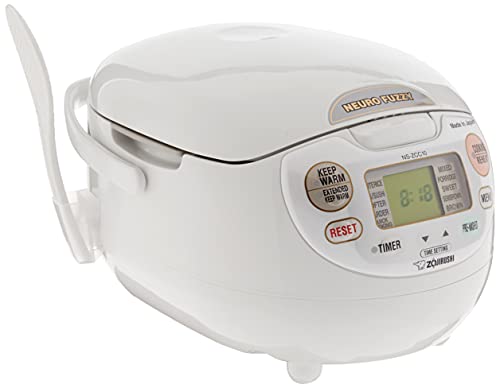
Zojirushi NS-ZCC10 Neuro Fuzzy Rice Cooker and Warmer
Badge: Best for Grain Texture
The Zojirushi NS-ZCC10 brings Neuro Fuzzy logic to the job: the cooker senses and adjusts through the cycle rather than following a fixed timer, which is the technology cooks credit for consistently distinct, fluffy grains — including the mixed rice-and-vegetable pots where moisture varies with what you added. Automatic keep warm and a delay timer complete a machine aimed at people who eat rice daily and notice texture.
The Zojirushi’s vegetable strength is mixed cooking rather than basket steaming: rice cooked together with diced vegetables, sweet potato, edamame or corn, where the Neuro Fuzzy logic manages the variable moisture load. If your style is takikomi-style mixed rice rather than separate steamed vegetables, this is your machine. Japanese-style machines are covered in Best Small Japanese Rice Cookers.
A dedicated rice cooker succeeds by controlling the end of the cycle: as the water absorbs and the temperature at the pot’s base begins to rise, the cooker knows the rice is done and drops to keep warm. That simple thermostat logic — or the fuzzy logic refinements of it in the smarter machines here — is why a rice cooker turns out consistent grains while a stovetop pot demands attention. For mixed pots, remember the vegetables contribute moisture of their own, so a small reduction in cooking water keeps the grains distinct rather than soupy.
Strengths
- Neuro Fuzzy logic adapts to variable loads like rice with vegetables
- Delay timer supports meal planning
- Keep warm holds finished rice without drying it out
Trade-offs
- Premium-tier positioning in this pool
- Rice-focused — steaming capacity is secondary to grain quality
- Capacity is not stated in the listing title, so confirm the size before buying
| Specification | Detail |
|---|---|
| Capacity | Not stated in listing title |
| Type | Neuro Fuzzy rice cooker and warmer |
| Key features (from listing) | Neuro Fuzzy logic; automatic keep warm; delay timer |
| Construction | White finish body |
Best for: Daily rice eaters who mix vegetables through their grains / Not suited for: Shoppers who mainly want a big steaming capacity
Check on Amazon to check the latest price on Amazon and confirm the current configuration before you buy.
Comparison Table
| Pick | Capacity | Type | Key features |
|---|---|---|---|
| Sweetcrispy 16-in-1 Electric Pressure Cooker, 8QT — Check on Amazon | 8 quart | Electric pressure cooker / multicooker (16-in-1) | 12 presets; ceramic pot; slow cook, rice, steamer, saute, soup and yogurt functions; recipe book included |
| AROMA Digital Rice Cooker, 4-Cup Uncooked / 8-Cup Cooked, ARC-914SBD — Check on Amazon | 4-cup uncooked / 8-cup cooked (2 Qt) | Digital rice cooker and steamer | Steamer, grain cooker and multicooker functions; stainless steel exterior; 2 quart capacity |
| Cosori Rice Cooker 10 Cup, Fuzzy Logic, 18-in-1 — Check on Amazon | 10-cup (20-cup cooked) | Fuzzy logic rice cooker (18-in-1) | Ceramic coating inner pot; saute, slow cook; 24H keep warm and delay timer; stainless steel steamer basket |
| BLACK+DECKER Rice Cooker, 6-Cup Cooked — Check on Amazon | 6-cup cooked | Rice cooker with steaming basket | Steaming basket included; removable non-stick bowl |
| AROMA Rice Cooker, 3-Cup Uncooked / 6-Cup Cooked, ARC-363NG — Check on Amazon | 3-cup uncooked / 6-cup cooked (1.5 Qt) | Rice cooker and multicooker | Oatmeal cooker and soup maker functions; auto keep warm; 1.5 quart; white |
| Zojirushi NS-ZCC10 Neuro Fuzzy Rice Cooker and Warmer — Check on Amazon | Not stated in listing title | Neuro Fuzzy rice cooker and warmer | Neuro Fuzzy logic; automatic keep warm; delay timer |
Compare the steaming arrangement and capacity first; the function count matters less for this job than how vegetables physically cook in each machine.
How to Choose a Rice Cooker for Vegetables
Decide your method: above or in. Steaming above the rice keeps vegetables distinct — their own texture, their own seasoning — and suits firm vegetables like carrots, broccoli and green beans. Cooking in the rice suits mixed dishes where flavors should merge. Basket steamers serve the first style; intelligent fuzzy-logic machines serve the second. Most households do both, which is why the Cosori and Zojirushi anchor this guide’s top tier.
Size the basket, not just the pot. A cooker’s headline capacity describes rice, not vegetables. The steaming space above the grains is what limits your vegetable load, and overloading it steams unevenly — the layer nearest the steam cooks, the top layer stays raw. If vegetables are half the meal, step up a size class.
Match intelligence to your vegetables. Dry, firm vegetables barely change a rice cycle. Watery ones — zucchini, fresh tomatoes, mushrooms, frozen mixes — release liquid that fixed-timer cookers cannot account for. Fuzzy logic exists precisely for that variance; if your vegetable rotation is watery, it is worth having.
Think about timing control. A delay timer lets you load rice in the morning and add quick-cooking vegetables when you get home; long keep-warm holds the finished pot for staggered family dinners. Greens and delicate vegetables should always go in late regardless — plan the add, and the machine handles the rest.
How to Steam Vegetables Over Rice: Step by Step
Step 1 — Start the rice first. Rinse the rice, add water to the line for your quantity, and start the cycle. The vegetables join partway through, not at the beginning — rice needs the full cycle, most vegetables do not.
Step 2 — Prep vegetables to even sizes. Cut carrots, broccoli stems and squash to similar thicknesses so they finish together. Dense vegetables go in earlier and lower in the basket; delicate ones — peas, spinach, herbs — go on top and in last.
Step 3 — Time the basket drop. As a working pattern: hard vegetables (carrot, potato, winter squash) join with about twenty minutes of rice time remaining; medium vegetables (broccoli, green beans, zucchini) with about ten; tender greens and frozen peas in the final few minutes or on keep-warm with the lid closed.
Step 4 — Season after, not before. Steam strips surface seasoning into the rice water below. Salt, oil, citrus and sauces belong on the vegetables after cooking — or embrace the exchange and season the rice knowing the vegetables will flavor it. Brown-rice-focused picks appear in Best Small Rice Cookers For Brown Rice.
Step 5 — Rest and serve together. Let the closed pot rest briefly off the boil so the rice finishes absorbing and the vegetables settle, then fluff the rice and lift the basket out in one motion.
Troubleshooting. Problem: vegetables are raw in the middle → pieces were too thick or the basket was overloaded; cut smaller and steam in a single layer. Problem: rice is soggy → watery vegetables added too much liquid; reduce the rice water slightly on mixed loads. Problem: vegetables are dull and waterlogged → they went in too early; shorten their time and season after steaming, not before.
Which Vegetables Steam Best Over Rice?
The reliable performers are the firm and the forgiving: broccoli and cauliflower florets, carrot coins, green beans, snap peas, corn, edamame, diced sweet potato and winter squash, and sliced zucchini added late. Leafy greens — spinach, bok choy, chard — steam beautifully but in minutes, so they are a finishing move, not a full-cycle passenger. Vegetables to route elsewhere: anything you want browned or crisp (peppers for char, onions for caramelization) and anything very delicate, like asparagus tips, which deserve a shorter, separate steam. Frozen vegetable mixes are the weeknight cheat code — they are pre-cut to even sizes and steam predictably straight from the bag.
Mixed Rice: Cooking Vegetables in the Grains
The other tradition cooks vegetables in the rice itself: diced carrot, peas, corn, mushrooms, sweet potato or edamame folded through the grains before the cycle starts, seasoned with soy, stock or spices so the whole pot emerges as one dish. Two disciplines make it work. Keep the added vegetables to a modest proportion of the rice volume, or the grains cook unevenly; and account for their moisture — juicy additions mean a touch less water, dry additions a touch more. This is where fuzzy-logic machines earn their keep, sensing the load and adjusting, while basic cookers need you to learn your regular mixtures by repetition. Either way, mixed rice is the most forgiving packed-lunch and meal-prep format in this guide: it reheats as one complete dish. Steamer-first models are compared in Best Steamer And Rice Cookers.
Meal Prep With a Rice Cooker: The Sunday Batch
A family-size cooker turns Sunday into base-building: a full pot of rice with a basket of vegetables above it becomes four days of lunches with nothing more than a protein and a sauce added each day. Rotate the vegetable basket — broccoli and carrot one week, squash and green beans the next — and rotate the sauce, and the same batch never tastes repeated. The large machines in this guide, the Sweetcrispy and the Cosori, exist for exactly this rhythm; the small ones serve households that would rather cook fresh in ten minutes than reheat all week. Neither rhythm is better — but buy the machine that matches yours.
Keeping Steamed Vegetables Bright
Steamed vegetables turn dull for two reasons: overcooking and sitting. Chlorophyll fades when greens stay in residual heat, so serve promptly or lift the basket out the moment the cycle ends rather than letting it ride on keep-warm. A brief rest in the open air — not a cold shock, just an uncovered minute — sets color surprisingly well. And season with something acidic at the table: lemon, lime or a vinegar-based dressing restores the brightness that plain steaming softens, which is why a squeeze of citrus is the professional finish for a plate of rice and steamed vegetables.
Seasoning Steamed Vegetables So People Ask for Seconds
Steaming is the gentlest cooking method and the easiest to make dull, because the vegetables emerge tasting only of themselves. The fix is a finishing pantry, applied in the ninety seconds after the basket comes out. Fat first: olive oil, butter or sesame oil carries every other flavor. Acid second: lemon, lime, rice vinegar or a ponzu-style splash wakes up greens and roots alike. Salt last and deliberately, because steamed surfaces take seasoning unevenly if you rush. Then one signature move per vegetable family — chili crisp on broccoli, miso butter on carrots, garlic and herbs on green beans, a furikake-style sprinkle over mixed vegetables destined for rice bowls. None of this needs the cooker to do anything but steam well and on time; it needs the cook to treat the finish as a step, not an afterthought. Households that build this habit find the rice cooker’s vegetable basket quietly becomes the most-used feature they own.
Rice Cooker Vegetables for Particular Eaters
Different eaters need the same basket used differently. For toddlers and soft-food diets, steam longer and choose naturally soft vegetables — sweet potato, carrot, zucchini, peas — which mash or cut easily and carry mild sweetness. For texture-sensitive adults, steam shorter and serve the firm end of the range: green beans, broccoli stems, snap peas, corn. For meal-prep households, choose vegetables that reheat gracefully — carrots, squash, green beans, edamame — and avoid packing delicate greens, which belong in the fresh, last-minute category. For low-effort nutrition, frozen mixed vegetables are the honest answer: nutritionally sound, pre-cut to even sizes, and steamed predictably by every machine in this guide. The cooker does not change across these cases; the cutting, timing and finishing do, which is why the how-to section’s timing ladder is the most important page in this guide for families.
Beyond the Basket: Other Vegetable Jobs These Cookers Do
The steamer basket gets the attention, but these machines cook vegetables in other ways worth knowing. The rice cookers with saute functions — the Cosori most explicitly — can soften onions, garlic and spices before the grains go in, building a pilaf base that plain steaming never achieves. Soup functions turn the pot into a vegetable soup maker: load chopped vegetables and stock, and the machine handles the simmer while you do anything else. Slow-cook modes suit root-vegetable stews and ratatouille-style braises that want hours rather than minutes. And keep-warm quietly serves as a vegetable holder for staggered dinners, keeping a finished basket warm while the rest of the meal catches up — used for minutes, not hours, so textures survive. A household that learns all four modes stops thinking of the appliance as a rice cooker with a basket and starts treating it as the vegetable station it actually is.
Cleaning and Care for Steaming Duty
Vegetable steaming is gentle on a cooker but not effortless, and three habits keep it that way. Rinse the basket and pot promptly: vegetable starches and rice starch together dry into a film that takes real scrubbing later, while a thirty-second rinse when the pot is warm takes it all away. Wash the lid’s underside and steam vent regularly, because starchy steam condenses there and, left alone, becomes the stale smell that haunts the next pot of rice. And dry the steamer basket fully before storing it inside the cooker — trapped moisture in a closed pot is how musty odors start, in plastic and steel baskets alike. None of this is weekly deep maintenance; it is the thirty-second discipline after each use, and it is the difference between a five-year machine and a two-year one, whatever brand name is on the front.
Vegetable Timing Chart, in Words
Keep this ladder in your head and you will rarely miss. At the long end, winter squash, potatoes and thick carrot pieces want the closest thing to the full rice cycle — twenty minutes or more of steam. The middle band — broccoli and cauliflower florets, green beans, zucchini rounds, corn — wants roughly the last ten minutes. The short end — peas, edamame, sweetcorn kernels, sliced mushrooms — wants five minutes or a little more. And the finishing band — spinach, chard, bok choy leaves, fresh herbs — wants two or three minutes, or simply the residual heat of the closed pot on keep-warm. When vegetables share a basket, arrange them by the ladder: longest-cooking at the bottom nearest the steam, shortest on top, and pull the whole basket when the top layer is right, because the bottom layers can take a little grace. Cut size can move a vegetable one band in either direction, which is the cook’s real control — thick for patience, thin for speed.
Kid-Friendly Vegetable Rice, Without the Negotiation
The rice cooker is a quiet ally in the vegetable wars, because it changes the presentation rather than the vegetable. Mixed rice hides diced carrot, peas and corn inside a familiar food, seasoned gently, where they are eaten as part of the grains rather than confronted as a side. Steamed sweet potato and squash come out naturally sweet and soft enough for small eaters to manage proudly. Broccoli steamed over rice, finished with a little butter and salt, is a different food from the boiled version many children decided against years ago. And the machine’s predictability helps the cook: the same timing produces the same texture every night, and consistency is what lets a cautious eater relax. Start with the vegetables already closest to accepted, keep portions small and repeat them often — familiarity, delivered by the same basket on the same schedule, does more than any single clever recipe.
When to Use the Oven Instead
An honest guide names the jobs to send elsewhere. Anything that should be crisp, charred or caramelized — peppers with blistered skins, onions cooked to sweetness, roasted squash with dark edges — belongs in dry heat, because steam cannot brown. Anything breaded belongs in an oven or air fryer. And very large, irregular loads — a holiday crowd’s worth of mixed vegetables — steam more evenly on a wide stovetop steamer than in a deep rice-cooker basket. Knowing these boundaries protects the method’s reputation: steam-over-rice fails only when it is asked to be roasting. Used for what it is — gentle, hands-off, perfectly timed vegetables that land with the grains — it is the most reliable weeknight vegetable technique in this entire guide, and the machines above are ranked by exactly that reliability.
Common Buying Mistakes
Buying capacity for the household you wish you had. A family-size cooker for a one-person kitchen means stale leftovers or wasted batches; a mini cooker for a family of five means cooking in relays. Count the portions your home actually eats on a weekday and buy for that number, not for holidays.
Counting functions instead of reading them. A 16-in-1 badge means little if the three functions you need are buried or weak. List the jobs you will run weekly — pressure, rice, steam, slow cook — and check each pick does those specific jobs well.
Ignoring the inner pot. The pot is the part you touch, wash and eventually replace. Ceramic and nonstick coatings are easy-release but wear; stainless is tougher but sticks more. Choose the material that matches how carefully you actually cook and wash.
Skipping the ownership math. Sealing rings, inner pots and lids are consumables on any cooker used weekly. A machine whose parts are easy to find costs less over its life than a slightly cheaper machine whose parts are not — a point the warranty-focused sections of this site return to often.
Final Recommendation
The first choice for most households is the Cosori 10 Cup: stainless steamer basket, fuzzy logic for mixed loads, and a timer that makes the whole routine automatic. Families cooking at volume should take the Sweetcrispy 8QT; mixed-rice devotees should take the Zojirushi and its Neuro Fuzzy control; the AROMA Digital is the classic steam-over-rice value design; and small households are best served by the little AROMA or the simple BLACK+DECKER. Match the machine to your method — above the rice or in it — and weeknight vegetables stop being a separate chore. Stainless pot options are rounded up in Best Stainless Rice Cookers.
To act on this guide: start with the Sweetcrispy 16-in-1 Electric Pressure Cooker, 8QT; start with the AROMA Digital Rice Cooker, 4-Cup Uncooked / 8-Cup Cooked, ARC-914SBD; start with the Cosori Rice Cooker 10 Cup, Fuzzy Logic, 18-in-1 — each link lets you check the latest price on Amazon and confirm the current configuration.
Frequently Asked Questions
Can you really cook vegetables and rice at the same time in a rice cooker?
Yes — that is what the steamer basket or tray is for. Vegetables sit above the rice and cook in its steam, timed to finish as the rice does. Firm vegetables go in earlier in the cycle, delicate greens in the last few minutes.
What vegetables should not be steamed over rice?
Anything you want browned, crisped or caramelized — steaming is wet heat and cannot do those jobs. Very delicate items like asparagus tips also overcook easily; give them a short, separate steam instead.
How do I stop the rice going soggy when I add vegetables?
Reduce the cooking water slightly when the vegetables are watery — zucchini, tomatoes, mushrooms or frozen mixes all release liquid — and choose a fuzzy-logic cooker if mixed loads are your routine, since it adjusts for the extra moisture automatically.
Is a stainless steamer basket worth it?
For daily steaming, yes: stainless does not stain, absorb odors or grow brittle like plastic baskets can over years of heat cycles. The Cosori in this guide includes a stainless basket, which is a big part of its top ranking here.
How much vegetable can I steam at once?
A single, loosely packed layer in the basket steams evenly; a heaped basket does not. If vegetables are half the meal rather than a side, choose a larger machine — the 8 quart Sweetcrispy or the 10-cup Cosori — instead of overloading a small one.
Can I cook frozen vegetables over rice?
Yes, and they are the easiest option: pre-cut, even-sized and consistent. Add them a little earlier than fresh equivalents, and tip any ice crystals off first so they do not water down the rice.


