A Belgian waffle maker bakes thick waffles with deep pockets for toppings. The main design choice is how the batter is spread: a flip model rotates 180 degrees after the pour, a vertical model stands upright, and a plain hinged iron stays flat. Browning control, plate coating and storage shape also differ.
The six makers below cover flip, vertical and hinged designs. Sizes, wattage and features come from each product’s listing page. We have not used these waffle makers ourselves. Coating and performance statements are the makers’ own.
As an Amazon Associate we earn from qualifying purchases. Links below are affiliate links, and they do not change the product information we give.
In this guide
Quick Picks
| Product | Type | Best for |
|---|---|---|
| Cuisinart Non-Stick Flip Belgian Waffle Maker WAF-F30NAS | Waffle maker | weekend breakfasts |
| Cuisinart Waffle Maker 5-Setting Browning Control Stainless Steel | Waffle maker | weekend breakfasts |
| Dash Top-Pour Waffle Maker 5-Inch Square Stainless Steel | Waffle maker | weekend breakfasts |
| Dash 4 Slice Belgian Waffle Maker Dishwasher-Safe Plates | Waffle maker | weekend breakfasts |
| Dash Multi Mini Heart Waffle Maker Makes 6 Hearts at Once Red | Waffle maker | weekend breakfasts |
| Waring Belgian Waffle Maker with Rotary Feature & 25 Waffles per | Waffle maker | weekend breakfasts |
| Waffle Maker 1400W Belgian Waffle Maker Double Waffle Iron 180° | Waffle maker | weekend breakfasts |
| Ninja Belgian Waffle Maker Pro 5 Shade Settings Black/Silver | Waffle maker | weekend breakfasts |
Our Picks
Top pickBest for weekend breakfasts
1. Cuisinart Non-Stick Flip Belgian Waffle Maker WAF-F30NAS
A Cuisinart Non-Stick Flip Belgian Waffle Maker WAF-F30NAS (waffle maker), per the listing. Check price on Amazon.
Good for: weekend breakfasts. Watch out: Check batter overflow.
Best for weekend breakfasts
2. Cuisinart Waffle Maker 5-Setting Browning Control Stainless Steel
A Cuisinart Waffle Maker 5-Setting Browning Control Stainless Steel (waffle maker), per the listing. Check price on Amazon.
Good for: weekend breakfasts. Watch out: Check batter overflow.
Best for weekend breakfasts
3. Dash Top-Pour Waffle Maker 5-Inch Square Stainless Steel
A Dash Top-Pour Waffle Maker 5-Inch Square Stainless Steel (waffle maker), per the listing. Check price on Amazon.
Good for: weekend breakfasts. Watch out: Check batter overflow.
Best for weekend breakfasts
4. Dash 4 Slice Belgian Waffle Maker Dishwasher-Safe Plates
A Dash 4 Slice Belgian Waffle Maker Dishwasher-Safe Plates (waffle maker), per the listing. Check price on Amazon.
Good for: weekend breakfasts. Watch out: Check batter overflow.
Best for weekend breakfasts
5. Dash Multi Mini Heart Waffle Maker Makes 6 Hearts at Once Red
A Dash Multi Mini Heart Waffle Maker Makes 6 Hearts at Once Red (waffle maker), per the listing. Check price on Amazon.
Good for: weekend breakfasts. Watch out: Check batter overflow.
Best for weekend breakfasts
6. Waring Belgian Waffle Maker with Rotary Feature & 25 Waffles per
A Waring Belgian Waffle Maker with Rotary Feature & 25 Waffles per (waffle maker), per the listing. Check price on Amazon.
Good for: weekend breakfasts. Watch out: Check batter overflow.
Best for weekend breakfasts
7. Waffle Maker 1400W Belgian Waffle Maker Double Waffle Iron 180°
A Waffle Maker 1400W Belgian Waffle Maker Double Waffle Iron 180° (waffle maker), per the listing. Check price on Amazon.
Good for: weekend breakfasts. Watch out: Check batter overflow.
Best for weekend breakfasts
8. Ninja Belgian Waffle Maker Pro 5 Shade Settings Black/Silver
A Ninja Belgian Waffle Maker Pro 5 Shade Settings Black/Silver (waffle maker), per the listing. Check price on Amazon.
Good for: weekend breakfasts. Watch out: Check batter overflow.
Belgian, Standard and Mini Waffle Styles
Waffle makers are not interchangeable, and the style decides what lands on your plate. Belgian-style irons have deep pockets that produce thick waffles with a fluffy interior and plenty of room for syrup, fruit and cream. Standard or classic irons make thinner waffles with shallower grids and a crisper bite. Mini makers produce small waffles, often in fun shapes, and suit snacks, kids and quick cooking for one or two.
Think about how you eat waffles. If they are the centerpiece of a weekend brunch, deep Belgian grids make sense. If you want a crispy base for toppings or a sandwich, a thinner style may suit better. Mini irons are also popular for batter-based projects beyond breakfast, such as small hash brown or cheese waffles, though results depend on the recipe.
Shape matters too. Round grids are classic, square grids hold toppings in neat pockets, and multi-waffle designs can cook several small waffles at once. Check the listing for the grid depth, the number of waffles per batch and the plate size. A double or multi-slice iron is a time saver for families, while a single mini iron takes less space. Match the format to how many people you serve and how often.
Plate Coatings and Heat Control
The cooking plates and heating system have more effect on results than any other feature. Nonstick coatings help release the waffle and make cleanup easier, but they need gentle handling. Avoid metal utensils, which can scratch the coating, and use wood, silicone or nylon tools instead. Follow the maker’s advice about whether to grease the plates, since some coatings need a light wipe of oil and others do not.
Browning control varies from a simple on-off thermostat to dial settings or a set of shade levels. A dial gives you more repeatable results because you can note the setting that works for your batter. Fixed-temperature models are simpler but leave more to timing and judgment. Indicator lights and audible signals are helpful when you are cooking several waffles in a row.
- Preheat fully before adding batter, since a cold iron gives pale, sticky waffles.
- Check for even heating by looking at the first waffle and adjusting the setting.
- Look for cool-touch handles and a latch that holds the lid closed.
- Note the wattage on the listing, but treat it as one clue and not a guarantee of performance.
Flip-style irons rotate to spread batter evenly across the grid, which can help with thick Belgian batters. Rotary designs like this can be a plus for consistency, but they take more counter space.
Batter Volume, Overflow and Mess Control
Overflow is the most common frustration in waffle making. Too much batter squeezes out from the sides and burns on the outer surface or the heating element. The right amount depends on the iron. Many listings or manuals suggest a measure, and it is worth starting with less than you think, then adjusting. Pour into the center and let the batter spread as you close the lid.
Some irons have a moat or channel around the grid to catch spills, which is helpful, especially with deep Belgian designs. Top-pour designs let you add batter without opening the iron, which keeps the heat in and can reduce mess. Check the listing for these features, since a drip tray or moat saves cleanup time.
Batter itself affects the result. Thin batters spread and leak more easily, while thick batters can leave gaps. Let yeasted batters rest as the recipe says, and avoid overmixing, which makes waffles tough. Keep a spoon, spatula or measuring cup near the iron, and place the iron on a heat-safe surface with a tray or paper towel underneath. After the last waffle, let the iron cool before wiping it down. Keep a small stack of waffles warm in a low oven on a rack so they stay crisp rather than steaming.
What to Look For
| Feature | Why it matters |
|---|---|
| Design | Flip, vertical or flat hinged irons spread batter differently |
| Waffle size | Plate diameter and thickness set the waffle you get |
| Browning control | Shade settings or a dial let you go lighter or darker |
| Cleanup and storage | Drip trays, nonstick plates and upright storage save effort |
Specs at a Glance
| Waffle maker | Design and size | Power | Notes |
|---|---|---|---|
| Ninja BW1001 | Vertical; 1 in. waffles | 1000 W | 5 shade settings; pour cup included; 1-year warranty |
| Cuisinart WAF-F30NAS | 180 degree flip; round, 1 in. waffles | 1000 W | 5 browning settings; removable drip tray; 3-year warranty |
| Chefman Rotating | 180 degree flip | 1080 W | Adjustable timer dial; drip tray; stores vertically |
| Oster Nonstick | Hinged; 8 in. waffles | Not listed | Temperature control; ready light; wrap cord |
| bella Flip-n-Store | Flip; 7 in. waffles, 1.5 in. thick | 1000 W | Stands upright; ceramic coating; 3.3 lb |
| Presto 03510 | Flip; 7 in. waffles in four sections | 1100 W | Ceramic grid; locks upright; 1-year warranty |
The 6 Best Waffle Makers
Top pickBest for a small counter footprint with shade settings
1. Ninja Belgian Waffle Maker Pro BW1001
A vertical-design maker listed at 1000 watts with five shade settings, 1 inch Belgian waffles, an audible and visual done alert, and a specialty setting for high-sugar batters such as brownie and cake mix. A precision pour cup and recipe booklet are included. It measures 7.72 by 6.57 by 11.9 inches and weighs 6.7 pounds.
Suits: a small counter footprint with shade settings. Strengths: a pour cup, a done alert and a specialty setting. Weaknesses: the heaviest here at 6.7 pounds. Skip it if you want a flip iron.
View Ninja Belgian Waffle Maker Pro, 5 Shade Settings, Black/Silver, BW1001 on Amazon
Best for a flip maker with a drip tray
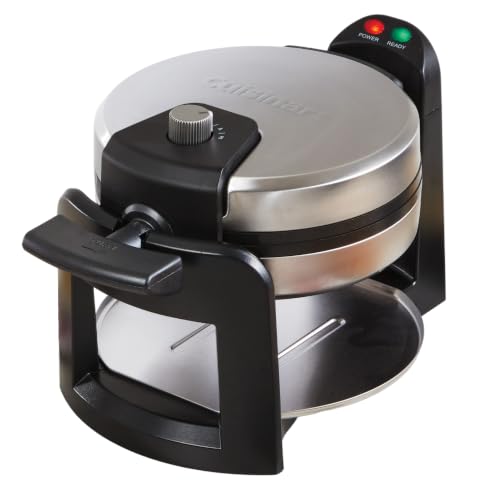
2. Cuisinart Non-Stick Flip Belgian Waffle Maker WAF-F30NAS
A round flip maker with a 180 degree rotary handle, a 1 inch Belgian plate, five browning settings, ceramic nonstick plates and ready indicators with an audio alert. A removable stainless drip tray (dishwasher safe per the listing) and a batter measuring cup are included. It is listed at 1000 watts and 4.3 pounds with a 3-year warranty.
Suits: a flip maker with a drip tray. Strengths: a 3-year warranty and five settings. Weaknesses: bakes one waffle at a time. Skip it if you need several waffles at once.
View Cuisinart Non-Stick Flip Belgian Waffle Maker, WAF-F30NAS on Amazon

Best for a flip iron with a timer dial
3. Chefman Rotating Belgian Waffle Maker
A 180 degree rotating iron listed at 1080 watts with extra-thick nonstick plates, an adjustable browning timer dial, a locking lid and a removable drip tray. It can be stored vertically. Listed dimensions are 10 by 15.6 by 7 inches and 4 pounds, with a 1-year warranty.
Suits: a flip iron with a timer dial. Strengths: a locking lid and vertical storage. Weaknesses: a 1-year warranty. Skip it if you want a longer warranty.

Best for a larger round waffle
4. Oster Nonstick Belgian Waffle Maker
A hinged stainless-look iron that makes 8 inch waffles with extra-deep pockets. The maker describes the ceramic nonstick finish as free of PFAS, lead and cadmium, and the listing mentions a ready light, adjustable temperature, cool-touch handles that fold for storage and a cord wrap. It measures 5.1 by 8.4 by 10.6 inches. Wattage is not listed.
Suits: a larger round waffle. Strengths: deep pockets and folding handles. Weaknesses: no wattage listed. Skip it if you want a flip design.
View Oster Nonstick Belgian Waffle Maker, Nonstick Ceramic Waffle Iron on Amazon

Best for thick waffles and tight storage
5. bella Fits-Anywhere Flip-n-Store Belgian Waffle Maker
A lightweight flip maker (3.3 pounds, 1000 watts) that bakes 7 inch waffles about 1.5 inches thick and stands upright to store. The maker states that its ceramic coating is made without PFAS, PFOA, PTFE, lead or cadmium. The listing shows 230 volts, which conflicts with its US listing, so check the voltage with the seller before buying.
Suits: thick waffles and tight storage. Strengths: light weight and upright storage. Weaknesses: a conflicting voltage listing. Skip it if you want a drip tray.

View bella Fits-Anywhere™ Flip-n-Store Non-Toxic, Belgian Waffle Maker, Oatmilk on Amazon

Best for quarter-cut waffles
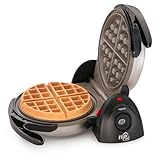
6. Presto 03510 Ceramic FlipSide Belgian Waffle Maker
A flip maker listed at 1100 watts, the highest here, with a ceramic nonstick grid, 7 inch waffles in four easy-to-cut sections, cool-touch handles and a base that rotates 180 degrees and locks upright for storage. It weighs 4.9 pounds and carries a 1-year warranty. Listed dimensions are 11.25 by 11.75 by 4 inches.
Suits: quarter-cut waffles. Strengths: the highest wattage and a ceramic grid. Weaknesses: the listed height looks off for an upright unit. Skip it if you want a drip tray.
View Presto 03510 Ceramic FlipSide Belgian Waffle Maker on Amazon
Care and Setup
- Let the iron cool, then wipe the plates with a damp cloth.
- Do not use metal tools on nonstick plates.
- Empty and wash a drip tray after each use if one is included.
- Pour batter to the amount the manual suggests to limit overflow.
Mistakes to Avoid
- Overfilling the plates.
- Opening the lid early before the done signal.
- Soaking an electric base in water.
- Ignoring the listed waffle size when you plan servings.
Batter Volume and Plate Depth
The most common waffle maker problem is not the machine but the amount of batter. Deep Belgian plates hold more than shallow ones, and overfilling pushes batter out of the sides, where it burns onto the housing and is hard to clean. Underfilling gives you waffles with missing corners. Check the manual for a recommended amount, and use it as a starting point until you learn how your batter behaves.
Plate depth is the other half of the story. A thicker waffle has a soft interior and deep pockets, while a thinner one browns faster and turns crisper. If you like loaded toppings such as fruit and syrup, deeper pockets help hold them. If you prefer a crisp classic waffle, a thinner plate or a lower batter level may suit you better. The product listing normally gives plate size and thickness, so compare those rather than relying on the word Belgian alone.
Batter thickness changes the result too. Thin batters spread easily but can leak, while thick batters may need a nudge with a spatula in flat irons. Flip and vertical designs are meant to even out the spread through gravity, but they do not remove the need for sensible portions.
A few habits help in any design:
- Pour in the center and let batter spread before closing.
- Pause a moment before opening so the waffle can set.
- Use the maker’s recommended oil or spray, if any, for the first batch.
These details are general, so follow your own manual where it differs.
Browning Controls and Doneness Cues
Browning control sounds simple, but makers implement it differently. Some use a dial with numbered shades, some offer a timer, and some rely on indicator lights. A dial is easy to adjust per batch, while a timer gives repeatable results once you have found your setting. Indicator lights tell you the iron is ready or that cooking has finished, but they are not an exact measure of how crisp the waffle will be.
Because every batter differs, treat the first waffle as a test. Sugar, fat and moisture all change how fast a waffle browns. A sweeter batter darkens sooner, while a drier one may need extra time. If your recipe is high in sugar, lower the shade setting and watch more closely, or follow any special instruction the maker gives for that kind of batter.
Steam is a useful cue. Many cooks watch the steam escaping from the edges: as it slows, the waffle is usually close to done. It is not a guarantee, so lift the lid gently to check rather than forcing it open early, which can tear the waffle in half.
For serving a group, keep finished waffles in a single layer on a rack in a warm oven if you want them to stay crisp. Stacking them on a plate traps steam and softens them. Choose a shade setting you can repeat, note it, and adjust in small steps rather than large jumps.
Non-Stick Coatings and Plate Care
Waffle plates usually carry a non-stick surface, though the type differs between models and the details should come from the product listing. Whatever the coating, the care rules are similar. Avoid metal utensils, which can scratch, and use wood, silicone or heat-safe plastic to lift out waffles. Do not spray aerosol cooking sprays heavily, since residue can build up and make surfaces sticky over time.
Let the iron cool fully before cleaning, then wipe plates with a damp cloth or soft sponge. Most makers say not to immerse the appliance in water because it contains heating elements and electrical parts. Stuck-on batter in the grooves can be loosened with a soft brush or a wooden skewer, never a sharp metal tool. Some plates are removable and dishwasher safe, while many are not, so check the manual.
Drip trays, where included, catch overflow and are generally easier to wash than the base of the machine. Empty and clean them after each use to avoid stale smells. Wrap or store the cord according to the maker’s design, and avoid pulling on it.
If waffles begin to stick even with sensible oiling, the coating may be wearing or covered in baked-on residue. A careful clean is the first thing to try. If the surface is visibly flaking or scratched through, it is worth considering replacement and checking whether the maker offers warranty support.
Counter Space, Storage and Daily Use
Waffle makers are bulky when stored, so consider where yours will live. Models that stand upright or lock closed on one side can slip into a cabinet or sit on a shelf more easily. Flat hinged irons take up more counter area in use but may be simpler to store flat in a drawer or on a shelf. Measure your storage space against the dimensions on the listing.
Think about the footprint during use as well. Flip designs rotate, so they need clearance on the sides and above, and vertical designs need height under cabinets. Keep the machine away from the edge of the counter, and keep the cord out of reach of children. The exterior can become hot, so check what the maker says about handles and touching surfaces.
Capacity and frequency should shape your choice. If you cook one or two waffles on weekends, a simple machine with one or two settings is plenty. If you serve a family every morning, speed, easy cleanup and consistent browning will matter more. A larger plate makes bigger waffles, but a single large waffle does not always mean faster service for a crowd than a pair of smaller ones.
Finally, think about power. Check the wattage on the listing and consider your circuit: plugging a high-wattage appliance into a shared outlet alongside a kettle or toaster can trip a breaker. Plug the maker directly into a wall outlet, not an extension cord, unless the manual allows it.
Flip Models, Vertical Models and Classic Fixed Irons
Waffle makers differ in more than looks. A flip-style Belgian waffle maker rotates after you close the lid so batter spreads evenly across both plates, producing deep pockets and a consistent shape. Vertical models stand upright and fill with batter from the top, which can save counter space and reduce spills. Classic fixed irons stay flat and rely on you to pour carefully. Each design makes slightly different waffles, from tall and fluffy to thin and crisp. Think about the kind of waffle you like, and how much storage space you have. Check the listing for plate depth and the number of waffles per batch, as that determines how long breakfast takes when feeding a group.
- Flip makers: Even batter spread and tall, deep-pocket waffles.
- Vertical makers: Store upright and often have a drip-resistant design.
- Fixed flat irons: Simple and often compact, but need careful pouring.
- Shapes: Round, square or novelty shapes change the look, not the basics.
- Plate coating: Nonstick surfaces help release the waffle, with care instructions to follow.
- Browning control: Dials or digital settings help you reach your preferred color.
Batter, Fill Amount and Getting Even Browning
A waffle maker only performs as well as the batter you put in it. Overfilling causes batter to ooze out of the sides, while underfilling leaves gaps. The manual usually gives a recommended amount, which can be measured with a scoop or a cup. Let the batter rest for a few minutes if the recipe suggests it. Preheat until the indicator light signals readiness, brush or spray the plates lightly if the maker recommends it, and avoid opening the lid early. Steam escaping is a good sign that the waffle is still cooking, and when it slows, the waffle is nearly done.
| Problem | Common cause | Simple fix |
|---|---|---|
| Sticking | Not enough fat or a worn coating | Follow the maker on oiling, and replace worn plates if needed |
| Pale waffles | Heat setting too low or lid opened early | Raise the browning level and wait |
| Overflowing batter | Too much batter | Reduce the fill amount |
| Soggy texture | Waffle stacked while hot | Rest on a rack instead |
| Uneven browning | Batter not spread evenly | Pour in the center and let it spread |
Keeping Waffles Crisp for a Crowd
When feeding a group, hold finished waffles on a wire rack set over a baking sheet in a low oven, if your oven manual and recipe allow it. Stacking traps steam and makes them soft. Cook in batches and serve as they come out, or freeze extras in a single layer and reheat in a toaster or oven.
- Preheat the waffle maker and oven, if holding waffles warm.
- Pour the right amount of batter.
- Close the lid and wait for the signal.
- Lift the waffle with a plastic or wooden tool.
- Rest it on a rack, not a plate.
Cleaning the Plates Without Scratching Them
Unplug, let the iron cool slightly, then wipe with a damp cloth. Use a soft brush on grooves, and avoid metal tools.
Batter Ideas, Toppings and Make-Ahead Options
Once you own a waffle maker, you may find yourself using it for more than breakfast. A basic batter of flour, eggs, milk, a raising agent and a little fat can be adjusted for sweet or savory results. Add cinnamon or vanilla for a sweeter waffle, or cheese and herbs for a savory one. Buttermilk or yogurt gives a tangier taste and a tender crumb, and separating eggs and folding in whipped whites makes a lighter texture. Mix wet and dry ingredients just until combined, because overmixing can make waffles tough. Read the recipe and the maker’s notes for the amount of batter your plates need.
- Classic toppings: Fruit, yogurt, nuts, syrup and whipped cream.
- Savory options: Fried eggs, cheese, vegetables or roasted meats on top.
- Freezer batches: Cool completely, freeze in a single layer and reheat in a toaster or oven.
- Dietary swaps: Many recipes work with alternative flours or milks, so adjust to your needs.
- Hash brown waffles: Some makers allow potato or other mixtures; check the manual first.
- Batter prep: Mix the dry ingredients the night before.
Waffle Maker FAQ
Flip or vertical?
Both aim to spread batter evenly. Flip models rotate the iron, vertical models stand upright and take less counter space.
Do all of them have a drip tray?
No. The Cuisinart and Chefman list one. The others do not in the text we read.
Why does my batter leak out the sides?
The usual cause is pouring too much batter or a batter thin enough to run. Reduce the amount and let the batter spread before closing. Always check your manual for the recommended quantity.
Do I need to grease a non-stick waffle maker?
Many makers say the plates need little or no oil, but some suggest a light coating for the first use or for sticky batters. Follow the instructions that came with your model.
How do I keep waffles crisp?
Place them on a wire rack instead of a plate so steam can escape. A warm oven can hold them for a short while if you are cooking in batches.
Can I use pancake mix in a waffle maker?
It can work, but results vary because waffle batters usually have more fat and sugar for crispness. Try a small test and adjust the shade setting.
Is it safe to wash the plates in water?
Only if the maker says the plates are removable and washable. Never immerse the main body, as it contains electrical parts. Wipe it with a damp cloth once cool.
Why is my waffle pale in the middle?
Uneven batter spread, an under-heated iron or opening the lid too soon can all cause this. Wait for the ready signal before pouring and keep the lid closed until steaming slows.
How long should a waffle maker last?
It depends on the model and how it is used. Gentle cleaning and avoiding scratches helps the coating last, and a warranty, where offered, is worth reading in the listing.
Batter Basics That Matter More Than the Machine
Most waffle disappointment is batter disappointment. A waffle batter needs leavening that is still lively, a fat for crispness and flavour, and a rest that lets the flour hydrate. Mix until the ingredients just come together; a few small lumps are fine, while heavy beating develops a tougher crumb and can make waffles chewy rather than crisp. If your mix uses beaten egg whites folded in, fold gently at the end and cook soon after, because that air is the lift. Cold batter straight from the fridge cooks unevenly, so let it stand while the iron heats.
Thickness is the quiet variable. A batter that pours like thick cream fills the grid and rises into the pockets; a thin batter runs, leaks and makes lace-edged waffles that tear. If a first waffle comes out pale and floppy, the batter may be thin or the iron may not have recovered its heat. If it comes out dark outside and doughy inside, the batter may be too thick or the setting too high. Change one thing at a time and cook a small test waffle, since every iron in this list heats and signals a little differently.
Sweet and savoury batters behave differently, too. Sugar browns fast, which is why the Ninja pick includes a specialty setting for high-sugar batters like brownie and cake mixes. Cheese and herbs add moisture and can stick if the plates are not ready. For a first run with any new recipe, cook one waffle, taste it, and adjust the browning control before cooking for a table of expectant people. Waffle making rewards a calm first waffle more than almost any other breakfast cooking.
Heat, Timing and the Meaning of the Ready Light
A waffle iron cooks by contact, so preheating is not a suggestion. The ready light or alert tells you the plates have reached the set temperature, but the first waffle still acts as a heat test, because the whole body of the iron warms as you cook. Many cooks find the second and third waffles brown more evenly than the first. If your iron has a browning dial or shade settings, like the five settings on the Ninja and Cuisinart picks, treat the middle as a starting point and move one step at a time; the same setting gives different results with different batters.
Steam is your most honest timer. While a waffle cooks, steam escapes at the edges; as the waffle dries and sets, the steam eases. Opening the lid at full steam tears a soft waffle and coats the plates with batter. Wait for the maker’s done signal, and if you must peek, open slowly and close at once if the waffle looks pale and wet. A cooked waffle should release cleanly and feel light and crisp rather than heavy. If it sticks, the plates may need a light brushing of oil, the batter may be low in fat, or the waffle may simply need another half minute.
Between batches, close the lid so the iron holds its heat, and give it a moment to recover after each waffle. Cooking for a crowd is a rhythm: pour, close, wait, lift, close again. Keep finished waffles on a rack in a warm oven rather than stacked on a plate, because stacking traps steam and undoes the crispness you just made. A rack, a low oven and a steady rhythm turn a single-waffle iron into a breakfast system.
Reading the Six Picks by Household
The Ninja BW1001 is the counter-space answer: a vertical design with a small footprint, shade settings, a done alert and a pour cup that helps you fill without flooding. It suits small kitchens and cooks who like a guided process, and its specialty setting invites experiments beyond breakfast. Its weight is the trade-off, so plan a permanent home for it rather than lifting it in and out of a high cupboard. If your kitchen has more height than counter depth, this is the shape that fits your life.
The flip pair, the Cuisinart WAF-F30NAS and the Chefman rotating model, suit cooks who like the ritual of the turn. Flipping spreads batter across the plates and is the classic route to an even Belgian waffle. The Cuisinart adds a removable drip tray and a longer warranty, which families will value. The Chefman adds a timer dial, a locking lid and vertical storage. The Presto FlipSide joins them with the highest listed wattage here and a grid that divides the waffle into four sections, which children and portion-minded cooks appreciate.
The Oster and the bella cover the simpler end with different virtues. The Oster is a hinged iron with deep pockets, folding handles and a cord wrap, suiting cooks who want a larger round waffle without a flipping mechanism. The bella is the light, upright-storing option for tight cupboards and occasional use, though its listing shows a voltage figure that conflicts with its market, so confirm with the seller. Across all six, the honest dividing lines are footprint, flip or fixed, and how much guidance the controls give. Pick by kitchen and habit, not by wattage alone.
Breakfast Workflow: Cooking for More Than Two
A waffle maker cooks one or two waffles at a time, so serving a group is a logistics exercise. Set the table and the toppings out first. Warm the oven low and put a rack over a tray inside it. Make the full batch of batter before the first waffle, keep a ladle or the maker’s cup dedicated to pouring, and start cooking before everyone sits down. The cook eats last or eats the test waffle; every experienced waffle maker knows this rule and plans a quiet moment with the final waffle.
Toppings change the cooking plan. If berries, compote or whipped cream are coming, plainer waffles are fine. If waffles will be eaten with just butter and syrup, a slightly richer batter carries the plate. Fried chicken and waffles need a sturdier, less sweet waffle and a timing plan that finishes both together. For children, smaller or sectioned waffles, like those from the Presto grid, reduce waste and arguments. Think of the iron as one station in a breakfast line, and the morning stops feeling like a performance.
Leftovers are a feature, not a failure. Cool spare waffles on a rack, freeze them in a single layer, then bag them. They reheat in a toaster or a hot oven straight from frozen and come back crisper than any microwave attempt. Many households deliberately double the batch on a weekend and buy weekday breakfasts with the surplus. If that is your plan, favour an iron whose plates you find easy to clean, because you will be cooking often and cleaning often.
Savoury Waffles and Other Jobs for the Iron
Once the breakfast routine is settled, the iron earns extra keep. Cheese and herb waffles make a base for eggs or a side for soup. Cornmeal waffles suit chilli. Mashed potato waffles turn leftovers into something crisp that people request. Shredded vegetables bound with a little batter cook into tidy cakes. Each of these asks the same discipline: do not overfill, let the iron signal, and clean the plates promptly, because cheese and sugars bake on harder than plain batter.
Sweet experiments need a watchful eye. Brownie and cake batters, which the Ninja pick explicitly caters for, brown quickly and can go from glossy to scorched while you answer the door. Cook a test piece, lower the setting, and stay nearby. Cookie dough and cinnamon roll pieces are popular tricks, but they vary wildly by brand and sugar content, so treat the first attempt as research. The iron is forgiving of experiments as long as you respect heat and clean-up.
Keep a short notebook if you cook often: batter, setting, time by the clock on the wall, result. Three lines per attempt turn guesswork into a house recipe within a few weekends. Note which setting suited your standard batter on your specific iron, because dials are not standardised across brands. That little record is worth more than any generic chart, and it is how a good waffle stops being an accident.
More Waffle Maker Questions, Answered
Why do my waffles stick even though the plates are non-stick?
Common causes are opening too early, a batter low in fat, plates that were not fully preheated, or a coating worn by metal tools and harsh cleaning. Let the iron signal readiness, wait for the done cue, and try a light brush of oil. If sticking persists on an older iron, the coating may be at the end of its life.
Can I use cooking spray on the plates?
Follow the maker’s guidance. Some sprays leave a residue that builds up on non-stick surfaces and becomes sticky itself. A brush or a folded paper towel with a little neutral oil gives you control without the build-up. Apply lightly; puddled oil fries the surface of the waffle unevenly.
How full should I fill the iron?
Use the cup or amount the manual suggests for your model, poured into the centre and spread by closing the lid or flipping. Underfilling makes thin, patchy waffles; overfilling leaks batter that burns on the housing. After two waffles you will know your iron’s appetite by sight.
Is a first-use smell normal?
A new iron can give off a brief manufacturing smell on its first heating. Run it empty as the manual directs, in a ventilated kitchen, before the first batter. If a strong smell persists after that first cycle, stop and contact the seller rather than cooking through it.
Can I cook hash browns or eggs in a waffle maker?
Many cooks do press seasoned shredded potatoes in the iron with good results. Eggs are trickier and can leak and stick. If you experiment, keep portions small, expect extra cleaning, and check that the maker’s instructions do not forbid it. Savoury residues should be cleaned promptly so the next sweet waffle tastes as it should.
Why is one side of my waffle paler than the other?
On a fixed hinged iron, the top plate may run cooler or the batter may not reach it. Flipping models exist partly to solve this. For a hinged iron, ensure a full preheat, use enough batter to contact both plates, and avoid opening early. A small difference is normal; a raw top means heat or batter needs adjusting.
How should I store the iron?
Cool, clean and dry, with the cord wrapped as the maker allows and nothing heavy stacked on top. Vertical models and flip models that lock upright save real space. If the iron will sit unused for months, a light wipe of the plates and storage in a dry cupboard keep it ready.
When is it time to replace a waffle maker?
When the coating is scratched through or flaking, when heating becomes patchy despite correct preheating, when latches or hinges fail, or when the cord or housing is damaged. Stop using any appliance with a damaged cord. A sound iron should brown evenly and release cleanly for years.
Final Practical Notes
Choose the iron for the breakfast you actually eat. A household that makes waffles twice a year needs easy storage and simple cleaning more than it needs five shade settings. A household with a Sunday waffle tradition will use every control it is given. Both are right, and the list above has a pick for each, which is why the best waffle maker is the one still on your counter, clean and ready, six months from now.
One last habit: clean the iron while it is still slightly warm, not hot, with a damp cloth, and pick baked-on batter out of the grid corners with a soft brush or a wooden pick. Two minutes then saves twenty minutes later, and keeps the non-stick surface doing the job you bought it for.
Batters for Different Households: Whole Grain, Gluten-Free and More
Different batters ask slightly different things of the same iron. Whole grain batters are thirstier and produce a heartier, less lofty waffle; let them rest a little longer so the flour hydrates, and expect to nudge the browning control up a step, since a denser waffle needs the time. They also release more willingly when the plates are properly hot, because their structure sets firmly. If a whole grain waffle tears, the answer is usually patience rather than more oil: give it the full cooking time and let the steam ease before opening.
Gluten-free batters vary widely by blend, and the first waffle is always research. They can be more fragile and more prone to sticking, so a thorough preheat, a light brushing of oil even on non-stick plates, and a complete cook before opening all matter more than usual. Cook one, judge its structure, and adjust the batter’s thickness before cooking the rest. Vegan batters, made without eggs, rely on their leavening and any binding ingredients in the recipe; they brown a little differently and benefit from a setting one step lighter until you know the recipe’s habits.
For children and cautious eaters, plain batters flavoured at the table beat flavoured batters that commit the whole batch. Keep the waffle neutral, and let toppings carry the variety: fruit, yoghurt, nut butters where the household uses them, or simply butter and syrup. The iron does not care; the cook’s life gets easier, because one batch serves everyone. Whatever the batter, write down the setting that worked on your iron, since blends differ and memory flatters us all.
The Iron’s Place in a Small or Busy Kitchen
Storage shape is a real feature, and this list knows it: the Ninja stands vertically by design, the Chefman and the Presto store upright, and the bella is built around standing in a tight space. Measure the cupboard or the counter corner the iron will actually occupy, including the cord, before choosing. An iron that must be fetched from a high shelf with two hands gets used on birthdays. An iron that lives within one-handed reach of the counter gets used on Tuesdays, which is where its value is.
Busy kitchens should also think about cleaning time as part of the footprint. A drip tray that catches overflow, like those on the Cuisinart and Chefman picks, saves the counter and the iron’s exterior. Plates that wipe clean in a minute keep the habit sustainable. If your household cooks waffles while also making eggs, bacon and coffee, choose the iron whose signals you can hear and see from across the room, such as a done alert, so the waffle does not depend on your standing over it.
Safety placement completes the picture. Keep the iron where its cord cannot cross a walkway or dangle for a child to pull, on a surface that tolerates heat, away from the sink’s splash zone. Let it cool in place before storing, and never wrap a cord tightly around a warm iron. These are dull instructions that prevent the only bad stories waffle makers ever feature in, and they take less time to follow than this paragraph took to read.
Further Waffle Maker Questions
Can I make the batter the night before?
Many batters keep overnight in the fridge, though those relying on beaten egg whites or fast-acting leavening lose lift. A batter mixed without its most delicate element, finished in the morning, is a good compromise. Bring it toward room temperature while the iron heats, stir gently, and cook a test waffle first.
Why are my waffles tough rather than crisp?
Overmixing is the usual cause, followed by a batter that is too lean or an iron that is not hot enough, which steams the waffle instead of crisping it. Mix until just combined, preheat fully, and check that finished waffles cool on a rack rather than steaming on a plate.
How do I clean burnt sugar from the plates?
Let the iron cool until warm, then lay a damp cloth over the closed plates for a few minutes to soften the residue, and lift it away with a soft brush or cloth. Never use metal or abrasive pads on non-stick surfaces. Sweet batters repay prompt cleaning more than any other kind.
Is it safe to leave a waffle maker unattended while it cooks?
Stay in the kitchen while any cooking appliance is hot. A waffle takes only a few minutes, and the done signal needs you nearby anyway. Keep the area around the iron clear, and switch it off at the socket when the last waffle is done and the iron is cooling.
Closing Notes
Rotate your recipes with the seasons and the iron stays interesting: berries in summer, spiced batters in winter, savoury waffles whenever soup is on the menu. The appliance does not change; the habit does. That is the difference between a gadget and a kitchen fixture, and it is decided by the cook, not the purchase.
If you are torn between a flip and a fixed iron, decide by your storage and your patience. Both make good waffles. The one you will preheat without sighing is the right one.
Troubleshooting the Five Classic Waffle Problems
Problem one is the pale waffle: the iron was not fully hot, the batter was thin or cold, or the setting sits too low for that recipe. Solve it in that order, changing one variable and cooking one waffle. Problem two is the dark outside with a raw middle, which usually means the setting is too high for a thick or sweet batter; lower the setting and give the waffle its full time. Problem three is leakage, almost always overfilling or a batter made thinner by melted butter added too hot; measure with the maker’s cup until your eye learns the amount.
Problem four is sticking, covered earlier but worth repeating in short form: preheat fully, do not open early, brush lightly with oil, and respect an ageing coating. Problem five is the uneven waffle, thick at the hinge and thin at the front or the reverse, which points to how the batter was poured and whether the iron was flipped or closed promptly. Pour into the centre, close or flip at once, and let the lid’s weight and the batter’s own spread do the distribution.
Keep the solutions in order and waffle problems stop feeling mysterious. Heat, batter, amount, timing: nearly every disappointing waffle fails on one of those four, and each has a calm fix. The irons in this list differ in shape and signals, but they all obey the same four rules, which is why a cook who learns them on one iron can walk up to any other and make breakfast.
If you are still deciding, let the shape of your mornings choose. A household that eats together at a table, unhurried, will enjoy the theatre of a flip iron and the even waffles it makes. A household that eats in shifts, one foot out of the door, will value the vertical Ninja’s small footprint and clear signals, or the hinged Oster’s simple routine. A household that cooks waffles twice a year should choose storage and easy cleaning over every other virtue. There is no universal winner in this list, and that is honest: waffle makers are simple machines, and the best one is the one whose habits match yours.
Store this guide’s simplest lesson where you will see it: heat first, batter second, patience third. A waffle maker rewards those three in that order, every single time, whatever its shape or price of entry. Tape the setting that suits your house batter inside the cupboard door and breakfast becomes a routine anyone in the house can run.
The Short Version
For a vertical design, the Ninja. For a flip maker with a 3-year warranty, the Cuisinart. For a timer dial, the Chefman. For 8 inch waffles, the Oster. For thick waffles and upright storage, the bella. For quarter-cut waffles, the Presto.