Disclosure: topratedkitchenware.com is reader-supported. When you buy through links on our site, we may earn an affiliate commission from Amazon and other retailers, at no extra cost to you.
Where to buy
This shortlist covers the best water saving kitchen faucets as audited against the verified listings. This guide holds a strict line: only one pick is linked, because only one listing – the Pfister Pfirst – actually states a water-efficient model. The other five are good faucets covered prose-only, with the reason stated plainly: their listings make no flow-rate or efficiency claim, and a water-saving guide does not get to invent one for them.
- Pfister Pfirst Series 1-Handle Pull-Out Kitchen Faucet, Stainless Steel (G13310SS) – Best Verified Water-Saving Pick
- hansgrohe Talis S Single-Handle Kitchen Faucet with Pull-Out Sprayer, Chrome (06462000) – Prose-Only: No Stated Saving Claim (prose-only in this guide; see its review below for why)
- FORIOUS Kitchen Faucet with Pull-Out Sprayer, Matte Black – Prose-Only: No Stated Saving Claim (prose-only in this guide; see its review below for why)
- VFAUOSIT Kitchen Faucet with Pull-Down Sprayer, Modern Bar Sink Faucet – Prose-Only: Cold-Start Only (prose-only in this guide; see its review below for why)
- WEWE High-Arc Pull-Down Kitchen Faucet, Brushed Nickel – Prose-Only: No Stated Saving Claim (prose-only in this guide; see its review below for why)
- Moen Essie Pulldown Kitchen Faucet, Spot Resist Stainless (87014SRS) – Prose-Only: No Stated Saving Claim (prose-only in this guide; see its review below for why)
Read the full guide below for the research method, the detailed reviews, the comparison table, the buying guide and the care instructions.
The search for best water saving kitchen faucets sounds like a simple shopping trip and is actually an evidence test. Plenty of faucets look efficient; far fewer say so where it counts, in verifiable terms – a stated water-efficient model, a printed flow rate, a recognised efficiency certification. This guide was built by reading the six verified listings for exactly those claims, and reporting what it found without decoration.
Here is the finding up front. One listing passes: the Pfister Pfirst Series G13310SS, whose title states a water-efficient model outright. The other five – a hansgrohe, a FORIOUS, a VFAUOSIT, a WEWE and a Moen – are respectable faucets whose listings state formats, finishes, modes and materials, but no flow rate, no efficiency designation, nothing a water-saving claim could honestly rest on. They are reviewed prose-only below, so you can see the pool as it is, and the buying guide teaches the checks that find genuine savers anywhere.
That discipline is the guide’s real content. Water saving is a numbers claim, and numbers claims need sources; a guide that links first and verifies later teaches the opposite habit. Readers who want the general faucet picture first can start from Best Water Faucets For Kitchen and return here for the efficiency audit.
Key Takeaways
- Only 1 of the 6 verified listings states a water-efficiency claim: the Pfister Pfirst’s ‘water-efficient model’. It is the guide’s only linked pick.
- A flow-rate figure or a recognised efficiency mark is the evidence to demand; absence of the claim in a listing is itself information.
- Cold-start safety (VFAUOSIT) trims hot-water and energy waste on short uses, but it is not a flow rating and is not counted as one here.
- Spray modes help in practice – targeted water rinses faster – but a mode count is not a water-saving specification either.
- Five picks are prose-only for one stated reason each; their reviews judge them fairly as faucets while withholding the water-saving label.
- Your own habits multiply or erase any faucet’s rating: the buying guide covers the behaviours that decide real consumption.
In this guide
Quick Picks
| Pick | Badge | Why it made the list |
|---|---|---|
| Pfister Pfirst Series 1-Handle Pull-Out Kitchen Faucet, Stainless Steel (G13310SS) | Best Verified Water-Saving Pick | Pfister Pfirst pull-out – listing states a water-efficient model |
| hansgrohe Talis S Single-Handle Kitchen Faucet with Pull-Out Sprayer, Chrome (06462000) | Prose-Only: No Stated Saving Claim | hansgrohe Talis S – no efficiency claim stated in the listing |
| FORIOUS Kitchen Faucet with Pull-Out Sprayer, Matte Black | Prose-Only: No Stated Saving Claim | FORIOUS matte black pull-out – no efficiency claim stated |
| VFAUOSIT Kitchen Faucet with Pull-Down Sprayer, Modern Bar Sink Faucet | Prose-Only: Cold-Start Only | VFAUOSIT – cold-start safety stated; no flow or efficiency rating stated |
| WEWE High-Arc Pull-Down Kitchen Faucet, Brushed Nickel | Prose-Only: No Stated Saving Claim | WEWE high-arc – no efficiency claim stated in the listing |
| Moen Essie Pulldown Kitchen Faucet, Spot Resist Stainless (87014SRS) | Prose-Only: No Stated Saving Claim | Moen Essie – no efficiency claim stated in the listing |
How These Picks Were Chosen
The audit for this guide had one question per listing: does the verified title state a water-saving fact – an efficiency designation, a flow-rate figure, or a recognised efficiency certification? One listing answered yes: the Pfister, with ‘water-efficient model’ in its title. Five answered with silence on the subject, and silence was recorded as silence.
That produced an unusual shortlist – one linked pick and five prose-only reviews – and the guide keeps it unusual rather than laundering the five into savers with soft language. Each prose-only review states the missing claim explicitly, then judges the faucet on its ordinary merits, because a reader cross-shopping models deserves both halves of the truth. The link arithmetic follows the house rule: one linked pick carries four links plus one final-recommendation link, for five in total.
This is research-led guidance with no hands-on flow testing, and it does not pretend a listing audit is a laboratory measurement. What it can do reliably is separate stated evidence from assumption – the same discipline recommended for the wider market in Best Quality Kitchen Sink Faucets, applied here to the efficiency claim specifically.
The 6 Best water saving kitchen faucets Candidates, Reviewed in Detail
The linked review comes first in pool order’s spirit if not its letter: the Pfister is reviewed as the guide’s one verified saver, and the five prose-only reviews follow, each opening with the evidence gap before judging the faucet itself.
Badges in this guide double as audit labels – a prose-only badge states its reason – and spec boxes quote only verified listing data throughout.

Pfister Pfirst Series 1-Handle Pull-Out Kitchen Faucet, Stainless Steel (G13310SS)
Badge: Best Verified Water-Saving Pick
Strengths
- The only pick in its water-saving pool whose listing states a water-efficient model outright
- Pfister’s Pfirst Series is the brand’s long-running, parts-friendly mainstream line
- A pull-out sprayer adds rinsing reach without a tall arc
Trade-offs
- The listing title does not print the exact flow-rate figure – confirm the gallons-per-minute number on the live listing
- A single-handle pull-out is a conventional format with no multi-mode spray head stated
- Stainless finish over the series’ standard construction – read the full listing for body details
Mini spec box: 1-handle pull-out kitchen faucet; Stainless steel finish (per API title); Water-efficient model (per API title); Pfirst Series model G13310SS (per API title).
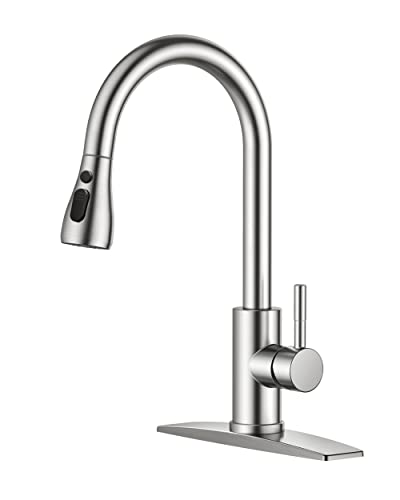
The Pfister G13310SS from the Pfirst Series is a one-handle pull-out kitchen faucet in a stainless steel finish, and its listing states the words this guide’s water-saving search turns on: water-efficient model. In a pool where no other title makes an efficiency claim at all, that single stated claim is what earns this faucet its link.
Pfister is one of the established plumbing brands, and the Pfirst Series is its accessible mainstream line, which matters for a water-saving purchase you may keep for a decade: cartridges and sprayer parts for a long-running series are the kind a hardware store recognises. The pull-out format keeps the profile conventional while still giving the sprayer reach that fixed spouts lack.
Day to day the efficiency shows up invisibly – ordinary washing, rinsing and filling at a moderated flow, with the sprayer pulled out when a stuck pan needs directed water rather than more water. The honest limitation is that the title does not print the exact flow figure, so a buyer comparing precise gallons-per-minute numbers should read it on the live listing before ordering.
Ownership note: a water-efficient faucet saves the most when its aerator and sprayer stay clean – a clogged, skewed spray makes people run the tap longer, quietly handing the savings back. A quarterly rinse of the aerator screen protects the efficiency you paid for.
The Pfister’s claim is modest and stated – a water-efficient model from a mainstream series – and modest stated claims are exactly what this category should reward. Confirm the exact flow figure on the live listing, then buy the evidence.
Best for: households that want a stated water-efficient model from an established brand, in a conventional pull-out format / Not suited for: buyers who need the exact flow-rate figure confirmed before purchase – check the live listing first
Check on Amazon for the current listing, configuration and latest price.
hansgrohe Talis S Single-Handle Kitchen Faucet with Pull-Out Sprayer, Chrome (06462000)
Badge: Prose-Only: No Stated Saving Claim
Strengths
- A single lever controls flow and temperature together – the classic one-hand routine at the sink
- Pull-out sprayer extends rinsing beyond the spout’s fixed arc
- Chrome is the easiest finish to match with existing sinks and appliances
Trade-offs
- Chrome shows water spots and fingerprints more readily than brushed finishes
- The listing title states no spray-mode count, so treat it as a straightforward sprayer rather than a multi-mode head
- A pull-out hose needs clear space under the sink to retract freely
Mini spec box: Single-handle kitchen faucet; Pull-out sprayer (per API title); Chrome finish; Model 06462000 (per API title).
The hansgrohe Talis S is the most established name in this pool: a single-handle kitchen faucet in chrome with a pull-out sprayer, sold under model number 06462000. The design is deliberately conventional – one lever, one spout, a sprayer that pulls out for rinsing – which is exactly what many buyers mean when they ask for a traditional faucet rather than a touchless or smart one.
hansgrohe’s presence matters for ownership rather than for novelty. A long-running model from a major plumbing brand means cartridges and hoses remain the kind of parts a plumber recognises, and the chrome finish pairs with the stainless and chrome hardware already in most kitchens. Nothing in the listing promises electronic features, and that absence is the point for this guide.
Day to day it is a one-handed faucet: lever up for water, across for temperature, sprayer out for the corners of the sink and back in when the job is done. The honest limitation is the finish – chrome rewards a quick wipe and shows every splash until it gets one.
Ownership note: keep the under-sink hose loop free of stored bottles and cleaning caddies. A pull-out sprayer that starts retracting lazily is almost always snagging on clutter, not failing – clear the loop before you blame the weight or the hose.
The hansgrohe is a fine conventional faucet wearing no efficiency evidence in its listing. If its full specification elsewhere states a flow figure, that is where a saver should verify it – this guide links only what its own pool states.
Best for: buyers who want a proven, conventional single-handle faucet with a pull-out sprayer from a major brand / Not suited for: buyers who want touchless operation, multiple spray modes or a brushed finish
This pick is covered prose-only in this guide, so it carries no Amazon link here; check the latest price on Amazon by searching the product name if you want to compare it directly.
FORIOUS Kitchen Faucet with Pull-Out Sprayer, Matte Black
Badge: Prose-Only: No Stated Saving Claim
Strengths
- Matte black is the finish that modern and farmhouse-style kitchens ask for most
- A deck plate in the box covers a 1-hole or 3-hole sink from the same package
- Pull-out sprayer suits bar and prep sinks as well as the main sink
Trade-offs
- Matte black finishes show pale water scale more visibly in hard-water homes
- Positioned as a bar sink faucet, so check its reach against a large main sink before ordering
- The title states no spray-mode count – expect a simpler sprayer head
Mini spec box: Single-handle pull-out bar sink faucet; Stainless steel (per API title); Matte black finish; Deck plate for 1 or 3 holes (per API title).
This FORIOUS model is a single-handle pull-out faucet in matte black, built in stainless steel and supplied with a deck plate for one-hole or three-hole sinks. Its listing positions it as a bar sink faucet, which tells you the design intent: a compact, modern faucet for a prep or secondary sink that also works at a smaller main sink.
The matte black finish is its clearest statement. Against white or light stone counters it gives the strong contrast current kitchens favour, and against a black sink it disappears into a single colour story. The trade is maintenance visibility – light mineral scale reads pale against black, so hard-water households should expect to wipe the spout more often.
In daily use the single lever keeps one hand free for the pan or the produce, and the pull-out head covers rinsing and sink-cleaning duty. The honest limitation is scale: measure spout reach over your sink bowls before assuming a bar-format faucet will centre over a wide double bowl.
Ownership note: clean matte black with a soft cloth and plain water or mild soap. Abrasive pads and harsh descalers can polish shiny patches into a matte finish, and those patches cannot be un-polished afterwards.
The FORIOUS makes no efficiency claim and is not given one here. Judge it as a matte black pull-out for bar and prep sinks, and look elsewhere in this guide for the verified saving option.
Best for: prep, bar and smaller main sinks where a matte black single-handle faucet is the design goal / Not suited for: very wide double-bowl sinks, or buyers who want multiple spray modes
This pick is covered prose-only in this guide, so it carries no Amazon link here; check the latest price on Amazon by searching the product name if you want to compare it directly.
VFAUOSIT Kitchen Faucet with Pull-Down Sprayer, Modern Bar Sink Faucet
Badge: Prose-Only: Cold-Start Only
Strengths
- Three spray modes cover a gentle stream, a rinse spray and a stronger sweep in one head
- A 23-inch retractable hose is a genuinely long reach for filling and rinsing beyond the sink
- Cold-start safety means the lever’s rest position delivers cold water first – a scald and energy safeguard
Trade-offs
- Positioned as a modern bar sink faucet, so its proportions suit prep sinks and smaller mains best
- More spray modes mean a mode switch to learn and keep clean
- The tool-free install claim still deserves a dry-fit check of your sink’s hole spacing first
Mini spec box: Pull-down sprayer; Lead-free; NSF 61/372 and cUPC (per API title); 3 spray modes (per API title); 23in retractable hose (per API title); Cold-start safety (per API title); Tool-free install positioning (per API title).
The VFAUOSIT is a modern bar sink faucet with a pull-down sprayer, three spray modes and a 23-inch retractable hose – the longest hose figure stated anywhere in this pool. Its listing also carries the certifications a careful buyer looks for: lead-free construction with NSF 61/372 and cUPC named outright, plus a cold-start safety feature.
Cold-start deserves a sentence of its own, because it is a real daily benefit disguised as a footnote. On a cold-start faucet the lever’s default position draws cold water only, so a quick rinse does not fire the water heater for nothing and small hands are less likely to meet a hot first blast. Combined with the three modes, this is the most feature-complete listing in the pool.
Day to day the long hose is what you notice: pots filled on the counter beside the sink, every corner of the basin reached without swinging the spout, and modes swapped with a thumb press. The honest limitation is format – it is a bar-format faucet, so confirm its height and reach against a deep, wide main sink.
Ownership note: a 23-inch hose needs a clear, generous loop under the sink to retract fully. Route it away from the disposal and stored items at install time, and the sprayer will dock crisply for years instead of drifting.
The VFAUOSIT is the near-miss: cold-start genuinely trims hot-water waste on short draws, and its certifications are named – but neither is a flow rating, so it stays prose-only with its real virtues described accurately.
Best for: prep and bar sinks, and smaller main sinks where hose reach, modes and certifications all matter / Not suited for: buyers who want a tall high-arc profile over a large farmhouse sink
This pick is covered prose-only in this guide, so it carries no Amazon link here; check the latest price on Amazon by searching the product name if you want to compare it directly.
WEWE High-Arc Pull-Down Kitchen Faucet, Brushed Nickel
Badge: Prose-Only: No Stated Saving Claim
Strengths
- A high arc clears tall stockpots and baking trays that a low spout cannot
- Silicone nozzles rub clean with a fingertip – the simplest answer to limescale clogging
- A stated 20-inch pull-down reach plus a full 360-degree swivel covers double-bowl sinks properly
Trade-offs
- A high arc splashes more in a shallow sink – deep bowls suit it best
- Brushed nickel reads warmer than chrome, so match it against your other metals deliberately
- Three modes and a long hose are moving parts that reward gentle handling
Mini spec box: High-arc pull-down design; Brushed nickel finish; 3-mode sprayer (per API title); Soft silicone nozzles, easy to rub clean (per API title); 360-degree swivel (per API title); 20-inch pull-down reach (per API title); SUS 304 stainless steel (per API title); 1- or 3-hole fit; ceramic cartridge (per API title).
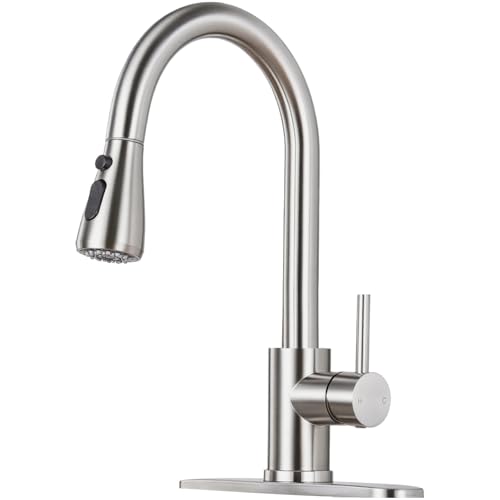
WEWE’s high-arc model is the specification-heavy pick of this pool: SUS 304 stainless steel, a three-mode sprayer, soft silicone nozzles you rub clean, a 360-degree swivel, a stated 20-inch pull-down reach and a ceramic cartridge, in brushed nickel for one-hole or three-hole sinks. Almost every line of that list answers a real ownership complaint.
The silicone nozzles are the quiet headline. Spray heads clog one pinhole at a time in hard-water homes until the spray skews sideways; a rub-clean silicone face lets you clear the scale with a thumb during the wash-up. Paired with the high arc, this is the pick for cooks whose sink sees stockpots, sheet pans and canning jars rather than only mugs and plates.
In daily use the arc height changes what fits under the tap, and the swivel lets the head travel bowl to bowl without moving the pot. The honest limitation is splash geometry: a high outlet over a shallow basin bounces water onto the counter, so deep-sink households get the best of this design.
Ownership note: make the nozzle rub a weekly habit – ten seconds with a thumb while the water runs keeps every jet straight. It is the cheapest maintenance in this entire guide and the one most often skipped until the spray pattern is already ruined.
The WEWE’s specification is the pool’s most detailed and still says nothing about flow. It is a reminder that a long feature list and an efficiency claim are different documents.
Best for: deep sinks, tall-pot cooking and hard-water homes that need rub-clean nozzles / Not suited for: shallow sinks prone to splashing, or buyers wanting a low-profile spout
This pick is covered prose-only in this guide, so it carries no Amazon link here; check the latest price on Amazon by searching the product name if you want to compare it directly.
Moen Essie Pulldown Kitchen Faucet, Spot Resist Stainless (87014SRS)
Badge: Prose-Only: No Stated Saving Claim
Strengths
- Moen is one of the most established faucet brands, with deep parts and support coverage
- Spot Resist Stainless is Moen’s finish positioning for resisting fingerprints and water spots
- A pulldown head covers rinsing and filling duties a fixed spout cannot
Trade-offs
- The listing title states no flow-rate, water-efficiency or WaterSense claim – it is prose-only in the water-saving guide for that reason
- The title states no spray-mode count or hose figure
- A brand-name mainstream model sits in a higher tier than the value listings in these pools
Mini spec box: Pulldown kitchen faucet; Spot Resist Stainless finish (per API title); Model 87014SRS (per API title).
The Moen Essie, model 87014SRS, is a pulldown kitchen faucet in Spot Resist Stainless – Moen’s finish designed to resist the fingerprints and water spots that stainless finishes collect. Moen’s brand weight is the other half of the story: a mainstream model from a top-tier faucet maker, with the support and parts ecosystem that position implies.
Where this pick appears in the water-saving guide it is covered prose-only, and the reason is evidence, not quality: its listing title makes no water-efficiency, flow-rate or WaterSense claim, so a water-saving guide cannot link it as a water-saving faucet. In the general water-faucets guide it links on its ordinary merits as a well-supported pulldown from a leading brand.
In daily use it is the low-drama option: a pulldown head for rinsing, a finish chosen to look clean between wipes, and a lever routine every household member already understands. The honest limitation is specification brevity in the title – buyers comparing spray modes or flow figures should read the full listing.
Ownership note: spot-resistant finishes still benefit from a soft-cloth wipe rather than abrasive pads, which can dull the very coating that resists the spots. Treat the finish gently and it keeps its one advantage for years.
The Moen Essie may well have efficiency data in its full documentation – many mainstream models do – but its listing here states none, and this guide’s rule is to link the evidence in hand, not the evidence a brand probably holds.
Best for: buyers who prioritise brand support and a spot-resistant finish in a pulldown faucet / Not suited for: water-saving shoppers who need a stated efficiency claim in the listing
This pick is covered prose-only in this guide, so it carries no Amazon link here; check the latest price on Amazon by searching the product name if you want to compare it directly.
Comparison Table
| Pick | Badge | Headline spec (from listing) | Standout trait |
|---|---|---|---|
| Pfister Pfirst Series 1-Handle Pull-Out Kitchen Faucet, Stainless Steel (G13310SS) | Best Verified Water-Saving Pick | 1-handle pull-out kitchen faucet | Pfister Pfirst pull-out – listing states a water-efficient model |
| hansgrohe Talis S Single-Handle Kitchen Faucet with Pull-Out Sprayer, Chrome (06462000) | Prose-Only: No Stated Saving Claim | Single-handle kitchen faucet | hansgrohe Talis S – no efficiency claim stated in the listing |
| FORIOUS Kitchen Faucet with Pull-Out Sprayer, Matte Black | Prose-Only: No Stated Saving Claim | Single-handle pull-out bar sink faucet | FORIOUS matte black pull-out – no efficiency claim stated |
| VFAUOSIT Kitchen Faucet with Pull-Down Sprayer, Modern Bar Sink Faucet | Prose-Only: Cold-Start Only | Pull-down sprayer | VFAUOSIT – cold-start safety stated; no flow or efficiency rating stated |
| WEWE High-Arc Pull-Down Kitchen Faucet, Brushed Nickel | Prose-Only: No Stated Saving Claim | High-arc pull-down design | WEWE high-arc – no efficiency claim stated in the listing |
| Moen Essie Pulldown Kitchen Faucet, Spot Resist Stainless (87014SRS) | Prose-Only: No Stated Saving Claim | Pulldown kitchen faucet | Moen Essie – no efficiency claim stated in the listing |
This table is an audit table: the standout-trait column records each listing’s efficiency evidence, or its absence, in plain words. One row carries a claim; five rows carry an honest blank.
How to Choose Best water saving kitchen faucets
Learn to read for the three forms real evidence takes. The strongest is a printed flow-rate figure in gallons per minute, because it can be compared across models directly. Next is a recognised efficiency designation or certification named in the listing. Weakest – and the form this guide’s one linked pick takes – is a stated water-efficient model claim from the manufacturer, which is genuine evidence but should still be followed to the exact figure on the full listing before you compare it against rivals.
Understand what the saving mechanism actually is. An efficient faucet saves water two ways: a moderated maximum flow, shaped by its aerator and cartridge, and spray patterns that finish rinsing tasks sooner. The first is measurable and belongs in a listing; the second is real but behavioural, which is why this guide refuses to convert ‘three spray modes’ into a saving claim – modes help a careful user save, and help a careless one waste at three different patterns.
Count cold-start honestly. A cold-start faucet, like the prose-only VFAUOSIT here, rests at cold and only draws hot water when the lever moves deliberately. Across thousands of short uses – a rinsed plate, washed hands – that avoids firing the water heater for water that never arrives warm anyway. It is an energy and hot-water saving, worth having, and it is still not a flow rating; this guide credits it in prose and declines to link on it, which is the correct weight for a marginal, unquantified benefit.
Audit your own plumbing before blaming or crediting a faucet. House pressure varies, stop valves get left half-closed, and a clogged aerator can strangle any faucet’s flow below its rating – or a worn one can pass more than it should. The cheapest water-saving act in most kitchens is maintaining the faucet already installed: clean aerator, sound cartridge, no drips. A slow drip is unmeasured waste leaving the house day and night, and no purchase fixes a household that ignores one.
Finally, shop the second listing, not the first impression. Where a title is silent on efficiency – five of six here – the full listing, the manufacturer’s specification sheet or the model’s documentation is where the figure, if any, lives. Readers who find a stated figure for a prose-only model have done exactly the verification this guide models; the recommendations in Best Recommended Kitchen Faucets reward the same habit across the wider market.
How to Save Water at the Kitchen Sink, Faucet First
Equipment is half the saving story; routine is the other half. The steps below combine the install checks that make an efficient faucet deliver its rating with the daily habits that multiply it.
None of them requires giving up a functional kitchen – they are about aiming water at work instead of at the drain.
- Fit and flush the aerator. After any install, flush the lines before fitting the aerator, then fit it snugly: the aerator shapes the stream and is central to how an efficient faucet delivers its rated flow.
- Fix drips the week they appear. A dripping faucet wastes water continuously and usually needs only a cartridge. Note the model, close the stops and swap the cartridge rather than living with the drip.
- Rinse with the sprayer, not the stream. Pull the sprayer to the item and rinse at close range; targeted water finishes stuck food faster than a distant fixed stream at higher total volume.
- Fill a basin for washing up. A basin of hot water for washing and a brief rinse beats running the tap through a whole sink of dishes, on any faucet, efficient or not.
- Use cold-start logic manually. On an ordinary lever faucet, start short tasks from the cold side and add hot only when the task truly needs it – the same discipline cold-start designs automate.
- Soak instead of blasting. A ten-minute soak loosens baked pans with a bowl of water; blasting them under a running tap spends far more for the same result.
- Check the aerator quarterly. Rinse its screen and straighten the spray pattern; a clogged aerator makes users run the tap longer, quietly returning the savings the faucet was bought for.
Troubleshooting
Problem: the sprayer retracts slowly or will not dock -> the hose is snagging on stored items or the weight has slid along the hose – clear the under-sink loop and reposition the weight on a straight section of hose.
Problem: spray jets skew sideways or pulse -> scale is blocking some nozzles – rub silicone nozzle faces clean with a thumb, and soak a fixed aerator or head in vinegar solution if the blockage persists.
Problem: a slow drip from the spout after shut-off -> the cartridge is passing a trickle – note your model number, shut off the stops and replace the cartridge, which is the standard wear part on single-handle faucets.
Why This Guide Links Only One Faucet
A reader could fairly ask whether a one-link guide is a guide at all. The answer is that the alternative – dressing five unrated faucets in saving language because they share a pool with one rated model – is how greenwashing works at retail scale. Each of those five listings had every opportunity to state a flow figure or an efficiency designation; their manufacturers chose to spend the title’s words on finishes, modes and materials instead. That choice is data, and this guide reports it.
The prose-only reviews are the constructive half of the policy. A household that loves the WEWE’s nozzles or the Moen’s finish can still buy either with open eyes: an excellent faucet, efficiency unverified by its listing. And a household for whom saving is the actual brief gets one clean, evidenced recommendation instead of six muddy ones. Both readers are better served than by a guide that blurs the line – the same editorial line drawn throughout Best Replacement Kitchen Faucets when an old faucet’s true condition decides repair versus replacement.
If the pool changes – if a future verified pool states flow figures for more models – a future version of this guide should link them gladly. The rule is not scarcity; the rule is evidence.
The Behaviour Half: Where Kitchen Water Actually Goes
Faucet ratings govern maximum flow, but households consume through habits. The biggest kitchen water decisions are rarely the faucet’s: thawing food under a running tap instead of in the fridge overnight, rinsing dishes individually before a dishwasher that is designed to receive them unrinsed, and running a half-empty dishwasher are each worth more water than the gap between two faucet ratings across a year.
That is not an argument against efficient faucets – the rating works every second the tap runs, silently, for a decade, with no willpower required. It is an argument for pairing the purchase with the two or three habits your household actually has. A family that hand-washes everything gains most from basin discipline; a dishwasher household gains most from loading it fully and skipping the pre-rinse.
Measured that way, the efficient faucet is best understood as the floor of a saving strategy rather than its ceiling: it guarantees the equipment side, and the household supplies the rest. Buy the evidenced model, keep its aerator clean, and let the routine do the compounding.
Reading a Flow Figure Like an Engineer
When you do find a flow figure – on the Pfister’s full listing, or any model’s specification – read it with its conditions attached. Flow is stated at a reference pressure, and a home with lower pressure will see less, proportionally, from every faucet. That is why chasing the lowest printed number has limits: below a comfortable working flow, users compensate by running the tap longer, and the saving evaporates into behaviour.
The practical target is a faucet whose stated figure sits in the efficient band while its spray still feels decisive – which is a property of aerator and spray-head design as much as of the raw number. Judge by the combination: a stated efficient model, a sprayer you will actually use at close range, and an aerator you commit to keeping clean. That trio, not any single digit, is what a water-saving purchase really consists of.
A simple home audit takes one bucket and one minute: time how long your current faucet takes to fill a known container, and you have your real-world flow baseline. Any replacement’s improvement can then be judged against your own kitchen rather than a catalogue’s conditions.
Faucet care is mostly water management. Wipe the finish after splashes in hard-water homes, because mineral scale is easy in its first hour and stubborn in its second week. Clean with a soft cloth and mild soap; abrasive pads and harsh chemicals attack finishes – especially matte and brushed ones – faster than years of ordinary use. Once a quarter, unscrew the aerator, rinse its screen and check the sprayer face; that ten-minute habit prevents the slow flow decline that owners often misread as a failing water supply. Under the sink, a dry fingertip around each connection twice a year catches weeps while they are still a tightening job rather than a cabinet repair.
Common Buying Mistakes
- Assuming a faucet saves water because its marketing photographs look lean and modern.
- Counting spray modes, certifications or cold-start as flow ratings – each is a different claim.
- Ignoring a slow drip for months while shopping carefully for an efficient replacement.
- Letting a clogged aerator strangle flow, then compensating by running the tap longer.
- Pre-rinsing every dish under a running tap before a dishwasher designed to handle them.
- Comparing flow figures without noting the pressure they were measured at.
Final Recommendation
The verified recommendation is the Pfister Pfirst Series G13310SS: the one pick whose listing states a water-efficient model, in a conventional one-handle pull-out format from an established brand’s mainstream series. Confirm its exact flow figure on the live listing, and it is the evidenced choice this keyword asks for.
The five prose-only faucets remain buyable for their own reasons – the WEWE for its specification depth, the VFAUOSIT for cold-start and certifications, the Moen for brand support – provided the buyer understands that water saving is not among the claims their listings make. If saving is a secondary wish rather than the brief, any of them can serve; if it is the brief, the Pfister is the answer in this pool.
Hold every future faucet listing to the standard this guide applied: a figure, a designation, or it did not happen. That single habit will save more water than any individual model choice.
Start your shortlist with Pfister Pfirst Series 1-Handle Pull-Out Kitchen Faucet, Stainless Steel (G13310SS) – compare their current listings, configurations and latest prices, then commit to the one that matches your space and your cooking.
Frequently Asked Questions
How much water can an efficient kitchen faucet actually save?
It depends on the two flow figures being compared and on how much the tap runs, which is why this guide avoids inventing a household number. The honest method: compare the stated flow figure of the efficient model against your current faucet’s, and multiply by your household’s real minutes of daily use – the bucket audit in this guide gives you the baseline.
Is the Pfister the only water-saving faucet in this guide?
It is the only one whose verified listing states a water-efficiency claim – ‘water-efficient model’ in its title. The other five picks may have efficiency data in their full documentation, but their listings here state none, so they are covered prose-only rather than linked on an assumption.
Does cold-start count as water saving?
Partly, and in energy more than in flow. Cold-start avoids drawing hot water for short tasks, which saves the heated water that would otherwise cool unused in the pipe. It does not moderate the faucet’s flow rate, so this guide credits it as a genuine secondary benefit without treating it as a water-saving rating.
Do spray modes save water?
They can help a careful user: a focused spray at close range finishes rinsing with less total water than a distant stream. But a mode count is a feature list, not a measured efficiency claim, and the same modes in careless use save nothing. This guide therefore never converts modes into a saving claim.
What is the cheapest water-saving step at my existing faucet?
Maintenance: rinse the aerator screen, fix any drip with a cartridge swap, and check the sprayer face for blocked nozzles. A clogged or dripping faucet wastes or prolongs water use every day, and correcting it costs little compared with any replacement.
Where should I verify a faucet’s exact flow rate?
On the full product listing or the manufacturer’s specification for the exact model number. Titles often omit the figure even on efficient models – the Pfister here states the efficiency claim without printing the number – so the specification sheet is the document of record before you compare models.